

High-Performance Ventilation Systems for Sports Facilities Market Built Around Airflow Control, Occupant Density, and Indoor Performance Demand
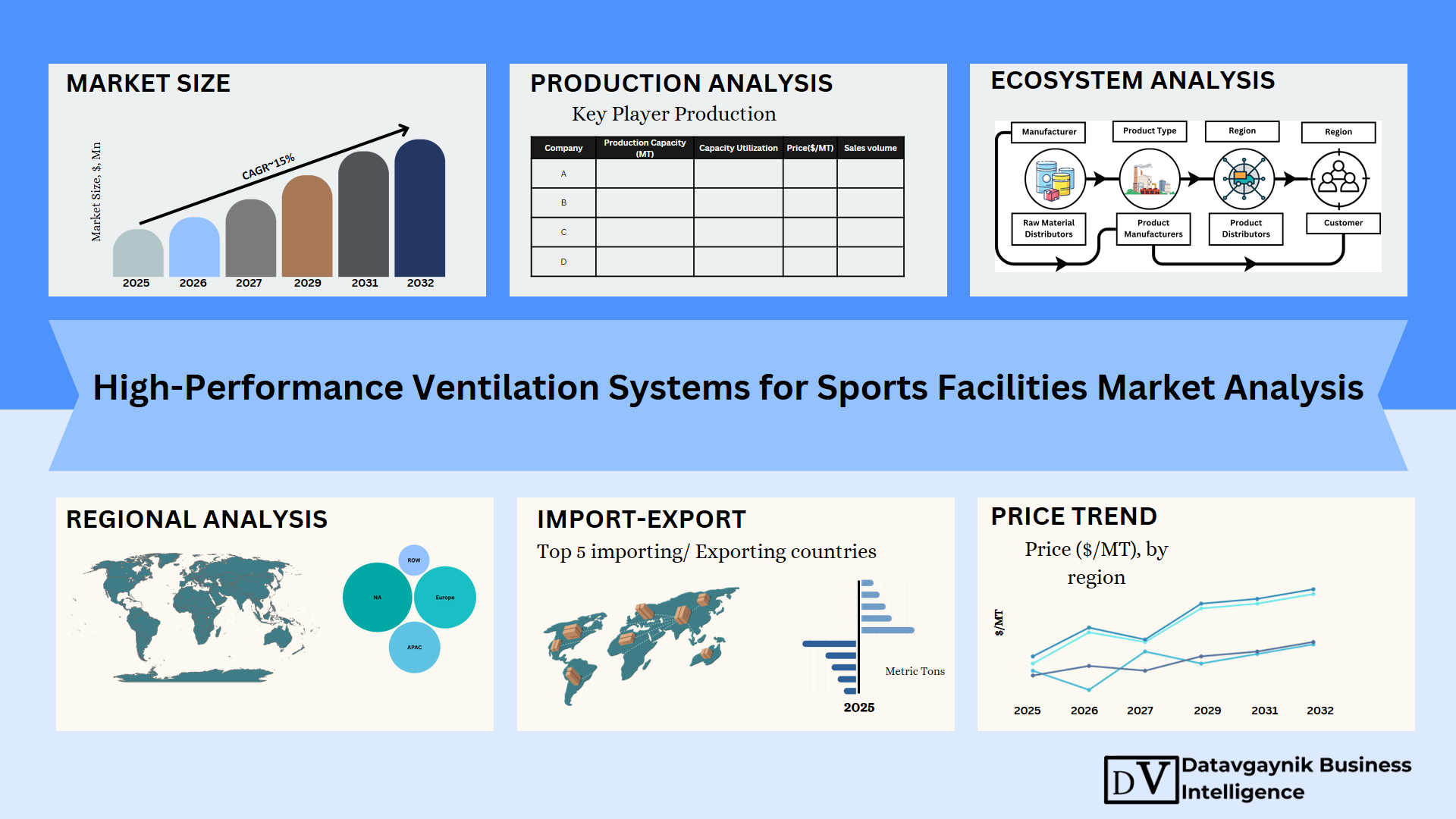
High-performance ventilation systems for sports facilities are moving from basic air exchange equipment to engineered airflow platforms designed for high-occupancy, high-respiration, moisture-intensive, and event-driven indoor environments. The High-Performance Ventilation Systems for Sports Facilities Market is estimated at USD 2.25 billion in 2026 and is projected to reach USD 3.34 billion by 2032, expanding at a CAGR of 6.8% during the forecast period. Demand is concentrated across indoor arenas, training centers, gymnasiums, natatoriums, university sports halls, multipurpose stadiums, fitness complexes, and professional club facilities where ventilation is tied directly to athlete comfort, spectator density, humidity control, odor removal, airborne particle dilution, and code-compliant outside air delivery. The main buyers are stadium operators, municipal sports authorities, universities, school districts, fitness chains, sports academies, event venue owners, MEP contractors, and facility management companies.
Ventilation demand is stronger where occupancy density, respiration load, and event scheduling are highest
Sports facilities require a different ventilation logic from offices, retail buildings, or standard institutional spaces. The operating load changes sharply within the same day. A basketball arena can shift from low daytime maintenance occupancy to 10,000–20,000 spectators within a few hours, while a school gymnasium can move from physical education classes to tournaments, assemblies, and weekend events. In these settings, ventilation is specified around peak occupancy, not average occupancy.
The strongest demand comes from indoor arenas, gymnasiums, fitness centers, swimming facilities, and multipurpose venues because these buildings combine high metabolic activity with dense human presence. During exercise, breathing rates rise materially compared with seated office use, increasing the need for outdoor air, filtration, and air distribution control. This makes CO₂ control, particulate removal, supply air throw, humidity management, and airflow zoning more important than simple fan capacity.
Gymnasiums and training halls remain a core application because they operate with repeated high-intensity use. Compared with a standard classroom or meeting room, sports halls need higher air volume, faster recovery after occupancy peaks, and more reliable distribution at breathing height. Modern systems are therefore specified with demand-controlled ventilation, variable air volume operation, high-efficiency filtration, energy recovery ventilation, destratification fans, and building management system integration.
Specification requirements are shifting from capacity-only buying to measurable indoor air performance
The market is specification-driven. Buyers are not only purchasing fans, ducts, air handling units, or controls; they are purchasing the ability to maintain temperature, humidity, air change effectiveness, CO₂ levels, and filtration performance under fluctuating loads. For indoor sports buildings, the important design parameters include outdoor air rate per occupant, air distribution effectiveness, filtration level, humidity range, noise level, energy recovery efficiency, control response time, and ease of maintenance.
ASHRAE 62.1 remains one of the reference points for acceptable indoor air quality in commercial and institutional buildings, while ASHRAE Standard 241 has increased attention on infectious aerosol risk reduction in new buildings, existing buildings, and major renovations. This matters for sports facilities because arenas and gyms combine large occupant counts with frequent respiratory activity. The impact on procurement is visible in the shift toward higher-grade filters, better outdoor air modulation, sensor-led controls, and upgrade-ready air handling units.
A typical high-performance package for sports facilities includes central air handling units, energy recovery ventilators, high-volume low-speed fans, MERV-rated filtration, CO₂ sensors, humidity sensors, variable frequency drives, smart dampers, and integration with building automation platforms. In natatoriums, dehumidification and corrosion-resistant components become more important than simple airflow volume because pool chemicals, warm air, and moisture can damage roof structures, seating areas, ducts, and electrical systems. In ice arenas, ventilation must balance air quality with temperature stability and humidity suppression to protect ice quality and reduce fogging.
Product-type behavior differs by facility size and operating profile
Centralized air handling systems dominate large arenas, stadium concourses, aquatic centers, and university sports complexes because they can manage large air volumes, zoning, filtration, and energy recovery. These systems are preferred where the venue has multiple spaces such as locker rooms, spectator seating, concessions, courts, training rooms, medical rooms, and hospitality areas.
Energy recovery ventilation is gaining stronger acceptance in facilities with long operating hours because outdoor air requirements increase energy load. Sports buildings often have wide temperature differences between indoor comfort conditions and outdoor air, especially in North America, Northern Europe, the Middle East, and parts of East Asia. Energy recovery units reduce heating and cooling penalties while maintaining fresh air delivery, making them attractive for municipalities and schools with operating budget limits.
Demand-controlled ventilation is stronger in multipurpose arenas and fitness clubs because occupancy is variable. CO₂ sensors and occupancy-linked controls allow systems to increase air volume during events and reduce airflow during low-use periods. This directly reduces electricity consumption, fan wear, and heating or cooling load. For private fitness chains and sports academies, this operating-cost logic is often more persuasive than compliance language alone.
High-volume low-speed fans and destratification systems are stronger in large-volume halls where roof height creates temperature layering. These products are common in indoor courts, field houses, training halls, and recreational centers because they improve air movement without requiring full mechanical cooling in every operating period. However, they do not replace outdoor air ventilation. Their role is stronger when paired with mechanical ventilation and controls.
Customer adoption is tied to retrofit pressure and new facility design
Replacement and retrofit demand is becoming more visible because many sports facilities were designed before current indoor air quality expectations became standard procurement criteria. Older gyms and arenas often have undersized outdoor air systems, limited filtration, weak controls, poor zoning, and high maintenance cost. Replacement logic usually starts with one of four triggers: occupant complaints, condensation or odor issues, rising energy bills, or major renovation.
Public-sector facilities are often procurement-led. School districts, universities, city sports departments, and county recreation authorities typically upgrade ventilation during broader modernization programs rather than as standalone HVAC purchases. This creates project-based demand, where ventilation systems are bundled with roof work, lighting upgrades, seating improvements, locker room renovation, or building automation upgrades.
Private-sector buyers behave differently. Fitness clubs, sports academies, indoor tennis centers, climbing gyms, and performance training facilities prioritize user comfort, odor control, brand perception, and energy cost. For these customers, ventilation performance affects member retention and daily utilization. A training facility that cannot manage heat, humidity, or odor during peak evening hours loses commercial value even if the building remains code-compliant.
Recent sports infrastructure projects support this demand pattern. In March 2026, construction began on the USD 280 million Sports Performance Hub in Homestead, Florida, covering a 92-acre site with a future 10,000-seat venue, multi-sport academies, hotel, boarding school, park, and sports medicine center. This type of multi-use sports campus expands demand beyond stadium bowl ventilation into training halls, recovery rooms, education spaces, hospitality buildings, and medical environments. In September 2025, work began on a 6,300-capacity Greenville Triumph stadium project in South Carolina, reported at USD 80–100 million, with public-private funding and community event use. Smaller-capacity venues of this type still require advanced ventilation because they host sports, concerts, youth events, and community gatherings with different occupancy profiles.
Application fit is strongest in arenas, natatoriums, gymnasiums, and fitness complexes
Indoor arenas represent the highest-value application because they require large air handling capacity, multi-zone control, smoke control coordination, filtration, acoustic management, and integration with event scheduling. These venues also contain premium hospitality spaces, media rooms, locker areas, food service zones, and back-of-house corridors, each with different ventilation requirements.
Natatoriums form a technically demanding segment. The combination of pool evaporation, chloramine control, high humidity, and corrosion risk makes ventilation system quality central to building life. Poor air distribution above the pool surface can create swimmer discomfort and chemical odor, while excessive humidity can damage structural steel, ceilings, glazing, and mechanical components. This makes dehumidification units, corrosion-resistant materials, and precise exhaust placement important.
Gymnasiums and school sports halls offer higher unit volume but lower average project value. They favor packaged rooftop units, energy recovery ventilators, demand controls, and retrofit-friendly ducting. Fitness centers and training studios are more service-dependent because filters, sensors, belts, dampers, and controls require scheduled maintenance to maintain air quality during peak usage.
Service access and maintenance capability influence buyer preference
Ventilation performance declines quickly when filters are not replaced, dampers are not calibrated, coils are dirty, belts slip, or sensors drift. This makes service availability a competitive factor. Large venue operators prefer suppliers and contractors with preventive maintenance contracts, 24/7 emergency response, spare-part availability, control-system diagnostics, and commissioning capability.
Commissioning is especially important in sports facilities because design airflow and actual airflow often differ after construction. Balancing supply and return air, validating outside air intake, testing CO₂ sensor response, and confirming humidity performance are required to make high-performance systems deliver measurable results. For municipal and education buyers, third-party commissioning is increasingly used to reduce underperformance risk.
Market constraints remain cost, retrofit complexity, and energy penalty
The biggest constraint is capital cost. High-performance systems require larger air handling units, better filters, controls, sensors, dampers, duct redesign, energy recovery sections, and commissioning. In older buildings, structural limitations, ceiling height, roof load, and mechanical room space can restrict upgrade options. Retrofitting a school gym or community arena can also disrupt seasonal programming, tournaments, and rental income.
Energy use is another barrier. More outdoor air improves indoor air quality but increases heating and cooling load if not paired with recovery systems and controls. This is why energy recovery ventilation and demand-controlled ventilation are gaining share over constant-volume designs. Buyers want better indoor air but still need utility bills to remain manageable.
The High-Performance Ventilation Systems for Sports Facilities Market therefore grows through a mix of compliance pressure, user comfort expectations, facility modernization, event-driven occupancy, and operating-cost control. Demand is strongest where sports buildings are used for multiple activities, where indoor air quality is tied to athlete and spectator experience, and where facility owners have enough capital to move from basic ventilation to measured performance.
Product segmentation in the High-Performance Ventilation Systems for Sports Facilities Market is led by air handling, energy recovery, and control-integrated systems
Segmentation in the High-Performance Ventilation Systems for Sports Facilities Market is best understood through operating load rather than only equipment type. Sports buildings need ventilation systems that respond to occupancy spikes, athlete respiration, humidity, odor, spectator density, and event scheduling. This makes product selection highly dependent on facility size, ceiling height, indoor moisture, user count, and whether the building operates daily or only during events.
By product type, central air handling units hold the strongest value share because they serve arenas, indoor stadium zones, natatoriums, university athletic centers, and professional training complexes. These systems are specified for high airflow volume, filtration, heating and cooling coil integration, noise control, and zoning flexibility. For large sports venues, one system rarely serves the whole building. Air handling is normally split across seating bowls, locker rooms, press rooms, hospitality lounges, concessions, courts, corridors, and back-of-house spaces.
Energy recovery ventilators form the fastest-rising product group because sports buildings need outdoor air without excessive utility cost. In cold regions, ERVs reduce heating penalty; in humid regions, they reduce latent load by preconditioning incoming air. Their adoption is stronger in schools, universities, recreation centers, and municipal sports buildings where annual energy budgets are tightly controlled.
Demand-controlled ventilation systems are gaining share where occupancy changes hour by hour. Fitness centers, basketball halls, indoor tennis courts, and multipurpose event spaces benefit from CO₂-led or occupancy-led airflow adjustment. A gym operating at 20% occupancy in the morning and 90% occupancy in the evening does not need constant-volume ventilation throughout the day. This is why sensors, variable frequency drives, motorized dampers, and building automation interfaces are moving from premium options to practical requirements.
High-volume low-speed fans and destratification systems occupy a separate segment. These systems are not substitutes for outdoor air supply, but they improve air distribution in tall gymnasiums, field houses, indoor courts, multipurpose halls, and fitness areas. Their strongest fit is in buildings with 8–15 meter ceiling heights where warm air collects near the roof and comfort at floor level is inconsistent.
Specification-based segmentation is stronger than brand-led buying
Performance class divides the market into three broad groups. Standard code-compliant systems remain common in small school gyms and community recreation buildings. Enhanced indoor air quality systems are used in universities, private fitness chains, indoor sports clubs, and municipal facilities with higher usage. Premium performance systems are used in arenas, natatoriums, professional training centers, and venues that host sports plus concerts, exhibitions, conferences, and public events.
The specification gap is visible in filtration, controls, and commissioning. Entry-level systems usually meet minimum outdoor air requirements but have limited sensor feedback. Mid-range systems include energy recovery, better filtration, variable airflow, and automated controls. Premium systems add zone-level monitoring, high-efficiency filtration, advanced humidity control, low-noise operation, redundancy, remote diagnostics, and full commissioning.
Important specification indicators include:
- Outdoor air delivery per person and per square meter
- Filtration level, commonly moving from basic filters toward higher MERV-rated systems
- Air distribution effectiveness at player and spectator breathing height
- Humidity control range, especially for pools and ice facilities
- Noise control for arenas, broadcast spaces, and training rooms
- Energy recovery effectiveness and fan power efficiency
- Sensor accuracy for CO₂, humidity, temperature, and occupancy
- Availability of replacement filters, belts, dampers, motors, and controls
This specification-led buying explains why professional sports venues and aquatic centers spend more per square meter than standard gymnasiums. The technical failure cost is higher. Poor ventilation in a natatorium creates corrosion, odor, and comfort complaints. Poor ventilation in an arena affects spectators, athletes, broadcasters, and event scheduling.
Application segmentation shows why arenas and aquatic facilities generate higher revenue per site
Indoor arenas generate the highest project value because they combine spectator seating, athlete spaces, concessions, premium lounges, media rooms, circulation areas, and event conversion requirements. A single venue may need separate systems for game-day operation, concert mode, maintenance mode, and low-occupancy weekdays. This creates demand for controls, zoning, commissioning, and lifecycle service.
Natatoriums are smaller in site count but stronger in specification intensity. Ventilation and dehumidification must remove chloramine-laden air from the pool surface, control humidity, prevent condensation, and protect structural materials. Buyers in this segment usually prioritize corrosion resistance, exhaust placement, air distribution, and dehumidification capacity over lowest upfront cost.
Gymnasiums and multipurpose halls represent the highest unit opportunity. They are installed across schools, colleges, municipalities, military bases, recreation centers, and private sports academies. Their replacement demand is broad because many existing facilities were built before current air quality expectations, energy-recovery economics, and sensor-based controls became common.
Fitness centers and boutique training studios show a different buying pattern. Their ventilation systems are tied to member experience, odor control, thermal comfort, and operating cost. HVAC contractors and facility managers influence purchasing more than public procurement committees. Packaged rooftop units, ERVs, duct upgrades, and control retrofits dominate this customer group.
Regional adoption is led by North America, Europe, the Middle East, and selected Asia Pacific markets
North America remains the strongest region by value because of its large installed base of school gyms, university athletic centers, NHL/NBA arenas, indoor recreation centers, and private fitness facilities. Retrofit economics are important. In June 2025, the Franklin County Convention Facilities Authority sought USD 400 million for upgrades to Nationwide Arena in Ohio, including roof and HVAC work, with the objective of extending the venue’s usability by another 25 years. Projects of this type show that HVAC upgrades are not isolated mechanical purchases; they are part of long-term arena asset protection.
Europe is a compliance- and energy-efficiency-led market. Germany, the United Kingdom, France, the Nordics, and the Netherlands favor heat recovery, low-energy ventilation, commissioning, and building performance documentation. The strongest adoption is in indoor sports halls, municipal leisure centers, aquatic centers, and multipurpose community venues. Energy pricing and building decarbonization policies push buyers toward ERVs, efficient fans, smart controls, and heat-pump-compatible air systems.
The Middle East has fewer legacy facilities but higher new-build intensity. Saudi Arabia’s sports infrastructure pipeline, including stadium work tied to major international events, supports demand for engineered ventilation in hot climates where cooling load dominates system design. In large desert-climate venues, outdoor air treatment, filtration against dust, humidity management, and high-efficiency cooling integration are key procurement criteria.
Asia Pacific demand is mixed. Japan, South Korea, Australia, Singapore, and China favor higher-performance systems in urban indoor arenas, aquatic centers, and institutional sports complexes. India’s opportunity is more volume-led through multipurpose halls, indoor stadiums, university sports centers, and public sports infrastructure. Under India’s Khelo India infrastructure listings, multipurpose indoor stadium projects include state-backed facilities such as a 60m × 40m indoor stadium in Andhra Pradesh with a listed sanctioned cost of ₹13.76 crore in January 2026. This type of project creates demand for mid-range ventilation systems rather than premium arena-scale solutions.
Channels and service models decide adoption after specification approval
The market sells through MEP consultants, HVAC contractors, design-build firms, public tendering, distributor networks, and direct manufacturer support for large projects. Large arenas and aquatic centers are consultant-driven. School and municipal projects are tender-driven. Fitness chains and private academies often rely on local HVAC contractors and equipment distributors.
Service model segmentation matters because ventilation performance is not fixed after installation. Filters, sensors, dampers, fans, belts, coils, control logic, and balancing need recurring service. Annual maintenance contracts are stronger in arenas, universities, natatoriums, and large recreation centers. Smaller gyms often buy reactive service, which creates inconsistent performance and higher long-term failure risk.
Replacement behavior is also segment-specific. Controls and sensors may be upgraded every 5–8 years. Filters and belts are recurring consumables. Fans, dampers, coils, and motors move through mid-life replacement. Full air handling units and major duct systems usually shift during renovation cycles, roof replacement, building expansion, or compliance upgrades. This creates a layered revenue model: equipment sale at installation, controls upgrade during occupancy growth, and maintenance revenue across the operating life.
Competitive structure in ventilation systems for sports facilities is shaped by equipment breadth, controls, and service reach
The supplier base includes global HVAC equipment manufacturers, air movement specialists, energy recovery manufacturers, building automation companies, MEP contractors, commissioning firms, and regional service providers. Exact market share by company is not publicly reliable because sports facility ventilation is typically embedded inside broader commercial HVAC, institutional HVAC, and construction contracts. Competitive position is therefore better measured by product breadth, service reach, controls capability, application expertise, and contractor access.
Carrier, Trane Technologies, Johnson Controls/YORK, Daikin, Systemair, Greenheck, FläktGroup, Swegon, Munters, and Zehnder are among the important supplier groups connected to this market. Their relevance differs by product category. Carrier, Trane, Johnson Controls/YORK, and Daikin are stronger in broad commercial HVAC platforms, air handling, chillers, controls, and service networks. Greenheck is important in fans, air movement, energy recovery, dampers, and dedicated ventilation components. Munters is stronger where dehumidification and moisture control are central, including pool and specialty indoor environments. Swegon, Systemair, and FläktGroup are relevant in European ventilation markets where energy recovery, air handling, and low-energy building specifications influence procurement.
Product differentiation is not limited to airflow capacity. Large venue buyers evaluate system efficiency, custom air handler configuration, sound performance, corrosion resistance, cleanability, controls compatibility, and speed of spare-part support. For example, YORK air handling systems are positioned around flexible and custom configurations for varied building environments, while Greenheck’s HVLS and energy recovery products address air movement, destratification, and ventilation efficiency. These portfolios fit sports facilities because gyms, arenas, and fitness spaces require both outdoor air and effective air movement across large volumes.
Controls capability is a major competitive divider. Suppliers with building automation platforms can connect ventilation to occupancy schedules, CO₂ levels, event calendars, humidity levels, and energy management targets. This matters more in arenas and university sports buildings than in small gyms because facility operators want visibility across several zones. A system that can adjust between practice mode, game mode, concert mode, and shutdown mode reduces wasted fan energy and improves indoor air performance.
Service coverage is equally important. Sports venues cannot easily shut down during tournament weeks, league matches, concerts, or school schedules. Suppliers and contractors with local technicians, filter inventory, belt and motor availability, emergency service, and controls expertise hold an advantage. In public facilities, service capability also affects procurement scoring because the cheapest installed system may not be the lowest-risk system over 15–20 years.
Pricing behavior is linked to customization and site complexity. A basic packaged rooftop ventilation retrofit for a small gym may be evaluated mainly on equipment and installation cost. A natatorium or arena project carries higher engineering cost because of humidity modeling, air distribution design, corrosion-resistant materials, controls integration, commissioning, and after-sales support. Premium systems therefore command higher margins where performance failure has measurable building or user consequences. However, municipal buyers often cap specification ambition when budgets are restricted, which keeps mid-range systems highly competitive.
Distribution is fragmented below the large-project tier. Local HVAC contractors, regional distributors, and MEP firms strongly influence buying in schools, private fitness centers, indoor courts, and recreation centers. In contrast, professional arenas and large public projects usually involve architects, consulting engineers, construction managers, and direct manufacturer engagement. This creates a two-speed competitive structure: global manufacturers dominate engineered projects, while regional contractors control retrofit access in smaller facilities.
Recent developments show how the demand ecosystem is expanding:
- In June 2025, Nationwide Arena in Columbus, Ohio, moved toward a USD 400 million renovation plan that included HVAC work, showing how aging arenas are creating mechanical upgrade demand alongside roof, entrance, concessions, and fan-experience improvements.
- In March 2026, construction started on the USD 280 million Sports Performance Hub in Homestead, Florida, a 92-acre sports campus with a planned 10,000-seat venue, academies, sports medicine facilities, hospitality space, and public park. Multi-building sports campuses of this scale increase demand for zoned ventilation rather than single-building HVAC packages.
- In September 2025, construction began on the Greenville Triumph stadium project in South Carolina, with capacity revised to 6,300 and use cases extending beyond soccer to concerts, festivals, youth sports, college sports, and community events. Multipurpose use increases ventilation design complexity because occupancy density and operating hours vary by event.
- ASHRAE’s Standard 241, first published in 2023 and supported through technical resources in 2024, continues to influence ventilation planning by formalizing attention on infectious aerosol risk reduction in buildings. For sports facilities, this strengthens the case for clean airflow, better filtration, outdoor air control, and commissioning during renovations.
- India’s Khelo India infrastructure pipeline continued to list indoor multipurpose sports facilities through 2024–2026, including sanctioned indoor stadium and multipurpose hall projects. These projects support demand for mid-capacity ventilation systems where buyer focus is functionality, affordability, and maintainable performance.


