

Market Summary and Growth Forecast
The global Hydraulic Fracturing Fluids Market will witness a robust CAGR of 6.2%, valued at $12.8 billion in 2026, expected to appreciate and reach $22.0 billion by 2035.
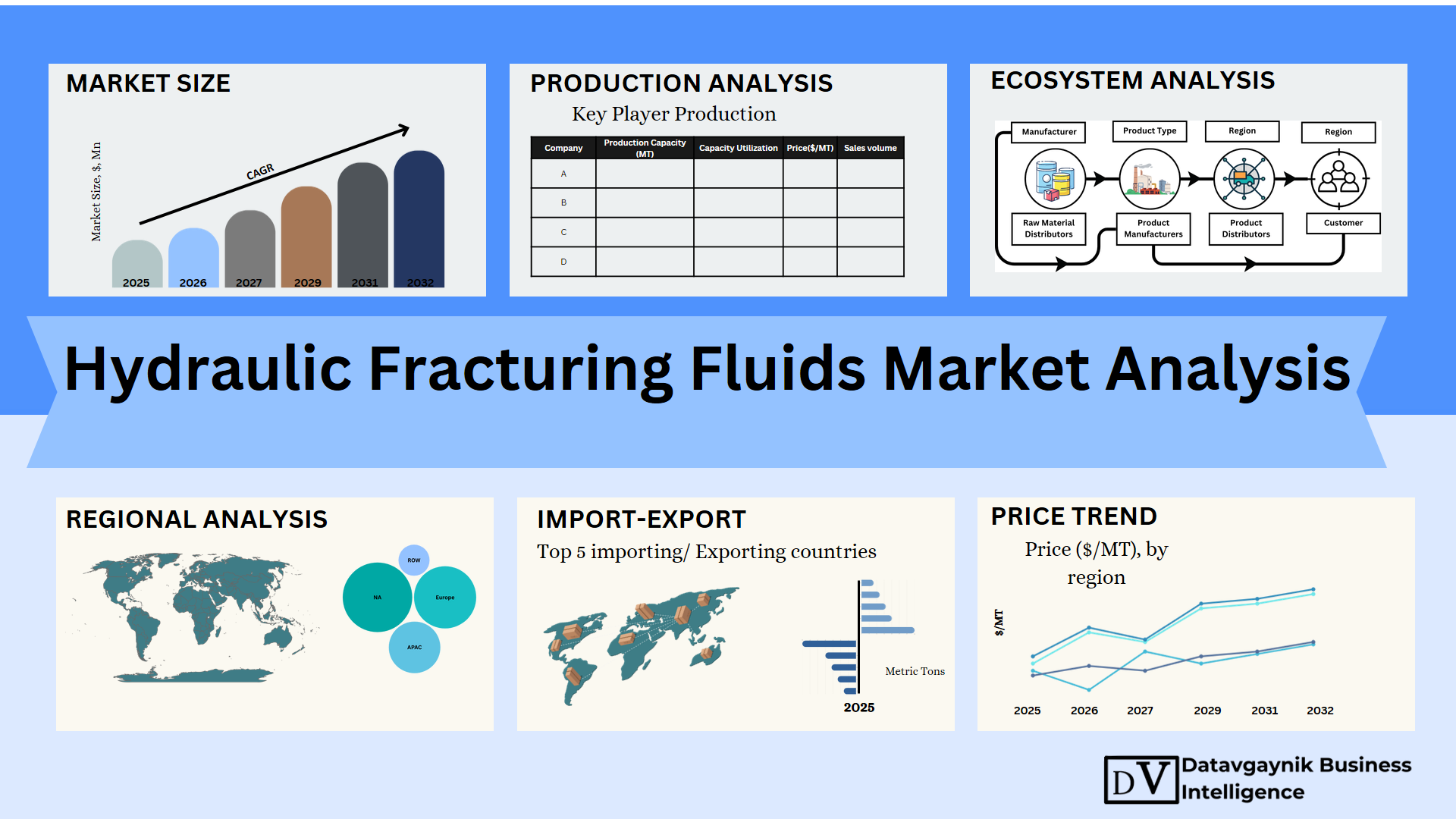
The market covers fluid systems and chemical additives used during hydraulic fracturing to create fractures, reduce friction, carry proppant, control microbial activity, protect wellbore integrity, and improve hydrocarbon recovery. It includes slickwater fluids, gel-based fluids, hybrid fluid systems, foam-based fluids, acidizing-compatible fluids, and chemical packages such as friction reducers, biocides, surfactants, clay stabilizers, scale inhibitors, breakers, corrosion inhibitors, and pH control agents. It does not include proppants, pumping fleets, drilling fluids, or broader well-completion services.
For decision-makers, the Hydraulic Fracturing Fluids Market sits at the intersection of unconventional oil and gas production, water management, chemicals innovation, and regulatory scrutiny. In 2026, the market is no longer only about pumping large fluid volumes. Operators are asking sharper questions. Can the fluid reduce pressure loss? Can it support recycled water? Can it perform in high-salinity basins? Can chemical loadings be reduced without damaging well productivity? These questions are now shaping procurement and formulation strategy.
The strongest demand base remains North America, led by the Permian, Eagle Ford, Bakken, Montney, and Duvernay plays. The Permian Basin alone remained a major unconventional production center, with EIA data showing shale and tight formations producing 6.0 million barrels per day of crude oil and 22.2 Bcf/d of dry natural gas in December 2025. That scale keeps completion chemistry structurally relevant even when rig counts fluctuate.
Beyond North America, growth is becoming more selective. Argentina’s Vaca Muerta, China’s Sichuan shale, and parts of the Middle East are moving deeper into unconventional resource development. China is targeting ultra-deep shale formations in the Sichuan Basin, where drilling depths of 4,500–5,000 meters raise the technical bar for fluid stability, friction reduction, and reservoir compatibility. Argentina is also building unconventional momentum, with Vaca Muerta becoming central to export-led oil and gas growth plans. Reuters reported that YPF’s $25 billion LLL oil project targets 240,000 barrels per day by 2032 through more than 1,100 wells, creating a direct long-term demand case for water, sand, frac fleets, and fluids.
Regulation is another force. Chemical disclosure, water sourcing, produced-water handling, and local environmental risk assessment now influence fluid selection. FracFocus remains a key disclosure registry for hydraulic fracturing chemicals in the U.S., and its public data structure has expanded over time. The EPA has also stated that hydraulic fracturing water-cycle activities can affect drinking water resources under certain conditions, which keeps water chemistry and risk control in the spotlight.
Expert insight: The next phase of this market will not be driven only by well count. It will be driven by fluid efficiency per stage, compatibility with recycled water, and the ability to lower chemical intensity without hurting production curves.
Global Hydraulic Fracturing Fluids Market Snapshot
| Metric | Estimate / Outlook |
| Global Market Size, 2026 | $12.8 billion |
| Projected Market Size, 2035 | $22.0 billion |
| CAGR, 2026–2035 | 6.2% |
| Largest Regional Market, 2026 | North America |
| Fastest-Growing Regional Market, 2026–2035 | Asia Pacific |
| Most Strategic Fluid System | Slickwater and high-viscosity friction reducer fluids |
| Most Strategic Additive Group | Friction reducers and recycled-water-compatible additive packages |
| Core Demand Driver | Unconventional oil and gas completions |
| Key Constraint | Water sourcing, chemical disclosure, and environmental scrutiny |
Key Stakeholders
The market ecosystem includes oil and gas E&P operators, oilfield service companies, specialty chemical suppliers, water treatment companies, fracturing equipment OEMs, national oil companies, independent shale producers, chemical distributors, regulators, industry associations, investors, and local governments in shale-producing regions.
The Hydraulic Fracturing Fluids Market will remain strategically important through 2035 because unconventional reservoirs still need engineered fluids to unlock production. That said, the winners will not be those selling commodity additives alone. The advantage will sit with suppliers that can offer basin-specific chemistry, lower water stress, and better completion economics.
Market Segmentation and Forecast Scope
The Hydraulic Fracturing Fluids Market is best segmented by fluid type, additive type, application, end user, and region. This structure captures how purchasing decisions actually happen. Operators usually define the well design first. Service companies then select the fluid architecture. Chemical suppliers support the program with additives matched to water quality, reservoir temperature, pressure, clay content, salinity, and production objectives.
Segmentation Scope
| Segmentation Dimension | Sub-Segments Covered | Strategic Relevance |
| By Fluid Type | Slickwater fluids, linear gel fluids, crosslinked gel fluids, foam-based fluids, acid-based fluids, hybrid fluids | Defines the basic completion design and cost-performance profile |
| By Additive Type | Friction reducers, gelling agents, crosslinkers, biocides, surfactants, clay stabilizers, scale inhibitors, breakers, pH control agents, corrosion inhibitors | Determines operational efficiency, reservoir compatibility, and post-frac clean-up |
| By Application | Shale gas, tight oil, coalbed methane, tight sandstone, deep unconventional reservoirs | Tracks demand by reservoir type and production model |
| By End User | E&P operators, oilfield service providers, national oil companies, independent shale producers, integrated energy companies | Captures buying influence and contract structure |
| By Region | North America, Europe, Asia Pacific, LAMEA | Reflects basin maturity, regulation, water availability, and shale development pace |
In 2026, slickwater fluids account for an estimated 54% of global revenue. Their share is high because slickwater systems are widely used across horizontal shale wells where high-rate pumping, lower viscosity, and friction reduction matter more than heavy gel loading. Slickwater also aligns well with large multi-stage completions and pad drilling.
By additive type, friction reducers hold an estimated 31% share of global additive revenue in 2026. This is not surprising. Friction reducers directly support pumping efficiency, horsepower optimization, lower pressure loss, and stage-level execution. Polymer science remains central here. A 2025 review of polymer applications in hydraulic fracturing highlighted friction reducers such as polyacrylamide-based systems as important tools for improving pumping efficiency in slickwater fracturing.
Selected Sub-Segment Share View, 2026
| Sub-Segment | Estimated Share, 2026 | Why It Matters |
| Slickwater Fluids | 54% of total market revenue | Dominant in high-stage shale completions and large horizontal well programs |
| Friction Reducers | 31% of additive revenue | Critical for pump-rate control, pressure management, and completion efficiency |
Other sub-segment shares are intentionally not disclosed here to keep the forecast scope concise. The broader market model should still capture each sub-segment at the backend level.
Most Strategic Growth Pockets
High-viscosity friction reducer fluids are one of the most strategic areas through 2035. They combine the simplicity of slickwater with improved proppant transport. This makes them attractive in longer laterals where operators want fewer fluid transitions and better stage consistency.
Recycled-water-compatible fluid systems are another high-value pocket. More operators are using produced water or blended water streams to reduce freshwater dependence. That creates demand for additives that tolerate high total dissolved solids, bacteria load, iron, hardness, and variable pH.
Deep shale fluid systems should also grow faster than the market average. China’s ultra-deep shale programs show why. At greater depth, fluid chemistry has to handle higher pressure, higher temperature, and more complex mineral interaction. Standard formulations may not be enough.
Asia Pacific is expected to be the fastest-growing region between 2026 and 2035, led by shale gas development in China, tight gas activity, and national energy-security goals. North America will remain the largest market, but its growth will be more tied to completion intensity, refracturing, water reuse, and productivity gains than to simple acreage expansion.
Expert insight: The market is shifting from “more barrels through more stages” to “better barrels through better chemistry.” That is a subtle change, but it matters for pricing power.
Market Trends and Innovation Landscape
Innovation in the Hydraulic Fracturing Fluids Market is moving in three practical directions: cleaner chemistry, better friction reduction, and fluids that work with lower-quality water. The industry is not chasing novelty for its own sake. Operators want chemicals that reduce completion cost, simplify logistics, and support production performance.
R&D Evolution
R&D activity is increasingly focused on polymer efficiency, low-residue formulations, temperature-stable additives, and high-salinity tolerance. Traditional gel systems still have a role, especially where proppant transport is difficult. But slickwater and high-viscosity friction reducer systems are taking more attention because they can reduce operational complexity.
Biocides, scale inhibitors, and corrosion inhibitors are also being reformulated to work in recycled and produced water. That matters because water chemistry can vary well by well. A fluid system that performs in clean freshwater may fail when exposed to brine, bacteria, iron, or high hardness.
Expert commentary: Water quality is becoming a design variable, not a constraint handled at the last minute. This may push chemical suppliers closer to water-treatment partners and completion engineers.
Technology Evolution
Fluid technology is becoming more basin-specific. In the Permian, the focus is on large-volume slickwater systems, produced-water compatibility, and cost per lateral foot. In Vaca Muerta, the market needs scalable fluid systems that can support export-led drilling growth as infrastructure expands. In China’s deep shale, the emphasis is on high-pressure, high-temperature tolerance and performance in complex geology.
Digital tools are also influencing the market, but not always at the fluid formulation level. AI and automation are more visible in frac design, pumping control, and real-time execution than in chemical discovery. Halliburton, for example, highlights automated fracturing and closed-loop platform capabilities within its hydraulic fracturing solutions, showing how digital control is entering field operations.
So, AI should be treated as an operational enabler rather than a core fluid ingredient. It may help operators adjust stage design, pump schedules, pressure response, and fluid loading. But the chemistry still has to perform underground.
Material Science and Chemical Innovation
Material science is most relevant in polymer-based friction reducers, surfactants, breakers, and gels. The goal is simple: get the same or better performance with lower dosage, lower residue, and stronger compatibility with difficult water.
Key innovation themes include:
| Innovation Area | What Is Changing | Likely Market Impact by 2035 |
| High-Viscosity Friction Reducers | Improved polymer architecture for proppant transport and lower pressure loss | Higher adoption in long laterals and high-intensity shale completions |
| Recycled-Water-Compatible Additives | Better tolerance to salinity, hardness, bacteria, and iron | Strong demand in water-stressed basins |
| Low-Residue Gel Systems | Cleaner break profiles and reduced formation damage | Selective growth in complex reservoirs |
| Biocide Optimization | More targeted microbial control in variable water streams | Improved reliability in produced-water reuse |
| Surfactant Packages | Improved flowback and hydrocarbon recovery support | Higher use in liquids-rich shale plays |
| Reduced-Toxicity Chemistry | More attention to disclosure, handling, and environmental profile | Stronger positioning in regulated basins |
Mergers, Partnerships, and Market Announcements
The competitive landscape is consolidating around integrated service capability and production chemistry. SLB completed its acquisition of ChampionX in July 2025, strengthening its exposure to production chemicals and broader lifecycle well optimization. The company also indicated expected annual pretax synergies of around $400 million within the first three years after closing.
This matters for fracturing fluids because production chemistry, completion chemistry, digital workflows, and reservoir optimization are becoming more connected. Large service companies can now position themselves across the well lifecycle. Smaller specialty chemical suppliers may still compete well, but they will need sharper formulation depth or basin-specific advantage.
Vaca Muerta activity is also shaping the opportunity map. Argentina’s unconventional oil and gas growth is attracting new capital, and large-scale well development plans will require fracturing chemicals, water logistics, friction reducers, biocides, and fluid engineering support.
Overall, the Hydraulic Fracturing Fluids Market is moving toward higher-performance chemistry with better environmental handling. The market is not becoming less technical. It is becoming more disciplined. Buyers want proof, repeatability, and lower full-cycle cost.
Expert commentary: By 2035, fluid suppliers that can combine chemistry, water intelligence, and field data will have a stronger edge than suppliers selling standard additive drums into spot contracts.
Competitive Intelligence and Benchmarking
Competition is split between two groups. The first group includes integrated oilfield service companies that provide stimulation design, pumping, digital execution, and fluid systems. The second group includes specialty chemical suppliers that focus on additives such as friction reducers, biocides, surfactants, gelling agents, scale inhibitors, and corrosion-control packages.
In this market, scale matters. But it is not enough. Operators are increasingly asking for basin-specific chemistry, produced-water compatibility, lower chemical loading, better stage consistency, and field-level proof. That pushes suppliers to compete on formulation depth and operational reliability rather than price alone.
| Company | Portfolio Position | Market Position and Strategic Benchmark |
| Halliburton | Offers hydraulic fracturing services, stimulation design, automation-enabled frac execution, reservoir monitoring, and chemical optimization support. | One of the strongest integrated players in North America and international shale basins. Its position is supported by field execution scale, digital frac platforms, and operator relationships. Halliburton’s hydraulic fracturing solutions emphasize surface reliability, real-time control, and complex reservoir performance. |
| SLB | Provides engineered fracturing fluids, stimulation workflows, digital planning, reservoir-driven completion design, and production chemistry after the ChampionX acquisition. | A global technology leader with strong international reach. Its engineered fluid portfolio is positioned around water quality flexibility, proppant volume handling, and location-specific constraints. The 2025 ChampionX acquisition also strengthens its chemicals exposure across the well lifecycle. |
| Baker Hughes | Participates in stimulation and fracturing through pressure pumping technology, onshore equipment, and oilfield chemical support. | Strong in equipment, oilfield technology, and global energy services. Compared with Halliburton and SLB, its role in frac fluids is more selective by geography and contract structure. It remains relevant where operators want integrated stimulation and field technology support. |
| Liberty Energy | Focuses on hydraulic fracturing services, low-emission frac fleets, equipment innovation, frac sequencing, and completion execution. | A major North American pressure-pumping specialist. Its differentiation is tied to fleet efficiency, lower-emission equipment, natural-gas-powered systems, and shale-focused execution. It is more service-led than chemistry-led, but fluid usage is central to its operating model. |
| Patterson-UTI Energy | Provides drilling and completions services, including pressure pumping through its expanded platform after the NexTier merger. | A large U.S. shale services competitor with strong exposure to completion activity. The NexTier combination improved its pressure pumping scale and made it more relevant in large pad-development programs. |
| BASF | Supplies chemical building blocks and performance additives used across oilfield chemicals, including surfactant, polymer, and specialty chemistry platforms. | Strong upstream chemical supplier position. It is not usually the visible frac contractor at the wellsite, but it plays an important role in additive supply chains and formulation inputs used by service companies and blenders. |
| Dow | Supplies performance materials, polymers, surfactants, and specialty chemical inputs used in oilfield and industrial formulations. | Important in the upstream chemistry chain. Its relevance is strongest where fluid formulators need scalable chemical inputs, consistency, and technical support for water-based systems. |
Expert commentary: The competitive advantage is shifting from “who can pump more stages” to “who can engineer repeatable fluid performance under messy field conditions.” That gives integrated players an edge, but it also leaves room for focused chemical specialists.
Regional Landscape and Adoption Outlook
Regional adoption is shaped by reservoir maturity, water availability, regulatory tolerance, field infrastructure, and the commercial strength of unconventional oil and gas. The Hydraulic Fracturing Fluids Market remains North America-led, but growth pockets are becoming more international.
North America
North America is the largest and most mature market. The U.S. leads by a wide margin, supported by the Permian, Eagle Ford, Bakken, Haynesville, Marcellus, and DJ Basin. The Permian Basin remains the main demand engine. EIA reported that shale and tight formations within the basin produced 6.0 million b/d of crude oil and 22.2 Bcf/d of dry natural gas in December 2025. That level of production keeps fluid demand structurally deep even when drilling activity slows.
Canada is also important, especially through the Montney and Duvernay plays. Adoption is technically advanced, but stricter environmental expectations push suppliers toward water-efficient systems and lower-impact chemistry.
White space: Produced-water reuse, high-viscosity friction reducers, low-emission frac execution, and chemistry designed for longer laterals.
Europe
Europe remains a limited adoption region. The geology exists in parts of the UK, Poland, Germany, and Romania, but public opposition, permitting complexity, and seismic-risk concerns restrict shale activity. In the UK, current policy includes moratoriums on fracking across all four parts of the country. Germany also maintains a restrictive position, with commercial shale gas fracking effectively prohibited under its regulatory framework.
White space: Specialist fluids for geothermal stimulation, low-toxicity chemicals, and selective tight-gas or enhanced geothermal use cases rather than broad shale commercialization.
China
China is the most strategic growth market in Asia Pacific. The country wants more domestic gas production and lower reliance on imported LNG. Sichuan Basin shale development is moving deeper, with state firms targeting ultra-deep formations at around 4,500–5,000 meters. Reuters reported that China’s shale gas output could grow by more than one-third by 2035 if ultra-deep programs scale.
This creates demand for temperature-stable fluids, friction reducers that perform under higher pressure, and chemistry that can handle complex reservoir conditions.
White space: Ultra-deep shale fluid systems, HPHT-compatible additives, local chemical manufacturing, and advanced fracture diagnostics.
India
India is still an early-stage market for hydraulic fracturing fluids. The country has tight gas, coalbed methane, and unconventional resource potential, but large-scale shale development has not reached the maturity seen in the U.S. or China. The main opportunity is not immediate mass adoption. It is pilot-stage development, domestic chemical blending, and selective deployment in unconventional gas and mature-field stimulation.
Regulation, water availability, land access, and field economics remain key barriers. That said, India’s long-term gas demand and import dependence may keep unconventional resource development on the policy radar.
White space: Pilot-scale shale and tight-gas fluids, coalbed methane stimulation support, domestic additive blending, and water-treatment-linked frac chemistry.
Japan
Japan has minimal domestic hydraulic fracturing fluid demand for oil and gas. The country is energy import-dependent, but it has limited domestic shale resource commercialization. Adoption is more relevant in research, geothermal stimulation, specialty chemicals, and technology supply rather than direct shale-field deployment.
White space: Chemical technology exports, geothermal stimulation fluids, and specialty additives for international oilfield service chains.
South Korea
South Korea is not a major upstream fracturing market. Its role is more industrial and technology-linked. Korean chemical companies, equipment suppliers, and energy firms may participate indirectly through materials, specialty chemicals, EPC services, and overseas energy investments.
Domestic adoption is limited due to resource constraints. But the country’s manufacturing strength could support export-oriented chemical and equipment supply.
White space: Specialty additive manufacturing, water-treatment systems, and participation in overseas shale infrastructure projects.
Rest of the World
The strongest opportunities outside the regions above are in Argentina, the Middle East, and selective parts of Australia. Argentina’s Vaca Muerta is the standout. YPF’s $25 billion LLL oil project, registered under Argentina’s large-investment incentive regime, targets 240,000 b/d by 2032 through 1,152 wells. That scale has direct implications for frac fluids, water logistics, friction reducers, and completion services.
The Middle East is also attractive because national oil companies are testing unconventional gas and tight reservoirs. Adoption will be selective, but funding strength is high.
White space: Vaca Muerta fluid logistics, locally blended chemical packages, water reuse, and high-temperature fluids for Middle East unconventional gas.
End-User Dynamics and Use Case
End-user behavior differs by maturity level. In developed shale regions, buyers focus on efficiency, cost per stage, reduced downtime, and fluid compatibility with recycled water. In emerging basins, the focus is usually on technical assurance, supply reliability, field trials, and transfer of operational know-how.
End-User Adoption Dynamics
| End User | How They Adopt Fracturing Fluids | Decision Priority |
| E&P Operators | Specify performance expectations, reservoir requirements, water-use targets, and completion economics. | Lower cost per barrel, stronger well productivity, fewer stage failures |
| Oilfield Service Providers | Select fluid systems and additives as part of integrated frac execution. | Pumpability, reliability, logistics, and field performance |
| National Oil Companies | Use fluids in pilot projects and strategic unconventional resource programs. | Energy security, local capability building, and long-term reservoir access |
| Independent Shale Producers | Choose cost-effective fluid systems for repeatable pad development. | Fast execution, predictable output, and operating cost control |
| Integrated Energy Companies | Use fluids across shale, tight oil, tight gas, and emerging unconventional portfolios. | Technical consistency, ESG alignment, and supplier reliability |
Realistic Use Case
A shale operator in the Permian Basin shifted from a conventional slickwater package to a high-viscosity friction reducer system across a multi-well pad. The goal was simple: reduce fluid complexity while improving proppant transport across longer laterals. The service provider adjusted polymer loading based on produced-water quality and stage pressure response. The operator reduced fluid-switching time, improved pumping consistency, and lowered freshwater dependence by blending treated produced water into the system.
This use case is realistic because it reflects how U.S. shale operators are actually making fluid decisions. They are not only buying chemicals. They are buying stage reliability, water flexibility, and lower completion cost.
Expert commentary: End users will keep pushing suppliers for measurable proof. A fluid system that looks strong in a lab but fails with real basin water will lose quickly.
Recent Developments + Opportunities & Restraints
Recent Developments
| Year / Month | Event | Impact on the Industry |
| July 2025 | SLB completed its acquisition of ChampionX. | Strengthened SLB’s position across production chemicals, well optimization, and lifecycle service integration. It also signals more consolidation between oilfield services and specialty chemistry. |
| June 2025 | Chevron and Halliburton enabled an intelligent hydraulic fracturing process combining automated stage execution with subsurface feedback. | Supports automation-led completion efficiency and may influence how fluid loading, stage design, and real-time execution are optimized. |
| July 2025 | VMOS signed a $2 billion loan for the Vaca Muerta South pipeline project. | Improves export infrastructure for Argentina’s shale system and supports long-term demand for frac fluids, water logistics, and completion services. |
| May 2026 | YPF registered its $25 billion LLL oil project under Argentina’s RIGI investment framework. | Creates one of the clearest long-term unconventional demand signals outside North America, with more than 1,100 wells planned. |
| June 2026 | China advanced ultra-deep shale activity in the Sichuan Basin, targeting formations around 4,500–5,000 meters deep. | Raises demand for HPHT-compatible fluids, advanced friction reducers, and reservoir-specific additive packages. |
Opportunities
Emerging unconventional basins: Argentina, China, and select Middle East markets offer the clearest growth runway outside North America.
Water-compatible chemistry: Produced-water reuse creates demand for additives that can tolerate salinity, hardness, bacteria, and iron without losing performance.
Automation-linked productivity: Digital frac control may support better fluid dosing, cleaner stage execution, and lower operational variance.
Restraints
Environmental and water scrutiny: Water sourcing, disposal, induced seismicity, and chemical disclosure remain major concerns. The EPA has noted that hydraulic fracturing water-cycle activities can affect drinking water resources under certain conditions.
Oil and gas price volatility: Fluid demand is tied to drilling and completion budgets. Lower commodity prices can quickly reduce completion intensity.
Regulatory barriers in Europe: Moratoriums and bans limit shale commercialization in several countries, especially the UK and Germany.


