

Market Summary and Growth Forecast
The global Hydroponic Greenhouse Ventilation Systems Market is valued at $742 million in 2026 and is expected to appreciate to $1,625 million by 2035, at a CAGR of 9.1%.
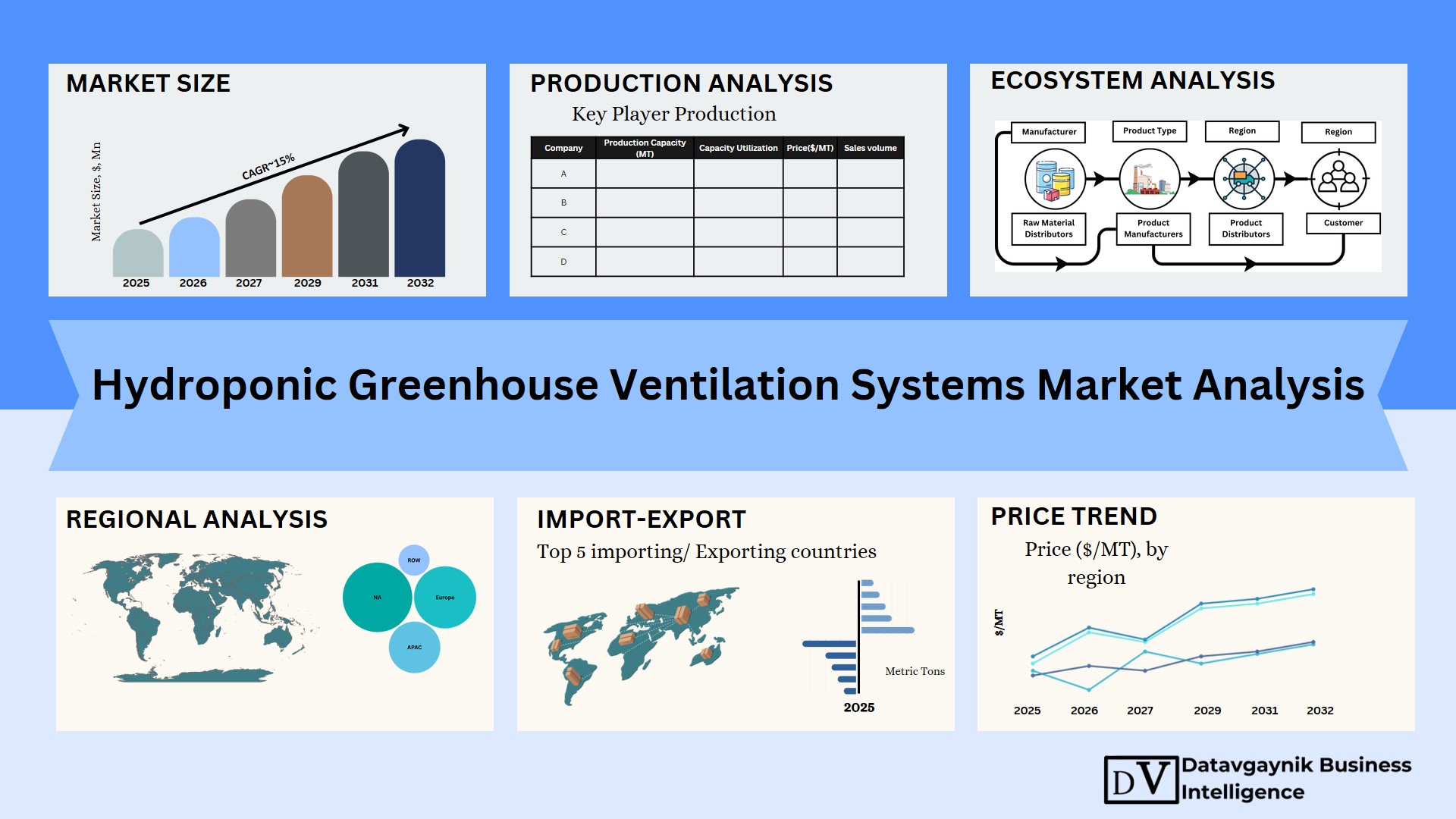
The market covers ventilation equipment and integrated airflow-control solutions installed in hydroponic greenhouses. It includes exhaust fans, circulation fans, roof and side vents, evaporative cooling units, air distribution systems, sensors, control panels and related climate-management software. These systems control temperature, humidity, carbon dioxide distribution and air movement around crops grown without soil.
Ventilation has direct commercial value in hydroponic cultivation. Poor airflow can create uneven crop temperatures, moisture pockets and favorable conditions for fungal disease. Excess humidity may also reduce transpiration and disrupt nutrient uptake. So, growers increasingly treat ventilation as part of the production system rather than basic greenhouse infrastructure.
The Hydroponic Greenhouse Ventilation Systems Market will benefit from the wider shift toward controlled-environment agriculture between 2026 and 2035. Urbanization is reducing the availability of productive farmland near large consumption centers. Water stress is also encouraging growers to use closed-loop and recirculating cultivation systems. Hydroponic greenhouses fit this requirement because they can deliver consistent production while using less water than conventional field cultivation.
| Market indicator | Estimate |
| Global market size, 2026 | $742 million |
| Projected market size, 2035 | $1,625 million |
| Forecast CAGR, 2026–2035 | 9.1% |
| Absolute revenue addition | $883 million |
| Revenue multiple over forecast period | 2.19 times |
Technology is changing the structure of demand. Conventional fans controlled by fixed timers are giving way to variable-speed equipment linked with temperature, humidity and vapor-pressure-deficit sensors. Growers can increase or reduce airflow by greenhouse zone. This lowers unnecessary electricity use and supports more stable growing conditions.
Energy cost remains an important issue. Fans, pumps, lighting and cooling equipment operate together in a hydroponic facility. Efficient motors, natural ventilation and automated vent positioning can reduce the load placed on mechanical cooling. This is especially relevant in warm regions, where heat removal can represent a major operating expense.
Food-safety rules and pesticide-reduction targets also support controlled production. Retail chains and food-service buyers want predictable volumes, uniform quality and year-round supply. Hydroponic greenhouse operators can meet these conditions more consistently when airflow, humidity and temperature are tightly managed.
The principal consumers and clients include:
- Commercial hydroponic vegetable growers
- Greenhouse owners and operators
- Controlled-environment agriculture companies
- Urban and peri-urban farming businesses
- Horticultural cooperatives
- Agricultural universities and research centers
- Seed producers and plant-breeding companies
- Greenhouse engineering and turnkey project contractors
- Fresh produce suppliers serving supermarkets and restaurants
Lettuce, tomatoes, cucumbers, peppers, herbs and strawberries account for a large part of addressable demand. These crops are sensitive to heat, moisture imbalance and disease pressure. High-value crops can therefore justify more precise ventilation investment than low-margin commodity production.
Expert view: Ventilation suppliers that connect airflow control with crop-level data will capture a larger share of greenhouse automation budgets. Buyers increasingly want measurable yield stability, not simply higher fan capacity.
Market Segmentation and Forecast Scope
The Hydroponic Greenhouse Ventilation Systems Market can be assessed by product type, application, end user and region. Each dimension reflects a different purchasing decision. Product segmentation shows how airflow is physically managed. Application analysis connects investment with crop economics. End-user analysis explains the level of system complexity, while regional assessment captures climate and greenhouse development patterns.
By Product Type
- Mechanical ventilation systems
- Exhaust fans
- Circulation and horizontal airflow fans
- Variable-speed fan systems
- Air distribution ducts
- Natural ventilation systems
- Roof vents
- Side vents
- Louvers and roll-up openings
- Cooling and ventilation combinations
- Fan-and-pad cooling systems
- Fogging-assisted ventilation
- Evaporative cooling units
- Controls and monitoring components
- Temperature and humidity sensors
- Carbon dioxide sensors
- Motor controllers
- Climate-control software
- Automated vent actuators
Mechanical ventilation systems are estimated to hold 46.8% of global revenue in 2026. Their lead comes from dependable airflow under changing outdoor conditions. Exhaust and circulation fans are widely used in commercial facilities because growers can measure, adjust and automate their performance.
Controls and monitoring components are expected to record the fastest growth through 2035. They allow equipment to respond to real-time greenhouse conditions. The segment also carries attractive aftermarket potential because sensors, controllers and software can be upgraded without replacing the full ventilation installation.
Natural ventilation remains commercially important, particularly in moderate climates. Roof and side vents reduce electricity use and can lower initial equipment requirements. That said, their performance depends on wind, outdoor temperature and greenhouse design. Many new projects therefore combine natural ventilation with mechanical backup.
By Application
- Leafy greens
- Tomatoes
- Cucumbers
- Peppers
- Herbs and microgreens
- Strawberries
- Flowers and ornamental plants
- Seedlings and plant propagation
- Research and specialty crops
Leafy greens are estimated to account for 28.4% of market revenue in 2026. Lettuce and similar crops are widely produced in hydroponic systems due to their short cultivation cycles and repeatable production schedules. Their sensitivity to humidity and foliar disease supports continuous air movement.
Tomato applications represent one of the most strategic segments. Tomato greenhouses are often larger, taller and more technically complex than leafy-green facilities. The crop requires careful management of temperature, humidity, pollination conditions and carbon dioxide movement. This results in higher ventilation spending per project.
Herbs, microgreens and strawberries should expand at a faster pace from a smaller base. Their high selling price can support investment in precise climate control. Production near cities also reduces delivery time for crops with short shelf lives.
By End User
- Large commercial greenhouse operators
- Small and medium-sized growers
- Vertical and urban farming companies
- Research institutions and universities
- Seed and plant-propagation businesses
- Greenhouse project developers
- Government-supported horticulture facilities
Large commercial operators generate the strongest demand for integrated systems. These buyers commonly require centralized controls, equipment redundancy and zone-level monitoring. They also evaluate suppliers on energy consumption, maintenance response and compatibility with existing greenhouse platforms.
Small and medium-sized growers remain a sizeable equipment-volume opportunity. Their purchases are usually more price-sensitive and may focus on stand-alone fans, basic sensors and manually controlled vents. Modular products that can be expanded as production grows are well suited to this customer group.
Research institutions and seed companies form a smaller but technically demanding segment. Their facilities may require different environmental conditions across individual greenhouse compartments. Accuracy and data recording matter more than equipment scale in these projects.
By Region
- North America
- Europe
- Asia Pacific
- Latin America
- Middle East and Africa
North America and Europe currently represent established demand centers. The Netherlands, Spain, Germany, France, Canada, the United States and Mexico have developed commercial greenhouse clusters or strong controlled-agriculture ecosystems. Replacement demand, automation upgrades and energy-efficiency improvements support equipment sales in these markets.
Asia Pacific is forecast to be the fastest-growing regional segment through 2035. China, Japan, South Korea, Australia and parts of Southeast Asia are investing in protected cultivation to improve crop quality and supply stability. The region also has broad climate variation, creating demand for both natural and mechanically assisted ventilation.
The Middle East is strategically important despite its smaller installed base. Food-import dependence, limited water availability and government-backed agriculture projects support hydroponic greenhouse investment. However, extreme heat raises cooling loads and project costs. Suppliers must therefore design systems around heat rejection, evaporative cooling potential and water quality.
Expert view: Regional growth will not follow one equipment formula. Temperate markets will place more weight on automation and energy recovery, while hot-climate projects will prioritize cooling capacity, equipment durability and water-efficient heat management.
Market Trends and Business Innovations
The Hydroponic Greenhouse Ventilation Systems Market is moving from equipment-led selling toward integrated climate-management solutions. Growers are no longer evaluating fans, vents and sensors separately. They want the full system to maintain stable crop conditions while controlling energy consumption.
Sensor-Based Airflow Management
Modern systems combine humidity, temperature, carbon dioxide and light measurements. Data from these sensors can control fan speed, vent position, fogging and evaporative cooling. The goal is not to maintain one fixed temperature throughout the day. It is to keep the crop within an acceptable operating range as sunlight, outdoor weather and plant growth change.
Vapor-pressure-deficit monitoring is gaining practical value. It helps growers understand the relationship between air temperature and moisture demand around the plant. When connected with airflow controls, it can support transpiration and reduce condensation risk.
Variable-Speed and Energy-Efficient Equipment
Fixed-speed fans can waste energy when full airflow is not required. Variable-frequency drives and electronically commutated motors allow operators to match fan output with actual conditions. These systems cost more initially, but lower electricity use and reduced equipment wear can improve lifecycle economics.
Fan design is also improving. Manufacturers are working on blade geometry, motor efficiency and airflow uniformity. The relevant performance measure is shifting from maximum airflow alone to usable airflow per unit of energy.
Expert view: Electricity savings will become a stronger procurement factor as greenhouse operators compare ventilation equipment over its full operating life. Purchase price will remain important, but energy cost will increasingly decide supplier selection.
Hybrid Natural and Mechanical Ventilation
Greenhouse developers are combining automated roof vents with circulation and exhaust fans. Natural airflow handles moderate conditions, while mechanical equipment provides support during heat, humidity or low-wind periods. This hybrid layout can reduce operating costs without sacrificing environmental control.
The approach is particularly useful in regions with seasonal climate variation. It also provides operational resilience. If outdoor conditions become unsuitable for natural ventilation, the control system can shift more of the load to mechanical equipment.
Crop-Zone and Compartment-Level Control
Large greenhouses can develop temperature and humidity differences between the crop canopy, roof area and perimeter zones. Uniform control at the building level may not correct these local variations. So, suppliers are developing zone-based ventilation layouts supported by distributed sensors.
Wireless sensor networks make this structure easier to deploy. Operators can compare conditions across greenhouse compartments and identify areas with weak airflow. This may lead to targeted fan placement instead of excessive ventilation across the full facility.
AI-Supported Climate Decisions
AI has a relevant but still developing role in greenhouse ventilation. Its practical use lies in processing weather forecasts, historical greenhouse behavior and live sensor readings. Software can estimate how the internal climate may respond before conditions move outside the target range.
Predictive controls may open vents earlier, reduce fan speed when natural airflow is adequate or coordinate ventilation with irrigation and carbon dioxide dosing. The commercial benefit is better crop consistency and lower resource waste. Human oversight remains necessary because plant response, equipment condition and local weather can create exceptions that automated systems do not fully anticipate.
Integration with Complete Greenhouse Platforms
Ventilation is increasingly connected with irrigation, lighting, shading, heating and nutrient-delivery systems. This matters because these systems affect one another. For example, opening a roof vent may remove excess heat but can also release injected carbon dioxide. Fogging can cool the greenhouse but may raise humidity beyond the desired level.
Companies such as Priva, Ridder, Hoogendoorn Growth Management, Munters, Vostermans Ventilation, Schaefer Ventilation Equipment, Delta T Systems and Rough Brothers participate in different parts of this ecosystem. Their offerings range from fans and cooling equipment to climate computers, automation controls and full greenhouse engineering.
Business partnerships are increasingly built around interoperability. Climate-control companies work with greenhouse constructors, irrigation specialists, sensor suppliers and crop consultants. Turnkey project alliances are especially important in emerging markets, where customers may prefer one contractor to manage design, installation and commissioning.
Mergers and strategic investments are also shaping the wider controlled-environment agriculture supply chain. Buyers are looking for suppliers with broader technical portfolios and stronger service networks. This favors companies that can combine physical ventilation equipment with controls, maintenance and performance monitoring.
Predictive Maintenance and Remote Service
Connected motors and controllers can record operating hours, temperature, vibration and power draw. Changes in these indicators may show bearing wear, airflow blockage or motor stress. Remote diagnostics allow service teams to identify faults before a complete breakdown.
This capability is valuable in hydroponic facilities because ventilation failure can damage crops quickly during hot or humid conditions. Service contracts, monitoring subscriptions and spare-part programs could therefore become a larger source of recurring revenue.
Expert view: The competitive edge will gradually move from selling individual fans toward guaranteeing climate performance. Suppliers with equipment, controls and dependable local service will be better placed to secure multi-site greenhouse contracts.
Competitive Intelligence and Benchmarking
Competition is split between ventilation-equipment manufacturers, climate-automation specialists and integrated greenhouse technology providers. No single supplier controls the full value chain. Buyers often combine fans from one manufacturer, controls from another and installation support from a local engineering company.
| Company | Portfolio and market position | Competitive strength |
| Priva | Supplies greenhouse climate computers, sensor networks, actuator controls and cloud-based management tools. Its systems coordinate ventilation with heating, lighting, irrigation and carbon dioxide delivery. | Strong position in large, automated glasshouses and multi-site horticultural operations. Its value lies in full climate integration rather than stand-alone ventilation hardware. |
| Ridder | Provides climate-control platforms, vent-drive systems, screens, water-management equipment and connected greenhouse controls. Ventilation is managed as part of a wider crop-production environment. | Well placed in turnkey greenhouse projects. Its open-system strategy and work with AI providers support autonomous growing applications. |
| Munters | Offers exhaust fans, circulation equipment, evaporative cooling, inlets, controllers and air-treatment solutions. Its ventilation knowledge extends beyond horticulture into other agricultural environments. | Competes on high airflow, energy efficiency, durability and hot-climate capability. It is particularly relevant where forced ventilation and cooling must operate together. |
| Vostermans Ventilation | Specializes in axial, horizontal and vertical circulation fans for greenhouses. Its equipment addresses humidity control, crop-level airflow and temperature uniformity. | Holds a focused position in air-movement hardware. Global manufacturing and sales coverage support both new greenhouse projects and replacement demand. |
| Hoogendoorn Growth Management | Develops greenhouse process computers and software that connect ventilation, screening, heating, irrigation and energy use. | Strong in data-led climate management. Its strategic position is tied to precise crop control and resource optimization in advanced greenhouses. |
| Schaefer Ventilation Equipment | Supplies portable, mounted, exhaust and circulation fans for greenhouse and agricultural applications. Its portfolio serves a broad range of facility sizes. | Competes through practical equipment, distributor coverage and suitability for retrofit projects. It has particular relevance among small and medium-sized operators. |
| Delta T Systems | Provides greenhouse heating, cooling, circulation and environmental-control solutions. Its systems are generally configured around the requirements of an individual facility. | Strong project-engineering orientation. It can address ventilation as part of a complete environmental system rather than as an isolated equipment purchase. |
Competitive benchmarking
- Priva, Ridder and Hoogendoorn Growth Management are strongest in software-led climate coordination.
- Munters and Vostermans Ventilation have deeper specialization in physical airflow and cooling equipment.
- Schaefer Ventilation Equipment is well positioned in accessible, modular and replacement-oriented ventilation.
- Delta T Systems competes through customized project design and integrated environmental systems.
- Local greenhouse contractors remain important because equipment selection depends on structure size, crop density, outdoor climate and available power.
The market does not reward airflow capacity alone. Energy consumption, noise, corrosion resistance, motor life and control compatibility affect the purchasing decision. Service access is equally important. A fan or vent-drive failure during a heat event can damage production within hours.
Expert view: Competitive advantage will increasingly come from combining efficient hardware with crop-aware control software. Equipment manufacturers without strong integration capabilities may become component suppliers to larger greenhouse platforms.
Regional Landscape and Adoption Outlook
United States
The United States has a broad commercial greenhouse base serving vegetables, herbs, ornamental plants and cannabis cultivation. Hydroponic production is concentrated around major consumption markets and established greenhouse clusters in states such as California, Arizona, Texas, Ohio, New York and Michigan.
Mechanical ventilation is important in warmer states, while hybrid natural-mechanical systems are more suitable in moderate climates. High labor and electricity costs encourage automated controls, variable-speed fans and remote monitoring. Federal agricultural programs support urban agriculture, rural energy efficiency and innovative production, though funding is spread across multiple programs rather than one national hydroponics policy.
Europe
Europe is the most technically mature greenhouse region. The Netherlands leads in climate-control technology, glasshouse engineering and supplier expertise. Spain has a large protected-cultivation base, although many structures use lower-cost natural ventilation. France, Germany, Italy, Belgium and the Nordic countries support demand for higher-control installations.
European growers face pressure to reduce energy use, chemical inputs and carbon emissions. This is accelerating interest in efficient motors, thermal screens, dehumidification and ventilation strategies that limit heat loss. Investment decisions are increasingly based on total energy performance.
The Netherlands remains the regional technology center, while Spain, Poland and parts of Eastern Europe offer stronger project-growth potential. EU agricultural and sustainability funding can support greenhouse modernization, but permitting, energy prices and national subsidy rules differ by country.
China
China has one of the world’s largest protected-cultivation footprints, but its greenhouse stock varies widely in technical sophistication. Basic solar greenhouses coexist with automated glasshouses and multi-hectare hydroponic projects.
The main opportunity lies in upgrading structures with powered vents, circulation fans, sensors and central controls. Demand is strongest near major cities and in provinces investing in modern horticulture. Shandong, Jiangsu, Yunnan, Henan and areas surrounding large urban centers are commercially relevant.
Domestic suppliers compete strongly in standard equipment. International companies remain better positioned in advanced control platforms and complex projects where crop consistency and energy management justify higher investment.
India
India represents an emerging market rather than a mature hydroponic greenhouse base. Adoption is led by commercial growers near Delhi NCR, Mumbai, Pune, Bengaluru, Hyderabad, Chennai and other high-income urban markets. Leafy greens, herbs, tomatoes, cucumbers and specialty vegetables are the main crops.
Government support for protected cultivation lowers part of the infrastructure burden. However, hydroponic systems, advanced controls and cooling equipment can still require substantial private investment. High temperatures create strong ventilation demand, but they also raise operating costs.
The most attractive solutions are modular fans, automated vents, efficient evaporative cooling and basic sensor packages. High-end European systems may be viable for premium projects, but locally assembled equipment will address the larger cost-sensitive market.
Japan
Japan has strong capabilities in precision agriculture, sensors and plant-factory technologies. Limited farmland, an aging agricultural workforce and high demand for consistent food quality support controlled cultivation.
Adoption favors compact, automated systems. Energy cost is the main restraint. Suppliers must show clear improvements in crop quality, labor efficiency or production density. Ventilation systems integrated with heat pumps, shading and predictive climate controls have stronger commercial relevance than stand-alone fans.
South Korea
South Korea supports smart-farm development through technology programs, demonstration facilities and training infrastructure. Greenhouse automation is linked with the country’s interest in digital agriculture and rural productivity.
Modern greenhouse clusters create opportunities for sensors, environmental controls and remotely managed ventilation. The domestic technology sector supports local integration, while specialist overseas companies can compete in high-performance fans, climate computers and advanced hydroponic projects.
Middle East
The Middle East is relevant because governments are investing in food security and water-efficient agriculture. The United Arab Emirates and Saudi Arabia are the leading opportunity markets. Qatar, Oman and Israel also have specialized controlled-agriculture activity.
Extreme heat changes the equipment requirement. Natural ventilation alone is often inadequate during hotter months. Projects may require high-capacity exhaust systems, evaporative cooling, fogging, shading and tightly coordinated controls.
Capital availability can support advanced facilities, but cooling energy, water quality and maintenance capacity determine long-term viability. Suppliers offering durable equipment and regional technical service are likely to outperform firms focused only on initial installation.
| Market | Infrastructure maturity | Policy or funding support | Primary buying priority |
| United States | High | Moderate and program-based | Automation and energy savings |
| Europe | Very high | Strong but country-specific | Efficiency and emissions reduction |
| China | Mixed, rapidly modernizing | Strong strategic support | Scalable greenhouse upgrades |
| India | Emerging | Protected-cultivation assistance | Affordable cooling and ventilation |
| Japan | High but compact | Technology-led support | Precision and labor reduction |
| South Korea | Growing smart-farm base | Strong technology programs | Connected climate management |
| Middle East | Project-led, capital intensive | Strong in selected countries | Heat control and operational reliability |
Expert view: Asia and the Middle East provide the highest greenfield potential, while Europe and North America offer steadier revenue from system upgrades, replacements and software integration.
Recent Developments, Opportunities and Restraints
Recent Developments
- December 2024: India issued updated horticulture-development guidelines covering financial assistance for protected cultivation and greenhouse demonstration projects. The policy supports greenhouse infrastructure that can later generate demand for ventilation, cooling and climate-control equipment.
- June 2025: Ridder and crop-sensing company Gardin announced the direct integration of real-time photosynthesis insights with a greenhouse climate platform. The development connects plant-response data with environmental control and supports more precise ventilation decisions.
- August 2025: India’s National Horticulture Board notified modifications to protected-cultivation guidelines. The update reinforced public support for greenhouse development and related horticultural infrastructure.
- December 2025: Vostermans Ventilation highlighted vertical air circulation for reaching lower crop layers, controlling moisture and improving temperature uniformity in dense greenhouse crops. The development reflects the shift from general air exchange toward crop-zone airflow management.
Opportunities and Business Insights
- Emerging-market greenhouse development: India, China, Southeast Asia and the Middle East offer opportunities for modular ventilation packages designed around local climate and project budgets.
- Automation and remote monitoring: Sensor-connected fans, vent drives and cloud controls can generate equipment revenue along with software, diagnostics and service income.
- Energy-saving retrofits: Existing greenhouses can replace fixed-speed motors and poorly positioned fans without rebuilding the full structure. Retrofit projects offer shorter sales cycles than greenfield facilities.
Market Restraints
- Advanced ventilation controls increase initial project cost.
- Electricity prices can weaken operating economics in hot climates.
- Inadequate system design may create uneven airflow despite high installed capacity.
- Small growers may lack the technical staff needed to manage connected systems.
- Natural ventilation remains a lower-cost substitute in suitable climates.


