

Market Summary and Growth Forecast
The global Hydroxypropyl Methylcellulose (HPMC) Market will witness a robust CAGR of 5.1%, valued at $1.75 billion in 2026, expected to appreciate and reach $2.73 billion by 2035.
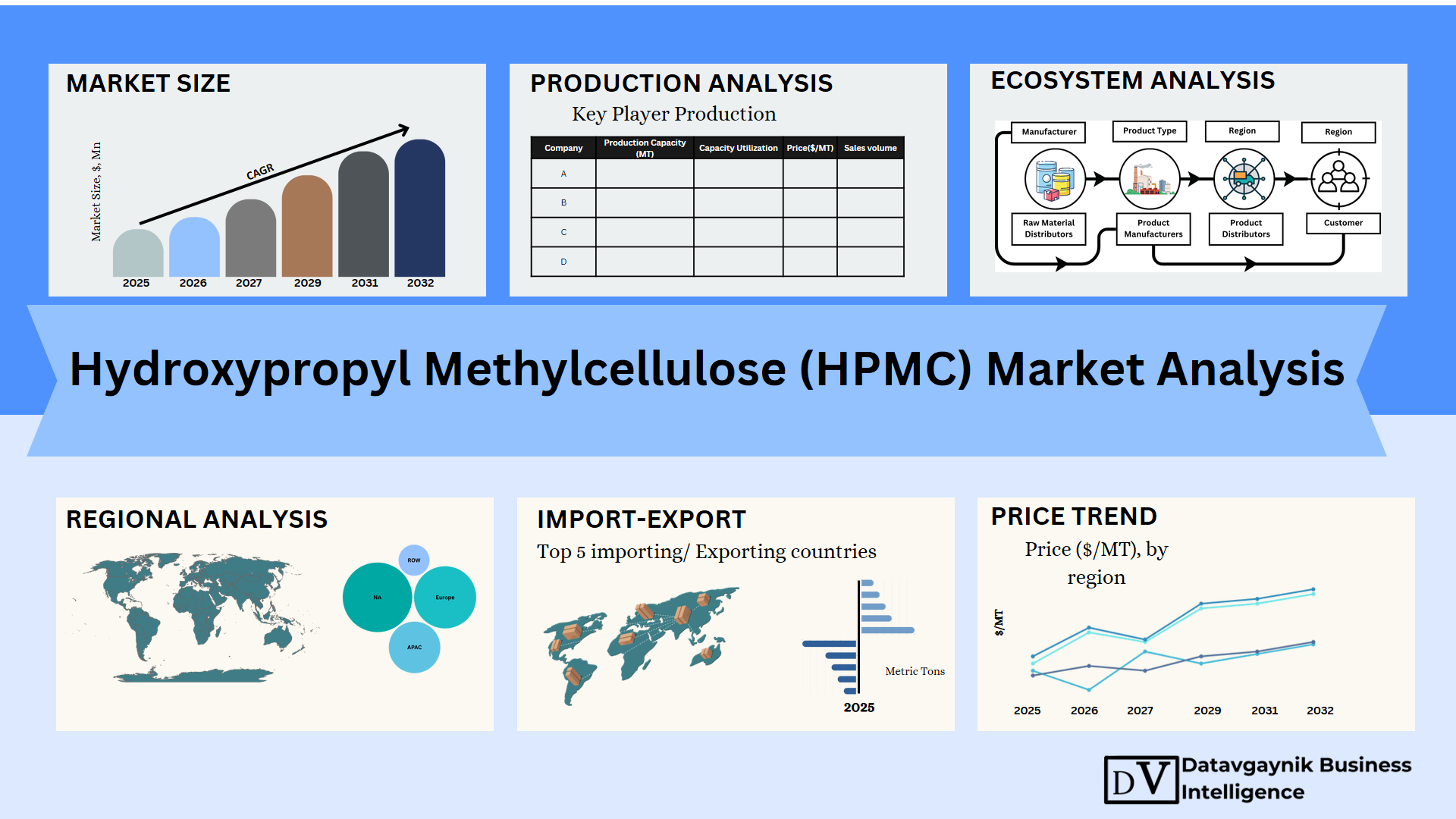
The market covers hydroxypropyl methylcellulose grades used as binders, thickeners, film formers, stabilizers, emulsifiers, controlled-release polymers, and water-retention additives. In simple terms, HPMC helps materials behave better. It improves tablet release profiles in pharmaceuticals. It controls water retention in cement and tile adhesives. It adds texture and stability in food. It supports viscosity and film formation in personal care products.
Strategically, the Hydroxypropyl Methylcellulose (HPMC) Market sits at the intersection of construction chemistry, drug formulation, food texture systems, and plant-derived functional ingredients. That makes it a quiet but important market. It doesn’t always sit at the front of the value chain, but it influences performance in several high-volume end markets.
In 2026, construction-grade HPMC remains the largest volume pool. Dry-mix mortars, tile adhesives, renders, plasters, wall putties, and self-leveling compounds continue to rely on HPMC for workability, sag resistance, adhesion, and open time. This demand is tied closely to urban housing, renovation cycles, infrastructure spending, and the shift from site-mixed materials toward factory-formulated construction systems.
Pharmaceutical-grade HPMC is smaller in volume but stronger in value. Its role in controlled-release tablets, capsule shells, coatings, ophthalmic preparations, and binder systems gives it a premium position. The growth case here is not only about more medicines. It is also about safer excipients, tighter impurity control, low-nitrite grades, and formulation reliability.
Food and personal care applications add another layer of stability. In food, HPMC supports texture, moisture control, emulsification, and thermal gelation. It is especially relevant in plant-based foods, bakery systems, sauces, dressings, and coatings. In personal care, it works as a rheology modifier, stabilizer, binder, and film former.
| Market Metric | Estimate |
| Global Market Size, 2026 | $1.75 billion |
| Projected Market Size, 2035 | $2.73 billion |
| Forecast CAGR, 2026–2035 | 5.1% |
| Largest Application Pool, 2026 | Construction materials |
| Highest Value Application Pool, 2026 | Pharmaceutical excipients |
| Fastest-Growing Strategic Use Case | Low-nitrite pharma-grade HPMC and plant-based food texturizers |
Three macro forces will shape the market between 2026 and 2035.
First, construction materials are becoming more engineered. Contractors want predictable performance, less rework, and easier application. That favors cellulose ethers with consistent viscosity, water retention, and setting behavior. HPMC is already embedded in this trend.
Second, pharmaceutical formulation is becoming more quality-sensitive. Excipients are no longer viewed as passive ingredients. Regulators and drug companies now care more about impurity profiles, nitrite levels, particle morphology, and controlled-release performance. This is likely to widen the value gap between commodity HPMC and pharma-grade HPMC.
Third, sustainability is influencing procurement. HPMC is derived from cellulose sources such as wood pulp or cotton linters, so it benefits from the broader shift toward bio-based functional additives. That said, customers will still judge the product by performance first. A “green” label without consistent viscosity and batch quality won’t win serious industrial accounts.
Expert insight: The market’s growth won’t come from one dramatic breakthrough. It will come from steady formulation upgrades across construction, pharma, food, and personal care. The companies that can guarantee cleaner grades, stable supply, and application support will capture the premium end of the value chain.
Key stakeholders in the Hydroxypropyl Methylcellulose (HPMC) Market include chemical manufacturers, cellulose ether producers, pharmaceutical excipient suppliers, dry-mix mortar producers, food ingredient formulators, personal care brands, construction material OEMs, pharmaceutical OEMs, contract development and manufacturing organizations, regulators, industry associations, distributors, investors, and governments supporting housing, healthcare, and local chemical production.
Market Segmentation and Forecast Scope
The Hydroxypropyl Methylcellulose (HPMC) Market is best segmented by product grade, viscosity profile, application, end user, and region. This structure reflects how buyers actually make decisions. A pharmaceutical formulator does not buy HPMC the same way a dry-mix mortar producer does. One cares about excipient quality, impurity control, and release kinetics. The other cares about water retention, open time, workability, and cost per tonne of finished formulation.
By Product Type
The market can be divided into industrial-grade HPMC, pharmaceutical-grade HPMC, food-grade HPMC, and cosmetic/personal care-grade HPMC.
Industrial-grade HPMC is the largest volume segment. It is mainly used in construction chemicals, paints, coatings, detergents, ceramics, and related technical formulations. In 2026, industrial and construction-linked grades account for an estimated 47% of global market value. The share is higher on a volume basis because these grades carry lower average prices than pharma-grade materials.
Pharmaceutical-grade HPMC is a premium segment. It is used in controlled-release tablets, film coating, granulation, binders, capsule shells, ophthalmic preparations, and other dosage systems. Growth is being supported by generic drug manufacturing, patient-friendly dosage formats, and demand for excipients with better safety documentation.
Food-grade HPMC is gaining relevance in texture systems. It supports plant-based foods, gluten-free bakery, sauces, coatings, and heat-activated binding. This segment is not the largest today, but it has a strong innovation runway.
Cosmetic and personal care-grade HPMC is used in creams, gels, shampoos, liquid cleansers, color cosmetics, and other products where viscosity, stability, and film-forming behavior matter.
By Application
The core application groups include construction materials, pharmaceuticals, food and beverages, personal care and cosmetics, paints and coatings, and other industrial uses.
Construction materials remain the anchor demand pool. HPMC improves workability, adhesion, water retention, and anti-sag behavior in cement-based and gypsum-based systems. Tile adhesives, plasters, renders, wall putties, skim coats, and self-leveling compounds are major use cases.
Pharmaceuticals represent the highest-value technical application. HPMC is used in matrix tablets, coating systems, granules, capsules, and controlled-release platforms. The segment benefits from rising oral solid dosage production and stricter formulation standards.
Food and beverages are becoming more attractive because manufacturers want clean-label-friendly texture and stability systems. HPMC can support moisture control, thermal gelation, structure, and emulsification.
Personal care and cosmetics use HPMC for viscosity control, foam quality, stabilization, binding, and film formation. Demand is steady rather than explosive, but premium formulations create room for specialized grades.
By End User
Key end users include construction chemical producers, pharmaceutical companies, food processors, personal care manufacturers, paint and coating formulators, contract manufacturers, and specialty chemical distributors.
Construction chemical producers are the largest buyers by volume. They typically need dependable supply, price stability, and grade consistency. Pharmaceutical companies buy smaller quantities but demand stronger documentation, regulatory alignment, and batch quality. Food and personal care manufacturers sit in the middle. They need performance, safety, and formulation support.
By Region
The regional scope includes North America, Europe, Asia Pacific, and LAMEA.
Asia Pacific is the largest regional market and is estimated to hold about 48% of global market value in 2026. China, India, South Korea, Japan, and Southeast Asia contribute through construction activity, pharmaceutical production, food processing, and regional chemical manufacturing.
North America is a mature but attractive market. Growth comes from pharma excipients, food formulation, personal care, renovation-led construction, and demand for higher-specification grades.
Europe is quality-driven. Sustainability, regulatory compliance, and advanced construction materials support demand. However, energy costs and slower construction cycles can limit volume growth in some countries.
LAMEA is smaller but improving. The Middle East supports construction chemical demand, while Latin America adds opportunities in pharmaceuticals, food processing, and building materials. Africa remains more price-sensitive but has long-term upside through urbanization.
| Segmentation Dimension | Core Sub-Segments | Forecast Scope and Strategic Signal |
| By Product Type | Industrial-grade, pharmaceutical-grade, food-grade, cosmetic-grade | Industrial-grade leads by volume. Pharmaceutical-grade leads on value intensity. |
| By Application | Construction, pharmaceuticals, food, personal care, paints and coatings, others | Construction holds the largest disclosed share at 47% of 2026 market value. |
| By End User | Construction chemical producers, pharma companies, food processors, personal care brands, distributors | Pharma and food users will push demand for higher-purity and application-specific grades. |
| By Region | North America, Europe, Asia Pacific, LAMEA | Asia Pacific holds the largest disclosed regional share at 48% in 2026. |
The fastest-growing strategic sub-segments are expected to be pharmaceutical-grade low-nitrite HPMC, controlled-release HPMC, plant-based food texturizing HPMC, and high-performance construction-grade HPMC for tile adhesives, exterior insulation systems, and dry-mix formulations.
Expert insight: The segmentation logic should not be treated as a simple volume split. HPMC is a specification-driven market. A tonne sold into dry-mix mortar and a tonne sold into controlled-release tablets have very different economics, customer expectations, and barriers to entry.
Market Trends and Innovation Landscape
Innovation in the Hydroxypropyl Methylcellulose (HPMC) Market is moving in a practical direction. The focus is not on replacing the molecule. The focus is on cleaner grades, better particle control, lower impurity risk, stronger application performance, and more reliable supply.
R&D Evolution
R&D activity is strongest in pharmaceutical excipients, construction additives, and food texture systems.
In pharmaceuticals, HPMC research is concentrated around controlled-release performance, low-nitrite grades, particle morphology, direct compression, and impurity management. This is being shaped by the global concern around nitrosamine formation in finished dosage forms. Excipients with lower nitrite levels are becoming strategically important because they reduce one possible input risk in drug formulation.
In construction, R&D is more application-led. Producers are working on grades that improve open time, slip resistance, water retention, workability, and adhesion under different cement and gypsum systems. This matters because construction materials are becoming more standardized. Ready-mix and dry-mix products need repeatable behavior across climates, job sites, and installer skill levels.
In food, innovation is tied to texture. HPMC can help build structure in plant-based meats, improve moisture control in bakery, stabilize sauces, and support coating systems. As food companies reformulate around plant proteins, reduced fat systems, and allergen-sensitive products, cellulose ethers can play a more visible role.
Technology Evolution
Technology development is happening through three routes.
The first route is grade specialization. Producers are moving from broad-purpose HPMC grades toward tailored viscosity, substitution, particle size, and purity profiles. This allows customers to tune release rates in tablets or workability in mortar.
The second route is process control. Better control over etherification, washing, drying, milling, and testing improves batch consistency. In pharma, this translates into tighter release profiles and lower impurity variability. In construction, it supports predictable performance across formulations.
The third route is application support. Large suppliers are not only selling HPMC powder. They are supporting formulators with lab testing, dosage optimization, rheology studies, and troubleshooting. That is especially important in food, pharma, and premium construction systems.
Material Science Direction
HPMC is a cellulose ether, so its performance depends on substitution chemistry, molecular weight, viscosity, particle morphology, solubility, and thermal gelation behavior. Small changes in these properties can materially change product behavior.
For example, high-viscosity grades can support controlled-release matrix tablets. Lower-viscosity grades may suit coating or binder systems. In construction, the right HPMC grade can change water retention and open time. In food, thermal gelation can support plant-based texture and heat-set structure.
This is why the market is shifting from commodity thinking to formulation-specific thinking. Buyers want the grade that solves a problem, not just the cheapest bag.
Mergers, Partnerships, and News Announcements
The most relevant market developments are concentrated around pharma excipients, food ingredient access, and specialty cellulose ether portfolios.
Roquette completed the acquisition of IFF Pharma Solutions in May 2025, strengthening its position in pharmaceutical excipients and plant-based ingredient systems. This matters because the acquired portfolio includes strong positions in oral dosage excipients and methylcellulosic solutions.
IFF Pharma Solutions launched Low Nitrite METHOCEL™ HPMC in April 2025, targeting nitrosamine risk mitigation in pharmaceutical dosage forms. This is a strong signal that excipient suppliers are moving closer to regulatory and risk-management priorities, not just formulation performance.
Roquette later highlighted Low-Nitrite METHOCEL™ HPMC through a November 2025 industry award announcement. The commercial point is clear: low-nitrite HPMC is becoming a differentiated pharma excipient category, not just a technical side note.
Caldic and LOTTE Fine Chemical announced a partnership in March 2026 to bring HPMC and methylcellulose ingredients into the U.S. food and beverage market from January 2026 onward. The focus areas include plant-based meats, gluten-free bakery, sauces, dressings, and coating systems.
On the product side, suppliers continue to position HPMC across construction, pharma, and personal care. Dow offers HPMC-based cellulose ether products for cement-based systems and personal care applications. Ashland markets HPMC under its Benecel™ platform for controlled-release and oral solid dosage applications. Shin-Etsu positions METOLOSE® for pharmaceutical use including binders, sustained release, film formation, and related functions. LOTTE Fine Chemical markets MECELLOSE® as a cellulose ether additive for dry-mix and ready-to-use construction applications.
Expert insight: The next phase of competition will be less about who can make HPMC and more about who can make the right HPMC for the right customer risk. In pharma, that means impurity control. In food, it means texture and regulatory fit. In construction, it means performance at the lowest effective dosage.
AI integration is not a major direct driver in this market today. There may be selective use of digital tools in formulation screening, quality control, demand planning, and production optimization. But it would be misleading to position AI as a core growth engine for HPMC at this stage.
For 2026–2035, the innovation landscape will likely favor companies with strong application labs, pharma documentation, regional distribution, and the ability to supply both high-volume industrial grades and high-value specialty grades. The Hydroxypropyl Methylcellulose (HPMC) Market will stay competitive, but value will gradually shift toward suppliers that can prove consistency, compliance, and formulation performance.
Competitive Intelligence and Benchmarking
The Hydroxypropyl Methylcellulose (HPMC) Market is moderately consolidated at the premium end and fragmented at the industrial-grade end. Global leaders compete on purity, viscosity control, pharma documentation, application laboratories, and regional supply reliability. Chinese producers compete strongly in construction-grade volume and are moving upward into food, pharma, and capsule applications.
Competitive Benchmarking Snapshot
| Company | Core Portfolio Position | Market Positioning | Strategic Strength |
| Dow | Cellulose ether grades for personal care, construction, coatings, and industrial systems | Strong multinational supplier with formulation depth | Application support, brand trust, global technical reach |
| Ashland | Pharmaceutical and specialty cellulose ether systems used in controlled-release and oral solid dosage formats | Premium excipient-focused player | Strong pharma relationships and controlled-release know-how |
| Shin-Etsu Chemical / SE Tylose | Cellulose ether portfolio across pharma, food, construction, personal care, and industrial uses | High-quality Japanese-German supplier with pharma credibility | GMP-grade production, technical consistency, strong specialty positioning |
| LOTTE Fine Chemical | Cellulose ether materials for construction, food, pharma-linked systems, and functional ingredients | Strong Asian producer with rising global distribution push | Scale, construction chemistry strength, food ingredient expansion |
| Shandong Head Group | Cellulose ethers, HPMC capsules, building material grades, pharma grades, food grades | Major China-based producer with integrated downstream exposure | Cost position, capacity scale, capsule linkage, global export network |
| Nouryon | Broader cellulose ether and rheology modifier portfolio for paints, coatings, and building materials | Specialist in industrial cellulose ether systems | Sustainability narrative, coatings expertise, strong European base |
| Roquette / former IFF Pharma Solutions portfolio | Pharmaceutical excipients, low-nitrite cellulose ether systems, oral dosage support | Fast-rising pharma excipient consolidator | Low-nitrite innovation, acquisition-led scale, pharma customer access |
Dow holds a strong position in performance additives, especially where customers need rheology control, film formation, water retention, and stability. Its role is more visible in personal care, coatings, and construction-linked formulations than in low-cost commodity supply. Dow’s advantage is not only material availability. It is the ability to support formulation teams that need consistency across regions.
Ashland is positioned toward the higher-value end of the market. Its cellulose ether portfolio is closely linked with pharmaceutical dosage design, controlled-release tablets, binder systems, and specialty formulation needs. The company is less exposed to price-only construction competition and more aligned with premium excipient demand. That gives it stronger margin defensibility.
Shin-Etsu Chemical / SE Tylose has a strong reputation in cellulose chemistry. Its market position is built on consistent grades, high regulatory credibility, and a broad portfolio spanning pharma, food, personal care, and construction. The company is especially relevant where buyers need long-term supply reliability and technical documentation.
LOTTE Fine Chemical is a key Asian producer with a meaningful role in construction-grade cellulose ethers. Its portfolio supports dry-mix mortars, tile adhesives, plasters, renders, and other building material applications. The company is also expanding visibility in food and pharmaceutical-related uses through partnerships and distribution channels.
Shandong Head Group is one of the most important China-based players. It has moved beyond basic cellulose ether production into adjacent areas such as HPMC capsules and plant-based food applications. This gives the company a broader value-chain position. It can serve price-sensitive construction customers while also developing higher-value pharma and nutraceutical exposure.
Nouryon is not a pure HPMC-focused supplier, but it is relevant in the wider cellulose ether and rheology modifier field. Its strength sits in paints, coatings, dry-mix materials, and industrial formulation support. It competes through performance, process know-how, and sustainability positioning rather than low-cost commodity supply.
Roquette, strengthened by the former IFF Pharma Solutions platform, has become more important in pharmaceutical excipients. Its positioning is tied to low-nitrite excipients, oral dosage solutions, and plant-based pharmaceutical ingredients. This makes it strategically relevant in the premium segment of the Hydroxypropyl Methylcellulose (HPMC) Market.
Expert insight: The competitive split is clear. Construction-grade HPMC rewards scale and cost control. Pharma-grade HPMC rewards documentation, impurity control, and long-term trust. Very few suppliers can win strongly in both spaces at the same time.
Regional Landscape and Adoption Outlook
The Hydroxypropyl Methylcellulose (HPMC) Market has different demand logic across regions. Asia is volume-led. North America and Europe are quality-led. India and Southeast Asia are growth-led. Japan and South Korea are specification-led. This regional split will remain important through 2035.
North America
North America is a mature but attractive market. The United States leads demand through pharmaceuticals, nutraceuticals, personal care, food ingredients, construction renovation, and specialty building materials. Canada adds stable demand through construction chemicals, food processing, and pharma supply chains.
The region has strong regulatory expectations. Pharma and food customers require documentation, traceability, and supplier reliability. This supports premium suppliers and distributors with technical service capabilities. Recent domestic investment in HPMC capsule capacity also shows that customers want shorter supply chains and reduced dependence on imports.
White space exists in plant-based food systems, nutraceutical capsules, and low-nitrite excipient adoption. The underserved area is not basic HPMC availability. It is application-specific technical support for smaller and mid-sized formulators.
Europe
Europe is a high-quality market with strict standards. Germany, France, Italy, the United Kingdom, Spain, and the Nordic region are important demand centers. Germany has particular relevance due to pharmaceutical excipients, specialty chemicals, construction materials, and advanced manufacturing.
European demand is shaped by sustainability, regulatory compliance, and performance consistency. Construction activity can be uneven because of interest rates and building-cycle softness, but renovation, energy-efficient buildings, and premium dry-mix materials still support HPMC consumption.
The region has less white space in mature Western Europe. Eastern Europe and parts of Southern Europe offer better growth potential, especially in construction chemicals, generic drug manufacturing, and packaged food production.
China
China is both a major producer and a major consumer. It has strong demand from dry-mix mortars, tile adhesives, coatings, pharmaceutical excipients, food ingredients, and HPMC capsules. Domestic producers have built meaningful scale and continue to improve grade quality.
China’s strength is production economics. It has strong local supply and export capability. That said, premium pharmaceutical customers still evaluate suppliers carefully on impurity control, documentation, and batch consistency.
High-growth areas include HPMC capsules, construction additives, plant-based food systems, and pharma excipients. The market is competitive, but volume depth gives China a central role in global supply.
India
India is one of the most attractive long-term growth markets. Demand is supported by generic pharmaceuticals, nutraceuticals, food processing, affordable housing, infrastructure spending, and organized construction chemicals. Domestic pharma production is a major driver because HPMC is used in coatings, binders, controlled-release systems, capsules, and related oral dosage applications.
India’s challenge is quality segmentation. Price-sensitive customers often use basic industrial grades, while pharma buyers require higher documentation and consistency. This creates a two-speed market.
White space is strong in pharma-grade HPMC, plant-based capsules, ready-mix construction systems, and food texture applications. Local formulation support will matter. Suppliers that only compete on price may miss the premium opportunity.
Japan
Japan is a mature and technically demanding market. Demand is concentrated in pharmaceuticals, personal care, specialty food applications, and high-performance industrial formulations. The country also has strong domestic expertise in cellulose chemistry.
Japan is not the fastest-growing market by volume. Its importance lies in quality standards and innovation. Pharmaceutical and food-grade applications carry higher value, while construction demand is relatively stable.
The white space is narrow but premium. Low-nitrite excipients, controlled-release systems, and advanced oral dosage formats offer the best opportunity.
South Korea
South Korea has a strong chemical, pharmaceutical, cosmetics, and construction materials base. Local demand is supported by premium personal care, pharma formulations, food systems, and dry-mix construction products. South Korea also benefits from the presence of strong regional suppliers and specialty chemical manufacturers.
The country’s adoption profile is quality-oriented. Buyers value technical reliability and performance consistency. Cosmetics and pharmaceuticals are especially relevant because both sectors require formulation stability and documentation.
White space exists in nutraceutical capsules, plant-based food texture systems, and specialty pharma excipients.
Rest of the World
The Rest of the World includes Southeast Asia, Latin America, the Middle East, Africa, and Oceania.
Southeast Asia is a high-growth zone. Vietnam, Indonesia, Thailand, Malaysia, and the Philippines are adding demand through construction, food processing, and pharma packaging. Latin America has steady opportunities in Brazil, Mexico, Colombia, and Argentina. The Middle East is construction-led, especially in Saudi Arabia and the UAE. Africa remains smaller but has long-term upside from urbanization and local pharmaceutical development.
The most underserved markets are Africa, parts of Latin America, and smaller Southeast Asian countries. These regions often depend on imports and distributors. Technical service is limited. So, reliable local distribution could become a real differentiator.
Expert insight: Regional growth will not follow one pattern. China leads supply. India leads long-term demand expansion. North America and Europe lead premium-grade adoption. Japan and South Korea set the bar for technical quality.
End-User Dynamics and Use Case
End-user adoption in the Hydroxypropyl Methylcellulose (HPMC) Market depends heavily on performance need, regulatory exposure, and formulation economics.
Construction Chemical Producers
Construction chemical producers are the largest volume users. They use HPMC in tile adhesives, plasters, renders, wall putties, grouts, skim coats, and self-leveling compounds. The buying decision is practical. Does it improve water retention? Does it extend open time? Does it reduce sagging? Does it keep the mortar workable on site?
These customers usually evaluate cost per effective dose, not just price per kilogram. A slightly higher-priced grade can be acceptable if it reduces dosage or improves job-site consistency.
Pharmaceutical Companies
Pharmaceutical companies use HPMC in tablet coatings, binders, sustained-release systems, capsule shells, granulation, and ophthalmic products. This is a stricter purchasing environment. Buyers care about pharmacopeial compliance, impurity profile, nitrite level, documentation, audit readiness, and long-term supplier reliability.
A pharma customer is unlikely to switch supplier purely for a small price saving. The switching cost is high because reformulation, validation, and regulatory filings can be expensive and time-consuming.
Food and Beverage Manufacturers
Food companies use HPMC for texture, stabilization, moisture control, emulsification, coating, and thermal gelation. The strongest interest is coming from plant-based foods, gluten-free bakery, sauces, dressings, and processed foods that require stable structure under heat or freeze-thaw conditions.
Adoption depends on label fit, sensory quality, regulatory approval, and processing behavior. Food manufacturers want performance, but they also need consumer-friendly formulation logic.
Personal Care and Cosmetics Producers
Personal care companies use HPMC in creams, lotions, gels, shampoos, cleansers, color cosmetics, and styling products. It helps with viscosity, suspension, stability, spreadability, and film formation. This segment is stable and premium-oriented, especially in skin care and hair care.
Distributors and Formulation Houses
Distributors are important because many small and mid-sized customers do not buy directly from large producers. They rely on local suppliers for grade selection, documentation, small-batch availability, and troubleshooting. In emerging markets, distributors often decide which HPMC brands gain traction.
Realistic Use Case
A mid-sized generic pharmaceutical manufacturer in Hyderabad used pharmaceutical-grade HPMC to reformulate a once-daily controlled-release tablet for a chronic therapy product. The company needed a polymer that could deliver stable drug release across multiple pilot batches while keeping tablet hardness and compression behavior manageable on high-speed lines. After screening several viscosity grades, the formulation team selected a high-viscosity HPMC grade with tighter particle-size consistency. The result was fewer dissolution failures, smoother scale-up, and lower risk during validation. This is a typical adoption case: the customer isn’t buying “HPMC powder.” It is buying predictable release behavior, documentation, and manufacturing confidence.
Recent Developments + Opportunities & Restraints
Recent Developments
| Month / Year | Event | Market Relevance |
| September 2024 | Shin-Etsu SE Tylose and LBB Specialties announced a North and Central America distribution partnership for cellulose pharma excipients. | Strengthens regional access to HPMC and related cellulose excipients for pharma and nutraceutical customers. |
| December 2024 | Shandong Head Group announced a planned $80 million HPMC capsule manufacturing facility in the United States. | Signals stronger localization in North American capsule supply and reduces regional supply-chain risk. |
| April 2025 | IFF Pharma Solutions launched a low-nitrite HPMC range for nitrosamine mitigation in finished dosage forms. | Supports premium pharma-grade demand and aligns HPMC supply with drug-safety risk reduction. |
| May 2025 | Roquette completed the acquisition of IFF Pharma Solutions. | Builds a larger pharma excipient platform with stronger oral dosage and drug-delivery exposure. |
| March 2026 | Caldic and LOTTE Fine Chemical announced a U.S. partnership for HPMC and methylcellulose ingredients in food and beverage markets. | Expands access to HPMC-based texture and stability solutions for plant-forward and processed food systems. |
Opportunities
Emerging markets: India, Southeast Asia, the Middle East, and parts of Latin America offer strong room for HPMC growth in construction chemicals, generic drugs, food processing, and personal care.
Premium pharma excipients: Low-nitrite grades, controlled-release systems, and capsule applications can lift value even when volume growth is moderate.
Food texture innovation: Plant-based meat, gluten-free bakery, sauces, coatings, and clean-label reformulation create new demand pockets for food-grade HPMC.
Restraints
Raw material and energy volatility: Cellulose feedstock, chemical inputs, energy costs, and logistics can affect production economics.
Grade qualification barriers: Pharmaceutical customers move slowly because supplier changes can require validation, documentation, and regulatory review.
Construction-grade price pressure: Industrial-grade HPMC is exposed to competition from China-based suppliers and price-sensitive dry-mix producers.
Expert insight: The biggest upside in the Hydroxypropyl Methylcellulose (HPMC) Market is not basic construction demand. It is the migration from commodity cellulose ether use toward application-specific, higher-margin grades in pharma, food, and performance construction systems.


