

Construction Industry Expansion Catalyzes Growth in the Isocyanates Market
The isocyanates market is witnessing robust growth, driven by the rising global demand for energy-efficient building materials. Rigid polyurethane foams, a primary application of isocyanates, are widely used in insulation panels, roofing systems, and structural foams. For instance, global construction output, which stood at approximately USD 10.7 trillion in 2020, is projected to reach USD 13.9 trillion by 2032. Emerging economies across Asia-Pacific, Latin America, and Africa are leading this surge, with rapid urbanization and infrastructure development requiring modern insulation solutions. As governments push for green building standards and low-energy housing, the isocyanates market is directly benefiting from policies incentivizing high-performance insulation materials.
Automotive Sector’s Transition to Lightweighting Elevates the Isocyanates Market
In the automotive industry, isocyanates are integral to the manufacturing of lightweight polyurethane components that enhance fuel efficiency and vehicle dynamics. Polyurethane-based parts contribute significantly to weight reduction without compromising strength. For instance, polyurethane composites can reduce component weight by up to 30 percent compared to traditional materials. As of 2024, global electric vehicle sales crossed the 14 million mark, up from just 2.1 million in 2019. This shift toward EVs has intensified the demand for lightweight materials, accelerating the growth of the isocyanates market. Manufacturers are increasingly adopting isocyanate-based coatings, adhesives, and elastomers to improve energy efficiency and durability in next-generation vehicles.
Furniture and Bedding Innovations Drive Consumption in the Isocyanates Market
Flexible polyurethane foams, derived from isocyanates, are crucial in the furniture and bedding industries. These foams are used extensively in mattresses, cushions, and upholstered furniture. With the global furniture market valued at over USD 700 billion in 2023 and projected to reach nearly USD 950 billion by 2030, the corresponding rise in demand for comfort-centric products has directly influenced isocyanate consumption. For example, premium mattress manufacturers are increasingly emphasizing pressure-relieving, high-resilience foams that rely heavily on TDI- and MDI-based isocyanates. Rising disposable incomes and a growing preference for ergonomic and luxury furnishings are further propelling this segment of the isocyanates market.
Isocyanates Market Sees Strong Uptake in Coatings and Adhesives
Aromatic isocyanates like methylene diphenyl diisocyanate (MDI) and toluene diisocyanate (TDI) are key ingredients in high-performance coatings, sealants, and adhesives. These products offer superior durability, chemical resistance, and weatherproofing, making them indispensable in sectors such as automotive, construction, aerospace, and packaging. The global industrial coatings market surpassed USD 100 billion in 2023 and is growing at a CAGR of 5.2 percent, which signals a strong demand outlook for isocyanates. For instance, in automotive refinish coatings and factory-applied protective layers, isocyanate-based systems are favored for their long-lasting finish and resilience under harsh conditions. As demand for corrosion-resistant coatings increases, so does the demand within the isocyanates market.
Electronics Industry Emerges as a High-Growth Vertical in the Isocyanates Market
In the electronics sector, isocyanates are used in potting and encapsulation materials that safeguard sensitive components from environmental stressors such as moisture, dust, and temperature fluctuations. The proliferation of 5G networks, IoT devices, and semiconductor components is fueling the need for robust protective materials. For instance, global electronics manufacturing services reached nearly USD 600 billion in 2023 and are projected to exceed USD 800 billion by 2030. Isocyanates offer a combination of dielectric stability and mechanical protection, making them a preferred choice in smart devices and industrial automation systems. This technological evolution is a significant growth vector for the isocyanates market.
Healthcare Sector Integration Boosts Specialized Applications in the Isocyanates Market
The healthcare sector is increasingly adopting isocyanates in the development of medical-grade foams, adhesives, and coatings. These materials are used in surgical drapes, orthotics, wound dressings, and diagnostic equipment. As of 2023, global healthcare expenditure exceeded USD 9.5 trillion and continues to grow, driven by an aging population, medical innovations, and improved healthcare infrastructure. Polyurethane foams derived from isocyanates offer antimicrobial properties, flexibility, and skin compatibility, making them ideal for medical applications. For example, single-use surgical devices and wound care patches utilize isocyanate-based coatings to ensure barrier protection and biocompatibility, further expanding the isocyanates market into high-value, regulated applications.
E-Commerce Growth Fuels Demand for Isocyanate-Based Packaging
With global e-commerce sales projected to surpass USD 8.1 trillion by 2026, the demand for advanced protective packaging solutions is surging. Isocyanates play a crucial role in the production of flexible polyurethane foams used in packaging high-value goods, especially electronics and precision tools. These foams absorb shock and prevent damage during transit. Major packaging companies are shifting toward sustainable and customizable foam packaging solutions, which are enabled through isocyanate chemistry. This trend has significantly strengthened the isocyanates market footprint in the global packaging industry.
Sustainability and Energy Efficiency Trends Reshape the Isocyanates Market
As the global economy pivots toward sustainability, the isocyanates market is responding with the development of bio-based and low-VOC isocyanate variants. For example, bio-based MDI and TDI options are being formulated using renewable feedstocks such as soy and castor oil. Additionally, building codes in markets like the EU, U.S., and Japan mandate strict energy efficiency compliance, which drives the adoption of rigid polyurethane foam insulation. These foams, known for their low thermal conductivity and superior performance-to-weight ratio, help buildings meet net-zero energy standards. With over 120 countries committing to carbon neutrality goals, the emphasis on low-emission materials is positioning the isocyanates market at the center of green transformation strategies.
Emerging Economies Drive Volume Growth in the Isocyanates Market
Countries across Asia-Pacific, Latin America, and Africa are witnessing a surge in isocyanate consumption due to rapid industrialization and urban development. For example, India’s Smart Cities Mission has earmarked investments exceeding USD 30 billion for urban infrastructure, including energy-efficient housing, which relies on isocyanate-based insulation. Similarly, ASEAN nations are seeing growing demand for isocyanates in automotive, electronics, and construction sectors. The isocyanates market in these regions benefits from favorable demographics, rising middle-class populations, and increasing foreign direct investments in manufacturing hubs.
Isocyanates Market Size Shows Strong Upward Trajectory
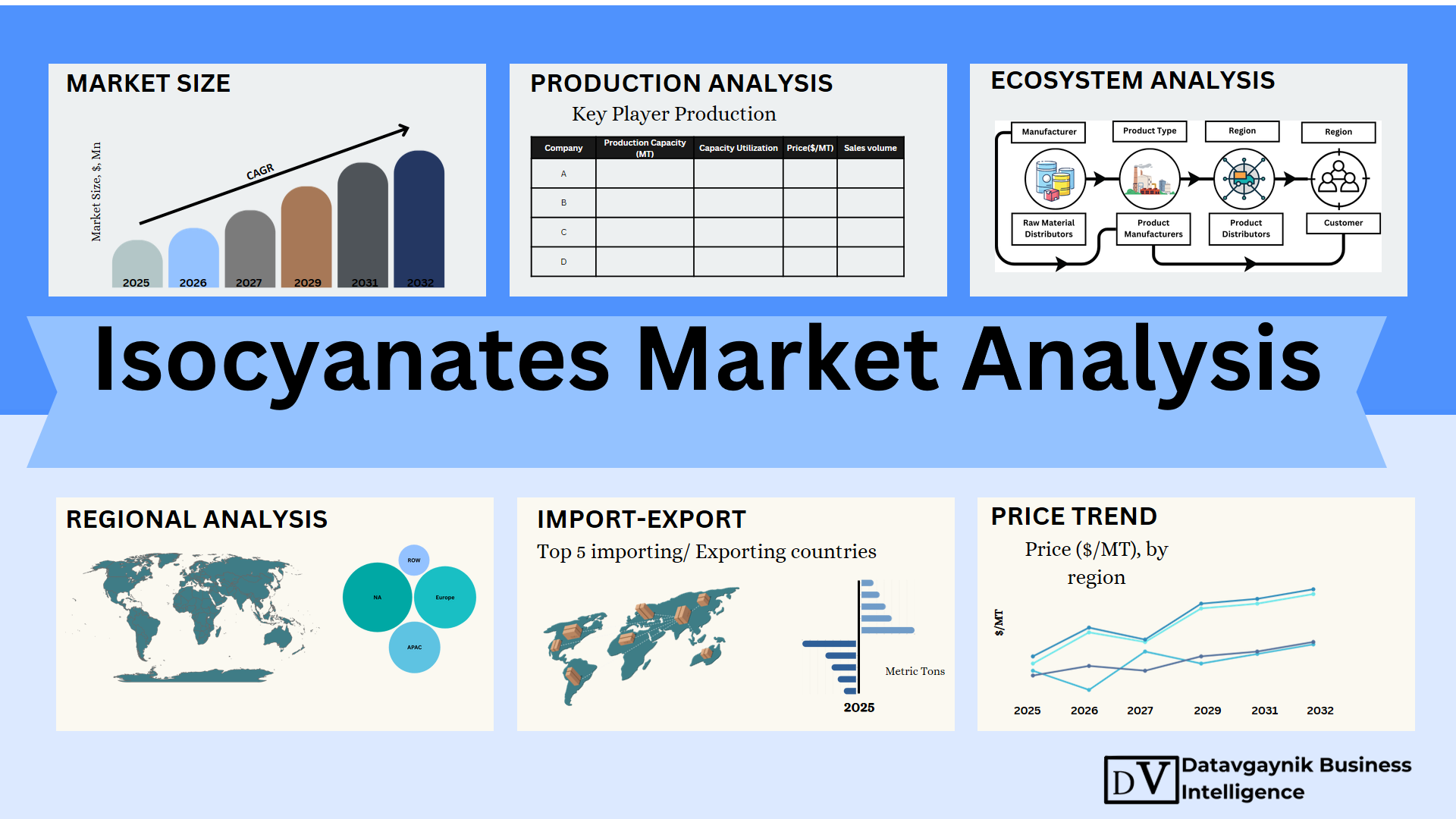
According to Datavagyanik, the isocyanates market size was valued at over USD 28 billion in 2023 and is projected to grow at a compound annual growth rate (CAGR) of 6.5 percent between 2024 and 2032. The expansion is fueled by diversified end-use sectors and increased application versatility. Market dynamics are further reinforced by innovations in formulation technologies, supply chain efficiencies, and the transition toward more sustainable chemical processes. Isocyanate producers are enhancing capacity utilization while exploring circular economy models, including the chemical recycling of polyurethane waste.
Technological Advancements Expand Application Horizons for the Isocyanates Market
Breakthroughs in isocyanate chemistry are expanding application areas in sectors such as aerospace, wind energy, and smart infrastructure. For instance, in the aerospace industry, polyurethane coatings based on aliphatic isocyanates are used for high-UV resistance and reduced drag surfaces. Similarly, wind turbine blades increasingly incorporate isocyanate-modified composite materials that offer strength and durability. The global renewable energy sector, expected to attract investments of over USD 2 trillion by 2030, presents a long-term opportunity for the isocyanates market in advanced material applications.
Isocyanates Market Maintains Momentum Amid Global Supply Chain Shifts
While the COVID-19 pandemic and geopolitical tensions have disrupted raw material supply chains, the isocyanates market has demonstrated resilience. Strategic partnerships between chemical producers and end-user industries have ensured steady supply and innovation. For example, companies are investing in backward integration to secure access to phosgene and aniline, key raw materials in isocyanate production. This move toward supply chain autonomy is enhancing stability and predictability across the isocyanates market.
Outlook: Rising Demand and Innovation Secure the Future of the Isocyanates Market
With increasing application diversity and technological adaptability, the isocyanates market is poised for sustained expansion. The convergence of megatrends such as urbanization, electric mobility, green construction, and digital infrastructure continues to shape market demand. According to Datavagyanik, the isocyanates market size is expected to exceed USD 47 billion by 2032, with Asia-Pacific leading the charge due to its unmatched manufacturing scale and consumption base. Manufacturers who align with sustainability standards and invest in next-gen formulations are likely to dominate this evolving landscape.
“Track Country-wise Isocyanates Production and Demand through our Isocyanates Production Database”
-
-
- Isocyanates production database for 30+ countries worldwide
- Isocyanates sales volume for 32+ countries
- Country-wise Isocyanates production capacity, production plant mapping, production capacity utilization for 30+ manufacturers
- Isocyanates production plants and production plant capacity analysis by top manufacturers
-
“Track real-time Isocyanates Prices, Isocyanates price charts for 30+ countries, Isocyanates weekly price tracker and Isocyanates monthly price tracker”
-
-
- Track real-time Isocyanates prices and Isocyanates price trend in 30+ countries though our excel-based Isocyanates price charts
- Real-time Isocyanates price tracker dashboard with 30+ countries
- Complete transparency on Isocyanates price trend through our Isocyanates monthly price tracker, Isocyanates weekly price tracker
-
Asia-Pacific Dominates Global Demand in the Isocyanates Market
The Asia-Pacific region continues to lead the global isocyanates market, accounting for more than 50 percent of global consumption in 2023. This dominance is attributed to rapid industrialization, population growth, and the robust expansion of the construction, automotive, and electronics sectors across countries such as China, India, Japan, and South Korea. For instance, China’s polyurethane production capacity exceeded 7 million tons in 2023, with over 65 percent attributed to domestic isocyanate demand in sectors ranging from infrastructure to consumer goods.
The Indian isocyanates market is also rapidly expanding, supported by strong growth in affordable housing and industrial development under initiatives like Smart Cities and Make in India. South Korea and Japan are investing heavily in automotive innovation and semiconductor manufacturing, both of which utilize isocyanate-based materials extensively.
North America Maintains Stable Growth Trajectory in the Isocyanates Market
The North American isocyanates market remains resilient, driven by technological advancements, sustainability initiatives, and a mature industrial base. The United States, in particular, has seen rising demand for MDI- and TDI-based products used in insulation, EV manufacturing, and medical applications. With electric vehicle sales in the U.S. growing at an annual rate of over 50 percent, the demand for polyurethane components is scaling rapidly. Furthermore, stringent energy efficiency regulations such as the IECC and California’s Title 24 have created strong momentum for isocyanate-based insulation foams in residential and commercial buildings. According to Datavagyanik, the North American isocyanates market is expected to exceed USD 9 billion by 2030, supported by increased R&D and a shift toward bio-based isocyanate solutions.
European Isocyanates Market Fueled by Sustainability Regulations and Advanced Manufacturing
Europe’s isocyanates market is characterized by a strong emphasis on environmental compliance, circular economy initiatives, and advanced material engineering. Countries like Germany, France, and the UK lead the regional demand due to their thriving automotive, aerospace, and green construction sectors. For example, Germany’s car production volume exceeded 3.7 million units in 2023, and the integration of lightweight isocyanate-derived composites is now standard in electric and hybrid vehicles. At the same time, EU regulations on volatile organic compounds (VOCs) have led to the development of low-emission isocyanate formulations. Datavagyanik confirms that nearly 25 percent of new isocyanate product launches in Europe are now bio-based or low-VOC, highlighting the region’s transformation.
Middle East Expands Its Footprint in the Global Isocyanates Market
The Middle East is emerging as a strategic market for isocyanates, particularly in countries like Saudi Arabia, the United Arab Emirates, and Qatar. Mega infrastructure projects such as NEOM and Expo City Dubai are creating significant demand for rigid polyurethane foams, used in energy-efficient building insulation. Moreover, the region’s petrochemical industry plays a crucial role in the backward integration of isocyanate production. For instance, Saudi Arabia’s SABIC and Sadara have scaled up local MDI production, reducing dependence on imports. As a result, the isocyanates market in the Middle East is not only a major consumer but is beginning to shape into a notable producer region as well.
South America and Africa Present Emerging Growth Frontiers for the Isocyanates Market
Though smaller in volume, South America and Africa are poised for accelerated growth in the isocyanates market. Countries like Brazil, Chile, South Africa, and Nigeria are experiencing rapid urbanization, driving investments in residential construction and industrial zones. For instance, Brazil’s construction sector grew by 6.2 percent in 2023 alone, significantly increasing demand for isocyanate-based insulation and coatings. In Africa, infrastructure development and growing automotive imports are also supporting market expansion. These emerging economies represent untapped potential for isocyanate manufacturers aiming to diversify their global footprint.
Global Production Hubs Reshape Isocyanates Market Supply Chains
Isocyanate production remains highly concentrated, with China, the United States, Germany, and South Korea leading the global output. China’s large-scale manufacturing complexes benefit from integrated supply chains, enabling cost-effective and high-volume MDI and TDI production. For instance, Wanhua Chemical, the world’s largest MDI producer, accounted for over 25 percent of global capacity in 2023. In the U.S., production is supported by major players such as BASF, Covestro, and Huntsman, who are also investing in bio-based and specialty isocyanate R&D.
Germany and South Korea, meanwhile, focus on high-purity isocyanates used in specialty coatings and electronics applications. According to Datavagyanik, global production capacity for isocyanates exceeded 11 million tons in 2023, with more than 70 percent consumed domestically by the top five producer countries.
Isocyanates Market Segmentation Shows Increasing Diversification
The isocyanates market is segmented by type, application, formulation, and end-use industry. Among types, methylene diphenyl diisocyanate (MDI) leads with over 60 percent market share due to its widespread use in rigid foams. Toluene diisocyanate (TDI) holds a significant position in flexible foam applications for bedding, seating, and automotive interiors. Aliphatic isocyanates, although smaller in volume, are growing rapidly in high-performance coatings and electronics due to their UV stability and non-yellowing properties.
By application, polyurethane foams dominate the market, accounting for approximately 75 percent of total isocyanate usage. Rigid foams, used in construction and cold-chain logistics, are growing at a CAGR of 6.8 percent, while flexible foams in furniture and bedding maintain steady demand. The CASE segment—coatings, adhesives, sealants, and elastomers—is expanding its share, driven by demand for durable surface protection and high-performance bonding solutions. In terms of formulation, polymeric MDI (pMDI) is gaining traction due to its superior strength and low-viscosity characteristics.
Automotive, Construction, and Electronics Remain Key End-Use Verticals in the Isocyanates Market
The construction industry remains the largest consumer of isocyanates, with demand linked directly to energy efficiency standards and insulation needs. In 2023, global building floor area exceeded 260 billion square meters, and nearly 40 percent of new builds incorporated polyurethane-based thermal insulation. The automotive industry is the second-largest consumer, where isocyanates contribute to weight reduction, comfort, and soundproofing. For example, a mid-size EV uses over 20 kilograms of polyurethane materials, much of which is derived from isocyanates. Electronics, healthcare, and packaging represent high-growth application segments, each with unique demands for tailored isocyanate formulations.
Volatility in Raw Materials Impacts Isocyanates Price and Supply Chain Planning
Isocyanates price trends have shown significant volatility over the past three years due to fluctuations in raw material costs, logistical disruptions, and regulatory pressures. Key precursors such as aniline and phosgene are subject to global supply-demand dynamics and environmental compliance challenges. For example, during 2021-2022, isocyanates price levels for MDI increased by more than 40 percent in North America due to constrained supply and a sharp rise in energy costs. Datavagyanik notes that while prices stabilized in 2023, they remain sensitive to oil price swings and transportation costs.
Regional Isocyanates Price Trends Reflect Local Supply Chain Dynamics
In Asia-Pacific, isocyanates price trends remain competitive due to large-scale integrated production and lower labor costs. However, temporary plant shutdowns in China during environmental audits have occasionally spiked local prices. In Europe, stringent REACH regulations and energy inflation have pushed up isocyanates price points, especially for low-VOC and specialty variants. North America has shown a moderate upward price trend due to rising demand for advanced polyurethane products and domestic transport costs. Meanwhile, import-reliant regions like Africa and South America face elevated isocyanates price levels due to shipping costs and currency fluctuations.
Shift Toward Bio-Based Materials Begins to Influence Isocyanates Price Trend
The growing interest in sustainability is reshaping the long-term isocyanates price trend. Bio-based isocyanates, while currently priced 20–30 percent higher than conventional variants, are gaining traction due to regulatory incentives and consumer preference for green materials. For instance, polyurethane foams made from bio-MDI are now being piloted in automotive and medical applications. As production scales up and process efficiencies improve, the price differential is expected to narrow, potentially reshaping competitiveness in the isocyanates market.
Future Isocyanates Price Outlook Tied to Feedstock Innovation and Localization
Datavagyanik forecasts that future isocyanates price stability will depend on innovations in feedstock utilization and regionalization of production. Novel production routes using CO2, biomass, and alternative diisocyanate precursors are under development, aiming to reduce environmental impact and cost variability. Moreover, new capacity additions in Southeast Asia, India, and the Middle East are expected to reduce import dependency and balance regional supply chains. These developments are likely to smoothen the isocyanates price trend curve and enhance predictability for manufacturers and end-users alike.
Conclusion: Geographical Diversification and Innovation Drive the Isocyanates Market Forward
The global isocyanates market is undergoing a dynamic transformation driven by regional growth patterns, regulatory evolution, and technological advancements. Asia-Pacific remains the epicenter of demand and production, while Europe leads in sustainability innovation. North America balances scale with specialty applications, and the Middle East is developing as a production hub. With pricing volatility becoming a critical consideration, stakeholders are adapting through feedstock diversification, supply chain localization, and investment in bio-based alternatives. As Datavagyanik outlines, the isocyanates market will continue to evolve as industries align with performance, cost-efficiency, and environmental responsibility.
“Isocyanates Manufacturing Database, Isocyanates Manufacturing Capacity”
-
-
- Isocyanates top manufacturers market share for 30+ manufacturers
- Top 8 manufacturers and top 18 manufacturers of Isocyanates in North America, Europe, Asia Pacific
- Isocyanates production plant capacity by manufacturers and Isocyanates production data for 30+ market players
- Isocyanates production dashboard, Isocyanates production data in excel format
-
“Isocyanates price charts, Isocyanates weekly price tracker and Isocyanates monthly price tracker”
-
-
- Factors impacting real-time Isocyanates prices in 24+ countries worldwide
- Isocyanates monthly price tracker, Isocyanates weekly price tracker
- Real-time Isocyanates price trend, Isocyanates price charts, news and updates
- Tracking Isocyanates price fluctuations
-
Top Manufacturers Driving Global Competitiveness in the Isocyanates Market
The isocyanates market is shaped by a concentrated group of multinational chemical giants with vertically integrated operations, wide product portfolios, and strong global distribution networks. These companies dominate the value chain from feedstock procurement to isocyanate synthesis, and ultimately to end-use product applications in sectors such as construction, automotive, electronics, and healthcare.
Wanhua Chemical Group
Wanhua Chemical is the undisputed global leader in the isocyanates market. Based in China, it has grown to command more than 25 percent of the global market share for methylene diphenyl diisocyanate (MDI). Its Yantai Industrial Park hosts one of the world’s largest MDI production capacities, with a combined output exceeding 3 million tons annually. Wanhua’s product lines include WANNATE® MDI and modified polyisocyanates tailored for polyurethane foams, CASE applications, and specialty coatings. The company’s aggressive capacity expansion plans in Asia and Eastern Europe continue to reinforce its global leadership position in the isocyanates market.
BASF SE
BASF holds a significant position in both MDI and toluene diisocyanate (TDI) markets, contributing roughly 12 to 14 percent of global supply. Its Lupranate® series includes aromatic diisocyanates for flexible foams and high-performance coatings, adhesives, and sealants. BASF also produces polyether polyols that complement its isocyanate offerings, creating a fully integrated polyurethane solutions ecosystem. The company’s facilities in Ludwigshafen (Germany), Geismar (USA), and Caojing (China) serve key global regions, ensuring reliable supply for a diverse customer base. BASF’s innovations in low-emission and bio-based isocyanates underscore its shift toward sustainable manufacturing practices.
Covestro AG
Spun off from Bayer, Covestro is a dominant player in both MDI and TDI segments with around 10 percent of the global isocyanates market share. The company markets its isocyanates under the Desmodur® brand, known for their high-quality and application-specific performance. Covestro operates major production hubs in Dormagen (Germany), Shanghai (China), and Baytown (USA), providing robust global reach. The company is investing in CO₂-based isocyanate intermediates and pursuing climate-neutral product lines under its long-term circular economy strategy, aligning its operations with changing regulatory and market demands.
Huntsman Corporation
Huntsman is a key MDI supplier, with production assets in the U.S., Netherlands, and China. It holds an estimated 8 percent of the global market share in isocyanates. Under the Rubinate® brand, Huntsman offers a broad portfolio of MDI products for insulation foams, composite materials, automotive seating, and spray polyurethane systems. The company has emphasized the development of low-VOC MDI blends and systems for energy-efficient construction applications, particularly in North America and Europe, positioning itself as a sustainability-focused manufacturer within the isocyanates market.
Mitsui Chemicals
Mitsui Chemicals maintains a strong presence in the Asia-Pacific region, especially Japan and Southeast Asia. The company offers both MDI and TDI under its Milionate® brand. Its portfolio includes high-purity isocyanates tailored for optical lenses, electronic encapsulation, and specialty adhesives. Although Mitsui’s global market share is smaller, typically in the 3 to 4 percent range, its focus on high-end, high-margin applications makes it a strategic player, particularly in specialty isocyanate markets.
Tosoh Corporation
Tosoh Corporation is another notable Japanese player, primarily focused on TDI production. Its TDI products are used in furniture, automotive cushions, and bedding applications. The company’s facility in Nanyo, Japan, produces both standard and modified TDI grades, enabling it to serve export markets in Asia and North America. With approximately 2 to 3 percent share in the global isocyanates market, Tosoh contributes significantly to maintaining regional supply security in high-demand consumer foam markets.
KPX Chemical
Based in South Korea, KPX Chemical supplies both TDI and MDI products for use in foams and CASE applications. It has been scaling up its production facilities and diversifying into prepolymers and polyol systems to provide integrated solutions to manufacturers. KPX plays a growing role in the regional isocyanates market, particularly with the demand uptick in electronics and EV components across Asia.
Vibrant Regional and Niche Players
Apart from these dominant multinationals, several regional producers in India, Southeast Asia, Eastern Europe, and the Middle East are entering the isocyanates market with focused production capabilities. Companies such as GNFC (India), Sadara (Saudi Arabia), and Shanghai Lianheng (China) are investing in plant expansions and process improvements to meet local demand and reduce dependence on imports.
Isocyanates Market Share by Manufacturer Indicates High Concentration
The top five manufacturers—Wanhua Chemical, BASF, Covestro, Huntsman, and Mitsui Chemicals—control nearly 60 percent of the total isocyanates market. This concentration provides them with strong pricing power and resilience in supply chain disruptions. However, the remainder of the market is relatively fragmented, with smaller players catering to niche applications or regional markets. The consolidation trend continues, with leading firms investing in strategic acquisitions and joint ventures to expand capacity and access new geographies.
Product Differentiation and Innovation Becoming Key Competitive Advantages
As the isocyanates market matures, product differentiation has emerged as a key strategy among top manufacturers. For example, low-VOC isocyanates for indoor applications, bio-based variants, and smart polyurethane systems integrated with sensors are seeing increased R&D investment. These innovations not only support sustainability goals but also enable premium pricing strategies. Covestro and BASF are at the forefront of these product innovations, closely followed by Huntsman and Wanhua, which are adapting technologies for high-performance applications in aerospace, wind energy, and medical devices.
Recent Developments and Strategic Moves in the Isocyanates Market
- In January 2024, Wanhua Chemical announced the commissioning of a new 600,000-ton MDI production unit in Yantai, aimed at strengthening its leadership in Asia-Pacific and enhancing export capacity to Europe and Latin America.
- BASF began pilot production of its new low-carbon MDI formulation in October 2023 at its Ludwigshafen site, targeting applications in green construction and climate-controlled logistics.
- Covestro signed a strategic agreement in March 2024 with a leading auto OEM to co-develop bio-based Desmodur® systems for use in EV interiors, scheduled for mass deployment by 2026.
- In July 2023, Huntsman completed an expansion of its spray foam systems facility in Texas, doubling its capacity to meet growing demand in residential retrofitting and weatherization programs in North America.
- Mitsui Chemicals announced in February 2024 that it has developed a new grade of Milionate® MDI with superior UV resistance for solar panel encapsulation, opening a new application vertical for the isocyanates market.
These developments reflect how manufacturers are actively reshaping their portfolios to align with emerging trends in circular economy, electrification, and next-gen materials.
“Isocyanates Production Data and Isocyanates Production Trend, Isocyanates Production Database and forecast”
-
-
- Isocyanates production database for historical years, 10 years historical data
- Isocyanates production data and forecast for next 7 years
- Isocyanates sales volume by manufacturers
-
“Track Real-time Isocyanates Prices for purchase and sales contracts, Isocyanates price charts, Isocyanates weekly price tracker and Isocyanates monthly price tracker”
-
-
- Gain control on your purchase and sales contracts through our real-time Isocyanates price tracker and Isocyanates price trend analysis
- Isocyanates weekly price tracker and forecast for next four weeks
- Isocyanates monthly price tracker and forecast for next two months
-
Market Scenario, Demand vs Supply, Average Product Price, Import vs Export, till 2035
- Global Isocyanates Market revenue and demand by region
- Global Isocyanates Market production and sales volume
- United States Isocyanates Market revenue size and demand by country
- Europe Isocyanates Market revenue size and demand by country
- Asia Pacific Isocyanates Market revenue size and demand by country
- Middle East & Africa Isocyanates Market revenue size and demand by country
- Latin America Isocyanates Market revenue size and demand by
- Import-export scenario – United States, Europe, APAC, Latin America, Middle East & Africa
- Average product price – United States, Europe, APAC, Latin America, Middle East & Africa
- Market player analysis, competitive scenario, market share analysis
- Business opportunity analysis
Key questions answered in the Global Isocyanates Market Analysis Report:
- What is the market size for Isocyanates in United States, Europe, APAC, Middle East & Africa, Latin America?
- What is the yearly sales volume of Isocyanates and how is the demand rising?
- Who are the top market players by market share, in each product segment?
- Which is the fastest growing business/ product segment?
- What should be the business strategies and Go to Market strategies?
The report covers Isocyanates Market revenue, Production, Sales volume, by regions, (further split into countries):
- Asia Pacific (China, Japan, South Korea, India, Indonesia, Vietnam, Rest of APAC)
- Europe (UK, Germany, France, Italy, Spain, Benelux, Poland, Rest of Europe)
- North America (United States, Canada, Mexico)
- Latin America (Brazil, Argentina, Rest of Latin America)
- Middle East & Africa
Table of Contents:
- Executive Summary
1 Overview of the Sulfur Donors Market
1.2 Key Findings and Strategic Insights
1.3 Market Attractiveness by Region - Introduction to Sulfur Donors
1 Definition and Chemical Properties
2.2 Applications Across Industries
2.3 Evolution of Sulfur Donors in the Global Market - Global Market Landscape
1 Market Value and Volume Analysis
3.2 Key Trends Shaping the Market
3.3 Opportunities for Stakeholders - Product Segmentation and Analysis
1 Classification of Sulfur Donors
4.2 Application-Specific Products
4.3 Performance Comparison Across Categories - Market Demand Drivers
1 Industrial Applications and Use Cases
5.2 Technological Advancements in Sulfur Donors
5.3 Sustainability and Environmental Considerations - Regional Market Performance
1 North America: Market Overview and Key Trends
6.2 Europe: Regulatory Landscape and Demand Drivers
6.3 Asia-Pacific: Growth Hotspots and Emerging Players
6.4 Latin America: Opportunities and Challenges
6.5 Middle East & Africa: Key Market Insights - Production and Supply Chain Analysis
1 Global Production Capacities and Locations
7.2 Supply Chain Dynamics and Challenges
7.3 Raw Material Sourcing and Cost Analysis - Trade and Distribution Network
1 Export and Import Patterns
8.2 Key Trade Agreements Impacting the Market
8.3 Distributor and Reseller Insights - Market Competition Analysis
1 Leading Players and Market Share
9.2 Recent Developments and Strategic Initiatives
9.3 Competitive Advantage Analysis - Cost Structure and Pricing Dynamics
1 Manufacturing Cost Breakdown
10.2 Regional Pricing Trends
10.3 Margins and Profitability Analysis - End-Use and Application Insights
1 Industrial Applications Overview
11.2 Sector-Specific Demand Analysis
11.3 Emerging Applications - Market Dynamics and Challenges
1 Growth Drivers
12.2 Market Restraints and Challenges
12.3 Opportunities in Emerging Markets - Regulatory and Environmental Impact
1 Industry Regulations by Region
13.2 Compliance and Sustainability Practices - Technological Advancements in Sulfur Donors
1 Innovations in Manufacturing Processes
14.2 Development of New Applications
14.3 Role of R&D in Market Growth - Future Outlook and Forecast (2025-2035)
1 Demand and Supply Projections
15.2 Key Growth Areas by Region
15.3 Strategic Recommendations for Market Participants - Appendices
1 Glossary of Key Terms
16.2 List of Major Market Participants
16.3 Research Methodology

