

Market Summary and Growth Forecast
The global Isosorbide (Bio-based) Market is estimated at US$186 million in 2026 and is expected to reach US$421 million by 2035, growing at a CAGR of 9.5%.
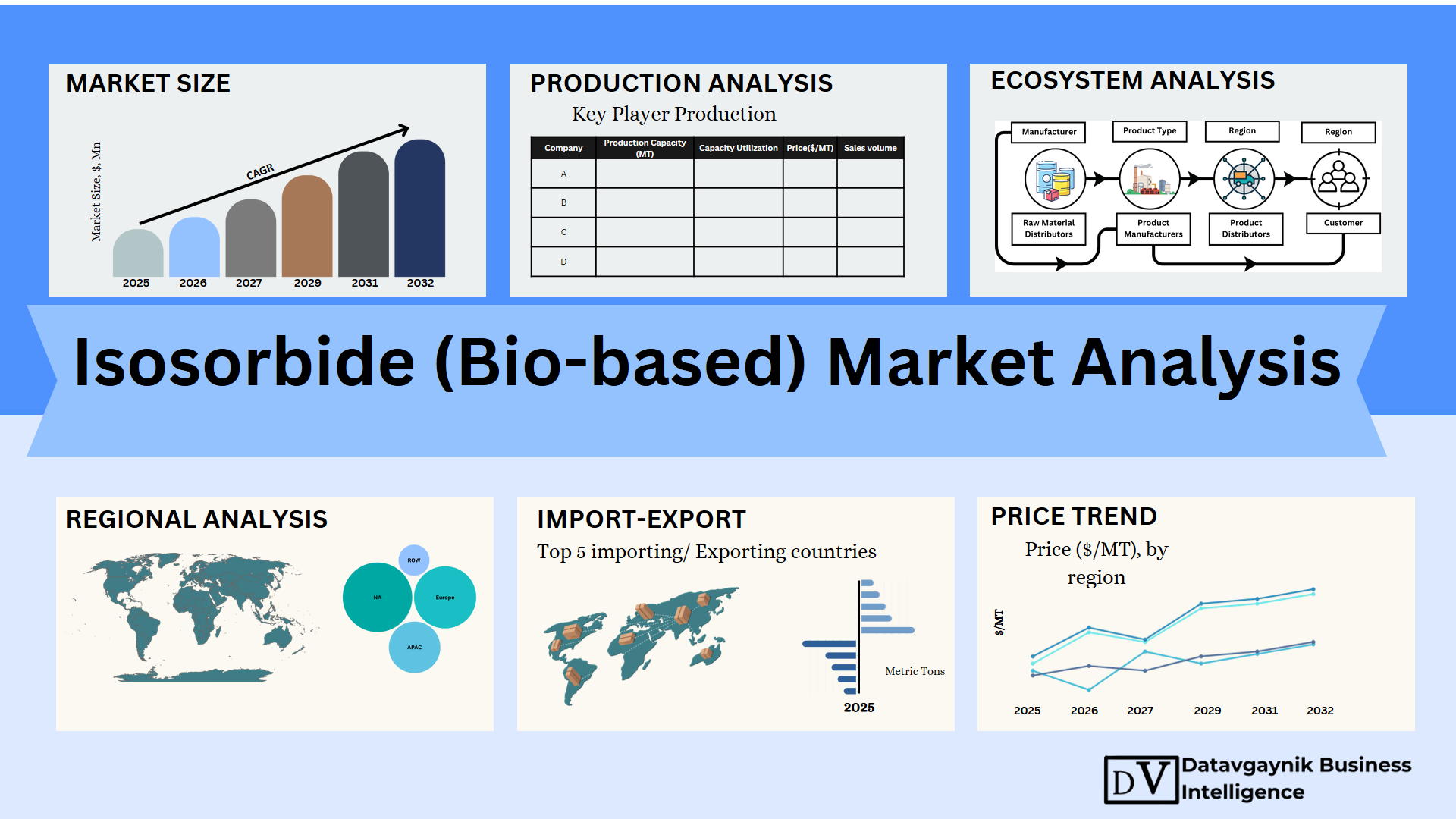
Isosorbide is a bio-based platform chemical derived mainly from sorbitol, which is produced from glucose and starch-based feedstocks. In business terms, it sits at the intersection of renewable chemistry, high-performance polymers, specialty resins, and lower-carbon material substitution. The compound is not a bulk commodity. It is a specialty intermediate. That makes the market smaller in volume but strategically important for companies trying to reduce fossil-based inputs without giving up performance.
The Isosorbide (Bio-based) Market in 2026 is still shaped by early commercial adoption rather than mass-scale replacement. Most demand comes from polyesters, polycarbonates, polyurethane systems, epoxy modifiers, plasticizers, and selected pharmaceutical or personal care applications. The value proposition is clear. Isosorbide can improve glass transition temperature, rigidity, transparency, thermal resistance, and bio-content in downstream materials. That is why polymer producers, resin formulators, packaging companies, electronics material suppliers, coating manufacturers, and pharmaceutical ingredient companies are watching this space closely.
The next phase of growth will not come from one single application. It will come from a wider shift in procurement behavior. Large consumer goods companies are asking suppliers to reduce petrochemical dependency. Automotive and electronics brands are testing bio-based engineering plastics. Packaging converters are looking for recyclable and lower-carbon materials. Coating and adhesive formulators are under pressure to improve sustainability claims without weakening product performance. This creates a practical growth runway for isosorbide-based chemistry.
Production economics remain the main gating factor. Isosorbide requires controlled dehydration of sorbitol, followed by purification. High-purity grades are more expensive because color, residual sugars, thermal stability, and moisture control matter in polymer applications. So, scale-up is not just about adding capacity. It is about consistent quality. Producers with integrated access to sorbitol, glucose, starch processing, or advanced purification technology have a better cost position.
Regulation is also helping, though indirectly. Policies around plastic circularity, carbon disclosure, renewable content, and safer chemical substitution are pushing material buyers toward bio-based intermediates. Europe is the strongest regulatory pull market. North America is more demand-led through brand commitments and specialty polymer innovation. Asia Pacific has the larger manufacturing base, especially in chemicals, packaging, electronics, and textiles. China, Japan, and South Korea are important because they combine polymer production with downstream material innovation.
That said, isosorbide will not replace conventional petrochemical intermediates overnight. Price premiums still matter. Qualification cycles are slow in food packaging, automotive, electronics, and medical-related materials. Buyers need proof on processing behavior, mechanical performance, migration, regulatory compliance, and long-term stability. This keeps adoption disciplined. It also makes the market more defensible once applications are approved.
| Metric | Estimate / Outlook |
| Global market size, 2026 | US$186 million |
| Projected market size, 2035 | US$421 million |
| Forecast CAGR, 2026–2035 | 9.5% |
| Estimated global demand, 2026 | 28–32 kilotons |
| Estimated global demand, 2035 | 62–70 kilotons |
| Primary revenue base | Polymer intermediates, resins, coatings, plasticizers, pharmaceuticals, personal care ingredients |
| Most active adoption regions | Europe, North America, China, Japan, South Korea |
Key consumers in the market include specialty polymer manufacturers, bio-based resin producers, packaging material companies, coating and adhesive formulators, engineering plastic compounders, pharmaceutical excipient or intermediate buyers, and personal care ingredient suppliers. Client groups typically include chemical producers, polymer converters, sustainable packaging companies, automotive material teams, electronics component suppliers, and large consumer goods brands with renewable-content targets.
Expert view: The most attractive part of the market is not basic chemical supply. It is application-qualified isosorbide chemistry. Suppliers that can support formulation trials, polymer performance testing, and regulatory documentation will capture better margins than those selling only standard intermediate grades.
By 2035, the market should be larger, more application-specific, and more regionalized. Europe will remain the reference market for sustainability-led adoption. Asia Pacific will become the production and conversion center. North America will continue to support premium use cases in packaging, coatings, and specialty polymers. So, the commercial story is not just “bio-based.” It is about whether isosorbide can deliver performance that buyers are willing to pay for.
Competitive Intelligence and Benchmarking
The Isosorbide (Bio-based) Market is not crowded in the way commodity chemical markets are. It has a narrow supplier base, a limited number of high-purity monomer producers, and a wider ecosystem of resin developers, polyol suppliers, distributors, and specialty chemical players. This structure gives early movers a real advantage. Buyers do not only look for price. They also look for purity, color stability, feedstock traceability, polymerization performance, and technical support.
| Company | Core Role in the Market | Estimated Positioning | Business Relevance |
| Roquette Frères | High-purity bio-based isosorbide producer | Global leader | Strongest integrated position across starch, sorbitol, and certified plant-based monomer supply |
| Samyang Innochem | Bio-based isosorbide and derivatives | Asia-focused challenger | Builds regional supply strength for bio-polycarbonate, bio-polyester, and bio-PU applications |
| Mitsubishi Chemical Group | Isosorbide-based engineering plastic developer | Downstream innovation leader | Drives demand through automotive, optics, electronics, and design-led resin applications |
| SK Chemicals | Bio-copolyester and green materials platform | Strategic resin converter | Uses renewable inputs in high-performance copolyester and circular material programs |
| ADM | Sorbitol and plant-derived polyol supplier | Upstream feedstock enabler | Supports North American renewable intermediate supply through starch-based polyol chemistry |
| Cargill | Glucose, sorbitol, and bioindustrial feedstock platform | Upstream ecosystem player | Strong in renewable carbohydrate streams used by chemical and industrial processors |
| Novaphene Specialities | Specialty isosorbide grades and derivatives | Niche emerging-market supplier | Relevant for India-linked specialty chemicals, cosmetics, and intermediate demand |
Roquette Frères holds the clearest leadership position. The company benefits from its starch-processing base, European manufacturing footprint, and direct access to sorbitol chemistry. Its isosorbide portfolio is positioned for polymers, coatings, polyurethanes, plasticizers, packaging materials, and specialty applications. The real strength is consistency. Polymer-grade isosorbide needs high purity and low color. That is where established process control becomes a commercial advantage.
Samyang Innochem is the most important Asian direct producer. Its market role is different from Roquette. It is not just selling a renewable intermediate. It is building a Korean bio-material chain around isosorbide-based polycarbonate, polyester, polyurethane, and derivative chemistry. This matters because Asia Pacific is where a large share of polymer conversion, electronics materials, packaging, and automotive components are manufactured. Samyang’s position gives South Korea a local supply base in a market that was earlier highly Europe-led.
Mitsubishi Chemical Group is more of a demand creator than a merchant monomer supplier. Its bio-based engineering plastic platform uses plant-derived isosorbide to deliver transparency, scratch resistance, optical quality, and weather resistance. That makes the company highly relevant in automotive trims, lighting components, optical films, electronic housings, and premium design parts. Its position shows where the market is heading. Value will sit in qualified applications, not only in raw monomer sales.
SK Chemicals sits in the downstream conversion layer. The company’s green materials portfolio is important because bio-copolyesters and circular polymers are natural demand outlets for renewable diols. SK’s role is strongest in Asia, where brand owners need polymers that combine processability, transparency, durability, and sustainability claims. It may not control the whole isosorbide value chain, but it helps scale end-use adoption.
ADM and Cargill should be viewed as upstream enablers. They are not the headline names in isosorbide monomer supply. Still, their role matters because sorbitol economics strongly influence isosorbide production cost. Both companies have deep positions in glucose, starch derivatives, and plant-derived polyols. If isosorbide demand scales in North America, upstream carbohydrate and sorbitol availability will become more important.
Novaphene Specialities represents the smaller but relevant emerging-market layer. Its role is more niche. It serves specialty chemical, personal care, and intermediate-grade demand rather than large-volume engineering plastic markets. That said, India’s specialty chemical base is growing. Local or regional suppliers could gain from pharma intermediates, cosmetic solvents, dimethyl isosorbide derivatives, and customized grades.
Expert view: The competitive edge will not come from announcing “bio-based” chemistry. It will come from application proof. Suppliers that can help customers qualify isosorbide in polycarbonates, coatings, films, adhesives, and personal care systems will defend pricing better than suppliers selling undifferentiated product.
The market is therefore split into three competitive layers. The first layer is high-purity monomer producers. The second is resin and material developers. The third is feedstock and derivative suppliers. For investors and clients, this is important. The most attractive opportunities may sit in integrated partnerships between these layers rather than in standalone chemical trading.
Regional Landscape and Adoption Outlook
Regional adoption in the Isosorbide (Bio-based) Market follows a clear pattern. Europe leads on regulation and certified sustainable materials. Asia Pacific leads on conversion capacity and downstream manufacturing. North America has strong feedstock depth and premium application development. India is still small but can scale in specialty chemicals and personal care derivatives.
| Region / Country | Estimated Market Size, 2026 | Projected Market Size, 2035 | Estimated CAGR, 2026–2035 | Adoption Character |
| United States | US$35 million | US$78 million | 9.3% | Feedstock-backed demand in specialty polymers, coatings, packaging, and pharma-linked uses |
| Europe | US$59 million | US$125 million | 8.7% | Regulation-led adoption with strong supplier and sustainability certification base |
| China | US$32 million | US$83 million | 11.2% | Fast conversion growth across packaging, electronics, coatings, and polymer modification |
| India | US$7 million | US$20 million | 12.4% | Small base but rising specialty chemical, personal care, and pharma intermediate demand |
| Japan | US$22 million | US$45 million | 8.3% | High-value use in automotive, electronics, optics, and engineering plastics |
| South Korea | US$16 million | US$42 million | 11.3% | Strong domestic material innovation around bio-polycarbonate and bio-copolyester |
| Rest of World / Middle East | US$15 million | US$28 million | 7.2% | Limited direct adoption; potential in packaging, coatings, and chemical diversification |
United States
The United States market is led by formulation demand rather than direct isosorbide manufacturing scale. The country has strong upstream carbohydrate and sorbitol infrastructure through large agricultural processors. That helps feedstock availability. Adoption is more visible in specialty polymers, industrial coatings, adhesives, packaging materials, pharmaceuticals, and personal care ingredients.
The U.S. also has a strong innovation base. Material companies and consumer brands are actively testing lower-carbon alternatives. However, the market remains price-sensitive. Most buyers still ask a practical question: does isosorbide improve performance enough to justify the cost? In premium coatings, optical polymers, and regulated formulations, the answer is increasingly yes.
Europe
Europe remains the reference market. France is important because of Roquette’s production base and wider starch-processing ecosystem. Germany, the Netherlands, Belgium, and Italy are important because of polymer processing, coatings, packaging, automotive materials, and specialty chemicals. The EU policy environment favors renewable feedstocks, lower-carbon materials, and tighter packaging rules. This creates a supportive demand backdrop.
That said, European growth is not the fastest. It is already more mature than India or China. The region’s strength is not just volume. It is validation. If a grade gains acceptance in Europe, it often becomes easier to market it globally.
China
China is one of the strongest growth markets through 2035. Demand is tied to packaging films, consumer electronics, coatings, adhesives, and engineering plastics. The country has a large chemical conversion base. It also has strong downstream customers in electronics, appliances, automotive interiors, and packaging.
The challenge is quality consistency. High-purity polymer-grade isosorbide is harder to produce than standard chemical intermediates. This means China may grow both as a demand center and as a future supply competitor. Local producers will likely focus on cost reduction. Imported high-purity grades may still serve premium applications.
India
India is a small market in 2026, but it should not be ignored. The opportunity is not bulk polymer demand yet. It is specialty chemicals, pharma intermediates, cosmetics, personal care solvents, and niche bio-based derivatives. Gujarat and Maharashtra are the most relevant industrial bases due to their chemical manufacturing clusters.
India’s growth will depend on two things. First, whether local specialty chemical players develop consistent isosorbide and derivative grades. Second, whether personal care and pharma customers adopt bio-based solvent and intermediate systems. Packaging and polymers may come later as scale improves.
Japan
Japan is a high-value adoption market. The country’s strength lies in automotive materials, electronics, optics, and precision polymer engineering. Mitsubishi Chemical Group has been central in building commercial use cases for isosorbide-based engineering plastics. Demand is not volume-heavy. It is specification-heavy. That means margins can be better where materials are qualified.
Japan is also relevant for design-led applications. Transparent trims, optical films, display components, lighting systems, and coated or coating-free automotive parts are logical use cases.
South Korea
South Korea is one of the most strategically important markets in Asia. Samyang Innochem gives the country a local isosorbide production base. SK Chemicals adds downstream polymer and green material capability. The country also has large electronics, automotive, packaging, and consumer goods industries. This creates a strong domestic testing ground.
Growth in South Korea should be faster than Japan because the market is still scaling. It also has a clearer link between local feedstock conversion, high-performance materials, and export-oriented manufacturing.
Middle East
The Middle East is relevant only in a limited way for now. It is not a major isosorbide demand center in 2026. However, Saudi Arabia and the UAE are investing in downstream chemicals, specialty materials, and industrial diversification. Over time, bio-based intermediates may enter packaging, coatings, and consumer goods supply chains. Still, the region should be treated as a secondary opportunity, not a core forecast engine.
Expert view: Europe will set the sustainability benchmark. Asia will decide the scale. North America will support premium application development. India may become relevant through derivatives before it becomes relevant through large-volume polymers.
Recent Developments + Opportunities & Restraints
Recent Developments
| Year / Month | Event | Market Impact |
| 2026 – January | Mitsubishi Chemical Group announced that its plant-derived isosorbide-based engineering plastic was adopted for AI speaker components in Dongfeng Nissan’s Teana in China. | Shows that isosorbide-based polymers are moving into automotive interiors where transparency, light effects, durability, and premium design matter. |
| 2025 – December | Mitsubishi Chemical Group announced adoption of its isosorbide-based engineering plastic for Honda’s N-ONE e: mini passenger EV. | Supports the case for wider automotive use, especially where coating reduction, surface finish, and VOC reduction are valued. |
| 2025 – June | USDA Rural Development issued the BioPreferred Program streamlining update, simplifying key biobased product processes. | Strengthens the policy environment for certified biobased materials and may support procurement visibility for renewable chemical products in the U.S. |
| 2025 – February | The EU Packaging and Packaging Waste Regulation entered into force, with general application from August 2026. | Adds pressure on packaging material suppliers to improve circularity, reduce virgin resource use, and evaluate lower-carbon material options. |
| 2026 – April | Roquette reported additional ISCC PLUS certifications for plant-based products and highlighted that certification was already in place for its isosorbide site in France. | Reinforces the value of certified renewable feedstock chains for packaging, consumer goods, and industrial chemical buyers. |
Opportunities & Business Insights
- Emerging markets can grow through derivatives first
India, China, and selected Southeast Asian markets may not immediately consume large volumes of polymer-grade isosorbide. But they can grow through dimethyl isosorbide, cosmetic solvents, pharma intermediates, coating modifiers, and specialty derivatives. This is a practical route. It needs lower volume but can support better margins.
- Automotive and electronics can become premium demand anchors
Automotive interiors, optical films, lighting covers, display components, and electronic housings are attractive use cases. These buyers care about performance. They need transparency, scratch resistance, low yellowing, heat stability, and design flexibility. Isosorbide-based polymers can fit this premium material logic.
- Process automation can improve cost and consistency
AI is not a direct demand driver for isosorbide. But automation, process analytics, and digital formulation tools can still help the market. Producers can use advanced process control to improve dehydration yield, reduce color variation, and manage purity. Resin developers can use digital screening to shorten formulation cycles. This may lead to faster customer qualification.
Restraints
- Price premium versus petrochemical alternatives
Isosorbide still carries a cost premium over many conventional diols and petrochemical intermediates. This limits adoption in price-sensitive packaging and commodity resin applications.
- Slow qualification cycles
Food contact materials, automotive parts, electronics, medical-related polymers, and personal care ingredients all require testing. Migration, stability, processing, safety, color, odor, and long-term performance can slow commercialization.
- Limited high-purity supply base
The market depends on a small number of credible suppliers. Any disruption in sorbitol supply, purification capacity, energy cost, or certification status can affect availability and pricing.
Expert view: The strongest opportunity is not broad replacement of petrochemicals. It is targeted substitution where isosorbide improves both sustainability and performance. That is where buyers will pay.


