

Market Summary and Growth Forecast
The global Levulinic Acid Market is valued at $80 million in 2026 and is expected to appreciate to $157 million by 2035, at a CAGR of 7.8%.
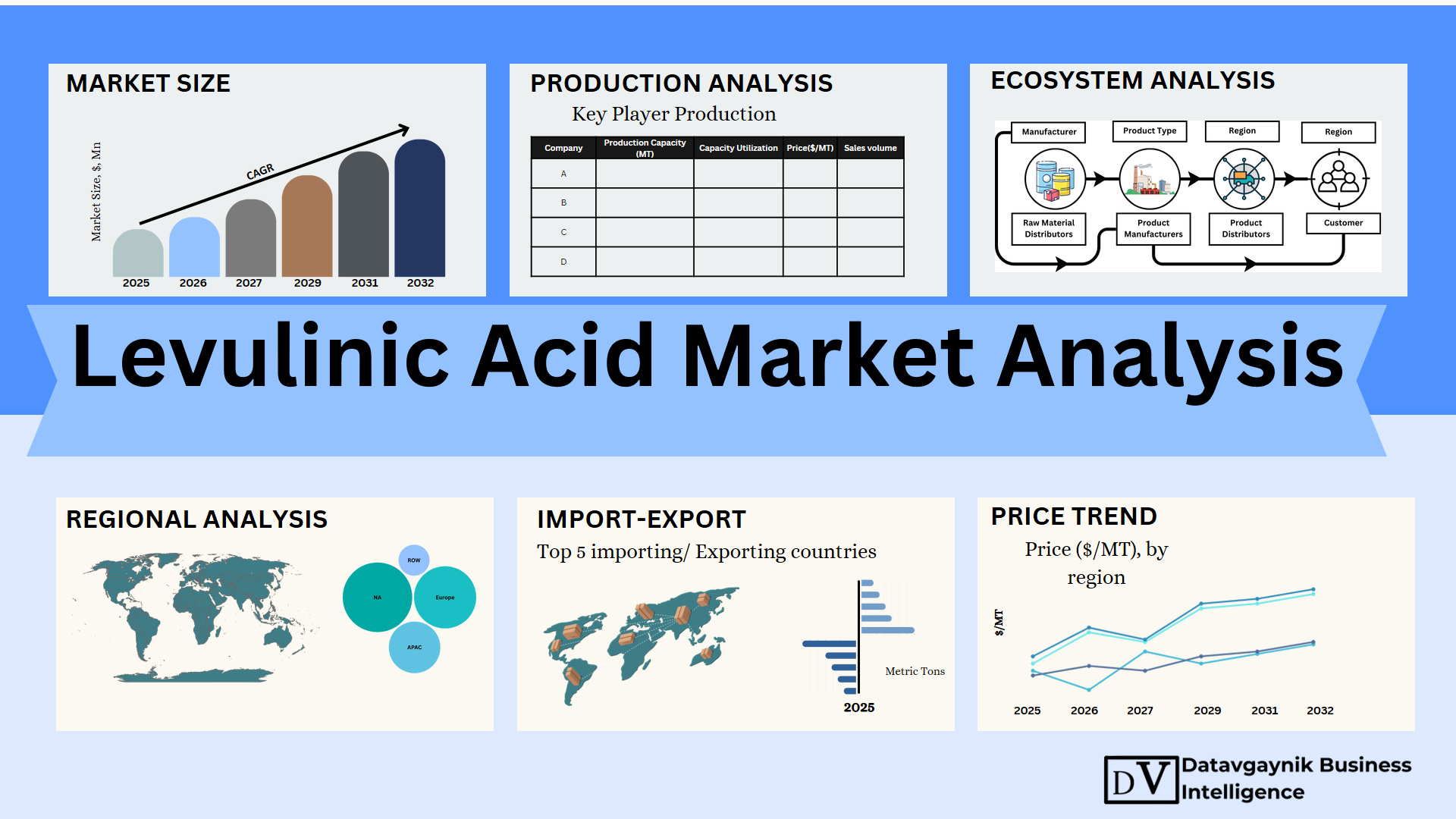
This valuation represents revenue generated from levulinic acid sold as an industrial or high-purity chemical. It does not include the full value of downstream products such as levulinate esters, gamma-valerolactone, bio-based solvents, resins, plasticizers or pharmaceutical formulations.
Global Market Forecast
| Market indicator | 2026 estimate | 2035 forecast | Growth implication |
| Market value | $80 million | $157 million | Value growth supported by volume, purity mix and specialty applications |
| Estimated demand volume | 25.4 kilotons | 43.8 kilotons | Approximately 6.2% annual volume growth |
| Average realized value | $3.15 per kg | $3.58 per kg | Higher share of cosmetic, pharmaceutical and derivative-grade material |
| Value CAGR | — | 7.8% | Price and product-mix gains add to underlying volume growth |
These figures are independent analyst estimates based on accessible production capacity, likely plant utilization, downstream consumption and prevailing differences between industrial and high-purity grades.
Levulinic acid is a five-carbon organic acid produced from carbohydrates, cellulose and other biomass-derived feedstocks. Its commercial importance comes from its ability to act as a platform molecule. It can be converted into solvents, fuel intermediates, plasticizers, resins, pharmaceuticals, agricultural chemicals and personal-care ingredients.
That flexibility gives the product strategic relevance. It allows chemical manufacturers to use one renewable building block across several value chains. Still, levulinic acid remains a specialty chemical rather than a large-volume commodity. Even the industry’s established biomass-based production facilities operate at a scale far below conventional petrochemical plants. GFBiochemicals, for example, began commercial production at a facility designed for approximately 10,000 metric tons per year, illustrating both the progress and the relatively modest scale of the current supply base.
Commercially, the Levulinic Acid Market sits between two competing forces. The first is the need for renewable chemical inputs. The second is the low cost and deep availability of established fossil-based substitutes.
Levulinic acid does not always replace a petrochemical molecule on a direct one-for-one basis. In many applications, it must be converted into a functional derivative. This adds processing cost. It also means suppliers must sell performance, safety and formulation benefits rather than renewable content alone.
Business Relevance During 2026–2035
Between 2026 and 2035, the Levulinic Acid Market will become more relevant in applications where customers place measurable value on one or more of the following:
- Renewable carbon content
- Lower solvent volatility
- Improved biodegradability
- Reduced dependence on petroleum-based intermediates
- Safer formulation profiles
- Compatibility with premium personal-care and specialty chemical products
- Potential reductions in product-level carbon intensity
The strongest commercial opportunities are unlikely to come from replacing low-priced bulk acids. They will emerge in formulations where levulinic acid or its derivatives perform more than one function.
Use case: A levulinate-based solvent may offer solvency, low volatility and renewable content in the same formulation. This creates a clearer commercial case than simply marketing it as a bio-based substitute.
Important Macro Forces
Technology development
Traditional production relies on acid-catalyzed conversion of carbohydrate-rich feedstocks. The core technical challenge is not only producing levulinic acid. It is controlling unwanted humin formation, corrosion, purification cost and variable feedstock quality.
Research is moving toward continuous reactors, more stable solid-acid catalysts, biphasic reaction systems and improved separation methods. Recent catalyst studies have focused on combining Brønsted and Lewis acidity to improve cellulose conversion and catalyst stability.
Production economics
Feedstock cost is important, but conversion yield and downstream purification often determine plant competitiveness. Agricultural waste may appear inexpensive at the source. However, collection, drying, storage and seasonal availability can raise delivered costs.
So, production economics will increasingly favour facilities located near sugar, starch, pulp, food-processing or agricultural-residue supply chains. Plants capable of using several feedstocks will also be better protected from regional biomass shortages.
Regulation and chemical substitution
Regulatory pressure is gradually shifting formulation decisions toward ingredients with safer handling, lower emissions and better environmental profiles. Levulinate derivatives are being positioned as alternatives to selected petrochemical solvents in coatings, adhesives, sealants and elastomers.
The March 2025 distribution agreement between Brenntag and GFBiochemicals covered three levulinate ester products for European CASE applications. The arrangement shows that chemical distributors now see enough customer interest to build dedicated commercial channels around these materials.
Cosmetic acceptance is another positive factor. In 2025, the Cosmetic Ingredient Review Expert Panel published its assessment concluding that levulinic acid and sodium levulinate are safe under current cosmetic-use practices. This provides formulation teams with stronger safety support, although individual product concentrations and irritation controls still matter.
Downstream product development
The addressable opportunity is considerably larger when derivatives are included. Gamma-valerolactone, alkyl levulinates, diphenolic acid and other conversion products can participate in solvents, polymers, coatings and fuel-related systems.
That said, the acid market should not be confused with the value of all downstream molecules. Producers that integrate into derivatives may generate much more revenue per ton than suppliers selling standard industrial-grade acid.
Key Consumers and Clients
The main purchasing and specification groups include:
- Specialty chemical manufacturers converting levulinic acid into esters, solvents and functional intermediates
- Coatings, adhesives and sealant formulators seeking lower-volatility solvent systems
- Plasticizer and polymer producers developing renewable-content materials
- Personal-care and cosmetic manufacturers using levulinic acid and sodium levulinate in conditioning and formulation systems
- Pharmaceutical companies using high-purity material as an intermediate
- Agrochemical manufacturers producing crop-protection intermediates and plant-related formulations
- Flavor and fragrance producers purchasing tightly controlled grades
- Biofuel and catalyst developers evaluating gamma-valerolactone and other upgraded products
- Chemical distributors, including firms such as Brenntag, that provide formulation support and regional market access
Expert view: Levulinic acid will not win because it is renewable alone. It will win where renewable content is combined with a clear technical benefit, acceptable conversion cost and dependable commercial supply.
Market Segmentation and Forecast Scope
To assess the Levulinic Acid Market correctly, segmentation must separate chemical grade, production pathway, downstream application, purchasing industry and geography. Combining these dimensions can overstate demand because the same ton of acid may move through several conversion steps before reaching a final product.
By Product Grade
Industrial Grade
Industrial-grade material is used in chemical synthesis, resins, solvents, plasticizers, agricultural intermediates and fuel-related research. It accounts for an estimated 68% of global volume in 2026.
This segment benefits from wider application coverage. However, it is also the most exposed to price competition, variable feedstock economics and substitution by conventional petrochemicals.
High-Purity Grade
High-purity material is required where impurity levels, colour, odour and consistency directly affect formulation quality. Important uses include pharmaceuticals, cosmetics, flavors, fragrances and laboratory synthesis.
Its tonnage is lower, but realized prices are higher. It is also more difficult for new producers to enter because buyers require validated specifications, stable batches and traceable manufacturing controls.
Custom and Derivative-Ready Grade
This category includes material supplied to customers with tightly controlled water content, acidity, colour or impurity profiles. It is designed for esterification, hydrogenation, resin chemistry or other defined conversion processes.
This will be one of the more strategic grades through 2035. Customers may be willing to pay more for a product that reduces their own purification steps and improves reaction consistency.
By Production Technology
Conventional Acid Hydrolysis
This route converts glucose, fructose, sucrose, starch or cellulose-derived sugars using mineral acids. It is commercially understood and can achieve practical yields. Its disadvantages include equipment corrosion, acid recovery requirements and by-product formation.
Lignocellulosic Biomass Conversion
This pathway uses agricultural residues, wood-derived materials, bagasse, straw and other cellulose-rich inputs. It offers a stronger renewable-carbon proposition and can improve waste utilization.
Its main constraint is feedstock variability. Moisture, ash, lignin content and particle size can change process performance. So, pretreatment and feedstock preparation remain important cost centres.
Heterogeneous and Solid-Catalyst Conversion
Solid-acid systems are being developed to reduce corrosion and simplify catalyst recovery. Current research is focused on catalyst stability, pore structure and the balance between different acid sites.
The strategic value is clear. A commercially durable solid catalyst could reduce waste and simplify downstream purification. However, laboratory performance does not always translate into multi-year industrial operation.
Continuous and Intensified Processing
Continuous-flow reactors, microwave-assisted systems and integrated reaction-separation configurations aim to improve heat transfer and reduce residence time.
A 2024 review of levulinic acid chemistry highlighted catalyst systems capable of generating strong yields from glucose under controlled aqueous conditions. The next challenge is achieving similar results with lower-cost, impure biomass at commercial throughput.
By Application
Solvents and Levulinate Esters
Levulinate esters can be used in coatings, cleaning products, adhesives and industrial formulations. This is one of the fastest-developing commercial areas because the derivatives can offer low volatility and broad solvency.
The Brenntag–GFBiochemicals agreement is a practical sign of movement from technical development toward distributor-led market adoption.
Plasticizers and Polymer Intermediates
Levulinic acid can be converted into molecules used in flexible polymers, specialty resins and renewable-content materials. Adoption will depend on thermal performance, compatibility, migration behaviour and cost relative to established plasticizers.
This segment has long-term potential, but qualification cycles are slow. Polymer customers generally require several rounds of performance, ageing and processability testing.
Pharmaceutical and Medical Intermediates
High-purity levulinic acid is used as a chemical intermediate in selected pharmaceutical synthesis routes. The segment offers higher margins but requires strong quality controls.
Demand growth will be steady rather than explosive. Individual pharmaceutical products consume relatively small volumes, even when the value per kilogram is attractive.
Personal Care and Cosmetics
Levulinic acid and sodium levulinate are used in skin-conditioning, fragrance and formulation systems. The published cosmetic safety assessment strengthens this application’s commercial basis.
This is expected to be among the fastest-growing end uses because personal-care brands can combine performance, renewable sourcing and ingredient-story benefits.
Agricultural Chemicals
Agricultural uses include chemical intermediates, plant-related formulations and potential routes toward bio-based crop inputs. Demand is sensitive to regulatory approvals, field performance and price.
Large agricultural volumes are possible, but only when formulation economics approach those of existing products.
Fuel and Energy Intermediates
Levulinic acid can be upgraded into gamma-valerolactone and other molecules relevant to renewable fuels, fuel additives and solvents. Research activity is strong. Commercial demand remains more limited because fuel applications require low production costs and large, reliable supply.
Recent studies continue to improve catalysts for converting levulinic acid into gamma-valerolactone, including more stable ruthenium-based systems.
Flavors and Fragrances
This is a small but established specialty segment. Buyers prioritize purity, consistency and regulatory documentation. Volumes are modest, while unit values are comparatively high.
By End User
Chemical Intermediate Producers
These companies represent the central demand group. They convert levulinic acid into solvents, lactones, resins, esters and other functional chemicals.
Coatings and Adhesives Manufacturers
These buyers are increasingly important because solvent substitution can create a direct route to commercial adoption. Their purchasing decisions depend on drying behaviour, solvency, odour, worker exposure and formulation cost.
Pharmaceutical and Personal-Care Companies
These industries require high-purity material and detailed quality documentation. Supplier approval takes longer, but customer retention can be strong once a grade is qualified.
Polymer and Plastics Manufacturers
This group evaluates renewable plasticizers, resin intermediates and functional monomers. Long testing cycles remain a barrier.
Agrochemical Companies
Agricultural buyers can create meaningful volume. However, price sensitivity and product-registration requirements make this a demanding segment.
Research Institutions and Technology Developers
Universities, catalyst companies and pilot-scale biorefineries consume small quantities. Their work can still influence future commercial routes, especially in fuels and advanced materials.
By Region
Asia Pacific
Asia Pacific holds an estimated 37% of global revenue in 2026. China is an important production and consumption centre due to its broad chemical manufacturing base. Japan and South Korea provide demand for higher-purity chemicals, specialty materials and advanced formulation work.
The region will remain central to volume growth. However, price competition among industrial-grade suppliers may limit margin expansion.
North America
North America has strong capabilities in biomass conversion research, specialty chemicals, pharmaceuticals, coatings and bio-based materials. Demand is supported by corporate renewable-content targets and customer interest in safer ingredients.
Commercial adoption will be concentrated in premium applications competition among industrial-grade suppliers may rather than bulk fuel use during the early forecast period.
Europe
Europe is strategically important for bio-based solvents, personal care and lower-emission chemical systems. Distributor involvement and formulation partnerships are improving market access.
Within the Levulinic Acid Market, Europe is likely to remain a leading region for levulinate-based specialty products, even if Asia produces more industrial-grade material.
Latin America, Middle East and Africa
These regions account for a smaller share of present demand. Brazil has long-term potential because of its sugarcane, bagasse and agricultural-processing base. The Middle East can participate through specialty chemical investment, while South Africa offers biomass and biorefinery opportunities.
Growth will depend on local conversion projects rather than direct consumption of imported levulinic acid.
Strategic Segments Through 2035
The most commercially attractive areas are expected to be:
High-purity personal-care and pharmaceutical grades
Levulinate esters for coatings and cleaning formulations
Derivative-ready grades for integrated chemical producers
Biomass routes using low-cost, regionally concentrated residues
Continuous production systems with improved acid recovery
Asia Pacific industrial demand
European specialty solvent adoption
Market Trends and Business Innovations
The next stage of the Levulinic Acid Market will be shaped less by laboratory proof and more by process reliability, customer qualification and downstream product design.
Levulinic acid has been described as a promising renewable platform chemical for many years. The issue is no longer whether useful derivatives can be produced. The issue is whether they can be manufactured consistently, priced competitively and supplied in quantities that industrial customers will trust.
R&D Is Moving Toward Process Stability
Earlier research concentrated on maximizing levulinic acid yield from pure sugars. Current work is more practical. Researchers are paying greater attention to real biomass, catalyst reuse, impurity tolerance and integrated separation.
A 2024 study reported a biomass-derived carbon-supported aluminium-zirconium catalyst designed with combined Brønsted and Lewis acidity for cellulose conversion. The wider significance is not one catalyst alone. It is the shift toward reusable systems that co corrosive liquid acids.
Research is also exploring unconventional feedstocks. A 2025 feasibility study examined invasive seaweed as a saccharide source for levulinic acid and linked the process with syngas production from residual biomass. The study estimated positive net revenue under its defined process conditions, showing ho biorefinery economics.
This may lead to region-specific production systems. Coastal biomass, bagasse, corn residues and pulp-industry side streams will not use identical plant designs.
Expert view: The commercially successful process may not achieve the highest laboratory yield. It will be the process that tolerates imperfect feedstock, recovers its catalyst and operates without frequent shutdowns.
Continuous Processing Is Replacing Batch-Led Thinking
Batch systems remain useful for specialty production. However, continuous processing offers better control over temperature, residence time and scale.
The innovation priority is to manage the rapid sequence from carbohydrate hydrolysis to intermediate formation and then to levulinic acid. Poor control can increase humin formation and reduce recoverable yield.
Continuous plants can also integrate acid recycling, heat recovery and by-product separation. This improves economics beyond the reactor itself.
Commercial expansion will therefore be tied to engineering improvements in:
- Corrosion-resistant equipment
- Feedstock pretreatment
- Reactor residence-time control
- Acid recovery
- Humin handling
- Water management
- Purification and colour removal
- Co-product recovery
Material Science Is Shifting Toward Derivative Families
The commercial future is moving from a single-molecule strategy to a product-family strategy.
Levulinic acid can be used to make:
- Alkyl levulinates for solvents, coatings and cleaning systems
- Gamma-valerolactone for solvent, chemical and fuel-related applications
- Diphenolic acid for resins and polymer chemistry
- 2-methyltetrahydrofuran-related intermediates for solvent and synthesis applications
- Specialty nitrogen-containing molecules for fine chemicals
- Renewable plasticizer intermediates for flexible materials
Research published in 2025 demonstrated microwave-assisted synthesis of medium- and long-chain alkyl levulinates. Such work aims to reduce reaction time and improve the egher-value derivatives.
The main business implication is margin expansion. Standard levulinic acid is exposed to chemical-price competition. A qualified solvent, plasticizer or formulation ingredient can command a higher value because the customer is buying performance rather than only a raw material.
Commercialization Is Becoming Distributor-Led
A major barrier for renewable specialty chemicals is not always product performance. It is market access.
Formulators often buy through established chemical distributors. They expect local inventory, technical support, documentation, samples and assistance with reformulation.
In March 2025, Brenntag signed a sole European distribution agreement with GFBiochemicals for three levulinate ester products serving coatings, adhesives, sealants and elastomers. The products were positioned as safer alte petrochemical solvents.
This development matters for three reasons:
- It gives levulinate products access to an existing formulation customer base.
- It reduces the commercial burden on the technology producer.
- It moves adoption from demonstration projects toward repeat purchasing.
GFBiochemicals also promoted its RE:CHEMISTRY platform in May 2025, emphasizing the use of levulinic acid derived from agricultural wastble chemical solutions.
Partnerships Are More Important Than Acquisitions
The sector has not experienced a large wave of recent mergers. Instead, development has centred on technology collaborations, distribution agreements and downstream formulation partnerships.
This structure makes sense. Levulinic acid producers need application expertise. Coatings companies need solvent-performance data. Polymer companies need testing support. Distributors need reliable supply and technical documentation.
A partnership can connect these capabilities without requiring a full acquisition.
Earlier collaboration between GFBiochemicals and BASF focused on developing resource-efficient chemical solutions using levulinate-based solvents. It demonstrated the value of combining platform technology with the applicablished chemical group.
Cosmetic Formulation Is Becoming More Credible
Personal care is moving from a secondary application to a strategic specialty segment.
Levulinic acid and sodium levulinate can support skin-conditioning, fragrance and formulation functions. The 2025 Cosmetic Ingredient Review publication concluded that both ingredientcosmetic-use practices.
This does not guarantee rapid volume growth. Cosmetic ingredients still require formulation stability, sensory testing and brand approval. However, stronger safety documentation removes one layer of uncertainty for product developers.
Premium natural-positioned products may adopt the chemistry faster than mass-market products because ingredient cost represents a smaller portion of retail value.
Catalytic Upgrading Will Expand the Addressable Market
Levulinic acid demand will increasingly be influenced by the economics of its derivatives.
Gamma-valerolactone is one of the most researched conversion products. Catalyst developers are working to reduce precious-metal use, improve hydrogen efficiency and extend catalyst life.
Recent research has examined ruthenium-iridium nanoalloys and oxide-derived ruthenium systems for levulinic acid hydrogenation. These approaches aiity.
The commercial impact will depend on total processing cost. High catalytic performance is valuable, but not enough if hydrogen supply, catalyst replacement or purification remains expensive.
Supply Reliability Will Become a Competitive Advantage
Large chemical customers are cautious about reformulating products around a material supplied by only one or two qualified plants.
So, future market development will require:
- Multiple production locations
- Consistent quality between batches
- Long-term feedstock contracts
- Regional inventory
- Transparent renewable-carbon documentation
- Reliable delivery schedules
- Technical support during customer qualification
This creates an advantage for producers working with established distributors and application partners.
Price Premiums Will Narrow, Not Disappear
Bio-based levulinic acid and its derivatives currently compete with petrochemical products supported by mature assets and larger production runs.
As utilization improves, the renewable price premium should decline. It is unlikely to disappear across every grade by 2035.
High-purity products will continue to carry premiums because of purification and quality-control requirements. Specialty derivatives may also maintain higher prices when they improve safety, processing or final-product performance.
Expert view: Market expansion will accelerate when buyers can justify levulinic chemistry through total formulation value. Carbon content opens the conversation. Performance and supply security close he sale.
Competitive Intelligence and Benchmarking
The competitive structure of the Levulinic Acid Market is fragmented. It includes integrated technology owners, biomass-conversion developers, industrial chemical suppliers and high-purity laboratory brands. These companies do not compete on identical terms.
Only a limited number of participants are building businesses around levulinic acid as a renewable platform molecule. Most suppliers sell it as one item within a much broader specialty chemical catalogue.
Public companies do not separately disclose levulinic acid revenue, production utilization or customer-level sales. So, assigning exact company shares would create false precision. A more reliable benchmark considers production capability, derivative breadth, process ownership, purity range and market access.
Competitive Benchmarking
| Company | Competitive role | Portfolio position | Scale orientation | Market position |
| GFBiochemicals | Integrated technology owner and derivative supplier | Levulinate-based solvents, ketals and multifunctional ingredients | Commercial and application-led | Best-evidenced leader in integrated levulinate commercialization |
| Biofine Developments Northeast | Biomass-conversion technology developer | Levulinic acid, formic acid, furfural, biofuels and biochar | Demonstration-to-commercial transition | Strong process intellectual property; commercial scale still developing |
| Haihang Industry | Chinese fine-chemical manufacturer and exporter | Industrial levulinic acid and selected esters | Drum-scale industrial supply | Cost-competitive supplier serving broad industrial applications |
| TNJ Chemical | Chinese specialty chemical supplier | Industrial and fine-chemical grades | Export-oriented supply | Competes through pricing, packaging flexibility and regional availability |
| Merck KGaA – Sigma-Aldrich | High-purity and documented specialty supplier | Synthesis, natural, fragrance and certified grades | Laboratory and specialty volumes | Strong in regulated, R&D and premium-purity applications |
| Tokyo Chemical Industry | Specialty organic chemical producer and distributor | Levulinic acid and multiple ester derivatives | Research, pilot and specialty production | Broadest catalogue-level levulinate coverage among laboratory suppliers |
| Thermo Fisher Scientific | Research and fine-chemical channel participant | Research-grade acid in multiple pack sizes | Laboratory and pilot-scale demand | Strong global distribution and customer qualification support |
GFBiochemicals
GFBiochemicals has the clearest commercial focus on levulinate chemistry. Its portfolio extends beyond the base acid into plant-derived ester and ketal systems for coatings, cleaning products, personal care and other formulated products.
The company reports more than a decade of technology development and a portfolio exceeding 200 patents. Its strategic advantage is downstream integration. It sells functional ingredients rather than relying only on bulk acid sales. This supports higher revenue per ton and creates stronger differentiation from low-cost suppliers.
The March 2025 distribution agreement with Brenntag further strengthened its position in European coatings, adhesives, sealants and elastomers. The agreement placed three levulinate-based products into an established chemical distribution channel.
Expert view: GFBiochemicals is commercially important because it is building demand for a family of levulinic derivatives. Selling only the acid would provide a much narrower competitive advantage.
Biofine Developments Northeast
Biofine Developments Northeast, or Biofine, owns a biomass-processing technology designed to convert waste lignocellulosic material into levulinic acid, formic acid, furfural, biochar and downstream renewable fuels.
Its platform has progressed through pilot and demonstration activity at the University of Maine’s Forest Bioproducts Research Institute. The company states that it is preparing for industrial commercialization, including a proposed biorefinery in Maine.
Biofine’s position is different from that of established chemical distributors. Its value lies in process design, feedstock conversion and co-product integration. Its commercial influence will depend on whether planned facilities achieve reliable operating rates and competitive purification costs.
A successful plant could materially change North American supply. However, planned nameplate capacity should not be treated as current market production until continuous commercial operation is demonstrated.
Haihang Industry
Haihang Industry participates as a Chinese fine-chemical manufacturer and exporter. It supplies levulinic acid in industrial packaging, including 250-kilogram drums, and markets the product for resins, medicines, fragrances, coatings, inks, plastic additives and agricultural intermediates.
Its competitive position is based on manufacturing flexibility and export pricing rather than proprietary biomass-conversion technology. The company also lists selected levulinate esters, giving it some derivative coverage.
This type of supplier is important in price-sensitive applications. Buyers can source industrial material without committing to a premium renewable-chemistry platform. That said, feedstock origin and carbon-intensity claims may not always be as central to the offering as they are for dedicated bio-based producers.
TNJ Chemical
TNJ Chemical supplies levulinic acid from China into international fine-chemical, pharmaceutical, agricultural and industrial channels. Its market position is built around export availability, customizable packaging and a wide chemical catalogue.
The company competes most directly with other Asian industrial suppliers. Price, specification consistency, shipment size and delivery time are the main purchasing criteria.
TNJ is less differentiated through application-specific derivatives than GFBiochemicals. Still, it can serve customers that need standard acid as an intermediate and plan to conduct their own downstream conversion.
Merck KGaA – Sigma-Aldrich
Merck KGaA, through Sigma-Aldrich, holds a strong position in documented high-purity material. Its portfolio includes synthesis-grade levulinic acid with an assay of at least 98%, as well as a natural fragrance-grade product with 99% purity and supporting food and fragrance documentation.
The company is not positioned as a large-volume commodity producer. Its strength lies in specification control, certificates of analysis, regulatory documentation and global laboratory distribution.
These capabilities support pharmaceutical development, flavor and fragrance research, formulation testing and customer qualification. Realized prices per kilogram are considerably higher in these channels, although purchased quantities are much smaller.
Tokyo Chemical Industry
Tokyo Chemical Industry supplies levulinic acid with purity above 97% and also lists methyl, ethyl, propyl and butyl levulinate derivatives. This provides researchers and specialty manufacturers with access to several members of the same chemical family.
Its position is particularly relevant in Japan and other Asian research markets. It also supports early-stage customer testing before a formulation moves to larger industrial volumes.
TCI’s wide derivative catalogue improves its technical visibility. However, catalogue leadership should not be confused with leadership in bulk levulinic acid output.
Thermo Fisher Scientific
Thermo Fisher Scientific supplies research-grade levulinic acid at approximately 98% purity in quantities ranging from hundreds of grams to several kilograms. It identifies applications across pharmaceuticals, agricultural chemicals, perfumes, polymers, paints, lubricants, inks and cosmetics.
Its main strength is channel reach. Research laboratories, pilot facilities and corporate development teams can source material through an established procurement system.
The company therefore influences application development and customer qualification. It is not positioned as a primary bulk producer for large-volume solvent, plasticizer or fuel applications.
Competitive Outlook
Competition in the Levulinic Acid Market will increasingly separate into three layers:
- Integrated renewable-chemistry suppliers selling derivatives and formulation value
- Industrial producers competing on price, specification and shipment reliability
- High-purity suppliers serving regulated, research and specialty applications
The strongest long-term position belongs to companies that combine process ownership with downstream products. Bulk acid alone offers limited protection against price competition.
Regional Landscape and Adoption Outlook
Regional growth depends on four factors: biomass availability, chemical-processing infrastructure, government support and the presence of downstream customers willing to qualify bio-based ingredients.
The following figures represent an analyst allocation consistent with the estimated global market value of $80 million in 2026 and $157 million in 2035. They should be read as commercial demand estimates rather than official production statistics.
Regional Market Outlook
| Geography | 2026 estimated value | 2026 global share | 2035 estimated value | 2026–2035 CAGR | Adoption position |
| United States | $15.2 million | 19% | $28.4 million | 7.2% | Strong technology development and specialty demand |
| Europe | $22.4 million | 28% | $45.9 million | 8.3% | Leading region for commercial bio-based derivatives |
| China | $17.6 million | 22% | $37.0 million | 8.6% | Largest individual production and price-competitive supply base |
| India | $3.2 million | 4% | $7.4 million | 9.7% | Fastest-growing named market from a low base |
| Japan | $4.8 million | 6% | $8.4 million | 6.4% | High-purity, research and specialty formulation demand |
| South Korea | $2.4 million | 3% | $4.6 million | 7.6% | Import-led demand with improving biomanufacturing infrastructure |
| Middle East | $1.6 million | 2% | $2.9 million | 7.0% | Selective opportunity; not yet a core market |
| Other countries | $12.8 million | 16% | $23.5 million | 6.4% | Distributed demand across Canada, Southeast Asia and Latin America |
United States
The United States combines strong biomass-conversion research with large downstream markets in coatings, pharmaceuticals, personal care, specialty chemicals and renewable fuels.
The U.S. Department of Energy identified levulinic acid as one of the promising value-added molecules obtainable from biomass. This helped establish the country’s early research base in carbohydrate conversion, catalytic upgrading and integrated biorefineries.
Biofine represents the most visible U.S.-based commercialization effort. Its technology converts cellulosic waste into levulinic acid and related products, while proposed development in Maine connects the process with forestry residues and existing pulp-and-paper infrastructure.
Adoption remains concentrated in higher-value uses. Low-cost bulk fuel applications are difficult because the product must compete with established petroleum-refining systems.
The United States is likely to remain a leader in process intellectual property. Its share of physical production will depend on whether planned biorefineries progress from demonstration activity to stable commercial output.
Europe
Europe is the most advanced region for converting levulinic chemistry into branded industrial ingredients.
France is important because it hosts GFBiochemicals’ headquarters and technology development. Germany is central through chemical formulation and distribution infrastructure. Belgium and the Netherlands provide logistics, chemical storage and access to regional customers. Italy also has a historical role in European levulinic acid production and development.
The commercial structure improved in March 2025, when Brenntag entered an exclusive European distribution agreement covering levulinate-based solvents for coatings and related applications.
Policy support is also stronger than in most regions. The European Commission’s 2025 Bioeconomy Strategy seeks to expand biomass processing, biomanufacturing and substitution of fossil-based materials. The strategy specifically recognizes chemicals as an area where renewable inputs can reduce fossil dependency.
That said, European buyers require detailed safety, lifecycle and feedstock documentation. This raises qualification costs, but it also favours suppliers with credible renewable-carbon claims.
The European Levulinic Acid Market is therefore expected to grow faster in value than in volume. Esters, ketals and personal-care ingredients will carry more commercial weight than standard industrial acid.
China
China has the broadest group of price-competitive levulinic acid suppliers. Companies such as Haihang Industry, TNJ Chemical and other domestic fine-chemical producers support industrial and export demand.
China’s advantage comes from its chemical-manufacturing infrastructure, supplier density, engineering workforce and access to agricultural and carbohydrate-based feedstocks. It can also integrate levulinic acid production with pharmaceutical, pesticide, resin, dye and fragrance supply chains.
The country’s 14th Five-Year Bioeconomy Development Plan supports the substitution of conventional chemical raw materials with bio-based materials and the replacement of selected traditional chemical processes with biological routes.
China is expected to remain the largest individual country market by volume. However, industrial-grade competition may restrict average selling-price growth.
Its strategic opportunity lies in moving from standard acid supply toward certified bio-based derivatives. Doing so would reduce exposure to price-only competition.
India
India represents the fastest-growing named country opportunity, although its starting base is small.
The country has substantial agricultural residues, sugar-processing by-products, starch feedstocks and a large chemical manufacturing sector. It also has downstream demand from pharmaceuticals, agrochemicals, personal care, fragrances and specialty materials.
The BioE3 Policy, approved in August 2024, specifically includes high-value bio-based chemicals, biopolymers and enzymes among its strategic sectors. The policy supports shared biomanufacturing infrastructure, biofoundries and commercialization-focused research.
By July 2026, more than 270 projects had been recommended for funding under BioE3, while 17 facilities and 15 Bio-AI hubs had received or been recommended for support. These figures cover the broader bioeconomy rather than levulinic acid alone, but they indicate a stronger scale-up environment for bio-based products.
India’s reported bioeconomy reached $165.7 billion in 2024, with a national objective of $300 billion by 2030.
The main constraint is not feedstock availability. It is the absence of a clearly established large-scale domestic levulinic acid production base. Near-term demand will continue to depend on imports and small-volume local supply.
Expert view: India has the feedstock and downstream customers. The missing link is a bankable conversion plant that can provide consistent purity without depending on premium pricing.
Japan
Japan is a smaller but technically important market. Demand is concentrated in high-purity chemicals, pharmaceutical research, flavors, fragrances and advanced material development.
Tokyo Chemical Industry provides local access to levulinic acid and several ester derivatives. This supports laboratory use, catalyst research and formulation screening.
Japan’s updated bioeconomy strategy continues the national objective of developing an advanced bioeconomy by 2030, including biomanufacturing and renewable materials.
The country is unlikely to lead global bulk production. Its strategic influence will come from catalyst technology, high-value formulations and partnerships between chemical companies and research institutions.
South Korea
South Korea’s current levulinic acid demand is largely import-led. The country has strong downstream industries in chemicals, cosmetics, coatings and advanced materials, but no clearly established large-scale domestic producer has been identified.
Government investment could improve the wider commercialization environment. South Korea is investing KRW 126.3 billion between 2025 and 2029 in public biofoundry infrastructure intended to accelerate biomanufacturing and reduce development timelines.
In April 2025, the country passed a dedicated Synthetic Biology Promotion Act, with implementation scheduled for 2026. The law creates a framework for research funding, biofoundries, data infrastructure and technology standardization.
These programs are not specific to thermochemical levulinic acid production. Their more direct relevance lies in developing bio-based derivatives, enzymes and engineered conversion pathways.
Middle East
The Middle East is not yet a priority production centre for levulinic acid.
The region has world-scale petrochemical assets, strong engineering capabilities and increasing interest in lower-carbon chemicals. However, local lignocellulosic feedstock availability is less favourable than in China, India, Europe or the United States.
Near-term demand will remain concentrated in imported specialty material for coatings, personal care, fragrances and research.
The strongest future opportunity may come through partnerships with European or Asian technology owners. A standalone regional levulinic acid plant is less likely unless it is integrated with imported biomass, municipal waste or another low-cost carbon source.
Recent Developments, Opportunities and Restraints
Recent Developments
| Year and month | Event | Market impact |
| August 2024 | India approved the BioE3 Policy, including high-value bio-based chemicals as a strategic sector. | Improved the funding and scale-up environment for renewable chemical technologies. |
| March 2025 | Brenntag and GFBiochemicals signed a sole European distribution agreement for three levulinate-based products used in coatings and related applications. | Expanded commercial access and technical support for levulinate derivatives across Europe. |
| April 2025 | South Korea passed its Synthetic Biology Promotion Act, scheduled to take effect in 2026. | Created a legal framework for biofoundries, national R&D and biomanufacturing infrastructure. |
| November 2025 | The European Commission presented a new EU Bioeconomy Strategy. | Strengthened policy support for biomass conversion and substitution of fossil-derived chemicals. |
| July 2026 | India reported that more than 270 BioE3 projects had been recommended for funding, alongside support for 17 facilities and 15 Bio-AI hubs. | Demonstrated movement from policy approval toward funded infrastructure and product-development programs. |
These developments show that government support is strengthening around the broader bioeconomy. Still, public funding for biomanufacturing should not automatically be counted as direct funding for the Levulinic Acid Market. Commercial impact will depend on which supported technologies progress into actual chemical production.
Opportunities and Business Insights
Derivative-first commercialization
The strongest opportunity is to convert levulinic acid into higher-value esters, ketals, solvents and specialty intermediates.
A producer selling standard acid may realize roughly $2–$4 per kilogram, depending on grade and volume. A formulated or highly purified derivative can generate several times more revenue per kilogram. The exact premium depends on application performance, certification and order size.
This makes downstream integration more attractive than competing only on bulk tonnage.
Agricultural-residue production hubs
China, India, Brazil and selected parts of the United States and Europe have concentrated sources of sugarcane residue, corn waste, forestry by-products and other carbohydrate-rich material.
Locating production close to these streams can reduce feedstock transport and storage costs. It can also improve traceability and create a clearer renewable-carbon proposition.
At estimated global demand of 25.4 kilotons in 2026, one plant producing 5 kilotons annually would represent almost 20% of current market volume. So, even one successful commercial project could alter pricing and regional trade flows.
Continuous processing and co-product utilization
The market requires approximately 18.4 kilotons of additional annual demand to move from 25.4 kilotons in 2026 to 43.8 kilotons in 2035.
At an average plant utilization rate of 70%, the industry would need roughly 26 kilotons of additional nameplate capacity to serve that increase.
Continuous reactors, acid recovery, automated process control and inline composition monitoring can improve productivity. Humin, formic acid, furfural and biochar recovery can also strengthen plant economics.
AI is not currently a direct market driver. Its practical role will be limited to feedstock characterization, catalyst optimization, predictive maintenance and process control.
Key Restraints
High purification and separation costs
Producing levulinic acid is technically achievable. Producing colour-stable, high-purity material at low cost is more difficult.
Mineral-acid recovery, corrosion-resistant equipment, water removal and humin separation can account for a substantial portion of operating and capital cost.
Competition from mature petrochemicals
Levulinic acid derivatives compete with solvents, plasticizers and intermediates manufactured in established assets. These incumbents benefit from large production runs, optimized logistics and long customer histories.
Renewable content alone may not justify a price premium. Products must offer measurable safety, solvency, biodegradability or formulation advantages.
Limited supply diversity
Commercial renewable supply remains concentrated. Large customers may avoid reformulating around a chemical that depends on one plant or one technology provider.
The Levulinic Acid Market therefore needs multiple qualified facilities, regional inventory and stronger contract-manufacturing arrangements.
Long customer qualification cycles
Coatings, cosmetics, polymers and pharmaceutical customers require stability testing, regulatory review and manufacturing validation.
A technically successful product may still take 12–36 months to move from laboratory testing into recurring commercial orders.


