

Market Summary and Growth Forecast
The global Magnesium oxide nanoparticles Market is estimated at $164 million in 2026 and is expected to reach $412 million by 2035, growing at a CAGR of 10.8%.
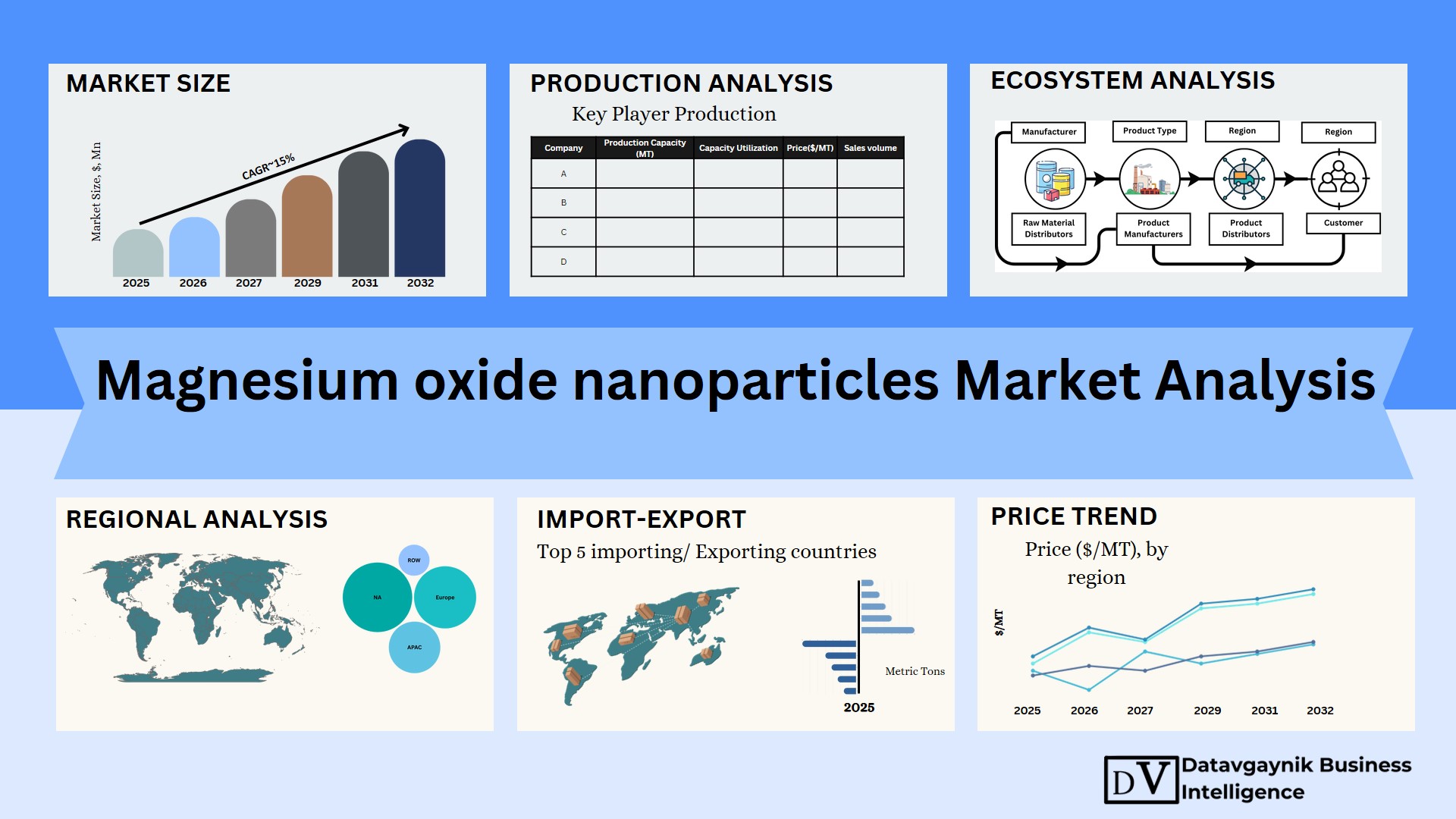
These figures represent an analytical market estimate based on addressable application demand, nanoparticle pricing, manufacturing capacity, downstream adoption and the gradual shift from laboratory use to commercial-scale formulations.
Datavagyanik also covers related markets such as the Magnesium Oxide Market, the Zinc oxide nanoparticles Market, and the Iron oxide nanoparticles Market. These materials are considered in high-temperature and specialty chemical environments, where glass production, catalysis, and safety regulations influence adoption patterns.
Magnesium oxide nanoparticles are ultrafine particles of magnesium oxide, generally produced with dimensions below 100 nanometres. At this scale, the material offers a high surface area, strong thermal stability, chemical reactivity and useful adsorption properties. These characteristics make it relevant to advanced ceramics, catalysts, coatings, environmental treatment, electronics and selected healthcare-related formulations.
The commercial opportunity is not driven by magnesium oxide volume alone. Conventional magnesium oxide is already widely available and relatively inexpensive. Value comes from controlling particle size, surface area, morphology, purity and dispersion. Buyers pay a premium when these properties improve reaction efficiency, coating performance, contaminant removal or material strength.
Global Market Outlook
| Market indicator | Estimate |
| Global market size, 2026 | $164 million |
| Projected market size, 2035 | $412 million |
| Forecast period | 2026–2035 |
| CAGR, 2026–2035 | 10.8% |
| Primary commercial form | Nanopowder and formulated dispersion |
| Main demand sectors | Ceramics, catalysts, coatings, environmental treatment and electronics |
Business Relevance During 2026–2035
The Magnesium oxide nanoparticles Market sits between commodity minerals and performance nanomaterials. It remains smaller than markets for silica, alumina or titanium dioxide nanoparticles. Still, it has a defensible position where alkalinity, heat resistance and surface activity are required together.
Environmental applications are likely to create a meaningful demand base. Magnesium oxide nanoparticles can support adsorption, neutralisation and catalytic treatment processes. Their high surface area allows more active contact with contaminants than conventional magnesium oxide particles. Commercial adoption will depend on regeneration potential, safe handling and cost per unit of contaminant removed.
Advanced ceramics will remain another important area. Nanostructured magnesium oxide can be used to influence grain structure, sintering behaviour, thermal resistance and dielectric properties. Demand will come from manufacturers seeking higher performance without substantially increasing material weight or component size.
Coatings and formulated chemical products offer a wider but more fragmented opportunity. Magnesium oxide nanoparticles may be incorporated into protective, antimicrobial, flame-resistant or functional surfaces. However, buyers will require stable dispersions. Agglomeration can reduce performance and create inconsistency during processing.
Technology and Production Forces
Production technology will have a direct influence on market economics. Precipitation, sol-gel processing, hydrothermal synthesis, combustion-based methods and related chemical routes can produce magnesium oxide nanoparticles with different purity and morphology profiles. No single method is ideal for every application.
The industry’s main technical challenge is moving from controlled laboratory batches to repeatable industrial production. Customers need consistent particle size distribution, surface chemistry and bulk density. Variations between batches can change viscosity, catalytic behaviour and final product quality.
Surface modification will become more important through 2035. Untreated nanopowders often agglomerate during storage or mixing. Producers that can supply application-ready dispersions, coated particles or customised surface treatments will be better placed than companies selling basic nanopowder alone.
Energy use is another issue. Calcination and thermal treatment can raise production costs. Manufacturers will therefore focus on lower-temperature processing, better precursor conversion and improved yield. This may gradually reduce unit costs, but high-purity grades will continue to command a premium.
Regulatory and Safety Considerations
Nanomaterial regulation will shape the pace of adoption. Producers must document particle characteristics, exposure risks, handling requirements and environmental behaviour. Requirements may differ depending on whether the material is used in an industrial catalyst, a consumer coating, a food-contact surface or a healthcare product.
Workplace exposure will remain a central concern. Fine magnesium oxide particles can become airborne during transfer, blending or packaging. Closed production systems, dust extraction, protective equipment and validated handling procedures will therefore be part of the commercial offering.
Applications involving direct human contact will face a higher approval threshold. Growth in cosmetics, medical materials or antimicrobial consumer products will depend on toxicology data and permitted concentration levels. Industrial applications are likely to commercialise faster because exposure pathways are easier to control.
Demand Structure and Purchasing Criteria
Customers will not select suppliers solely on price. The main purchasing criteria will include:
- Particle size and distribution consistency
- Magnesium oxide purity
- Specific surface area
- Dispersion stability
- Surface functionalisation
- Moisture and carbon dioxide sensitivity
- Batch traceability
- Regulatory documentation
- Ability to supply commercial volumes
Small research-grade orders currently generate high prices per kilogram. As demand scales, more revenue will shift toward industrial grades sold under long-term supply arrangements. This will lower average selling prices in some applications while increasing total shipment volume.
Key Consumers and Client Groups
The principal consumers and target clients include:
- Advanced ceramic manufacturers producing thermal, electrical and structural components
- Catalyst and catalyst-support companies serving chemical processing and emissions control
- Specialty coating formulators developing protective and functional surfaces
- Water and wastewater treatment companies evaluating adsorbent and reactive treatment materials
- Electronics-material suppliers working on insulating, dielectric and heat-resistant formulations
- Polymer compounders adding functional mineral fillers to engineered materials
- Research institutes and universities purchasing high-purity materials for development work
- Pharmaceutical, healthcare and personal-care formulators where safety and regulatory conditions permit nanoparticle use
Representative commercial organisations that may participate as suppliers, formulators, development partners or downstream users include Merck, American Elements, US Research Nanomaterials, Nanoshel, Inframat Advanced Materials, BASF, Evonik, Saint-Gobain, DuPont and 3M. Their exact involvement differs by application, so they should not all be treated as direct purchasers of magnesium oxide nanoparticles.
Overall, the market’s strongest commercial case lies in performance-led applications where conventional magnesium oxide cannot provide enough surface activity or material control. The winners will be suppliers that move beyond powder production and help customers solve dispersion, formulation, qualification and scale-up problems.
Competitive Intelligence and Benchmarking
Competition in the Magnesium oxide nanoparticles Market remains fragmented. Most suppliers operate across a wider portfolio of metal oxides rather than relying only on magnesium oxide. So, market position depends less on production volume and more on particle consistency, purity, surface area, dispersion stability and technical support.
Precise company shares should not be assigned without audited nanoparticle-level revenue disclosures. The following ranking is therefore a strategic benchmark rather than a formal market-share table.
Competitive Benchmarking
| Company | Portfolio and market position | Competitive assessment |
| American Elements | High-purity nanopowders, customised particle specifications, coated materials and liquid dispersions | Broadest product and formulation capability |
| Merck KGaA / Sigma-Aldrich | Standardised research-grade nanopowders supported by analytical documentation and global laboratory distribution | Strongest position in academic and laboratory procurement |
| US Research Nanomaterials | Multiple particle-size grades, dry powders and solvent-based dispersions | Flexible supplier for research, formulation trials and pilot orders |
| Nanoshel | Commercial nanopowders with standard purity and particle-size specifications | Competitive in small-volume and price-sensitive orders |
| Nanografi | Powder and pre-dispersed formats serving electronics, coatings, catalysis and ceramics research | Broad application reach and accessible catalogue supply |
| Inframat Advanced Materials | High-purity nanoscale powders aimed at ceramics, composites and advanced material development | Niche supplier with clear technical specifications |
American Elements
American Elements has one of the broadest magnesium oxide nanomaterial offerings among specialist suppliers. Its portfolio covers high-purity and ultra-high-purity particles, coated variants and dispersions in liquid media. Particle sizes generally fall within the 5–100 nanometre range.
Its main advantage is customisation. Customers can seek different purity levels, particle dimensions, surface characteristics and delivery forms. This supports demanding work in catalysis, coatings, electronics and advanced ceramics.
Analyst view: American Elements is well positioned where buyers need an engineered material rather than a standard catalogue powder.
Merck KGaA / Sigma-Aldrich
Merck KGaA, through Sigma-Aldrich, focuses mainly on standardised research and development materials. Its magnesium oxide nanopowder offering includes particles at or below approximately 50 nanometres. The material is positioned for ceramic synthesis, dielectric composites and experimental material development.
The company benefits from strong documentation, recognised quality systems and an established distribution network among universities, pharmaceutical laboratories and industrial research centres. Its commercial strength is not necessarily bulk industrial pricing. It is reliability during early-stage research and qualification.
Analyst view: Merck holds a strong position in specification-sensitive laboratory procurement but may face specialist competition when customers move into larger commercial volumes.
US Research Nanomaterials
US Research Nanomaterials supplies magnesium oxide nanopowders across several particle-size and purity combinations. It also provides material in ethanol dispersion. The stated applications extend across ceramics, polymers, fire-resistant materials, electronics, insulating fillers and chemical processing.
The company’s portfolio suits customers that need manageable quantities for product trials. Ready-made dispersions can also reduce the initial formulation burden for buyers that lack dedicated nanoparticle mixing equipment.
Analyst view: Its position is strongest between laboratory-scale suppliers and fully customised industrial nanomaterial producers.
Nanoshel
Nanoshel offers standard magnesium oxide nanoparticles with specifications around 99.9% purity and an average particle size near 40 nanometres. Its commercial model emphasises direct ordering, international shipment and accessibility for universities, start-ups and smaller industrial development teams.
The company competes through catalogue availability and lower procurement complexity. That said, customers in regulated or high-performance industries may still require further batch testing and application-specific qualification.
Analyst view: Nanoshel is relevant in price-conscious research and early pilot programmes rather than highly customised, long-term industrial supply contracts.
Nanografi
Nanografi supplies magnesium oxide in dry nanopowder and solvent-dispersed forms. Available grades include particles around 18 nanometres and ethanol dispersions with particles around 45 nanometres. Target applications include electronics, ceramics, catalysis, coatings and petrochemical formulations.
Its ability to offer both powder and dispersion formats gives formulators more choice. This is important because buyers increasingly want materials that can be introduced directly into coatings, polymers or chemical systems.
Analyst view: Nanografi is positioned as an application-oriented catalogue supplier with a comparatively broad range of usable formats.
Inframat Advanced Materials
Inframat Advanced Materials supplies high-purity magnesium oxide nanopowder with particle dimensions near 30 nanometres. Its portfolio is narrower than that of larger nanomaterial distributors. However, it has a recognised presence in advanced ceramics, composite materials and specialised research.
Transparent technical specifications and small-volume pricing make the company accessible to development laboratories. Its limitation is comparatively lower visibility in application-ready dispersions and large-volume customised supply.
Analyst view: Inframat is a credible niche competitor where customers value defined powder properties and specialist material expertise.
Competitive Success Factors Through 2035
The strongest suppliers will differentiate themselves through:
- Consistent particle-size distribution between production batches
- High-purity grades for electronics and advanced ceramics
- Stable water-based and solvent-based dispersions
- Surface-treated particles compatible with polymers and coatings
- Detailed toxicology and regulatory documentation
- Scale-up support from laboratory quantities to commercial volumes
- Lower-energy production and improved precursor utilisation
Basic nanopowder will face pricing pressure. Application-ready material will retain stronger margins. This includes coated particles, nanocomposites and dispersions designed around the customer’s manufacturing process.
Expert view: The market will gradually move from selling “nanoparticles in a container” toward selling qualified material systems that already address dispersion, handling and processing problems.
Regional Landscape and Adoption Outlook
Regional development in the Magnesium oxide nanoparticles Market will not follow one pattern. The United States, Europe and Japan will remain important for high-purity and technically qualified grades. China will lead volume expansion. India will grow from a smaller base. South Korea will focus on electronics and nano-enabled material systems.
Regional Adoption Comparison
| Market | Adoption position | Main demand areas | Infrastructure and policy environment |
| United States | High-value market | Coatings, catalysts, environmental treatment, research and electronics | Strong federal nanotechnology funding with formal TSCA oversight |
| Europe | Premium and compliance-led | Specialty chemicals, ceramics, coatings and environmental applications | Strict REACH nanoform requirements |
| China | Fastest volume expansion | Ceramics, catalysts, polymers, coatings and electronics | Large materials manufacturing base and continued advanced-material research support |
| India | High growth from a smaller base | Water treatment, healthcare research, ceramics and chemical processing | Established public nanoscience institutions but uneven commercial scale-up |
| Japan | High-purity specialist market | Electronics, advanced ceramics and functional materials | Strong shared research infrastructure and advanced characterisation facilities |
| South Korea | Application-focused market | Semiconductors, sensors, electronics and nano-composites | Public nanofabrication and commercialisation support |
| Middle East | Emerging opportunity | Water treatment, energy, construction materials and research | Concentrated around Saudi Arabian and UAE research institutions |
United States
The United States is likely to remain one of the largest high-value markets. Demand is supported by advanced coating formulators, catalyst developers, defence-related material research, environmental technology companies and university laboratories.
Federal support remains substantial. The 2025 US budget request included a record $2.2 billion for the National Nanotechnology Initiative. The 2026 request was lower at $1.45 billion, but it continued to support foundational and application-oriented nanoscale research.
Commercialisation comes with regulatory obligations. The US Environmental Protection Agency applies Toxic Substances Control Act requirements to relevant nanoscale chemical substances. Manufacturers and importers may face reporting, recordkeeping and premanufacture review requirements.
Analyst view: US suppliers can obtain premium prices, but only when they provide reproducible material data, exposure information and technical support.
Europe
Europe is a technically advanced but regulation-intensive market. Germany is expected to remain the leading commercial opportunity because of its specialty chemical, industrial coating and advanced ceramic base. France, the United Kingdom, the Netherlands and the Nordic countries will remain important in research and environmental applications.
REACH requirements specifically address nanoforms of substances. Producers must provide clear characterisation, exposure and safety information. Updated nanoform information requirements have applied since 1 January 2020. Workplace handling and safety data sheet compliance also influence supplier qualification.
These requirements can slow initial market entry. They can also favour established suppliers with strong documentation.
Analyst view: Europe will not always deliver the fastest unit growth. It may, however, provide some of the strongest margins for fully documented specialty grades.
China
China is expected to record the fastest expansion in commercial volume. It already has a large manufacturing base across ceramics, electronics, polymers, chemical intermediates and industrial coatings. These industries create several routes for magnesium oxide nanoparticle adoption.
Chinese research funding continues to include advanced materials, specialty chemicals, micro-nano processing, energy storage and environmental science. This supports both basic material development and process optimisation.
Domestic suppliers are likely to compete aggressively on cost. Higher-purity grades and material supplied to export-oriented manufacturers will still require tighter quality control.
Analyst view: China may lead in tonnes sold before it leads in average selling price. Consistency and international documentation will determine which domestic producers move into premium applications.
India
India represents a high-growth market from a relatively limited commercial base. Potential demand is strongest in wastewater treatment, antimicrobial research, pharmaceutical development, ceramics, agriculture and chemical processing.
The country has built a sizeable nanoscience research network through the Department of Science and Technology. The original Nano Mission has been completed and converted into a broader National Programme on Nano Science and Technology. Institutes such as the Institute of Nano Science and Technology provide research and characterisation capacity.
The main gap lies between academic research and repeatable industrial manufacturing. Local production can grow when suppliers establish stronger scale-up, quality assurance and customer qualification capabilities.
Analyst view: India offers attractive development potential, but commercial demand will remain fragmented until downstream companies move beyond laboratory trials.
Japan
Japan will remain a specialist market for high-purity material used in ceramics, electronic components, dielectric systems and other functional materials. Customers place high importance on batch consistency and contamination control.
The country benefits from shared materials research infrastructure. The Advanced Research Infrastructure for Materials and Nanotechnology gives external researchers access to advanced facilities and material data. NanoTerasu began operation in April 2024, strengthening nanoscale material characterisation and industry-academic collaboration.
Analyst view: Japan is unlikely to be the lowest-cost market. It is one of the most attractive for highly controlled grades and long qualification-driven customer relationships.
South Korea
South Korea offers a focused opportunity in electronics, sensors, semiconductor materials and nano-enabled components. The country’s National Nanofab Center supports material development, nano-semiconductor applications, process testing and commercialisation.
The market will favour suppliers capable of meeting electronics-grade requirements. General-purpose nanopowder will face competition from China. Higher-value opportunities will involve customised surfaces, controlled impurities and integration into device or coating systems.
Analyst view: South Korea’s opportunity is not primarily bulk consumption. It is the use of tightly specified nanoparticles within higher-value electronic and functional material platforms.
Middle East
The Middle East is relevant, though it is not yet a core volume centre. Saudi Arabia and the United Arab Emirates provide the strongest opportunities because of investment in water treatment, advanced materials, clean energy and research infrastructure.
Saudi Arabia’s KAUST maintains nanomaterials programmes covering energy storage, sensors, electronics and related applications. Its February 2025 agreement with the Italian Institute of Technology included nanotechnology research and technology transfer. UAE researchers are also studying magnesium oxide nanoadsorbents for heavy-metal and dye removal from wastewater.
Analyst view: Regional adoption will initially be project-led. Water treatment and energy applications are more commercially realistic than broad local nanoparticle manufacturing.
Recent Developments, Opportunities and Restraints
Recent activity around the Magnesium oxide nanoparticles Market is concentrated in greener synthesis, water treatment, antimicrobial performance and biomedical research. Most developments remain at research or pilot stage. They should not yet be treated as evidence of full commercial adoption.
Recent Developments
- August 2024 – Green production and photocatalysis: Researchers reported plant-assisted synthesis of magnesium oxide nanoparticles measuring approximately 20–60 nanometres. The material achieved 98% methylene-blue degradation after 110 minutes under the reported test conditions. The study strengthens the case for lower-toxicity synthesis and environmental-remediation applications.
- December 2024 – US nanotechnology funding: The US National Nanotechnology Coordination Office published the 2025 budget supplement. It included a record $2.2 billion request for the National Nanotechnology Initiative across 12 federal agencies. The funding was not specific to magnesium oxide, but it supports the wider research, infrastructure and commercialisation environment for nanoscale materials.
- February 2025 – Saudi–Italian research partnership: KAUST and the Italian Institute of Technology signed a long-term collaboration agreement covering nanotechnology, life sciences, artificial intelligence and related fields. The partnership includes joint projects, researcher exchanges and industry technology transfer.
- April 2025 – Wastewater-treatment nanocomposite: A magnesium oxide and sodium alginate nanocomposite achieved 94% reduction of rhodamine B within 14 minutes in laboratory testing. The work shows how magnesium oxide can gain value when incorporated into a recoverable or application-ready composite rather than sold only as loose powder.
- February 2026 – Preclinical wound-healing research: An RSC study evaluated green-synthesised magnesium oxide nanoparticles in diabetic rats. The treated group recorded 95% wound closure by day 7, compared with 83% in the untreated diabetic group. The finding is promising, but it remains preclinical and will require extensive toxicology, dosage and regulatory validation.
Opportunities and Business Insights
Water and Wastewater Treatment
High surface activity makes magnesium oxide nanoparticles relevant for dye degradation, heavy-metal adsorption and chemical neutralisation. The stronger commercial model may involve fixed media, membranes, beads or recoverable composites. Loose nanoparticles are harder to collect after treatment.
Application-Ready Dispersions
Many end users cannot efficiently de-agglomerate dry nanopowder. Suppliers can capture more value by offering stable aqueous and solvent dispersions designed for coatings, polymers, catalysts or ceramic slurries.
Green and Lower-Energy Production
Plant-assisted synthesis and lower-temperature processing could reduce chemical waste and energy use. However, green synthesis will become commercially meaningful only when particle properties remain consistent across large batches.
AI is not yet a direct market driver. Its near-term role is more practical: screening synthesis parameters, predicting particle behaviour and improving process control.
Principal Restraints
- Nanoparticles can agglomerate during storage, shipping and formulation.
- Batch-to-batch variation can alter catalytic, optical and mechanical performance.
- Conventional magnesium oxide remains much cheaper for applications that do not require nanoscale properties.
- Regulatory approval can be slow in healthcare, cosmetics and direct-contact consumer products.
- Producers must manage airborne-powder exposure and generate credible safety data.
- Many promising applications remain at laboratory scale without validated commercial economics.
Expert view: Growth will depend less on the number of published applications and more on whether suppliers can demonstrate repeatable performance at an acceptable cost per treated litre, coated square metre or manufactured component.


