

Accelerating Demand for Mesoporous Silica in Drug Delivery Systems
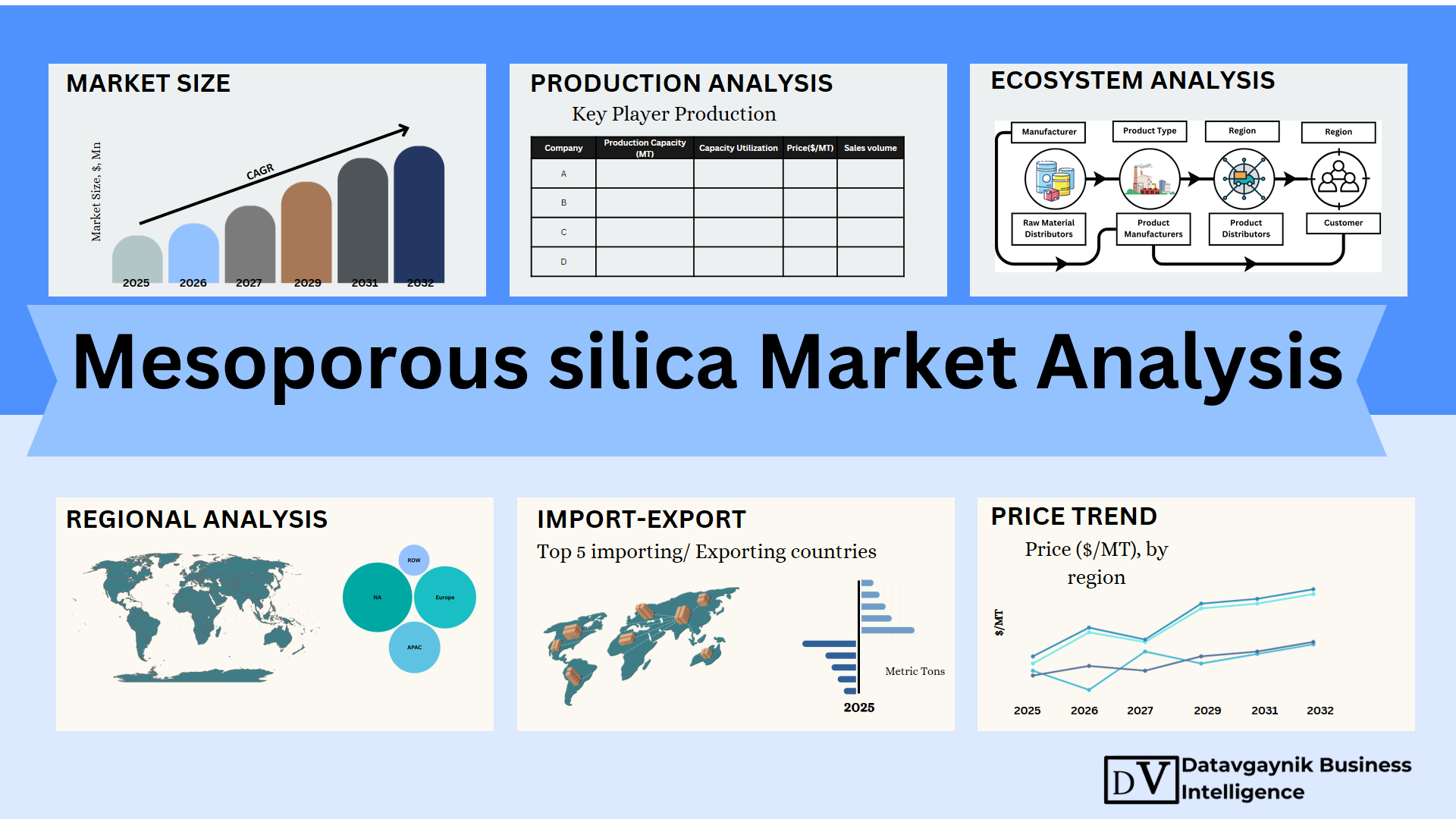
The mesoporous silica market is witnessing rapid expansion due to the growing demand for advanced drug delivery technologies. Mesoporous silica offers a unique structure—high surface area, uniform pore size, and excellent biocompatibility—making it a preferred material for controlled drug release systems. For instance, mesoporous silica is increasingly used in oncology treatments to improve the solubility of poorly water-soluble drugs and provide targeted release.
As the global pharmaceutical industry pivots toward personalized medicine, the demand for materials that enhance drug stability and bioavailability is rising sharply. With over 40% of new drug candidates falling under the BCS Class II and IV categories (low solubility), the need for mesoporous carriers has become more pressing than ever. This growth trajectory strongly positions the mesoporous silica market at the forefront of innovation in healthcare.
Mesoporous Silica Market Gains Momentum in Environmental Catalysis and Adsorption
The mesoporous silica market is also expanding rapidly due to its critical applications in environmental catalysis and adsorption technologies. The porous structure of mesoporous silica allows it to act as a highly efficient support for catalysts in processes such as hydrodesulfurization and CO₂ capture. For example, in the petrochemical industry, mesoporous silica is employed to enhance reaction efficiency and reduce energy consumption, which directly contributes to lowering carbon emissions.
Furthermore, its role in water treatment and air purification is gaining traction. Industrial wastewater treatment systems are increasingly incorporating mesoporous silica as an adsorbent to remove heavy metals and organic pollutants. Given the rise in global environmental regulations and sustainability mandates, the market for mesoporous silica in green chemistry applications is expected to grow at double-digit rates over the next decade.
Cosmetic and Personal Care Applications Drive New Revenue Streams in Mesoporous Silica Market
In the personal care industry, the mesoporous silica market is experiencing a surge in demand due to its multifunctional role in skincare and cosmetics. Mesoporous silica is used in formulations to absorb excess sebum, improve texture, and provide controlled release of active ingredients such as retinoids and antioxidants. For instance, high-performance sunscreens now incorporate mesoporous silica to reduce greasiness and improve skin feel, while anti-aging creams leverage its ability to encapsulate and gradually deliver active compounds. As consumers become increasingly ingredient-conscious, the demand for science-backed, effective materials is intensifying. The personal care segment, projected to exceed $450 billion globally by 2030, is creating significant growth avenues for the mesoporous silica market.
Nanotechnology Revolution Accelerates Mesoporous Silica Market Penetration
The evolution of nanotechnology is another critical driver of the mesoporous silica market. Research and development in this field have opened up a plethora of high-value applications, from advanced sensors and imaging systems to next-generation nanocomposites. The tunable nature of mesoporous silica’s pore structure and surface chemistry makes it highly suitable for designing multifunctional nanodevices.
For instance, in biosensing, mesoporous silica can be functionalized to selectively detect biomolecules, enabling early disease diagnostics. As more industries adopt nanoscale solutions for precision and efficiency, the demand for engineered materials like mesoporous silica is escalating. The increasing funding in nanoscience research, particularly in countries like the United States, Germany, China, and Japan, is expected to accelerate commercialization, further boosting mesoporous silica market size.
Energy Storage and Conversion Applications Amplify Mesoporous Silica Market Potential
The global shift towards renewable energy sources has elevated the demand for energy storage materials, pushing the mesoporous silica market into new territories. Mesoporous silica is being explored for use in lithium-ion batteries, fuel cells, and supercapacitors due to its excellent ion transport properties and thermal stability. In lithium-silicon anodes, mesoporous silica acts as a buffer matrix to manage volume expansion and enhance battery cycle life. Additionally, its role in hydrogen storage systems and electrochemical supercapacitors has gained prominence in the pursuit of efficient, compact energy solutions. As electric vehicle adoption grows—projected to exceed 50 million units annually by 2030—the demand for high-performance materials like mesoporous silica will experience a parallel surge.
Food and Agriculture Sectors Emerge as Emerging Frontiers for Mesoporous Silica Market
Beyond industrial and healthcare applications, the food and agriculture industries are contributing to the expansion of the mesoporous silica market. In food processing, mesoporous silica is used as an anti-caking agent and preservative carrier, helping to extend shelf life and maintain nutritional value. In agriculture, it plays a role in slow-release fertilizers and pesticide delivery systems, minimizing leaching and maximizing crop efficiency. For example, controlled-release urea using mesoporous silica matrices has shown a 20–30% increase in nitrogen use efficiency, directly translating into higher yields and reduced environmental impact. As food security and sustainable agriculture remain global priorities, the strategic use of mesoporous silica will be essential in optimizing resource use.
Sustainability and Green Chemistry Mandates Fuel Demand in Mesoporous Silica Market
Environmental sustainability has become a central theme across all industries, and the mesoporous silica market is benefiting directly from this paradigm shift. As companies aim to reduce their carbon footprint and transition to green production processes, mesoporous silica is being adopted in applications like carbon capture, low-energy catalysis, and eco-friendly coatings. Its inert nature and ability to be engineered for specific tasks make it a versatile tool in developing environmentally benign solutions. For example, mesoporous silica-supported catalysts can reduce the energy input in chemical manufacturing by up to 40%, aligning with global emissions reduction targets. As green chemistry principles become standard across sectors, the material’s value proposition will continue to strengthen.
Regional Industrial Growth and R&D Investment Power Mesoporous Silica Market Size
The mesoporous silica market size is also expanding due to regional industrialization trends and heavy investments in research and development. For instance, China’s aggressive push in advanced materials manufacturing and India’s fast-growing pharmaceutical industry are creating massive demand for mesoporous silica. Similarly, North America and Europe are driving high-value applications through strategic partnerships between academic institutions and private enterprises. Countries like Germany and Japan are at the forefront of developing novel synthesis techniques that enhance the performance and scalability of mesoporous silica materials. These regional dynamics, supported by favorable policy frameworks and a strong emphasis on innovation, are laying the foundation for the sustained growth of the mesoporous silica market.
Versatility and Customization Continue to Differentiate the Mesoporous Silica Market
One of the most compelling aspects of the mesoporous silica market is the material’s versatility. With its ability to be customized for different pore sizes, surface properties, and functionalization strategies, mesoporous silica can be tailored to serve an extraordinary range of applications. This has led to growing demand in sectors such as construction, textiles, advanced coatings, and even 3D printing. For example, in additive manufacturing, mesoporous silica can be used to control the viscosity and drying rate of printing inks, enhancing resolution and material performance. As industries continue to diversify and evolve, the inherent adaptability of mesoporous silica will ensure its relevance and drive continuous market growth.
“Track Country-wise Mesoporous silica Production and Demand through our Mesoporous silica Production Database”
-
-
- Mesoporous silica production database for 32+ countries worldwide
- Mesoporous silica sales volume for 32+ countries
- Country-wise Mesoporous silica production capacity, production plant mapping, production capacity utilization for 32+ manufacturers
- Mesoporous silica production plants and production plant capacity analysis by top manufacturers
-
“Track real-time Mesoporous silica Prices, Mesoporous silica price charts for 32+ countries, Mesoporous silica weekly price tracker and Mesoporous silica monthly price tracker”
-
-
- Track real-time Mesoporous silica prices and Mesoporous silica price trend in 32+ countries though our excel-based Mesoporous silica price charts
- Real-time Mesoporous silica price tracker dashboard with 32+ countries
- Complete transparency on Mesoporous silica price trend through our Mesoporous silica monthly price tracker, Mesoporous silica weekly price tracker
-
Geographical Demand Dynamics in the Mesoporous Silica Market
The mesoporous silica market reflects strong regional divergence in both demand and specialization. Asia Pacific leads the global demand, driven by rapid industrialization, manufacturing dominance, and expanding pharmaceutical and chemical sectors. For example, China holds the largest share in the regional mesoporous silica market due to its vast base of generic drug production, petrochemical facilities, and material science innovations. With over 60% of the world’s electronics manufacturing centered in East Asia, the region has also become a hub for mesoporous silica used in energy storage and semiconductors.
India has seen a 12% annual rise in mesoporous silica consumption over the past five years, driven by its surging pharmaceutical exports, which surpassed $25 billion recently. The country’s focus on enhancing drug bioavailability and compliance with international regulatory standards is fueling this upward trajectory. Similarly, Japan and South Korea, known for high-end electronics and biotechnology applications, are pushing the boundaries of mesoporous silica usage in nanotechnology and energy storage.
Europe, on the other hand, showcases demand driven by high regulatory standards and sustainability goals. Countries like Germany, France, and the Netherlands are at the forefront of integrating mesoporous silica into green chemistry processes. Germany, with its €30 billion chemical exports annually, is investing in catalysis and CO₂ capture applications, positioning mesoporous silica as a strategic material in carbon-neutral manufacturing.
North America reflects strong demand in high-value applications like biomedical imaging, controlled drug delivery, and environmental remediation. The United States is a top innovator, focusing on developing functionalized mesoporous silica for next-generation medical devices and diagnostics. As the U.S. FDA encourages the use of advanced excipients in novel drug formulations, mesoporous silica demand in pharmaceuticals is expected to grow by over 8% annually.
Mesoporous Silica Market Anchored by Strong Global Production Hubs
In terms of production, Asia Pacific dominates the mesoporous silica market with China at the center, producing more than 40% of the global supply. This dominance is due to large-scale synthesis capabilities, abundant raw materials, and lower production costs. Chinese manufacturers are rapidly scaling up with new synthesis techniques like microwave-assisted methods, reducing processing time by nearly 60% while improving product quality.
India is emerging as a key secondary producer, focusing on domestic consumption in pharma and agriculture. Indian manufacturers are investing in sol-gel processes and pilot-scale reactors to meet the growing demand from drug delivery and water treatment sectors. Meanwhile, Japan and South Korea focus on ultra-high purity mesoporous silica for electronics and biomedical devices, where structural uniformity and stability are critical.
Europe remains a center of innovation-driven production. Germany and France lead in producing functionalized and application-specific mesoporous silica, tailored for catalysis and advanced energy applications. North American production is more concentrated in specialty segments. U.S. companies are integrating mesoporous silica production with R&D to manufacture customized nanoparticles for biotechnology and defense applications.
Strategic Market Segmentation Shapes the Mesoporous Silica Market
The mesoporous silica market is segmented by product type, application, end-user industry, and synthesis method, each influencing market direction. Product-wise, MCM-41 dominates due to its hexagonal mesostructure and tunable pore volume, ideal for catalysis and drug delivery. For example, over 45% of MCM-41 output is directed to pharmaceutical applications, especially for drugs with poor solubility profiles.
SBA-15, characterized by larger pores and thicker walls, is favored in energy storage and biomedical applications. In lithium-sulfur batteries, SBA-15’s pore structure improves electrolyte access and charge-discharge rates, enhancing battery longevity. SBA-16 and FSM-16 cater to niche segments in petrochemicals and gas adsorption, with their cubic symmetry and high thermal stability providing operational advantages.
From an application standpoint, catalysis continues to be the largest revenue-contributing segment in the mesoporous silica market, accounting for nearly 30% of overall demand. Drug delivery is close behind, followed by adsorption systems used in air and water purification. Sensor applications, though currently a smaller slice, are showing growth of over 11% annually as smart diagnostics and biosensing technologies evolve.
End-user segmentation reveals pharmaceuticals as the dominant consumer, comprising more than one-third of total mesoporous silica market demand. Chemicals, environmental management, and cosmetics follow closely. In agriculture, the use of mesoporous silica in slow-release fertilizers and crop protection is opening a new revenue stream, especially in emerging markets.
Mesoporous Silica Price Trend: Impact of Scale, Purity, and Innovation
Mesoporous silica price trends are closely linked to synthesis method, purity level, and regional production efficiencies. Standard mesoporous silica, used in catalysis and adsorption, typically ranges between $300 to $600 per kilogram. However, functionalized or high-purity grades used in drug delivery and nanomedicine can exceed $1,200 per kilogram.
Over the past three years, the average mesoporous silica price has witnessed moderate fluctuation. Bulk-grade mesoporous silica prices dropped by around 8% as Chinese suppliers expanded capacity, creating competitive pressure. However, in high-spec markets like pharmaceuticals and energy storage, mesoporous silica prices have remained resilient due to consistent demand and high R&D costs involved in production.
For instance, the adoption of SBA-15 in lithium-ion battery research has pushed mesoporous silica price trends upward, especially in Japan and Germany, where demand for precision materials is high. Similarly, the shift toward eco-friendly synthesis methods in Europe—such as using bio-based templates and energy-efficient calcination—has slightly increased mesoporous silica prices in the region, but also positioned producers for long-term regulatory and competitive advantage.
In North America, mesoporous silica price trends are being shaped by innovation. U.S. manufacturers are moving toward process intensification to lower the cost-per-gram of ultra-pure mesoporous silica. At the same time, increasing applications in FDA-regulated drug formulations are allowing suppliers to maintain premium pricing, as compliance and performance are more important than volume economics in this market.
Mesoporous Silica Price Influenced by Logistics, Regulation, and Customization
Transportation and logistics costs also significantly influence mesoporous silica price trends. As the material is often shipped in controlled environments to prevent contamination or moisture absorption, international freight rates affect final pricing. For example, European imports from Asia incur a 10–15% cost markup due to stringent packaging and handling standards.
Regulatory compliance, especially for pharmaceutical-grade mesoporous silica, adds another layer of cost. Cleanroom manufacturing, traceability, and ISO certifications required for biomedical use can raise production costs by 20–30%. These cost structures directly reflect in the price trends across medical and diagnostic segments.
Moreover, customization plays a pivotal role in mesoporous silica pricing. Functionalization with amines, thiols, or other organic groups, depending on the end use, increases both the value and cost of the product. For example, mesoporous silica customized for gene delivery or enzyme immobilization commands significantly higher pricing than unmodified variants due to the complex surface engineering involved.
Future Outlook: Regional Shifts and Value-Centric Growth in the Mesoporous Silica Market
Looking forward, the mesoporous silica market is expected to experience both geographical and value-based shifts. Asia Pacific will continue to lead in production, but the U.S. and Europe are set to drive value through innovation and high-end applications. African and Middle Eastern countries may emerge as consumers for water purification and environmental remediation applications, pushing global trade routes for mesoporous silica.
The market is also expected to see more contract manufacturing, especially for pharmaceutical companies seeking to outsource the production of mesoporous silica-based excipients. This outsourcing trend may stabilize mesoporous silica price trends as producers optimize batch sizes and standardize production costs.
At the same time, sustainability mandates are encouraging producers to adopt greener synthesis pathways, which, while raising short-term costs, will align with long-term industry expectations and regulatory frameworks. Companies that integrate environmental performance with product innovation will be best positioned to capture premium segments and ensure consistent revenue growth.
“Mesoporous silica Manufacturing Database, Mesoporous silica Manufacturing Capacity”
-
-
- Mesoporous silica top manufacturers market share for 32+ manufacturers
- Top 12 manufacturers and top 19 manufacturers of Mesoporous silica in North America, Europe, Asia Pacific
- Mesoporous silica production plant capacity by manufacturers and Mesoporous silica production data for 32+ market players
- Mesoporous silica production dashboard, Mesoporous silica production data in excel format
-
“Mesoporous silica price charts, Mesoporous silica weekly price tracker and Mesoporous silica monthly price tracker”
-
-
- Factors impacting real-time Mesoporous silica prices in 32+ countries worldwide
- Mesoporous silica monthly price tracker, Mesoporous silica weekly price tracker
- Real-time Mesoporous silica price trend, Mesoporous silica price charts, news and updates
- Tracking Mesoporous silica price fluctuations
-
Top Manufacturers Driving Growth in the Mesoporous Silica Market
The mesoporous silica market is shaped by a group of leading manufacturers that are advancing the material’s applications across pharmaceuticals, energy, environment, and nanotechnology. These companies are leveraging innovation, scale, and strategic positioning to capture significant market share, often through specialized product lines designed for specific industries.
Merck KGaA: Precision Materials for High-Purity Applications
Merck KGaA has solidified its role in the mesoporous silica market by focusing on high-purity, research-grade materials. The company offers customized mesoporous silica products tailored for biomedical research, drug delivery systems, and diagnostics. One of their known product lines includes nanoporous silica used for gene and drug encapsulation. Merck’s strategy is centered on advanced life science applications, and the company holds a sizable share in the pharmaceutical-grade mesoporous silica segment, particularly in Europe and North America.
W.R. Grace & Co.: Catalysis-Centric Silica Innovation
W.R. Grace & Co. is a dominant force in catalysis-grade mesoporous silica. Through its product series focused on structured silicas, the company serves the chemical and petrochemical sectors extensively. Their specialty includes materials that improve reaction efficiency and reduce energy inputs in hydrocracking and fluid catalytic cracking. With its well-established partnerships in oil refining and fine chemical manufacturing, Grace holds a leading position in the industrial-grade mesoporous silica market, especially in North America and Latin America.
Evonik Industries: Versatile Solutions for Cosmetics and Adsorption
Evonik Industries offers a comprehensive mesoporous silica product portfolio under the brand name SIPERNAT. These materials are used across a wide spectrum—from cosmetics, where they serve as mattifying and oil-control agents, to industrial adsorption systems for moisture control and volatile compound removal. Evonik’s silica business commands a significant market share in the cosmetics segment, particularly in Asia and Europe, where demand for functional personal care ingredients is on the rise. The company has also expanded its capabilities in energy storage applications through functionalized silica for battery components.
BASF SE: Driving Sustainability through Catalysis and Environmental Products
BASF SE has positioned itself as a key innovator in the mesoporous silica market, focusing on green chemistry and sustainable catalysis. The company offers materials designed for gas separation, CO₂ capture, and wastewater treatment. Their mesoporous silica line plays a role in industrial applications that require materials with high mechanical strength and thermal stability. BASF is investing in proprietary synthesis methods that lower energy usage during production, giving them an advantage in the European environmental solutions market. Their share in this segment continues to expand as global regulations on emissions tighten.
PQ Corporation: Focused on Silicate Chemistry and Tailored Materials
PQ Corporation leverages deep expertise in silicate chemistry to produce mesoporous silica used in detergents, coatings, and high-surface-area catalysts. With its vertically integrated operations, PQ ensures cost-effective production while maintaining control over quality. The company has gained traction in markets requiring silica with precise particle morphology and porosity control, such as agriculture and performance coatings. Its market share is growing steadily in North America and selected parts of Asia where demand for value-engineered materials is accelerating.
Mitsubishi Chemical Holdings: Advanced Materials for Electronics and Energy
Mitsubishi Chemical has brought its strengths in polymer science and materials engineering to the mesoporous silica market. The company focuses on high-performance applications, including electronics, sensors, and fuel cells. Their mesoporous silica is used in semiconductor polishing and electrode materials, particularly in Japan and South Korea. Mitsubishi’s focus on electronic-grade and energy sector silica has enabled it to capture niche, high-value segments with growth potential tied to electric vehicles and semiconductor manufacturing.
Market Share Overview by Manufacturer
In terms of global mesoporous silica market share, Merck KGaA and Evonik Industries together account for approximately 25% of the market, with Merck dominating pharmaceutical and diagnostics-grade materials, while Evonik leads in cosmetics and adsorbents. W.R. Grace & Co. controls nearly 15% of the market due to its extensive reach in petrochemical catalysis. BASF holds around 10–12% share, driven by its environmental and industrial product lines.
Other manufacturers, including PQ Corporation and Mitsubishi Chemical, contribute to the remaining share through focused niche applications. A large portion of the market is also fragmented, with regional players and contract manufacturers catering to local demand, particularly in Asia Pacific where China and India host several mid-tier producers.
Product Specialization as a Competitive Lever
Manufacturers are increasingly segmenting their product portfolios to cater to industry-specific requirements. For example, drug delivery systems require mesoporous silica with controlled surface charge and functionalized internal surfaces, while water treatment applications prioritize pore volume and adsorption kinetics. This specialization allows companies to lock in long-term supply agreements and move up the value chain.
In cosmetics, Evonik’s developments in silica particles with optimized oil absorption and light-scattering capabilities have led to widespread adoption by global skincare brands. Similarly, BASF’s advancements in mesoporous silica for catalytic converters in automobiles are helping reduce NOx emissions, aligning with environmental regulations in the EU.
Recent Developments and Industry Movements
Over the past two years, several key developments have reshaped the competitive landscape of the mesoporous silica market:
- In July 2023, Evonik announced a strategic expansion of its SIPERNAT production facility in Germany, aimed at increasing capacity for cosmetic and pharmaceutical applications.
- Merck completed the acquisition of a specialty nanomaterials firm in Q4 2023, adding advanced functionalized silica formulations to its product line for drug delivery.
- In March 2024, W.R. Grace & Co. signed a long-term supply agreement with a Middle Eastern refinery group to provide mesoporous silica catalysts, signaling the company’s focus on global market penetration.
- BASF revealed in January 2024 a new eco-friendly synthesis platform that reduces the carbon footprint of mesoporous silica by 25%, aligning with its 2030 sustainability roadmap.
- Mitsubishi Chemical launched a new mesoporous silica grade in May 2024 for solid-state battery applications, highlighting the material’s expanding role in next-generation energy storage.
These developments indicate a clear shift toward sustainability, application diversification, and regional expansion. Manufacturers are not only expanding capacity but also investing in R&D to differentiate their offerings, maintain pricing power, and align with evolving industry demands.
“Mesoporous silica Production Data and Mesoporous silica Production Trend, Mesoporous silica Production Database and forecast”
-
-
- Mesoporous silica production database for historical years, 12 years historical data
- Mesoporous silica production data and forecast for next 12 years
- Mesoporous silica sales volume by manufacturers
-
“Track Real-time Mesoporous silica Prices for purchase and sales contracts, Mesoporous silica price charts, Mesoporous silica weekly price tracker and Mesoporous silica monthly price tracker”
-
-
- Gain control on your purchase and sales contracts through our real-time Mesoporous silica price tracker and Mesoporous silica price trend analysis
- Mesoporous silica weekly price tracker and forecast for next four weeks
- Mesoporous silica monthly price tracker and forecast for next two months
-
Market Scenario, Demand vs Supply, Average Product Price, Import vs Export, till 2035
- Global Mesoporous silica Market revenue and demand by region
- Global Mesoporous silica Market production and sales volume
- United States Mesoporous silica Market revenue size and demand by country
- Europe Mesoporous silica Market revenue size and demand by country
- Asia Pacific Mesoporous silica Market revenue size and demand by country
- Middle East & Africa Mesoporous silica Market revenue size and demand by country
- Latin America Mesoporous silica Market revenue size and demand by
- Import-export scenario – United States, Europe, APAC, Latin America, Middle East & Africa
- Average product price – United States, Europe, APAC, Latin America, Middle East & Africa
- Market player analysis, competitive scenario, market share analysis
- Business opportunity analysis
Key questions answered in the Global Mesoporous silica Market Analysis Report:
- What is the market size for Mesoporous silica in United States, Europe, APAC, Middle East & Africa, Latin America?
- What is the yearly sales volume of Mesoporous silica and how is the demand rising?
- Who are the top market players by market share, in each product segment?
- Which is the fastest growing business/ product segment?
- What should be the business strategies and Go to Market strategies?
The report covers Mesoporous silica Market revenue, Production, Sales volume, by regions, (further split into countries):
- Asia Pacific (China, Japan, South Korea, India, Indonesia, Vietnam, Rest of APAC)
- Europe (UK, Germany, France, Italy, Spain, Benelux, Poland, Rest of Europe)
- North America (United States, Canada, Mexico)
- Latin America (Brazil, Argentina, Rest of Latin America)
- Middle East & Africa
Table of Contents:
Mesoporous Silica Market:
- Introduction to Mesoporous Silica Market
- Definition and Overview
- Historical Evolution and Development
- Key Applications and Industry Relevance
- Market Dynamics
- Drivers of Market Growth
- Restraints and Challenges
- Opportunities and Emerging Trends
- Regulatory Landscape and Industry Policies
- Mesoporous Silica Product Segmentation
- By Pore Size (Small, Medium, Large)
- By Material Type (MCM-41, SBA-15, Others)
- By Form (Powder, Granules, Others)
- By Functionalization (Surface Modified, Non-modified)
- Global Mesoporous Silica Market Overview (2019-2035)
- Market Size and Revenue Forecast
- Volume Analysis and Growth Projections
- Market Penetration Across Key Industries
- Regional Market Insights
- North America (USA, Canada, Mexico)
- Market Size, Production, Demand, and Import-Export Analysis
- Europe (Germany, UK, France, Italy, Rest of Europe)
- Market Trends, Revenue, Production, and Trade Flow
- Asia Pacific (China, Japan, India, South Korea, Rest of APAC)
- Manufacturing Capacity, Sales, and Growth Drivers
- Latin America (Brazil, Argentina, Rest of Latin America)
- Market Expansion, Sales, and Key Import-Export Data
- Middle East & Africa (GCC, South Africa, Rest of MEA)
- Emerging Market Trends and Strategic Opportunities
- North America (USA, Canada, Mexico)
- Global Production Capacity and Forecast (2019-2035)
- Production Capacity Trends
- Expansion Plans of Leading Manufacturers
- Technology Impact on Production Efficiency
- Competitive Landscape
- Overview of Key Market Players
- Company Profiles, Product Portfolios, and Strategic Developments
- Market Share Analysis (2019-2025)
- Innovation and R&D Initiatives
- Pricing Analysis
- Global Price Trends (2019-2035)
- Regional Price Differentials
- Factors Influencing Pricing Strategy
- Supply Chain and Value Chain Analysis
- Raw Material Sourcing and Procurement Strategy
- Value Addition Across the Supply Chain
- Distribution Channels and Logistics Overview
- Raw Material Analysis
- Key Raw Materials Used in Mesoporous Silica Production
- Supply Sources and Price Volatility Trends
- Impact of Raw Material Availability on Production
- Manufacturing Process and Cost Structure
- Detailed Manufacturing Process Flow
- Cost Breakdown: Labor, Energy, Raw Materials, and Overheads
- Economies of Scale and Cost Optimization Strategies
- Trade and Export-Import Analysis
- Major Exporting and Importing Countries
- Trade Policies and Tariff Structures
- Impact of Global Trade Dynamics on the Market
- Mesoporous Silica Applications Analysis
- Catalysts and Adsorbents
- Drug Delivery Systems
- Energy Storage and Conversion
- Environmental Applications
- Others (Sensors, Cosmetics, etc.)
- End-User Industry Analysis
- Pharmaceuticals
- Chemicals and Petrochemicals
- Environmental & Water Treatment
- Electronics and Semiconductors
- Construction Materials
- Consumer Insights and Demand Trends
- Consumption Patterns by Region
- Factors Influencing Consumer Preferences
- Forecast of Demand Trends (2025-2035)
- Technological Advancements and Innovations
- Emerging Technologies in Mesoporous Silica Production
- Sustainable and Eco-friendly Manufacturing Techniques
- Impact of Nanotechnology and Smart Materials
- Strategic Analysis for Market Entry and Growth
- Barriers to Entry
- Key Success Factors
- Strategic Recommendations for New Entrants
- Impact of Global Economic and Environmental Factors
- Influence of Macroeconomic Indicators
- Environmental Regulations and Sustainability Trends
- COVID-19 and Its Long-term Market Impact
- Risk Analysis and Mitigation Strategies
- Market Risks and Uncertainties
- Risk Management Approaches for Businesses
- Investment Analysis and Opportunities
- Attractive Investment Regions and Segments
- Venture Capital and Funding Trends
- Mergers, Acquisitions, and Strategic Alliances
- Forecast Scenarios (2025-2035)
- Optimistic, Realistic, and Pessimistic Growth Scenarios
- Factors Influencing Forecast Variability
- Key Findings and Strategic Insights
- Summary of Key Market Trends and Insights
- Strategic Takeaways for Stakeholders
- Appendix
- Glossary of Terms
- Methodology
- List of Abbreviations
- References and Data Sources
Other recently published reports:


