

Surging Demand Across Diverse Sectors Boosting the Mint Terpene Market
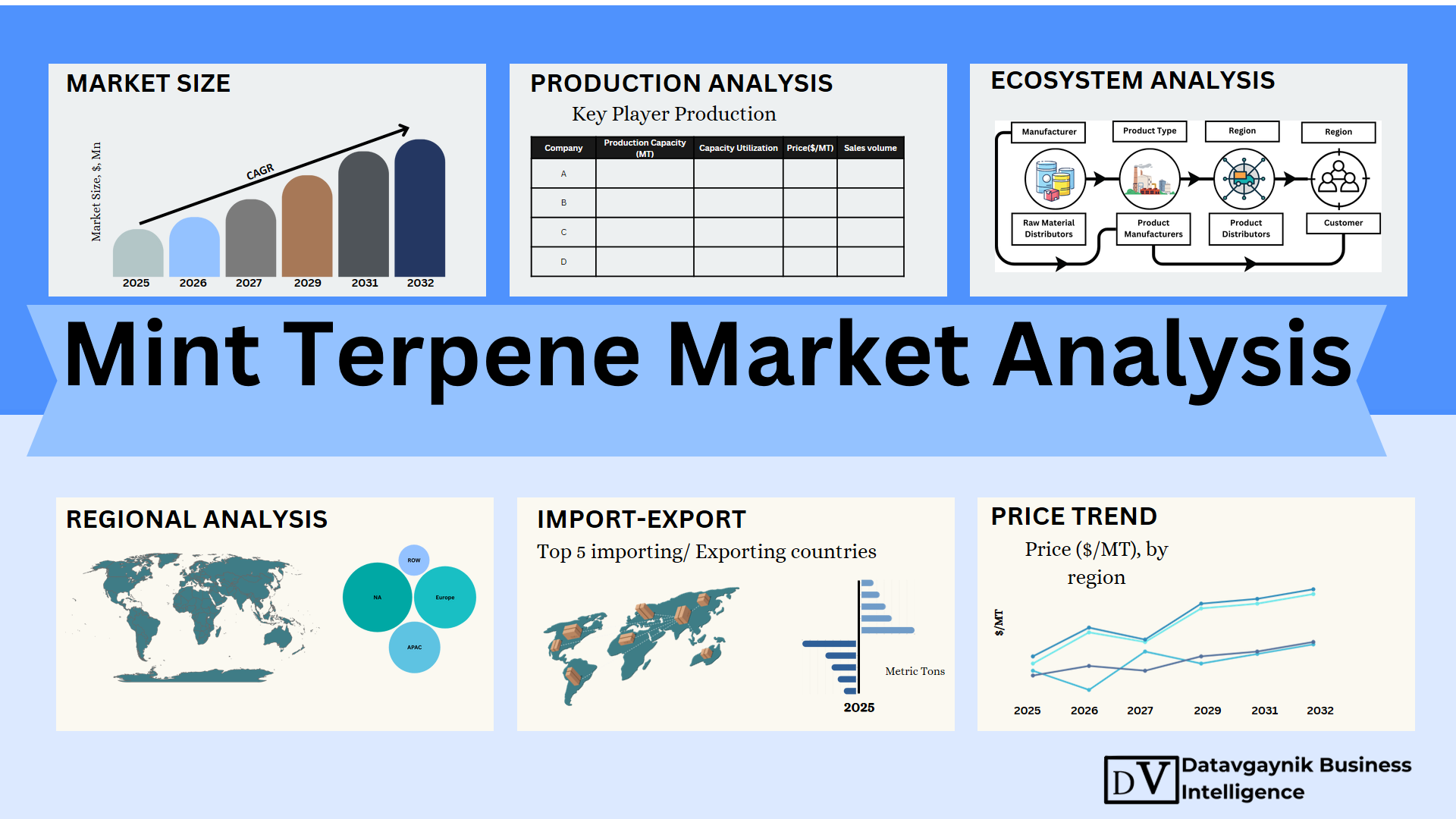
The Mint Terpene Market is undergoing a robust expansion phase, driven by its growing utility across multiple industries. From food and beverages to pharmaceuticals and cosmetics, the appeal of mint-derived terpenes lies in their aromatic potency, bioactivity, and natural origin. As of 2025, the Mint Terpene Market Size has shown a consistent upward trajectory, propelled by consumers’ shift toward organic ingredients and plant-based wellness products.
For instance, the rising global interest in clean-label food and beverages has triggered a strong demand for mint terpenes as natural flavor enhancers. Chewing gums, dairy drinks, and flavored waters featuring mint undertones are witnessing double-digit growth rates annually. Functional beverage consumption is projected to grow at over 8% CAGR through 2030, which directly boosts the inclusion of mint terpenes in formulations seeking freshness and digestive appeal.
Food and Beverage Innovation Fueling Mint Terpene Market Size Growth
The food and beverage industry continues to be one of the strongest pillars supporting the Mint Terpene Market. With consumer demand intensifying for products that combine taste with functionality, mint terpenes are increasingly integrated into not only traditional products like candies and gums, but also modern offerings such as kombucha, flavored yogurts, and nutritional bars.
For example, the global chewing gum segment alone is valued at over $25 billion, and more than 40% of that market is dominated by mint-flavored variants. Terpenes like menthol, carvone, and limonene are crucial in delivering the characteristic freshness and cooling effects consumers associate with mint products. As product development leans into sensory experiences, manufacturers are ramping up mint terpene inclusion to capture consumer loyalty.
Pharmaceutical Industry Emerges as a Core Consumer of Mint Terpenes
The Mint Terpene Market is witnessing a surge in demand from the pharmaceutical sector, primarily due to the therapeutic properties of compounds like menthol and cineole. Mint terpenes exhibit anti-inflammatory, antimicrobial, analgesic, and decongestant effects, making them indispensable for over-the-counter drugs and respiratory treatments.
For instance, the global cough and cold market is projected to cross $50 billion by 2027, and mint terpenes are key active ingredients in syrups, lozenges, nasal sprays, and inhalants. With an aging global population and rising respiratory disorders due to urban pollution, demand for mint-based pharmaceuticals is expected to grow steadily at a CAGR of 6.2% through 2030, directly reinforcing the strength of the Mint Terpene Market.
Cosmetics and Personal Care Industry Accelerates Mint Terpene Market Expansion
Mint terpenes have carved out a crucial role in the cosmetics and personal care sector, where consumer expectations now go beyond scent to include functionality and sustainability. Products infused with mint terpenes offer cooling, anti-bacterial, and soothing benefits, aligning perfectly with market trends such as “skinimalism” and natural skincare.
In 2024 alone, the global market for natural personal care products exceeded $15 billion. Within this category, items like face masks, scalp treatments, and body washes featuring menthol and carvone are experiencing rapid adoption. The Mint Terpene Market benefits substantially from this growth, particularly as major brands reformulate with botanical and terpene-based actives to meet green beauty standards.
Cannabis Industry Integration Reinforces Mint Terpene Market Potential
One of the most transformative drivers of the Mint Terpene Market is the cannabis industry, where terpenes play a central role in defining flavor profiles and enhancing therapeutic effects. Mint terpenes, especially when blended with cannabinoids, amplify both the sensory and medicinal impact of cannabis products.
The legal cannabis market is expected to exceed $90 billion globally by 2030. Within this space, mint terpene applications in vape cartridges, tinctures, and infused edibles are skyrocketing. Formulators seek out mint terpenes not only for their flavoring but also for their potential entourage effects—enhancing absorption and efficacy of cannabinoids like CBD and THC. This intersection is rapidly redefining value creation within the Mint Terpene Market.
Rising Popularity of Aromatherapy Driving Global Mint Terpene Market
Aromatherapy has shifted from a niche wellness practice to a mainstream consumer interest, further advancing the Mint Terpene Market. Mint terpenes such as menthol and pulegone are well-known for their uplifting, refreshing, and stress-relieving effects. Their inclusion in diffusers, massage oils, and personal wellness blends has become increasingly commonplace.
In 2023, the global aromatherapy market surpassed $8 billion, and essential oils derived from mint species accounted for nearly 30% of total volume sold. Consumers are turning to natural inhalants and roll-ons as daily mood enhancers and sleep aids. This strong and sustained demand contributes significantly to the expansion of the Mint Terpene Market in both retail and therapeutic channels.
Sustainability and Clean Label Trends Underpin Mint Terpene Market Growth
The global pivot toward sustainable and ethical sourcing is fundamentally reshaping the Mint Terpene Market. Terpenes derived from peppermint, spearmint, and wild mint offer an ideal solution for companies aiming to meet clean-label requirements while maintaining performance in their formulations.
Mint is a highly renewable crop with robust yields per acre and low pesticide requirements, making it attractive from both an environmental and economic perspective. Furthermore, steam distillation and solvent-free extraction methods now dominate industrial processing, enabling manufacturers to offer certified organic and ISO-compliant terpene products. These developments align closely with the rising consumer demand for transparency, further elevating the stature of mint terpenes in global supply chains.
R&D and Product Innovation Catalyze Mint Terpene Market Opportunities
Innovation continues to be a cornerstone in the evolution of the Mint Terpene Market. Advances in terpene extraction technologies—such as supercritical CO₂ and microwave-assisted distillation—are improving yield, purity, and consistency, making mint terpenes more accessible for a broader range of applications.
In addition, R&D efforts are expanding the scope of mint terpenes in emerging industries such as nutraceuticals, biodegradable cleaning agents, and bio-based solvents. For instance, eco-friendly mint-based cleaning products are projected to grow by 12% CAGR as consumer awareness around indoor air quality and toxin exposure increases. These new use cases are opening up high-margin segments for producers and helping diversify market dependence beyond traditional sectors.
Global Mint Terpene Market Size Strengthened by Regional Leadership
The Mint Terpene Market Size is being fortified by strong regional performances, especially in the U.S., India, and China—three nations that collectively contribute over 65% of global mint terpene production. India’s Uttar Pradesh region remains the backbone of raw material supply, while U.S.-based companies in Oregon and Idaho lead in high-purity extractions for food and fragrance applications.
Meanwhile, Europe’s stringent regulatory landscape around synthetic additives has led to a surge in imports of natural mint terpenes, particularly from countries with established organic certification frameworks. This international demand dynamic ensures a healthy trade flow and supports long-term scalability for stakeholders within the Mint Terpene Market.
Consumer Awareness and Health Consciousness Reshape Mint Terpene Demand
Lastly, the ongoing global health renaissance—driven by post-pandemic lifestyle shifts—is directly fueling the Mint Terpene Market. Mint terpenes are increasingly viewed not just as flavor or fragrance agents, but as wellness enhancers with functional health benefits. The use of mint terpenes in digestive aids, decongestants, and oral care aligns with this growing interest in preventative healthcare and natural remedies.
As more consumers seek alternatives to synthetic chemicals, the appeal of mint terpenes continues to rise across age groups and demographics. This rising awareness, coupled with industry-wide reformulation efforts, positions the Mint Terpene Market for sustained, innovation-led growth in the coming decade.
“Mint Terpene Manufacturing Database, Mint Terpene Manufacturing Capacity”
-
-
- Mint Terpene top manufacturers market share for 32+ manufacturers
- Top 12 manufacturers and top 19 manufacturers of Mint Terpene in North America, Europe, Asia Pacific
- Mint Terpene production plant capacity by manufacturers and Mint Terpene production data for 32+ market players
- Mint Terpene production dashboard, Mint Terpene production data in excel format
-
“Mint Terpene price charts, Mint Terpene weekly price tracker and Mint Terpene monthly price tracker”
-
-
- Factors impacting real-time Mint Terpene prices in 32+ countries worldwide
- Mint Terpene monthly price tracker, Mint Terpene weekly price tracker
- Real-time Mint Terpene price trend, Mint Terpene price charts, news and updates
- Tracking Mint Terpene price fluctuations
-
Geographical Demand Patterns Reshaping the Mint Terpene Market
North America: The Powerhouse of High-Purity Mint Terpene Market
The Mint Terpene Market in North America, particularly in the United States, is evolving as a global benchmark for high-quality production. The states of Oregon, Washington, and Idaho dominate mint cultivation, supported by favorable climate and advanced agritech practices. These regions supply the bulk of the menthol, carvone, and limonene used in applications ranging from pharmaceuticals to functional beverages.
For instance, U.S. demand for mint terpenes in oral hygiene products alone has increased by over 18% in the past three years. This is directly linked to a consumer pivot toward naturally sourced actives in toothpaste, mouthwash, and throat sprays. Additionally, with functional beverage consumption surging across North America—expected to grow at over 7% CAGR—the requirement for mint-based flavoring agents is rising rapidly, further strengthening the Mint Terpene Market across the region.
Europe: Regulatory Precision Driving Imports and Market Optimization
In Europe, stringent regulations around synthetic ingredients have pushed manufacturers to embrace naturally derived alternatives, giving the Mint Terpene Market a distinct edge. Countries like Germany, France, and the United Kingdom lead in terpene-based product innovation, especially in pharmaceuticals and cosmetics. The German pharmaceutical industry, valued at over $65 billion, has adopted mint terpenes in everything from nasal sprays to digestive aids.
For example, in France, the natural cosmetics market has expanded by more than 15% year-on-year, with mint terpene-based ingredients like menthol and pulegone becoming core components in cooling skin treatments and therapeutic oils. The demand for imported mint terpenes has grown steadily, particularly from producers in India and the U.S., due to Europe’s limited large-scale mint cultivation.
Asia Pacific: Production Stronghold and Demand Acceleration
The Asia Pacific region represents a powerful dual force in the Mint Terpene Market: high production and exponentially growing demand. India, China, and Japan are central players. India, with its vast cultivation in Uttar Pradesh, is a global supplier of mint terpenes. The country accounts for over 80% of the world’s natural menthol exports, with annual growth in terpene extraction facilities exceeding 10%.
Meanwhile, domestic demand is increasing. In India, the Ayurvedic wellness market—valued at over $7 billion—is incorporating mint terpenes in a wide array of products, from herbal balms to digestive tonics. In China, terpenes are being rapidly integrated into both traditional medicine and modern pharma, driven by a health-conscious middle class. Japan continues to innovate in food and cosmetics, incorporating mint terpenes in refreshing teas, deodorants, and topical analgesics.
Latin America: Emerging Opportunities in the Mint Terpene Market
Latin America is showing clear signs of growth in the Mint Terpene Market, with countries like Brazil and Mexico tapping into their favorable climates and rising consumer demand for herbal and plant-based products. Brazil’s food flavoring sector, expanding at a CAGR of 6%, is increasingly adopting mint terpenes in confectionery and health beverages.
Mexico, a significant player in the flavor and fragrance sector, is leveraging mint terpenes in both domestic production and exports, particularly for chewing gums and herbal throat lozenges. With increasing investment in organic agriculture, the region is positioning itself as a strategic supplier of naturally derived mint-based compounds to North American and European buyers.
Middle East and Africa: Untapped Potential in Wellness and Personal Care
The Mint Terpene Market in the Middle East and Africa is still in the early growth stage but shows considerable promise. Countries like the United Arab Emirates and South Africa are increasing their imports of mint terpenes for use in aromatherapy, natural cosmetics, and over-the-counter remedies. As the wellness industry gains momentum—growing at over 9% annually in the region—mint-based essential oils and topical formulations are becoming more mainstream.
Several African countries are exploring mint cultivation as a new cash crop, leveraging their agrarian economies and favorable conditions. With proper infrastructure and investment in extraction facilities, the region could soon become both a producer and a consumer in the global mint terpene ecosystem.
Market Segmentation Unlocking Growth Channels in the Mint Terpene Market
By Type: Functional Diversity Driving Segment Performance
Within the Mint Terpene Market, segmentation by type reflects clear demand patterns. Menthol remains the dominant terpene, accounting for nearly 60% of market volume. Its application in analgesics, decongestants, and skincare ensures consistent industrial demand. Carvone, primarily used in flavoring gum and dental products, is gaining traction due to its antimicrobial benefits.
Limonene, with its mint-citrus profile, is increasingly preferred in natural cleaning products and wellness beverages. For instance, eco-friendly surface cleaners featuring limonene have seen over 12% year-on-year growth. Secondary compounds like pulegone and cineole are carving out niches in aromatherapy and veterinary care, expanding the market footprint across new consumer bases.
By Application: Versatility Ensuring Sustainable Expansion
Segmentation by application reveals that pharmaceuticals continue to hold the largest share in the Mint Terpene Market. Mint terpenes are featured in hundreds of SKUs for respiratory, digestive, and pain relief applications. The food and beverage segment is closely behind, particularly due to its use in clean-label flavored water, candies, and dairy alternatives.
Cosmetics and personal care is the fastest-growing application segment, projected to increase at a CAGR of 9.1%. Mint terpenes are used not only for their scent but also for their anti-inflammatory and pore-tightening properties. Meanwhile, aromatherapy continues to gain traction in both developed and emerging economies, with consumers favoring mint-scented oils for relaxation and mental clarity.
By End-Use Industry: Wellness, Healthcare, and Clean Tech Leading
The end-use industries dominating the Mint Terpene Market are healthcare, personal care, and eco-conscious cleaning. For instance, demand from the natural cleaning product sector is projected to grow at 13% CAGR, with companies replacing synthetic agents with terpenes like limonene for natural disinfecting capabilities.
The nutraceuticals industry is also a rapidly expanding user, incorporating mint terpenes in capsules, herbal shots, and digestive chews. As regulatory bodies tighten standards around synthetic additives, companies across these end-use industries are actively sourcing high-purity, naturally derived terpenes, reinforcing long-term market stability.
Mint Terpene Price Trend: Navigating Cost, Quality, and Supply Pressures
The Mint Terpene Price Trend has been marked by volatility over the past five years, largely due to fluctuations in raw material supply and evolving global demand. Mint Terpene Prices tend to spike during periods of high agricultural stress, such as droughts or pest outbreaks in key producing regions like India and the U.S.
For instance, menthol prices rose by nearly 20% in late 2023 due to reduced peppermint yields in North India. On the other hand, the growing scale of steam distillation and solvent-free extraction has helped stabilize production costs for certain terpenes like carvone and limonene.
The Mint Terpene Price is also being influenced by labor costs, energy inputs, and freight charges, especially in export-heavy economies. Europe’s dependence on imported mint terpenes means that shipping disruptions and customs regulations can significantly affect local Mint Terpene Price Trend patterns.
Technological Advancements Impacting Mint Terpene Price and Scalability
Innovation in extraction and processing is gradually lowering the cost per unit in high-volume terpene production. Techniques such as supercritical CO₂ extraction and green chemistry-based solvent separation are improving yield efficiency and reducing environmental impact. As a result, the Mint Terpene Price for food-grade and pharmaceutical-grade products has become more competitive.
Furthermore, the integration of AI in cultivation analytics is helping farmers optimize crop cycles and reduce waste, thus indirectly impacting Mint Terpene Price trends by making upstream supply chains more efficient.
Premiumization and Certification Adding a Tiered Pricing Structure
The Mint Terpene Market is also undergoing premiumization, particularly in regions like Switzerland, Germany, and Japan, where certified organic, non-GMO terpenes command a significantly higher Mint Terpene Price. This has led to a three-tier pricing model—basic industrial-grade, food/pharma-grade, and certified organic-grade—with price differences exceeding 30% between levels.
For example, a standard kilogram of industrial menthol may retail for $15–$20, while certified organic menthol can cross the $30 mark, depending on purity and origin. This pricing model is expected to gain more clarity as labeling standards improve and traceability becomes more important to end consumers.
Outlook: Strategic Supply Chain Realignment to Balance Mint Terpene Price Volatility
Going forward, the Mint Terpene Price Trend is expected to stabilize as producers invest in backward integration and multi-sourcing strategies. Establishing localized extraction hubs near mint farms and investing in renewable energy inputs can significantly mitigate cost fluctuations.
Additionally, the increasing availability of blockchain-enabled traceability platforms is allowing buyers to verify product authenticity, fostering trust in higher-priced premium terpene segments. These trends are not only supporting transparent pricing but also driving resilience in the global Mint Terpene Market supply chain.
“Mint Terpene Manufacturing Database, Mint Terpene Manufacturing Capacity”
-
-
- Mint Terpene top manufacturers market share for 32+ manufacturers
- Top 12 manufacturers and top 19 manufacturers of Mint Terpene in North America, Europe, Asia Pacific
- Mint Terpene production plant capacity by manufacturers and Mint Terpene production data for 32+ market players
- Mint Terpene production dashboard, Mint Terpene production data in excel format
-
“Mint Terpene price charts, Mint Terpene weekly price tracker and Mint Terpene monthly price tracker”
-
-
- Factors impacting real-time Mint Terpene prices in 32+ countries worldwide
- Mint Terpene monthly price tracker, Mint Terpene weekly price tracker
- Real-time Mint Terpene price trend, Mint Terpene price charts, news and updates
- Tracking Mint Terpene price fluctuations
-
Top Manufacturers Shaping the Global Mint Terpene Market
Dominant Players in the Mint Terpene Market
The global Mint Terpene Market is increasingly being defined by the strategic actions of a handful of major manufacturers. These companies control significant portions of the supply chain—from raw material cultivation and terpene extraction to formulation and distribution. Their market dominance stems from large-scale infrastructure, advanced R&D capabilities, and well-established global networks.
Among the leaders in the Mint Terpene Market are Symrise AG, Takasago International Corporation, Firmenich, Givaudan, BASF, International Flavors & Fragrances (IFF), Arora Aromatics, Mentha & Allied Products, and Nectar Lifesciences. Each of these companies has carved out a unique position, either through product innovation, regional specialization, or diversified application coverage.
Symrise AG: Innovation-Driven Leadership in Mint Terpenes
Symrise AG holds a strong position in the Mint Terpene Market, known for its wide-ranging portfolio of mint-derived compounds used in flavors, fragrances, and personal care. Its Coolact series, including Coolact 10 and Coolact P, is engineered to deliver high-performance cooling effects in skincare and oral care formulations.
Symrise’s global supply chain, with sourcing hubs in Asia and distillation units in Europe and the Americas, enables it to serve major FMCG brands across regions. The company is estimated to account for approximately 12–14% of the global Mint Terpene Market share.
Givaudan: Premium Product Line and Regional Strength
Givaudan, one of the largest fragrance and flavor companies in the world, plays a significant role in the Mint Terpene Market. Its product line includes mint-based natural isolates like Menthol Natural and Menthyl Lactate, widely used in chewing gums, beverages, and oral hygiene.
Givaudan’s stronghold lies in its premium-quality offerings and sustainable sourcing practices. The company has heavily invested in traceable mint farming projects across India and the U.S. With robust partnerships across North America and Europe, Givaudan holds an estimated 10–12% market share in the Mint Terpene Market.
Firmenich: Blending Terpene Science with Sensory Innovation
Firmenich is a key player with a strong presence in mint-based fragrance and flavor compounds. The company’s mint derivatives are used extensively in confectionery, toothpaste, and functional health products. Their proprietary cooling technology enhances the performance of traditional menthol by extending its sensory duration.
Through its Natural Ingredients division, Firmenich focuses on extracting high-purity terpenes such as menthone and carvone for wellness-based product lines. It is estimated that Firmenich commands around 9–10% of the Mint Terpene Market globally, particularly excelling in the European and Latin American regions.
Takasago International: Asia’s Pioneer in Mint Terpene Production
Takasago is a Japanese company with deep roots in terpene chemistry and a leading role in the Mint Terpene Market across the Asia-Pacific region. Its mint-based compounds are formulated for food flavoring, pharmaceuticals, and air care products.
With production facilities in China, Japan, and Singapore, Takasago serves regional demands efficiently while maintaining a strong export pipeline to North America. The company’s market share stands at around 6–8%, supported by a strong emphasis on synthetic biology and green chemistry.
BASF and IFF: Industrial-Scale Mint Terpene Applications
BASF, though better known for its chemicals portfolio, has a growing presence in the Mint Terpene Market through its aroma ingredients segment. The company supplies industrial-grade menthol and limonene used in large-scale personal care and cleaning product formulations.
Similarly, International Flavors & Fragrances (IFF) has expanded its mint terpene offerings under its Health & Biosciences and Nourish divisions. IFF’s proprietary blends are widely used in chewing gums, oral rinses, and cold relief products. Combined, BASF and IFF represent nearly 10–11% of global market share in the mint terpene space.
Arora Aromatics and Mentha & Allied Products: Indian Manufacturing Giants
India, being a dominant cultivator of mint crops, is home to some of the largest natural menthol producers. Arora Aromatics and Mentha & Allied Products have emerged as key exporters of mint terpenes such as menthol, carvone, and pulegone. These firms primarily supply to bulk buyers in Europe, the U.S., and Southeast Asia.
Arora Aromatics operates one of the largest menthol processing units in the world, with an annual output exceeding 4,000 tons. Mentha & Allied Products, on the other hand, is known for its essential oil precision and consistent quality in bulk terpene delivery. Combined, these two players contribute over 15% of the global Mint Terpene Market supply.
Nectar Lifesciences: Pharma-Grade Mint Terpene Leadership
Nectar Lifesciences has made a mark in the Mint Terpene Market by supplying pharmaceutical-grade compounds to global drug manufacturers. The company’s menthol and menthone grades meet international pharmacopeial standards, making them ideal for use in respiratory drugs, lozenges, and topical analgesics.
With rising demand for natural pharmaceutical excipients, Nectar’s market share in the mint terpene segment is growing steadily and currently stands around 4–5%.
Mint Terpene Market Share Dynamics: Consolidation at the Top
The Mint Terpene Market remains moderately consolidated, with the top ten players controlling nearly 65–70% of global supply. Market share distribution is largely shaped by integration depth (from cultivation to finished terpene), product specialization, and geographic access.
While large multinational firms dominate premium and pharma-grade segments, smaller regional manufacturers excel in volume production and essential oil blending. Market consolidation is expected to continue as leading players acquire smaller firms to gain access to regional supply chains and enhance extraction capabilities.
Recent Developments in the Mint Terpene Market
– In January 2024, Givaudan announced the expansion of its natural ingredients facility in Gujarat, India, focusing on high-purity mint terpene extraction to meet growing demand from oral care product manufacturers.
– Symrise introduced Coolact Crystal Freeze in March 2024, an advanced menthyl derivative designed for long-lasting cooling in sports and wellness formulations. This product strengthens its portfolio in the personal care segment.
– In July 2023, Firmenich completed trials on a new sustainable mint cultivation method using controlled environment agriculture. The initiative aims to reduce land and water usage by up to 40%.
– BASF launched a bio-based limonene solvent in September 2023, targeted at the industrial cleaning segment, showcasing how mint-derived compounds are extending beyond traditional FMCG categories.
– In October 2024, IFF partnered with an Indian cooperative farming initiative to source organically certified mint oil, aligning with its sustainability objectives and enhancing its position in the natural flavors sector.
These developments signal a clear trajectory of innovation, sustainability, and regional expansion in the Mint Terpene Market. As competition intensifies, manufacturers are increasingly investing in technology, traceability, and vertically integrated supply chains to secure long-term market advantage.
“Mint Terpene Production Data and Mint Terpene Production Trend, Mint Terpene Production Database and forecast”
-
-
- Mint Terpene production database for historical years, 12 years historical data
- Mint Terpene production data and forecast for next 12 years
- Mint Terpene sales volume by manufacturers
-
“Track Real-time Mint Terpene Prices for purchase and sales contracts, Mint Terpene price charts, Mint Terpene weekly price tracker and Mint Terpene monthly price tracker”
-
-
- Gain control on your purchase and sales contracts through our real-time Mint Terpene price tracker and Mint Terpene price trend analysis
- Mint Terpene weekly price tracker and forecast for next four weeks
- Mint Terpene monthly price tracker and forecast for next two months
-
Market Scenario, Demand vs Supply, Average Product Price, Import vs Export, till 2035
- Global Mint Terpene Market revenue and demand by region
- Global Mint Terpene Market production and sales volume
- United States Mint Terpene Market revenue size and demand by country
- Europe Mint Terpene Market revenue size and demand by country
- Asia Pacific Mint Terpene Market revenue size and demand by country
- Middle East & Africa Mint Terpene Market revenue size and demand by country
- Latin America Mint Terpene Market revenue size and demand by
- Import-export scenario – United States, Europe, APAC, Latin America, Middle East & Africa
- Average product price – United States, Europe, APAC, Latin America, Middle East & Africa
- Market player analysis, competitive scenario, market share analysis
- Business opportunity analysis
Key questions answered in the Global Mint Terpene Market Analysis Report:
- What is the market size for Mint Terpene in United States, Europe, APAC, Middle East & Africa, Latin America?
- What is the yearly sales volume of Mint Terpene and how is the demand rising?
- Who are the top market players by market share, in each product segment?
- Which is the fastest growing business/ product segment?
- What should be the business strategies and Go to Market strategies?
The report covers Mint Terpene Market revenue, Production, Sales volume, by regions, (further split into countries):
- Asia Pacific (China, Japan, South Korea, India, Indonesia, Vietnam, Rest of APAC)
- Europe (UK, Germany, France, Italy, Spain, Benelux, Poland, Rest of Europe)
- North America (United States, Canada, Mexico)
- Latin America (Brazil, Argentina, Rest of Latin America)
- Middle East & Africa
Table of Contents:
Mint Terpene Market
- Executive Summary
- Key Market Highlights
- Market Snapshot: Trends and Growth Outlook
- Strategic Recommendations for Stakeholders
- Introduction to Mint Terpenes
- Definition, Chemical Structure, and Properties
- Historical Background and Industry Evolution
- Importance in Flavor, Fragrance, and Therapeutic Applications
- Market Dynamics
- Market Drivers: Demand for Natural Flavors, Essential Oils, and Therapeutic Products
- Restraints and Challenges in Production and Distribution
- Emerging Opportunities in Global and Niche Markets
- Impact of Sustainability and Green Chemistry Trends
- Global Mint Terpene Market Overview (2020–2035)
- Market Size and Revenue Forecasts
- Growth Analysis by Region and Application
- Key Factors Influencing Market Trends
- Product Segmentation Analysis
- By Terpene Type (Limonene, Menthone, Pulegone, etc.)
- By Source (Natural Extraction vs. Synthetic Production)
- By Purity Grade and Form (Liquid, Crystalline, etc.)
- Application Analysis
- Use in Flavors and Fragrances Industry
- Role in Pharmaceuticals, Aromatherapy, and Personal Care Products
- Industrial Applications in Cleaning Agents and Agriculture
- Regional Market Insights
- North America: Trends, Regulatory Landscape, and Market Share
- Europe: Market Growth, Sustainability Trends, and Consumer Demand
- Asia Pacific: Emerging Markets, Production Hubs, and Growth Opportunities
- Latin America: Market Potential and Key Players
- Middle East & Africa: Demand Drivers and Market Outlook
- Production Analysis
- Global Production Volumes and Capacity Trends
- Key Production Techniques: Steam Distillation, Cold Pressing, and Chemical Synthesis
- Production Costs, Efficiency, and Supply Chain Impact
- Supply Chain and Distribution Analysis
- Overview of the Mint Terpene Supply Chain
- Key Suppliers, Distributors, and Retail Channels
- Supply Chain Challenges and Risk Mitigation Strategies
- Trade Analysis: Import & Export Dynamics
- Global Trade Patterns and Key Exporting/Importing Countries
- Impact of Trade Regulations and Tariffs
- Market Trends in International Trade Flows
- Competitive Landscape
- Market Share Analysis of Leading Players
- Competitive Strategies: Product Innovation, Mergers, and Partnerships
- Profiles of Key Manufacturers and Suppliers
- Pricing and Cost Structure Analysis
- Historical Pricing Trends and Forecast (2020–2035)
- Factors Affecting Mint Terpene Pricing Globally
- Regional Price Variations and Cost Drivers
- Consumption Analysis
- Global Consumption Patterns by Application and Region
- Key Consumption Trends in Emerging and Established Markets
- Demand Forecasts for Mint Terpenes (2020–2035)
- Technological Developments and Innovations
- Advances in Extraction and Isolation Techniques
- Biotechnology and Synthetic Biology in Terpene Production
- Role of R&D in Enhancing Product Quality and Efficiency
- Regulatory Environment and Compliance
- Global and Regional Regulatory Frameworks
- Food Safety, Cosmetic Regulations, and Pharmaceutical Compliance
- Environmental Regulations Impacting Production and Distribution
- Sustainability and Environmental Impact
- Sustainable Production Practices and Eco-friendly Technologies
- Lifecycle Assessment and Carbon Footprint Analysis
- Industry Initiatives for Sustainable Sourcing
- Risk Assessment and Mitigation Strategies
- Market Risks: Economic, Political, and Environmental Factors
- Supply Chain Vulnerabilities and Mitigation Plans
- Strategies for Navigating Market Uncertainties
- Investment Opportunities and Market Entry Strategies
- High-Growth Regions and Emerging Markets
- Key Investment Trends in the Mint Terpene Industry
- Strategic Recommendations for New Market Entrants
- Future Market Outlook (2020–2035)
- Long-Term Growth Projections and Market Evolution
- Emerging Trends and Innovations Shaping the Market
- Impact of Consumer Preferences and Global Policies
- Appendix
- Glossary of Industry Terms and Definitions
- Research Methodology and Data Sources
- Acronyms and Abbreviations
- Company Profiles of Key Industry Players
- Company Overview and Product Portfolio
- Financial Performance and Global Presence
- Recent Developments and Strategic Initiatives
- FAQs and Expert Insights
- Frequently Asked Questions About the Mint Terpene Market
- Insights from Industry Experts on Future Growth and Trends
Other recently published reports:

