

Supplier-Qualified Natural Ester Demand Is Defining the Myricyl WaxMarket
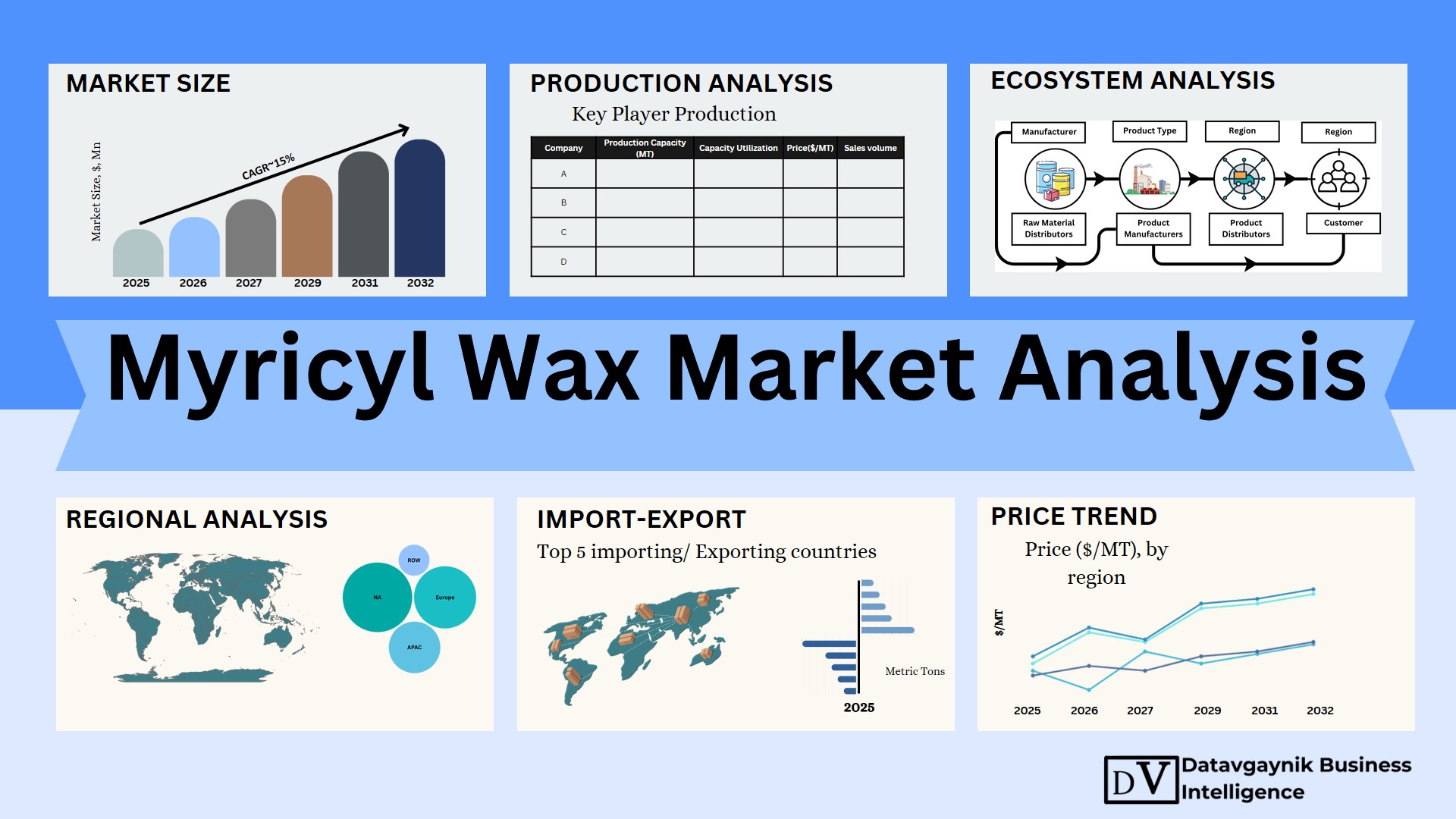
Supplier qualification controls the Myricyl WaxMarket more than bulk availability because buyers usually procure myricyl-rich wax through refined beeswax, purified natural ester wax, cosmetic wax blends, and pharmaceutical-grade wax inputs rather than through a large standalone commodity channel. On this commercial basis, the global Myricyl WaxMarket is estimated at about USD 155 million in 2026, with demand projected to reach nearly USD 232 million by 2032, reflecting a CAGR of around 6.9%. The forecast is supported by higher use of high-melting natural wax esters in lip care, ointments, sticks, balms, controlled-texture cosmetics, specialty polishes, and pharmaceutical bases.
Myricyl Wax is chemically linked to long-chain fatty alcohol esters, especially myricyl palmitate and related C30 wax esters found naturally in beeswax. Its demand is therefore tied to wax systems that need structure, gloss, water resistance, film formation, and slow melt behavior. In cosmetics, small dosage levels of 2–10% can change stick hardness, payoff, and thermal stability, making the ingredient more valuable than its volume share suggests.
The strongest pull comes from cosmetic and personal care formulations where natural wax positioning now matters alongside performance. Lipsticks, lip balms, solid perfumes, deodorant sticks, mascara bases, pomades, and salves need waxes that can hold shape above normal room temperature while softening on skin contact. This is where myricyl-rich wax fractions compete with carnauba, candelilla, synthetic waxes, microcrystalline wax, and hydrogenated vegetable waxes.
A March 2026 manufacturing signal came from Spain-based Cosmewax, which strengthened its contract-manufacturing portfolio across sun care, solid cosmetics, lip care, and intimate care. Its Puzol skincare facility, reported with 5,100 square meters of manufacturing space and planned annual capacity of about 7,000 tons, indicates why structured wax ingredients are moving from niche formulation aids into larger-volume finished-product platforms. Solid cosmetics and lip care formats directly increase demand for waxes that provide hardness, glide, emulsion stability, and clean-label positioning.
Demand is also shaped by pharmaceutical and nutraceutical use. Myricyl Wax and related natural wax esters are used in ointment bases, tablet-coating aids, controlled-release matrices, capsule polishing, and protective topical formulations. Pharmaceutical buyers place higher value on color control, acid value, ester profile, microbial limits, pesticide residue control, and batch traceability. These requirements create a grade premium over crude or industrial wax.
Production does not behave like petrochemical wax supply. Availability depends on apiculture output, crude beeswax recovery, filtration, bleaching, deodorization, residue testing, and blending consistency. Since beeswax yield is linked to hive management and honey-processing economics, supply expansion is slower than demand expansion in cosmetics. This supports price resilience for refined natural wax grades.
Controlled Refining and Apiculture-Linked Supply Shape Myricyl Wax Production Economics
Myricyl Wax production is not built around dedicated large chemical plants. Commercial supply is mainly recovered through beeswax refining, natural wax fractionation, ester purification, deodorization, filtration, bleaching, and blending. This keeps production capacity tied to apiculture output, crude wax collection, and the ability of refiners to meet cosmetic, pharmaceutical, and food-contact specifications.
Crude beeswax normally contains long-chain esters, free fatty acids, hydrocarbons, alcohols, pigments, pollen residues, propolis traces, and odor-bearing compounds. Refiners convert it into saleable myricyl-rich wax grades through controlled heating, plate or pressure filtration, adsorbent bleaching, vacuum deodorization, and quality testing. The technical target is consistency: melting point generally around 61–65°C for refined beeswax-type grades, low moisture, controlled acid value, low ash, acceptable color, and stable odor profile.
The supply base is geographically uneven because wax recovery follows honey production rather than industrial demand. FAO reported in May 2025 that global honey production reached 1.894 million tonnes in 2023, with Africa producing 223,000 tonnes annually and accounting for 12% of global honey output. Ethiopia remains Africa’s largest honey producer, while China, Turkey, Argentina, India, and several African countries remain important wax-linked supply origins. This structure makes Myricyl Wax supply more dependent on agricultural yield and collection systems than on reactor capacity.
Production behavior differs by grade:
| Supply form | Production route | Main buyer logic |
| Crude beeswax | Hive recovery, melting, coarse filtration | Industrial polishing, candles, low-spec blends |
| Refined yellow wax | Filtration, bleaching control, odor adjustment | Cosmetics, balms, salves, personal care |
| White wax | Stronger bleaching and deodorization | Pharma, color-sensitive cosmetics |
| Myricyl-rich ester wax blends | Fractionation, blending, specification control | Premium cosmetics, ointment bases, specialty wax systems |
Asia supplies large volumes because of honey and wax collection depth, while Europe and North America hold stronger positions in refining, residue testing, documentation, and finished cosmetic-grade supply. Import-dependent buyers prefer suppliers that can provide pesticide residue certificates, origin traceability, allergen information, heavy-metal data, and batch-level COA. These documents can decide supplier approval more than nominal wax content.
A relevant 2026 capacity signal came from contract cosmetics manufacturing rather than wax extraction itself. Spain-based Cosmewax’s Puzol skincare production platform, with about 5,100 square meters of manufacturing space and planned annual output near 7,000 tons, shows how solid cosmetics, lip care, and wax-structured personal care products are becoming larger downstream pull points. When contract manufacturers scale stick, balm, ointment, and sun-care formats, demand shifts toward wax inputs that can deliver repeatable hardness, glide, and melting behavior across batches.
Supply bottlenecks appear at three points. First, crude wax quality varies by geography, hive practice, climate, and contamination level. Second, refining yield falls when dark wax, old comb wax, or adulterated material requires stronger bleaching and filtration. Third, pharmaceutical and premium cosmetic grades face slower qualification because buyers test color, odor, melting range, ester value, microbial profile, and residue limits before approval.
Logistics also influence availability. Beeswax and Myricyl Wax are solid, high-value, low-moisture materials, but freight cost becomes visible in small lots, drum packaging, and temperature-controlled storage for premium grades. Regional price gaps widen when European or U.S. buyers require traceable natural wax but source crude or semi-refined material from Asia, Africa, or Latin America.
Production security in the Myricyl WaxMarket therefore depends on diversified crude wax sourcing, refining discipline, residue control, and documentation quality. Suppliers with multi-origin procurement and in-house refining can stabilize color, odor, and melting point better than traders that only aggregate wax lots.
Main Myricyl WaxMarket Segments
- By customer category
- Cosmetic and personal care manufacturers
- Pharmaceutical and ointment-base producers
- Natural polish and coating formulators
- Specialty wax compounders
- Food-contact and nutraceutical coating users
- By product form
- Refined yellow wax
- White bleached wax
- Myricyl-rich natural ester wax blends
- Cosmetic-grade wax pellets or pastilles
- Industrial wax flakes and blocks
- By application
- Lip care, sticks, balms, and solid cosmetics
- Ointments, salves, and topical bases
- Tablet coating, capsule polishing, and nutraceutical finishes
- Leather, wood, and furniture polish
- Specialty protective coatings
Cosmetic and personal care manufacturers account for the leading demand cluster in the Myricyl WaxMarket because wax dosage directly affects texture, hardness, gloss, payoff, and thermal stability. In lip balms, sticks, and solid cosmetics, wax systems often represent 10–35% of the formulation, while myricyl-rich fractions may be used as part of a wider wax blend to balance hardness and skin feel.
The personal care segment also pays the strongest premium for traceability. A cosmetic buyer does not purchase Myricyl Wax only as a natural wax input; it evaluates color value, odor neutrality, melting range, pesticide residue status, allergen declaration, vegan substitution pressure, and batch documentation. This is why refined yellow and white wax grades capture higher margins than crude beeswax blocks.
Pharmaceutical and topical formulation use forms the second high-value segment. Myricyl Wax is relevant in ointment bases, salves, medicated balms, capsule polishing, and coating systems where controlled melting, film formation, and low impurity levels matter. Pharmaceutical buyers usually require tighter microbial control, heavy-metal limits, residual impurity checks, and supplier audit readiness, creating a qualification barrier of 6–18 months for new vendors.
A January 2026 manufacturing signal from the European cosmetics supply chain showed rising investment in solid and semi-solid product formats, including lip care, sun care sticks, and balm-based skincare. Spain-based Cosmewax’s skincare platform, with around 5,100 square meters of production space and planned annual output near 7,000 tons, supports the application-side shift toward wax-structured formulations. Each additional solid-format line raises demand for waxes that provide melt control, stick strength, spreadability, and sensory consistency.
Industrial polish, leather care, wood care, and specialty coating applications represent a lower-value but stable demand base. These users are more price-sensitive and may blend Myricyl Wax with paraffin, microcrystalline wax, carnauba, candelilla, or synthetic waxes. The buying decision is usually based on gloss, water repellency, hardness, buffability, and cost per kilogram rather than pharmaceutical-grade documentation.
By product form, white bleached wax leads in color-sensitive cosmetics and pharma, while refined yellow wax remains stronger in natural balms, salves, polish, and traditional wax formulations. Pellets and pastilles are gaining share because automated dosing systems prefer uniform particle size, lower dust, and faster melting compared with irregular blocks.
The Myricyl WaxMarket therefore divides into two commercial layers: premium documented grades for cosmetics and pharma, and functional natural wax grades for polish, coatings, and industrial blends. The leading segment is not the largest by physical volume alone; it is the segment where specification control, supplier approval, and formulation performance convert natural wax chemistry into higher sales value.
Supplier Pricing Power Is Highest Where Myricyl Wax Requires Traceable Natural-Wax Documentation
Pricing in the Myricyl WaxMarket is controlled by specification rather than only raw wax availability. Crude wax, refined yellow wax, bleached white wax, cosmetic-grade pellets, and pharmaceutical-grade wax inputs can sit in separate price layers because each grade carries different refining yield, testing cost, residue-control requirement, and buyer approval burden.
The raw material base is the first pricing anchor. Myricyl Wax is commercially linked to beeswax and natural long-chain ester wax fractions, so crude beeswax availability influences the floor price. When honey production, hive recovery, or crude wax collection weakens, refiners face tighter access to feedstock. Since beeswax recovery is a secondary output of apiculture, supply cannot be expanded quickly like petrochemical wax capacity.
Processing cost creates the second layer. Darker crude wax needs stronger filtration, bleaching, deodorization, and impurity removal. Each additional refining step reduces yield and increases energy use. A batch that requires repeated adsorbent treatment may deliver better color but lower finished output, making white wax and low-odor cosmetic grades more expensive than standard yellow wax.
The strongest premium appears in documented cosmetic and pharmaceutical grades. Buyers pay more when suppliers provide:
- melting range control, commonly around 61–65°C for refined beeswax-type grades
• low moisture and low ash levels
• controlled acid value and ester value
• pesticide residue and heavy-metal testing
• allergen, origin, and batch traceability documents
• microbial and impurity checks for topical or pharmaceutical use
These requirements convert Myricyl Wax from a basic natural wax into a qualified formulation input. The price difference is not only material cost; it includes laboratory testing, rejected-lot risk, documentation, supplier audits, and longer customer approval cycles.
Energy cost also affects price because refining requires controlled heating, filtration, bleaching, vacuum deodorization, melting, pelletizing, and packaging. The energy share is lower than in petrochemical cracking or metal refining, but it becomes visible when suppliers process smaller batches for cosmetic or pharmaceutical customers. Small-batch production raises per-kilogram cost because cleaning, testing, and changeover time are spread across fewer tonnes.
A relevant 2026 demand-side cost signal came from solid cosmetics and skincare manufacturing. Spain-based Cosmewax’s Puzol facility, with about 5,100 square meters of production space and planned annual output near 7,000 tons, reflects larger downstream use of wax-structured lip care, balm, sun-care stick, and semi-solid skincare formats. These buyers require consistent wax behavior at industrial filling speeds, so supplier approval is tied to melt profile, odor, hardness contribution, and repeatability, not only quoted price.
Regional price gaps are visible between crude-wax-origin countries and regulated end-use markets. Asia, Africa, and Latin America remain important crude and semi-refined wax supply regions, while Europe and North America often pay premiums for certified, filtered, deodorized, residue-tested, and cosmetically acceptable wax. Freight, drum packaging, minimum order size, import duty, and documentation gaps can widen the delivered price.
Substitute waxes also set price boundaries. Paraffin and microcrystalline wax usually offer lower-cost structure, while carnauba and candelilla provide stronger hardness or vegan positioning at higher price points. Myricyl Wax gains pricing strength where buyers need natural ester chemistry, moderate hardness, skin-compatible texture, and established use in balms, ointments, polishes, and topical bases.
The Myricyl WaxMarket therefore prices on qualification depth. Industrial buyers negotiate on cost per kilogram, but cosmetic and pharmaceutical customers pay for stable specification, residue control, and supplier reliability across repeated production cycles.
Pricing Power Sits With Refiners That Can Qualify Myricyl Wax for Cosmetics and Pharma Buyers
Competition in the Myricyl WaxMarket is concentrated around refiners, natural wax processors, specialty wax blenders, and ingredient distributors rather than large petrochemical wax producers. The leading supplier group includes Koster Keunen, Strahl & Pitsch, Paramold Manufacturing, Frank B. Ross, Poth Hille, British Wax, New Zealand Beeswax, Arjun Beeswax Industries, Jedwards International, and regional beeswax refiners in China, India, Turkey, Argentina, Ethiopia, and Eastern Europe.
The market is fragmented at crude wax collection level but more selective at refined cosmetic and pharmaceutical grade level. Thousands of beekeeping networks and wax collectors supply crude material, yet only a smaller group can consistently deliver white wax, yellow NF wax, cosmetic wax pellets, traceable natural wax blends, and myricyl-rich ester wax grades with batch certificates.
Koster Keunen holds a strong position because its portfolio covers white beeswax NF, yellow beeswax NF, organic beeswax, sustainable beeswax, synthetic beeswax, carnauba wax, candelilla wax, rice bran wax, sunflower wax, and specialty Kester waxes. This range allows formulators to adjust hardness, melting behavior, gloss, vegan positioning, and texture without changing supplier families. Its advantage comes from wax processing depth, regulatory documentation, global beekeeper sourcing relationships, and cGMP-grade production.
Strahl & Pitsch competes through natural wax importing, refining, and custom blending, with specific emphasis on beeswax, carnauba, candelilla, and other waxes for cosmetic and pharmaceutical users. Its competitive strength is not crude wax volume alone; it is the ability to convert multi-origin wax into consistent white and yellow grades for formulators that need repeatable color, odor, melting point, and application behavior.
Paramold Manufacturing, Frank B. Ross, Poth Hille, British Wax, and New Zealand Beeswax serve as important regional and specialty suppliers. Their positioning is stronger where buyers need smaller qualified lots, private-label wax blends, food-contact waxes, natural wax compounds, industrial polish waxes, or local supply reliability. In Asia, Arjun Beeswax Industries and Chinese beeswax refiners compete more visibly on crude and semi-refined wax availability, export pricing, and flexible shipment volumes.
A 2026 downstream signal reinforces why competition is shifting toward qualified supply. Cosmewax’s Puzol skincare manufacturing platform in Spain, with about 5,100 square meters of production area and planned annual output close to 7,000 tons, supports larger production of lip care, balm, sun-care stick, and semi-solid skincare formats. These finished-product lines increase demand for wax suppliers that can pass formulation trials, stability testing, odor checks, and batch-repeatability requirements.
Competitive comparison is therefore split across three supplier groups:
| Supplier group | Competitive advantage | Main limitation |
| Global wax refiners | Broad grade range, testing, documentation, traceability | Higher price and longer qualification |
| Regional beeswax processors | Local sourcing, flexible supply, lower logistics cost | Variable color, odor, and residue control |
| Specialty wax blenders | Custom texture, melt profile, application support | Dependence on crude wax and base wax availability |
Market share is difficult to assign precisely because Myricyl Wax is traded inside broader beeswax and natural wax categories. Still, top-tier refiners and specialty wax processors likely control the higher-value cosmetic and pharmaceutical share, while crude and industrial wax supply remains highly fragmented.
Switching cost is high for premium buyers. Once a wax grade is approved in lipstick, ointment, balm, or capsule-polishing systems, changing supplier can require 3–12 months of stability testing, sensory review, documentation checks, and production-line validation. This qualification burden gives established suppliers stronger pricing power than commodity wax traders.
The Myricyl WaxMarket therefore rewards suppliers with multi-origin sourcing, refining control, residue testing, technical application support, and product-form flexibility. Low-cost crude wax suppliers compete on availability, but the higher-margin market belongs to companies that can translate natural wax variability into consistent industrial formulation behavior.


