

Market Summary and Growth Forecast
The global N-phenyl-1-naphthylamine (PNA) Market will witness a robust CAGR of 4.8%, valued at $0.074 billion in 2026, expected to appreciate and reach $0.113 billion by 2035.
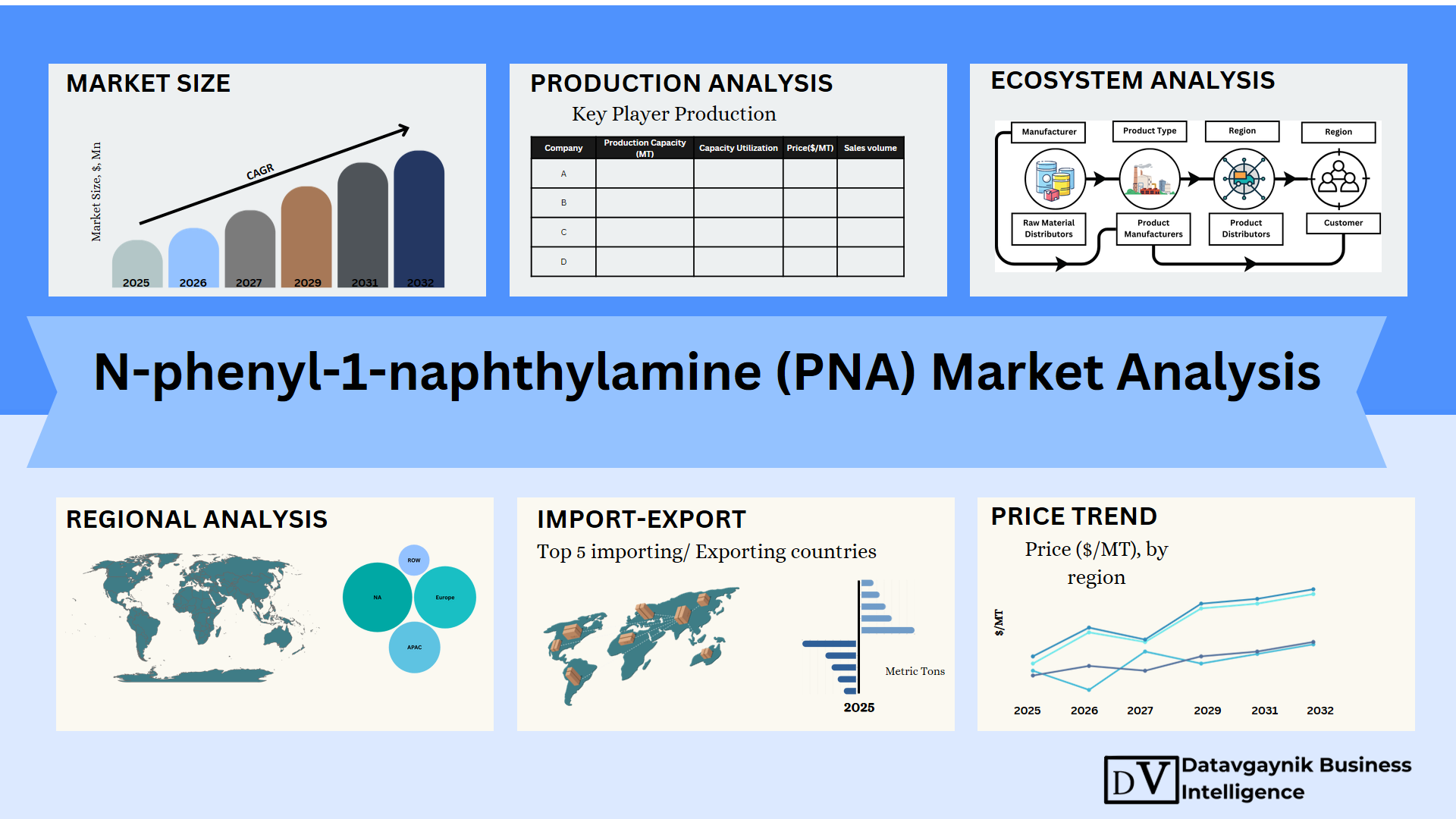
The N-phenyl-1-naphthylamine (PNA) Market sits inside the specialty antioxidant additives space. It is not a mass-volume chemical market. Its role is narrower and more technical. PNA is mainly used as an aromatic amine antioxidant in high-performance lubricants, synthetic oils, petroleum products, greases, rubber compounds, and select organic intermediate applications. In simple terms, it helps slow oxidation. That matters when oils, rubber parts, and industrial fluids operate under heat, pressure, shear, or long service cycles.
The market’s strategic relevance during 2026–2035 will come from three linked demand pockets. First, industrial equipment operators are pushing for longer lubricant drain intervals. Second, aviation, energy, mining, marine, and heavy-duty machinery users need fluids that can withstand high temperatures. Third, rubber compounders still need antioxidant systems that improve flex-crack resistance and aging performance in demanding elastomer applications.
This is why the N-phenyl-1-naphthylamine (PNA) Market should be viewed as a performance-driven additives market rather than a simple chemical supply market. Buyers are not only purchasing a molecule. They are purchasing oxidation control, formulation stability, and service-life protection.
From a macro standpoint, the market will be shaped by the movement toward synthetic and semi-synthetic lubricants. These products typically face higher performance expectations. They are used in turbines, compressors, hydraulic systems, aerospace oils, and specialized industrial machinery. That gives PNA a stable platform, especially where high-temperature oxidation resistance is needed.
That said, regulation will remain a careful watch point. PNA is an aromatic amine chemical. Handling, occupational exposure, aquatic toxicity, impurity control, and downstream formulation compliance will influence supplier selection. Large buyers will prefer producers with stronger safety documentation, consistent purity, and traceable supply chains. This may gradually shift value toward qualified suppliers rather than low-cost spot sellers.
Production will remain moderately concentrated. China and India will support cost-competitive supply. North America and Europe will stay important in high-purity grades, branded lubricant additives, and regulated specialty applications. The supply chain will be sensitive to feedstock pricing, aromatic amine availability, energy costs, environmental compliance, and export reliability.
By 2026, the global market is estimated at $0.074 billion, equal to roughly 9.6 kilotons of commercial PNA demand. By 2035, the value pool is projected to reach $0.113 billion, supported by volume growth, higher purity requirements, and a mild uplift in average selling prices. The implied volume demand by 2035 is estimated near 13.7 kilotons.
| Metric | 2026 Estimate | 2035 Forecast | Analyst View |
| Global Market Size | $0.074 billion | $0.113 billion | Small but technically sticky market |
| Estimated Volume Demand | 9.6 kilotons | 13.7 kilotons | Growth led by lubricants and industrial fluids |
| Average Selling Price | $7.7/kg | $8.2/kg | Purity and compliance lift pricing |
| CAGR | 4.8% | 2026–2035 | Steady, not explosive |
| Core Demand Base | Lubricants, rubber, greases | Lubricants, synthetic fluids, elastomers | Performance additives remain the anchor |
Key stakeholders include lubricant additive formulators, rubber compounders, specialty chemical manufacturers, aviation lubricant suppliers, industrial oil blenders, distributors, OEM maintenance teams, chemical regulators, industry associations, environmental agencies, investors, and large industrial end users.
Expert insight: PNA is unlikely to become a high-growth headline chemical. But it has a defensible role where oxidation stability matters and where replacement is not always simple. The real opportunity lies in qualified grades, clean impurity profiles, and integration into high-performance additive packages.
Market Segmentation and Forecast Scope
The N-phenyl-1-naphthylamine (PNA) Market can be segmented across Product Form, Application, End User, and Region. The segmentation should stay practical. This is a niche molecule, so over-segmentation can create false precision. A tighter structure gives a better view of demand.
By Product Form
The market includes powder/crystalline grade, flake grade, molten or bulk grade, and high-purity specialty grade. Powder and crystalline grades are common in chemical distribution and research-linked supply. Flake grades are preferred where easier dissolution into oils is required. Molten or bulk formats serve larger industrial buyers. High-purity specialty grades are more relevant for lubricant additive packages, aviation oils, and sensitive industrial formulations.
The most strategic segment is high-purity specialty grade. It is smaller in volume but stronger in margin. Buyers in this segment care about impurity control, batch consistency, regulatory documentation, and compatibility with downstream formulation systems.
By Application
Major application areas include lubricant antioxidants, rubber antioxidants, grease and industrial fluid additives, and organic intermediate use. Among these, lubricant antioxidants represent the largest demand pool, accounting for an estimated 54% share in 2026. This includes industrial oils, gear oils, hydraulic fluids, turbine oils, synthetic lubricants, and selected aviation-grade formulations.
Rubber antioxidants remain relevant, especially in industrial rubber goods, belts, hoses, seals, gaskets, mechanical goods, and elastomer parts exposed to heat and flexing. Growth here is stable but more price-sensitive. Rubber buyers often compare PNA with alternative antidegradants and blended antioxidant systems.
Greases and industrial fluids offer a smaller but attractive opportunity. This segment benefits from equipment reliability programs in manufacturing, power generation, mining, and marine operations. Organic intermediate use is limited and more dependent on specialty chemical synthesis demand.
By End User
End users include lubricant additive manufacturers, oil blenders, rubber compounders, industrial machinery operators, aviation and defense lubricant suppliers, automotive aftermarket lubricant formulators, and specialty chemical processors.
The most attractive customer group is lubricant additive manufacturers. They buy on performance, documentation, and long-term supply assurance. Rubber compounders, by contrast, often buy with stronger cost discipline. So margin quality differs sharply by end-use channel.
Expert commentary: For suppliers, the best route is not chasing every customer. It is qualifying with formulation-led buyers where switching costs are higher. Once PNA is approved in a lubricant or elastomer system, replacement usually needs testing. That creates commercial stickiness.
By Region
Regional coverage includes North America, Europe, Asia Pacific, and LAMEA. Asia Pacific is estimated to hold around 46% of global demand in 2026, supported by chemical manufacturing, rubber processing, industrial lubricant blending, and expanding machinery use in China, India, South Korea, and Southeast Asia.
North America is smaller by volume but strong in specialty lubricant applications. Europe remains compliance-heavy and formulation-focused. LAMEA demand is led by industrial lubricants, mining, energy, marine, and infrastructure-linked machinery use. Growth in LAMEA will be steady but distribution-led.
| Segmentation Dimension | Included Scope | Strategic Sub-Segments | 2026 Share Disclosure |
| By Product Form | Powder, crystalline, flake, molten, high-purity grade | High-purity specialty grade | Not disclosed |
| By Application | Lubricants, rubber, greases, industrial fluids, intermediates | Lubricant antioxidants | 54% |
| By End User | Additive makers, oil blenders, rubber compounders, industrial users | Lubricant additive manufacturers | Not disclosed |
| By Region | North America, Europe, Asia Pacific, LAMEA | Asia Pacific | 46% |
The fastest-growing sub-segment will be high-purity PNA for synthetic and high-temperature lubricant systems. The most strategic regional opportunity will be Asia Pacific, not only because of demand size but also because of its manufacturing depth. India could gain incremental relevance as buyers diversify supply away from single-country sourcing models.
Market Trends and Innovation Landscape
The N-phenyl-1-naphthylamine (PNA) Market is evolving through formulation refinement rather than dramatic product reinvention. PNA is a mature antioxidant chemistry. So the innovation story is not about discovering the molecule again. It is about using it better, cleaning up its quality profile, and positioning it inside higher-performance additive systems.
The first trend is the shift toward high-temperature lubricant stability. Industrial oils, turbine oils, aviation lubricants, compressor oils, and heavy-duty hydraulic fluids are being asked to perform longer under harsher conditions. This gives aromatic amine antioxidants a useful role because they support oxidation control in demanding operating environments. PNA benefits from this trend when formulators need proven amine chemistry with strong thermal performance.
The second trend is formulation blending. PNA is often considered alongside hindered phenols, other aromatic amines, metal deactivators, dispersants, anti-wear agents, and corrosion inhibitors. The goal is balanced performance. A lubricant formulation cannot only resist oxidation. It must also manage deposits, viscosity change, corrosion, wear, sludge, and compatibility with seals. So future PNA demand will increasingly depend on how well it works inside additive packages, not only as a stand-alone antioxidant.
The third trend is material science optimization in elastomers. In rubber applications, antioxidant systems are being adjusted for heat aging, flex-crack resistance, migration behavior, staining, cure compatibility, and long-term mechanical performance. PNA has a role in this landscape, but it competes with other amine antioxidants and newer stabilizer systems. This will keep innovation focused on dosage efficiency and compound compatibility.
The fourth trend is purity and impurity control. This will become more important during 2026–2035. Buyers serving regulated or technically demanding applications will look closely at product consistency, residual impurities, color profile, environmental classification, and safety documentation. Suppliers that can offer stable assay levels, cleaner material profiles, and reliable technical files will be better positioned.
The fifth trend is regional supply-chain qualification. Large chemical and lubricant buyers are no longer comfortable with fragile single-source models. They want dual sourcing, local documentation support, and dependable logistics. This opens space for qualified suppliers in Asia, especially India and China, while giving established Western suppliers room to defend premium accounts.
AI is not a major direct innovation lever for this market. It may support formulation screening, predictive oxidation testing, quality analytics, and procurement planning. But there is limited evidence that AI is reshaping PNA chemistry itself. So it should not be overstated.
Recent industry movement supports the broader direction. BASF announced additional capacity for aminic antioxidants for lubricants in March 2025, showing that demand for high-performance antioxidant chemistry remains active. LANXESS continues to position PANA chemistry under its lubricant additives portfolio for high-temperature synthetic and mineral oil uses. SI Group, Nation Ford Chemical, and regional Asian suppliers remain relevant through specialty antioxidant and rubber chemical channels.
Expert commentary: The next phase of the N-phenyl-1-naphthylamine (PNA) Market will be less about volume aggression and more about qualification. Suppliers that can prove performance, safety, documentation, and supply reliability will win better accounts. Low-cost supply will still matter, but it won’t be enough for premium lubricant and aviation-linked applications.
A practical use case is easy to see. A turbine oil blender may use PNA in a high-temperature antioxidant package for industrial gas turbine lubrication. The buyer is not looking for the cheapest additive. They need oxidation stability, low deposit formation, and long fluid life because downtime is expensive. This is where PNA’s value becomes more visible.
Overall, the N-phenyl-1-naphthylamine (PNA) Market will move through quiet technical upgrading. It will not be a disruptive market. But it will remain commercially relevant wherever oils, greases, and elastomer systems need dependable oxidation protection under stress.
Competitive Intelligence and Benchmarking
The competitive base of the N-phenyl-1-naphthylamine (PNA) Market is split between large specialty additive companies, regional chemical manufacturers, and smaller high-purity suppliers. This is not a market where hundreds of branded competitors compete openly at scale. Supply strength depends on purity control, batch repeatability, safety documentation, formulation support, and access to lubricant or rubber compounder accounts.
Large players have an advantage in qualification-heavy lubricant applications. Smaller and regional suppliers compete more strongly in rubber, intermediates, and distribution-led demand. The gap between the two groups is important. A buyer serving aviation turbine oils or premium industrial lubricants will not treat PNA the same way as a buyer making general-purpose rubber goods.
| Company | Portfolio Position | Market Position and Benchmarking View |
| LANXESS | Specialty lubricant antioxidants, rubber additives, industrial additive systems | LANXESS is one of the strongest benchmark suppliers for PNA-linked antioxidant chemistry. Its position is supported by technical lubricant applications, rubber additive reach, and strong documentation standards. The company is better positioned in high-performance oils, greases, and regulated specialty uses than in commodity spot supply. |
| BASF | Aminic antioxidants, lubricant additive components, specialty performance chemicals | BASF does not compete only on one molecule. Its strength comes from broader antioxidant chemistry and lubricant additive capability. The company’s capacity investment in aminic antioxidants reinforces its long-term commitment to long-life lubricants and technically demanding oil systems. |
| SI Group | Antioxidants, performance additives, intermediates, lubricant and rubber solutions | SI Group has a strong additives identity across lubricants, fuels, plastics, and rubber. Its competitive position is built around formulation support, global manufacturing reach, and specialty antioxidant know-how. It is a credible benchmark for customers that want supply reliability and multi-chemistry additive access. |
| SONGWON Industrial | Fuel and lubricant antioxidants, polymer stabilizers, additive packages | SONGWON Industrial is relevant in the broader aminic and phenolic antioxidant landscape. Its strength is portfolio breadth across fuel, lubricant, and polymer stabilization. The company is better viewed as an adjacent competitive force rather than a pure PNA supplier. |
| Nation Ford Chemical | High-purity PNA and specialty organic chemicals | Nation Ford Chemical is more focused and niche compared with global additive majors. Its positioning is useful for high-purity supply, specialty chemical users, and buyers requiring technical-grade material for petroleum products, synthetic lubricants, rubber, and intermediate applications. |
| Akrochem Corporation | Rubber chemical distribution, antioxidant systems, compounding additives | Akrochem Corporation has a stronger position in rubber compounding channels. It is relevant where PNA is used as a rubber antioxidant or anti-aging additive. Its edge lies in compounding support, product accessibility, and formulation guidance for rubber processors. |
| Ascent Petrochem / Asian Specialty Suppliers | PNA, antioxidant intermediates, rubber and lubricant additives | Regional Asian suppliers support the cost-sensitive side of the market. Their role is important in China, India, Southeast Asia, and export-led rubber chemical supply. The main challenge is not capacity alone. It is consistency, documentation, and acceptance by premium lubricant buyers. |
LANXESS, BASF, and SI Group represent the premium benchmark group. They bring stronger technical credibility and better access to high-performance lubricant customers. Nation Ford Chemical and Akrochem Corporation are more relevant to focused PNA and rubber-channel demand. Asian suppliers compete on cost and responsiveness. Their share can rise if they improve documentation, impurity control, and export reliability.
The N-phenyl-1-naphthylamine (PNA) Market will likely see more competition around qualified supply than around new product launches. Buyers in lubricants want suppliers that can meet testing requirements and provide consistent performance. Buyers in rubber want cost control, availability, and compound compatibility. The best-positioned companies will be those that can serve both without diluting quality.
Expert commentary: The market is small, but supplier qualification is serious. Once a PNA grade is approved in a lubricant or rubber formulation, buyers are cautious about switching. That gives technically approved suppliers a stronger moat than their market size suggests.
Regional Landscape and Adoption Outlook
The regional structure of the N-phenyl-1-naphthylamine (PNA) Market reflects where lubricant blending, rubber processing, specialty chemicals, aviation oils, and industrial machinery demand are concentrated. Asia holds the demand and supply advantage. North America and Europe hold technical-grade and compliance-led value. Japan and South Korea remain smaller but high-quality formulation markets.
| Region / Country | 2026 Market Value Estimate | 2035 Market Value Forecast | Growth Outlook | Adoption Pattern |
| North America | $0.012 billion | $0.017 billion | 3.9% CAGR | Specialty lubricants, aviation oils, industrial greases, regulated additive supply |
| Europe | $0.013 billion | $0.018 billion | 3.7% CAGR | Compliance-led lubricants, rubber goods, premium industrial fluids |
| China | $0.022 billion | $0.035 billion | 5.3% CAGR | Large-scale rubber processing, lubricant blending, chemical intermediate supply |
| India | $0.006 billion | $0.011 billion | 6.2% CAGR | Fastest-growing demand from industrial lubricants, rubber goods, and export-oriented additives |
| Japan | $0.004 billion | $0.005 billion | 2.8% CAGR | High-spec lubricant formulations, specialty industrial oils, precision manufacturing |
| South Korea | $0.003 billion | $0.005 billion | 4.4% CAGR | Synthetic lubricants, automotive components, electronics-linked machinery fluids |
| Rest of the World | $0.014 billion | $0.022 billion | 5.0% CAGR | Mining, marine, infrastructure machinery, distribution-led chemical demand |
North America
North America is a premium-grade market. The United States leads regional demand through aviation lubricants, industrial oils, specialty greases, metalworking fluids, and high-performance rubber goods. The region is not the largest volume base, but it is important for qualification-heavy applications.
Regulation and workplace safety expectations are high. Buyers want strong safety data, impurity control, and documentation. This supports established suppliers and technical distributors. White space exists in high-purity PNA for long-life industrial lubricants, especially in energy, aerospace maintenance, and heavy manufacturing.
Europe
Europe is shaped by compliance and substitution review. Germany, France, Italy, and the United Kingdom are the main demand centers. The region has strong lubricant technology, rubber goods, and industrial engineering demand. But chemical compliance creates higher entry barriers.
European buyers are conservative. They prefer suppliers that can handle REACH documentation, product stewardship, and long-term regulatory visibility. Growth will be slower than Asia, but value per kilogram will remain healthy. White space exists in cleaner grades, lower-residue materials, and additive packages aligned with longer fluid life and sustainability targets.
China
China is the largest single-country demand and supply center. Its role comes from rubber processing, tire and industrial goods manufacturing, machinery oils, chemical intermediates, and export-oriented specialty chemicals. Domestic suppliers are active across general-purpose and mid-grade demand.
China’s infrastructure base is strong. It has chemical parks, feedstock access, export capability, and a large customer base. That said, environmental inspections and quality differentiation are becoming more important. Buyers serving premium lubricants will still prefer qualified and well-documented grades. White space remains in high-purity PNA for synthetic lubricants and export-grade additive packages.
India
India is the fastest-growing regional opportunity. Demand is supported by industrialization, lubricant blending, automotive aftermarket growth, rubber goods manufacturing, railways, mining, infrastructure equipment, and energy-sector machinery. Local production and formulation capability are improving.
India’s advantage is cost competitiveness and a growing specialty chemical export base. Its constraint is uneven quality perception across suppliers. Premium buyers still require stronger documentation, impurity control, and application testing. White space is attractive in qualified PNA grades for lubricant additive makers and rubber compounders serving export markets.
Japan
Japan is a small but technically advanced market. Demand comes from precision manufacturing, high-spec industrial oils, specialty greases, automotive components, and equipment reliability programs. Japanese buyers value consistency more than price.
The market is mature. Growth will be modest. But quality requirements are high. This makes Japan more relevant for premium formulation benchmarking than for volume expansion. White space exists in niche high-performance fluid systems and maintenance-critical machinery applications.
South Korea
South Korea is linked to automotive components, heavy industry, shipbuilding, petrochemicals, electronics manufacturing, and synthetic lubricant demand. It is not a large PNA market by volume, but it has strategic value because its industrial base uses high-performance fluids and elastomers.
Adoption will improve where machinery uptime, thermal control, and export-quality rubber components matter. White space exists in synthetic lubricant antioxidant packages and rubber goods used in automotive, industrial, and marine applications.
Rest of the World
Rest of the World includes Southeast Asia, Latin America, the Middle East, Africa, Australia, and Turkey. Demand is fragmented. Growth is driven by mining, marine, construction equipment, oil and gas, industrial maintenance, and rubber goods.
Southeast Asia is the most promising sub-region due to tire manufacturing, rubber processing, and industrial lubricant demand. The Middle East and Africa offer industrial lubricant potential but remain more dependent on imports and distributors. Latin America has steady demand through mining, agriculture equipment, and automotive aftermarket channels.
Expert commentary: The regional opportunity is not only about where PNA is consumed. It is about where suppliers can qualify. Asia will carry volume growth. North America, Europe, Japan, and South Korea will continue to set the quality benchmark.
End-User Dynamics and Use Case
End-user adoption in the N-phenyl-1-naphthylamine (PNA) Market is practical and performance-led. Customers use PNA where oxidation, heat, aging, or service-life loss creates operating risk. The adoption logic differs by user group.
Lubricant additive manufacturers are the most technically demanding buyers. They use PNA as part of antioxidant packages for industrial oils, turbine oils, hydraulic fluids, compressor oils, gear oils, and synthetic lubricants. Their purchase decision is based on oxidation performance, treat rate, additive compatibility, filter residue, batch consistency, and regulatory documentation.
Oil blenders adopt PNA through additive packages or direct formulation. Smaller blenders may buy through distributors. Larger blenders often work with additive companies to meet performance specifications. For them, the commercial question is simple: does the additive help extend lubricant life without creating deposits, color instability, or compatibility issues?
Rubber compounders use PNA as an antioxidant and anti-aging additive in selected rubber goods. Adoption is strongest where rubber parts face heat, oxygen, flexing, or long service cycles. These users are more price-sensitive than lubricant additive companies. They also compare PNA with alternative rubber antioxidants based on staining, migration, cure behavior, and long-term physical properties.
Industrial machinery operators usually do not buy PNA directly. They influence demand indirectly through lubricant performance requirements. If a steel mill, mine, power plant, or refinery asks for longer drain intervals and stronger oxidation resistance, lubricant formulators respond by using better antioxidant systems.
Aviation and defense lubricant suppliers represent a small but valuable end-user channel. Performance requirements are high. Fluids face temperature extremes and long qualification cycles. PNA-linked chemistry can be relevant where high-temperature oxidation control is required. However, adoption depends on strict formulation approval.
Specialty chemical processors use PNA in smaller volumes as an intermediate or stabilizer. This is a less visible demand pool, but it supports baseline consumption.
Use case scenario: A South Korean industrial lubricant blender supplying turbine oils to power-generation maintenance contractors used a high-purity PNA-based antioxidant system in a synthetic oil formulation. The goal was to improve oxidation stability during extended operating cycles. The blender did not position the additive as a low-cost input. It used it to support longer oil life, lower sludge risk, and fewer unplanned maintenance interruptions. This is a realistic adoption case because turbine and compressor oil users value operating reliability more than marginal additive savings.
Expert commentary: PNA adoption works best when the customer can measure the cost of failure. In premium oils and demanding rubber parts, oxidation control is not a small formulation detail. It can decide service life.
Recent Developments + Opportunities & Restraints
Recent Developments
March 2026 – LANXESS raised prices for rubber additives by 15% to 50%.
The move reflected higher energy, raw material, and logistics costs. This matters for the N-phenyl-1-naphthylamine (PNA) Market because rubber antioxidants and specialty additives share similar cost pressures. It also signals that premium suppliers are defending margins rather than absorbing inflation.
March 2026 – LANXESS increased prices for diphenylamine and alkylated diphenylamine antioxidants by 50% or more.
These are adjacent aminic antioxidant chemistries used in lubricants. The event points to tighter economics in high-performance antioxidant supply. It may support firmer pricing for qualified antioxidant additives, including PNA-based systems where buyer qualification limits easy switching.
September 2025 – SI Group announced sustainable additive innovations for plastics and rubber applications at K 2025.
The announcement highlighted the industry’s movement toward lower-risk, sustainability-led additive systems. For PNA suppliers, this raises the bar on safety documentation, impurity profiles, and product stewardship.
March 2025 – BASF announced investment to increase aminic antioxidant production capacity for lubricants at its Puebla, Mexico site.
The expansion is expected to support growing demand for long-life lubricants. This is one of the clearest recent signals that lubricant antioxidant chemistry remains strategically relevant.
March 2025 – LANXESS presented sustainable rubber additive solutions for tire and specialty rubber applications.
The event reinforced the role of additive innovation in rubber durability, processing efficiency, and sustainability. This is relevant because PNA demand in rubber will increasingly depend on formulation performance and compliance expectations.
Opportunities
High-purity lubricant antioxidant grades offer the best value opportunity. Demand for longer oil life, synthetic lubricants, and high-temperature operating fluids will support qualified PNA suppliers.
India and Southeast Asia offer strong growth potential. Both regions have expanding rubber processing, lubricant blending, and industrial equipment demand. Suppliers with stable quality and export documentation can gain share.
Formulation-led antioxidant packages are another opportunity. PNA can gain relevance when used with phenolic antioxidants, metal deactivators, and other stabilizers to improve oxidation control in demanding oils.
Restraints
Regulatory and safety scrutiny will remain the biggest restraint. Aromatic amine chemistry requires careful handling, exposure management, and documentation. This can limit use in sensitive applications.
Substitution pressure is also real. Alternative aminic antioxidants, phenolic antioxidants, and blended stabilizer systems can reduce PNA use where buyers want lower toxicity concerns, lighter color, or different performance behavior.
Supplier qualification barriers can slow adoption. Premium lubricant and rubber buyers will not switch quickly without testing. This protects approved suppliers but makes new entry harder.
Expert commentary: The opportunity is not in selling more PNA everywhere. The better strategy is to sell better PNA into tighter applications. Quality, documentation, and formulation support will decide who captures value.


