

Negative Pressure Ventilation Systems Demand Is Concentrated Around Hospital Isolation Capacity and Retrofit-Ready Healthcare Infrastructure
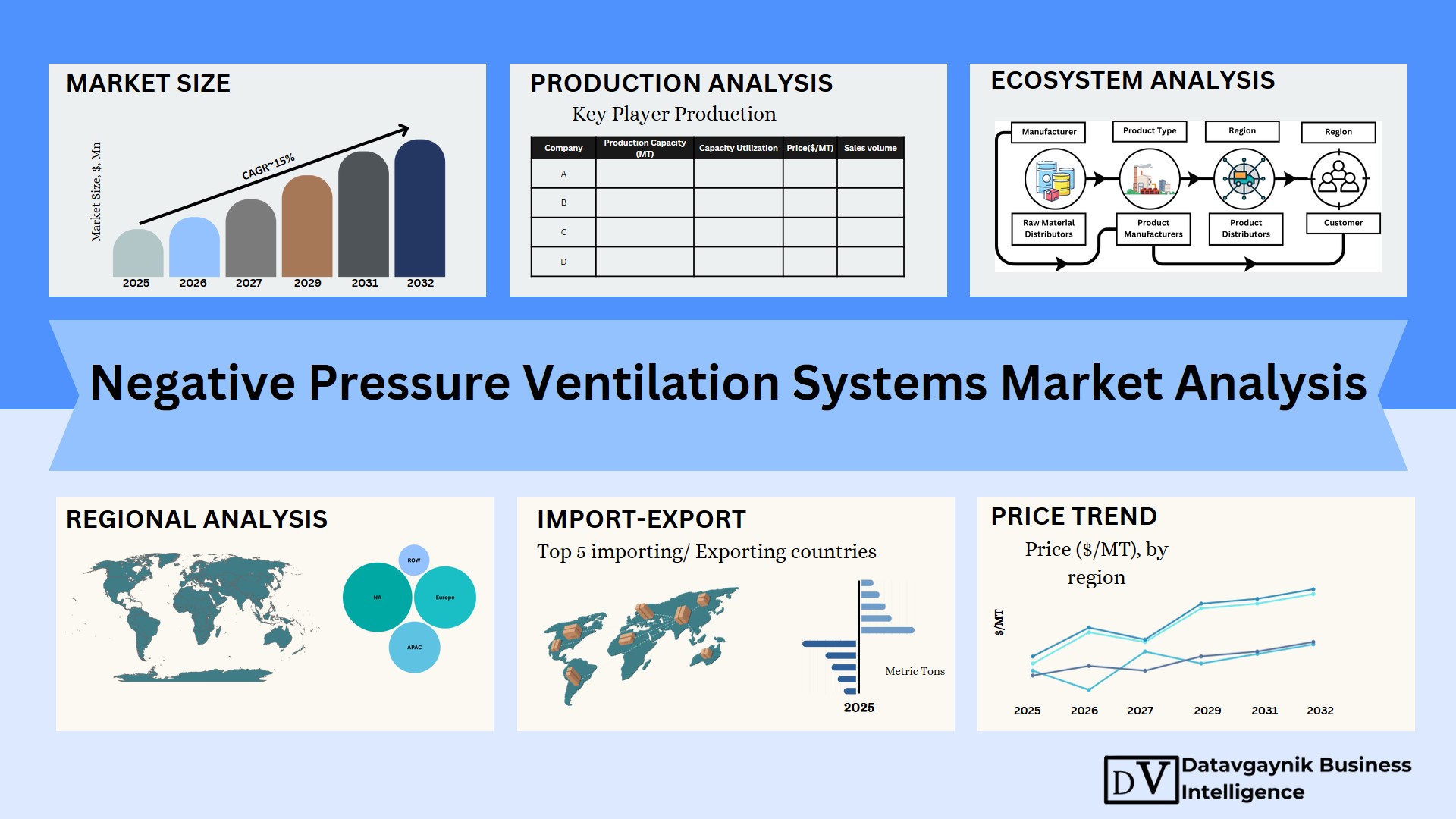
North America, Western Europe, Japan, South Korea, China, India, and the Gulf hospital construction belt account for the strongest demand base for Negative Pressure Ventilation Systems because these regions combine higher infectious-disease preparedness, large tertiary-care hospital networks, regulated healthcare HVAC design, and replacement spending on aging isolation rooms. The global Negative Pressure Ventilation Systems market is estimated at USD 1.42 billion in 2026 and is projected to reach USD 2.23 billion by 2032, reflecting a CAGR of 7.8% during the forecast period, with hospitals, diagnostic laboratories, emergency departments, cleanroom-adjacent healthcare zones, and temporary isolation areas forming the main customer base. Demand is not uniform: the United States buys more through hospital renovation and compliance-driven replacement, China and India add demand through bed-capacity expansion, while the UAE, Saudi Arabia, Singapore, and South Korea concentrate procurement around premium hospital projects, infection-control upgrades, and high-spec medical infrastructure.
United States Leads Because Isolation-Room Replacement Is Tied to a Large Hospital Installed Base
The United States remains the most important country-level market for Negative Pressure Ventilation Systems because procurement is anchored in a large installed base of acute-care hospitals, ICU rooms, emergency departments, and procedure areas. Demand is less dependent on greenfield hospital construction and more linked to room conversion, pressure monitoring, exhaust fan replacement, HEPA filtration integration, and building-management-system upgrades.
The customer base is mainly integrated delivery networks, university hospitals, Veterans Affairs facilities, state hospitals, and private operators. HCA Healthcare, one of the largest U.S. hospital operators, reported in January 2026 that it operated 179 acute-care hospitals with 50,436 licensed beds at the end of 2025. Even a low single-digit annual retrofit rate across such large portfolios creates recurring demand for pressure controls, dampers, exhaust systems, room monitors, and validation services.
Hospital construction cost also supports the replacement logic. In 2026, large tertiary hospital projects in the U.S. commonly fall in the USD 560–800 per sq. ft. range, while general acute-care hospitals are typically in the USD 430–470 per sq. ft. range. In this cost structure, ventilation and air-balance systems are not optional accessories; they are part of the mechanical backbone of high-acuity care areas. For Negative Pressure Ventilation Systems, this keeps the market tied to capital planning, maintenance budgets, and infection-control audits rather than only new-build activity.
Recent U.S. hospital expansion also shows why demand remains concentrated in high-income states and metro health systems. In June 2026, NYU Langone announced plans for a 500-plus-bed academic medical center on Long Island, including 70 emergency department bays, advanced operating suites, research space, and a 45-acre site purchased for USD 135.5 million. Projects of this scale generally require advanced pressure zoning, isolation capability, emergency preparedness rooms, and commissioning services, increasing demand for integrated negative-pressure ventilation packages rather than standalone exhaust fans.
Europe Is Specification-Driven, with Stronger Demand in the UK, Germany, France, and the Nordics
European demand for Negative Pressure Ventilation Systems is more specification-led than volume-led. The strongest countries are the UK, Germany, France, the Netherlands, Switzerland, Sweden, and Denmark, where hospital engineering standards, infection-control protocols, and publicly funded capital programs influence procurement. Buyers tend to specify systems through MEP consultants, hospital estates teams, HVAC contractors, and infection-prevention departments.
The UK is a useful example of how public capital planning shapes demand. In January 2025, the UK government published its implementation plan for the New Hospital Programme, setting delivery waves and cost expectations for hospital schemes after review. Although the programme is broader than isolation-room ventilation, it affects the same hospital estate where pressure-controlled rooms, replacement air-handling units, ducted exhaust, filtration, and room-pressure monitoring are specified during design or refurbishment.
Germany and France are stronger in high-spec hospital retrofits because they have dense networks of tertiary-care hospitals, university clinics, and specialist infection-control wards. Procurement is often slower than in the U.S. because public and insurance-linked reimbursement structures affect capital approval. However, once approved, projects usually require better documentation, commissioning records, and lifecycle service support. This favors suppliers with local service partners, validation capability, and experience with EN, ISO, and healthcare ventilation norms.
The constraint in Europe is not lack of awareness. It is the pace of public hospital funding, aging building stock, and complexity of retrofitting negative-pressure rooms inside older facilities. Many hospitals cannot simply add exhaust capacity without rebalancing adjacent corridors, anterooms, return-air systems, and fire-compartment ventilation. This makes engineering service availability as important as product supply.
Asia-Pacific Demand Is Split Between High-Spec Hospital Markets and Bed-Expansion Economies
Asia-Pacific has the widest country-level variation. Japan, South Korea, Singapore, and Australia are mature specification markets, while China, India, Indonesia, Vietnam, and Thailand are capacity-expansion markets where demand depends on hospital construction, private healthcare investment, and infectious-disease preparedness.
China remains one of the largest demand clusters because of its extensive hospital network, post-pandemic public-health infrastructure upgrades, and large domestic HVAC manufacturing base. Chinese hospitals often source through local engineering contractors and domestic ventilation equipment manufacturers, especially for exhaust fans, dampers, pressure sensors, filters, and control panels. Imported systems are more visible in premium hospitals, international clinics, biosafety laboratories, and research-linked medical centers.
India is becoming more important because private hospital chains and state medical colleges are adding capacity. In June 2025, Aster DM Healthcare announced a capital expenditure plan of about INR 1,900 crore to expand across India and increase combined bed capacity to 13,600 by FY2026–27, including 3,300 planned organic beds after its merger with Quality Care India. Bengaluru alone was identified for 939 additional beds. Such brownfield and greenfield hospital additions create demand for isolation rooms, ICU ventilation upgrades, modular critical-care areas, and negative-pressure capability in emergency and infectious-disease zones.
Public hospital expansion is also visible. In December 2025, Madhya Pradesh laid the foundation stone for a 1,450-bed new building at MY Hospital in Indore, with an estimated project cost of INR 773.07 crore. The facility includes large allocations for medicine, surgery, orthopaedics, emergency medicine, nursing hostel capacity, parking, sewage treatment, and solar systems. Large public tertiary projects like this affect Negative Pressure Ventilation Systems demand because infectious-disease isolation and emergency-room air control are increasingly included in hospital planning after COVID-19, tuberculosis burden, and periodic respiratory outbreaks.
India’s constraint is procurement fragmentation. Premium private hospitals in Delhi NCR, Bengaluru, Mumbai, Hyderabad, Chennai, and Pune can afford ducted, monitored, and validated negative-pressure systems. District hospitals and smaller nursing homes often choose lower-cost exhaust-based conversions or portable HEPA filtration units, which lowers average selling price and increases service-quality variation.
Gulf Countries Buy Through Premium Hospital Projects and Centralized Procurement
Saudi Arabia, the UAE, Qatar, and Kuwait form a smaller but high-value regional cluster. Demand is tied to premium hospital construction, medical tourism, public-sector healthcare modernization, and specialist hospitals. In these countries, Negative Pressure Ventilation Systems are often procured as part of integrated HVAC and medical infrastructure packages rather than as isolated equipment orders.
Saudi Arabia’s market is shaped by large public healthcare programs and private hospital investment under Vision 2030-linked healthcare modernization. The UAE has higher demand intensity in Dubai and Abu Dhabi because private hospital groups, international clinics, and specialty facilities compete on facility quality, accreditation, and infection-control readiness. Buyers prefer imported or internationally certified components when projects are linked to high-end hospitals, oncology centers, transplant units, or specialist infectious-disease facilities.
The main regional constraint is service dependence. Dust, high ambient temperatures, and heavy HVAC operating loads increase filter replacement, fan maintenance, and pressure-stability challenges. Systems that perform well in temperate climates may require stronger commissioning and preventive maintenance in Gulf environments. This makes local distributor capability, spare-part availability, and annual maintenance contracts central to supplier selection.
Application Demand Is Strongest in Isolation Rooms, Emergency Departments, Laboratories, and Temporary Surge Areas
By application, airborne infection isolation rooms remain the core demand center for Negative Pressure Ventilation Systems. These rooms require controlled airflow from clean to less-clean areas, exhaust management, pressure monitoring, and periodic verification. The CDC defines airborne infection isolation rooms as single-occupancy patient-care rooms used for suspected or confirmed airborne infectious diseases, with environmental controls intended to reduce pathogen transmission.
Emergency departments are the second important application because suspected infectious patients often enter through emergency triage before diagnosis. Hospitals increasingly prefer at least a few negative-pressure exam rooms or convertible treatment bays. Measles guidance updated by the CDC in August 2025 stated that after a patient leaves a room, the room may need to remain vacant for up to two hours to allow 99.9% removal of airborne contaminants, depending on ventilation conditions. This type of operational guidance directly increases hospital attention to air-change rates, pressure monitoring, and room turnover.
Laboratories, autopsy suites, bronchoscopy rooms, and tuberculosis clinics form a smaller but more specification-heavy buyer group. These sites need reliable containment because aerosol-generating procedures or sample handling can expose staff. For this segment, buyers prioritize HEPA filtration, alarmed pressure monitors, redundancy, and validation records rather than only upfront price.
Regional Constraints Are Practical: Retrofitting, Air Balance, Skilled Service, and Budget Timing
The main constraint for Negative Pressure Ventilation Systems is that demand is technically simple to understand but difficult to execute inside existing buildings. A hospital cannot create a reliable negative-pressure room by installing a fan alone. Supply air, exhaust air, door leakage, corridor pressure, anteroom design, filtration, controls, and maintenance access must work together.
In older hospitals, duct routing, ceiling height, fire dampers, electrical load, and air-handling capacity limit conversion speed. In emerging markets, budget availability and contractor skill determine whether systems are fully validated or installed as basic exhaust arrangements. In developed markets, compliance documentation and commissioning delay procurement cycles but increase system value.
The market therefore remains concentrated in countries with three conditions: large hospital bed bases, active hospital construction or refurbishment, and engineering service networks capable of pressure testing and maintenance. The United States leads by installed base and replacement demand; Europe leads in specification rigor; China and India lead in capacity-linked expansion; and Gulf countries create high-value project demand. This regional pattern makes Negative Pressure Ventilation Systems a procurement-led, service-dependent, and compliance-sensitive market rather than a broad HVAC commodity category.
Country-Level Segmentation Shows That Negative Pressure Ventilation Systems Are Bought Through Hospital Engineering, Not Mass HVAC Channels
Negative Pressure Ventilation Systems are segmented less by broad geography and more by how each country funds, specifies, installs, and services hospital ventilation. In mature healthcare markets, demand moves through hospital estates teams, MEP consultants, infection-control committees, and certified HVAC contractors. In emerging healthcare markets, the same product category is often split between permanent ducted systems for tertiary hospitals and lower-cost portable or semi-permanent isolation solutions for district facilities.
The United States represents the deepest replacement-led demand pool. Hospital chains, university medical centers, Veterans Affairs hospitals, and state facilities buy through capital projects, infection-control upgrades, and maintenance-linked replacement. The country has one of the largest acute-care installed bases, and large hospital operators create repeated demand across multiple facilities. HCA Healthcare reported 190 hospitals at the end of 2025 in its January 2026 operating update, while its SEC filing separately identified 179 general acute-care hospitals with 50,436 licensed beds at December 31, 2025. For suppliers, this type of institutional footprint supports multi-site service contracts, standardized room-pressure monitoring, recurring filter replacement, and staged retrofit work across ICU, emergency, respiratory-care, and procedure areas.
The U.S. channel is also more formal than in most regions. Equipment reaches buyers through mechanical contractors, healthcare HVAC specialists, controls integrators, construction-management firms, and facility-services vendors. Product supply is divided between permanent systems such as exhaust fans, air-handling units, dampers, pressure sensors, room monitors, HEPA housings, and controls, and portable negative-air machines used for temporary isolation or surge capacity. Permanent systems dominate higher-value procurement because they require commissioning, pressure verification, and integration with building automation systems.
Europe Separates High-Spec Hospital Refurbishment from Public-Budget Timing
Europe is not a single demand block. Germany, the UK, France, Switzerland, the Netherlands, Sweden, Denmark, and Norway show stronger specification demand because healthcare ventilation is closely linked to public hospital standards, engineering documentation, and commissioning discipline. Southern and Eastern Europe have demand, but procurement is more budget-sensitive and often tied to EU-funded hospital renovation, public tenders, and phased hospital modernization.
In the UK, the New Hospital Programme and wider hospital estate repair agenda influence long-cycle demand for Negative Pressure Ventilation Systems. The UK government’s 2025 infrastructure strategy allocated annual repair funding that included around GBP 6 billion for hospitals and healthcare estate work. This matters because negative-pressure systems are commonly installed during refurbishment of emergency departments, infectious-disease rooms, ICU wings, operating support areas, and isolation corridors. However, the UK market is also constrained by delayed hospital schemes and stretched public capital budgets. Suppliers with NHS tender access, proven service records, and the ability to work in occupied hospitals have an advantage over vendors selling only equipment.
Germany has stronger local engineering depth. Demand is concentrated in university hospitals, specialist clinics, municipal hospitals, and private hospital groups. German buyers are more likely to require documented air-change performance, low-noise operation, energy efficiency, and compliance with healthcare ventilation norms. France shows similar institutional buying, but public procurement cycles are slower. Nordic markets are smaller in volume but stronger in specification discipline, especially for pressure monitoring, filtration, low-energy fans, and lifecycle service.
European supply access is good because of local HVAC engineering firms, filter manufacturers, controls companies, and hospital contractors. The constraint is not product availability; it is the cost and complexity of retrofitting pressure-controlled rooms inside older hospital buildings where duct space, fire compartments, and air-balancing limitations make installation slower.
Asia-Pacific Splits Between China’s Domestic Supply Base, India’s Bed Expansion, and Japan–Korea Premium Specification
China is the largest Asia-Pacific opportunity by hospital scale and domestic supply availability. Most demand is served through local HVAC contractors, domestic exhaust fan manufacturers, building-controls suppliers, and hospital engineering companies. Imported components appear more frequently in international hospitals, specialist infectious-disease facilities, biosafety-linked labs, and high-end private hospitals. The country has strong local manufacturing for fans, filtration housings, dampers, sensors, control panels, and modular medical ventilation equipment, which keeps pricing competitive.
India is a faster-expanding buyer market but more fragmented on service quality. The strongest demand is in Delhi NCR, Bengaluru, Mumbai, Hyderabad, Chennai, Pune, Kochi, Ahmedabad, and state medical-college clusters. Large private chains generally buy engineered, permanent systems for ICUs, emergency departments, transplant units, and infectious-disease zones. Smaller hospitals often use exhaust-led conversions or portable HEPA systems, reducing average project value but expanding unit demand.
Recent private hospital investment supports this pattern. In June 2025, Aster DM Healthcare outlined around INR 1,900 crore in expansion spending to increase its India bed capacity to 13,600 by FY2026–27. In May 2026, Aster also invested INR 96 crore to expand its Whitefield facility in Bengaluru, increasing the hospital to 539 beds. These projects do not represent ventilation orders directly, but they indicate the type of private tertiary-care capacity where Negative Pressure Ventilation Systems are specified during critical-care and specialty-wing expansion.
Japan and South Korea are smaller in volume than China and India but stronger in quality expectations. Buyers prefer reliable controls, low-noise equipment, compact design, documented maintenance, and certified service partners. Japan’s aging hospital estate supports replacement demand, while South Korea’s hospital groups and medical-device ecosystem support premium adoption in Seoul, Busan, Incheon, and Daegu.
Middle East Demand Is Project-Led, High-Value, and Service-Dependent
Saudi Arabia, the UAE, Qatar, and Kuwait buy Negative Pressure Ventilation Systems through hospital projects, medical-city developments, specialist centers, and private hospital construction. Unlike India, where small hospitals create fragmented low-cost demand, the Gulf market is more project-led and consultant-led. Specification decisions are often made by international engineering consultants, healthcare architects, MEP contractors, and government health authorities.
Saudi Arabia’s hospital and medical-city projects create demand for ducted isolation suites, emergency isolation rooms, and central monitoring. UAE demand is concentrated in Dubai and Abu Dhabi, where private hospitals and international clinics use facility quality and accreditation as part of competitive positioning. Qatar and Kuwait are smaller but high-value markets because procurement often favors internationally recognized brands, imported controls, and long-term maintenance support.
The service model is important because high ambient temperatures and dust increase filter loading, fan wear, and commissioning sensitivity. Buyers require local distributor stock, preventive maintenance contracts, and quick access to replacement filters, dampers, sensors, and fan components. Suppliers without regional service partners struggle even when their product specifications are strong.
Segment Highlights by Product, Customer, Application, Channel, and Service Model
- By product type: Permanent ducted systems hold the highest value because they combine exhaust fans, HEPA filtration, dampers, pressure sensors, controls, alarms, and commissioning. Portable negative-air units serve temporary isolation, renovation phases, emergency preparedness, and small healthcare facilities.
- By customer type: Tertiary hospitals and academic medical centers buy the most advanced systems. District hospitals and nursing homes buy simpler systems or portable units. Labs, autopsy suites, bronchoscopy rooms, and tuberculosis clinics buy lower volume but higher-specification packages.
- By application: Airborne infection isolation rooms remain the core application. Emergency departments are the fastest practical adoption area because suspected infectious patients arrive before diagnosis. Labs and procedure rooms have higher validation requirements.
- By channel: Mature markets buy through hospital contractors, MEP consultants, group purchasing, and framework agreements. Emerging markets rely more on local HVAC contractors, dealer-led supply, and project-by-project procurement.
- By service model: Commissioning, annual validation, filter replacement, airflow testing, and alarm calibration are central to system economics. Service revenue is strongest in the U.S., Europe, Gulf countries, Japan, South Korea, Singapore, and Australia.
One important buying pattern is the move from “equipment purchase” to “room performance assurance.” Hospitals increasingly want evidence that pressure differential, exhaust rate, door leakage, filtration, alarm response, and airflow direction are working after installation. This shifts value toward suppliers and contractors that can provide testing, balancing, documentation, and service continuity rather than only shipping fans or filtration units.
Regional Supplier Ecosystem Is Built Around HVAC Majors, Controls Specialists, Filter Companies, and Healthcare Contractors
The supplier ecosystem for Negative Pressure Ventilation Systems is fragmented because no single company usually supplies the full room as a standalone product. Most projects combine products from HVAC equipment manufacturers, controls suppliers, filtration companies, pressure-monitoring firms, mechanical contractors, and commissioning specialists. Competitive strength therefore depends on integration capability, local service coverage, and hospital-reference experience.
Johnson Controls is a major participant through healthcare HVAC systems, building automation, controls, service, and facility optimization. Its Metasys building automation platform and YORK HVAC equipment give it access to large hospital projects where negative-pressure zones need to be linked with central air-handling systems, alarms, and energy management. The company’s advantage is not only equipment supply but installed-base access and service relationships with hospitals.
Honeywell is relevant through building automation, critical-environment controls, sensors, and its Phoenix Controls portfolio, which is widely associated with airflow control in laboratories and critical spaces. Phoenix Controls systems are used where airflow stability, pressure relationships, and rapid control response matter. This positions Honeywell well in hospitals, labs, research buildings, and high-spec healthcare zones where pressure-control accuracy is more important than low upfront cost.
Siemens competes through building automation, HVAC controls, smart infrastructure, and service integration. Its Desigo building automation ecosystem gives it a role in hospitals that want pressure zones, alarms, ventilation status, and energy controls integrated into a larger facility-management platform. Siemens is stronger in Europe, the Middle East, and high-spec Asia-Pacific projects where engineering consultants prefer established automation brands.
TSI is important on the measurement and monitoring side. The company is known for precision measurement instrumentation and room-pressure monitoring solutions used in healthcare, laboratories, cleanrooms, and controlled environments. For buyers, TSI-type products are valuable because pressure data, alarms, and compliance documentation matter during infection-control audits and room validation.
Setra Systems, now part of Fortive, also participates through room-pressure monitors and differential-pressure sensing. Its products are used where hospitals need visible room status, alarms, and pressure differential tracking. In many projects, this monitoring layer is as important as the ventilation hardware because clinical staff need to know whether a room is actually operating under negative pressure.
Camfil, AAF International, and Donaldson are relevant through air filtration and clean-air product supply. Camfil has a strong global clean-air positioning, while AAF International has extensive commercial and industrial filtration availability. These companies benefit when healthcare buyers specify HEPA filtration, pre-filters, bag filters, filter housings, and replacement filter contracts. Filtration is also where recurring revenue appears most clearly because filter replacement depends on operating hours, dust load, and hospital maintenance schedules.
Greenheck, Twin City Fan, ebm-papst, Systemair, FläktGroup, and Swegon are relevant in fans, ventilation components, air movement, and building ventilation equipment. Their role varies by region. Greenheck is stronger in North America, while Systemair, FläktGroup, and Swegon have deeper European visibility. ebm-papst contributes through high-efficiency fan technology and electronically commutated motors used in ventilation and air-handling equipment.
In India, China, Southeast Asia, and the Gulf, local contractors and distributors are often as important as global brands. Hospital buyers depend on contractors for duct design, installation, testing and balancing, filter replacement, and emergency maintenance. In these markets, imported equipment can lose competitiveness if the local installer cannot provide spare parts, pressure testing, or quick troubleshooting.
Pricing behavior differs by system depth. A basic portable negative-air machine or exhaust-led room conversion can be several times cheaper than a fully ducted, monitored, HEPA-filtered, commissioned negative-pressure room. Permanent hospital installations include engineering design, ductwork, dampers, controls, sensors, alarms, electrical work, balancing, validation, and maintenance access. This is why hospitals with accreditation pressure and critical-care intensity are willing to pay more for integrated systems, while smaller facilities often choose lower-cost room conversions.
Recent developments influencing supplier access and demand include:
- January 2026, United States: HCA Healthcare reported 190 hospitals at the end of 2025, showing the scale of multi-site acute-care infrastructure where replacement ventilation, room-pressure monitoring, and infection-control upgrades can be standardized across hospital networks.
- May 2026, India: Aster DM Healthcare invested INR 96 crore to expand its Whitefield facility in Bengaluru to 539 beds, reinforcing demand for engineered critical-care ventilation, specialty wards, and hospital HVAC service access in India’s premium private hospital corridor.
- June 2025, India: Aster DM Healthcare announced about INR 1,900 crore in expansion spending to raise India bed capacity to 13,600 by FY2026–27, supporting medium-term demand for isolation rooms, ICU ventilation upgrades, and hospital air-control infrastructure.
- June 2025, United Kingdom: The UK infrastructure strategy included around GBP 6 billion annually for hospital and healthcare estate repair, supporting refurbishment-led opportunities for ventilation replacement, pressure-controlled rooms, and hospital HVAC modernization.
- April 2026, United States: HCA Healthcare reported first-quarter 2026 results with 189 hospitals and 192 freestanding surgery centers, showing continuing demand potential across hospital and outpatient assets where infection-control ventilation and service contracts remain relevant.


