

Market Summary and Growth Forecast
The global Paint Booth Ventilation Systems Market will witness a robust CAGR of 5.8%, valued at $2.15 billion in 2026, expected to appreciate and reach $3.58 billion by 2035.
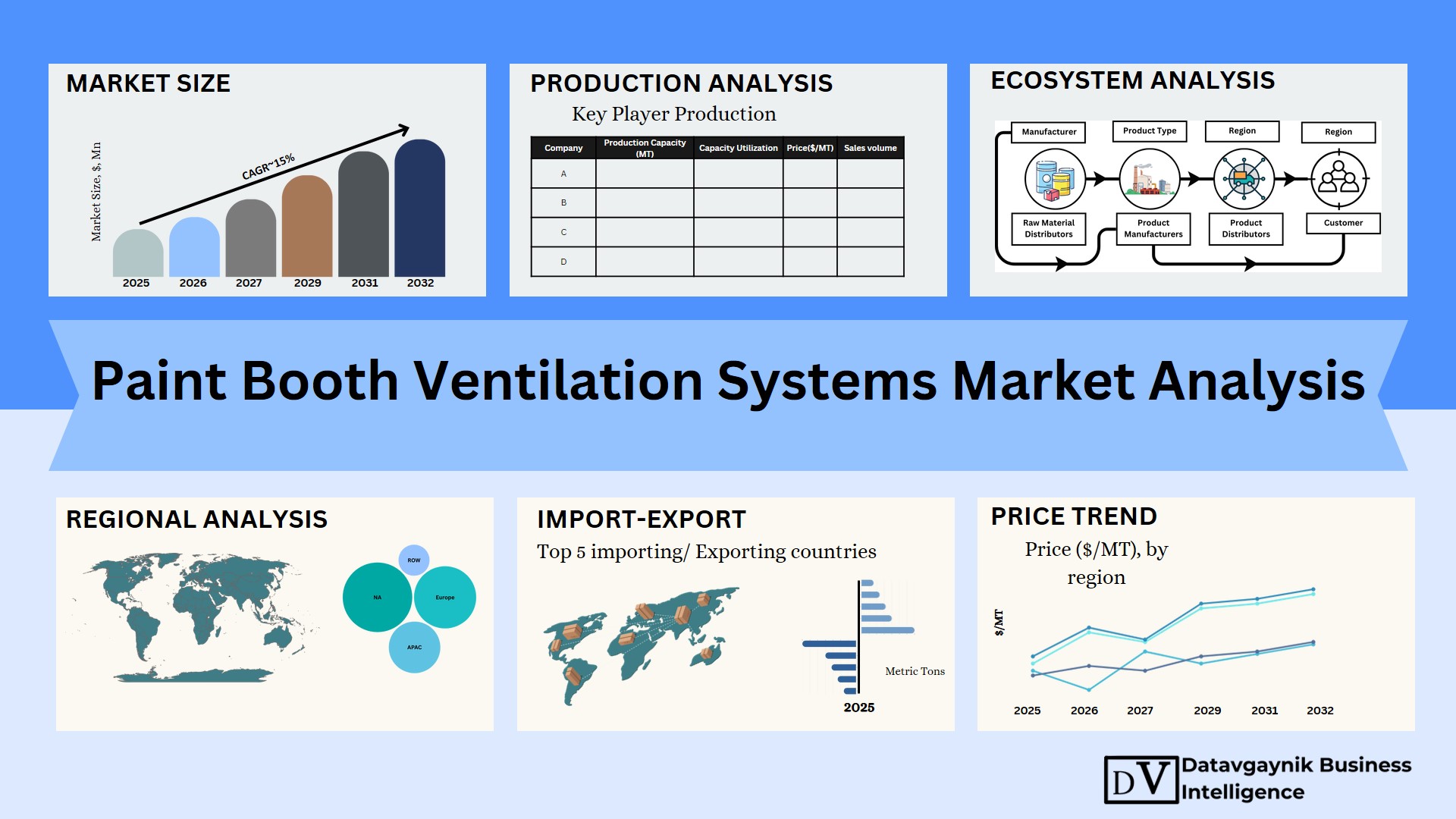
Paint booth ventilation systems cover the engineered airflow, exhaust, filtration, intake, make-up air, ducting, control, and safety systems used in enclosed spray-painting environments. These systems are used to control overspray, remove solvent vapors, protect operators, maintain coating quality, and keep paint shops compliant with workplace safety and air-emission norms. In simple terms, they decide whether a paint booth is only a box with fans or a controlled production asset.
The market has become more strategic in 2026 because coating operations are no longer judged only by finish quality. Manufacturers now look at worker exposure, fire safety, air balance, energy cost, particulate capture, and permit compliance together. Automotive refinishing shops, OEM paint lines, aerospace coating bays, industrial equipment producers, rail workshops, marine yards, and furniture manufacturers are all under pressure to run cleaner and more predictable spray environments.
A large share of demand still comes from replacement and retrofit activity. Many older booths were built around high air-change rates and basic exhaust logic. That design worked when energy cost and environmental reporting were not as tight. It is less attractive now. Operators are moving toward better airflow control, higher-efficiency filtration, variable-frequency drives, heat recovery, recirculation-ready configurations where allowed, and digitally monitored fan-filter systems. This is creating a healthy upgrade cycle across mature markets.
Regulation is one of the strongest forces shaping the Paint Booth Ventilation Systems Market. In the United States, OSHA rules require spray areas to use mechanical ventilation capable of removing flammable vapors, mists, and powders. EPA’s surface coating rules also push facilities toward enclosed and filtered spray operations. Similar compliance thinking is visible in Europe and parts of Asia, where fire protection, VOC control, worker safety, and hazardous air pollutant reduction are being built into factory audits and permitting processes. So, ventilation is not optional infrastructure. It is part of operational permission.
The market also benefits from global manufacturing expansion. Automotive production, EV component coating, heavy machinery refurbishment, aerospace maintenance, and industrial surface finishing are all adding new paint capacity. Asia Pacific is especially important because new factories often specify integrated paint booths from the start. North America and Europe are more retrofit-heavy, but these regions spend more per installation because of stricter safety expectations and higher energy-saving requirements.
By 2035, the market will be shaped by three buying priorities: compliance, energy efficiency, and process consistency. A paint booth that consumes less power, keeps airflow stable, reduces rework, and supports clean audits will command a premium. That said, smaller workshops may still delay upgrades unless rules are enforced or energy costs become painful. This creates a two-speed market: advanced systems for OEMs and regulated industrial users, and cost-sensitive systems for small refinishers and local fabrication units.
Estimated Global Paint Booth Ventilation Systems Market Outlook
| Metric | Estimate |
| Global market size, 2026 | $2.15 billion |
| Projected market size, 2035 | $3.58 billion |
| CAGR, 2026–2035 | 5.8% |
| Largest demand base in 2026 | Automotive OEMs and refinishing facilities |
| Fastest-growing demand pocket | Asia Pacific industrial and automotive coating facilities |
| Most important purchasing factor | Compliance-ready airflow and filtration performance |
| Strategic upgrade theme | Energy-efficient ventilation with digital monitoring |
Key stakeholders include paint booth OEMs, ventilation system integrators, filtration suppliers, automotive and aerospace manufacturers, collision repair networks, industrial coating contractors, fire safety authorities, environmental regulators, factory engineering consultants, insurance auditors, investors, and industry associations linked to surface finishing, coatings, workplace safety, and air-quality control.
Expert insight: The next phase of growth will not come only from new booth installations. A meaningful part of value will come from upgrading the air-handling layer inside existing booths. Buyers want lower operating cost, fewer compliance gaps, and a more stable coating environment. That is where premium suppliers can defend margins.
Competitive Intelligence and Benchmarking
The competitive structure of the Paint Booth Ventilation Systems Market is split between large turnkey paint-shop engineering groups, specialized booth manufacturers, regional fabricators, and retrofit-focused ventilation integrators. The top end of the market is engineering-led. Buyers here care about airflow modeling, code compliance, heat recovery, robotic coating compatibility, and lifetime service. The lower end is more price-driven, especially among independent body shops and small fabrication units.
Dürr holds one of the strongest positions in high-value automotive paint shops. Its portfolio covers complete paint-shop engineering, booth airflow systems, overspray separation, dry filtration, air recirculation, process automation, and energy-saving booth layouts. The company is positioned strongly with global OEMs because it does not sell only a booth shell. It sells the full painting ecosystem. Its strength is highest in automated vehicle body coating lines, EV plants, and large-scale modernization projects.
Global Finishing Solutions is a major North American player with a broad booth portfolio for automotive refinish, aerospace, defense, industrial manufacturing, and general finishing. Its position is strong in modular and custom-engineered systems. The company competes well where customers need code-compliant booths, air make-up units, filtration packages, controls, and field support from a single supplier. It has a strong installed-base advantage in the U.S. and Canada.
Blowtherm is positioned as a premium European booth supplier with strong visibility in collision repair, commercial vehicle refinishing, rail, aerospace, marine, woodworking, and industrial coating. Its products focus on airflow stability, heating efficiency, curing performance, and controlled ventilation. The company performs well in markets where workshops are willing to pay more for finish quality, shorter cycle times, and lower rework.
RTT Engineered Solutions / Col-Met has a practical advantage in industrial and automotive booth categories. Its portfolio covers crossdraft, semi-downdraft, downdraft, open-front, powder, and finishing-system configurations. The company’s market position is strongest among industrial users, refinish shops, and batch-production facilities looking for durable, customizable systems without moving into full turnkey automotive OEM paint-shop pricing.
Spray-Tech / Junair serves automotive, aerospace, manufacturing, and industrial finishing customers with engineered booth systems, ovens, air replacement systems, and finishing lines. Its strength is customization. The company is more relevant in projects where airflow, humidity, temperature, and booth size must be matched to the product being painted. Aerospace and large-part coating are especially attractive pockets for this type of supplier.
USI Italia has a strong brand position in premium automotive refinishing and collision repair booths. The company is associated with high-performance spray cabins, prep areas, drying systems, and controlled airflow designs. Its market role is strongest in body shops and refinish networks where color consistency, curing speed, paint quality, and technician productivity are central buying criteria.
Nova Verta is another important European booth supplier with exposure to automotive refinishing and industrial painting. Its positioning is built around booth design, ventilation performance, heating systems, and customized spray environments. The company is more visible in Europe, the Middle East, and selected export markets where body shops and industrial users want European-built systems at a mid-to-premium level.
Competitive Benchmarking Snapshot
| Company | Core Strength | Primary Market Position |
| Dürr | Full paint-shop engineering, dry overspray separation, recirculation-ready systems | Premium OEM and automated paint-shop leader |
| Global Finishing Solutions | Modular/custom booths, air make-up, filtration, field support | Strong North American multi-industry supplier |
| Blowtherm | Heating, airflow control, curing efficiency | Premium refinish and industrial booth supplier |
| RTT / Col-Met | Practical booth range, customization, industrial applications | Strong mid-market and industrial booth player |
| Spray-Tech / Junair | Large-part booths, aerospace and industrial customization | Engineered project-based supplier |
| USI Italia | Premium refinish booths and controlled spray cabins | High-end body shop and collision repair specialist |
| Nova Verta | European booth design and ventilation systems | Mid-to-premium automotive and industrial supplier |
Expert insight: The best-positioned companies are not only selling booth hardware. They are selling airflow assurance. This is where the margin sits. Fans, filters, ducting, and controls become strategic when the buyer connects them with compliance, finish quality, cycle time, and energy cost.
Regional Landscape and Adoption Outlook
The Paint Booth Ventilation Systems Market is regional by nature because booth specification depends on local fire codes, environmental rules, utility cost, labor safety enforcement, and the structure of the automotive and industrial base. Mature markets spend more per system. Emerging markets install more new capacity but often at lower average system value.
North America remains one of the most valuable regions. The U.S. leads demand due to its large automotive refinish base, aerospace manufacturing, defense coating work, industrial equipment production, and collision repair networks. Buyers here place strong emphasis on OSHA compliance, NFPA-aligned booth design, fire protection, air make-up, and filtered exhaust. Canada follows similar adoption logic, though with a smaller installed base. Mexico is gaining importance because of automotive assembly growth and supplier localization. The main white space is in small and medium workshops still using older booths with poor air balance and high energy loss.
Europe is a quality-driven market. Germany, Italy, France, the U.K., Spain, and the Netherlands are leading adopters due to automotive production, premium refinish networks, industrial coating, rail, aerospace, and strict workplace safety norms. European buyers are more receptive to energy-efficient booths, heat recovery, dry separation, and recirculation concepts where technically allowed. Germany and Italy also have a strong supplier base. The constraint is replacement timing. Many operators already have booth assets, so growth depends more on retrofit, modernization, and compliance upgrades than on first-time installations.
China is the largest opportunity pool in Asia because of its automotive scale, EV production, industrial machinery base, rail manufacturing, and export-led appliance and equipment sectors. Demand is shifting from basic enclosure systems toward more advanced air-handling packages in high-volume factories. Local suppliers serve cost-sensitive users, while international companies compete in premium automotive and export-grade industrial projects. The strongest growth will come from EV plants, body-in-white coating lines, parts coating, and industrial zones where environmental inspections are becoming more demanding.
India is moving from fragmented adoption to structured demand. Automotive OEMs, two-wheeler manufacturers, commercial vehicle plants, rail workshops, aerospace suppliers, and organized collision repair chains are creating steady demand. Local booth manufacturers dominate lower and mid-range systems, while premium imported or jointly engineered booths are used in high-end refinish and large industrial projects. India’s white space is large because thousands of workshops still operate with limited ventilation discipline. As insurance-led repairs, OEM body shops, and industrial safety audits expand, booth ventilation upgrades should move from optional spending to operational necessity.
Japan is a mature and technically disciplined market. Adoption is strongest in automotive OEMs, tier suppliers, machinery companies, electronics-related coating, and precision manufacturing. Japanese buyers prioritize reliability, low downtime, clean finish quality, and compact efficient layouts. Growth is not volume-heavy but value-heavy. Replacement systems with better energy control, quieter operation, and tighter airflow stability are likely to outperform basic booth sales.
South Korea is a high-specification market due to automotive, shipbuilding, electronics, machinery, and aerospace-related manufacturing. Demand is led by industrial coating lines, vehicle production, maintenance facilities, and heavy fabrication yards. Large companies tend to adopt advanced ventilation and filtration systems, while small refinish and fabrication users remain more cost-sensitive. South Korea’s opportunity lies in replacing older high-energy booths and improving air management in heavy industrial coating environments.
Rest of the World includes Latin America, the Middle East, Africa, Southeast Asia, and Oceania. Brazil, Thailand, Vietnam, Indonesia, Saudi Arabia, the UAE, Turkey, and Australia are the most relevant pockets. Growth is supported by automotive repair networks, transport fleet refurbishment, industrial parks, defense maintenance, ship repair, and construction equipment coating. The main gap is uneven regulation. Where enforcement is weak, booth purchases remain price-led. Where multinational manufacturers or export-oriented plants are present, ventilation specifications improve quickly.
Regional Adoption Comparison
| Region | Adoption Profile | Growth Outlook to 2035 |
| North America | Retrofit-heavy, compliance-led, strong refinish and aerospace demand | Stable value growth |
| Europe | Energy-efficiency and safety-led modernization | Moderate but premium |
| China | New factory demand plus EV and industrial coating expansion | High growth |
| India | Large underpenetrated base, rising organized repair and manufacturing demand | High growth |
| Japan | Mature, quality-led, replacement-focused | Low to moderate growth |
| South Korea | High-spec industrial and automotive coating demand | Moderate to strong growth |
| Rest of the World | Mixed adoption, led by industrial zones and fleet repair | Selective high growth |
Expert insight: Asia will add booth capacity. North America and Europe will add value per booth. That difference matters. In mature markets, the sales argument is energy, compliance, and uptime. In emerging markets, it is often safety, throughput, and first-time formalization of paint operations.
End-User Dynamics and Use Case
End-user behavior in the Paint Booth Ventilation Systems Market varies sharply by production intensity. A global automotive OEM does not buy the same system as a small body shop. The technical requirement may look similar at the surface — controlled airflow, exhaust, filtration, make-up air — but the decision logic is completely different.
Automotive OEMs are the highest-value buyers. They need integrated booth ventilation inside full paint shops. Their focus is on air balance, overspray capture, robotic compatibility, temperature and humidity control, emissions control, and energy consumption. These customers prefer turnkey or highly engineered systems because booth failure can stop production. Even a small airflow issue can create coating defects, rework, or line downtime.
Collision repair centers and body shops form the broadest customer base by unit count. Their adoption is driven by faster curing, better finish quality, technician safety, insurer expectations, and compliance with local fire and ventilation rules. Larger multi-shop operators are more likely to invest in downdraft or semi-downdraft systems with better controls. Independent workshops often buy smaller or lower-cost systems, though this is changing as paint materials and repair-cycle expectations become more demanding.
Aerospace and defense users need larger booths with strict control over airflow, filtration, humidity, temperature, and safety. Aircraft components, helicopters, drones, ground support equipment, and defense vehicles often require coating in large enclosures. These users are less price-sensitive because finish quality, corrosion protection, traceability, and safety documentation carry higher weight.
Industrial manufacturers use these systems for machinery, metal parts, appliances, rail components, agricultural equipment, fabricated structures, plastic parts, and furniture. Their main requirement is practical: remove overspray, protect workers, maintain coating consistency, and avoid contamination. In this segment, booth ventilation is often part of a wider finishing line with pretreatment, drying, curing, and material-handling systems.
Marine, rail, and heavy equipment users require large-volume ventilation and flexible booth layouts. These applications often deal with oversized components. So, airflow design becomes more complex. The booth must manage worker exposure without wasting excessive conditioned air. Demand here is more project-based but system value is high.
Use case: A commercial vehicle refurbishment facility in Germany upgraded from an older crossdraft booth to a semi-downdraft booth with variable-speed exhaust, filtered make-up air, and heat recovery. The facility handled buses and municipal fleet vehicles. Before the upgrade, paint rework was frequent during winter because air temperature and dust control were inconsistent. After the upgrade, the operator reduced curing delays, improved finish consistency, and lowered fuel consumption during long spraying cycles. The business case was not only regulatory compliance. It was fewer repaint jobs and faster vehicle turnaround.
End-User Adoption Matrix
| End User | Main Purchase Trigger | Preferred System Direction |
| Automotive OEMs | Throughput, emissions, robotic paint quality, energy use | Integrated high-spec ventilation and overspray separation |
| Collision repair centers | Finish quality, faster repair cycle, technician safety | Downdraft or semi-downdraft booths with efficient air make-up |
| Aerospace and defense | Large-part coating, documentation, environmental control | Custom large booths with humidity, filtration, and airflow control |
| Industrial manufacturers | Worker safety, overspray control, production consistency | Modular industrial booths and finishing lines |
| Marine and rail | Oversized structures and heavy coating requirements | Large engineered booths with flexible airflow layouts |
| Furniture and woodworking | Dust-free coating and operator protection | Cost-effective filtered exhaust and controlled spray rooms |
Expert insight: End users increasingly calculate booth ROI through rework reduction. That is an important shift. A cleaner, better-balanced booth is not just a safety asset. It can protect paint material cost, labor hours, energy use, and delivery schedules.
Recent Developments + Opportunities & Restraints
Recent Developments
May 2024 – PPG announced a $300 million North American manufacturing investment.
PPG disclosed plans to expand automotive coatings manufacturing capacity, including a new facility in Tennessee. This does not directly create booth sales by itself. But it strengthens the automotive coatings ecosystem around major vehicle production clusters. More coating output and localized supply typically support paint-line upgrades, refinish capacity, and related booth infrastructure demand.
April 2025 – Global Finishing Solutions highlighted energy-efficient booth systems for cleaner manufacturing.
The announcement emphasized recirculating paint booth systems, smart controls, and advanced filtration. This supports a broader market shift: buyers are asking how much energy a booth wastes when the gun is not spraying. Ventilation suppliers that can prove energy savings without compromising safety will gain more attention.
July 2025 – Dürr promoted dry overspray separation through its EcoDryScrubber technology.
The system uses dry separation instead of conventional wet scrubbing logic. For large paint shops, this matters because water use, chemical handling, filter efficiency, and energy demand are all under review. Dry separation is becoming more relevant where automotive OEMs want lower environmental load and lower operating complexity.
September 2025 – Dürr reported a CO₂-efficient turnkey paint shop project for Volkswagen in Puebla, Mexico.
The project reflects how paint shops are being redesigned around flexible production, high throughput, and lower environmental impact. For the Paint Booth Ventilation Systems Market, this is important because the paint booth is no longer treated as a standalone room. It is part of a full energy and process architecture.
Opportunities
Emerging market formalization is the clearest volume opportunity. India, Southeast Asia, Latin America, and parts of the Middle East still have a large base of informal or semi-compliant painting operations. As OEM-certified repair, industrial safety audits, and export manufacturing expand, demand for compliant booth ventilation should rise.
Energy-saving retrofits offer a strong margin pool. Variable-frequency drives, smart booth controls, heat recovery, better filtration, and balanced air make-up systems can be sold into existing facilities without full booth replacement. This is especially attractive in North America, Europe, Japan, and South Korea.
Remote monitoring and automation will become more relevant in premium installations. Sensors for filter loading, airflow imbalance, fan performance, booth pressure, and temperature can reduce maintenance guesswork. AI as a standalone theme is still not central here. But automated monitoring and predictive service are clearly relevant.
Restraints
High upfront cost remains the largest barrier. A proper booth ventilation system requires enclosure design, fans, ducting, make-up air, filtration, controls, fire safety, electrical work, and installation. Small workshops often delay investment unless compliance pressure or productivity gains are clear.
Fragmented regulation slows standardization. Requirements vary by country, state, municipality, insurer, and fire authority. This creates design complexity and can stretch project timelines.
Operating cost sensitivity can delay adoption. Ventilation systems consume power and conditioned air. If buyers focus only on purchase price and not lifetime cost, they may select low-cost systems that underperform on energy and process quality.
Expert insight: The market’s strongest opportunity is not simply “more paint booths.” It is smarter ventilation inside paint operations. The winners will be suppliers that reduce energy use, simplify compliance, and keep finish quality stable under real production conditions.


