

Market Summary and Growth Forecast
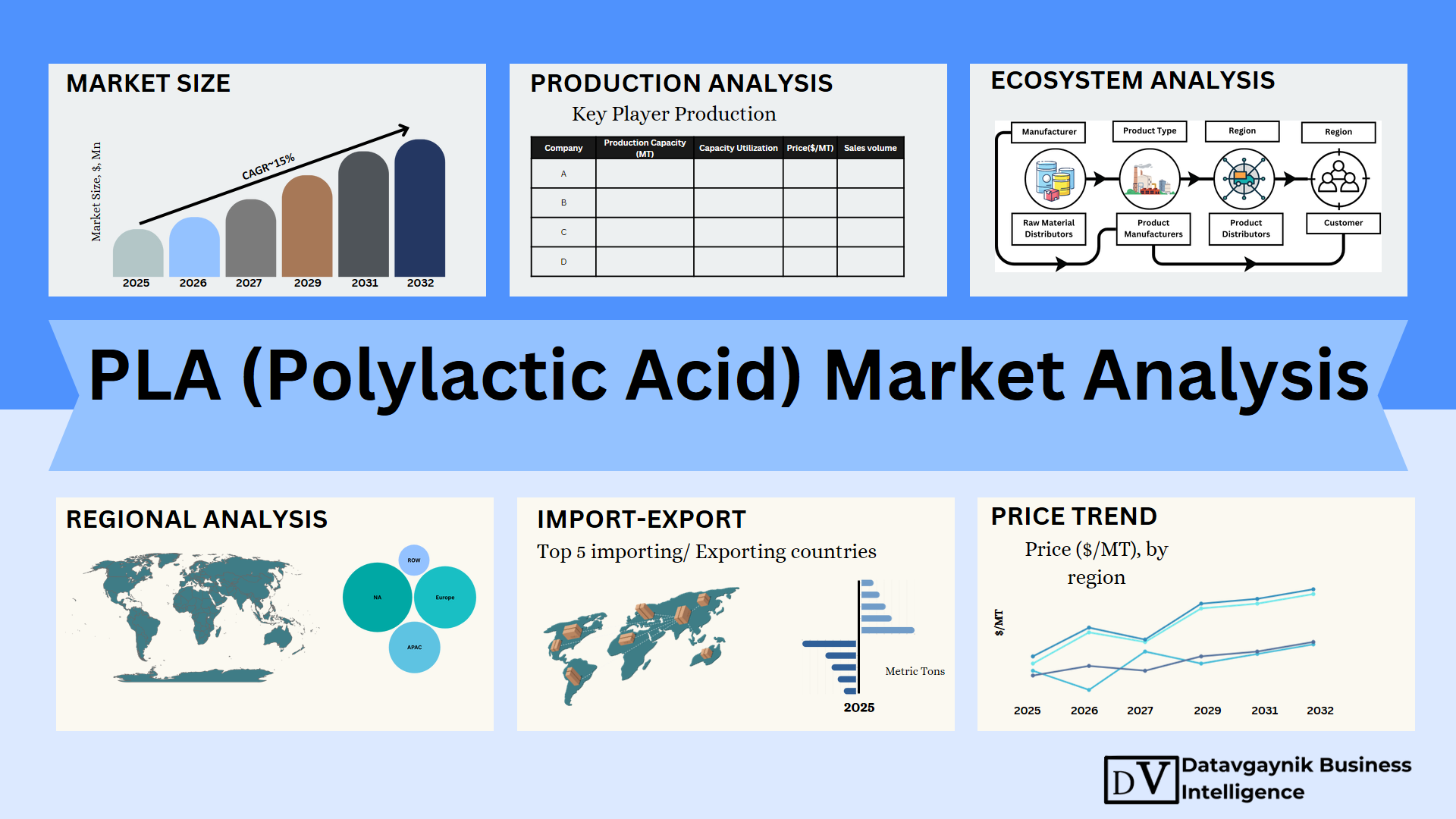
The global PLA (Polylactic Acid) Market is valued at $1,480 million in 2026 and is expected to appreciate to $5,672 million by 2035, at a CAGR of 16.1%.
Polylactic acid is a renewable thermoplastic polyester produced through the fermentation of plant-derived sugars into lactic acid, followed by lactide formation and polymerization. Commercial PLA is supplied as resin, compound, film material, fiber-grade polymer, foam-grade material and additive-manufacturing filament.
Its business relevance is now moving beyond the simple replacement of conventional plastic. Between 2026 and 2035, PLA will increasingly be evaluated as part of a broader material strategy covering carbon reduction, renewable feedstocks, packaging circularity, industrial composting and supply-chain diversification.
Datavagyanik also covers related markets such as the Polylactic Acid (PLA) Market and the Polylactide (PLA) Composites Market. They create a more holistic picture of the ecosystem in which the primary topic exists, including technological shifts and market demands.
The market estimate is based on expected resin consumption of approximately 520,000 metric tons in 2026, combined with a blended global selling price of nearly $2,845 per metric ton. By 2035, annual consumption could approach 1.92 million metric tons, supported by larger production plants, improved utilization and a greater mix of high-performance grades.
Global PLA Market Forecast
| Year | Estimated Market Revenue | Market Direction |
| 2026 | $1,480 million | Capacity expansion and packaging conversion programs gain pace |
| 2027 | $1,718 million | Asian supply improves and new film applications enter commercialization |
| 2028 | $1,995 million | Additional production assets begin supporting regional availability |
| 2029 | $2,316 million | High-heat, flexible and recycled-content grades gain a wider customer base |
| 2030 | $2,689 million | Packaging recyclability and carbon requirements reshape material selection |
| 2031 | $3,122 million | Greater adoption in fibers, durable goods and food-contact formats |
| 2032 | $3,625 million | Local compounding and recycling systems reduce application barriers |
| 2033 | $4,208 million | PLA becomes more established outside foodservice packaging |
| 2034 | $4,886 million | Performance-grade products carry a larger value contribution |
| 2035 | $5,672 million | Market reaches broader industrial scale |
Forecast figures represent independent analyst estimates developed from announced production capacity, utilization levels, application demand and expected product-mix changes.
Why the Market Matters
PLA addresses three commercial priorities at the same time. It reduces dependence on fossil-based raw materials. It gives consumer-facing businesses a renewable material option. Also, it supports selected recycling and industrial-composting pathways when products are correctly designed and collected.
That said, PLA is not automatically sustainable in every application. The environmental and commercial result depends on feedstock sourcing, manufacturing energy, product design, transport distance and end-of-life infrastructure. A compostable cup sent to landfill, for example, does not create the same value as one collected through a functioning organic-waste system.
The business case for the PLA (Polylactic Acid) Market will therefore be strongest in applications where material performance and waste-management systems are aligned.
Major Growth Forces
Production capacity expansion
Global biobased-plastics capacity stood at approximately 2.31 million metric tons in 2025 and is projected to reach around 4.69 million metric tons by 2030. Average industry utilization was about 72% in 2025, showing that demand growth must be accompanied by stronger plant loading and customer conversion.
PLA capacity is becoming more geographically distributed. NatureWorks operates a 150,000-metric-ton facility in Nebraska and opened a second integrated facility in Thailand with approximately 75,000 metric tons of annual capacity in April 2026. TotalEnergies Corbion operates a 75,000-metric-ton plant in Rayong, Thailand. These assets improve resin availability in North America and Asia while reducing dependence on a small number of shipping routes.
Packaging regulation
Regulation will have a strong but selective effect. The European Union’s Packaging and Packaging Waste Regulation entered into force on February 11, 2025, and generally applies from August 12, 2026. It introduces requirements covering packaging design, composition, waste prevention, recycled content and recyclability. The regulation also aims to make packaging economically recyclable by 2030.
This does not guarantee automatic substitution in favor of PLA. It creates demand for formats that can demonstrate a clear collection and recovery route. So, recyclable mono-material designs, certified compostable food-contaminated packaging and low-carbon rigid packaging will perform better than products carrying only broad environmental claims.
Material performance
Early PLA grades were mainly selected for transparency, rigidity and ease of processing. Their main limitations were low heat resistance, brittleness, slow crystallization and limited gas or moisture barrier performance.
Newer grades address these issues through crystallization control, impact modifiers, nucleating agents, stereocomplex structures, barrier coatings and polymer blending. This may lead to more usage in hot-food packaging, appliances, electronics, transportation interiors and other semi-durable products.
Production economics
PLA pricing remains influenced by sugar and starch costs, fermentation yield, energy consumption, lactide-purification efficiency, plant utilization and logistics. Conventional polypropylene, polyethylene and PET still benefit from much larger production systems.
So, PLA will not win every application on price. Its stronger position will be in products where renewable content, carbon reduction, compostability or brand differentiation creates measurable commercial value.
Corporate sustainability procurement
Food companies, retailers, restaurant chains, consumer-product manufacturers and packaging suppliers are moving from broad sustainability pledges toward material-specific procurement targets. Buyers increasingly ask for carbon-footprint data, renewable-content verification, food-contact compliance, compostability certification and end-of-life guidance.
This gives technically supported PLA grades an advantage. It also increases documentation and qualification costs for resin producers and converters.
Key Consumers and Commercial Clients
| Customer Group | How PLA Is Used | Primary Buying Requirement |
| Packaging converters | Cups, trays, films, labels, coated paper and containers | Processability, clarity, sealing and regulatory compliance |
| Food and beverage companies | Fresh-food packaging, coffee capsules, confectionery wraps and serviceware | Food-contact safety and end-of-life positioning |
| Foodservice and hospitality operators | Cutlery, lids, cups, takeaway containers and waste bags | Compostability and reliable large-volume supply |
| Retail and consumer-goods companies | Cosmetic packaging, household products and display materials | Renewable content and visual quality |
| 3D-printing filament producers | Consumer, educational and industrial printing filament | Dimensional stability, print quality and grade consistency |
| Fiber and nonwoven manufacturers | Hygiene products, tea bags, wipes, apparel and furnishing materials | Spinnability, softness and thermal performance |
| Medical-product manufacturers | Sutures, implants, drug-delivery systems and resorbable components | Purity, controlled degradation and biocompatibility |
| Agricultural-product manufacturers | Mulch films, clips, plant pots and controlled-release systems | Soil or compost performance and field durability |
| Electronics and appliance brands | Casings, accessories and semi-durable components | Heat resistance, impact strength and surface finish |
The forecast for the PLA (Polylactic Acid) Market assumes that packaging will remain its largest revenue base. However, the value mix will gradually move toward high-performance compounds, flexible packaging, fibers, medical grades and durable applications.
Expert view: PLA is moving from a “green alternative” into a designed material platform. The next stage of growth will depend less on environmental messaging and more on performance, certification and recovery systems.
Market Segmentation and Forecast Scope
The PLA (Polylactic Acid) Market can be assessed by product type, application, end-user industry and region. Each dimension reflects a different purchasing decision.
Product segmentation explains performance and price positioning. Application segmentation shows how the resin is converted. End-user segmentation identifies the industry controlling material approval. Regional segmentation captures differences in production capacity, regulation, feedstock access and waste infrastructure.
By Product Type
Standard and General-Purpose PLA
Standard PLA represents an estimated 66.5% of global demand in 2026. It is used in thermoformed packaging, disposable serviceware, extrusion coatings, basic injection-molded products and standard 3D-printing filament.
Its commercial strength comes from established processing knowledge and relatively broad availability. Its limitations remain heat distortion, brittleness and suitability for demanding hot-fill or durable applications.
Growth will remain healthy, but this category will lose part of its market share as customers move toward higher-value modified grades.
High-Heat and Crystallized PLA
High-heat PLA uses controlled crystallization, nucleating systems, stereocomplex structures or process modifications to improve thermal stability.
It is one of the most strategic product categories through 2035. Target applications include hot beverage lids, microwaveable packaging, electronics housings, appliances and automotive interior components.
The segment is projected to expand at approximately 18.6% CAGR between 2026 and 2035. Commercial adoption will depend on whether converters can achieve higher heat resistance without introducing excessive cycle time or processing complexity.
Impact-Modified and Flexible PLA
Impact-modified grades address the rigidity and brittleness of conventional PLA. They are used where bending, drop resistance or puncture strength matters.
These grades are commonly combined with biodegradable polymers, elastomers or proprietary modifiers. Flexible PLA compounds are particularly important for bags, flexible films, agricultural products and selected consumer goods.
The category should benefit from continued progress in compostable polymer blends. Still, suppliers must manage the trade-off between flexibility, transparency, strength and biodegradation.
Recycled PLA
Recycled PLA includes mechanically recovered and chemically recycled material. Commercial grades containing recycled content have started entering packaging and durable-product applications.
TotalEnergies Corbion, for example, markets PLA grades containing 30% and 100% recycled PLA. This indicates that circular-content products are moving from technical trials toward commercial availability.
The segment is forecast to record one of the highest growth rates, although it will start from a small base. Collection volume, sorting accuracy and contamination control remain the main constraints.
Medical and High-Purity PLA
Medical-grade PLA is used in resorbable sutures, orthopedic fixation devices, implants, tissue-engineering structures and controlled drug-delivery products.
This segment is much smaller by volume but carries a substantially higher unit value. Qualification periods are longer, quality requirements are strict and changing an approved material can be difficult. As a result, medical-grade producers can maintain stronger margins than commodity packaging-resin suppliers.
By Application
Packaging and Foodservice
Packaging and foodservice account for an estimated 57.2% of global PLA consumption in 2026.
The segment covers rigid trays, cups, lids, cutlery, transparent containers, coated paper, coffee capsules, labels and flexible packaging. Clear appearance, stiffness and food-contact suitability make PLA practical for many short-life applications.
Rigid packaging is currently the established base. Flexible packaging is expected to grow faster as orientation technology, sealing performance and barrier structures improve.
Industry-wide data also show that packaging remains the largest application for biobased plastics, accounting for 41.3% of global bioplastics capacity in 2025. PLA has a stronger packaging concentration than the overall bioplastics industry.
Fibers and Nonwovens
PLA fibers are used in hygiene products, wipes, bedding, apparel, tea bags, filtration materials and agricultural textiles.
The segment offers an important route beyond packaging. Fibers can provide softness, moisture management and renewable content. Growth will be supported by hygiene applications and brands seeking lower-fossil-content textiles.
Cost competition from polypropylene and polyester remains intense. Therefore, adoption will be concentrated in products where sustainability claims influence purchasing.
3D Printing
PLA remains a preferred material for material-extrusion 3D printing because it processes at relatively low temperatures, exhibits limited warping and produces good surface detail.
Demand comes from hobby users, education, prototyping, architectural models and selected industrial applications. The market is also shifting toward tougher, heat-resistant, carbon-fiber-filled and recycled-content filaments.
The segment is forecast to grow at approximately 17.3% CAGR through 2035. Growth may moderate in basic consumer filament as price competition increases, while engineered filament should remain attractive.
Consumer and Durable Goods
This category includes household products, cosmetic components, toys, stationery, appliance parts and electronics accessories.
Its strategic value is higher than its present volume. Durable products require better heat resistance, impact performance, dimensional stability and color retention. Advances in compounding are gradually closing these gaps.
A successful move into durable products would also reduce PLA’s dependence on disposable packaging.
Agriculture
Agricultural applications include clips, pots, controlled-release systems, plant supports and biodegradable or compostable film structures.
Demand is influenced by local standards governing soil biodegradation and compostability. Products must maintain mechanical performance during use but degrade under intended conditions after disposal. That balance is technically difficult.
The segment will remain selective but could grow quickly where collection of conventional agricultural plastic is expensive.
Biomedical Applications
Biomedical usage includes implants, scaffolds, sutures and drug-delivery systems. Demand is supported by the ability to control polymer degradation and molecular structure.
Volume will remain limited. Revenue contribution will be higher because medical-grade PLA sells at a premium and requires specialized manufacturing.
By End User
Food and Beverage Industry
Food and beverage companies are the largest end-user group. They use PLA directly through packaging partners and contract manufacturers.
Fresh produce, cold beverages, coffee systems, confectionery and foodservice are important demand areas. The main purchasing criteria are food-contact compliance, transparency, sealing, barrier performance and recovery options.
Foodservice and Hospitality
Restaurants, cafés, caterers, event venues, airlines, hotels and institutional kitchens use PLA-based serviceware and waste-management products.
Closed environments offer better collection potential than open retail systems. A stadium or corporate campus, for example, can collect serviceware and food waste in the same managed system.
Use case: A venue using certified compostable cups, plates and cutlery can create a relatively clean organic-waste stream when collection bins and composting contracts are arranged in advance.
Retail and Fast-Moving Consumer Goods
Retailers and consumer-goods companies use PLA in cosmetics, personal care, display packaging and household products.
These companies can accelerate adoption because they influence product specification across large supplier networks. However, they also demand stable pricing and consistency across regions.
Textile, Hygiene and Healthcare Industries
Textile and hygiene producers use PLA in fibers, nonwovens and specialized medical materials. Healthcare applications have higher technical requirements and longer approval cycles.
The segment provides a more defensible commercial position than basic disposable packaging, particularly for producers offering high-purity or application-specific grades.
Additive Manufacturing Industry
Filament extruders, printer companies, service bureaus, educational suppliers and industrial prototyping companies form the additive-manufacturing customer base.
Engineered filament will become more important than basic PLA as customers require improved toughness, thermal stability and recycled content.
By Region
North America
North America has an established PLA production and conversion base, supported by the 150,000-metric-ton NatureWorks facility in Nebraska. Demand is concentrated in foodservice, fresh-food packaging, coffee capsules, coated paper and 3D printing.
Growth will depend on state-level packaging policies, composting access and the ability to create clear disposal instructions. The region is expected to record approximately 14.6% CAGR between 2026 and 2035.
Europe
Europe remains an important technology, regulation and specialty-application market.
The region has strong interest in carbon-footprint reduction and packaging circularity. That said, the PPWR places substantial emphasis on recyclability and recycled content. PLA suppliers must therefore prove where recycling or compostability creates a practical system advantage.
European growth is projected at nearly 15.5% CAGR, led by films, coated paper, food-contaminated packaging, fibers and specialty compounds.
Asia Pacific
Asia Pacific is expected to remain the largest and fastest-growing regional market. China provides a broad conversion and manufacturing base. Thailand has become an important production center, while India, Japan and South Korea are developing additional applications and supply capabilities.
The opening of NatureWorks’ 75,000-metric-ton Thailand plant in 2026 strengthens local access to grades used in flexible packaging, foodserviceware, nonwovens and 3D printing.
The region is projected to grow at around 17.8% CAGR through 2035. Packaging conversion, manufacturing scale and locally available agricultural feedstocks will support expansion.
This regional shift will make the PLA (Polylactic Acid) Market less dependent on North American production than it was in its earlier commercial stage.
Latin America, Middle East and Africa
LAMEA remains smaller but offers opportunities in food packaging, agricultural products, hospitality and institutional procurement.
The Middle East is moving from a consumption market toward potential production. Sulzer and Emirates Biotech are working on an integrated UAE facility using plant-based feedstock, lactide formation and polymerization technology. Operations are targeted for early 2028.
Growth across LAMEA is estimated at approximately 16.3% CAGR, although commercial progress will vary sharply by country.
Expert view: Asia Pacific will lead in production and conversion volume. Europe will continue to influence product design and end-of-life requirements. North America will remain important for established supply, foodservice products and additive manufacturing.
Market Trends and Business Innovations
Innovation in PLA is becoming more application-specific. Resin producers are no longer relying only on renewable feedstock or compostability as selling points. R&D now focuses on heat performance, toughness, processing speed, thin-wall conversion, film orientation, barrier properties and circular recovery.
High-Heat PLA Moves Toward Durable Applications
Heat resistance remains one of the main technical barriers to broader adoption. Conventional PLA can deform at temperatures that are common in hot-food packaging, transport interiors and electrical products.
Research programs are addressing this through faster crystallization, nucleating agents, stereocomplex PLA, mineral reinforcement and improved mold-temperature control.
The commercial effect could be substantial. High-heat PLA can compete in applications that previously required polypropylene, polystyrene or engineering-plastic blends. This includes appliance parts, hot-drink lids, reusable food containers and electronic accessories.
Expert view: Improving heat resistance is more commercially important than creating another basic transparent PLA grade. It expands the addressable market rather than simply dividing existing packaging demand.
Biaxially Oriented PLA Film Gains Attention
Flexible packaging has historically been difficult for PLA because of brittleness, sealing requirements and film-processing limitations.
New molecular and processing platforms are improving orientation behavior. NatureWorks’ Ingeo Extend platform, for example, is designed to enable biaxially oriented PLA film on equipment originally used for materials such as polypropylene. The company reports transverse stretching of up to seven times for its 4950D grade.
This development matters because existing BOPP-style equipment represents a large installed conversion base. A material that runs on familiar machinery can enter the market faster than one requiring a dedicated production line.
Potential applications include confectionery wrappers, sachets, labels, coffee packaging and coated structures.
Foamed PLA Targets Polystyrene Applications
Foamed PLA is emerging as a lightweight option for insulation packaging, trays, protective formats and foodservice products.
In July 2026, TotalEnergies Corbion introduced a PLA foam grade designed as an alternative to polystyrene and intended to run on existing extruded-polystyrene equipment with limited modification.
This is strategically important. Converters are more likely to trial a new resin when existing extrusion assets can be retained. Lightweight foam also reduces material usage per product, partly offsetting PLA’s higher resin price.
Commercial success will depend on cell structure, insulation performance, dimensional stability and the availability of a credible recovery route.
Recycled PLA Becomes a Product Category
The PLA industry is gradually moving beyond the idea that renewable feedstock alone is enough.
Mechanical recycling can recover relatively clean production scrap and post-industrial material. Chemical recycling can break PLA down into reusable intermediates, creating the potential for higher-quality recycled resin.
Commercial availability of 30% and 100% recycled PLA grades from TotalEnergies Corbion shows that recycled-content PLA is entering supplier portfolios.
The main challenge is feedstock collection. PLA packaging is still a small portion of the overall plastic-waste stream. Sorting it from PET and other clear plastics requires adequate volume, identification and customer participation.
So, the earliest recycling systems are likely to develop in controlled environments such as manufacturing plants, distribution centers, stadiums, festivals, airports and institutional foodservice operations.
Material Blending Expands Performance
PLA is increasingly used as part of a compound rather than as a standalone resin.
Blending with flexible biodegradable polymers can improve elongation and puncture strength. Natural fibers and mineral fillers can increase stiffness or reduce resin usage. Impact modifiers can improve drop resistance. Barrier coatings can improve shelf life.
This creates opportunities for compounders and additive suppliers. It also makes certification more complex. Each component may affect food-contact status, compostability, recyclability and degradation behavior.
The winning formulations will be those that solve a specific performance problem without weakening the product’s end-of-life claim.
Production Shifts Closer to Feedstock and Customers
The opening of NatureWorks’ integrated Thailand facility in April 2026 added approximately 75,000 metric tons of annual capacity. The site uses regional renewable feedstocks and serves flexible packaging, foodserviceware, fibers and 3D-printing customers in Asia Pacific.
The planned UAE project involving Emirates Biotech, Sulzer and Samsung E&A follows a similar logic. It combines production technology, regional investment and access to growing packaging markets. Commercial operations are expected in early 2028.
Sulzer has also reported technology partnerships supporting PLA-production projects in India. These investments indicate that capacity growth is spreading into markets previously dependent on imports.
This localization can reduce freight costs, shorten delivery times and allow grades to be developed around regional feedstocks and customer requirements.
End-of-Life Design Becomes Part of Product Development
A PLA product can be designed for industrial composting, mechanical recycling, chemical recycling or controlled biodegradation. It cannot be assumed to perform equally well in every recovery route.
Product developers are therefore considering end-of-life during material selection rather than after launch. Labels, inks, adhesives, colors and multilayer structures must be compatible with the intended system.
This is particularly important under the EU PPWR. From August 12, 2026, the regulation begins applying broad requirements covering packaging design, recoverability and waste prevention. Its objective of economically recyclable packaging by 2030 will place greater scrutiny on unsupported disposal claims.
Compostable PLA formats may perform best where food contamination makes conventional recycling impractical. Recyclable PLA may work better in closed-loop environments with sufficient collection volume.
Partnerships and Commercial Announcements
The industry’s recent deal activity has been led more by partnerships, licensing agreements and capacity investments than by large producer mergers.
| Date | Companies | Development | Commercial Importance |
| April 2026 | NatureWorks, PTT Global Chemical and Cargill | Opened an integrated 75,000-metric-ton PLA facility in Thailand | Expands Asian supply and strengthens local feedstock integration |
| July 2026 | TotalEnergies Corbion | Introduced a low-carbon PLA foam grade positioned against polystyrene | Opens lightweight foam and existing XPS-conversion opportunities |
| May 2025 | Sulzer, Emirates Biotech and Samsung E&A | Advanced equipment and engineering agreements for a UAE PLA plant | Builds a new production base in the Middle East |
| 2025 | NatureWorks and FLO Group | Developed a compostable single-serve coffee pod for North America | Shows how resin producers are working directly with packaging-system specialists |
| 2024 | Sulzer and Balrampur Chini Mills | Advanced technology cooperation for an Indian bioplastics facility | Supports domestic production in a large import-dependent market |
Large-scale mergers remain limited because the commercial resin market is already concentrated among a relatively small group of integrated producers. Investment is instead flowing into new plants, process licensing, compounding partnerships and application development.
Business Impact Through 2035
The strongest innovation opportunities will not come from selling undifferentiated resin. They will come from complete material solutions.
These include high-heat compounds for hot-food packaging, thin oriented films, recyclable coated paper, foamed structures, recycled-content grades and application-specific 3D-printing materials.
The PLA (Polylactic Acid) Market will also become more closely linked with waste companies, composting operators, recyclers, certification bodies and packaging-design specialists.
Expert view: By 2035, PLA suppliers will compete on application support and end-of-life credibility as much as resin capacity. Producers that can connect material science, conversion technology and waste infrastructure will capture the strongest customer relationships.
Competitive Intelligence and Benchmarking
Competition in the global PLA industry is shaped by four capabilities: access to fermentation feedstock, control over lactide production, polymerization scale and application-development support.
Installed capacity alone does not determine market strength. A producer also needs stable plant utilization, consistent optical purity, food-contact approvals, regional warehousing and technical support for converters. This is why the commercial field remains narrower than the list of announced PLA projects suggests.
The competitive structure can be divided into three groups:
- Large commercial producers with operating integrated facilities
- Chinese and Indian companies building feedstock-linked capacity
- Specialty suppliers focused on medical, high-purity or engineered PLA
Competitive Benchmarking of Major PLA Companies
| Company | Operating or Announced Position | Portfolio Emphasis | Market Position and Strategic Advantage |
| NatureWorks | Approximately 225,000 metric tons per year of combined nameplate capacity across the United States and Thailand | Packaging resin, films, fibers, nonwovens, foodservice materials, durable compounds and additive-manufacturing grades | Current global scale leader with two integrated production locations and extensive converter relationships |
| TotalEnergies Corbion | 75,000 metric tons per year in Thailand | Standard, high-heat and recycled PLA for rigid packaging, flexible films, fibers, durable goods, foams and 3D printing | Strong position in engineered grades, chemical recycling and application-specific development |
| Futerro | Commercial production in China and planned 75,000-metric-ton integrated French biorefinery | Lactic acid, lactide, PLA resin, agricultural films, fibers, packaging and recycling technologies | Vertically integrated challenger with a strong European circularity strategy |
| Zhejiang Hisun Biomaterials | 65,000 metric tons per year of disclosed PLA capacity, with a further 150,000 metric tons listed in its expansion pipeline | Injection molding, extrusion, thermoforming, films, laminating, nonwovens and 3D printing | Established Chinese producer positioned to benefit from domestic conversion scale |
| Anhui BBCA Biochemical | Company-disclosed 100,000-metric-ton operating base and a larger expansion program | PLA resin, lactic acid and broader fermentation-based materials | Strong upstream integration into agricultural processing and fermentation |
| Balrampur Chini Mills | Approximately 75,000 metric tons per year under implementation in India | Compostable packaging resin and downstream bio-based products | Important emerging Indian entrant with direct sugarcane-feedstock access |
| Musashino Chemical Laboratory | Specialty output; capacity not publicly disclosed | High-purity medical PLA, implant materials and controlled drug-delivery polymers | Niche technology supplier with stronger value per kilogram than commodity packaging-resin producers |
Capacity figures represent operating nameplate capacity or formally disclosed projects. Announced projects should not be treated as fully available supply until commissioning and commercial qualification are completed.
NatureWorks
NatureWorks has the broadest established commercial position. Its Nebraska facility has a nameplate capacity of 150,000 metric tons per year. The company added an integrated 75,000-metric-ton facility in Thailand in April 2026, bringing its combined disclosed capacity to approximately 225,000 metric tons per year.
The company serves rigid and flexible packaging, foodservice, fibers, hygiene materials, consumer products and additive manufacturing. Its advantage comes from scale and long-term application-development experience.
The Thailand investment also changes its supply position. The new facility converts locally sourced sugarcane into lactic acid, lactide and polymer at one location. This gives the company a stronger Asia Pacific supply base and reduces dependence on exports from the United States.
Its main challenge is defending a premium market position as lower-cost Asian capacity enters commercial production.
TotalEnergies Corbion
TotalEnergies Corbion operates a 75,000-metric-ton-per-year facility in Rayong, Thailand. Its portfolio covers packaging, fibers, foodserviceware, consumer goods, automotive components, additive manufacturing and engineered compounds.
The company has built a differentiated position in high-heat PLA, recycled-content resin and foam technology. It also offers grades containing mechanically or chemically recovered PLA. Its hydrolysis-based recycling capability allows used polymer to be returned to lactic-acid feedstock.
This positioning is commercially important. Standard packaging resin is increasingly exposed to price competition. Recycled, high-temperature and foam-grade materials have higher qualification barriers and can support better margins.
The company’s July 2026 foam launch was designed for existing polystyrene extrusion equipment with limited modification. That lowers the investment needed for converters testing PLA-based foam.
Futerro
Futerro operates across lactic acid, lactide, PLA polymerization and recycling. Its existing industrial footprint includes production in China, while its planned Normandy biorefinery is designed for 75,000 metric tons of annual PLA output.
The French project also includes mechanical and chemical recycling. The estimated total investment is approximately €500 million, with €12 million raised in November 2024 during an external financing round.
Futerro’s strategic advantage is full value-chain control. The planned site would combine renewable feedstock, fermentation intermediates, polymer production and recovery infrastructure.
Execution remains the main risk. Large integrated biorefineries require substantial capital, stable feedstock contracts, environmental approvals and long customer-qualification cycles.
Zhejiang Hisun Biomaterials
Zhejiang Hisun Biomaterials is one of China’s established domestic PLA producers. The company reports annual capacity of 65,000 metric tons, with a further 150,000 metric tons listed for future construction.
Its portfolio covers extrusion, injection molding, thermoforming, blown formats, films, laminates, nonwovens and 3D-printing materials.
Its strongest advantage is access to China’s large plastics-processing ecosystem. Local converters can source resin without the freight cost and lead time associated with imported material.
However, future competitiveness will depend on grade consistency and utilization. Chinese capacity announcements have expanded faster than proven global PLA demand. Producers may face pricing pressure if plants are commissioned before downstream applications mature.
Anhui BBCA Biochemical
Anhui BBCA Biochemical follows an agricultural-feedstock integration strategy. The company operates across organic acids, amino acids, bioenergy and biomaterials.
It reports an operating base of 180,000 metric tons of lactic acid and 100,000 metric tons of PLA annually. Its larger expansion plan includes 500,000 metric tons of lactic acid and 300,000 metric tons of PLA under a company-disclosed modular development program.
The group’s strength is upstream fermentation scale. Lactic acid availability is a critical cost and quality factor in PLA manufacturing.
That said, the announced expansion timetable should be monitored carefully. Declared capacity does not immediately translate into qualified output, exports or stable utilization.
Balrampur Chini Mills
Balrampur Chini Mills represents a new type of market participant. It is moving from sugar production into higher-value bio-based materials.
The company is implementing an approximately 75,000-metric-ton-per-year PLA facility in Uttar Pradesh. The plant is intended to use agricultural sugar streams and create a domestic source of PLA for India.
The project could reduce India’s reliance on imported PLA resin. It also creates a direct connection between sugar-industry economics and biopolymer production.
Its near-term challenge will be market development. A new producer must establish technical grades, converter trials, food-contact compliance and collection partnerships before reaching high plant utilization.
Musashino Chemical Laboratory
Musashino Chemical Laboratory operates in a different competitive category. It focuses on high-purity PLA for medical devices and controlled drug-delivery applications rather than bulk packaging.
The company manufactures customized polymers from pharmaceutical-grade lactic acid. Its products are designed around molecular weight, optical purity, monomer content and degradation period.
Applications include absorbable medical materials, implants, surgical components, microneedles and controlled-release formulations.
This segment offers lower volume but much higher value per kilogram. Qualification requirements also create stronger customer retention than commodity resin markets.
Competitive Positioning Outlook
The PLA (Polylactic Acid) Market is likely to become more competitive through 2035, but concentration will remain high in technically demanding grades.
Basic thermoforming and extrusion resin will experience the greatest pricing pressure. High-heat polymers, medical grades, recycled PLA and specialty film materials will remain more defensible.
| Competitive Factor | Companies Currently Best Positioned |
| Global production scale | NatureWorks |
| Engineered and recycled grades | TotalEnergies Corbion |
| Integrated European circular production | Futerro |
| Chinese domestic scale | Zhejiang Hisun Biomaterials, Anhui BBCA Biochemical |
| Indian feedstock localization | Balrampur Chini Mills |
| Medical and high-purity applications | Musashino Chemical Laboratory |
Expert view: The competitive gap will increasingly come from reliable conversion performance rather than nominal capacity. Customers cannot use an announced production line. They need qualified resin that runs consistently on commercial equipment.
Regional Landscape and Adoption Outlook
Regional PLA adoption will remain uneven through 2035. Production availability, packaging rules, industrial-composting access and converter capability vary considerably by country.
Asia will add the most manufacturing capacity. Europe will apply the strictest packaging-design criteria. The United States will retain a large installed production base, while India and the Middle East will emerge from relatively small starting positions.
Regional Adoption and Growth Comparison
| Geography | Estimated Revenue CAGR, 2026–2035 | Current Market Stage | Primary Adoption Engine | Main Constraint |
| United States | 14.4% | Established | Domestic resin supply and foodservice demand | Uneven composting and collection systems |
| Europe | 15.5% | Advanced but regulation-sensitive | Packaging circularity, carbon targets and funded bioeconomy R&D | Strict recyclability and disposal requirements |
| China | 18.4% | Rapid scale-up | Manufacturing capacity and local converting base | Risk of capacity growing ahead of qualified demand |
| India | 20.2% | Early high-growth stage | Domestic production, sugar feedstock and packaging demand | Certification, price and waste infrastructure |
| Japan | 12.8% | High-value specialist market | Medical, electronics, fibers and premium packaging | Conservative qualification and recycling-first policy |
| South Korea | 14.1% | Selective commercial adoption | Advanced converting and corporate sustainability programs | Limited dedicated PLA recovery |
| Middle East | 19.0% | Emerging from a low base | New regional production and distribution investment | Small downstream processing and collection base |
Growth rates are independent analyst estimates. They measure market revenue by place of consumption rather than resin-production capacity.
United States
The United States remains one of the most established national PLA markets. NatureWorks’ Nebraska facility provides 150,000 metric tons per year of domestic nameplate capacity.
Demand is concentrated in:
- Cold-food containers
- Produce packaging
- Cups and lids
- Coffee and tea applications
- Coated paper
- Compostable foodservice products
- 3D-printing filament
- Hygiene fibers and nonwovens
The country also has a federal procurement mechanism supporting biobased materials. The USDA BioPreferred Program combines mandatory purchasing provisions for federal agencies with voluntary product certification and labeling. Biopolymers and bioresins can fall within its definition of biobased intermediate materials.
Adoption is strongest in controlled collection settings. Universities, corporate campuses, sports facilities and foodservice venues can coordinate product purchasing with organic-waste collection.
Use case: A campus can specify PLA serviceware, use clearly marked bins and contract with one composting operator. The same approach is harder across an open municipal waste system.
The main weakness is fragmented end-of-life infrastructure. Compostability rules, labeling requirements and commercial collection options differ by state and municipality.
The United States should therefore remain a large market, but growth will be stronger in closed systems than in unrestricted consumer packaging.
Europe
Europe has the most policy-sensitive PLA market.
The EU Packaging and Packaging Waste Regulation entered into force on February 11, 2025, and generally applies from August 12, 2026. It covers packaging composition, design, recoverability, waste prevention and recycled content. It also aims to make all packaging economically recyclable by 2030.
This creates both opportunity and risk for PLA.
Certified compostable formats may gain relevance where food contamination limits conventional recycling. Examples include selected coffee systems, produce labels, tea bags and food-waste collection products.
However, renewable content alone will not be enough. Packaging suppliers must explain whether an item is recyclable, industrially compostable or intended for another approved route.
France is becoming an important production-investment location through the planned 75,000-metric-ton Futerro biorefinery in Normandy. Germany, Italy, Belgium and the Netherlands remain important centers for converting, compounding, packaging development and bioeconomy research.
Funding infrastructure is also stronger than in most regions. The Circular Bio-based Europe Joint Undertaking is a €2 billion public-private partnership. Its 2026 call allocated €170.7 million for bio-based innovation, while its broader portfolio includes 243 projects and 1,860 beneficiaries from 46 countries.
European demand will favor technically documented applications. It will be less tolerant of unclear disposal claims.
China
China is positioned to become the largest manufacturing and conversion center for PLA.
Zhejiang Hisun Biomaterials reports 65,000 metric tons per year of current capacity and a planned 150,000-metric-ton addition. Anhui BBCA Biochemical reports 100,000 metric tons of operating PLA capacity and a larger expansion program. COFCO Biotechnology also participates through corn processing, lactide and PLA production.
China’s advantages include:
- Large starch and fermentation industries
- Extensive plastics-conversion infrastructure
- Strong domestic packaging demand
- Established export manufacturing
- Lower equipment and construction costs
- Government support for bio-based materials and plastic-pollution control
National plastic-pollution policies have promoted alternative products, improved collection and tighter control over selected disposable plastics. More recent policy has also placed greater emphasis on recycled-material use.
The fastest-growing applications are expected to include foodserviceware, fibers, nonwovens, 3D printing, e-commerce packaging and agricultural products.
The main risk is overbuilding. Capacity additions can put pressure on pricing before brand owners and converters complete qualification.
Expert view: China can lower global PLA production costs, but high utilization will depend on domestic demand. Export markets alone are unlikely to absorb every announced plant.
India
India is expected to record one of the highest growth rates, although it begins from a small commercial base.
Demand is supported by a large food-processing sector, quick-service restaurants, institutional catering, e-commerce and growing interest in compostable packaging.
Balrampur Chini Mills is developing a domestic PLA manufacturing facility with approximately 75,000 metric tons of annual capacity. The project connects sugar production with fermentation-based polymer manufacturing.
This could change India’s supply structure. Most PLA has historically been imported, exposing converters to freight charges, currency movements and longer lead times.
India’s Plastic Waste Management framework recognizes compostable and biodegradable plastics and places them within certification and producer-responsibility requirements. The rules refer to approved standards, registration and material-performance protocols.
Domestic adoption will still depend on pricing. PLA-based packaging often competes with low-cost polypropylene, polyethylene, paper laminates and other compostable blends.
The most attractive opportunities are likely to be:
- Certified foodservice packaging
- Institutional waste bags
- Agricultural applications
- 3D-printing materials
- Fibers and nonwovens
- Export-oriented consumer packaging
India could also become a regional supplier to South Asia, the Middle East and parts of Africa once local output reaches stable commercial quality.
Japan
Japan is a mature but selective market.
The country’s Plastic Resource Circulation Act took effect on April 1, 2022. It supports design changes, sorted collection and recycling across the plastics life cycle. Government programs have also helped municipalities develop collection and recovery systems.
Japan’s market is less dependent on disposable foodservice products than several other countries. Adoption is more concentrated in:
- High-purity medical polymers
- Electronics and appliance components
- Fibers and textiles
- Premium consumer packaging
- Agricultural and horticultural materials
- Specialized films
Musashino Chemical Laboratory represents Japan’s strength in medical PLA. Its customized polymers are used in medical devices and controlled drug-delivery systems.
Japanese customers tend to have lengthy qualification procedures and strict performance requirements. This slows initial adoption but creates stable relationships after approval.
Growth will remain below the global average by volume. Revenue growth may be stronger in specialty products because medical and technical grades command higher prices.
South Korea
South Korea combines advanced plastics processing with strong consumer-electronics, hygiene, cosmetics and food-packaging industries.
The government has strengthened its plastic-reduction and circular-economy agenda. A comprehensive policy announced in 2026 set a 2030 target to reduce virgin-plastic input at source by 30% against projected levels, alongside sustainable design, collection and recycling measures.
PLA adoption is expected in:
- Hygiene and nonwoven products
- Cosmetic and personal-care packaging
- Food-contact materials
- Specialty films
- Recycled-content applications
- Durable consumer products
South Korea’s technical converter base is a major advantage. Producers can develop thin films, meltblown fibers and precision-molded components.
The constraint is end-of-life separation. PLA recovery remains difficult when volumes are dispersed across conventional plastic streams.
The market should therefore favor brand-led partnerships and controlled collection projects rather than broad substitution.
Middle East
The Middle East is relevant because it is moving toward regional production.
Emirates Biotech has selected Sulzer technology for a UAE facility planned in two 80,000-metric-ton phases. Full capacity would reach 160,000 metric tons per year, with operations targeted for early 2028. An equipment-supply agreement signed in May 2025 moved the project from planning toward execution.
This project could position the UAE as an export hub serving:
- Gulf Cooperation Council countries
- Europe
- India
- Africa
- Mediterranean packaging markets
Regional distribution is also developing. In September 2025, TotalEnergies Corbion appointed a distribution partner for the UAE, Saudi Arabia and the wider Middle East.
Local demand will initially come from hospitality, aviation catering, events, foodservice and premium retail packaging.
The region has strong logistics and investment capacity. It has less developed composting and bio-based converting infrastructure. So, production may grow faster than local consumption.
Expert view: The Middle East’s first commercial role will be as a production and distribution platform. Large-scale regional consumption will require parallel investment in converters, certification laboratories and recovery systems.
Recent Developments, Opportunities and Restraints
Recent Developments
| Date | Event | Market Impact |
| November 2024 | Futerro completed a €12 million external fundraising round for its planned Normandy biorefinery, designed for 75,000 metric tons of annual PLA output and integrated recycling. | Strengthened the prospect of local European PLA production and circular recovery capacity. |
| February 2025 | The EU Packaging and Packaging Waste Regulation entered into force. Its provisions generally apply from August 12, 2026. | Increased scrutiny of packaging design, recyclability, material use and environmental claims. |
| May 2025 | Sulzer and Emirates Biotech signed an equipment-supply agreement for the planned UAE PLA facility. | Advanced a potential 160,000-metric-ton Middle Eastern production platform toward execution. |
| April 2026 | NatureWorks inaugurated its integrated 75,000-metric-ton-per-year facility in Thailand. | Expanded Asian supply and created a second global production base for the company. |
| July 2026 | TotalEnergies Corbion launched a high-melt-strength PLA foam material designed for existing polystyrene extrusion lines. | Reduced conversion barriers for lightweight food packaging and protective foam applications. |
Business Opportunities
Regional Production Localization
India, China, Thailand and the UAE are developing new production bases. Local supply can reduce freight costs, import dependence, working-capital requirements and delivery uncertainty.
This may be especially important for converters that currently purchase small quantities from distant plants.
Higher-Performance Applications
High-heat PLA, oriented film, flexible compounds, recycled-content materials and foam grades can expand the addressable market beyond cold-food packaging.
These products also face fewer direct commodity competitors. Suppliers can compete on processing performance rather than resin price alone.
Closed-Loop Recovery Systems
Campuses, airports, festivals, stadiums, factories and restaurant networks provide practical environments for collection.
Automated sorting, resin-identification systems and inline quality controls can improve recovery economics. Artificial intelligence is not a primary market driver, but machine-vision systems may support contamination detection and waste-stream classification.
Market Restraints
| Restraint | Commercial Effect |
| Price premium | Limits substitution in high-volume applications where buyers prioritize material cost |
| Insufficient recovery infrastructure | Causes compostable or recyclable PLA to enter landfill or conventional plastic streams |
| Heat and barrier limitations | Restricts usage in hot-fill, high-moisture and long-shelf-life packaging |
| Unclear disposal communication | Creates consumer confusion and contamination of recycling or composting systems |
| Capacity-utilization risk | New plants may place pressure on prices if downstream demand develops more slowly |
| Feedstock and energy variability | Changes fermentation economics and regional production costs |
The strongest commercial opportunities will come from matching the material to a defined recovery route. PLA should not be positioned as a universal replacement for every plastic.
Expert view: Market growth will remain high, but adoption quality matters more than substitution volume. Products supported by collection, certification and clear disposal instructions will create more durable demand.


