

Polycarboxylate Aqueous Solution Market: Trends Shaping the Industry
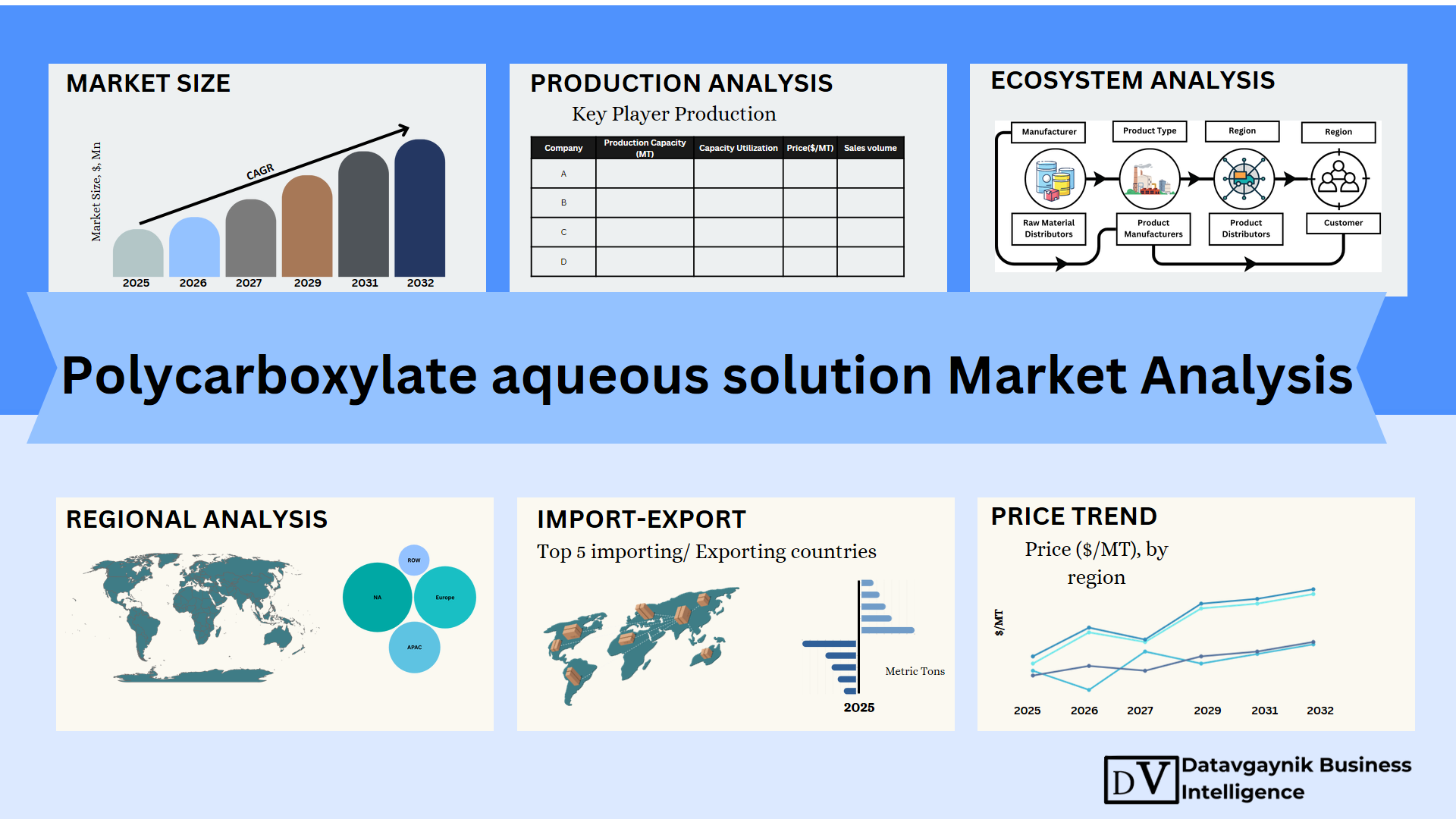
The Polycarboxylate aqueous solution market is seeing robust growth, driven by key trends in the construction and industrial sectors. The increasing demand for high-performance materials in infrastructure development, along with a strong push toward sustainable solutions, is shaping the future of this market. Polycarboxylate aqueous solutions are becoming essential in various applications, particularly in construction, due to their water-reducing and dispersing properties. These solutions are highly effective as superplasticizers, enhancing the workability and durability of concrete while reducing the need for additional water, which is critical in large-scale construction projects worldwide.
Rising Demand for Polycarboxylate Aqueous Solutions in the Construction Sector
One of the primary drivers of the Polycarboxylate aqueous solution market is the booming construction industry. The growing focus on infrastructure development, urbanization, and the demand for energy-efficient buildings is directly contributing to the increasing consumption of Polycarboxylate aqueous solutions. These solutions are primarily used in concrete as superplasticizers, helping to reduce water content while improving the strength and workability of the mix. As cities around the world continue to grow, and more infrastructure projects are initiated, the need for durable and high-strength concrete is increasing. The Polycarboxylate aqueous solution market size has seen significant expansion in response to these growing needs.
The demand for Polycarboxylate aqueous solutions is particularly high in markets like the United States and Europe, where ongoing urban renewal projects and infrastructure development require cutting-edge construction materials. Additionally, the adoption of green construction practices has accelerated in recent years, leading to a surge in the use of sustainable concrete additives like Polycarboxylate aqueous solutions. This shift towards eco-friendly building materials further boosts the growth of the market, as companies and governments look to reduce the carbon footprint of their construction projects.
Environmental Sustainability Driving Market Growth
Sustainability has become a central focus for industries worldwide, and the Polycarboxylate aqueous solution market is no exception. As environmental concerns rise, there is a significant push toward reducing the use of harmful chemicals in various applications, including construction and detergents. Polycarboxylate aqueous solutions, which are considered more environmentally friendly than traditional chemical additives, are gaining traction as sustainable alternatives. They are particularly valued in the construction industry for their ability to improve the performance of concrete while reducing the overall environmental impact of construction projects.
Polycarboxylate-based superplasticizers are preferred over conventional admixtures due to their ability to lower water content in concrete without compromising strength. This not only results in more durable and long-lasting structures but also reduces the amount of water used in the mixing process, contributing to water conservation. Furthermore, Polycarboxylate aqueous solutions have been found to have a lower environmental impact compared to traditional chemical additives, which often contain harmful phosphates and other pollutants. As industries around the world shift toward greener alternatives, the demand for Polycarboxylate aqueous solutions is poised for continued growth.
Expansion of Polycarboxylate Aqueous Solutions Beyond Construction
While the construction industry remains the largest consumer of Polycarboxylate aqueous solutions, other industries are beginning to recognize the value of these versatile solutions. For example, the detergent industry has increasingly adopted Polycarboxylate aqueous solutions due to their excellent dispersing properties. Polycarboxylate aqueous solutions act as anti-redeposition agents in laundry detergents, helping to maintain the cleanliness of clothes and prevent dirt from resettling. The growing preference for phosphate-free and biodegradable detergents has spurred increased production of Polycarboxylate aqueous solutions in the detergent industry, further expanding the market.
In addition to construction and detergents, Polycarboxylate aqueous solutions are finding applications in various other industrial sectors, such as textiles, ceramics, and water treatment. In the textile industry, these solutions are used to improve the uniformity and strength of fabrics, while in ceramics, they act as dispersing agents to enhance the consistency of clay mixtures. In water treatment, Polycarboxylate aqueous solutions are used to prevent scaling and improve the efficiency of treatment processes. As industries continue to adopt Polycarboxylate aqueous solutions for a variety of applications, the market is expected to see significant growth across multiple sectors.
Technological Advancements Fueling Market Innovation
Technological advancements in polymer chemistry have played a crucial role in the development of more efficient and cost-effective Polycarboxylate aqueous solutions. Continuous research and innovation in polymer science have led to the creation of more effective dispersing agents with improved properties. These advancements allow for better performance in a variety of applications, including concrete, detergents, and industrial processes. Manufacturers are now able to produce Polycarboxylate aqueous solutions with enhanced dispersion capabilities, making them more effective at reducing water content in concrete mixes and improving the overall performance of other products.
The development of bio-based and eco-friendly Polycarboxylate aqueous solutions is also gaining momentum. With the growing demand for sustainable solutions, companies are investing in the production of biodegradable and non-toxic Polycarboxylate aqueous solutions. These innovations not only meet environmental regulations but also offer competitive advantages in an increasingly eco-conscious market. The continued focus on research and development in the field of polymer chemistry is expected to drive the next phase of growth for the Polycarboxylate aqueous solution market.
Polycarboxylate Aqueous Solution Market Size: Growing Global Opportunities
The global Polycarboxylate aqueous solution market is witnessing significant expansion, driven by both demand from traditional sectors such as construction and the rising adoption of these solutions in new industries. This market is being shaped by various economic, technological, and regulatory factors. For instance, in the United States and Europe, the demand for eco-friendly and high-performance concrete additives is expected to continue rising as more infrastructure projects take place. This includes large-scale urban developments, transportation projects, and residential complexes that require high-strength concrete.
In emerging markets, particularly in the Asia Pacific region, the Polycarboxylate aqueous solution market is seeing rapid growth as industrialization accelerates. Countries like China, India, and Southeast Asia are investing heavily in infrastructure, further increasing the demand for concrete and other construction materials. As these economies continue to urbanize, the need for durable and high-performance construction materials will continue to drive the demand for Polycarboxylate aqueous solutions. In fact, the Asia Pacific region is projected to become the largest market for Polycarboxylate aqueous solutions in the coming years, with China and India leading the charge due to their massive infrastructure development initiatives.
Future Outlook: Strategic Opportunities in the Polycarboxylate Aqueous Solution Market
Looking ahead, the Polycarboxylate aqueous solution market is poised for continued growth, underpinned by advancements in technology, the expansion of new application areas, and a strong push for sustainability. As industries seek to reduce their environmental impact and meet stricter regulatory standards, the demand for Polycarboxylate aqueous solutions is expected to rise. Companies that focus on innovation, product differentiation, and sustainable manufacturing practices will be well-positioned to capitalize on these trends.
Additionally, strategic partnerships and collaborations between manufacturers and end-users are expected to play a pivotal role in expanding market reach and improving product performance. Companies are likely to invest in expanding their product portfolios to meet the growing demand for eco-friendly solutions, especially in the construction and detergent industries. As the Polycarboxylate aqueous solution market continues to evolve, it will present new opportunities for businesses to strengthen their market presence and enhance their competitive edge.
In conclusion, the Polycarboxylate aqueous solution market is at the forefront of industry innovation, driven by sustainability goals, technological advancements, and expanding industrial applications. The future of this market looks promising, with a growing emphasis on environmentally friendly solutions and a rising global demand for high-performance materials across various sectors.
“Track Country-wise Polycarboxylate aqueous solution Production and Demand through our Polycarboxylate aqueous solution Production Database”
-
- Polycarboxylate aqueous solution production database for 30+ countries worldwide
- Polycarboxylate aqueous solution sales volume for 31+ countries
- Country-wise Polycarboxylate aqueous solution production capacity, production plant mapping, production capacity utilization for 30+ manufacturers
- Polycarboxylate aqueous solution production plants and production plant capacity analysis by top manufacturers
“Track real-time Polycarboxylate aqueous solution Prices, Polycarboxylate aqueous solution price charts for 30+ countries, Polycarboxylate aqueous solution weekly price tracker and Polycarboxylate aqueous solution monthly price tracker”
-
- Track real-time Polycarboxylate aqueous solution prices and Polycarboxylate aqueous solution price trend in 30+ countries though our excel-based Polycarboxylate aqueous solution price charts
- Real-time Polycarboxylate aqueous solution price tracker dashboard with 30+ countries
- Complete transparency on Polycarboxylate aqueous solution price trend through our Polycarboxylate aqueous solution monthly price tracker, Polycarboxylate aqueous solution weekly price tracker
Geographical Demand in the Polycarboxylate Aqueous Solution Market
The geographical distribution of the Polycarboxylate aqueous solution market is heavily influenced by regional infrastructure development, economic growth, and sustainability trends. In particular, regions with significant construction and industrial activities are seeing the most robust demand for Polycarboxylate aqueous solutions. Asia Pacific, Europe, and North America are key regions driving the market, each with distinct demands that shape the overall dynamics of this sector.
In Asia Pacific, countries like China and India are experiencing rapid industrialization, leading to increased demand for high-performance concrete additives. The growing demand for urban development, smart cities, and large-scale infrastructure projects has directly impacted the consumption of Polycarboxylate aqueous solutions in these regions. For instance, China, the world’s largest producer and consumer of Polycarboxylate aqueous solutions, continues to expand its infrastructure projects, particularly in urban housing, commercial buildings, and transportation networks. India follows suit with major infrastructure initiatives like highways, metro rail systems, and residential projects.
Meanwhile, North America is also seeing steady growth in demand, driven by the ongoing urban development, infrastructure upgrades, and a shift toward sustainable building practices. The demand for Polycarboxylate aqueous solutions in the United States is rising due to significant investment in road networks, smart cities, and green building initiatives. As cities push for more eco-friendly materials and stricter environmental regulations, the demand for Polycarboxylate aqueous solutions in construction projects is expected to keep growing.
Europe remains a vital market for Polycarboxylate aqueous solutions, with nations like Germany, the United Kingdom, and France leading in consumption. These regions are embracing sustainable and high-performance construction materials, contributing to increased adoption of Polycarboxylate aqueous solutions. Europe’s focus on reducing its carbon footprint and meeting green building standards has made these solutions increasingly attractive to the construction sector, fueling market demand.
Polycarboxylate Aqueous Solution Market Production Landscape
The global production landscape of Polycarboxylate aqueous solutions is distributed across regions that have strong industrial bases and high demand for concrete and construction additives. The leading production centers are located in China, the United States, Germany, Japan, and India, where manufacturers focus on meeting the growing demand for high-performance construction chemicals and sustainable materials.
China, as the largest producer of Polycarboxylate aqueous solutions, plays a pivotal role in the market. The country’s manufacturing capabilities are unmatched, with the government’s investment in large-scale infrastructure projects, such as smart cities, railways, and urban housing developments, continuing to drive up demand for these solutions. Chinese manufacturers are ramping up their production capacities to cater to both domestic and international needs, including regions like Southeast Asia and the Middle East, where demand for high-strength concrete additives is growing.
In Germany, manufacturers are focusing on eco-friendly formulations of Polycarboxylate aqueous solutions, aligning with the European Union’s push for sustainability in construction. Germany’s strong emphasis on green building practices and high-quality products has led to an increase in production of these solutions, particularly in the context of environmentally friendly construction materials.
India has seen significant strides in increasing the production of Polycarboxylate aqueous solutions, mainly driven by the country’s growing construction sector. With urbanization at an all-time high, India’s need for concrete additives is surging. Local manufacturers are investing in advanced production techniques and increasing their output to meet the growing domestic and export demand.
Japan and South Korea are also important players in the production of Polycarboxylate aqueous solutions, particularly known for their high-tech innovations and environmentally conscious manufacturing processes. The focus on developing low-carbon and bio-based solutions is set to position these countries as leaders in sustainable Polycarboxylate aqueous solution production in the coming years.
Polycarboxylate Aqueous Solution Market Segmentation
The Polycarboxylate aqueous solution market can be segmented by application, type, end-user industry, and geography. This segmentation helps in understanding the diverse uses of these solutions and their role across different sectors.
In terms of applications, the largest demand for Polycarboxylate aqueous solutions comes from the construction industry, where these solutions are used as superplasticizers to improve the workability, strength, and durability of concrete. Concrete admixtures, particularly for large-scale infrastructure projects and residential buildings, account for a significant portion of the overall market. Other applications include detergents, where Polycarboxylate aqueous solutions are used as dispersing agents and anti-redeposition agents, and water treatment, where they help prevent scale formation and enhance water quality.
Polycarboxylate aqueous solutions are also used in industries such as ceramics, textiles, and coatings, where their dispersing and stabilizing properties enhance the uniformity and strength of products. For instance, in the textile industry, these solutions improve the processing of fibers, making them a crucial ingredient in manufacturing durable fabrics.
Polycarboxylate Aqueous Solution Price Trend and Impact on Market Growth
The Polycarboxylate aqueous solution price has shown a noticeable upward trend over the past few years, driven by several factors. First, the increasing demand for sustainable and high-performance materials in construction and industrial sectors has resulted in higher prices for these solutions. Manufacturers are also investing in advanced technologies to enhance the performance of Polycarboxylate aqueous solutions, which requires substantial research and development costs, contributing to price increases.
The Polycarboxylate aqueous solution price trend is further influenced by fluctuations in the cost of raw materials. Prices of key raw materials, such as acrylic acid and other monomers, have seen significant changes in recent years, which in turn affect the production cost of Polycarboxylate aqueous solutions. Supply chain disruptions and logistics challenges have also played a role in increasing the price of these solutions, as manufacturers face rising transportation and raw material costs.
Despite the increasing Polycarboxylate aqueous solution price, the market remains strong due to the undeniable advantages these solutions offer. The demand for high-strength, durable, and sustainable concrete additives outweighs the higher costs in many cases, particularly in the construction and infrastructure sectors. The long-term benefits, including better workability, reduced environmental impact, and improved concrete performance, justify the price premium for many consumers.
As more industries recognize the long-term value of Polycarboxylate aqueous solutions, manufacturers are continuing to innovate to keep prices competitive. The development of bio-based and eco-friendly formulations is expected to play a role in keeping prices stable while meeting the growing demand for sustainable materials.
Polycarboxylate Aqueous Solution Price and Market Demand Dynamics
The Polycarboxylate aqueous solution price is a critical factor in market dynamics, influencing purchasing decisions across industries. In the construction sector, where budget constraints are often a primary concern, the price sensitivity of Polycarboxylate aqueous solutions plays a significant role. While these solutions offer enhanced performance, including improved strength and durability of concrete, the higher cost may deter some smaller players or contractors from adopting them.
However, the growing recognition of the long-term cost savings associated with Polycarboxylate aqueous solutions is helping to mitigate this concern. In large-scale infrastructure projects, where concrete strength and workability are paramount, the benefits far outweigh the initial cost. Additionally, as environmental regulations tighten, Polycarboxylate aqueous solutions are increasingly being favored due to their lower environmental impact compared to traditional chemical additives.
For the detergent industry, the price trend of Polycarboxylate aqueous solutions also plays an important role. As the demand for phosphate-free detergents rises, the need for cost-effective dispersing agents becomes more critical. Manufacturers are focusing on balancing the Polycarboxylate aqueous solution price with performance to ensure that these solutions remain attractive to consumers in the home care and industrial cleaning sectors.
Polycarboxylate Aqueous Solution Price Trend and Its Influence on Regional Markets
The Polycarboxylate aqueous solution price trend has varied across regions, influenced by local economic factors, manufacturing capabilities, and supply chains. In North America and Europe, where there is a high demand for sustainable and high-performance building materials, the price trend has generally been upward due to the rising costs of raw materials and labor. However, these regions are also seeing strong competition in the market, with companies leveraging economies of scale and technological advancements to keep prices in check.
In Asia Pacific, particularly in China and India, the price of Polycarboxylate aqueous solutions is relatively more competitive, given the region’s lower production costs and vast manufacturing capabilities. However, as demand continues to rise in these markets, the price trend may shift upward, reflecting the growing need for high-quality products in construction and industrial applications.
Overall, the Polycarboxylate aqueous solution price is expected to remain volatile in the short term, with fluctuations driven by changes in raw material costs, production techniques, and market demand. Nevertheless, the long-term outlook for Polycarboxylate aqueous solutions remains positive, as the demand for sustainable, high-performance materials continues to rise globally.
Conclusion: The Evolving Landscape of the Polycarboxylate Aqueous Solution Market
The Polycarboxylate aqueous solution market is experiencing significant growth, driven by increasing demand in construction, industrial applications, and the growing emphasis on sustainability. As geographic markets like Asia Pacific, North America, and Europe continue to expand their infrastructure and industrial sectors, the need for Polycarboxylate aqueous solutions will only increase.
With the production of Polycarboxylate aqueous solutions growing globally, innovations in formulation and production techniques will keep the market dynamic. The Polycarboxylate aqueous solution price trend will play a critical role in shaping demand, with manufacturers focusing on balancing cost and performance. As the market continues to evolve, Polycarboxylate aqueous solutions will remain essential in meeting the growing demands for durable, sustainable, and high-performance materials across various industries
“Polycarboxylate aqueous solution Manufacturing Database, Polycarboxylate aqueous solution Manufacturing Capacity”
-
-
- Polycarboxylate aqueous solution top manufacturers market share for 30+ manufacturers
- Top 11 manufacturers and top 18 manufacturers of Polycarboxylate aqueous solution in North America, Europe, Asia Pacific
- Polycarboxylate aqueous solution production plant capacity by manufacturers and Polycarboxylate aqueous solution production data for 30+ market players
- Polycarboxylate aqueous solution production dashboard, Polycarboxylate aqueous solution production data in excel format
-
“Polycarboxylate aqueous solution price charts, Polycarboxylate aqueous solution weekly price tracker and Polycarboxylate aqueous solution monthly price tracker”
-
-
- Factors impacting real-time Polycarboxylate aqueous solution prices in 30+ countries worldwide
- Polycarboxylate aqueous solution monthly price tracker, Polycarboxylate aqueous solution weekly price tracker
- Real-time Polycarboxylate aqueous solution price trend, Polycarboxylate aqueous solution price charts, news and updates
- Tracking Polycarboxylate aqueous solution price fluctuations
-
Top Manufacturers in the Polycarboxylate Aqueous Solution Market
The Polycarboxylate aqueous solution market is a competitive space, with several global players vying for market share. The top manufacturers have made significant strides in developing innovative solutions, expanding production capacities, and focusing on sustainable products to meet the growing demand for high-performance materials. These companies dominate the market, supported by their extensive research and development capabilities, strong distribution networks, and solid customer bases.
Some of the leading manufacturers in the Polycarboxylate aqueous solution market include:
- BASF SE
BASF is one of the largest players in the global Polycarboxylate aqueous solution market. The company offers a range of high-quality Polycarboxylate-based superplasticizers and dispersing agents under the product line “MasterEase” and “MasterGlenium.” BASF focuses on innovation and sustainability, aligning with the increasing demand for eco-friendly and high-performance construction materials. Their MasterEase product line is particularly popular in concrete applications, where workability and strength are essential. BASF’s commitment to advancing technology in polymer chemistry has helped maintain its market dominance.
- Sika AG
Sika is another key player in the Polycarboxylate aqueous solution market, providing a wide range of products, including the “SikaViscoCrete” and “SikaPlast” product lines. These solutions are widely used as superplasticizers and water-reducing agents in the construction sector. Sika has a strong global presence, with manufacturing facilities and distribution networks in multiple countries. The company is committed to sustainability and environmental protection, often offering solutions that help reduce the carbon footprint of concrete structures. Sika’s research and development initiatives continue to drive innovations in their Polycarboxylate aqueous solution offerings.
- Fosroc International Limited
Fosroc is known for its high-performance Polycarboxylate aqueous solutions used in the construction and infrastructure sectors. Their product lines, such as “Conplast” and “Glenium,” provide exceptional performance as concrete superplasticizers and are used widely for enhancing the durability and workability of concrete. Fosroc focuses on creating tailored solutions for different types of concrete, ensuring that customers can rely on its products to meet their specific project requirements. The company’s strong emphasis on sustainable construction and eco-friendly additives helps to position it as a leading manufacturer in the Polycarboxylate aqueous solution market.
- Chryso Group
Chryso is a global leader in producing high-performance additives, including Polycarboxylate-based superplasticizers for the construction industry. Their flagship product, “ChrysoFluid,” is designed to improve concrete workability and strength while reducing water content. Chryso is committed to advancing sustainable practices in construction and focusing on solutions that help reduce the environmental impact of concrete production. Their strong presence in Europe, Asia Pacific, and Latin America is supported by their extensive network of distributors and R&D facilities.
- W.R. Grace & Co.
W.R. Grace is a major player in the construction chemicals industry and a prominent supplier of Polycarboxylate aqueous solutions, particularly in the form of superplasticizers. Their product line, “DURACRETE,” is used in various concrete applications to enhance workability and reduce water content. Grace focuses heavily on improving the durability and performance of concrete, especially for large-scale infrastructure projects. The company’s technological advancements and commitment to sustainability have allowed them to remain a key player in the Polycarboxylate aqueous solution market.
Polycarboxylate Aqueous Solution Market Share by Manufacturers
The Polycarboxylate aqueous solution market is highly competitive, with a few key manufacturers holding a significant market share due to their global presence, extensive product portfolios, and established brand reputation. BASF, Sika, Fosroc, Chryso, and W.R. Grace are among the leading companies in the Polycarboxylate aqueous solution market. Together, these companies control a significant portion of the global market.
BASF holds the largest market share, driven by its comprehensive portfolio of high-performance Polycarboxylate aqueous solutions, such as the MasterGlenium and MasterEase product lines. The company’s global presence, along with its strong distribution channels, has enabled it to maintain its leading position in various regions, including North America, Europe, and Asia Pacific.
Sika follows closely behind, with its popular SikaViscoCrete and SikaPlast lines dominating the construction industry, especially in Europe and North America. Sika’s market share is also supported by its focus on sustainability, which aligns with growing environmental concerns in the construction sector. The company’s innovative solutions have made it a preferred choice for projects that require high-performance concrete and eco-friendly additives.
Fosroc and Chryso hold a significant market share in the Asia Pacific region, as well as in emerging markets in Africa and the Middle East. Both companies have built strong customer bases by providing Polycarboxylate aqueous solutions that cater to specific regional needs, such as high-temperature performance and resistance to harsh weather conditions.
W.R. Grace & Co. has carved out a strong niche in the high-end construction market with its DURACRETE product line. Grace’s focus on improving the durability and performance of concrete in critical infrastructure projects has helped it capture a solid share of the market, especially in North America and Europe.
Product Lines and Innovations by Manufacturers
The Polycarboxylate aqueous solution market is evolving, with manufacturers constantly innovating their product lines to meet the growing demand for eco-friendly and high-performance solutions. Each of the top manufacturers has a distinct approach to meeting these demands, with product lines that emphasize superior performance, environmental sustainability, and cost-effectiveness.
- BASF’s MasterGlenium line is widely used for producing high-strength concrete, especially in large infrastructure projects, where durability and workability are paramount. The MasterEase line is known for its enhanced performance, especially in low-carbon concrete production.
- Sika’s SikaViscoCrete is a leading product in the concrete industry, known for its superior ability to reduce water content while improving workability. The SikaPlast range focuses on various applications, from residential to commercial projects, offering tailored solutions based on specific needs.
- Fosroc offers a range of products under the Conplast and Glenium brands. These products are used extensively for reducing water content in concrete, particularly in large-scale construction projects, ensuring improved workability and strength.
- Chryso’s ChrysoFluid line is designed for both the construction and industrial sectors. These solutions enhance concrete performance while ensuring lower environmental impact. Chryso’s commitment to sustainable development is reflected in their innovative formulations that meet stringent global environmental standards.
- W.R. Grace & Co. focuses on the DURACRETE range, which is designed to address the specific needs of high-performance concrete applications. The company’s emphasis on innovation and performance has made DURACRETE a trusted solution in critical infrastructure projects.
Recent Developments and News in the Polycarboxylate Aqueous Solution Market
The Polycarboxylate aqueous solution market continues to evolve with new developments from key players in the industry. Recent innovations and market dynamics indicate a shift towards more sustainable and bio-based solutions.
In 2024, BASF announced the launch of an enhanced version of their MasterGlenium line, which includes eco-friendly formulations designed to reduce the carbon footprint of concrete. This move reflects the company’s ongoing commitment to sustainability in the construction sector.
In early 2025, Sika expanded its product offerings by introducing new formulations of SikaViscoCrete, aimed at improving the workability and durability of concrete in high-performance applications. The company’s investment in green chemistry is positioning it as a leader in sustainable construction materials.
Fosroc also made headlines in late 2024 with the introduction of their next-generation Glenium superplasticizers. These new products are designed to meet the evolving demands of the construction industry by providing enhanced water reduction properties while being more environmentally friendly.
The Polycarboxylate aqueous solution market is expected to remain dynamic, with manufacturers focusing on sustainability, performance enhancement, and technological innovation. As the market continues to grow, key players like BASF, Sika, Fosroc, Chryso, and W.R. Grace are poised to drive the next phase of market expansion with cutting-edge solutions that cater to the ever-evolving demands of the construction and industrial sectors.
“Polycarboxylate aqueous solution Production Data and Polycarboxylate aqueous solution Production Trend, Polycarboxylate aqueous solution Production Database and forecast”
-
-
- Polycarboxylate aqueous solution production database for historical years, 11 years historical data
- Polycarboxylate aqueous solution production data and forecast for next 11 years
- Polycarboxylate aqueous solution sales volume by manufacturers
-
“Track Real-time Polycarboxylate aqueous solution Prices for purchase and sales contracts, Polycarboxylate aqueous solution price charts, Polycarboxylate aqueous solution weekly price tracker and Polycarboxylate aqueous solution monthly price tracker”
-
-
- Gain control on your purchase and sales contracts through our real-time Polycarboxylate aqueous solution price tracker and Polycarboxylate aqueous solution price trend analysis
- Polycarboxylate aqueous solution weekly price tracker and forecast for next four weeks
- Polycarboxylate aqueous solution monthly price tracker and forecast for next two months
-
Market Scenario, Demand vs Supply, Average Product Price, Import vs Export, till 2035
- Global Polycarboxylate aqueous solution Market revenue and demand by region
- Global Polycarboxylate aqueous solution Market production and sales volume
- United States Polycarboxylate aqueous solution Market revenue size and demand by country
- Europe Polycarboxylate aqueous solution Market revenue size and demand by country
- Asia Pacific Polycarboxylate aqueous solution Market revenue size and demand by country
- Middle East & Africa Polycarboxylate aqueous solution Market revenue size and demand by country
- Latin America Polycarboxylate aqueous solution Market revenue size and demand by
- Import-export scenario – United States, Europe, APAC, Latin America, Middle East & Africa
- Average product price – United States, Europe, APAC, Latin America, Middle East & Africa
- Market player analysis, competitive scenario, market share analysis
- Business opportunity analysis
Key questions answered in the Global Polycarboxylate aqueous solution Market Analysis Report:
- What is the market size for Polycarboxylate aqueous solution in United States, Europe, APAC, Middle East & Africa, Latin America?
- What is the yearly sales volume of Polycarboxylate aqueous solution and how is the demand rising?
- Who are the top market players by market share, in each product segment?
- Which is the fastest growing business/ product segment?
- What should be the business strategies and Go to Market strategies?
The report covers Polycarboxylate aqueous solution Market revenue, Production, Sales volume, by regions, (further split into countries):
- Asia Pacific (China, Japan, South Korea, India, Indonesia, Vietnam, Rest of APAC)
- Europe (UK, Germany, France, Italy, Spain, Benelux, Poland, Rest of Europe)
- North America (United States, Canada, Mexico)
- Latin America (Brazil, Argentina, Rest of Latin America)
- Middle East & Africa
Table of Contents:
Polycarboxylate Aqueous Solution Market
- Introduction to Polycarboxylate Aqueous Solution
- Overview and Composition
- Key Functional Properties
- Industrial and Commercial Applications
- Market Growth Drivers and Restraints
- Major Factors Fueling Market Expansion
- Key Challenges and Market Limitations
- Emerging Opportunities in the Industry
- Classification and Segmentation of Polycarboxylate Aqueous Solutions
- Product Categories and Variants
- End-User Industries and Applications
- Regional Classification and Demand Distribution
- Global Market Trends and Forecast (2021-2035)
- Evolution of the Industry and Technological Innovations
- Revenue Forecast and Market Size Expansion
- Market Impact of Sustainability and Eco-Friendly Solutions
- United States Market Landscape
- Production Capabilities and Manufacturing Trends
- Sales, Consumption, and Pricing Overview
- Domestic Demand vs. Import Trends
- European Market Insights
- Key Market Players and Regional Distribution
- Performance of Leading Countries in Europe
- Trade Regulations and Market Growth Factors
- Asia-Pacific Market Analysis
- Market Trends in China, Japan, South Korea, and India
- Growth Potential in Developing Asian Countries
- Competitive Landscape and Production Capacity
- Latin America Market Outlook
- Demand Trends Across the Region
- Import-Export Analysis and Market Expansion
- Key Players and Business Opportunities
- Middle East & Africa Market Prospects
- Infrastructure Development and Market Penetration
- Industrial Applications Driving Growth
- Challenges and Investment Potential
- Competitive Analysis and Industry Players
- Leading Global and Regional Companies
- Market Share and Business Strategies
- Mergers, Acquisitions, and Industry Developments
- Global Production Trends and Forecast (2021-2035)
- Manufacturing Innovations and Supply Chain Optimization
- Geographical Production Hubs
- Projected Capacity Expansion and Market Impact
- Market Share Analysis by Key Companies
- Comparative Analysis of Leading Manufacturers
- Business Growth Strategies and Revenue Contribution
- New Entrants and Market Disruptors
- Manufacturing Process and Cost Structures
- Production Techniques and Efficiency Improvements
- Manufacturing Cost Breakdown
- Factors Affecting Cost Variability
- Pricing Dynamics and Market Economics
- Historical Price Trends (2021-2025)
- Future Pricing Forecasts (2025-2035)
- Global Price Variations and Influencing Factors
- Global Trade and Supply Chain Analysis
- Export-Import Data of Major Regions
- Key Exporting and Importing Countries
- Logistics, Transportation, and Supply Chain Challenges
- Consumption Patterns and Demand Outlook
- Industry-Specific Demand Trends
- Consumer Preferences and Market Adaptations
- Expected Future Consumption Growth
- Industry Applications and End-User Segments
- Role in Construction and Cement Additives
- Usage in Detergents and Cleaning Agents
- Industrial and Chemical Processing Applications
- Raw Materials and Supply Chain Considerations
- Availability of Raw Materials and Market Trends
- Key Suppliers and Global Distribution
- Alternative Sources and Substitutes
- Technological Advancements and R&D Innovations
- Breakthroughs in Production Techniques
- Development of High-Performance Variants
- Sustainability and Biodegradable Formulations
- Environmental Regulations and Compliance Standards
- Impact of Environmental Laws on Production
- Global and Regional Compliance Requirements
- Green Initiatives and Industry Sustainability Efforts
- Investment and Business Expansion Strategies
- Entry Strategies for New Market Players
- Expansion Plans of Established Companies
- Growth Potential in Emerging Economies
- Marketing Channels and Sales Distribution
- Role of Distributors and Retailers
- Digital Transformation in the Sales Landscape
- B2B vs. B2C Market Strategies
- Customer Insights and Industry Demand Trends
- Key Consumer Segments and Preferences
- Factors Influencing Purchasing Decisions
- Brand Awareness and Competitive Positioning
- Future Market Projections and Strategic Planning (2025-2035)
- Long-Term Market Growth Scenarios
- Investment Hotspots and Business Opportunities
- Evolving Industry Trends and Competitive Positioning
- Conclusion and Industry Recommendations
- Summary of Key Market Findings
- Actionable Insights for Stakeholders
- Future Outlook for the Industry
Other recently published reports:

