

Market Summary and Growth Forecast
The global Polydimethylsiloxane (PDMS) for Drug Delivery Market is estimated at $510 million in 2026 and is expected to reach $1,010 million by 2035, growing at a CAGR of 7.9%.
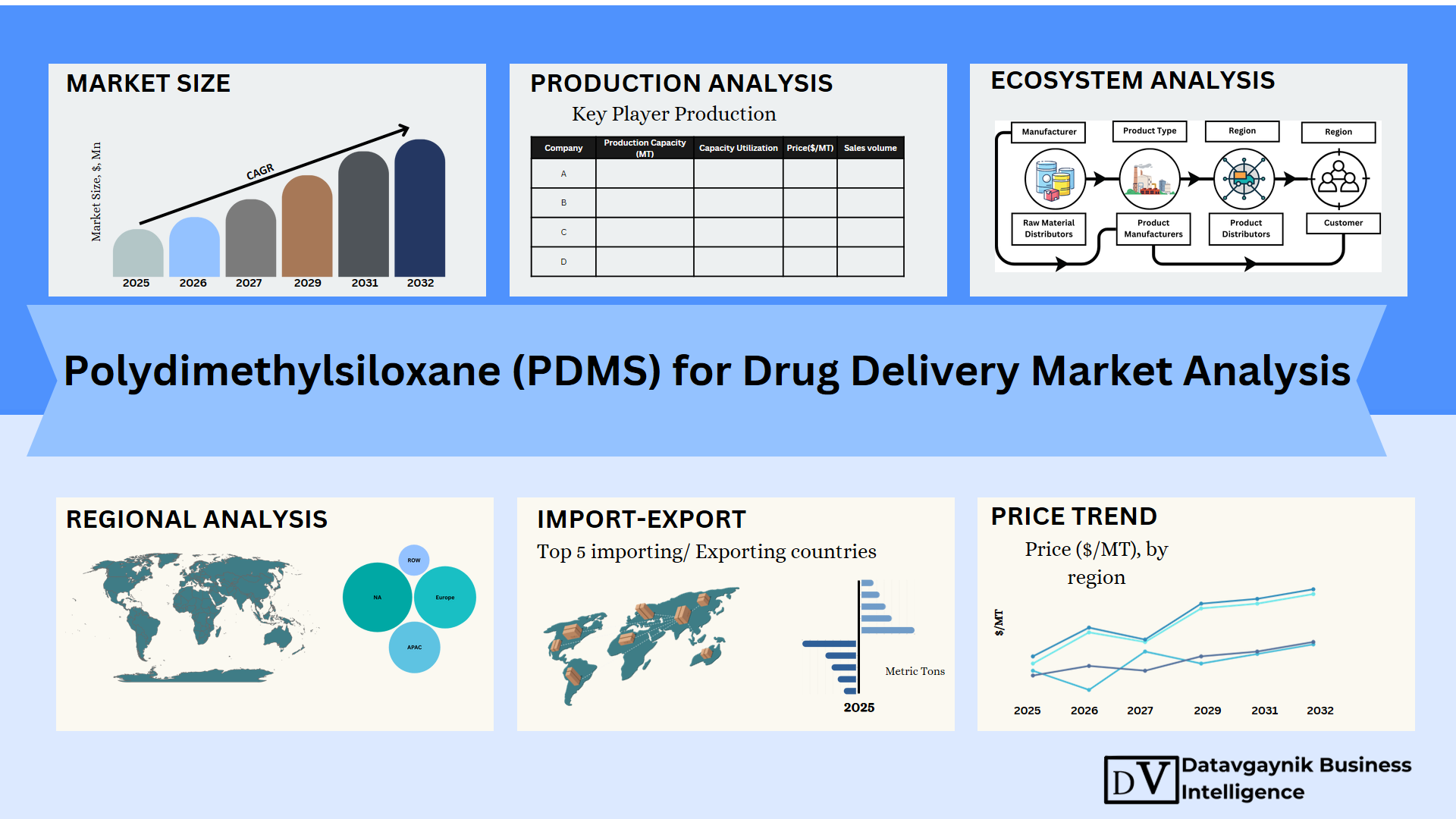
The Polydimethylsiloxane (PDMS) for Drug Delivery Market covers medical-grade silicone elastomers, membranes, gels, tubing, adhesives, and molded components used to control, support, or enable drug release. It does not include the full value of finished drug-device products. The revenue boundary is focused on PDMS materials and PDMS-based delivery components used in implants, transdermal systems, ocular devices, intravaginal rings, infusion systems, and microfluidic drug delivery platforms.
PDMS matters because drug delivery is moving toward longer dosing intervals, better patient compliance, and more device-linked therapies. Oral delivery still dominates pharma. But for hormones, ophthalmology, pain therapy, oncology support care, diabetes care, and selected biologic-adjacent applications, controlled release platforms are gaining more attention. PDMS fits well here. It is flexible, biocompatible, chemically stable, and can be engineered to release active ingredients over days, weeks, or even months.
By 2026, the market is still selective rather than mass-market. PDMS is not used for every drug delivery format. It performs best where permeability, softness, durability, and long-term body contact matter. That makes it more strategic in high-value delivery systems than in commodity packaging or standard oral dosage forms.
| Market Indicator | Estimate / View |
| Global market size, 2026 | $510 million |
| Projected market size, 2035 | $1,010 million |
| CAGR, 2026–2035 | 7.9% |
| Core revenue scope | Medical-grade PDMS materials and PDMS-based delivery components |
| Highest-value demand area | Long-acting controlled-release drug delivery systems |
| Most strategic growth region | Asia Pacific |
| Most relevant customer group | Pharma-device developers and medical device OEMs |
The biggest macro force is the shift from short-cycle dosing to long-acting therapy. Patients are less willing to manage frequent dosing. Healthcare systems also want fewer interventions and better adherence. This creates room for implantable reservoirs, vaginal rings, ocular inserts, topical patches, and wearable or semi-implantable delivery systems.
Regulation is another important force. PDMS used in drug delivery must meet strict medical-grade requirements. Buyers look for biocompatibility data, extractables and leachables control, USP Class VI alignment, ISO 10993 testing support, clean manufacturing, and traceable quality systems. So, the market is not mainly won on price. It is won on validation history, regulatory documentation, and supplier consistency.
Production also matters. Drug delivery-grade PDMS needs tighter control over curing chemistry, purity, molecular weight distribution, residual volatiles, additives, and surface behavior. Any small change in material performance can alter drug diffusion. That is why pharma companies and device OEMs prefer qualified suppliers with stable grades and long-term material availability.
The Polydimethylsiloxane (PDMS) for Drug Delivery Market is also linked to broader drug-device convergence. More pharma firms now think beyond the molecule. They look at how the drug is released, how often the patient uses it, and whether the delivery system can protect the product. PDMS becomes relevant when the delivery system needs controlled permeability, elasticity, sealing, or prolonged tissue contact.
Key consumers and clients include:
| Customer Group | Typical Use of PDMS in Drug Delivery |
| Pharmaceutical companies | Long-acting formulations, controlled-release implants, lifecycle extension of mature therapies |
| Medical device OEMs | Drug-eluting components, reservoirs, catheters, infusion devices, ocular systems |
| Drug-device combination product companies | Integrated systems where material performance affects dose delivery |
| CDMOs and contract manufacturers | Prototype development, molding, extrusion, assembly, validation batches |
| Ophthalmology and women’s health companies | Ocular inserts, intravaginal rings, hormone delivery platforms |
| Diabetes and infusion technology players | Tubing, seals, microfluidic pathways, wearable delivery systems |
| Academic and translational research labs | Early-stage PDMS microfluidic and controlled-release device development |
Expert view: PDMS will not become a universal drug delivery material. Its value is more specific. It wins where softness, permeability control, and long-contact safety are more important than lowest-cost production.
Market Segmentation and Forecast Scope
The Polydimethylsiloxane (PDMS) for Drug Delivery Market can be segmented by product type, application, end user, and region. The segmentation should stay close to how buyers actually purchase and qualify these materials. A pharma company does not simply buy “silicone.” It buys a validated PDMS grade, a molded component, a membrane, tubing, or a finished sub-assembly that can survive regulatory review.
By Product Type
| Product Type | Market Role | Strategic Outlook |
| Medical-grade PDMS elastomers | Used in implants, rings, molded reservoirs, seals, and controlled-release structures | Largest product category due to broad use in long-contact applications |
| PDMS membranes and films | Used where diffusion control is central to drug release | Strong growth in controlled-release and transdermal-style platforms |
| PDMS gels and soft silicones | Used for topical, wound-adjacent, transdermal, and cushioning delivery formats | Selective but useful where comfort and skin contact matter |
| PDMS tubing and microfluidic components | Used in infusion systems, lab-on-chip platforms, and small-volume delivery systems | Growing with wearable devices and micro-dosing platforms |
| Modified or functionalized PDMS | Surface-treated or chemically adjusted PDMS for improved compatibility or release control | Smaller today but strategically important for next-generation systems |
Medical-grade PDMS elastomers are estimated to hold around 38% of the market in 2026. This is the largest visible share because elastomers are used in several high-value applications, especially implants, vaginal rings, molded reservoirs, and drug-contact components.
Modified PDMS is a smaller category today, but it has higher strategic value. Why? Standard PDMS can absorb hydrophobic molecules and may require surface tuning for some active ingredients. Modified grades help manage that issue. This is where future differentiation is likely to happen.
By Application
| Application | Use Case | Growth View |
| Implantable controlled-release systems | Long-acting drug release through reservoirs, rods, capsules, or molded components | Most valuable application segment |
| Transdermal and topical delivery systems | Skin-contact systems, soft adhesives, diffusion-supporting materials | Moderate growth, led by comfort and wearability |
| Ocular drug delivery | Inserts, plugs, membranes, and device-linked ophthalmic platforms | High-growth niche due to unmet need in chronic eye diseases |
| Intravaginal rings and hormone delivery | Controlled hormone release over extended periods | Stable and clinically proven use area |
| Infusion and wearable delivery systems | Tubing, seals, flow paths, and flexible components | Growing with home-based care and connected drug delivery |
| Microfluidic and R&D platforms | Lab-on-chip testing and early drug delivery design | Important for innovation, smaller in commercial revenue |
Implantable controlled-release systems are estimated to account for about 34% of market demand in 2026. This is one of the few sub-segment shares worth revealing because it explains the structure of the market. PDMS is most valuable when the delivery system remains in contact with the body for an extended period and must release the drug at a controlled pace.
The fastest-growing application is expected to be ocular drug delivery. Chronic eye conditions need better dosing solutions. Eye drops are easy to prescribe but hard for patients to use consistently. PDMS-based inserts and components can help reduce dosing burden, although clinical validation remains demanding.
By End User
| End User | Demand Pattern |
| Pharmaceutical companies | Use PDMS to extend product lifecycle, improve adherence, and support controlled-release formats |
| Medical device OEMs | Use PDMS in device platforms where flexibility, sealing, and biocompatibility are needed |
| Combination product developers | Require PDMS where the material directly influences release rate or patient interface |
| CDMOs and component manufacturers | Support prototyping, extrusion, molding, and scale-up |
| Research institutes and translational labs | Use PDMS for microfluidics, diffusion testing, and early device concepts |
Pharmaceutical companies and device OEMs remain the core buyers. That said, CDMOs are becoming more important. Many pharma teams do not want to build PDMS molding, extrusion, and validation capability in-house. They prefer qualified partners that can move from prototype to pilot batch with less friction.
By Region
| Region | Market Position | Growth Logic |
| North America | Largest innovation and commercialization base | Strong drug-device ecosystem, FDA pathway experience, higher uptake of advanced therapies |
| Europe | High-quality manufacturing and regulatory discipline | Strong in medical-grade silicone processing and controlled-release research |
| Asia Pacific | Fastest-growing regional market | Expansion of medical device manufacturing, pharma outsourcing, and local innovation |
| LAMEA | Smaller but gradually expanding | Growth linked to imported devices, hospital access, and specialty pharma penetration |
North America leads in commercial adoption because it has a strong base of pharma-device developers, regulatory consultants, clinical trial infrastructure, and advanced medical device OEMs. Europe is strong in material science and precision manufacturing. Asia Pacific is the fastest-growing region because medical device production is scaling in China, Japan, South Korea, Singapore, and India.
The forecast scope for the Polydimethylsiloxane (PDMS) for Drug Delivery Market includes PDMS sold as raw material, semi-finished medical components, and engineered drug-contact structures. It excludes general industrial silicone, non-drug medical tubing, consumer silicone products, and finished drug revenue.
Example: A silicone intravaginal ring used for hormone release would be included for the PDMS component value. The full branded therapy revenue would not be counted in this market boundary.
Market Trends and Innovation Landscape
Innovation in the Polydimethylsiloxane (PDMS) for Drug Delivery Market is moving in three clear directions: better release control, better material compatibility, and easier regulatory translation. The market is not driven by flashy technology alone. It is driven by whether the material can perform predictably inside a real drug-device product.
R&D Evolution
R&D is shifting from basic PDMS feasibility work to application-specific design. Earlier work focused on whether PDMS could release a drug at all. Now the question is more precise: can it release the right dose, at the right rate, without absorbing too much of the active ingredient, and without creating regulatory risk?
This is especially relevant for hydrophobic drugs. PDMS has strong compatibility with many lipophilic molecules, but it can also absorb some actives. That can be useful in a controlled-release system, but problematic if the dose is too low or release behavior changes over time. So, formulation teams are working more closely with materials engineers.
Expert view: The next phase of PDMS drug delivery will be less about proving biocompatibility and more about proving dose predictability. That is where premium suppliers and specialist processors will defend margins.
Technology Evolution
Manufacturing technology is becoming more precise. Micro-molding, thin-film casting, extrusion control, laser-based processing, and cleaner assembly methods are helping companies produce PDMS structures with tighter dimensional accuracy. This matters because wall thickness, membrane geometry, and surface area can directly influence drug release.
There is also more work around hybrid drug-device platforms. PDMS can be used with reservoirs, membranes, sensors, pumps, and wearable delivery modules. In these systems, PDMS may not be the “headline” material, but it can decide whether the product feels comfortable, seals properly, or releases consistently.
3D printing and additive manufacturing of silicone-like materials are attracting R&D interest. However, commercial use in regulated drug delivery is still limited. Most large-scale applications still rely on validated molding, extrusion, and assembly methods. That said, additive manufacturing can help in early prototyping and custom device geometry.
Material Science Trends
Material science is central to this market. PDMS is useful because its permeability, elasticity, surface chemistry, and crosslink density can be adjusted. This gives developers room to tune performance.
Key material innovation areas include:
| Innovation Area | Why It Matters |
| Surface modification | Helps reduce unwanted drug absorption, protein attachment, or biofouling |
| Controlled crosslink density | Supports more predictable diffusion and mechanical performance |
| Low-extractable PDMS grades | Reduces regulatory and safety concerns in long-contact applications |
| Drug-compatible fillers and additives | Can modify release rate or mechanical behavior |
| Thin membranes and microstructured PDMS | Enables finer release control in small devices |
| Hybrid PDMS systems | Combines PDMS with coatings, reservoirs, or barrier layers |
AI is not a primary demand driver in this market. It is being used indirectly in some advanced R&D settings for diffusion modeling, formulation screening, and material selection. But it is not yet a mainstream purchasing factor for PDMS drug delivery materials. So, it should not be overstated.
Partnerships, Supplier Moves, and Market Signals
Large silicone and healthcare material suppliers are strengthening their medical-grade portfolios. Dow, Wacker Chemie, Shin-Etsu Chemical, Momentive, Elkem, and Avantor/NuSil remain important reference points in high-purity silicone materials, medical elastomers, and healthcare-grade processing support.
The more meaningful market activity is not always a headline acquisition. Much of it happens through qualification programs, joint development work, CDMO relationships, and long-term supply agreements. Drug delivery developers want suppliers that can support documentation, grade continuity, scale-up, and regulatory submissions.
Partnerships between pharma firms, device OEMs, and specialist silicone processors are becoming more important. This is because PDMS performance cannot be evaluated in isolation. The drug, the device design, the manufacturing process, and the sterilization method all interact.
News announcements in this space often focus on capacity expansion, healthcare-grade silicone launches, medical elastomer upgrades, or drug-device manufacturing partnerships. These signals point to a more regulated and application-specific market. Commodity silicone suppliers will find it difficult to compete unless they can offer validated medical documentation and consistent batch performance.
The Polydimethylsiloxane (PDMS) for Drug Delivery Market should therefore be viewed as a specialty materials market inside the wider drug delivery ecosystem. It is not huge in volume, but it is technically sticky. Once a PDMS grade is qualified into a regulated product, switching becomes slow, expensive, and risky.
Expert view: The strongest opportunity will sit with suppliers that can combine medical-grade PDMS chemistry, component engineering, and regulatory support. Material alone will not be enough.
Competitive Intelligence and Benchmarking
The Polydimethylsiloxane (PDMS) for Drug Delivery Market is not a crowded commodity field. It is led by specialty silicone suppliers, healthcare-grade material companies, and precision component manufacturers that can support regulatory documentation. Buyers care about purity, batch consistency, implant history, drug compatibility, and technical support. Price matters, but only after the material is qualified.
| Company | Portfolio Position | Market Position in PDMS Drug Delivery |
| Avantor / NuSil | High-purity medical and implant-grade silicone elastomers, gels, adhesives, coatings, and specialty silicone formulations | One of the strongest suppliers for high-specification healthcare silicone. Its value is in purity, regulatory support, and experience with drug-contact and implantable applications. |
| Elkem | Medical-grade silicone elastomers, LSR, HCR, gels, fluids, and silicone materials for drug-eluting devices | Strong in biomedical-grade silicone platforms. The company is well positioned in implantable drug delivery, women’s health, ophthalmic devices, and drug-eluting components. |
| DuPont Liveo | Medical-grade silicone elastomers, adhesives, tubing, assemblies, pharmaceutical silicones, and bioprocessing materials | A premium healthcare silicone supplier with a broad medical and pharmaceutical customer base. It is especially relevant where customers need documentation, traceability, and long-term grade continuity. |
| Wacker Chemie | Specialty silicones, silicone gels, adhesives, elastomers, and healthcare coating capabilities | A major specialty silicone producer with rising healthcare focus. Its acquisition of Bio Med Sciences’ assets gives it stronger positioning in silicone-coated healthcare products, stick-to-skin devices, and medical adhesive platforms. |
| Momentive | Healthcare silicone elastomers, long-term implant materials, medical device silicones, pharmaceutical processing aids, and adhesive systems | Strong in medical elastomers and healthcare silicone applications. Its position is more material-led than device-led, but it remains relevant for molded components, tubing, and drug delivery device parts. |
| Shin-Etsu Chemical | Silicone rubber compounds, healthcare silicones, medical rubber parts, and specialty silicone materials | A large silicone chemistry player with strong Asian manufacturing depth. It is more visible in medical parts and healthcare silicones than in branded drug delivery systems, but its scale and purity control make it strategically important. |
| Trelleborg Medical Solutions | Silicone and elastomer-based engineered components for medical, biotech, pharmaceutical, and drug-eluting devices | A strong component and development partner rather than a bulk silicone supplier. It is relevant when pharma-device companies need drug-loaded silicone parts, implantable delivery forms, or customized elastomer processing. |
Avantor / NuSil is the benchmark for high-purity silicone in demanding medical and implantable applications. Its portfolio covers medical elastomers, gels, coatings, adhesives, and customized silicone materials. In drug delivery, the company’s edge comes from material reliability and regulatory familiarity. Many early-stage developers prefer suppliers that understand how a material file, validation history, and application support will affect approval timelines.
Elkem has a clear drug delivery narrative. Its biomedical silicone portfolio supports drug-eluting devices and implantable systems. The company’s strength is not only the material. It also provides guidance around how silicone behaves as a permeable matrix for active ingredients. This gives it a stronger position in applications such as intravaginal rings, subcutaneous implants, ophthalmic devices, and localized therapy platforms.
DuPont Liveo sits at the premium end of the healthcare silicone market. Its strength is portfolio breadth. It can serve medical devices, pharmaceutical processing, tubing, adhesives, and drug delivery-related silicone needs. For large pharma and regulated device companies, that matters. They often prefer fewer suppliers with more documentation rather than fragmented material sourcing.
Wacker Chemie is building a stronger healthcare position from a specialty silicone base. Its move into silicone-coated healthcare products gives it more direct exposure to wearable devices, medical patches, wound care, and adhesive interfaces. This may not be pure implantable drug delivery today. Still, it strengthens its relevance in skin-contact delivery systems and stick-to-skin platforms.
Momentive competes through healthcare silicone elastomers and application support. It is well placed in molded parts, tubing, seals, and medical-grade silicone structures where durability, clarity, and biocompatibility matter. Its opportunity in the Polydimethylsiloxane (PDMS) for Drug Delivery Market will depend on how far it pushes into application-specific drug delivery grades rather than general healthcare elastomers.
Shin-Etsu Chemical brings scale, silicone chemistry know-how, and Asian production reach. Its healthcare silicone position is broader than drug delivery alone. That said, the company is strategically relevant because Asian pharma-device manufacturing is expanding. Local access to high-quality silicone rubber can reduce supply risk for regional OEMs.
Trelleborg Medical Solutions is different from the material suppliers. It is closer to the engineered component side. This matters because many drug delivery innovators do not just need PDMS material. They need drug-loaded parts, molded structures, assembly support, and manufacturing transfer. Trelleborg’s role becomes stronger when the project moves from lab formulation to device engineering.
Expert view: Competitive advantage is shifting from “who has silicone” to “who can help qualify silicone into a regulated drug-device product.” That is where the margin pool sits.
Regional Landscape and Adoption Outlook
Regional demand in the Polydimethylsiloxane (PDMS) for Drug Delivery Market follows three things: pharma innovation, medical device manufacturing depth, and regulatory maturity. Countries with all three factors move faster. Countries with only one or two factors usually depend on imported components or outsourced development.
| Country / Region | Adoption Level | Growth Outlook | Main Demand Logic |
| United States | High | Strong | Combination product innovation, FDA pathway experience, strong device OEM base |
| Europe | High | Steady to strong | Medical silicone expertise, regulatory discipline, advanced component manufacturing |
| China | Medium to high | Very strong | Local medtech scale-up, domestic substitution, fast device manufacturing growth |
| India | Emerging | Strong from a smaller base | Pharma strength, CDMO expansion, growing medical device manufacturing policy support |
| Japan | High but selective | Moderate to strong | Precision materials, aging population, ophthalmology and device engineering strength |
| South Korea | Medium to high | Strong | Advanced materials base, medtech exports, investment in specialty manufacturing |
| Middle East | Low to medium | Selective | Mostly import-led demand, specialty care expansion, limited local PDMS manufacturing |
United States
The United States is the most important commercial market. It has the strongest mix of pharma companies, drug-device developers, medical device OEMs, regulatory consultants, and advanced clinical trial infrastructure. The country also has deeper experience with combination products, which is critical for PDMS-based drug delivery.
Demand is strongest in implantable systems, wearable delivery devices, ophthalmic platforms, women’s health, and drug-eluting components. The supplier base is also strong. Avantor / NuSil, Wacker’s U.S. healthcare coating assets, Trelleborg Medical Solutions, DuPont Liveo, and several specialist molders support the ecosystem.
Regulation is demanding, but it also creates a competitive barrier. Once a PDMS grade is qualified into a drug-device product, switching becomes slow. So, approved suppliers gain long-term account stickiness.
Europe
Europe has a strong technical base in medical elastomers, precision molding, drug delivery R&D, and regulated healthcare manufacturing. Germany, France, Ireland, Switzerland, the United Kingdom, and the Nordics are the most relevant countries.
Germany is strong in specialty chemicals and medical engineering. Ireland and Switzerland matter because of pharma and medtech manufacturing. The UK has meaningful research activity in controlled-release systems and vaginal ring development. Europe is also important because regulatory scrutiny is high. That pushes buyers toward validated materials and clean documentation.
Europe’s growth is not as aggressive as China or India. But the value per project is high. The region is attractive for high-purity PDMS, implantable delivery systems, drug-device testing, and specialty component manufacturing.
China
China is the fastest-scaling market. Its growth is tied to medical device localization, domestic pharma innovation, and rising investment in specialty materials. China is still behind the U.S. and Europe in high-end drug-device approvals, but the gap is narrowing.
The country’s strongest demand is expected in infusion systems, wearable devices, localized drug delivery, medical tubing, and selected implantable components. Chinese buyers increasingly want local or regional supply to reduce dependence on imported materials. This may create space for domestic silicone processors. However, high-end implantable PDMS still depends heavily on international validation standards.
The key question for China is not demand. Demand is clearly there. The challenge is consistent medical-grade quality and global regulatory acceptability.
India
India is still an emerging PDMS drug delivery market, but it has a good long-term setup. The country has a large pharma base, growing CDMO capability, and rising policy support for local medical device manufacturing. Demand is strongest in contract development, transdermal systems, infusion-related components, and early-stage controlled-release R&D.
India’s current limitation is the lack of deep local infrastructure for high-end implantable silicone drug delivery platforms. Most advanced grades are imported or qualified through global suppliers. That said, Indian pharma companies are increasingly interested in differentiated dosage forms. This may lead to more PDMS-based development work over 2026–2035.
India will likely grow faster in formulation-linked development and device assembly before it becomes a major medical-grade PDMS material producer.
Japan
Japan has a mature healthcare system, advanced material science capability, and strong precision manufacturing. It is not a high-volume growth story like China. It is more of a high-quality innovation market.
Demand is relevant in ophthalmology, implantable delivery, diagnostic-device interfaces, and precision silicone components. Japanese companies also value supplier reliability and long qualification cycles. That makes the market suitable for premium PDMS grades and carefully validated components.
Japan’s aging population supports demand for drug delivery systems that reduce dosing burden. Ocular and chronic disease applications are especially relevant.
South Korea
South Korea is becoming more important due to its strength in advanced manufacturing, electronics-adjacent materials, medtech exports, and specialty chemicals. It has a smaller pharma-device base than the U.S. or Europe, but it is moving quickly.
PDMS demand is expected in wearable systems, implantable components, infusion systems, and medical adhesives. The country also benefits from strong manufacturing discipline and government support for biotech and medical technology.
South Korea may become a regional production and development hub for selected drug delivery components, especially where electronics, wearables, and medical-grade polymers overlap.
Middle East
The Middle East is relevant only as a demand-side market. Saudi Arabia, the UAE, and Israel are the most meaningful countries. Saudi Arabia and the UAE are investing in healthcare infrastructure and specialty care. Israel has stronger medtech innovation and startup activity.
Local production of PDMS drug delivery materials is limited. Most demand is met through imported devices, imported components, or overseas manufacturing partnerships. Growth will come from hospital modernization, chronic disease management, women’s health access, and specialist care expansion.
| Regional Comparison | Strongest Advantage | Main Constraint |
| United States | Commercialization and regulatory experience | High development cost |
| Europe | Quality systems and material engineering | Slower market scaling |
| China | Manufacturing scale and domestic demand | Premium-grade validation gap |
| India | Pharma base and CDMO growth | Limited implantable silicone infrastructure |
| Japan | Precision materials and aging-care demand | Conservative adoption cycle |
| South Korea | Advanced manufacturing and medtech exports | Smaller domestic market |
| Middle East | Healthcare investment | Import dependence |
Expert view: Asia will add the volume. The U.S. and Europe will keep the highest-value development work. That split is important for supplier strategy.
Recent Developments + Opportunities & Restraints
Recent Developments
| Year / Month | Event | Impact on the Market |
| 2024 / October | Elkem showcased medical- and implant-grade silicones for healthcare applications at COMPAMED / MEDICA 2024, including elastomers, adhesives, gels, fluids, and healthcare-grade silicone systems. | This supports the shift toward application-specific silicone grades for medical devices and drug delivery components. |
| 2025 / January | Wacker Chemie started up new specialty silicone production facilities in Japan and South Korea. | This strengthens Asia’s specialty silicone supply base. It indirectly supports regional medical and high-performance silicone customers, even though the announced focus also covers automotive and construction. |
| 2025 / June | The European Medicines Agency updated the regulatory position for the dapivirine vaginal ring, a silicone ring that releases the antiviral drug over one month, with use expanded to women from 16 years and older under defined conditions. | This is a strong signal for silicone-based long-acting delivery platforms, especially in women’s health and HIV prevention. |
| 2025 / August | The EMA product information for the dapivirine vaginal ring was updated after the June 2025 procedure. | This adds regulatory visibility to silicone-based controlled-release rings and supports confidence in similar drug-device formats. |
| 2026 / Ongoing | Suppliers are placing more emphasis on low-extractable, cleanroom-ready, implant-grade, and drug-contact silicone systems. | The market is moving toward documented material performance rather than general-purpose silicone supply. |
Opportunities and Business Insights
Opportunity 1: Long-acting drug delivery systems
Long-acting therapy is the strongest opportunity. PDMS is well suited for devices that need controlled diffusion over weeks or months. This includes implants, rings, ocular inserts, and localized therapy devices. Better adherence is the business case. Fewer missed doses means better clinical outcomes.
Opportunity 2: Asia-based medical device manufacturing
China, India, Japan, and South Korea are building stronger medical device ecosystems. This creates demand for qualified PDMS grades, local technical support, and regional component manufacturing. Suppliers that can combine global regulatory documentation with Asian production access will have an advantage.
Opportunity 3: Wearable and skin-contact drug delivery
Medical wearables and skin-contact devices need soft, stable, patient-friendly materials. PDMS-based adhesives, gels, and coatings can support patches, sensors, infusion interfaces, and drug delivery wearables. This is not pure implantable drug delivery, but it is a practical growth pocket.
Restraints
Restraint 1: Drug compatibility is not automatic
PDMS works well with many molecules, especially hydrophobic drugs. But it can also absorb active ingredients or change release behavior. Each drug-device combination needs testing. That slows development.
Restraint 2: Regulatory switching cost is high
Once a PDMS grade is qualified, companies avoid changing suppliers. This protects incumbents, but it makes market entry harder for new suppliers.
Restraint 3: High-purity production is expensive
Drug delivery-grade PDMS needs strict control of residues, extractables, additives, curing systems, and documentation. Smaller processors may struggle to meet these expectations at scale.
Expert view: The market opportunity is real, but it is not plug-and-play. Winning suppliers will need chemistry, processing, documentation, and device-design support in one package.


