

Market Summary and Growth Forecast
The global Polymeric Non-Ionic Dispersing Agent Market will witness a robust CAGR of 6.2%, valued at $1.64 billion in 2026, expected to appreciate and reach $2.82 billion by 2035. The market includes high-molecular-weight, non-ionic polymer-based additives used to disperse pigments, fillers, agrochemical actives, ceramic powders, mineral particles, and specialty solids in aqueous, solvent-borne, high-solids, and low-VOC formulations.
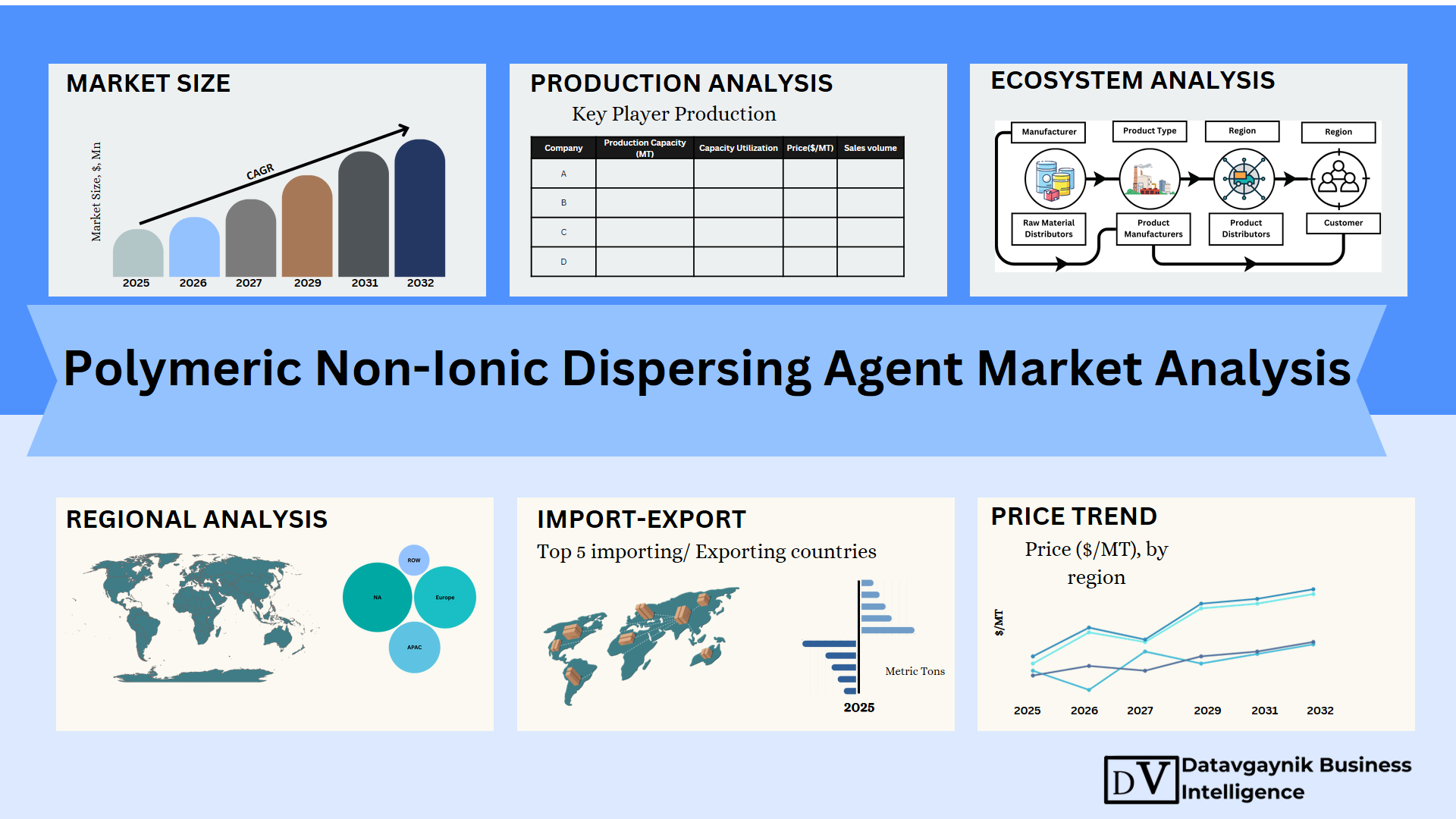
The strategic relevance of the Polymeric Non-Ionic Dispersing Agent Market during 2026–2035 will come from the shift toward waterborne coatings, pigment concentrates, suspension concentrates in crop protection, ceramic slurries, inkjet inks, battery-related specialty dispersions, and industrial formulations requiring long-term particle stability without ionic sensitivity. Unlike conventional ionic dispersants, polymeric non-ionic systems provide steric stabilization, better salt tolerance, broader pH flexibility, and improved compatibility with sensitive formulation chemistries.
In 2026, paints, coatings, and inks will remain the largest demand base, supported by architectural coatings, automotive refinishes, industrial coatings, packaging inks, and digital printing. Agrochemical formulations will represent one of the fastest-growing demand pockets as suspension concentrate and water-dispersible granule formulations continue replacing older solvent-heavy systems. Specialty ceramics, electronics materials, and high-performance composites will create premium demand for low-foam, APEO-free, VOC-reducing, and bio-based dispersant chemistries.
Key macro forces shaping the market include tighter VOC regulation, demand for APEO-free additives, growth in waterborne technologies, premium pigment dispersion requirements, higher raw material volatility in ethoxylates and acrylic monomers, and increased formulation complexity across end-use industries. Key stakeholders include specialty chemical manufacturers, coating OEMs, ink producers, agrochemical formulators, pigment suppliers, ceramic processors, distributors, regulators, investors, and industry associations focused on coatings, chemicals, agriculture inputs, and sustainable materials.
Market Segmentation and Forecast Scope
The Polymeric Non-Ionic Dispersing Agent Market is segmented by product chemistry, application, end user, and region. This structure avoids overlap because chemistry explains formulation behavior, application explains use-case demand, end user explains procurement behavior, and region explains market maturity and production-consumption balance.
By Product Type
Polyether-based polymeric dispersants will be widely used in waterborne systems, agrochemical suspension concentrates, pigment preparations, and specialty aqueous formulations where salt tolerance and steric stabilization are important. Acrylic and modified acrylic polymeric dispersants will remain important in paints, coatings, and inks due to their viscosity control, pigment wetting, and compatibility with latex and resin systems. Polyester/polyurethane-modified dispersants will serve higher-performance coatings, solvent-borne systems, radiation-cure inks, and specialty pigment concentrates. Bio-based and low-VOC polymeric non-ionic dispersants will remain a smaller but strategic segment, driven by sustainability targets and customer pressure for renewable-content additives.
In 2026, polyether-based and related non-ionic polymeric systems are estimated to account for nearly 34% of global revenue, supported by waterborne coatings and agrochemical formulations. Bio-based and renewable-content dispersants are expected to be the fastest-growing product category, expanding at an estimated CAGR of 8.1% during 2026–2035.
By Application
Paints, coatings, and inks form the core application base because these formulations require stable pigment dispersion, color strength, gloss retention, low viscosity, reduced flocculation, and compatibility with evolving resin platforms. Agrochemical formulations use polymeric non-ionic dispersants to stabilize active ingredients in suspension concentrates, seed treatment formulations, and water-dispersible systems. Ceramics, minerals, and construction materials use these additives for slurry stability, particle loading, viscosity reduction, and improved processability. Specialty applications include electronics materials, textile auxiliaries, adhesives, composites, personal care intermediates, and industrial cleaning formulations.
In 2026, paints, coatings, and inks are estimated to represent around 46% of global revenue. Agrochemical formulations will be among the most strategic high-growth applications due to the continued transition toward safer, water-based, and high-loading crop protection formats.
By End User
Coating and ink manufacturers will remain the largest end-user group because dispersant selection directly affects color development, milling time, stability, and finished coating performance. Agrochemical formulators will purchase these additives for formulation stability and active ingredient delivery. Pigment and color concentrate producers will use them to supply pre-dispersed systems to downstream users. Ceramic, mineral processing, electronics, and specialty material companies will represent smaller but higher-margin end users, especially where particle-size control and dispersion stability determine process yield.
By Region
North America will remain a mature but innovation-led market, driven by low-VOC coatings, specialty inks, agrochemical formulation technology, and premium industrial coatings. Europe will show strong demand for APEO-free, low-emission, and renewable-content dispersants due to strict chemical and environmental standards. Asia Pacific will be the largest volume-growth region, led by China, India, Japan, South Korea, and Southeast Asia, supported by coatings production, agrochemical exports, ceramic manufacturing, and packaging ink growth. LAMEA will grow from a smaller base, supported by construction coatings, crop protection demand, and industrial formulation localization.
Asia Pacific is expected to be the fastest-growing regional market, with an estimated CAGR of 7.0% during 2026–2035, supported by coating capacity expansion, agrochemical formulation outsourcing, and growing use of higher-performance additives in domestic manufacturing.
Market Trends and Innovation Landscape
The Polymeric Non-Ionic Dispersing Agent Market is moving from basic pigment wetting chemistry toward high-efficiency, formulation-specific dispersion platforms. R&D is focused on stronger particle anchoring, lower dosage levels, broader compatibility with waterborne and solvent-free systems, and improved performance in high-pigment-volume formulations. Suppliers are also developing dispersants that reduce milling time, improve tint strength, prevent viscosity drift, and maintain stability under heat, salt, and pH variation.
Technology evolution is strongest in waterborne coatings, high-solids coatings, pigment concentrates, digital inks, and agrochemical suspension concentrates. Non-ionic polymeric dispersants are increasingly preferred where ionic systems create compatibility issues, especially in formulations containing salts, electrolytes, sensitive actives, or complex resin packages. In inks and coatings, newer dispersants are being designed to support high color strength, low foam, improved gloss, and better storage stability. In agrochemicals, the focus is on dispersants that can hold higher active ingredient loading while maintaining pourability, suspension stability, and tank-mix compatibility.
Material science innovation is centered on polymer architecture. Suppliers are improving block copolymer structures, comb-like polymers, polyether backbones, hydrophobic-hydrophilic balance, and particle-affinity groups to improve steric stabilization. Another major direction is sustainability, including APEO-free products, lower-VOC systems, 100% active dispersants, renewable-feedstock surfactants, and lower-toxicity additives compatible with regulatory expectations.
Recent industry activity shows clear movement toward premium dispersion platforms. Lubrizol introduced new Solsperse water-based pigment dispersant technology in 2026 to improve efficiency in coatings and inks. BASF continues to position polymeric and oligomeric dispersant technologies for water-based, solvent-based, high-solids, 100% solids, and universal pigment concentrates. Croda’s portfolio includes non-ionic polymeric dispersants for both coatings and agrochemical suspension concentrate systems, while Arkema highlights non-ionic steric dispersion as important for water-based systems with pH and salt sensitivity.
Expert commentary: Between 2026 and 2035, the market will not be driven only by additive volume growth. The stronger value shift will come from performance substitution, where higher-value polymeric non-ionic dispersants replace conventional wetting agents and lower-efficiency dispersants in complex waterborne, low-VOC, agrochemical, pigment, and specialty material systems. This will keep average selling prices resilient even as large-volume coating and construction markets remain cost-sensitive.
Competitive Intelligence and Benchmarking
The competitive structure of the Polymeric Non-Ionic Dispersing Agent Market is led by diversified specialty chemical companies with strong positions in coatings, inks, agrochemical formulations, pigment concentrates, construction chemicals, and high-performance materials. Competition is not based only on price; it is driven by polymer design, formulation support, regulatory compliance, compatibility testing, regional supply reliability, and customer-specific technical service.
BASF holds a leading position through its broad additive platform for paints, coatings, inks, pigment concentrates, adhesives, construction materials, electronics, and paper-related applications. Its portfolio covers dispersing technologies for water-based, solvent-based, high-solids, 100% solids, and universal pigment systems. BASF is positioned as a premium supplier for formulators requiring color strength, viscosity reduction, gloss improvement, low-VOC compatibility, and long-term storage stability.
BYK, part of ALTANA, is one of the strongest specialist players in wetting and dispersing additives. The company serves coatings, inks, plastics, industrial formulations, and pigment systems. Its strength lies in high-performance additive chemistry, broad pigment and filler stabilization know-how, and deep technical support for complex coating systems. BYK is particularly strong in premium industrial coatings, automotive coatings, effect pigments, and high-value formulation development.
Evonik has a strong market position in coating additives and pigment dispersion systems. Its dispersant portfolio supports waterborne coatings, pigment concentrates, lacquers, inks, and high-performance colorant systems. Evonik’s strength is in specialty polymeric additive design, viscosity control, pigment stabilization, and compatibility with modern coating and ink technologies. The company is positioned strongly in premium coatings, printing inks, and formulation systems where performance and sustainability are both required.
Clariant is an important player in polymeric dispersants for paints, coatings, pigment preparations, and agrochemical formulations. Its portfolio includes non-ionic polymeric dispersing systems for water-based pigment concentrates and crop-protection suspension concentrates. Clariant is positioned as a strong supplier for low-VOC, APEO-free, waterborne, and regulatory-compliant formulations, especially where compatibility across different pigment and resin systems is required.
Croda is a relevant competitor in polymeric surfactants and dispersants, especially for agrochemicals, coatings, industrial specialties, and sustainable formulation systems. Its polymeric surfactant chemistries include EO/PO block structures, acrylic/styrene-based systems, methacrylic systems, hydroxystearate derivatives, and alkyd PEG resin derivatives. Croda’s market position is strongest in formulation-intensive applications where sustainability, biodegradability, active ingredient dispersion, and compatibility are key buying factors.
Arkema participates through specialty additive platforms for waterborne and low-VOC coatings, industrial dispersions, and material formulation systems. Its positioning is linked to non-ionic steric dispersion, pH and salt tolerance, pigment and filler stabilization, and reduced-solvent formulation trends. Arkema is strategically placed in Europe and North America, with growing relevance in Asia Pacific waterborne coating systems.
Lubrizol is a high-value specialty dispersant supplier with strong positioning in pigment dispersion, coatings, inks, plastics, and advanced material applications. Its strength lies in engineered dispersant chemistry for demanding organic pigments, inorganic pigments, carbon blacks, and high-performance dispersion systems. Lubrizol is particularly relevant in applications requiring premium pigment wetting, lower viscosity, color development, and long-term dispersion stability.
Regional Landscape and Adoption Outlook
North America
North America is a mature but high-value region for polymeric non-ionic dispersing agents. The United States leads demand due to its large coatings, inks, agrochemical formulation, construction chemicals, and specialty materials base. Adoption is strongest in architectural coatings, industrial coatings, packaging inks, pigment concentrates, and crop-protection formulations. Regulatory pressure on VOCs, APEO-free additives, worker safety, and sustainable formulation chemistry supports premium dispersant adoption. The region has strong infrastructure in R&D, technical service laboratories, toll formulation, and specialty chemical distribution. White space remains in bio-based dispersants, additive systems for recycled paint streams, and high-solids industrial coatings.
Europe
Europe is one of the most regulation-driven markets, with demand shaped by REACH compliance, low-VOC requirements, APEO-free systems, circularity targets, and sustainability reporting. Germany, France, the Netherlands, Italy, and the United Kingdom are the key adoption centers. Europe has a strong base of coating manufacturers, specialty chemical companies, pigment producers, agricultural formulation companies, and construction material suppliers. The region is expected to lead in renewable-content and biodegradable dispersant innovation, though growth will be more value-led than volume-led due to market maturity.
China
China is the largest volume-growth market due to its large coatings, construction materials, pigment, ceramics, packaging ink, agrochemical, and electronics manufacturing base. Adoption is moving from lower-cost dispersants toward higher-performance polymeric systems as domestic producers upgrade waterborne coatings, automotive coatings, lithium battery materials, ceramic slurries, and export-oriented agrochemical formulations. Environmental regulation, industrial consolidation, and demand for higher-quality finished products are supporting the shift toward better dispersant systems. The main white space is in premium, locally customized polymeric non-ionic dispersants for high-performance pigments and specialty materials.
India
India is a high-growth emerging market supported by architectural coatings, industrial coatings, agrochemical exports, packaging inks, ceramics, construction chemicals, and textile-related formulations. Adoption is still mixed: premium multinational formulators use high-performance dispersants, while many local producers remain cost-sensitive. Growth will be driven by waterborne paints, crop-protection formulation exports, ceramic tile production, infrastructure spending, and rising domestic specialty chemical capabilities. White space exists in local blending, technical service, agrochemical formulation support, and mid-priced polymeric dispersants for Indian climatic and water-quality conditions.
Japan
Japan is a technology-led market with strong adoption in high-performance coatings, inks, electronics materials, ceramics, automotive coatings, precision pigments, and specialty industrial formulations. Demand is not volume-led but quality-led. Japanese formulators prioritize particle-size control, stability, low contamination, defect reduction, and formulation reliability. The country will remain important for premium-grade dispersant adoption in electronics, automotive, advanced ceramics, display materials, and specialty inks.
South Korea
South Korea is a smaller but strategically important market due to its electronics, semiconductor materials, display, battery materials, automotive coatings, and specialty chemical ecosystem. Adoption is concentrated in high-performance dispersions where particle stability affects yield, coating uniformity, ink performance, and material consistency. Growth will be supported by advanced manufacturing, battery supply chains, and high-spec industrial coatings. White space exists in dispersants for ceramic slurries, conductive additives, battery-related dispersions, and precision coating materials.
Rest of the World
Rest of the World includes Southeast Asia, Latin America, the Middle East, and Africa. Southeast Asia is the strongest growth pocket due to coatings production, packaging inks, agrochemical formulation, construction activity, and relocation of manufacturing from China. Brazil and Mexico are important in Latin America due to crop protection, coatings, and construction materials. The Middle East is growing through construction coatings, infrastructure, and industrial coatings. Africa remains underserved, with demand mostly linked to imports, local paint manufacturing, and basic construction formulations. White space exists in local distribution, technical support, and affordable waterborne formulation additives.
End-User Dynamics and Use Case
End-user adoption in the Polymeric Non-Ionic Dispersing Agent Market depends on formulation complexity, performance requirements, raw material cost sensitivity, and regulatory pressure.
Coating manufacturers use polymeric non-ionic dispersing agents to improve pigment wetting, grinding efficiency, color strength, gloss, viscosity stability, and shelf life. These users normally evaluate dispersants through lab-scale drawdowns, mill-base viscosity tests, heat aging, tint strength, compatibility checks, and storage stability studies.
Ink manufacturers use these additives for pigment stabilization, low viscosity, color development, print consistency, and nozzle or plate performance. Digital inks, UV-curable inks, packaging inks, and polyurethane ink systems require higher-performance dispersants because pigment instability can create sedimentation, viscosity drift, and print defects.
Agrochemical formulators adopt polymeric non-ionic dispersants in suspension concentrates, seed treatments, and water-dispersible systems. The main objective is to maintain active ingredient suspension, prevent crystallization or sedimentation, improve pourability, and support tank-mix compatibility.
Pigment concentrate producers use these dispersants to create high-strength universal colorants and pre-dispersed pigment systems. Their buying decision is linked to pigment loading, compatibility across resin systems, tinting strength, and stability over time.
Ceramics, minerals, and specialty material producers adopt these additives to improve slurry flow, reduce viscosity at high solids loading, prevent particle agglomeration, and improve process consistency.
Use Case Scenario
A packaging ink manufacturer in Germany reformulated a waterborne pigment concentrate used for flexible packaging inks. The company replaced a conventional low-molecular-weight wetting package with a polymeric non-ionic dispersing system to stabilize organic pigments and carbon black in a high-solids mill-base. The reformulation reduced viscosity drift during storage, improved tint strength, reduced milling time, and improved compatibility with different binder systems used by downstream converters. The result was lower rework, better batch consistency, and improved performance in both flexographic and gravure ink applications.
Recent Developments + Opportunities & Restraints
Recent Developments
January 2026 – Evonik introduced a new hyperdispersant for inks. Evonik launched a new dispersant technology for radiation-curing inks and solventborne polyurethane inks. The product targets difficult pigment systems, formulation stability, viscosity reduction, and color strength development, showing continued innovation in premium pigment dispersion.
April 2026 – BASF highlighted high-performance dispersant systems for coatings. BASF emphasized its dispersant portfolio for waterborne, solventborne, universal pigment, architectural, industrial, and high-performance coating applications. This reflects the continued movement of the market toward low-VOC, high-efficiency, and formulation-specific dispersant platforms.
2025 – Clariant advanced low-VOC and APEO-free dispersing systems for waterborne paints. Clariant’s coatings portfolio highlights polymeric dispersants designed for organic and inorganic pigments, carbon blacks, titanium dioxide, waterborne systems, low-VOC requirements, and broad paint compatibility.
2025 – Clariant continued to support non-ionic polymeric dispersants for agrochemical suspension concentrates. The company’s agrochemical co-formulant portfolio includes non-ionic comb-shaped polymeric dispersants used in stable suspension concentrate formulations, reinforcing agrochemicals as a strategic growth area.
2024 – Croda continued innovation around polymeric surfactants for agrochemical and industrial formulations. Croda’s polymeric surfactant platform includes EO/PO block copolymers, acrylic/styrene copolymers, methacrylic polymers, and hydroxystearate derivatives, supporting demand for advanced dispersant systems in crop protection and specialty formulations.
Opportunities
Emerging market formulation upgrades: China, India, Southeast Asia, Brazil, and Mexico offer strong opportunities as local coating, agrochemical, ceramic, and ink manufacturers shift from basic dispersants to higher-performance polymeric systems.
Waterborne and low-VOC reformulation: Regulatory and customer pressure will continue to create demand for dispersants that support low-solvent, APEO-free, odor-reduced, and high-solids systems.
Productivity and cost-saving additives: Dispersants that reduce milling time, lower dosage, improve pigment loading, and reduce batch failure will gain share because they offer direct production-level cost savings.
Restraints
Raw material volatility: Acrylic monomers, ethoxylates, specialty polyols, and hydrophobic modifiers are exposed to cost fluctuations, which can pressure margins and pricing stability.
Formulation switching risk: Customers are slow to change dispersants because even small changes can affect viscosity, color, gloss, sedimentation, compatibility, and shelf life.
Cost sensitivity in emerging markets: Local formulators in paints, construction chemicals, and low-end inks may continue using lower-cost dispersants where performance requirements are less demanding.


