

Prefabricated Building Ventilation Systems Market Availability Strengthens as Modular Construction Buyers Shift Toward Factory-Integrated Airflow Solutions
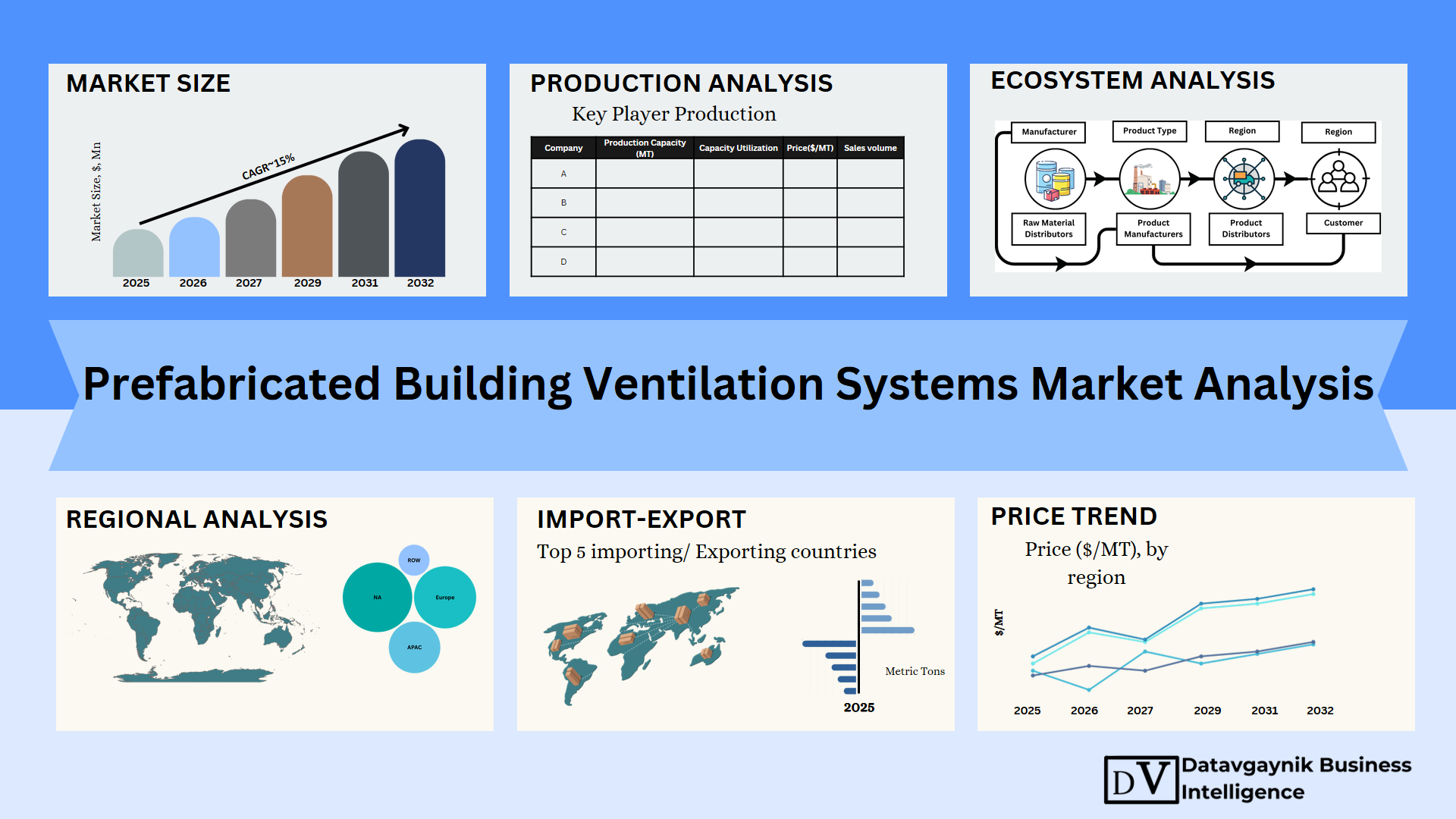
The Prefabricated Building Ventilation Systems market is estimated at USD 5.84 billion in 2026 and is projected to reach USD 10.07 billion by 2035, expanding at a 6.2% CAGR as modular housing producers, healthcare facility builders, school construction agencies, temporary accommodation operators, and commercial prefab contractors increasingly specify factory-fitted ventilation, heat recovery ventilation, duct modules, air handling units, exhaust systems, and decentralized airflow packages at the design stage. Availability is strongest in North America, Western Europe, Japan, South Korea, and parts of the Gulf, where prefabricated construction has deeper contractor access, certified HVAC installers, and building-code-linked indoor air quality requirements. The market remains specification-driven rather than purely volume-driven because buyers need systems that fit modular wall panels, ceiling cassettes, bathroom pods, service corridors, plant rooms, and transportable building modules without delaying factory assembly or site installation.
Buyer Access Is Strongest Where Modular Builders Already Use Integrated MEP Packages
Demand is concentrated among modular building manufacturers, off-site construction contractors, public housing agencies, student housing developers, hospital and clinic builders, mining camp operators, military accommodation contractors, and education facility planners. These buyers prefer ventilation systems that can be pre-installed, pre-tested, and commissioned with limited site work. In factory-built structures, ventilation is not treated as a loose site-installed component; it is part of the mechanical, electrical, and plumbing package that determines ceiling height, wall penetrations, acoustic comfort, fire stopping, filtration, and energy use.
The strongest buyer access is seen in permanent modular buildings because these projects require code-compliant ventilation, heat recovery, airflow balancing, and documentation before occupancy. Temporary classrooms, portable offices, workforce camps, and disaster-relief buildings use simpler exhaust and supply-air systems, but higher-specification temporary buildings are moving toward packaged ventilation with filtration, CO₂ monitoring, and heat recovery where climate or occupancy density demands it.
Global modular and prefabricated construction exceeded USD 171 billion in 2025 and is forecast to expand steadily through 2035, giving ventilation suppliers a larger addressable base of factory-built projects. Europe remains particularly relevant because Germany alone is a major prefabricated construction market, while the broader region is shaped by energy-performance regulation, housing shortages, and renovation programs. In March 2024, the European Parliament approved revised building energy rules with 370 votes in favor, directly supporting demand for better-performing HVAC and ventilation solutions in offices, hospitals, public buildings, and residential projects. This matters for prefabricated ventilation suppliers because modular buildings are often selected where project owners want faster completion while still meeting energy and indoor-air requirements.
Ventilation System Demand Is Moving From Basic Exhaust Toward Heat Recovery and Decentralized Units
Product demand is strongest for heat recovery ventilation units, decentralized ventilation systems, ducted supply-and-exhaust packages, bathroom and kitchen exhaust modules, compact air handling units, and filtration-integrated ventilation assemblies. Wall-mounted decentralized systems are gaining share in smaller modular units because they reduce duct complexity and allow each room or module to manage airflow independently. The decentralized ventilation systems market was valued at nearly USD 9.9 billion in 2025, with Europe alone estimated at USD 4.2 billion, showing how distributed airflow solutions are becoming more available for residential and light-commercial buildings.
Heat recovery ventilation has a stronger position in Europe, Canada, Japan, and colder U.S. states because airtight prefabricated buildings require controlled air exchange without heavy heating or cooling losses. In warmer markets, demand leans toward packaged fresh-air systems, exhaust fans, energy recovery units, and filtration-based ventilation tied to comfort cooling. Healthcare, laboratories, and education buildings usually require higher airflow control, filtration, zoning, and commissioning records, which gives engineered ventilation packages a higher value per project than basic residential modular units.
Service Reach, Commissioning, and Code Compliance Shape Adoption More Than Product Availability Alone
The market is not constrained only by manufacturing supply. Adoption depends on whether the ventilation supplier can support design coordination, BIM files, factory installation guidance, airflow balancing, commissioning documentation, replacement filters, spare motors, controls integration, and local code compliance. This makes the market partly service-dependent. Modular builders prefer suppliers that can deliver repeatable assemblies across multiple projects because factory production depends on consistent dimensions, predictable lead times, and pre-approved technical submittals.
ASHRAE Standard 241, which defines minimum requirements for reducing infectious aerosol exposure in new buildings, existing buildings, and major renovations, has also raised buyer attention toward equivalent clean airflow, filtration, and ventilation readiness planning. While it does not apply to every modular project, it supports higher specification levels in healthcare, education, offices, and high-density accommodation. The effect is visible in procurement language: buyers are asking not only for fans and ducts but also for airflow rates, filtration efficiency, maintenance access, controls compatibility, and commissioning evidence.
Major Constraints Come From Cost, Design Coordination, and Fragmented Modular Demand
The main constraint is that prefabricated ventilation systems must be planned early. Late-stage design changes can force rework in wall panels, service voids, ceilings, and plant-space allocation. Smaller modular builders often purchase standard fans, ducts, and compact units through distributors rather than buying fully engineered ventilation packages, which keeps the market fragmented. Price sensitivity is also high in affordable housing, portable classrooms, and temporary site accommodation, where buyers may choose lower-cost exhaust systems unless regulation, energy targets, or occupancy density requires better airflow control.
Material and component costs remain another pressure point. Ventilation assemblies use fans, motors, sensors, filters, heat exchangers, dampers, sheet metal, controls, insulation, and acoustic components. Any increase in electronics, motor, steel, aluminum, or logistics costs affects package pricing. In markets with weak installer networks or limited commissioning capacity, prefabricated ventilation adoption slows because buyers need post-installation support even when most of the system is factory-fitted.
North America and Europe currently offer the best demand quality because modular construction buyers, code consultants, HVAC distributors, and specialist contractors are more available. Asia-Pacific has stronger long-term volume potential through urban housing, healthcare expansion, and prefabricated public infrastructure, but adoption differs sharply by country. China, Japan, South Korea, Australia, Singapore, and parts of India show higher readiness than markets where modular construction is still mainly limited to low-cost temporary buildings.
Regional Availability and Channel Access Are Stronger Where Prefabrication and HVAC Specification Overlap
Europe has the highest specification pull for prefabricated building ventilation systems because modular construction, airtight building envelopes, energy-performance regulation, and heat recovery ventilation are moving together. Germany, the Nordic countries, the Netherlands, the United Kingdom, France, and Switzerland show stronger buyer access because prefabricated building producers already work with mechanical contractors, certified HVAC designers, ducting suppliers, and commissioning specialists. Germany is especially important because its prefabricated construction base is large, while its broader housing market remains under delivery pressure. The country approved 238,500 residential units in 2025, up 10.8% from 2024, but completions fell to 206,600 units, creating a clear gap between approvals, housing need, and actual delivery capacity. That gap supports modular construction methods and factory-integrated ventilation where developers want shorter site schedules.
European demand is also shaped by the revised Energy Performance of Buildings Directive. New buildings in the EU are moving toward zero-emission requirements from 2030, and public buildings face earlier efficiency pressure. For prefabricated building ventilation suppliers, this favors heat recovery systems, low-specific-fan-power units, balanced ventilation, demand-controlled airflow, and products that can support building energy certification. Basic exhaust-only units remain relevant in temporary site cabins, storage structures, and low-occupancy modular buildings, but they lose competitiveness in apartments, schools, healthcare spaces, and offices where indoor air quality documentation is required.
North America Favors Modular Project Delivery, But Service Access Separates Premium Suppliers
North America has a wider mix of permanent modular buildings, portable classrooms, workforce housing, healthcare extensions, military facilities, and disaster-response accommodation. The buyer base is more fragmented than Europe because modular building manufacturers, HVAC distributors, mechanical contractors, and rental fleet operators often buy through different channels. Permanent modular projects usually specify energy recovery ventilators, rooftop units with fresh-air modules, packaged air handling units, bathroom exhaust modules, and ducted supply systems. Temporary modular buildings often rely on simpler packaged HVAC and exhaust configurations, especially when buildings are leased for short periods.
Service coverage is a major differentiator. Buyers prefer suppliers that can provide submittal documents, factory installation support, spare filters, blower motors, controls troubleshooting, and commissioning guidance across multiple states or provinces. Ventilation systems in modular healthcare, school, and office buildings carry higher service expectations because occupancy approvals depend on airflow rates, filtration, and mechanical code compliance. Replacement demand is also more visible in North America because portable buildings are frequently moved, refurbished, re-leased, or repurposed, requiring fan replacement, filter upgrades, duct repair, controls updates, and fresh-air balancing.
Asia-Pacific Demand Is Volume-Led, But Adoption Depends on Building Type and Local Codes
Asia-Pacific has the strongest long-term volume opportunity, but adoption is uneven. Japan and South Korea have mature prefabricated housing practices, strong quality control expectations, and better acceptance of compact ventilation packages. Australia and Singapore have strong modular adoption in schools, healthcare, mining accommodation, and public infrastructure, making serviceable ventilation packages more relevant. China has large prefabricated building capacity, but product selection can vary widely between high-spec urban residential projects, public buildings, and lower-cost construction.
India and Southeast Asia remain more adoption-constrained. Prefabricated construction is expanding in industrial housing, project-site accommodation, hospitals, schools, warehousing, and infrastructure-linked facilities, but ventilation spending is often controlled tightly. Demand is stronger where buyers need faster occupancy, controlled indoor air, or repeatable building modules. In hot and humid regions, ventilation products are often linked with cooling load, dehumidification, filtration, and mold prevention rather than heat recovery alone. This makes energy recovery ventilation, treated fresh-air units, and exhaust balancing more relevant than simple residential HRV systems.
Segment Demand Reflects Building Use, Not Only Product Type
- Heat recovery and energy recovery units lead in permanent modular housing, schools, offices, healthcare buildings, and cold-climate projects because they reduce energy losses from controlled fresh-air supply.
- Decentralized wall-mounted ventilation units are stronger in small residential modules, student housing, hotel pods, and retrofit-style modular rooms where duct routing is difficult.
- Packaged air handling units and rooftop fresh-air systems fit commercial modular buildings, clinics, laboratories, and administrative facilities where airflow, filtration, and zoning need higher engineering input.
- Bathroom, kitchen, and utility exhaust modules remain high-volume because modular apartments, accommodation blocks, and student housing require repeatable wet-room ventilation layouts.
- Aftermarket filters, motors, dampers, controls, and balancing services gain importance as modular building fleets age, move between sites, or shift from temporary to semi-permanent use.
Channel structure is split between direct project supply and distributor-led sales. Large modular builders and public projects often use direct OEM or integrator procurement because ventilation must be coordinated with building design. Smaller contractors and rental fleet operators buy through HVAC distributors, electrical wholesalers, and local mechanical installers. The stronger suppliers are those that can support both models: standardized products for distributor access and engineered submittals for factory-integrated modular projects.
Supplier Ecosystem Is Led by HVAC Specialists With Modular-Ready Product Portfolios
The supplier ecosystem includes ventilation equipment manufacturers, ducting suppliers, HVAC control providers, heat exchanger manufacturers, modular building OEMs, mechanical contractors, commissioning providers, and regional distributors. Competition is not defined by one clear global leader because prefabricated building ventilation is supplied through a mix of residential HRV/ERV brands, commercial AHU manufacturers, duct and air-distribution companies, and integrated HVAC players. The strongest companies are those with tested ventilation units, compact form factors, reliable controls, local spare-parts support, and technical documentation that modular builders can integrate into repeatable factory assemblies.
Systemair has a strong position in project ventilation because its portfolio includes fans, modular air handling units, residential ventilation systems, air distribution products, fire-safety products, and product selection tools. This breadth matters for prefabricated buildings because a modular project may need compact fans, central AHUs, dampers, diffusers, and fire-rated ventilation components from the same supplier network. The company’s presence across Europe, North America, the Middle East, Asia, Australia, and Africa also supports cross-border modular builders that need repeatable specifications.
Swegon is relevant in commercial and institutional modular buildings because its air handling units are designed for varied building applications and include efficient fans, heat exchangers, and user-friendly control systems. Its GOLD air handling unit range is also positioned around energy efficiency and heat recovery, which fits schools, offices, healthcare extensions, and high-performance prefabricated buildings. Swegon’s acquisition activity in Europe has also strengthened its access to regional AHU production and service capability, especially in Germany, the United Kingdom, Ireland, and Italy.
Zehnder is stronger in residential and light-commercial controlled ventilation. Its ComfoAir Q range is positioned around high heat recovery efficiency, low noise, and balanced airflow control, while its North American portfolio includes Lifebreath and Zehnder America ventilation offerings. This gives the company relevance in prefabricated houses, apartment modules, student housing, and low-energy building projects where indoor air quality and occupant comfort are central buying criteria.
Daikin, Carrier, Trane, Mitsubishi Electric, Panasonic, Greenheck, TROX, Aldes, Lindab, FläktGroup, Johnson Controls, LG, and Fujitsu participate through different parts of the ecosystem. Daikin’s heat recovery ventilation portfolio is relevant where ventilation is bundled with VRV/VRF systems, packaged air conditioning, sensors, and building controls. Greenheck and TROX are stronger in commercial airflow, air distribution, dampers, and engineered ventilation components. Lindab has strong ducting and ventilation distribution access in Europe, which is important because modular ventilation packages still depend heavily on ducts, fittings, grilles, and local availability.
Pricing and Procurement Behavior Reflect Customization, Not Only Unit Cost
Pricing varies by product specification, airflow capacity, heat recovery efficiency, filtration class, acoustic performance, controls package, casing quality, fire compliance, and commissioning needs. A basic exhaust package for a temporary modular unit can be purchased through distribution at low cost, while an engineered heat recovery or air handling package for a healthcare or school module carries a higher margin because it includes design coordination, testing, documentation, and service support. Distribution cost also matters because modular factories need dependable inventory timing; a delayed fan, heat exchanger, damper, or controller can stop module completion.
Procurement is moving toward pre-approved ventilation kits for repeat modular building designs. This reduces engineering time, simplifies factory installation, and improves service planning. For suppliers, the advantage comes from repeatability: once a ventilation system is qualified for a modular housing, classroom, clinic, or workforce accommodation design, the same package can be reused across multiple projects with small regional adjustments.
Recent Market and Ecosystem Developments
- March 2024, European Union: The European Parliament approved the revised Energy Performance of Buildings Directive with 370 votes in favor, strengthening long-term demand for energy-efficient ventilation and heat recovery systems in new and renovated buildings.
- July 2023 onward, United States and global technical markets: ASHRAE Standard 241 introduced minimum requirements for reducing infectious aerosol exposure, including equivalent clean airflow concepts, supporting higher buyer attention toward filtration and ventilation readiness in schools, healthcare, offices, and high-occupancy buildings.
- November 2024, Germany: Swegon signed an agreement to acquire HOWATHERM Klimatechnik GmbH, a German modular air handling unit manufacturer, improving its coverage in Europe’s largest AHU market.
- October 2024, United Kingdom: The UK Competition and Markets Authority ordered Lindab to divest sites after competition concerns linked to circular ducts and fittings, showing how local ventilation distribution density can influence pricing and access.
- January 2024, Europe: Carrier completed the acquisition of Viessmann Climate Solutions, strengthening its position in intelligent climate and energy solutions and increasing competition in European HVAC channels.
- February 2026, Germany: Residential permits rose to 238,500 units in 2025 after three years of decline, but completions remained low at 206,600 units, supporting interest in faster construction models such as modular building and factory-installed MEP packages.


