

Market Summary and Growth Forecast
The global Produced Water Treatment Systems Market is estimated at $10,800 million in 2026 and is expected to reach $18,600 million by 2035, growing at a CAGR of 6.2%.
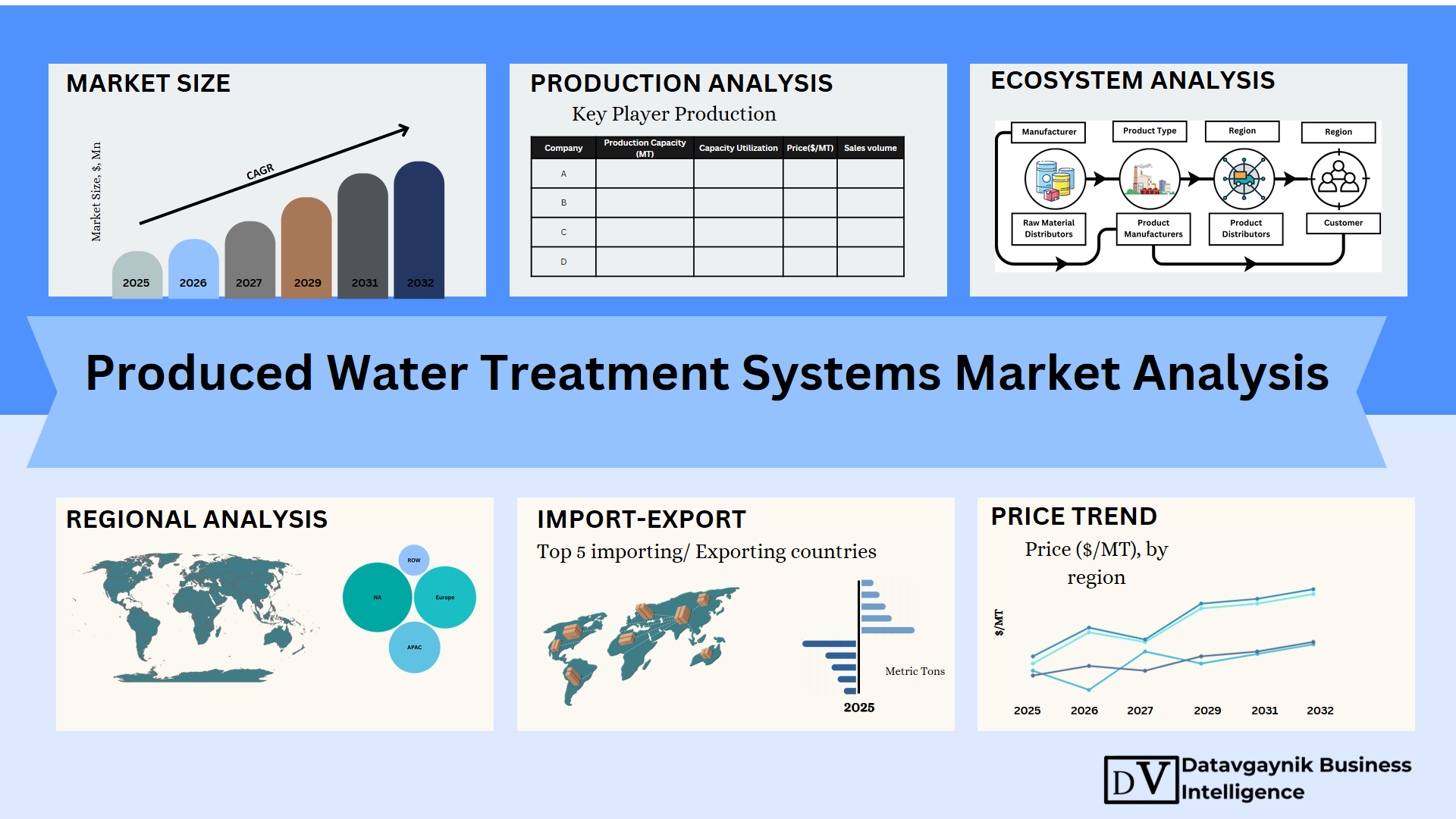
The Produced Water Treatment Systems Market covers engineered systems used to separate, treat, recycle, reuse, or safely dispose of water that comes up with oil and gas during production. This includes de-oiling units, hydrocyclones, flotation systems, media filters, membrane systems, thermal treatment units, chemical dosing modules, polishing systems, and digital control packages. The revenue boundary here is focused on treatment systems and integrated equipment packages. It does not include routine water hauling, basic disposal well operations, or general oilfield water logistics.
Datavagyanik also covers related markets such as the Boiler Water Treatment Chemicals Market, the Water Treatment Membranes for Reverse Osmosis Market, and the Ion Exchange Resin For Water Treatment Market. Understanding these markets sheds light on emerging innovations and industry crossovers that impact the main topic.
For 2026–2035, the business relevance is quite direct. Oil and gas producers are dealing with higher water cuts from mature fields, more water-intensive shale operations, tighter disposal capacity in key basins, and a clear push toward reuse. Produced water is no longer seen only as a waste stream. In several regions, it is becoming a cost-control issue, a regulatory issue, and in water-stressed basins, a resource question.
| Market Indicator | Estimate |
| Global market size, 2026 | $10,800 million |
| Projected market size, 2035 | $18,600 million |
| CAGR, 2026–2035 | 6.2% |
| Core revenue scope | Treatment systems, packaged equipment, controls, filtration, separation, polishing, reuse and disposal-ready treatment units |
| Excluded scope | Water hauling, basic saltwater disposal fees, drilling fluids, municipal wastewater systems, and general oilfield logistics |
Regulation is one of the strongest forces shaping this market. In the U.S., EPA oil and gas extraction effluent guidelines cover wastewater discharges from field exploration, drilling, production, well treatment, and completion activities. The EPA also announced in March 2025 that it would revise wastewater regulations for oil and gas extraction facilities, which keeps treatment performance and discharge pathways high on the strategic agenda.
For 2026–2035, the Produced Water Treatment Systems Market matters because it sits between production continuity and environmental permission. When disposal wells become constrained, when water sourcing costs rise, or when surface discharge rules evolve, treatment systems become part of the production infrastructure. Not a side utility.
The strongest demand is expected from:
| Key Consumer / Client Group | Why They Buy Treatment Systems |
| Integrated oil and gas companies | To manage high-volume produced water across mature fields, offshore assets, and shale portfolios |
| National oil companies | To support long-life production assets and reduce environmental discharge risk |
| Independent shale operators | To recycle produced water for completions and reduce freshwater sourcing costs |
| Midstream water companies | To build gathering, recycling, desalination, and disposal-linked water networks |
| EPC contractors and offshore facility builders | To integrate compact treatment trains into FPSOs, platforms, and central processing facilities |
| Produced water service providers | To offer mobile, modular, or basin-level treatment capacity |
| Mining, agriculture, and industrial users in pilot cases | To evaluate treated produced water as a supplemental non-potable water source where regulation allows |
North America will remain the anchor demand region in 2026, led by the Permian Basin and other unconventional plays. The Middle East will remain important due to large-scale mature oil production and water reinjection needs. Latin America, especially Brazil and Argentina, will add demand through offshore production and unconventional development. Asia Pacific will grow steadily, supported by aging fields in China, Indonesia, Malaysia, India, and Australia.
Expert view: Produced water treatment is shifting from “compliance equipment” to “operating leverage.” The companies that control water handling costs will protect margins better in high-water-cut fields. This may sound operational, but it has direct EBITDA impact.
Market Segmentation and Forecast Scope
Segmentation for the Produced Water Treatment Systems Market should be practical. Buyers do not purchase these systems by academic treatment category alone. They buy around water quality, oil content, salinity, solids load, flow rate, mobility, space limits, reuse target, and discharge pathway.
The forecast scope is segmented across technology, application, treatment objective, end user, and region.
By Technology
| Technology Segment | Scope and Market Logic | 2026 Position |
| Primary and secondary separation / de-oiling systems | Includes hydrocyclones, induced gas flotation, dissolved gas flotation, corrugated plate interceptors, skimmers, nutshell filters, and media filtration. These systems remove oil, suspended solids, and bulk contaminants before deeper polishing. | Largest segment with around 44% share in 2026 |
| Membrane filtration and desalination systems | Includes ultrafiltration, nanofiltration, reverse osmosis, ceramic membranes, and hybrid membrane trains. Adoption is rising where reuse or discharge-quality water is the target. | Strategic and fast-growing |
| Thermal treatment and evaporation systems | Used for high-salinity produced water where membrane economics are difficult. Includes evaporation, crystallization, and concentration systems. | Niche but important for difficult brines |
| Chemical and electrochemical treatment systems | Includes coagulation, flocculation, oxidation, electrocoagulation, scale control, and hydrogen sulfide control. Often used in mobile and modular oilfield systems. | Strong fit for shale recycling |
| Advanced polishing and oxidation systems | Includes ozone, advanced oxidation, activated carbon, ion exchange, and final-stage contaminant removal. | Growing from pilot to selective commercial use |
The largest revenue pool still sits in primary and secondary separation / de-oiling systems. That makes sense. Most produced water does not immediately need expensive desalination. It first needs reliable oil removal, solids control, and conditioning for reinjection or disposal.
That said, the fastest strategic growth will come from membrane filtration, desalination, ozone-based treatment, and hybrid polishing systems. These are the technologies that allow producers to think beyond disposal.
By Application
| Application Segment | Demand Outlook |
| Onshore conventional oilfields | Stable demand from aging fields with rising water cuts. System replacement and capacity expansion will support revenue. |
| Unconventional shale and tight oil | One of the most attractive demand pockets. Water recycling for completions is becoming a practical cost and logistics tool. |
| Offshore platforms and FPSOs | Requires compact, high-reliability systems with tight space and weight constraints. Offshore discharge limits also support demand. |
| Enhanced oil recovery and reinjection | Treatment is needed to meet reinjection quality and reduce scaling, plugging, corrosion, and reservoir damage. |
| Beneficial reuse and industrial reuse pilots | Small today but strategically important. This includes treated water for industrial cooling, construction, rangeland, agriculture pilots, and other non-potable applications where approved. |
The most strategic application is unconventional shale and tight oil because produced water volumes, freshwater constraints, and disposal limits all meet in the same operating environment. This creates a stronger economic case for recycling than in many conventional basins.
By Treatment Objective
| Treatment Objective | Commercial Role |
| Disposal-ready treatment | Removes oil and solids to protect disposal wells and reduce operational risk. |
| Reinjection-ready treatment | Supports waterflooding, pressure maintenance, and EOR programs. |
| Frac reuse / recycling | Treats produced water to a quality suitable for hydraulic fracturing fluids. |
| Surface discharge / beneficial reuse | Requires deeper treatment and higher testing confidence. Adoption depends heavily on regulation and local acceptance. |
| Resource recovery | Emerging area focused on salts, minerals, lithium, iodine, or other dissolved materials where chemistry and economics allow. |
The near-term money remains in disposal-ready and reinjection-ready systems. The higher-growth story sits in frac reuse, desalination, and beneficial reuse.
By End User
| End User Segment | Buying Behavior |
| Oil and gas operators | Buy systems to control cost, meet discharge rules, reduce downtime, and support field production. |
| Midstream water infrastructure companies | Build centralized treatment and recycling networks across basins. |
| EPC and offshore contractors | Integrate treatment packages into new facilities and brownfield upgrades. |
| National oil companies | Prefer durable, large-capacity systems for long-life assets and reinjection programs. |
| Specialized water service companies | Buy modular or mobile systems for basin-level service contracts. |
The rise of midstream water infrastructure companies is important. It changes the market from one-off equipment procurement to recurring basin-level infrastructure planning.
By Region
| Region | Forecast Scope and Growth Logic |
| North America | Largest market, with around 41% share in 2026. Growth is tied to shale recycling, disposal constraints, and Permian Basin water infrastructure. |
| Europe | Smaller but technically demanding. Offshore North Sea operations and environmental compliance shape system requirements. |
| Asia Pacific | Growth comes from mature fields, offshore production, and rising environmental oversight in China, India, Australia, Indonesia, and Malaysia. |
| LAMEA | Strong long-term potential across the Middle East, Brazil, Argentina, and parts of Africa. Water stress and reinjection needs support system upgrades. |
North America leads on scale. The Middle East leads on long-life production and reinjection relevance. Asia Pacific adds steady demand. LAMEA brings the most uneven but attractive upside.
Use case example: A Permian operator running multiple shale pads may install a modular treatment train to remove oil, solids, bacteria, and scale-forming ions before reusing the water in completions. The saving is not only freshwater cost. It also reduces trucking, disposal pressure, and operational delays.
Market Trends and Innovation Landscape
Innovation in the Produced Water Treatment Systems Market is moving in a practical direction. Buyers are not asking for elegant lab concepts. They want systems that can handle unstable water chemistry, high salinity, oil carryover, sand, bacteria, scale, and field-level abuse. They also want lower chemical intensity and smaller footprints.
R&D Evolution: From Disposal Support to Reuse-Ready Treatment
Earlier system design focused mainly on removing enough oil and solids to allow reinjection or disposal. That is still the base market. But R&D is now moving toward reuse quality, brine concentration, and selective contaminant control.
Technology suppliers are building broader treatment trains that combine gravity de-oiling, flotation, filtration, ion exchange, membrane separation, and polishing. Veolia, for example, positions its produced water technology portfolio from primary gravity de-oiling through ion-exchange softening and advanced membrane separation. SLB also markets produced water treatment solutions for cleaning water for disposal or injection.
The shift is clear. One system rarely solves the whole problem. Hybrid treatment trains are becoming the default answer.
Technology Evolution: Modular, Mobile, and Basin-Scale Systems
The market is moving in two directions at once.
First, operators want modular systems that can be moved close to production sites. These reduce transportation cost and allow fast deployment when drilling activity shifts.
Second, large basins are moving toward centralized water infrastructure. These facilities can aggregate produced water, treat it at scale, and send it back into reuse networks or disposal systems.
In June 2026, Western Midstream launched its second produced water treatment pilot facility, JIP 2, near Red Bluff Reservoir in Texas. The project is being developed with Chevron, ConocoPhillips, Devon Energy, and ExxonMobil. It is designed to treat 2,000 barrels per day and produce roughly 1,000 barrels per day of reclaimed freshwater.
That is not huge by oilfield standards. But it matters because it tests whether produced water desalination and reuse can move from demonstration to commercial planning.
Material Science and System Design
Material science is relevant here, especially in membranes, corrosion control, and fouling resistance. Produced water can be chemically aggressive. It may contain hydrocarbons, dissolved salts, metals, scale-forming ions, treatment chemicals, and hydrogen sulfide.
So, vendors are improving:
| Innovation Area | Why It Matters |
| Ceramic and advanced membranes | Better tolerance to heat, oil, chemicals, and abrasive solids |
| Anti-fouling membrane surfaces | Reduces cleaning frequency and improves uptime |
| Corrosion-resistant alloys and coatings | Extends system life in high-salinity and sour-water environments |
| Improved media filtration | Captures oil and fine solids before they damage downstream systems |
| Ozone and advanced oxidation | Helps reduce chemical handling and improves organic contaminant control |
| Low-sludge treatment chemistry | Reduces disposal burden and field handling cost |
In 2026, the strongest design trend is not “one breakthrough material.” It is better integration. Suppliers are combining separation, oxidation, filtration, and digital monitoring into smaller and easier-to-operate packages.
AI and Digital Monitoring: Useful, But Still Selective
AI is relevant, but it should not be overstated. Most oilfield water systems still depend on sensors, automation, SCADA, flow control, and operator judgement. AI is beginning to help in forecasting produced water volumes, optimizing chemical dosing, predicting fouling, and routing water across networks.
In 2026, Intelligent Core introduced Core Flow, an AI-driven produced water management platform for the Permian Basin. The platform connects with SCADA and IoT infrastructure and is designed to support predictive routing and treatment decisions.
Also, Sigma Advanced Technologies introduced second-generation mobile ozone units with automated remote monitoring for Permian Basin produced water treatment. These systems are designed for continuous field operation and variable treatment volumes.
Expert view: AI will not replace treatment chemistry. It will sit above the system as a control layer. The early value will come from fewer upsets, better chemical dosing, better routing, and faster response when water quality changes.
Partnerships, M&A, and Recent Announcements
| Month / Year | Company / Organization | Event | Market Relevance |
| March 2025 | EPA | Announced plans to revise wastewater regulations for oil and gas extraction facilities. | Keeps discharge standards and treatment performance central to investment planning. |
| August 2025 | ConocoPhillips and Texas A&M | Announced a research collaboration focused on beneficial reuse of produced water. | Shows stronger industry-academic work around off-field reuse and safety validation. |
| October 2025 | Western Midstream and Aris Water Solutions | Western Midstream completed its acquisition of Aris Water Solutions. | Confirms consolidation in produced water infrastructure and strengthens basin-level recycling capacity. |
| 2025 | WaterBridge Infrastructure | Raised $634 million through a U.S. IPO. | Signals investor interest in produced water infrastructure as a standalone asset class. |
| 2026 | WT Oil & Gas and EnviroKlean | Launched a zero-solids recycling system for high-volume Permian operations. | Supports the move toward lower-sludge, high-throughput recycling systems. |
| June 2026 | Western Midstream, Chevron, ConocoPhillips, Devon Energy, ExxonMobil | Launched JIP 2 produced water treatment pilot in Texas. | Important step toward commercial produced water desalination and reuse. |
| June 2026 | Sigma Advanced Technologies | Advanced mobile ozone treatment units in the Permian Basin. | Reinforces demand for mobile, chemical-light, remotely monitored treatment systems. |
The direction is becoming clear. Treatment systems are moving from isolated equipment purchases to integrated water platforms. M&A is strengthening basin-level infrastructure. Pilots are becoming larger. Digital tools are being layered into operations. And regulation is keeping reuse and discharge quality in focus.
Expert view: The next phase will reward vendors that can prove field reliability, not just lab performance. Produced water chemistry changes from well to well. Systems that keep working under those swings will win the premium contracts.
Competitive Intelligence and Benchmarking
The competitive structure of the Produced Water Treatment Systems Market is mixed. It includes large oilfield technology firms, industrial water specialists, modular treatment companies, chemical-treatment providers, and infrastructure-backed water management players. No single vendor controls the full market. Buyers usually select partners based on basin experience, water chemistry, uptime record, system footprint, and treatment objective.
| Company | Portfolio Focus | Market Position and Benchmarking View |
| SLB | Integrated produced water treatment, separation, compact flotation, filtration, polishing, and oilfield water management support. | SLB is one of the strongest oilfield-linked system providers because it understands the production environment, not only the water plant. Its strength is in upstream integration, offshore and onshore reliability, and treatment packages designed for injection, disposal, and discharge-quality use cases. The company positions produced water treatment as part of broader production optimization rather than as a standalone equipment sale. |
| Veolia Water Technologies | De-oiling, filtration, flotation, ion exchange, membrane separation, evaporation, and customized produced water treatment plants. | Veolia Water Technologies has one of the broadest industrial water portfolios. It is well placed in projects where operators need a full engineered treatment train rather than a single unit. The company has strength in large-scale reuse, offshore water treatment, heavy oil applications, and high-salinity treatment. Its position is strongest where regulatory compliance and multi-stage treatment quality matter. |
| NOV | Separation equipment, produced water treatment modules, offshore process upgrades, dynamic oil recovery, solids removal, and brownfield process debottlenecking. | NOV competes well in upstream process systems, especially where produced water treatment is connected to separators, offshore platforms, FPSOs, and facility upgrades. Its advantage is mechanical engineering depth. The company is more equipment and process-system focused than chemical-treatment focused. This gives it a strong fit in offshore and brownfield assets. |
| Aquatech International | Produced water reuse, desalination, evaporation, brine concentration, thermal systems, membrane-based systems, and zero-liquid-discharge-style solutions. | Aquatech International is stronger in difficult-water applications where salinity, silica, boron, organics, or high recovery targets create technical complexity. It is not a pure oilfield services company. That can be an advantage in industrial reuse and advanced treatment cases. Its position is strongest where clients want to reduce freshwater demand or recover water from high-TDS streams. |
| Xylem / Evoqua | Industrial water treatment, filtration, disinfection, ion exchange, membranes, instrumentation, and service-led water solutions. | Xylem / Evoqua sits more on the industrial water technology side than the upstream oilfield equipment side. Its portfolio is relevant where produced water projects require polishing, treatment media, disinfection, monitoring, and integrated industrial water management. The 2023 Evoqua combination strengthened Xylem’s depth in advanced treatment and service capability. |
| Halliburton | Water treatment chemistry, H₂S control, produced water conditioning, frac-water reuse support, and oilfield service integration. | Halliburton is best viewed as a chemical and field-service competitor rather than a full produced-water plant vendor. Its value is in operational chemistry, rapid field execution, and enabling reuse of challenging produced water in hydraulic fracturing. It is especially relevant in shale basins where operators need water treated quickly for completions. |
| TETRA Technologies | Water management, desalination pilots, produced water recycling, treatment chemistry, and beneficial reuse-linked systems. | TETRA Technologies is gaining attention in high-salinity produced water treatment and beneficial reuse pilots. Its position is more specialized than SLB or Veolia, but it has a practical Permian Basin angle. The company’s water treatment direction also links to mineral extraction potential from brines, which could become relevant later in the forecast period. |
Benchmarking insight: The most competitive vendors are not simply the ones with the most technologies. They are the ones that can prove field tolerance. Produced water chemistry changes fast. Oil carryover, salinity, bacteria, iron, sulfides, and scale risk vary by basin and even by well pad. That is why modular testing, pilot validation, service support, and chemical flexibility are now part of the buying decision.
| Competitive Factor | Leaders / Strong Players | Why It Matters |
| Full treatment train capability | Veolia, SLB, Aquatech | Helps in complex reuse, discharge, and desalination projects |
| Oilfield execution depth | SLB, Halliburton, NOV, TETRA Technologies | Important for fast-moving shale and offshore operations |
| High-salinity treatment | Aquatech, Veolia, TETRA Technologies | Supports desalination, evaporation, and beneficial reuse cases |
| Offshore / compact systems | SLB, NOV, Veolia | Critical where footprint and reliability are major constraints |
| Chemistry-led treatment | Halliburton, TETRA Technologies | Useful for frac reuse, H₂S control, iron control, and scale management |
| Digital and remote monitoring | SLB, Veolia, Xylem / Evoqua | Helps reduce field upsets and improve system uptime |
Expert view: This is not a winner-takes-all market. The better model is “fit-for-water chemistry.” A vendor that performs well in Permian shale may not automatically win offshore Brazil or high-salinity Middle East reinjection projects.
Regional Landscape and Adoption Outlook
Regional adoption is shaped by three practical issues: produced water volume, disposal constraints, and regulatory tolerance for reuse or discharge. The Produced Water Treatment Systems Market is most advanced where all three pressures meet at the same time.
United States
The United States is the largest regional market, with an estimated 39–42% global revenue share in 2026. The Permian Basin remains the center of gravity. It produces very large volumes of water alongside oil and gas. Industry commentary in 2025 placed Permian produced water above 20 million barrels per day in 2024, with further growth expected by 2030. Disposal is becoming more constrained as regulators respond to seismicity and formation-pressure issues.
Adoption is strongest in:
| U.S. Demand Pocket | Adoption Outlook |
| Permian Basin | Highest growth due to water recycling, disposal constraints, and infrastructure-backed treatment networks |
| Eagle Ford | Steady demand for reuse and disposal-ready treatment |
| Bakken | Selective demand due to logistics and produced water handling requirements |
| Gulf of Mexico | Offshore compact systems and discharge-quality treatment remain relevant |
Funding is increasingly available through midstream water infrastructure models. WaterBridge, Aris Water, Western Midstream, and other basin-level water players show that produced water is becoming infrastructure. Not just a field expense. The EPA’s 2025 decision to revisit oil and gas wastewater regulations may also influence treatment investment and reuse planning.
Europe
Europe is a smaller market but technically demanding. Demand is concentrated in the North Sea, including the United Kingdom, Norway, and parts of continental offshore production. The region is mature, so water cut management matters. But growth is not volume-led in the same way as the U.S. shale market.
European buyers prioritize:
| Adoption Driver | Regional Impact |
| Offshore platform reliability | Supports compact and low-maintenance systems |
| Strict discharge control | Pushes operators toward higher-quality de-oiling and polishing |
| Brownfield life extension | Creates upgrade demand rather than large greenfield demand |
| Energy transition pressure | Encourages lower-chemical and lower-footprint treatment approaches |
The market is service-intensive. Operators value proven offshore references, uptime guarantees, and retrofittable systems. Europe will not be the fastest-growing region, but it will remain a premium technology market.
China
China is a medium-to-high growth market. Demand is tied to mature oil and gas fields, reinjection needs, and tighter industrial wastewater management. Produced water reinjection remains important in gas fields and mature production areas, with treatment focused on solids control, scale prevention, oil removal, and reservoir compatibility. A 2025 study on produced water reinjection in Chinese gas fields highlights the importance of water source, chemical composition, treatment method, and reinjection performance.
High-growth areas include mature fields in Daqing, Shengli, Changqing, and western basins where water handling is part of long-life production management. Domestic suppliers are active, but advanced membranes, automation, and high-spec treatment packages still create space for global technology providers.
India
India is a selective but important market. Produced water treatment demand comes mainly from ONGC, Oil India, private upstream operators, refinery-linked oilfield assets, and enhanced oil recovery projects. The market is smaller than China and the U.S., but it has a strong need for cost-efficient treatment.
Adoption is shaped by:
| India Factor | Impact on Adoption |
| Mature oilfields | Supports reinjection and water conditioning systems |
| Cost sensitivity | Favors simpler, chemical-light, low-sludge systems |
| Water stress in producing regions | Creates long-term interest in reuse |
| Public-sector procurement | Can slow adoption but supports structured projects |
India will likely adopt produced water treatment through project-specific deployments rather than large private water-midstream networks. Local EPCs and Indian water technology firms will play an important integration role.
Japan
Japan is not a large produced water treatment market because it does not have the same upstream oil and gas production base as the U.S., China, or Middle East. Its role is different. Japan is more relevant as a technology, equipment, and engineering contributor.
Japanese firms can support:
| Japan Role | Market Relevance |
| Membrane materials and components | Useful in high-quality filtration and desalination systems |
| Automation and sensors | Relevant for remote monitoring and plant reliability |
| Offshore engineering partnerships | Supports regional projects outside Japan |
| Industrial water know-how | Can be adapted for high-spec produced water treatment |
So, Japan is not a demand leader. It is a technology-support market.
South Korea
South Korea also has limited domestic upstream demand. Its importance comes through shipbuilding, offshore engineering, EPC capability, and equipment supply. Korean yards and engineering firms can influence produced water system integration in FPSOs, offshore platforms, and floating production projects.
Demand is linked to overseas projects rather than domestic oilfield production. Korean participation will be stronger in offshore supply chains serving Southeast Asia, the Middle East, and Latin America.
Middle East
The Middle East is highly relevant. It should be included in the forecast because water stress, large oilfields, reinjection needs, and national oil company spending all support treatment demand. Saudi Arabia, UAE, Kuwait, Oman, Qatar, and Iraq are the core markets.
The region has three demand layers:
| Middle East Demand Layer | Adoption Outlook |
| Mature oilfield water handling | Large and steady demand for separation, filtration, and reinjection-quality treatment |
| Water reuse and conservation | Rising interest due to water scarcity and pressure to protect freshwater resources |
| Large EPC-led projects | Strong fit for engineered, centralized treatment plants |
Water-stressed regions in the Middle East and North Africa are increasingly looking at produced water as a resource where the right treatment and regulatory alignment exist.
| Region / Country | 2026 Adoption Level | 2035 Outlook | Main Buyer Type |
| United States | Very high | Largest and most active market | Shale operators, water midstream firms, oilfield service firms |
| Europe | Medium | Premium offshore upgrade market | Offshore operators, EPCs, service providers |
| China | Medium-high | Strong growth from mature fields and reinjection | NOCs, domestic oilfield service firms |
| India | Low-medium | Selective but improving | ONGC, Oil India, EPCs, industrial water firms |
| Japan | Low demand / high technology role | Component and engineering support | Technology suppliers, engineering firms |
| South Korea | Low domestic demand / offshore supply role | FPSO and offshore integration support | EPCs, shipyards, offshore contractors |
| Middle East | High | Large reinjection and reuse opportunity | NOCs, EPCs, global water technology firms |
Expert view: The U.S. will lead the market by commercial urgency. The Middle East will lead by long-life asset scale. China will grow through mature-field management. Europe, Japan, and South Korea will matter more through technology quality than raw volume.
Recent Developments + Opportunities & Restraints
Recent Developments
| Year / Month | Event | Why It Matters |
| 2025 / March | EPA announced plans to revise wastewater regulations for oil and gas extraction facilities. | This could reshape discharge pathways, treatment standards, and produced water reuse economics in the U.S. |
| 2025 / August | ConocoPhillips and Texas A&M University announced a research collaboration on beneficial reuse of produced water. | The move adds scientific validation to reuse pathways outside traditional oilfield recycling. |
| 2025 / September | WaterBridge Infrastructure raised $634 million through its U.S. IPO. | Public-market funding shows produced water infrastructure is becoming a standalone investment theme. |
| 2025 / October | Western Midstream completed its acquisition of Aris Water Solutions. | This strengthened consolidation in Permian Basin water gathering, recycling, and produced water infrastructure. |
| 2026 / June | Western Midstream launched JIP 2, a produced water treatment pilot with Chevron, ConocoPhillips, Devon Energy, and ExxonMobil. | The facility treats 2,000 barrels per day and is designed to produce around 1,000 barrels per day of reclaimed freshwater. It moves beneficial reuse closer to commercial testing. |
Opportunities and Business Insights
| Opportunity | Business Insight |
| Produced water recycling in shale basins | The strongest near-term opportunity sits in the Permian Basin, where water volumes, disposal limits, and frac demand create a clear reuse case. |
| Remote monitoring and automation | Operators want fewer field failures, lower chemical waste, and better routing decisions. Automation can reduce downtime and improve treatment consistency. |
| Beneficial reuse and desalination pilots | This is still early, but it could become a premium market after 2028 if regulatory pathways become clearer and treatment costs decline. |
Restraints
| Restraint | Business Impact |
| High salinity and unstable chemistry | Treatment costs can rise quickly when water quality changes by well, pad, or basin. This limits one-size-fits-all systems. |
| Regulatory uncertainty around non-oilfield reuse | Beneficial reuse outside oil and gas remains difficult without clear standards, monitoring protocols, and liability protection. |
| Capital intensity of desalination and evaporation | Advanced systems can be expensive. Many operators still prefer lower-cost recycling for frac use or reinjection when regulations allow it. |
Expert view: The commercial opportunity is real, but it will not move evenly. The first winners will be in shale recycling, reinjection-quality treatment, and centralized basin infrastructure. Full beneficial reuse will take longer because the science, regulation, and public trust still need to catch up.


