

Market Summary and Growth Forecast
The global Remote-Controlled Well Testing Devices Market is estimated at US$540 million in 2026 and is expected to reach US$1.10 billion by 2035, growing at a CAGR of 8.2%.
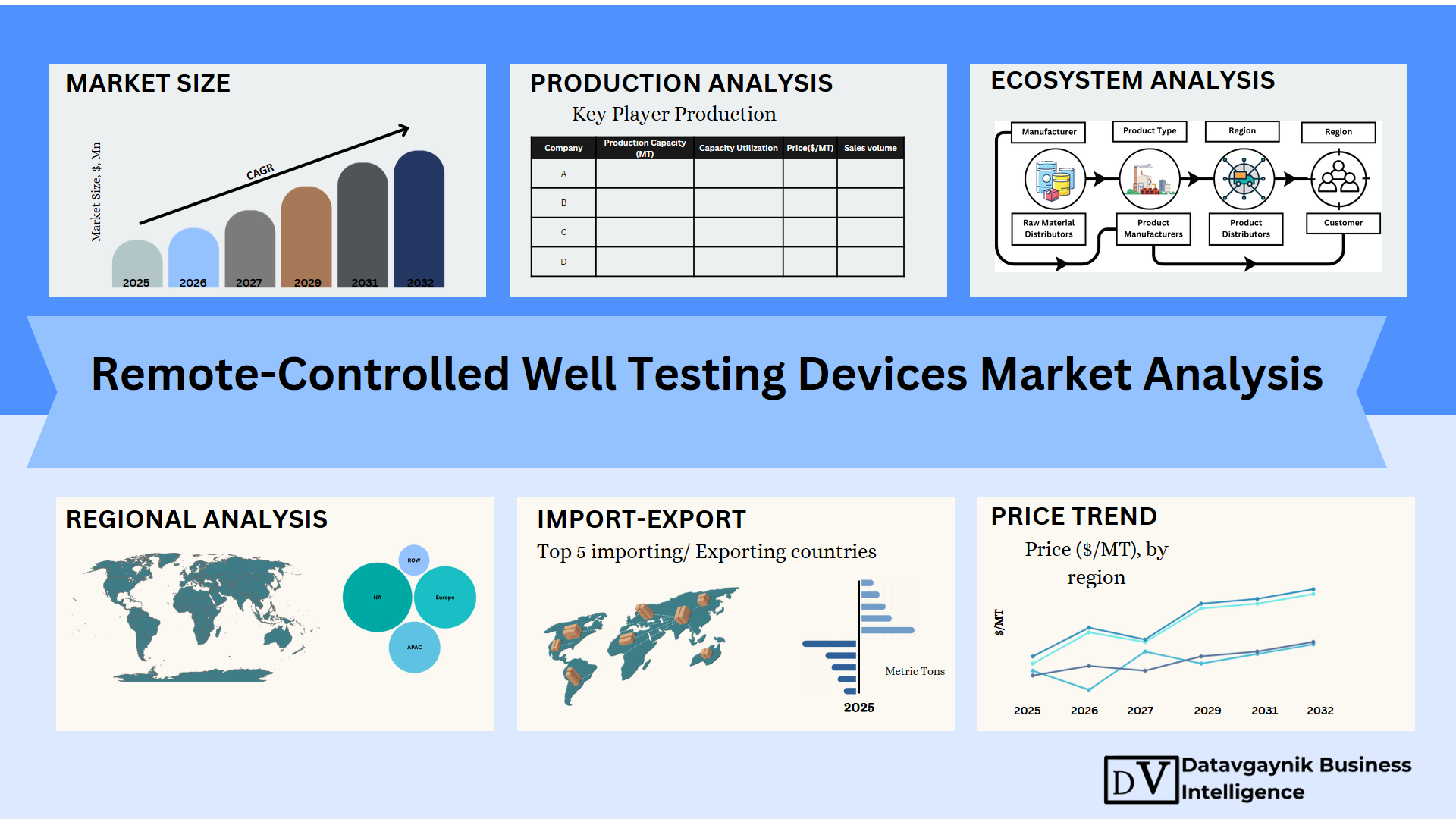
Remote-controlled well testing devices refer to automated or remotely operated systems used to measure, control, and monitor well flow during exploration, appraisal, clean-up, flowback, production testing, and reservoir surveillance. The scope includes remote-operated choke manifolds, automated well test separators, digital data acquisition systems, wireless downhole gauges, pressure-temperature sensors, flow measurement modules, emergency shutdown systems, edge-control units, and supervisory software. It excludes the broader well testing services market unless the device revenue or rental value can be separated.
Datavagyanik also covers related markets such as the Portable Well Testing Units Market and the Remote I/O System Market. Exploring these markets offers a broader view of the industry landscape and how adjacent sectors influence the main topic.
The business case is clear. Well testing is still a high-risk, data-sensitive activity. Operators need accurate reservoir information, but they also want fewer people near pressure equipment, sour gas exposure, and live flowlines. Remote-controlled devices solve that tension. They allow teams to monitor well performance from a safe zone, adjust choke settings without manual exposure, and capture cleaner real-time data. Halliburton’s FloConnect platform, for example, is positioned around automated surface well testing, remote monitoring, real-time data access, and emissions quantification. SLB also describes automated well testing as a move beyond conventional remote control into autonomous operation, using electrically actuated chokes, gate valves, separators, pressure sensors, temperature sensors, and centralized data acquisition.
For 2026–2035, demand will be shaped by five forces. First, offshore and high-pressure reservoirs will keep pushing safer testing methods. Second, unconventional wells will require faster repeatable flowback and production tests. Third, emissions reporting will place more weight on controlled flow measurement and reduced manual sampling. The U.S. EPA’s oil and gas methane framework has already increased attention on leak detection, super-emitter events, and emissions measurement pathways. Fourth, digital oilfield programs will turn well testing from a manual field operation into a connected data workflow. Fifth, CCS appraisal and injection testing will create a smaller but strategic new demand pocket. Expro secured a 2025 contract for integrated well testing services for a UK offshore CCS project, showing how testing capability is extending beyond conventional hydrocarbon wells.
The Remote-Controlled Well Testing Devices Market is not a mass-volume equipment market. It is a specialized upstream technology market. Unit pricing is high. Adoption is led by operators and service providers working in complex wells, offshore fields, high-H₂S reservoirs, unconventional pads, and remote basins. Growth comes less from every well buying a full automation package and more from selective deployment where safety, time, and data quality justify the premium.
| Market Metric | 2026 Estimate | 2035 Forecast | Analyst View |
| Global market size | US$540 million | US$1.10 billion | Device-level and rental-equivalent revenue only |
| CAGR | 8.2% | Supported by automation, HSE, emissions, and digital oilfield adoption | |
| Estimated annual active remote-enabled test deployments | 3,800–4,300 jobs | 7,200–8,000 jobs | Includes surface and downhole monitoring-led deployments |
| Average realized device/rental revenue per deployment | US$120,000–150,000 | US$135,000–165,000 | Premium retained for offshore, sour gas, and autonomous packages |
| Strategic demand base | NOCs, IOCs, independents, OFS firms, well testing contractors | Broader adoption across upstream and CCS operators | Adoption rises where test data has direct capital-allocation value |
Key consumers and clients include Saudi Aramco, ADNOC, QatarEnergy, Shell, BP, Chevron, ExxonMobil, TotalEnergies, Equinor, Petrobras, ONGC, CNOOC, shale-focused independents, offshore operators, well testing service companies, and CCS project developers. Service companies such as SLB, Halliburton, Expro, and specialist automation suppliers are both equipment providers and channel partners because many operators still prefer rental, bundled service, or managed testing models.
Expert view: The strongest buying trigger is not “digitalization” by itself. It is the combination of safety exposure, unstable flow behavior, and high-value reservoir decisions. When one test can affect a field development plan, operators are more willing to pay for remote control and cleaner data.
Market Segmentation and Forecast Scope
The Remote-Controlled Well Testing Devices Market should be segmented by product type, application, end user, and region. This keeps the scope tight and avoids mixing device demand with the full well testing services ecosystem.
By Product Type
Remote-operated surface well testing systems account for the largest value pool. This includes automated choke manifolds, automated separators, emergency shutdown skids, sensor-integrated control modules, and mobile well testing trailers. These systems carry higher hardware value and are used in higher-risk jobs. For 2026, this segment is estimated to represent 41% of global revenue.
Downhole wireless monitoring devices form the next strategic cluster. These include cableless pressure-temperature gauges, acoustic or wireless telemetry tools, and long-duration reservoir monitoring systems. Expro’s CaTS wireless monitoring system is one relevant example of continuous data acquisition and real-time transmission without surface cables or permanent control lines.
Digital data acquisition and SCADA modules sit across both surface and downhole testing. These systems collect, process, transmit, and visualize flow, pressure, temperature, and calculated test data. Expro’s EDGE-X platform, for instance, links surface well test data with secure online access and data-to-desk visibility.
Other product groups include remote multiphase metering packages, emissions and gas analysis modules, flowback monitoring kits, and retrofit automation packages for legacy well testing equipment.
| Product Segment | Scope Included | 2026 Share Disclosure | Growth Character |
| Remote-operated surface well testing systems | Chokes, separators, ESD, trailers, control modules | 41% | Largest revenue pool |
| Downhole wireless monitoring devices | Cableless gauges, telemetry modules, long-duration reservoir monitoring | Hidden | Fastest technical adoption in appraisal and surveillance |
| Digital data acquisition and SCADA packages | Edge control, dashboards, alarms, data-to-desk systems | Hidden | Strong retrofit demand |
| Remote multiphase metering and flow analytics modules | Gas, oil, water, condensate measurement tools | Hidden | Strategic in unconventional and offshore testing |
| Emissions and safety monitoring add-ons | Gas detection, emissions measurement, remote alarms | Hidden | Regulation-linked growth pocket |
By Application
Exploration and appraisal testing remains the core application because early reservoir data has high economic value. Operators use remote-controlled devices to capture pressure build-up, flow stability, productivity, fluid behavior, and reservoir connectivity.
Production testing and reservoir surveillance will gain share through 2035. Mature fields need better real-time visibility, especially when operators are trying to improve recovery without adding large field teams. Flowback and clean-up applications will also expand, mainly in shale and tight gas basins where repeatability and speed matter.
High-pressure and high-H₂S testing is one of the most strategic use cases. Here, remote operation is not a convenience. It is a safety requirement. Halliburton has highlighted use of automated testing in ultra-high-H₂S reservoirs, including remote monitoring and control from a command center or tablets.
CCS appraisal and injection testing is still small, but it is the fastest-growing niche. These projects need reliable injection and reservoir behavior data before final investment decisions.
By End User
National oil companies will remain the most important long-cycle demand base because they operate large fields, sour reservoirs, offshore assets, and national energy-security projects. International oil companies will buy or rent these systems for deepwater, frontier exploration, and decarbonized field development programs.
Oilfield service companies are equally important. They often own, package, and deploy the equipment on behalf of operators. Independent exploration and production companies represent a more selective demand base. They adopt remote systems when cycle time, manpower constraints, or unconventional pad economics make the payback visible.
CCS developers and geothermal operators will become relevant after 2028, but they will not dominate revenue. Their role is more strategic than volume-heavy.
By Region
North America is estimated to account for 32% of the 2026 market. The region benefits from shale testing, flowback activity, digital oilfield maturity, and strong service-company infrastructure. The U.S. rig count also rose year-over-year in late June 2026, while EIA-related reporting pointed to higher U.S. crude and gas output expectations. That supports near-term testing and monitoring demand, although activity remains price-sensitive.
Europe is smaller but technologically advanced. Demand is tied to North Sea redevelopment, late-life assets, CCS appraisal, offshore safety requirements, and digital operations.
Asia Pacific is strategic because of China, India, Australia, Malaysia, and Indonesia. Australia is seeing renewed gas exploration activity, with 2026 reports pointing to higher exploration spending and activity across basins such as Beetaloo, Otway, and Taroom.
LAMEA includes the Middle East, Africa, and Latin America. This region has the strongest upside from sour gas, unconventional gas, offshore Brazil, Guyana-Suriname activity, and NOC-led field development. Expro’s 2026 two-year unconventional well testing contract in the UAE is a useful signal for this regional demand pattern.
| Segmentation Dimension | Key Sub-Segments | Most Strategic Growth Area |
| By Product Type | Surface automation, wireless downhole gauges, SCADA, multiphase metering, emissions modules | Downhole wireless monitoring and automated surface packages |
| By Application | Appraisal, production testing, flowback, high-H₂S testing, CCS testing | CCS appraisal and high-H₂S remote testing |
| By End User | NOCs, IOCs, independents, OFS firms, CCS developers | NOCs and OFS-led deployment models |
| By Region | North America, Europe, Asia Pacific, LAMEA | LAMEA and Asia Pacific |
Expert view: The market will not grow evenly. Premium systems will cluster around complex wells. Basic remote monitoring will spread more widely through retrofits, tablets, cloud dashboards, and modular sensor packages.
Market Trends and Innovation Landscape
Innovation in the Remote-Controlled Well Testing Devices Market is moving in three layers: safer physical hardware, smarter field controls, and better use of live test data. The shift is practical. Operators want fewer manual adjustments at the wellsite. They also want test data that can move quickly from the field to subsurface, production, and commercial teams.
Automation Is Moving From Monitoring to Closed-Loop Control
The first wave of remote well testing focused on visibility. Field teams could view pressure, flow, temperature, and separator behavior from a safe distance. The next wave is control. Automated chokes, remotely actuated valves, separator controls, and emergency shutdown systems now allow operators to adjust the test process without entering the red zone.
SLB’s automated well testing system shows this direction clearly. Its automated well control module uses electrically actuated adjustable choke and gate valves, while its automated separator is designed to separate and measure well effluent without human intervention. The system can be managed remotely or autonomously to maintain safer and more efficient separation as well conditions change.
Halliburton’s FloConnect platform is also built around automated workflows, remote data access, process monitoring, command-center operation, and emissions quantification. This points to a wider industry shift: well testing equipment is no longer only mechanical hardware. It is becoming an integrated control-and-data platform.
Expert view: By 2035, the winning systems will not just record well test data. They will help stabilize the test, reduce avoidable shut-ins, and flag abnormal behavior before field crews would normally catch it.
Wireless Downhole Monitoring Is Becoming More Valuable
Wireless downhole monitoring is gaining traction because it extends the life of reservoir data collection. In appraisal campaigns, operators may want pressure and interference data long after a rig leaves the location. Cableless systems can support this need without permanent control lines.
Expro describes its CaTS wireless monitoring solution as a cableless system for high-quality real-time reservoir data. The company has also cited use cases where wireless gauges were used to monitor reservoir behavior for extended periods and support field-development decisions.
This trend matters because the economics of appraisal are changing. Operators are trying to reduce redundant wells, shorten appraisal timelines, and make better development choices with fewer interventions. Remote-controlled and wireless testing devices help by turning one well into a longer-duration data asset.
AI Will Be Relevant, But It Will Be Applied Selectively
AI integration is relevant here, but it should not be overstated. The near-term role is not fully autonomous decision-making across all well tests. It is more likely to appear in anomaly detection, automated data quality checks, flow-regime recognition, choke optimization support, and predictive maintenance for sensors and valves.
The wider oilfield services sector is moving in that direction. SLB launched an AI tool in 2025 to automate oilfield service workflows and support tasks such as interpreting well logs, predicting drilling issues, and optimizing equipment performance. SLB also outlined in 2026 a plan to nearly double annual digital revenue by 2030, showing how digital and AI-led workflows are becoming core to oilfield technology strategy.
For remote well testing, this means AI will likely sit on top of field data streams rather than inside every device. The first commercial use cases will be practical: “Is this sensor drifting?”, “Is the separator behaving normally?”, “Is the choke response stable?”, “Does this pressure build-up curve need immediate review?”
Emissions, Sour Gas, and HSE Are Driving Design Choices
Remote-controlled systems are increasingly designed around lower personnel exposure and cleaner measurement. This is especially true in high-H₂S reservoirs and in markets where methane or flaring rules are tightening. In the U.S., EPA rules and related reporting updates have increased attention on methane detection, emissions reporting accuracy, and advanced monitoring methods.
The link to well testing is direct. Manual sampling, unstable flow, venting, and field crew exposure can create operational and reputational risk. Remote control can reduce the need for personnel near live pressure systems. Automated measurement can also improve data consistency.
Use case/example: In a sour gas appraisal well, the operator can keep testing personnel away from the red zone while controlling choke changes from a command center. The value is not only safety. It also reduces interruptions in the test sequence and improves the quality of pressure-flow data.
Partnerships and M&A Are Expanding the Digital Well Stack
Recent activity shows that large oilfield service companies are building broader digital well ecosystems. Halliburton acquired Sekal AS in April 2026 to accelerate drilling automation services. While this is not a pure well testing transaction, it reflects the same direction: automation, remote execution, and software-led field operations.
SLB entered an agreement in April 2026 to acquire the geoscience and petroleum engineering software portfolio of S&P Global Energy, while S&P Global also announced a partnership with SLB to distribute energy data and develop new tools. This matters because well test data becomes more valuable when it connects directly with subsurface and reservoir decision software.
Expro announced in May 2026 an agreement to acquire Enhanced Drilling, expanding its managed pressure drilling and lifecycle well capabilities. Again, the strategic pattern is clear. Service companies are trying to control more of the high-value well workflow, from drilling and pressure management to testing, monitoring, and data interpretation.
Innovation Outlook
By 2035, the Remote-Controlled Well Testing Devices Market will likely split into two product tiers. The first tier will be premium autonomous or semi-autonomous testing packages for offshore, sour gas, high-pressure, and CCS applications. The second tier will be retrofit-friendly remote monitoring and control kits for conventional production testing and onshore flowback.
The most attractive suppliers will be those that combine rugged field hardware with secure data architecture, service support, and reservoir-domain interpretation. Hardware alone will be easier to copy. Integrated control, safety logic, and trusted test data will carry the margin.
Expert view: The market’s long-term value will sit at the intersection of equipment, software, and field credibility. Operators won’t buy automation because it sounds advanced. They’ll buy it when it makes a risky test safer, faster, and easier to defend in a reservoir review.
Competitive Intelligence and Benchmarking
The Remote-Controlled Well Testing Devices Market is led by large oilfield service groups, well-flow specialists, and automation suppliers. The competitive base is not highly fragmented at the premium end. Operators prefer vendors that can combine equipment, field crews, pressure-control experience, software, and safety certification. That naturally favors companies with offshore exposure, sour-gas track records, and global service bases.
At the same time, the market is not a pure equipment sale business. A large share of value moves through rental fleets, integrated well testing contracts, and bundled surface testing services. This is why the strongest players are not just device manufacturers. They are service-led technology owners.
| Company | Portfolio Position | Market Position | Benchmark View |
| SLB | Automated surface well testing, reservoir testing, digital control, connected data workflows, remote/autonomous well test packages | Global premium leader | Strongest in integrated automation and reservoir-domain interpretation |
| Halliburton | Surface well testing automation, remote command-center workflows, automated choke control, emissions-linked testing data | Top-tier global player | Strong in North America, Middle East, and high-HSE testing environments |
| Expro | Surface well testing, flowback, wireless monitoring, real-time data platforms, long-duration reservoir surveillance | Specialist well-flow leader | Strong in offshore, Middle East, CCS-related testing, and complex well campaigns |
| Weatherford | Surface well testing services, multiphase flow measurement, electronic data acquisition, real-time data transmission | Broad OFS challenger | Strong where well testing is bundled with production and intervention services |
| Baker Hughes | Downhole monitoring, pressure-temperature gauges, flowmeters, permanent well monitoring, analytics | Strong technology supplier | More relevant in monitoring-heavy and production-surveillance use cases |
| Emerson | Remote automation, SCADA, flow computers, well test management software, valve and control systems | Automation enabler | Important in retrofit, facility-level, and multi-well allocation testing |
| TETRA Technologies | Production testing, flowback equipment, surface testing packages, unconventional well support | Regional and shale-focused player | Stronger in North American flowback and production testing than offshore automation |
SLB sits at the upper end of the competitive curve. Its automated well testing system goes beyond standard remote monitoring and supports autonomous operation through controlled chokes, valves, separators, sensors, and centralized data acquisition. That gives SLB a strong position in complex reservoirs where operators want repeatable test control and high-quality interpretation-ready data.
Halliburton is one of the most visible automation-led players. Its surface automation platform controls, measures, and analyzes surface well testing through automated workflows. It also supports real-time data access, process monitoring, remote command-center control, and emissions quantification. That makes Halliburton highly relevant for high-pressure, sour-gas, and safety-critical environments.
Expro is more focused than the diversified oilfield giants. Its position is built around well flow management, surface well testing, wireless monitoring, and digital data-to-desk services. The company’s wireless monitoring capability is useful for long-duration reservoir surveillance. Its surface testing platforms are also tied to real-time data visibility. This makes Expro a strong specialist in the Remote-Controlled Well Testing Devices Market, especially where the client needs both equipment and operational execution.
Weatherford competes through surface testing, flow measurement, and production decision support. It has a broad testing and production services base and highlights the use of surface well testing packages, multiphase flowmeters, electronic data acquisition systems, and real-time transmission to approved off-site parties. This is a practical fit for operators that want reliable test data without building their own internal remote-testing infrastructure.
Baker Hughes is more exposed to downhole monitoring and analytics than surface well testing automation. Its portfolio includes electronic well monitoring, downhole pressure-temperature measurement, flowmeters, and continuous real-time data solutions. This gives it a strong role in surveillance-heavy applications, especially where remote testing overlaps with permanent monitoring and production optimization.
Emerson is not a classic well testing contractor. It is a control and automation supplier. That said, its remote automation and well test management systems are relevant where operators automate allocation testing, separator-based testing, and multi-well measurement. Its compact remote well testing concept also points to cost and footprint reduction, which matters for mature fields and offshore facilities.
TETRA Technologies is positioned around production testing and flowback. It is more regionally concentrated than SLB, Halliburton, or Expro, but it remains relevant in unconventional basins where high well counts require fast test setup, safe flowback handling, and repeatable production testing equipment.
Expert view: The market is moving toward “service-plus-automation.” A supplier that only sells hardware will struggle to protect margins. A supplier that owns the workflow, the data layer, and the field response model will command a better price.
Regional Landscape and Adoption Outlook
The Remote-Controlled Well Testing Devices Market has a clear regional pattern. North America drives volume. The Middle East drives premium sour-gas and unconventional demand. Europe drives offshore safety and CCS-linked testing. Asia Pacific is mixed, with China and India offering scale while Japan and South Korea remain selective, project-led markets.
United States
The United States is the largest adoption market in 2026. Demand is tied to unconventional oil and gas, flowback testing, multi-well pads, production optimization, and digital field operations. The Permian remains the most important basin for remote-enabled test workflows because operators need fast cycle times and repeatable well performance data.
The near-term activity base is supportive. U.S. energy firms added the highest number of oil and gas rigs in a single week since June 2022 during the week ending June 26, 2026, with the total rig count reaching 573. Reuters also reported that U.S. crude output hit a record 13.93 million barrels per day in April 2026, based on EIA data. That combination supports demand for surface testing, production surveillance, and flowback measurement.
Adoption is strongest among shale operators, large independents, and service companies. Regulation also matters. Methane and safety reporting expectations are pushing operators toward better measurement, lower manual exposure, and more auditable field data.
Europe
Europe is smaller in volume, but it has high technical intensity. The UK and Norway are the main demand centers. The UK North Sea is under policy pressure, but mature-field management, well intervention, decommissioning planning, and CCS appraisal still create need for safe testing and monitoring. The North Sea Transition Authority opened a 2025 carbon storage licensing round across Scottish and English waters for exploration and appraisal, with bids under review after the March 2026 close. That supports a future testing base linked to CO₂ storage characterization.
Norway remains more active than the UK, but its drilling outlook is becoming more selective. Reuters reported that oil companies on the Norwegian continental shelf planned 18% fewer exploration wells in 2026, while production drilling and existing field extraction remain important. This favors high-value testing on fewer but more capital-intensive wells.
The European adoption model is therefore quality-led, not volume-led. Buyers pay for safety, offshore reliability, emissions accountability, and integration with reservoir models.
China
China is one of the most strategic growth regions. The country is pushing domestic oil and gas output through offshore development, tight oil, shale gas, and deep formations. China Daily reported that China’s oil and gas output reached a record in 2025, with shale gas production exceeding 27 billion cubic meters and shale oil output reaching 7.7 million tons.
The demand base is led by national oil companies and large state-linked service providers. International vendors may participate through selected technology partnerships, but local procurement, domestic manufacturing, and data sovereignty will shape market access. Remote-controlled well testing devices will find the best opportunities in high-pressure gas, offshore Bohai and South China Sea assets, shale gas, and deeper unconventional programs.
India
India is an emerging but underpenetrated market. Domestic upstream activity is supported by policy efforts to increase exploration acreage and reduce import dependence. The Directorate General of Hydrocarbons shows OALP Bid Round XI offering 21 blocks covering about 80,234.49 sq. km for hydrocarbon exploration.
Adoption will be led by ONGC, Oil India, private upstream operators, and service companies working on offshore, marginal field, CBM, and deepwater programs. India is cost-sensitive, so rental-led deployment will remain more practical than direct equipment ownership. The strongest use cases will be offshore testing, high-cost appraisal wells, and remote monitoring where manpower or safety risk is a constraint.
Japan
Japan is a niche market for conventional oil and gas testing, but it has strategic relevance in methane hydrate, CCS, and offshore subsurface research. JOGMEC remains closely involved in methane hydrate R&D and offshore production-test planning. This creates limited but technically advanced opportunities for specialized testing, pressure-temperature monitoring, and remote data acquisition.
For the Remote-Controlled Well Testing Devices Market, Japan should be treated as a high-spec pilot and technology validation market rather than a large-volume commercial market. Funding quality is strong. Well count is low.
South Korea
South Korea is also selective. It does not have the upstream scale of China or India, but offshore exploration and energy security programs create periodic demand. KNOC continues to manage upstream and E&P activities, including offshore assets and gas-linked projects.
The adoption case is tied to offshore appraisal, subsea tiebacks, and imported technology partnerships. If new offshore gas prospects advance, remote monitoring and safe test execution will become more relevant. Still, South Korea should be modeled as a project-driven market, not a broad installed-base market.
Middle East
The Middle East is one of the most attractive regions for premium remote-controlled well testing. The region combines high-pressure gas, sour reservoirs, mega-field development, unconventional gas, and NOC-led investment discipline. The UAE, Saudi Arabia, Qatar, Oman, and Kuwait are the key demand centers.
Expro secured a two-year contract in the UAE in June 2026 to provide surface well testing services, equipment, and operational support for unconventional wells. That is directly relevant to market adoption because it shows active demand for advanced testing in Middle East unconventional resources.
The region’s funding environment is stronger than most markets. NOCs are more willing to pay for safety, uptime, and integrated service reliability. Regulation is also becoming more aligned with emissions monitoring and operational risk reduction, especially around sour gas and high-spec gas development.
| Region/Country | Adoption Level | Growth Outlook to 2035 | Main Adoption Trigger |
| United States | High | Moderate to high | Shale flowback, production testing, digital field operations |
| Europe | Medium | Selective | Offshore safety, CCS appraisal, mature-field optimization |
| China | Medium-high | High | Domestic production push, shale gas, offshore testing |
| India | Low-medium | High from small base | Exploration acreage, offshore appraisal, import-reduction policy |
| Japan | Low | Selective | Methane hydrate, CCS, technical pilots |
| South Korea | Low | Selective | Offshore gas appraisal and E&P partnerships |
| Middle East | High | High | Sour gas, unconventional gas, NOC-led field development |
Expert view: The best regional growth story is not simply “more wells.” It is “more complex wells.” That is why the Middle East, China, and offshore Europe remain strategically important even when total drilling activity is uneven.
Recent Developments + Opportunities & Restraints
Recent Developments
| Month & Year | Event | Impact on the Remote-Controlled Well Testing Devices Market |
| June 2026 | Expro secured a two-year UAE contract for unconventional well testing and flowback services. | Supports demand for advanced surface testing equipment, operational support, and remote-enabled flowback in Middle East unconventional resources. |
| May 2026 | Expro announced an agreement to acquire Enhanced Drilling, adding managed pressure drilling capabilities and expanding lifecycle well technology coverage. | Strengthens Expro’s ability to bundle pressure control, well flow, and testing workflows. |
| April 2026 | Halliburton acquired Sekal AS, a digital drilling autonomy specialist. | Signals continued investment in automated well execution. The same control logic can influence remote testing and pressure-management workflows. |
| March 2026 | SLB expanded its partnership with Nvidia to build AI infrastructure and models for the energy sector. | Supports faster processing of field, reservoir, and operational data. This strengthens the long-term case for AI-assisted well testing analytics. |
| December 2025–March 2026 | The UK NSTA opened and closed a carbon storage licensing round covering offshore locations for exploration and appraisal. | Creates future demand for injection testing, pressure monitoring, and remote reservoir characterization tools for CCS projects. |
Opportunities and Business Insights
Opportunity 1: Middle East sour gas and unconventional development
The Middle East offers the clearest premium opportunity. Remote-controlled testing fits high-H₂S reservoirs, large gas programs, and unconventional flowback. Buyers value safety and uptime more than low upfront cost. This supports higher margins for integrated service packages.
Opportunity 2: Retrofit automation for mature fields
Not every operator will buy a full autonomous testing package. Many will retrofit legacy separators, choke manifolds, sensors, and data systems. This opens space for modular automation suppliers and service companies that can upgrade existing fleets without forcing full capex replacement.
Opportunity 3: CCS and subsurface storage testing
CCS projects need injection behavior, pressure response, plume monitoring, and reservoir containment data. That creates a small but high-value extension of the Remote-Controlled Well Testing Devices Market. The opportunity is strongest in the UK, Norway, Japan, Australia, and parts of the U.S. Gulf Coast.
Key Restraints
Restraint 1: Cyclical upstream spending
Well testing demand remains linked to drilling and appraisal budgets. If oil and gas prices weaken, operators delay exploration and reduce test campaigns first. This can affect equipment utilization and rental pricing.
Restraint 2: High cost of premium automation
Automated surface testing packages, wireless downhole systems, and secure data platforms are expensive. Smaller operators may continue with conventional testing unless the safety risk or data value is obvious.
Restraint 3: Data security and field integration
Remote operation needs reliable connectivity, cybersecurity, safe failover logic, and compatibility with existing field systems. Operators will not accept automation that creates new operational risk.
Expert view: The market’s practical opportunity sits in modularity. Suppliers that can offer “remote-ready” upgrades to existing test spreads will reach more customers than those selling only premium autonomous packages.


