

Rising Demand Shaping the Future of the Sand-Salt Mixtures Market
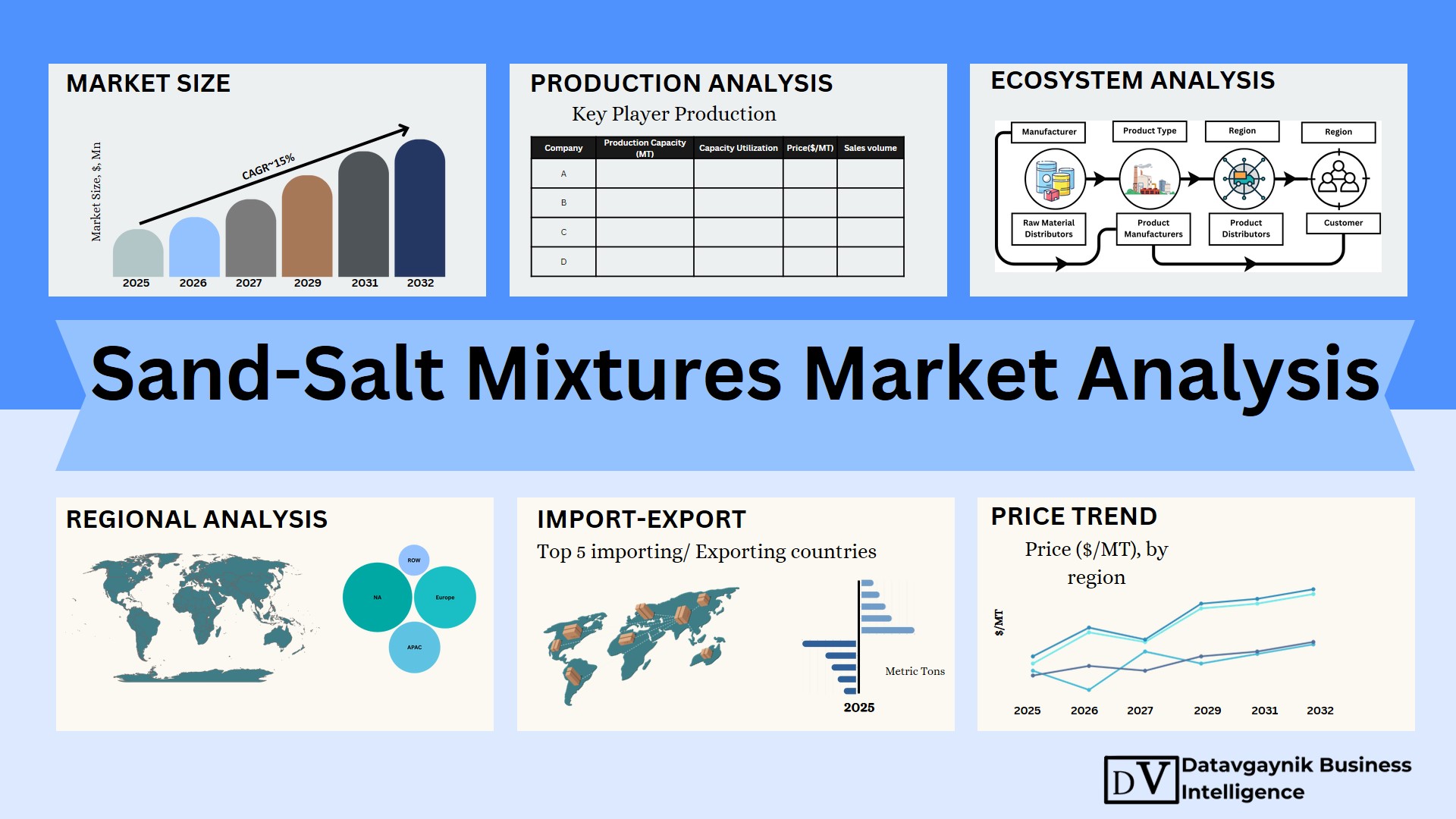
The sand-salt mixtures market is witnessing a sharp uptrend driven by a compelling mix of environmental concerns, cost pressures, and a rising need for effective winter road safety solutions. Datavagyanik analysis highlights a growing shift among municipalities and contractors toward alternatives that balance traction performance with sustainability goals. This momentum is particularly visible in North America and Europe, where harsh winters and stringent environmental regulations coexist. As of 2024, over 70 percent of municipalities in the northern United States have transitioned from pure salt applications to sand-salt mixtures for routine winter road maintenance.
Cost Optimization Catalyzing Market Expansion
One of the most influential factors accelerating the growth of the sand-salt mixtures market is its unmatched cost-effectiveness. The mixture allows local governments to significantly reduce the volume of expensive deicing salts without compromising safety. For example, a typical standard blend uses 70 percent sand and 30 percent salt, effectively stretching salt supplies while maintaining road usability. According to Datavagyanik, municipalities using these mixtures report an average of 25 to 40 percent savings on deicing materials annually. These savings are particularly important for areas with expansive road networks such as Canada, Germany, and several northern U.S. states.
Datavagyanik also covers related markets such as the Frac Sand (Hydraulic Fracturing Sand) Market. Tracking these sectors reveals parallel dynamics and helps anticipate shifts likely to affect the primary market.
Environmental Compliance Driving Demand in Developed Economies
In many developed countries, the environmental footprint of traditional deicing agents is no longer acceptable under current regulatory norms. Salt runoff is a major source of freshwater contamination, leading to elevated chloride levels in lakes, rivers, and urban groundwater systems. Sand-salt mixtures, by reducing salt content, are considered a more environmentally conscious solution. For instance, in Sweden and Norway, government regulations now mandate reduced salt usage in public deicing operations, indirectly boosting the demand for mixed formulations. Datavagyanik notes that this shift has contributed to a double-digit growth rate in the sand-salt mixtures market size across key European nations from 2021 to 2024.
Growing Application in Urban and Residential Settings
The sand-salt mixtures market is no longer confined to highway deicing. There is growing traction in suburban, residential, and even commercial zones, where immediate traction is as critical as melting ice. The granular sand in the mix provides instant friction, preventing slips and vehicle skids even before the salt starts acting. This makes it highly suitable for sidewalks, parking areas, and secondary roads. Datavagyanik forecasts that by 2027, non-highway applications will account for over 30 percent of the total sand-salt mixtures market size, compared to just 18 percent in 2020. This growth is fueled by city planners who prioritize public safety, especially in high-footfall zones.
Performance Stability at Low Temperatures Enhancing Market Value
One of the notable advantages of sand-salt mixtures is their functionality in extremely cold environments where salt alone becomes less effective. Salt begins to lose its melting power below -7°C, but sand continues to offer traction regardless of the temperature. In colder regions such as Hokkaido in Japan or Alberta in Canada, road maintenance departments are increasingly relying on sand-salt combinations during extended cold spells. According to Datavagyanik, this temperature resilience has significantly contributed to the growing preference for mixed solutions in extreme weather zones, where pure salt fails to ensure safety.
Reduced Infrastructure Corrosion as a Strategic Advantage
Corrosion caused by chloride-based salts has long been a concern for municipal infrastructure and personal vehicles alike. High salt usage contributes to faster deterioration of bridges, guardrails, and road surfaces. By integrating sand into the deicing mix, municipalities can reduce the amount of salt used and thereby minimize long-term damage. In fact, a comparative study by a U.S. Department of Transportation agency found that bridges in areas using sand-salt mixtures had 30 percent lower corrosion levels after five winter seasons. This cost-saving implication further adds to the economic rationale behind the growing sand-salt mixtures market.
Climate Volatility Fueling Long-Term Growth
The impact of climate change is increasingly evident in unpredictable and intensified winter storms across the Northern Hemisphere. Snowfall patterns that once followed predictable cycles are now extended, with frequent freeze-thaw cycles increasing road hazards. The need for flexible, quick-response deicing solutions has never been greater. Sand-salt mixtures offer a dual-action response—immediate traction through sand and delayed melting through salt—which makes them ideal in rapidly changing conditions. Datavagyanik points out that countries experiencing increased winter volatility, including Poland, South Korea, and the northeastern United States, are ramping up storage and distribution capacity for sand-salt mixtures to meet this new normal.
Supply Chain Advantages Supporting Market Growth
The raw materials required for sand-salt mixtures—natural sand and sodium chloride—are abundant and widely distributed. This geographic availability gives the sand-salt mixtures market a considerable supply chain advantage over more complex chemical deicers, which often require imports or specialized production facilities. Local sourcing of raw materials also helps lower the carbon footprint associated with transportation. For example, Germany sources over 80 percent of its deicing salt domestically, while sand is sourced from construction-grade quarries. Datavagyanik projects that this decentralized production model will continue to support market stability even during peak winter demand periods.
Emerging Markets in Asia-Pacific Catching Up Rapidly
While North America and Europe remain the dominant consumers, the sand-salt mixtures market in Asia-Pacific is gaining momentum. Northern China, parts of South Korea, and Japanese cities like Sapporo are experiencing longer, more intense winters, increasing the demand for deicing solutions. Local governments have begun to invest in large-scale salt storage facilities and sand procurement contracts to ensure continuous availability. According to Datavagyanik, the Asia-Pacific region is expected to see a compound annual growth rate of over 9 percent in sand-salt mixtures adoption between 2024 and 2029, with China leading regional demand expansion.
Government Initiatives and Policy Interventions Strengthening Market Position
Policy-level support continues to play a major role in advancing the sand-salt mixtures market. In countries like the United States, federal transportation grants include allocations for eco-friendly road maintenance materials, which include sand-salt blends. Similarly, France and Switzerland have rolled out incentive programs encouraging municipalities to adopt lower-salt deicing strategies. These initiatives not only promote sustainability but also open avenues for private contractors and suppliers to scale their operations. Datavagyanik notes that in the past three years alone, more than 120 regional public tenders in Europe explicitly required sand-salt compositions for winter road contracts.
Technological Innovation Enhancing Product Value
Technological innovation is also shaping the sand-salt mixtures market. Advanced blending technologies allow for more uniform distribution of salt within sand, increasing efficacy while minimizing environmental runoff. Some producers have started integrating corrosion inhibitors or organic binders into their mixtures, creating enhanced-performance variants suitable for sensitive ecological areas. For instance, in Austria, several road maintenance departments are now using treated sand-salt mixtures that include anti-caking agents and microbial additives for better environmental compatibility. These innovations are rapidly gaining traction and pushing the industry beyond traditional usage scenarios.
Conclusion: A Market Defined by Purpose, Performance, and Potential
The sand-salt mixtures market is transitioning from a basic utility commodity to a strategic environmental and economic solution. Supported by data-backed performance advantages, expanding application areas, and robust governmental backing, the market is poised for sustained long-term growth. From cost-savings in Minneapolis to eco-friendly practices in Stockholm, the case for sand-salt mixtures continues to strengthen. With climate change intensifying winter unpredictability and infrastructure safety gaining priority, these mixtures are set to become the default choice for winter road maintenance in the years ahead.
“Track Country-wise Sand-Salt Mixtures Production and Demand through our Sand-Salt Mixtures Production Database”
-
-
- Sand-Salt Mixtures production database for 30+ countries worldwide
- Sand-Salt Mixtures sales volume for 32+ countries
- Country-wise Sand-Salt Mixtures production capacity, production plant mapping, production capacity utilization for 30+ manufacturers
- Sand-Salt Mixtures production plants and production plant capacity analysis by top manufacturers
-
“Track real-time Sand-Salt Mixtures Prices, Sand-Salt Mixtures price charts for 30+ countries, Sand-Salt Mixtures weekly price tracker and Sand-Salt Mixtures monthly price tracker”
-
-
- Track real-time Sand-Salt Mixtures prices and Sand-Salt Mixtures price trend in 30+ countries though our excel-based Sand-Salt Mixtures price charts
- Real-time Sand-Salt Mixtures price tracker dashboard with 30+ countries
- Complete transparency on Sand-Salt Mixtures price trend through our Sand-Salt Mixtures monthly price tracker, Sand-Salt Mixtures weekly price tracker
-
Geographical Expansion Fueling Global Growth in the Sand-Salt Mixtures Market
The sand-salt mixtures market is experiencing rapid regional diversification, with growing demand not only in historically cold regions but also in areas facing unexpected winter volatility. Datavagyanik highlights that while North America and Europe remain the traditional strongholds, Asia-Pacific is emerging as a significant growth engine, and South America is demonstrating early signs of market potential.
North America: Mature but Expanding Sand-Salt Mixtures Market
North America continues to dominate the global sand-salt mixtures market, supported by its extensive winter road networks and institutionalized snow management protocols. In the United States alone, over 1.2 million miles of roads are subject to snow and ice conditions annually. States such as Minnesota, New York, and Illinois consume millions of tons of deicing materials each year, of which more than 60 percent are sand-salt blends.
Canada mirrors this trend. With regions like Ontario, Alberta, and Quebec experiencing over 100 snow days per year, the demand for traction-enhancing deicing solutions is exceptionally high. Datavagyanik estimates that in 2023, the North American sand-salt mixtures market accounted for over 42 percent of global revenue. This dominance is reinforced by robust local salt production, vast sand availability, and strong logistics infrastructure.
Europe: Regulatory Push Accelerating Market Momentum
In Europe, regulatory alignment around environmental protection is steering aggressive growth in the sand-salt mixtures market. Germany, Sweden, Norway, and the United Kingdom are leading adopters, where municipalities are incentivized to reduce chloride pollution. For example, in Germany, more than 75 percent of local governments have adopted sand-salt mixtures as their default deicing solution since 2020, following the enactment of stricter water preservation acts.
Scandinavian countries, often pioneers in sustainable infrastructure, are also scaling up usage. Norway’s road authority reported a 40 percent reduction in salt usage per kilometer between 2019 and 2023 due to increased reliance on sand-salt formulations. Datavagyanik projects that Europe’s share in the global sand-salt mixtures market will grow to 35 percent by 2026, supported by continuous innovation in corrosion-reducing and biodegradable additive technologies.
Asia-Pacific: Climate Variability Creating New Opportunities
The Asia-Pacific sand-salt mixtures market is transitioning from niche to necessity. As climate change introduces longer and more unpredictable winter conditions in parts of China, Japan, and South Korea, local governments are adopting new standards in road safety and winter resilience.
In Japan, the Hokkaido and Tohoku regions now allocate more than 60 percent of their winter maintenance budgets to sand-salt mixtures, prioritizing pedestrian safety on urban sidewalks and public roads. Similarly, in northern China, Datavagyanik reports that demand for blended deicers surged by 28 percent between 2021 and 2024, fueled by record snowfalls and stricter emissions regulations discouraging the use of chemical-heavy deicers.
South Korea’s Ministry of Land, Infrastructure, and Transport has set ambitious targets to reduce sodium chloride usage by 50 percent in the next five years, largely by promoting the use of high-efficiency sand-salt compositions. These developments signal long-term growth potential in the Asia-Pacific sand-salt mixtures market.
Latin America and Emerging Regions: An Underserved Market with Strategic Promise
Though traditionally considered outside the core winter deicing zones, regions in southern Chile, Argentina, and parts of the Middle East are beginning to adopt sand-salt mixtures, particularly for high-altitude roads and airport runways. For instance, Santiago’s road safety authority adopted sand-salt mixtures for its Andean roadways in 2023, citing the need for dual traction and deicing action in sub-zero temperatures. Datavagyanik sees this as an early but promising signal for market diversification in emerging economies.
Global Production Dynamics in the Sand-Salt Mixtures Market
Production hubs for sand-salt mixtures are strategically distributed near raw material sources. In the United States, production is concentrated around the Great Lakes, where salt mines in Michigan and Ohio meet over 70 percent of regional demand. These locations also benefit from proximity to abundant sand reserves sourced from construction and quarry operations.
In Europe, Germany and Poland host leading sand-salt production facilities due to their access to high-quality industrial salt and silica sand. Germany, in particular, has seen a 22 percent increase in annual production capacity between 2020 and 2023, as manufacturers upgraded blending facilities to meet rising demand. Datavagyanik points out that automated mixing and smart batching systems are helping producers create custom sand-salt formulations tailored to specific weather patterns and road types.
Asia-Pacific production is expanding quickly. China has scaled up production by 31 percent since 2020, particularly in the provinces of Heilongjiang and Inner Mongolia. These facilities benefit from China’s vast domestic salt production, which exceeds 60 million tons annually, and its growing infrastructure for sand sourcing and regional logistics.
Segmentation Deep Dive: Types and Applications in the Sand-Salt Mixtures Market
The sand-salt mixtures market is segmented based on mixture type, application area, and end-user industry. Each segment is evolving rapidly, reflecting shifts in operational priorities, technology, and regulatory focus.
Standard sand-salt mixtures remain dominant, particularly in municipalities seeking affordable bulk solutions. Typically composed of a 70:30 sand-to-salt ratio, these mixtures are prevalent across urban and rural roadways. However, enhanced sand-salt mixtures are gaining traction. These include anti-caking agents, corrosion inhibitors, and sometimes biodegradable binders. Datavagyanik notes a 17 percent year-on-year increase in demand for enhanced mixtures, especially in urban centers and environmentally sensitive zones.
Premium mixtures, which incorporate specialized salts such as calcium or magnesium chloride, represent a smaller but fast-growing segment. These are particularly useful in extreme low-temperature regions like northern Canada or Siberia, where sodium chloride loses efficacy.
In terms of application, road deicing constitutes the bulk of demand, accounting for over 65 percent of the global sand-salt mixtures market in 2023. However, non-traditional use cases such as railway track safety, airport runway maintenance, and public park paths are on the rise. For instance, airports in Canada and Japan have adopted treated sand-salt mixtures with anti-corrosive additives to minimize damage to critical infrastructure. Datavagyanik expects these niche applications to account for more than 20 percent of total market value by 2027.
Understanding the Sand-Salt Mixtures Price and Cost Drivers
The sand-salt mixtures price is influenced by several variables including salt quality, sand grade, transportation costs, regional availability, and added treatments such as corrosion resistance. In 2024, average global sand-salt mixtures prices ranged between USD 40 and USD 75 per ton, depending on composition and distance from production hubs.
In North America, due to proximity to salt mines and high road density, the average sand-salt mixtures price remained in the range of USD 45 to USD 55 per ton. Conversely, in landlocked regions of Asia-Pacific where salt must be transported over longer distances, prices ranged from USD 60 to USD 75 per ton. Datavagyanik identifies logistics as the single largest cost driver, often accounting for 25 to 35 percent of total sand-salt mixtures price in emerging markets.
Furthermore, the sand-salt mixtures price trend is expected to exhibit moderate inflationary pressure due to rising transportation fuel costs and environmental levies on salt mining operations. For instance, Germany’s environmental tax introduced in 2023 on chloride-rich deicers led to a 12 percent spike in average sand-salt mixtures prices within the first year. Producers are increasingly absorbing these costs by offering customizable blends that optimize cost-to-performance ratios.
Regional Variations in Sand-Salt Mixtures Price Trend
The sand-salt mixtures price trend differs significantly by geography. In the United States, price volatility is mitigated by long-term procurement contracts signed by state transportation agencies. Many states purchase sand-salt mixtures in bulk ahead of winter, stabilizing prices through the season.
In contrast, European prices are more volatile, driven by regulatory shifts and weather unpredictability. For example, during the winter of 2022–2023, prolonged snowstorms across Eastern Europe caused a temporary 18 percent spike in sand-salt mixtures prices due to sudden demand surges and limited inventory.
Asia-Pacific markets are expected to experience a gradual upward sand-salt mixtures price trend due to rising production costs, particularly in China and South Korea. Datavagyanik predicts a compounded annual increase of 4 to 6 percent in regional pricing through 2028, with higher spikes in years of severe snowfall.
Future Outlook on Global Pricing Strategies
Global producers are increasingly focusing on dynamic pricing models that adjust the sand-salt mixtures price based on regional weather forecasts, fuel prices, and demand surges. In addition, the integration of sustainable additives is influencing price trends, with premium eco-friendly formulations priced 20 to 30 percent higher than standard mixes. However, municipalities and private contractors continue to invest in these solutions due to their long-term environmental and infrastructural benefits.
Datavagyanik anticipates that as predictive analytics and smart logistics become mainstream in the industry, the sand-salt mixtures price trend will stabilize. This will allow buyers to budget more accurately while suppliers optimize inventory and production planning.
“Sand-Salt Mixtures Manufacturing Database, Sand-Salt Mixtures Manufacturing Capacity”
-
-
- Sand-Salt Mixtures top manufacturers market share for 30+ manufacturers
- Top 8 manufacturers and top 18 manufacturers of Sand-Salt Mixtures in North America, Europe, Asia Pacific
- Sand-Salt Mixtures production plant capacity by manufacturers and Sand-Salt Mixtures production data for 30+ market players
- Sand-Salt Mixtures production dashboard, Sand-Salt Mixtures production data in excel format
-
“Sand-Salt Mixtures price charts, Sand-Salt Mixtures weekly price tracker and Sand-Salt Mixtures monthly price tracker”
-
-
- Factors impacting real-time Sand-Salt Mixtures prices in 24+ countries worldwide
- Sand-Salt Mixtures monthly price tracker, Sand-Salt Mixtures weekly price tracker
- Real-time Sand-Salt Mixtures price trend, Sand-Salt Mixtures price charts, news and updates
- Tracking Sand-Salt Mixtures price fluctuations
-
Top Manufacturers Dominating the Sand-Salt Mixtures Market
The sand-salt mixtures market is currently shaped by a mix of global players and regional specialists that have established strong operational footprints in weather-affected territories. Manufacturers in this space focus not only on bulk volume production but also on formulating specialty blends that cater to different climatic zones, road surfaces, and environmental regulations. The top-tier companies command a considerable share of the global market, backed by established supply chains, government contracts, and integrated mining operations.
Morton Salt, Inc.
Morton Salt is among the most prominent players in the sand-salt mixtures market, particularly in the United States and Canada. The company operates multiple salt mines across North America and has invested significantly in deicing solutions. One of its known product lines includes the Morton Safe-T-Salt combined with sand under municipal contracts for winter road maintenance. The company’s strength lies in vertical integration, enabling it to control both mining and blending operations. With long-term supply contracts with numerous state and local transportation departments, Morton holds an estimated 14 to 16 percent share of the North American sand-salt mixtures market.
Cargill Deicing Technology
Cargill is another dominant manufacturer with a diverse product portfolio, including standard and premium sand-salt blends. Its ClearLane Enhanced Deicer is widely used in colder regions and often paired with abrasive sand for extreme winter conditions. The company has built an extensive logistics network across the Midwest and Northeast United States, supporting timely bulk distribution. Cargill holds approximately 10 to 12 percent of the global sand-salt mixtures market share and is expected to expand further due to its focus on sustainable formulations and corrosion inhibitor technologies.
Compass Minerals International
Compass Minerals operates large salt mines, including the Goderich mine in Ontario, one of the world’s largest underground salt mines. The company supplies sand-salt mixtures through various regional programs under brands like ProMelt and SafeStep Pro. Their products are available in both treated and untreated forms, with several variants designed for use in sub-zero temperatures. The company’s market share is estimated to be in the range of 9 to 11 percent globally. Its stronghold is in Canada and the northern United States, where it has established long-standing public contracts.
K+S Group
The German-based K+S Group is a key player in the European sand-salt mixtures market. Its subsidiaries produce various road maintenance blends under regional brands such as ESCO Deicing and KaliSel. The company integrates mining, processing, and logistics to support municipalities and infrastructure contractors across Germany, Poland, and Scandinavia. K+S is known for incorporating environmental additives in its sand-salt mixtures to comply with strict EU regulations. It currently holds an estimated 7 to 8 percent of the European sand-salt mixtures market, with expansion plans in Austria and Switzerland.
Detroit Salt Company
Operating in the heart of the Great Lakes region, Detroit Salt Company focuses on supplying bulk rock salt for deicing, often mixed with construction-grade sand for local municipalities. The company’s direct-to-customer model and proximity to large municipal buyers make it a reliable regional supplier. Although its global market share remains below 3 percent, it has a significant presence in the Midwest U.S. sand-salt mixtures market, particularly in Michigan and Ohio.
Windsor Salt
Windsor Salt, based in Canada, provides treated and untreated salt blends through its industrial and commercial channels. Products such as Safe-T-Traction are widely used in Quebec, Alberta, and Saskatchewan. The brand offers custom mixing services, allowing clients to specify sand-to-salt ratios and include corrosion inhibitors. Windsor Salt commands roughly 5 percent of the Canadian sand-salt mixtures market and continues to grow its footprint through local government partnerships.
Eurosalt
Eurosalt is a key mid-sized player in the sand-salt mixtures market, focusing primarily on southern and central European countries. Its product line includes moisture-resistant and quick-action blends used in cities like Vienna and Budapest. The company offers both bagged and bulk variants and collaborates with municipalities on tailored winter programs. With a niche in climate-adaptive formulations, Eurosalt’s regional market share is approximately 4 percent and rising.
Sand-Salt Mixtures Market Share by Manufacturer
The sand-salt mixtures market remains moderately consolidated in North America and Europe, with the top five companies controlling roughly 50 percent of the total market volume. The remaining share is divided among regional suppliers, specialty chemical companies, and municipal contractors with in-house blending capabilities.
In North America, Morton Salt, Cargill, and Compass Minerals dominate with a combined market share close to 40 percent. Their advantage stems from proximity to major salt reserves, established government contracts, and extensive logistics capabilities.
In Europe, K+S Group leads the field, especially in Germany and Poland, where public procurement favors eco-compliant products. Smaller firms like Eurosalt are gaining traction by offering innovative, localized solutions. Together, top manufacturers in Europe command nearly 45 percent of the market, with the rest covered by domestic quarry-based mixers and seasonal contract blenders.
In Asia-Pacific, market share remains fragmented. Local mining and construction firms supply sand-salt mixtures, but no single entity currently holds a dominant share. However, consolidation is expected over the next five years as governments begin to regulate product quality and environmental standards.
Recent Developments and Industry Movements in the Sand-Salt Mixtures Market
April 2024 – Compass Minerals announced an expansion of its blending facility in Manitoba, Canada, to support increasing demand for custom deicing products. The upgrade includes automated control systems for producing enhanced sand-salt mixtures with anti-corrosion agents.
February 2024 – Windsor Salt secured a multi-year contract with Alberta Transportation, covering over 1,200 kilometers of road network. The deal includes seasonal supply of sand-salt blends optimized for extreme cold and frequent freeze-thaw cycles.
December 2023 – Cargill Deicing Technology launched a pilot project with several municipalities in Minnesota to test its new treated sand-salt formulation aimed at reducing chloride runoff by up to 30 percent.
October 2023 – K+S Group introduced a new eco-variant of its deicing product line under the brand EcoTherm SandMix, which includes an organic binder to limit environmental runoff. The launch aligns with recent EU environmental performance benchmarks for public infrastructure materials.
August 2023 – Morton Salt began testing a new formulation of its Safe-T-Salt blend with embedded micro-grit technology in the Great Lakes region, aimed at increasing friction without requiring higher salt content.
These developments reflect a broader trend in the sand-salt mixtures market: manufacturers are moving beyond basic utility blends and investing in environmentally sustainable, performance-enhanced products. As demand grows for solutions that offer long-term infrastructure protection and environmental safety, leading producers are positioning themselves through innovation, capacity expansion, and strategic contracts.
“Sand-Salt Mixtures Production Data and Sand-Salt Mixtures Production Trend, Sand-Salt Mixtures Production Database and forecast”
-
-
- Sand-Salt Mixtures production database for historical years, 10 years historical data
- Sand-Salt Mixtures production data and forecast for next 7 years
- Sand-Salt Mixtures sales volume by manufacturers
-
“Track Real-time Sand-Salt Mixtures Prices for purchase and sales contracts, Sand-Salt Mixtures price charts, Sand-Salt Mixtures weekly price tracker and Sand-Salt Mixtures monthly price tracker”
-
-
- Gain control on your purchase and sales contracts through our real-time Sand-Salt Mixtures price tracker and Sand-Salt Mixtures price trend analysis
- Sand-Salt Mixtures weekly price tracker and forecast for next four weeks
- Sand-Salt Mixtures monthly price tracker and forecast for next two months
-
Market Scenario, Demand vs Supply, Average Product Price, Import vs Export, till 2035
- Global Sand-Salt Mixtures Market revenue and demand by region
- Global Sand-Salt Mixtures Market production and sales volume
- United States Sand-Salt Mixtures Market revenue size and demand by country
- Europe Sand-Salt Mixtures Market revenue size and demand by country
- Asia Pacific Sand-Salt Mixtures Market revenue size and demand by country
- Middle East & Africa Sand-Salt Mixtures Market revenue size and demand by country
- Latin America Sand-Salt Mixtures Market revenue size and demand by
- Import-export scenario – United States, Europe, APAC, Latin America, Middle East & Africa
- Average product price – United States, Europe, APAC, Latin America, Middle East & Africa
- Market player analysis, competitive scenario, market share analysis
- Business opportunity analysis
Key questions answered in the Global Sand-Salt Mixtures Market Analysis Report:
- What is the market size for Sand-Salt Mixtures in United States, Europe, APAC, Middle East & Africa, Latin America?
- What is the yearly sales volume of Sand-Salt Mixtures and how is the demand rising?
- Who are the top market players by market share, in each product segment?
- Which is the fastest growing business/ product segment?
- What should be the business strategies and Go to Market strategies?
The report covers Sand-Salt Mixtures Market revenue, Production, Sales volume, by regions, (further split into countries):
- Asia Pacific (China, Japan, South Korea, India, Indonesia, Vietnam, Rest of APAC)
- Europe (UK, Germany, France, Italy, Spain, Benelux, Poland, Rest of Europe)
- North America (United States, Canada, Mexico)
- Latin America (Brazil, Argentina, Rest of Latin America)
- Middle East & Africa
Table of Contents:
Sand-Salt Mixtures Market
- Introduction to Sand-Salt Mixtures
- Overview of Sand-Salt Mixtures as a Deicing Solution
- Benefits of Sand-Salt Mixtures for Road Safety and Environmental Impact
- Key Properties and Benefits of Sand-Salt Mixtures
- Effective Ice Melting and Traction Enhancement
- Cost-Effectiveness and Ease of Application
- Market Scope and Applications
- Use in Road, Airport, and Industrial Deicing
- Adoption in Municipal, Commercial, and Residential Sectors
- Global Market Overview and Trends (2019-2035)
- Growth in Demand for Cost-Effective and Environmentally Safer Deicing Solutions
- Technological Developments in Sand-Salt Mixture Formulations
- Market Segmentation by Sand Type
- Coarse Sand
- Fine Sand
- Crushed Sand
- Market Segmentation by Salt Type
- Sodium Chloride (Rock Salt)
- Calcium Chloride
- Magnesium Chloride
- Market Segmentation by Application
- Road and Highway Deicing
- Airport Runways and Taxiways
- Industrial and Commercial Deicing
- Residential and Agricultural Uses
- Regional Market Dynamics (2019-2035)
- North America
- Europe
- Asia-Pacific
- Latin America
- Middle East & Africa
- United States Market Insights
- Adoption in Municipal and Highway Deicing Programs
- Trends in Blending Sand and Salt for Roadway Maintenance
- European Market Insights
- Regulatory Drivers Promoting Sand-Salt Mixtures in Winter Maintenance
- Role in Green Infrastructure and Sustainable Deicing Practices
- Asia-Pacific Market Insights
- Increasing Infrastructure Development in Cold-Climate Regions
- Rising Demand for Low-Cost and Efficient Winter Maintenance Solutions
- Latin America Market Insights
- Opportunities for Sand-Salt Mixtures in Emerging Markets
- Demand for Cost-Effective Deicing in Infrastructure Projects
- Middle East & Africa Market Insights
- Adoption in Industrial and Regional Deicing Solutions
- Expanding Use of Sand-Salt Mixtures in Harsh Climatic Zones
- Production Processes for Sand-Salt Mixtures
- Techniques for Blending and Mixing Sand and Salt for Deicing
- Innovations in Product Customization for Different Environmental Conditions
- Competitive Landscape and Market Share Analysis
- Key Manufacturers and Suppliers of Sand-Salt Mixtures
- Market Strategies for Expanding Product Reach and Regional Coverage
- Cost Analysis of Sand-Salt Mixtures
- Breakdown of Raw Material, Production, and Distribution Costs
- Economic Benefits of Sand-Salt Mixtures Compared to Pure Salt Deicers
- Raw Materials for Sand-Salt Mixture Production
- Sourcing of Sand and Salt for Deicing Solutions
- Trends in Material Availability and Pricing
- Supply Chain and Distribution Strategies
- Role of Suppliers and Distributors in the Sand-Salt Mixture Market
- Seasonal Demand Management and Logistics Challenges
- Industrial Chain and Value Chain Analysis
- Integration of Sand-Salt Mixtures in Winter Maintenance Systems
- Opportunities for Value Addition in Custom Deicing Blends
- Revenue and Profitability Analysis
- Revenue Trends in Sand-Salt Mixtures by Region and Application
- Profit Margins in Deicing Product Manufacturing
- End-User and Consumer Insights
- Preferences for Reliable, Affordable, and Non-Corrosive Deicing Solutions
- Trends Among Municipalities, Airports, and Roadway Maintenance Providers
- Marketing and Branding Strategies
- Positioning Sand-Salt Mixtures as Sustainable and Cost-Effective Deicing Solutions
- Collaborations Between Manufacturers and Government Entities for Public Safety
- Environmental and Regulatory Considerations
- Compliance with Environmental Regulations for Deicing Materials
- Role of Sand-Salt Mixtures in Reducing Ecological Damage and Pollution
- Research and Development in Sand-Salt Mixtures
- Innovations in Enhancing Efficiency and Reducing Environmental Impact
- Emerging Trends in Custom Sand-Salt Products for Specific Applications
- Challenges in the Sand-Salt Mixtures Market
- Seasonality and Demand Fluctuations
- Competition from Chemical and Organic Deicing Products
- Opportunities in Emerging Applications
- Use in Anti-Icing Solutions and Pre-Treatment Technologies
- Adoption in Agricultural and Landscaping Markets
- Market Forecast and Projections (2019-2035)
- Regional and Global Growth Predictions
- Key Trends Shaping the Future of Sand-Salt Mixtures for Deicing

