

Market Summary and Growth Forecast
The global Smart Home Ventilation Systems Market is estimated at $12,480 million in 2026 and is expected to reach $25,970 million by 2035, growing at a CAGR of 8.5%.
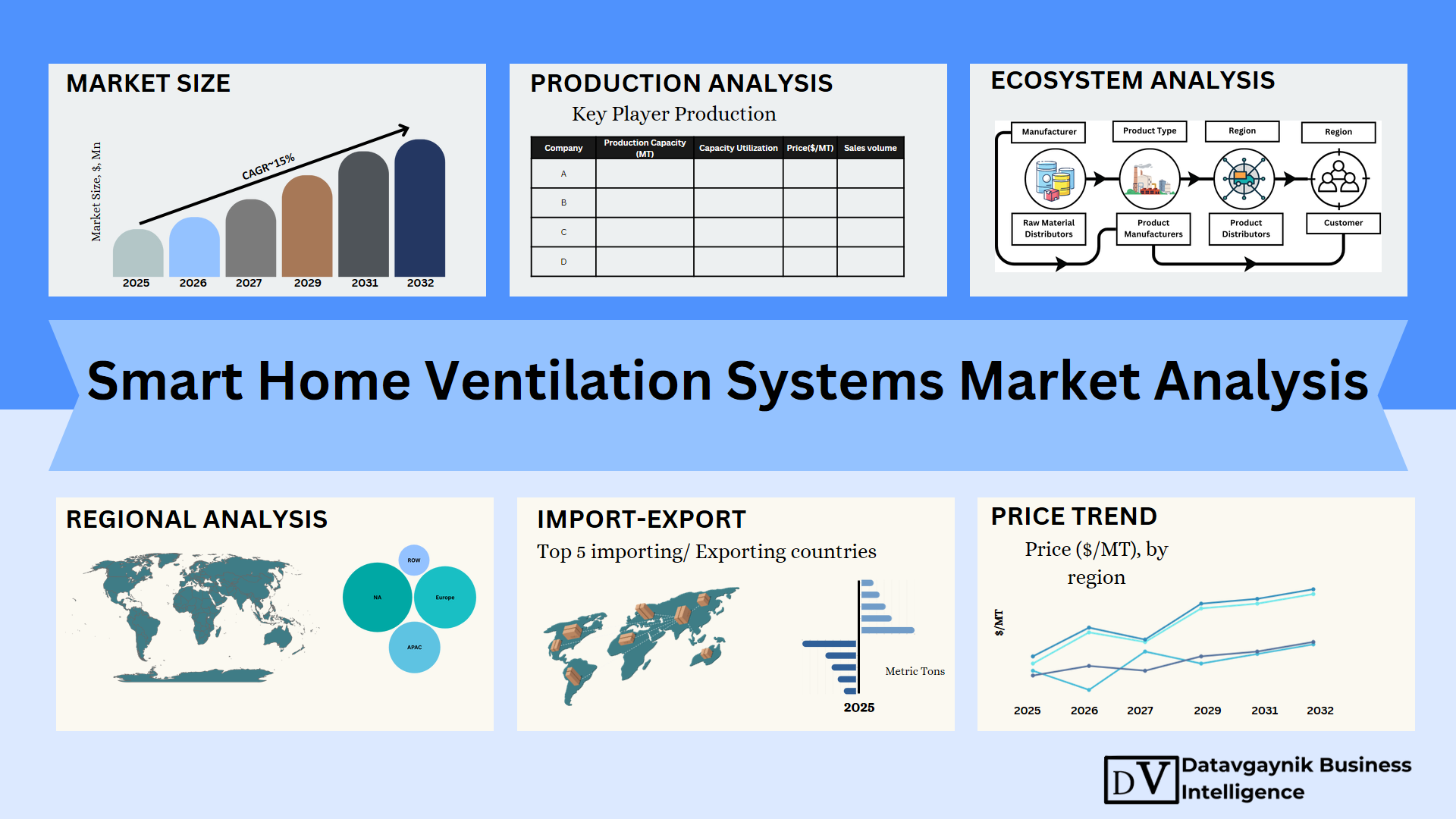
The market covers connected residential ventilation hardware and control layers that manage fresh-air intake, stale-air exhaust, humidity, pollutants, heat recovery, and room-level airflow. In simple terms, it is the part of the smart home stack that decides when a house should breathe. Revenue includes smart exhaust fans, connected HRVs and ERVs, sensors, controllers, smart dampers, fresh-air supply systems, intelligent kitchen ventilation, app-enabled controls, and related installation value tied directly to ventilation. It excludes conventional HVAC units where ventilation intelligence is not sold as a distinct function.
Datavagyanik also covers related markets such as the smart elastomer Market, the Pharmaceutical Ventilation Systems Market, and the Agricultural Ventilation Systems Market. They offer supporting insights that clarify downstream implications and strategic challenges in the context of the main topic.
Business relevance in 2026–2035 is anchored in three needs: healthier indoor air, lower home energy waste, and code-compliant airflow in tighter buildings. The U.S. Department of Energy notes that ventilation is crucial in energy-efficient homes and that efficient new and existing homes require mechanical ventilation to maintain indoor air quality. This matters because insulation and air sealing reduce leakage but also reduce passive air exchange. ASHRAE 62.2 remains a key residential IAQ reference point for dwelling-unit ventilation, local mechanical exhaust, and source control. In Europe, the recast Energy Performance of Buildings Directive entered into force in 2024 and supports lower building energy use, renovation, and digitalisation of building performance. That gives connected ventilation a clearer policy tailwind.
The Smart Home Ventilation Systems Market sits between HVAC, smart-home automation, residential wellness, and building controls. That makes buying behavior different from a normal appliance category. Builders care about code, HERS scores, callbacks, installation time, and duct constraints. Homeowners care about mold, bathroom humidity, kitchen odors, allergies, app control, and energy bills. HVAC contractors care about wiring, commissioning, warranty support, and whether the system integrates with thermostats, HRVs, and ERVs without repeat visits.
Our base-case model places North America as the largest revenue pool in 2026, helped by connected thermostats, higher ERV/HRV awareness in efficient homes, and strong bathroom/kitchen exhaust replacement demand. Europe follows, with adoption shaped by energy renovation and heat recovery ventilation. Asia Pacific is smaller in smart value share but faster-growing, led by China, Japan, South Korea, India, Australia, and premium urban housing clusters in Southeast Asia. LAMEA is early-stage, but hot-climate IAQ, dust control, and high-end residential projects are creating selective demand.
| Metric | 2026 Estimate | 2035 Forecast | Analyst Reading |
| Global revenue | $12,480 million | $25,970 million | Smart controls and ERV/HRV integration expand the value pool. |
| CAGR | — | 8.5% | Growth runs above conventional ventilation because connectivity lifts ASPs. |
| Installed/retrofit-led demand | ~58% of revenue | ~63% of revenue | Existing homes become the larger commercial prize. |
| New construction-led demand | ~42% of revenue | ~37% of revenue | Still important where codes and green building labels matter. |
| Connected whole-home systems share | ~34% | ~44% | HRVs, ERVs, and smart fresh-air systems gain share from basic exhaust units. |
Key consumers and client groups include homeowners, residential builders, multifamily developers, HVAC contractors, energy-efficiency retrofit firms, property managers, smart-home installers, green building consultants, and retail/home improvement channels. The most attractive clients are not only premium homeowners. Mid-market builders are becoming important because they need repeatable systems that satisfy code, reduce moisture complaints, and support energy labels without making every project custom.
Expert view: The category’s strongest pull will come from homes that are already becoming tighter, more sensorized, and more app-managed. Once the thermostat, purifier, and humidity sensor are connected, ventilation becomes the next logical control point.
Smart Home Ventilation Systems Market Segmentation and Forecast Scope
Segmentation should be built around how the system is bought, installed, and controlled. A pure product view is not enough. A smart bathroom fan, a connected ERV, and a thermostat-controlled ventilator solve different problems even when all three sit under residential ventilation. So, the forecast scope uses five dimensions: product type, control mode, installation type, end user, and region.
By product type, the market includes smart exhaust fans, connected HRVs/ERVs, fresh-air supply systems, smart kitchen/range hood ventilation, smart dampers and zone airflow devices, and IAQ sensors/controllers. Smart exhaust fans remain the entry point because they are affordable, familiar, and easy to retrofit. But the more strategic value is moving toward connected HRV/ERV systems. These systems bring in outdoor air while recovering energy from outgoing air. Broan-NuTone, for example, positions whole-home fresh-air ventilation around ERVs, HRVs, and fresh-air supply fans, while Panasonic offers ventilation fans and ERVs as part of its IAQ lineup.
By control mode, the market includes app-connected control, humidity-triggered control, CO₂/VOC/PM sensor-triggered control, thermostat-integrated ventilation, and predictive or AI-assisted ventilation logic. The most practical near-term growth is in sensor-triggered systems. PNNL’s Building America guidance recommends humidity and IAQ sensors that trigger additional ventilation when conditions inside the home change. This is where the product stops being a fan and starts behaving like a managed air-quality system.
By installation type, demand splits into new construction and retrofit/replacement. Retrofit accounts for ~58% of 2026 revenue in our model. This is the first disclosed sub-segment share. It includes bathroom fan upgrades, kitchen ventilation upgrades, smart thermostat-linked ventilators, ERV/HRV additions, and IAQ sensor/controller bundles. New construction remains easier for whole-home system design because ducting, commissioning, and fresh-air routing can be planned early. That said, retrofit wins on volume because the existing housing stock is much larger.
By end user, the market serves single-family homeowners, multifamily owners, custom builders, production homebuilders, HVAC contractors, property managers, and energy retrofit companies. Homeowners buy the comfort story. Builders buy the compliance and callback-reduction story. Contractors buy the installation and service story. Multifamily owners are more cautious because unit-level costs and maintenance complexity matter. Still, IAQ expectations in rental housing are improving, especially in premium urban assets.
By region, the forecast covers North America, Europe, Asia Pacific, and LAMEA. North America leads in connected controls and replacement demand. Europe leads in heat recovery logic and renovation policy support. Asia Pacific is the fastest-growing region because smart-home adoption, urban housing upgrades, and air-quality concerns are converging. LAMEA remains selective, with demand concentrated in high-income residential projects, villas, smart apartments, and dust-prone urban environments.
The Smart Home Ventilation Systems Market should be forecast with restraint because not every ventilation fan is smart and not every smart thermostat sale should be counted as ventilation revenue. The cleanest boundary is this: count the device or service only when ventilation control, airflow management, IAQ-triggered exhaust, or fresh-air exchange is a paid and identifiable function.
| Segmentation Dimension | Included Sub-Segments | 2026 Share Disclosure | Most Strategic Growth Area |
| By Product Type | Smart exhaust fans, connected HRVs/ERVs, fresh-air supply systems, smart kitchen ventilation, dampers, IAQ sensors/controllers | Connected whole-home systems: ~34% | Connected HRVs/ERVs and IAQ-driven fresh-air systems |
| By Control Mode | App control, humidity sensors, CO₂/VOC/PM sensors, thermostat integration, AI-assisted logic | Not disclosed | Sensor-triggered and thermostat-linked control |
| By Installation Type | New construction, retrofit/replacement | Retrofit: ~58% | Retrofit bundles for existing homes |
| By End User | Homeowners, builders, contractors, multifamily owners, property managers | Not disclosed | Builders and retrofit contractors |
| By Region | North America, Europe, Asia Pacific, LAMEA | Not disclosed | Asia Pacific growth, Europe heat recovery, North America replacement |
The fastest-growing sub-segments are likely to be connected HRVs/ERVs, sensor-triggered controls, and retrofit smart ventilation kits. The most strategic segment is not always the largest one. Smart exhaust fans may carry volume, but whole-home connected ventilation carries higher ASP, stronger service attachment, and better integration with energy-efficient housing.
Expert view: The winning segmentation logic is “problem solved,” not “fan type.” A bathroom humidity upgrade, a fresh-air compliance system, and a premium IAQ automation package should not be valued the same way.
Smart Home Ventilation Systems Market Trends and Innovation Landscape
Innovation is moving the category from fixed-speed extraction to responsive air management. Earlier systems were built around simple on/off operation. Newer systems are being designed around variable-speed motors, sensors, app control, heat recovery, occupancy logic, and integration with the wider smart-home stack. This shift is slow in mass housing but visible in premium homes, energy-efficient new construction, and retrofit projects where mold, humidity, or air-quality complaints are already costing money.
The first trend is sensor-led ventilation. Humidity remains the main trigger because it is easy to understand and directly tied to bathrooms, kitchens, basements, and laundry areas. CO₂, VOC, PM2.5, smoke, and occupancy sensors are now becoming more relevant. The DOE’s Building America work has examined smart ERV operation using low-cost IAQ sensors and time-varying humidity control logic, showing where R&D is moving: less fixed runtime, more condition-based airflow.
The second trend is whole-home IAQ integration. Brands are not just selling a fan. They are selling a healthier home package. Panasonic has positioned OASYS around real-time monitoring, automation, and energy-efficient comfort, while Broan-NuTone lists connected IAQ and whole-home ventilation solutions across exhaust, kitchen, and fresh-air products. This matters because homeowners don’t wake up asking for “ventilation control algorithms.” They want less dampness, fewer smells, and cleaner air without thinking about it.
The third trend is thermostat and HVAC accessory integration. Smart thermostats are becoming a control bridge for ventilation devices. ecobee, for example, specifies support for HRV/ERV ventilation accessories and broader integrations with Apple HomeKit, Amazon Alexa, Google Assistant, SmartThings, and IFTTT. This creates a practical route to adoption. A homeowner may not buy a standalone ventilation control panel, but they may accept ventilation as a feature inside the thermostat ecosystem.
The fourth trend is interoperability. The smart home has long suffered from too many apps, hubs, and closed ecosystems. Matter is positioned as an IP-based connectivity protocol for smart home devices, with the goal of improving reliability and cross-ecosystem compatibility. Google’s developer documentation also notes Matter allows a device to work with Matter-certified ecosystems using a single protocol, though not all device types are fully supported yet. For ventilation companies, this reduces friction. For consumers, it lowers the fear that a new device will not work with the rest of the home.
The fifth trend is energy-aware ventilation. This is where the commercial logic becomes stronger. Running a fan continuously can hurt energy performance. Under-ventilating can hurt IAQ. Smart ventilation tries to balance both. The better systems will combine indoor readings, outdoor air conditions, occupancy, humidity spikes, HVAC runtime, and electricity-price signals. This is not fully mature yet. But the direction is clear.
AI integration is relevant, but it should not be overstated. Today’s market is mostly sensor automation, rules-based control, and thermostat-linked scheduling. AI will become more useful where systems learn household routines, predict humidity events, use outdoor pollution data, and optimize ERV/HRV operation without user input. The near-term value is not flashy “AI homes.” It is fewer manual settings and fewer moisture complaints.
Material science is not the central growth lever in this market. Still, it matters in specific areas: ERV core membranes, acoustic insulation, low-noise fan housings, motor efficiency, filter media, and compact ducting components. The more important innovation layer is control intelligence, not the physical housing.
Recent activity is more about product ecosystems and partnerships than large ventilation-only mergers. Panasonic is pushing smart IAQ positioning through connected home air systems. Broan-NuTone is expanding its whole-home ventilation and connected IAQ ecosystem. Smart thermostat brands such as ecobee are making ventilation device control easier inside mainstream home automation. The broader Matter ecosystem is also acting like a partnership layer because it pulls device makers, platforms, retailers, and developers toward common connectivity rules.
For the Smart Home Ventilation Systems Market, the main innovation risk is complexity. If setup feels technical, adoption slows. If the installer cannot commission the system quickly, margins suffer. If apps add noise instead of convenience, homeowners ignore them. So the winning products will be quiet, self-adjusting, easy to install, and simple to explain.
| Innovation Trend | What Is Changing | Likely Impact by 2035 |
| Sensor-led ventilation | Humidity, CO₂, VOC, PM, and occupancy signals guide airflow. | Higher demand for IAQ sensor/controller bundles. |
| Connected HRV/ERV systems | Heat recovery shifts from niche efficient homes to broader premium and code-driven demand. | Higher ASP and stronger contractor-led sales. |
| Thermostat integration | Ventilation becomes part of HVAC control rather than a separate wall device. | Faster retrofit adoption. |
| Matter and interoperability | Smart-home platforms become easier to connect across brands. | Lower consumer friction, though device support will mature gradually. |
| Predictive control | Systems learn patterns and reduce unnecessary runtime. | Better energy-IAQ balance in premium systems first. |
| Low-noise, compact design | Hardware becomes easier to place in smaller homes and apartments. | Stronger multifamily and urban retrofit demand. |
Expert view: The next phase will not be won by the smartest algorithm alone. It will be won by systems that make fresh air feel automatic, quiet, and invisible. That is what homeowners will actually pay for.
Competitive Intelligence and Benchmarking
Competition in the Smart Home Ventilation Systems Market is not shaped by one clean category. It sits across ventilation fans, ERVs, HRVs, IAQ sensors, smart thermostats, HVAC controls, and whole-home comfort systems. That creates a mixed competitive field. Some players win through hardware volume. Some win through builder relationships. Some win through premium heat recovery systems. Others win by controlling the thermostat or smart-home interface.
The market is still fragmented. Our 2026 benchmark suggests the top 7 branded players account for roughly 36%–42% of global smart and semi-smart residential ventilation revenue. The rest is spread across regional ventilation manufacturers, HVAC distributors, private-label exhaust fan makers, home automation brands, and local installers.
| Company | Portfolio Position | Market Position and Analyst Benchmarking |
| Panasonic | Smart exhaust fans, ERVs, IAQ-oriented ventilation systems, sensors, balanced ventilation, and whole-home air quality systems. | Panasonic is one of the strongest players in North America and Japan-aligned IAQ ecosystems. Its position is moving beyond component ventilation into whole-home air management. The company’s ERV portfolio is positioned around code-compliant balanced air solutions and smart controls. |
| Broan-NuTone | Exhaust ventilation, range hood ventilation, whole-home fresh-air systems, connected IAQ controls, sensors, and automated ventilation systems. | Broan-NuTone remains one of the most important North American volume players. Its strength comes from installed base, builder familiarity, and exhaust fan replacement demand. Its Overture platform connects wall controls and sensors with ventilation devices, which gives it a practical smart-home angle. |
| Zehnder Group | Central and decentralized heat recovery ventilation, comfort ventilation, air distribution, filtration, and premium residential ventilation systems. | Zehnder Group is more premium than mass-market exhaust fan brands. It is especially strong in Europe, passive-house style projects, high-performance homes, and heat recovery ventilation. Its value proposition is energy recovery plus healthy indoor climate rather than low-cost replacement fans. |
| Daikin | Heat recovery ventilation, fresh-air systems, HVAC-linked ventilation, air conditioning integration, and controls. | Daikin is not only a ventilation brand. It is an HVAC ecosystem player. That matters because smart ventilation is increasingly linked with heating, cooling, and energy management. Its ventilation units are positioned around heat recovery and integration with broader HVAC systems. |
| Mitsubishi Electric | Heat recovery ventilation systems, Lossnay-type fresh-air exchange, HVAC-linked air management, and building comfort controls. | Mitsubishi Electric is strong in Japan, Asia Pacific, and selected international HVAC channels. Its positioning is built around heat exchange ventilation and energy savings. It fits especially well in urban homes where fresh filtered air and compact indoor systems matter. |
| Aldes | HRVs, ERVs, airflow management systems, connected ventilation, air purification, and residential ventilation for single-family and multifamily housing. | Aldes has a strong European and North American technical position, especially in controlled ventilation and heat recovery. Its offer is relevant for multifamily, condos, and high-efficiency residential buildings where airflow balancing matters. |
| Resideo / Honeywell Home | Whole-house ventilators, ERVs, HRVs, ventilation controls, smart thermostats, dampers, and contractor-facing air quality solutions. | Resideo / Honeywell Home is important because it controls part of the home interface. The company benefits from thermostat, contractor, and control-channel strength. Its ventilation systems target humid and cold climates and include models with wireless installation and remote control features. |
The competitive pattern is clear. Panasonic, Broan-NuTone, and Resideo / Honeywell Home are stronger in the North American retrofit and builder channel. Zehnder Group and Aldes are stronger in premium heat recovery and high-performance housing. Daikin and Mitsubishi Electric win where ventilation is sold as part of an HVAC comfort system rather than a standalone device.
Pricing also varies sharply. Basic smart exhaust units can sit near the lower end of the market. Connected ERV/HRV systems can be 5–12 times higher in installed value once controls, ducting, commissioning, and accessories are included. This is why the Smart Home Ventilation Systems Market should not be benchmarked only by unit shipments. Revenue quality improves as the mix shifts toward balanced ventilation and controls.
Expert view: The winning players will be those that can sell ventilation as an outcome. Less humidity. Cleaner air. Lower energy waste. Fewer callbacks. The product label matters less than the problem solved.
Regional Landscape and Adoption Outlook
The regional outlook is uneven. The Smart Home Ventilation Systems Market is mature in awareness across developed economies, but it is still early in true whole-home smart adoption. Retrofit demand is strongest where homes are old, sealed, and expensive to heat or cool. New construction demand is strongest where building codes and green-building labels are tightening.
| Region / Country | 2026 Revenue Estimate | 2035 Revenue Forecast | CAGR 2026–2035 | Adoption Reading |
| United States | $3,050 million | $6,020 million | 7.8% | Largest single-country market. Replacement demand and builder IAQ packages drive growth. |
| Europe | $3,300 million | $6,730 million | 8.2% | Heat recovery and renovation-led ventilation are key demand anchors. |
| China | $1,450 million | $3,420 million | 10.0% | Urban apartments, air-quality awareness, and smart-home penetration support growth. |
| India | $430 million | $1,250 million | 12.6% | Low base. Fastest growth among large countries due to urban housing and premium apartments. |
| Japan | $780 million | $1,360 million | 6.4% | Mature ventilation culture. Growth comes from connected controls and replacement. |
| South Korea | $360 million | $760 million | 8.6% | Strong smart-home infrastructure and dense apartment living support adoption. |
| Middle East | $520 million | $1,260 million | 10.3% | UAE and Saudi Arabia lead through premium housing, villas, IAQ regulation, and cooling-heavy buildings. |
United States
The United States is the largest single-country opportunity. Demand is split between builder-installed ventilation in new homes and replacement upgrades in bathrooms, kitchens, basements, and whole-home HVAC systems. The regulatory backdrop is supportive because residential ventilation is already tied to building science, energy-efficient housing, and IAQ standards. ASHRAE 62.2 remains a reference standard for residential ventilation and local exhaust. The U.S. Department of Energy also positions mechanical ventilation as important for energy-efficient homes because tighter envelopes reduce uncontrolled air leakage.
The U.S. also has the strongest contractor and retail infrastructure. That matters. A smart ERV or IAQ-linked exhaust fan is not sold like a small appliance. It needs specification, wiring, airflow understanding, and sometimes ductwork. So the strongest players are those with contractor training, distribution reach, and builder acceptance.
Europe
Europe is structurally attractive because heat recovery ventilation fits the building policy direction. The revised EPBD entered into force on 28 May 2024 and has a national transposition deadline of 29 May 2026. It pushes renovation and higher building energy performance. Also, the zero-emission building direction raises the value of ventilation systems that recover energy while protecting indoor air quality.
Country-level demand is strongest in Germany, Netherlands, Nordics, France, United Kingdom, and Switzerland. Premium systems have better acceptance in colder climates because heat loss through ventilation is visible in energy bills. Zehnder Group, Aldes, Daikin, and Mitsubishi Electric are well-positioned in this environment.
China
China is a high-growth market but not yet a high-margin market across all product layers. Demand is concentrated in urban apartments, premium residential developments, and consumers already buying smart-home devices. The policy background is building-energy focused. China’s GB 55015-2021, implemented in 2022, requires new, expanded, reconstructed buildings and energy-saving renovations to be designed for energy efficiency. This supports efficient ventilation as part of the broader low-carbon building ecosystem.
China’s challenge is price compression. Local smart-device players and domestic appliance ecosystems can reduce entry-level pricing quickly. Global brands will likely compete better in premium ERV/HRV, filtration-heavy systems, and homes where developers use better IAQ as a sales feature.
India
India is a small base market but strategically important. Adoption is still led by premium apartments, gated communities, villas, hospitals-linked residential developers, and high-income urban households. The mass market remains cost-sensitive. Exhaust fans dominate by volume, while smart and balanced ventilation is still niche.
The policy tailwind is improving. BEE’s Eco-Niwas Samhita 2024 consolidates residential energy conservation and sustainable building code provisions and includes indoor environmental quality, smart home, natural ventilation, and retrofitting elements. That does not automatically create mass smart ventilation demand. But it gives builders and consultants a stronger language for healthier and lower-carbon residential buildings.
The strongest Indian demand pockets are Delhi NCR, Mumbai Metropolitan Region, Bengaluru, Hyderabad, Pune, Chennai, and premium second-home markets. Growth will come from three buyer groups: luxury developers, retrofit installers, and consumers already buying smart thermostats, purifiers, and connected ACs.
Japan
Japan is more mature than India and China in ventilation awareness. Its building framework has long linked indoor air quality with ventilation due to concerns around chemical emissions and tighter buildings. MLIT materials highlight measures under the Building Standard Act involving building materials and ventilation to address sick building issues.
Growth will be steadier rather than explosive. The installed base is already significant. The opportunity is in replacement, heat recovery upgrades, quieter compact units, and ventilation that links with air conditioning and home controls. Panasonic, Mitsubishi Electric, and Daikin have strong structural positioning here.
South Korea
South Korea has the right infrastructure for adoption: high apartment density, strong broadband penetration, advanced consumer electronics, and high comfort expectations. The country’s energy-efficiency framework also supports smarter building systems. Korea Energy Agency states that energy-saving design standards are enforced for new buildings of 500 m² or more and that zero-energy building certification has been implemented for public buildings of 500 m² or more.
The opportunity is concentrated in apartments and premium residential towers. Smart-home platforms are already familiar to consumers. The commercial question is whether ventilation can be bundled into apartment specifications without raising upfront costs too much.
Middle East
The Middle East is relevant, especially UAE and Saudi Arabia. These are cooling-heavy markets. Homes are sealed for long periods because of heat, dust, and air-conditioning dependence. That creates an IAQ problem. It also creates an opportunity for controlled fresh-air systems, filtration, and ERV logic.
Dubai’s Green Building System includes ventilation and air quality requirements for air-conditioned buildings, including mechanical or mixed-mode ventilation. Saudi Arabia’s Green Building Code is also in force and is positioned as part of the Saudi Building Code framework to promote green practices, energy efficiency, and CO₂ reduction.
The best addressable segments are villas, luxury apartments, hotels converted into branded residences, and smart-city housing projects. Price sensitivity is lower at the premium end, but technical performance matters because outdoor dust, high cooling loads, and maintenance conditions are tougher than in Europe.
Expert view: The regional story is not one global curve. The U.S. buys convenience and replacement. Europe buys energy recovery. India buys premium wellness first. The Middle East buys filtration and comfort. China and South Korea buy smart-home integration.
- Recent Developments + Opportunities & Restraints
Recent Developments
| Year / Month | Event | Impact on Smart Home Ventilation Systems Market |
| 2024 / November | Connectivity Standards Alliance released Matter 1.4, expanding smart-home energy management capabilities and improving the technical base for more coordinated home systems. | This supports long-term interoperability. Ventilation systems linked with thermostats, sensors, heat pumps, and energy platforms should benefit as Matter adoption matures. |
| 2025 / January | Panasonic introduced OASYS, a whole-home air quality management solution focused on cleaner air, balanced humidity, consistent temperature, and energy-efficient comfort. | This signals a shift from standalone ventilation to full-home IAQ and comfort ecosystems. It also raises the competitive benchmark for builder-focused smart ventilation. |
| 2025 / February | Panasonic showcased OASYS for home builders at IBS 2025, positioning the solution for modern high-performance homes and claiming up to 53% lower heating and air-conditioning energy consumption versus traditional HVAC systems. | Builder-channel education is important. If systems can cut installation complexity and energy use, they become easier to justify in new homes. |
| 2025 / June | The European Commission moved further on EPBD implementation by setting the building sector on a pathway toward higher efficiency and decarbonisation, with national transposition due by 29 May 2026. | This supports demand for smart, efficient ventilation in renovations and zero-emission building pathways across Europe. |
| 2025 / June | IEA listed the Saudi Green Building Code 2024 as in force, noting its role within the Saudi Building Code framework for green practices, energy efficiency, and CO₂ reduction. | Saudi Arabia becomes more relevant for premium ventilation, filtration, and cooling-efficient IAQ systems in high-end residential and mixed-use projects. |
Sources: CSA Matter 1.4 ; Panasonic OASYS launch ; Panasonic IBS 2025 ; European Commission EPBD update ; IEA Saudi Green Building Code .
Opportunities and Business Insights
Opportunity 1: Retrofit bundles for existing homes
The largest near-term opportunity is not only new construction. It is retrofit. Existing homes have humidity problems, poor bathroom exhaust, kitchen odor issues, and limited fresh-air control. A bundled offer of smart exhaust fan, IAQ sensor, app control, and installer service can address a real problem without forcing a full HVAC replacement.
Use case/example: A homeowner with recurring bathroom mold may not buy a full ERV system. But a humidity-sensing fan with app visibility and automatic runtime can solve the immediate issue at a much lower installed cost.
Opportunity 2: Builder-grade whole-home IAQ packages
Builders need simple packages. Not complex technical options. A standardized ventilation bundle with ERV/HRV, smart controls, sensors, and commissioning support can become a differentiator for premium housing. This is especially relevant in North America, Europe, Japan, South Korea, and premium Indian urban projects.
Opportunity 3: Remote monitoring and service revenue
The Smart Home Ventilation Systems Market can generate recurring value through filter reminders, IAQ dashboards, fault alerts, preventive maintenance, and energy-use analytics. This is still early. But it may create a service layer for HVAC contractors and platform companies.
Restraints
Restraint 1: Installed cost remains a barrier
A smart fan is affordable. A whole-home connected ERV or HRV is not. Installation can include ducting, wiring, commissioning, balancing, wall controls, and contractor labor. This keeps adoption concentrated in premium homes unless retrofit kits become simpler.
Restraint 2: Consumer education is weak
Most homeowners understand air purifiers faster than ventilation. Ventilation is invisible until there is mold, odor, condensation, or discomfort. This limits pull-based demand.
Restraint 3: Interoperability is still uneven
Matter and other platforms are improving smart-home connectivity, but full cross-brand ventilation control is not yet frictionless. Many systems still rely on proprietary apps, contractor settings, or thermostat compatibility. That slows mass adoption.
Expert view: The commercial unlock is not adding more sensors. It is making ventilation simple enough for homeowners and profitable enough for installers. That balance will define the next decade.


