

Market Summary and Growth Forecast
The global Smoke Control Ventilation Market will witness a robust CAGR of 6.7%, valued at $4.15 billion in 2026, expected to appreciate and reach $7.42 billion by 2035.
Smoke control ventilation refers to engineered systems that manage smoke movement during a fire event. These systems support safe evacuation, protect escape routes, assist firefighting operations, and reduce damage to building assets. The market includes natural smoke vents, mechanical exhaust systems, smoke curtains, pressurization systems, control panels, sensors, actuators, dampers, and integrated fire-safety control solutions.
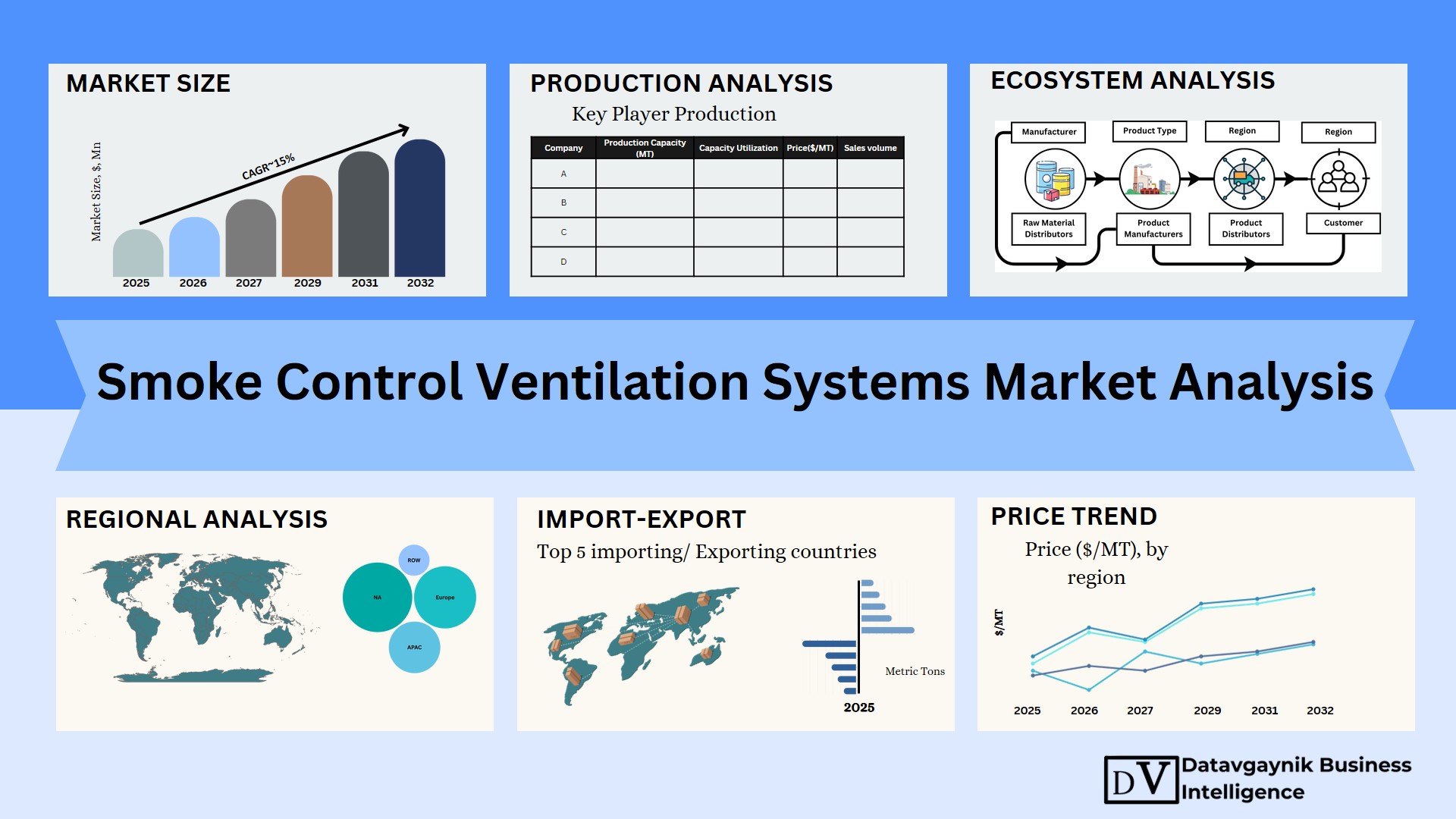
By 2026, the market is becoming more strategic because buildings are getting taller, denser, more automated, and more regulated. The shift is visible across high-rise residential towers, airports, metro stations, tunnels, hospitals, warehouses, shopping centers, and mixed-use developments. Smoke control is no longer treated as a passive compliance item. It is becoming part of the wider building safety and life-safety infrastructure.
The Smoke Control Ventilation Market is being shaped by four forces. First, fire-safety codes are getting tighter in urban construction. Second, property owners are moving toward active smoke management rather than basic ventilation-only designs. Third, smart building systems are pushing demand for connected controls, sensors, and automated dampers. Fourth, infrastructure investment in transport, logistics, healthcare, and commercial real estate is creating a larger installed base for engineered smoke exhaust systems.
| Metric | Estimate |
| Global market size, 2026 | $4.15 billion |
| Projected market size, 2035 | $7.42 billion |
| Forecast CAGR, 2026–2035 | 6.7% |
| Highest revenue region, 2026 | Europe |
| Fastest-growing region, 2026–2035 | Asia Pacific |
| Most strategic application area | High-rise buildings and transport infrastructure |
Europe holds a strong position due to mature fire-safety standards, high building compliance expectations, and a well-developed ecosystem of smoke ventilation specialists. Asia Pacific is moving faster in volume terms, driven by high-rise construction, metro networks, airports, industrial parks, and logistics hubs in countries such as China, India, Japan, South Korea, and Southeast Asian economies.
Datavagyanik also covers related markets such as the Pharmaceutical Ventilation Systems Market, the Agricultural Ventilation Systems Market, and the Mining Ventilation Systems Market. Each of these markets adds unique insights into end-user applications, regulatory influences, and competitive developments.
Key stakeholders include smoke ventilation system manufacturers, façade and roofing system suppliers, fire-safety contractors, MEP consultants, real estate developers, building owners, transport authorities, construction companies, governments, fire-safety regulators, insurance bodies, certification agencies, and infrastructure investors. OEMs such as Swegon, Colt Group, Kingspan, SE Controls, FläktGroup, Trox, Systemair, and Greenheck play important roles across system design, equipment supply, control integration, and aftersales support.
Expert insight: The next decade will not be defined only by new building demand. Retrofit compliance will matter just as much. Older commercial assets, hospitals, industrial facilities, and public infrastructure will need upgraded smoke control systems as safety expectations rise.
Market Segmentation and Forecast Scope
The Smoke Control Ventilation Market is segmented by product type, system type, application, end user, and region. This structure reflects how projects are specified in real buildings. A smoke ventilation package may include roof vents, extract fans, smoke dampers, pressurization units, smoke curtains, sensors, and control panels. So, the market should not be viewed as a single product category. It is a project-based safety system market.
By Product Type
Key product categories include:
| Product Type | Role in Smoke Control | Market Relevance |
| Natural smoke vents | Release smoke and hot gases through roof or façade openings | Common in atriums, warehouses, industrial buildings, and retail spaces |
| Mechanical smoke exhaust fans | Extract smoke using powered ventilation | Critical in basements, tunnels, high-rise buildings, and enclosed structures |
| Smoke dampers and fire dampers | Control smoke spread through ducts and compartments | Strong demand in commercial and institutional buildings |
| Smoke curtains and barriers | Channel or contain smoke movement | Used in malls, airports, atriums, and transport hubs |
| Pressurization systems | Keep stairwells and escape routes smoke-free | Essential in high-rise buildings and hospitals |
| Control panels, sensors, and actuators | Automate system response during fire events | Increasingly important as buildings become smarter |
Mechanical smoke exhaust systems are estimated to account for around 34% of global revenue in 2026. Their strong share comes from use in enclosed spaces where natural venting is not enough. Basements, underground parking areas, tunnels, metro stations, and large commercial buildings depend heavily on powered extraction.
By System Type
The market can also be split into natural smoke control systems, mechanical smoke control systems, and hybrid smoke control systems. Natural systems remain attractive where building design supports roof or façade-based smoke release. Mechanical systems are preferred in complex structures where airflow must be controlled with higher precision. Hybrid systems are gaining attention because they balance energy efficiency, design flexibility, and code compliance.
Hybrid smoke control systems are expected to be among the fastest-growing system types through 2035, especially in large commercial assets and transport infrastructure. They allow engineers to combine natural venting with powered extraction, smoke curtains, dampers, and smart controls.
By Application
Major application segments include:
| Application | Adoption Pattern |
| Commercial buildings | Offices, malls, hotels, mixed-use complexes, and business parks |
| Residential high-rise buildings | Apartment towers and premium residential developments |
| Industrial and warehousing facilities | Manufacturing plants, storage buildings, logistics hubs, and clean industrial spaces |
| Transport infrastructure | Airports, metro stations, tunnels, rail terminals, and bus depots |
| Healthcare and institutional buildings | Hospitals, universities, laboratories, public buildings, and government facilities |
Commercial buildings are estimated to represent around 29% of market revenue in 2026. This segment has broad adoption because malls, offices, hotels, and mixed-use spaces often require engineered smoke management to protect occupants across large floorplates and vertical circulation zones.
Transport infrastructure is the most strategic long-term application. It has higher system complexity, stronger safety scrutiny, and larger project-level spending. Metro stations, tunnels, underground rail corridors, and airports require smoke modelling, staged extraction, emergency controls, redundancy, and integration with public-safety systems.
By End User
End users include real estate developers, public infrastructure authorities, industrial facility owners, commercial property operators, healthcare institutions, transport agencies, and government bodies. Developers usually influence system selection during new construction. Facility owners and public agencies drive retrofit demand when existing assets require compliance upgrades.
By Region
Regional coverage includes North America, Europe, Asia Pacific, and LAMEA.
Europe remains the most mature revenue contributor due to strict fire engineering practices and strong refurbishment activity. North America benefits from institutional construction, commercial retrofits, and industrial safety investments. Asia Pacific is the key volume growth engine. LAMEA is smaller but improving through airports, commercial complexes, energy facilities, and urban infrastructure projects.
Within the Smoke Control Ventilation Market, Asia Pacific is expected to record the fastest CAGR during 2026–2035, supported by dense urban development and expanding public transport networks.
Expert insight: Segmentation should be read through project complexity, not just unit volume. A basic warehouse venting project and an underground metro smoke extraction package sit in the same market, but their engineering value and margin profile are very different.
Market Trends and Innovation Landscape
The Smoke Control Ventilation Market is moving from stand-alone equipment supply toward integrated fire-safety engineering. Buyers are asking for systems that are easier to test, easier to monitor, and easier to integrate with broader building management systems. That shift is changing product design, supplier positioning, and project delivery models.
R&D Evolution
R&D is focused on improving response speed, airflow reliability, system durability, and control accuracy. Suppliers are investing in better actuators, low-noise exhaust fans, fire-rated dampers, motorized vents, addressable control panels, and system diagnostics. The goal is simple: when a fire event happens, the system must respond exactly as designed.
Testing and certification also remain central. Smoke control products must perform under extreme temperatures, pressure differentials, and emergency operating conditions. This is why established manufacturers with tested assemblies, certified components, and engineering support have a clear advantage over low-cost suppliers.
Technology Evolution
The market is seeing stronger adoption of networked control architecture. In older installations, smoke vents or dampers were often controlled through simpler local panels. New projects are moving toward integrated control platforms that connect smoke detectors, fire alarms, dampers, fans, curtains, stairwell pressurization units, and building management systems.
Smart diagnostics are becoming more relevant. Building owners want to know whether dampers are operational, whether vents open properly, whether fan motors are healthy, and whether emergency sequences are functioning. This supports preventive maintenance and reduces the risk of hidden system failure.
AI is not yet a mainstream purchasing driver in this market. That said, limited AI-enabled analytics may gradually appear in predictive maintenance, airflow simulation, fault detection, and digital fire-safety modelling. The core market is still driven by regulation, reliability, and engineering compliance rather than AI branding.
Material and Design Innovation
Material innovation is practical rather than cosmetic. Products need corrosion resistance, fire resistance, structural strength, weather durability, and long operating life. Aluminium, galvanized steel, stainless steel, fire-rated glass, high-temperature insulation, and specialist coatings are commonly used depending on the building environment.
Smoke curtains and barriers are improving through compact headbox designs, better fabric performance, and more flexible deployment options. Mechanical fans are moving toward higher efficiency motors and improved control compatibility. Natural vents are becoming more architecturally integrated, especially in commercial buildings where safety equipment must align with façade and roof aesthetics.
Mergers, Partnerships, and Market Announcements
The competitive landscape is showing steady consolidation and partnership-led expansion. Larger HVAC and fire-safety groups are strengthening smoke control portfolios through specialist acquisitions, distributor partnerships, and integration with building automation platforms. Partnerships between smoke control OEMs, façade contractors, fire-engineering consultants, and MEP firms are becoming more important because complex projects require early-stage design coordination.
Companies such as Swegon, Colt Group, SE Controls, FläktGroup, Kingspan, Trox, Systemair, Greenheck, and Ruskin continue to shape product development and specification trends. Their advantage is not only product breadth. It is the ability to support design, documentation, testing, commissioning, and compliance.
Future Impact
The most important innovation will be system-level intelligence. Not “smart” for marketing purposes, but smart in the operational sense. Can the system self-check? Can it report faults before inspection? Can it integrate with emergency protocols? Can it adapt to complex airflow conditions in large buildings? These questions will guide the next phase of product development.
For stakeholders in the Smoke Control Ventilation Market, the biggest opportunity sits in engineered systems, retrofits, smart controls, and transport infrastructure. Basic hardware will remain necessary, but the value pool will tilt toward integrated, certified, and service-backed solutions.
Expert insight: The winners will be suppliers that combine equipment with fire-engineering support. In smoke control, trust is built before installation. Architects, consultants, and authorities want proof that the system will work when people need it most.
Competitive Intelligence and Benchmarking
The competitive structure is moderately fragmented. A few global HVAC and fire-safety groups lead large engineered projects, while regional specialists remain strong in installation-heavy smoke ventilation work. Competitive strength depends on certification, application engineering, project support, local code knowledge, and the ability to integrate fans, dampers, vents, controls, and commissioning services.
| Company | Portfolio Position | Market Position |
| Kingspan Group | Natural smoke ventilation, rooflight-integrated smoke systems, smoke management solutions, daylighting-linked ventilation, and building envelope fire-safety products | Strong in Europe and building envelope-linked smoke management. The company benefits from its construction materials channel and specification access among architects and contractors. |
| Swegon | Fire and smoke control dampers, smoke ventilation products, air handling systems, control platforms, and wider indoor climate systems | Well positioned in Northern Europe and commercial buildings. Its strength sits in combining smoke control with broader HVAC and building climate systems. |
| FläktGroup | Smoke extract systems, pressurization systems, car park ventilation, tunnel and metro ventilation, fire-safety fans, and control solutions | Strong in complex engineered applications. The company is relevant in transport infrastructure, enclosed car parks, high-rise buildings, and industrial ventilation projects. |
| Systemair | Smoke extraction fans, tunnel fans, car park ventilation systems, fire-safety ventilation, air distribution, and HVAC equipment | Broad global manufacturing footprint. Its advantage is scale, fan engineering, and access to commercial, industrial, and infrastructure ventilation projects. |
| SE Controls | Natural and mechanical smoke ventilation, façade automation, automatic opening vents, control systems, actuators, and commissioning services | Specialist player with strong project engineering capability. More focused than broad HVAC suppliers, especially in smoke ventilation design, façade-linked controls, and compliance support. |
| Trox | Fire and smoke dampers, air distribution equipment, ventilation components, control units, and building safety products | Strong in ducted systems, dampers, and airflow control. It is often specified in commercial, institutional, and healthcare buildings where certified components matter. |
| Greenheck | Smoke control fans, life-safety dampers, ventilation fans, louvers, controls, and air movement systems | Strong North American position. The company benefits from a wide air movement portfolio and deep presence in commercial and institutional building projects. |
Among these players, FläktGroup, Systemair, and Greenheck are more exposed to powered smoke extraction and fan-led systems. Kingspan, SE Controls, and Swegon have stronger relevance in natural smoke ventilation, automatic opening vents, dampers, and control integration. Trox has a clear position in airflow control components, especially dampers and certified ducted ventilation elements.
The market is not won only by product range. It is won at the design table. Consultants, fire engineers, MEP contractors, and authorities having jurisdiction often influence the final supplier shortlist. This gives an advantage to companies that can provide calculation support, compliance documentation, commissioning guidance, and long-term maintenance support.
Expert insight: The higher-value part of the market is moving toward engineered packages. Basic vents and fans still sell, but margin resilience is better where the supplier is involved in design, integration, testing, and lifecycle service.
Regional Landscape and Adoption Outlook
Regional adoption is strongly linked to fire codes, urban density, high-rise activity, transport infrastructure, and enforcement quality. Mature markets spend more on compliance and retrofits. Emerging markets spend more on new construction. The difference matters because retrofit projects often require higher engineering input, while new-build projects create volume demand.
| Region / Country | Adoption Outlook | Growth Character |
| North America | High adoption in commercial buildings, hospitals, airports, data centers, industrial facilities, and institutional projects | Stable growth driven by code compliance, replacement demand, and large public/private construction projects |
| Europe | Most mature market for certified smoke control systems, especially in the UK, Germany, Nordics, France, Benelux, and Central Europe | Strong retrofit and compliance-led demand. Regulations and technical standards support premium system adoption |
| China | Large demand base from high-rise construction, metro systems, airports, industrial parks, and commercial complexes | High volume market. Growth depends on infrastructure spending, urban redevelopment, and fire-safety enforcement consistency |
| India | Rising adoption in malls, airports, metro stations, hospitals, warehouses, IT parks, and high-rise residential projects | Fast-growing but uneven. Premium projects adopt engineered systems, while mid-tier construction remains cost-sensitive |
| Japan | Mature building safety culture with strong adoption in high-density urban buildings and transport infrastructure | Stable replacement and modernization demand. Growth is moderate but system quality expectations are high |
| South Korea | Strong use in hospitals, commercial towers, subway systems, logistics facilities, semiconductor facilities, and public buildings | High technical adoption. Demand benefits from advanced construction standards and complex urban infrastructure |
| Rest of the World | Includes Southeast Asia, Middle East, Latin America, Africa, and Oceania | Mixed adoption. High-growth pockets include Gulf states, Southeast Asia, Australia, Brazil, Mexico, and selected African urban centers |
North America
North America remains a high-value market because smoke control is closely tied to building codes, insurance expectations, and institutional safety practices. The United States leads regional demand, followed by Canada. Key applications include hospitals, universities, airports, correctional facilities, industrial buildings, data centers, and mixed-use commercial complexes.
The region’s white space sits in retrofit modernization. Many older buildings have legacy ventilation and life-safety systems that require upgrades, especially where occupancy use has changed or where local code interpretation has tightened.
Europe
Europe holds the strongest compliance-driven adoption profile. The UK, Germany, France, the Nordics, Benelux, Italy, and Spain have established demand for smoke exhaust systems, automatic opening vents, fire dampers, smoke curtains, and pressurization solutions. Public scrutiny around building safety has also increased the importance of documented testing and maintenance.
Europe is also a strong market for specialist smoke control companies. The region has a dense base of engineering consultants, façade contractors, fire-safety installers, and certified component suppliers.
China
China remains one of the largest addressable markets by project volume. High-rise buildings, metro corridors, industrial parks, airports, underground retail areas, and logistics infrastructure create consistent demand. However, supplier competition is intense. Domestic manufacturers compete aggressively on cost, while international players usually participate in high-spec commercial, industrial, transport, and multinational customer projects.
India
India is one of the most attractive growth markets through 2035. Adoption is being supported by airport expansion, metro rail projects, premium commercial real estate, organized warehousing, hospitals, IT campuses, and high-rise residential development. Demand is strongest in cities such as Mumbai, Delhi NCR, Bengaluru, Hyderabad, Chennai, Pune, Ahmedabad, and Kolkata.
That said, the market is still uneven. Large developers and public infrastructure agencies are more likely to specify engineered systems. Smaller commercial and residential projects often remain price-led. This creates a gap between regulatory intent and actual field adoption.
Japan
Japan has a mature safety culture and high technical expectations. The market is more replacement-led than volume-led. Demand comes from commercial towers, hospitals, rail infrastructure, underground spaces, and public buildings. Suppliers must compete on reliability, certifications, quiet operation, seismic-aware design considerations, and lifecycle support.
South Korea
South Korea is a high-quality demand market. Hospitals, metro stations, semiconductor plants, logistics centers, and dense commercial districts create strong use cases for mechanical smoke extraction, pressurization, and integrated fire-safety controls. Seoul and surrounding metropolitan areas remain the main demand centers.
Rest of the World
The Middle East is important for airports, malls, hotels, metro systems, high-rise buildings, and large mixed-use developments. Southeast Asia is growing through urban rail, commercial real estate, and industrial parks. Australia has a mature compliance base. Latin America and Africa remain selective markets, with demand concentrated in large urban and public infrastructure projects.
Expert insight: The biggest underserved opportunity is not simply “emerging markets.” It is emerging-market premium infrastructure. Airports, metro stations, hospitals, and logistics hubs are where smoke control spending becomes more sophisticated and less commoditized.
End-User Dynamics and Use Case
End-user adoption varies by project type. Developers look at code compliance, approval timelines, system cost, and space efficiency. Public infrastructure agencies focus on evacuation safety, redundancy, emergency operation, and long-term reliability. Hospitals need controlled smoke movement because evacuation is harder when patients are immobile. Industrial users care about asset protection, operational continuity, and insurance risk. Commercial property owners increasingly view smoke ventilation as part of broader building risk management.
| End User | Primary Buying Logic | Typical System Preference |
| Commercial real estate developers | Code approval, tenant safety, asset value, and design flexibility | Natural vents, mechanical extract, smoke curtains, dampers, and central controls |
| Transport authorities | Passenger evacuation, smoke modelling, redundancy, and emergency response | High-capacity mechanical smoke extraction, tunnel fans, control rooms, and staged ventilation |
| Hospitals and healthcare operators | Patient safety, compartmentalization, stairwell protection, and continuity of care | Pressurization systems, dampers, smoke extraction, and integrated fire alarm control |
| Industrial and warehouse operators | Worker safety, property protection, insurance compliance, and heat/smoke removal | Roof vents, exhaust fans, smoke curtains, and mechanical extraction |
| Government and public institutions | Life-safety compliance, procurement standards, and public accountability | Certified systems with documented testing and maintenance support |
Adoption is increasingly influenced by whole-life cost. A cheaper system can become expensive if it fails inspection, lacks proper documentation, or requires frequent corrective maintenance. This is pushing larger end users toward certified suppliers and integrated service partners.
Realistic Use Case
A tertiary hospital in South Korea used a hybrid smoke control system during a major expansion of its emergency and surgical wings. The building had patient rooms, operating areas, basement parking, diagnostic floors, and multiple vertical escape routes. A basic natural ventilation approach was not enough because smoke movement had to be controlled across corridors, stairwells, lift lobbies, and mechanically ventilated basement areas.
The hospital selected a package combining pressurization systems for escape stairs, smoke dampers for compartment control, mechanical smoke extraction in basement and service areas, and automated control links with the fire alarm system. The project team also required routine test sequencing so facility managers could verify damper positions and fan response without disrupting hospital operations.
The practical value was not only regulatory compliance. It reduced evacuation complexity, protected critical care zones, and gave emergency responders clearer control over smoke movement during a fire scenario. For hospitals, this is where smoke control becomes operational infrastructure rather than a construction add-on.
Within the Smoke Control Ventilation Market, healthcare and transport end users are among the most demanding buyers because failure risk is unacceptable. They usually require higher documentation, more system redundancy, and stronger commissioning discipline than standard commercial projects.
Recent Developments + Opportunities & Restraints
Recent Developments
| Year / Month | Event | Market Relevance |
| 2024 / May | Systemair acquired PHEM Engineering SDN. BHD., a Malaysian ventilation product manufacturer. | Strengthens Systemair’s Southeast Asia manufacturing and distribution base. This supports regional ventilation demand, including fire-safety and smoke extraction-related applications. |
| 2024 / November | The revised BS 9991:2024 fire-safety guidance in the UK introduced stronger expectations around smoke control in residential buildings. | Supports demand for compliant smoke ventilation, pressurization, and certified system design in higher-risk building categories. |
| 2025 / October | Kingspan Group completed the acquisition of Mercor’s natural smoke exhaust and fire ventilation business. | Expands Kingspan’s smoke management and fire ventilation capabilities across Europe and strengthens its position in building envelope-linked safety systems. |
| 2025 / November | Samsung Electronics completed the acquisition of FläktGroup, including subsidiaries active in ventilation, fire safety, air movement, and automation. | Signals stronger strategic interest in HVAC, ventilation, automation, and building systems. The transaction may support future R&D, supply-chain scale, and integrated building technology offerings. |
Opportunities
Emerging-market infrastructure
Metro rail, airports, hospitals, logistics parks, commercial towers, and mixed-use developments in Asia Pacific, the Middle East, and selected Latin American markets are creating large project pipelines. These projects need engineered smoke control rather than basic ventilation hardware.
Retrofit and compliance upgrades
Older buildings are becoming a major opportunity pool. Property owners are under pressure to improve fire-safety documentation, system testing, and evacuation performance. This supports demand for replacement dampers, fans, controls, automatic vents, and commissioning services.
Remote monitoring and predictive maintenance
Smart panels, actuator feedback, damper status monitoring, and fan health diagnostics can reduce hidden system failure. This is especially valuable in hospitals, airports, tunnels, campuses, and public buildings where system readiness must be documented.
Restraints
High installed cost in price-sensitive projects
Engineered smoke control systems require design work, certified equipment, installation expertise, commissioning, and periodic testing. In cost-sensitive construction, developers may delay upgrades or choose lower-spec systems.
Uneven enforcement across emerging markets
Regulations may exist on paper, but enforcement can vary by city, building type, and project owner. This limits premium adoption in mid-tier residential and commercial construction.
Shortage of specialist design and commissioning capability
Smoke control is not plug-and-play. Poor system design can undermine performance even when good equipment is installed. The shortage of trained fire engineers, commissioning teams, and maintenance specialists remains a practical bottleneck.
Sources for recent developments:
Systemair Q1 2024/25 report; RICS Built Environment Journal on BS 9991:2024; White & Case press release on Mercor sale to Kingspan; Samsung Newsroom announcement on FläktGroup acquisition.


