

Market Summary and Growth Forecast
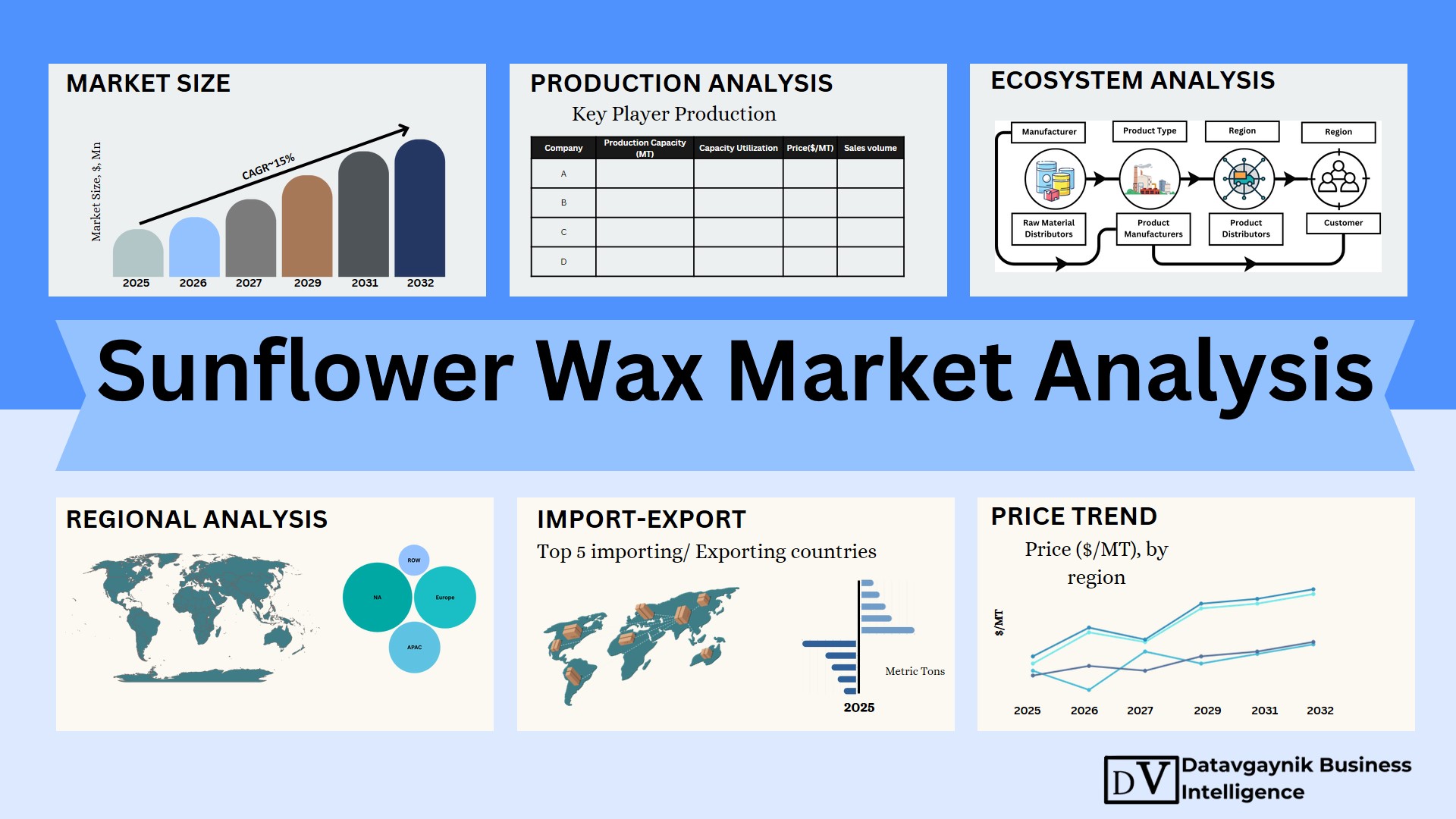
The global Sunflower Wax Market is estimated at $384 million in 2026 and is expected to reach $675 million by 2035, growing at a CAGR of 6.5%.
Sunflower wax is a hard, plant-derived wax obtained mainly during the winterization and refining of sunflower oil. In ingredient terms, it is commonly listed as Helianthus Annuus Seed Cera or sunflower seed wax. The European Commission’s CosIng database describes it as wax obtained from sunflower seed, while major ingredient suppliers position it as a high-melting, structure-building wax for cosmetics and personal care formulations.
Datavagyanik also covers related markets such as the Polyethylene Wax (PE Wax) Market, the Acrylic Wax Market, and the Polypropylene Wax Market. Understanding these markets sheds light on emerging innovations and industry crossovers that impact the main topic.
The business relevance of this market is simple. Brands want cleaner texture systems. Formulators want waxes that can harden sticks, stabilize balms, bind oils, improve heat resistance, and reduce greasy feel without relying too heavily on petroleum-based or animal-derived ingredients. Sunflower wax fits that need. It is not a bulk commodity like paraffin. It sits closer to a specialty wax. That means value is shaped by purity, color, odor, melting point, certification, traceability, and formulation performance.
The Sunflower Wax Market will grow through 2026–2035 because it connects with several steady demand pools. The first is cosmetics. Lip balms, lipsticks, mascara, solid perfumes, anhydrous balms, sun care sticks, and hair styling formats all need wax structuring. The second is food and confectionery. Edible coating systems and glazing applications need natural wax options, although the regulatory burden is higher here. The third is industrial and household use. Candles, polishes, leather care, surface protection, and bio-based coatings are all smaller but useful outlets.
| Metric | Analyst Estimate |
| Global Market Size, 2026 | $384 million |
| Projected Market Size, 2035 | $675 million |
| Forecast CAGR, 2026–2035 | 6.5% |
| Estimated 2026 Volume Range | 28,000–34,000 metric tons |
| Average Realized Price Range, 2026 | $11–14/kg |
| Core Demand Base | Cosmetics, personal care, food coatings, candles, polishes, pharma excipients, bio-based materials |
The strongest macro force is the shift away from synthetic and animal-derived waxes in premium personal care. Vegan and plant-based claims are now mainstream in lip care and color cosmetics. That said, sunflower wax is not replacing every wax. Carnauba, candelilla, rice bran, beeswax, paraffin, and microcrystalline wax still have roles. Sunflower wax wins where brands need plant origin, high melting point, oil-binding, and a clean sensory profile.
Production economics also matter. Sunflower wax is linked to sunflower oil refining. So availability depends partly on sunflower seed crushing, oil flows, refining intensity, and the ability to recover and purify wax fractions. This makes Europe, the Black Sea region, India, China, and selected Asian processors important to the supply ecosystem. A disruption in edible oil supply does not immediately become a wax shortage, but it can affect feedstock cost and procurement confidence.
Technology is moving the market from simple refined wax toward higher-performance grades. Hydrolyzed sunflower wax, organic-certified material, deodorized cosmetic grades, and pre-formulated wax blends are becoming more relevant. KahlWax, for example, lists both sunflower and hydrolyzed sunflower wax variants, with the latter positioned for different polarity and emulsification behavior.
Key consumers and clients include:
- Beauty and personal care brands using waxes in lip care, color cosmetics, deodorant sticks, balms, and hair care.
- Contract manufacturers that need reliable natural structuring agents for clean-label formulas.
- Food and confectionery manufacturers exploring plant-based coating and polishing systems.
- Candle and home fragrance companies looking for harder vegetable wax blends.
- Pharmaceutical and nutraceutical producers using waxes in coating, binding, and controlled texture applications.
- Industrial polish and surface-care formulators using waxes for gloss, hardness, and film formation.
Expert view: The market will not grow because sunflower wax is “new.” It will grow because it solves a narrow but valuable formulation problem. It gives structure without making products feel heavy. That is exactly what clean beauty and solid-format personal care need over the next decade.
Market Segmentation and Forecast Scope
The Sunflower Wax Market can be segmented by product grade, application, end user, and region. This is a more useful structure than treating it as a single wax category. Buyers do not purchase sunflower wax only by name. They buy it for melting behavior, hardness, purity, color, certification, compatibility with oils, and whether it performs in a finished formulation.
By Product Type
The main product types include refined sunflower wax, hydrolyzed sunflower wax, organic or certified sunflower wax, and sunflower wax blends.
Refined sunflower wax is the base commercial grade. It is used where hardness, oil binding, and texture control matter. It is especially relevant in sticks, balms, decorative cosmetics, creams, lotions, and some coating systems.
Hydrolyzed sunflower wax is a more specialized form. It has better polarity and is used when formulators need emulsification support, viscosity improvement, or a different skin feel. It is smaller in current revenue but strategically important because it moves sunflower wax from a simple structurant into a functional formulation aid.
Organic or certified sunflower wax serves premium personal care and natural cosmetics brands. Certification may include organic, vegan, natural-origin, non-GMO, or sustainability-linked claims depending on supplier and buyer requirements.
Sunflower wax blends combine sunflower wax with carnauba, rice bran, beeswax alternatives, esters, or emulsifiers. These blends are gaining attention because most formulators do not want to solve texture problems from scratch. They want ready-to-use systems.
By Application
| Application Segment | 2026 Share Visibility | Strategic Comment |
| Cosmetics and Personal Care | 54% | Largest demand pool. Strong use in lip care, color cosmetics, balms, deodorant sticks, and hair formats. |
| Food and Confectionery Coatings | Not disclosed | Smaller than cosmetics but stable. Growth depends on food-grade compliance and regional approvals. |
| Candles and Home Fragrance | Not disclosed | Used mainly in blends where hardness and higher melting behavior are needed. |
| Pharmaceutical and Nutraceutical Uses | Not disclosed | Niche but attractive where purity and texture control matter. |
| Industrial Polishes and Surface Care | Not disclosed | Mature but useful outlet for gloss, hardness, and film formation. |
| Bio-based Packaging and Coatings | Not disclosed | Early-stage opportunity. Commercial adoption is still selective. |
Cosmetics and personal care remains the anchor application. This segment accounts for an estimated 54% of global demand in 2026. The reason is not just “natural ingredients.” It is performance. Sunflower wax helps build harder sticks, improves heat stability, supports oil gelation, and reduces tackiness. Supplier data also highlights its use as a gellant and consistency modifier in sticks and emulsions.
Food and confectionery coatings will remain selective. Sunflower wax has a plant-based story, but food applications need stricter compliance, documentation, and migration safety. Adoption will likely be stronger in premium confectionery, fruit coatings, and natural glazing systems rather than mass-market food processing.
Candles and home fragrance will grow at a moderate pace. Sunflower wax is not likely to become the primary candle wax. Soy, paraffin, palm, and coconut wax blends are already established. But sunflower wax can improve hardness and burn structure in specialty blends.
Bio-based coatings and packaging is the strategic segment to watch. It is not the largest today. It may not even scale quickly. But it gives sunflower wax a role outside beauty. If coating developers can balance cost, barrier properties, and processing behavior, this segment may become more important after 2030.
By End User
The end-user base includes cosmetic brands, contract manufacturers, food processors, pharmaceutical formulators, candle manufacturers, specialty chemical distributors, and industrial product companies.
Cosmetic contract manufacturers are especially important because they influence material selection across many brands. A single contract manufacturer can qualify sunflower wax across multiple client formulas. That can accelerate demand faster than direct brand-level adoption.
Specialty distributors also shape the market. Many small and mid-sized brands do not buy directly from wax producers. They buy through ingredient distributors that provide technical data sheets, formulation support, samples, and regulatory documentation.
By Region
| Region | 2026 Share Visibility | Growth View |
| North America | Not disclosed | Premium personal care, indie beauty, and clean-label product development support steady demand. |
| Europe | 32% | Strong natural cosmetics base, regulatory discipline, and supplier concentration make Europe the leading regional market. |
| Asia Pacific | Not disclosed | Fastest-growing region due to beauty manufacturing, rising local brands, and expanding ingredient distribution. |
| LAMEA | Not disclosed | Smaller base. Growth tied to personal care imports, local cosmetics production, and food/coating applications. |
Europe holds an estimated 32% share in 2026, supported by natural cosmetics adoption, established wax suppliers, and strict formulation standards. Asia Pacific is expected to be the fastest-growing regional market through 2035. The logic is clear. China, India, South Korea, Japan, and Southeast Asia are expanding beauty manufacturing. They also have rising demand for vegan, plant-derived, and sensorially refined ingredients.
The forecast scope covers refined and specialty sunflower wax sold into cosmetics, food coating, pharmaceutical, candle, home care, industrial polish, and early bio-based coating applications. It excludes crude sunflower oil, sunflower meal, edible sunflower seeds, and non-wax by-products from oil refining.
Expert view: Segmentation should not be built only around “natural wax.” That hides the real value. The premium opportunity is in functional grades that help formulators solve stability, melting, and sensory problems.
Market Trends and Innovation Landscape
The Sunflower Wax Market is moving from ingredient substitution to formulation engineering. Earlier demand was driven by the need to replace beeswax, paraffin, or synthetic waxes. That story is still relevant, but it is no longer enough. The next phase is about how sunflower wax behaves inside complex products.
Clean Beauty Is Still the Demand Engine
Beauty brands are using plant waxes to support vegan, natural-origin, and petroleum-free claims. Sunflower wax fits these claims well because it is plant-derived and has a high melting profile. It also works in anhydrous products, which are becoming more common in balms, sticks, solid perfumes, body care, and low-water formats.
Koster Keunen positions sunflower wax as a vegetable wax obtained from sunflower oil winterization and highlights its long-chain saturated ester structure. These esters are linked to hardness, crystalline structure, and high melting behavior.
This matters because brands are not just asking for “natural.” They want formulas that survive shipping, warm bathrooms, and e-commerce logistics. A balm that melts too easily is a customer complaint. A lipstick that sweats oil on the surface is a quality issue. Sunflower wax can help reduce those risks.
R&D Is Moving Toward Better Texture Systems
Ingredient R&D is now focused on wax networks. Formulators are studying how sunflower wax interacts with oils, butters, esters, pigments, film formers, and emulsifiers. The goal is to create stable structures with less wax loading. That can improve glide and reduce drag.
Supplier-side formulation examples already show this direction. Koster Keunen’s 2025 in-cosmetics Global material included a vegan anhydrous gel concept using sunflower wax as part of the structuring system. The formulation angle is important because it shows sunflower wax being marketed not just as a raw ingredient but as part of a sensorial product architecture.
Hydrolyzed and Modified Grades Are Becoming More Strategic
Standard refined sunflower wax is useful. Modified grades are more interesting. Hydrolyzed sunflower wax can behave differently in emulsions and can support texture, viscosity, and body in creams and lotions. KahlWax lists hydrolyzed sunflower wax alongside standard sunflower wax products, showing how suppliers are building more differentiated portfolios around the same botanical source.
This may lead to higher margins. Commodity waxes are price-sensitive. Functional waxes are not judged only by cost per kilogram. They are judged by performance per formula.
Material Science Is Focused on Crystallinity and Heat Stability
Sunflower wax has a hard, crystalline structure. That is useful, but it can also be challenging. Too much crystallinity can affect texture. Too little structuring can weaken the finished product. So the innovation work sits in balancing wax particle behavior, cooling profiles, oil compatibility, and blend ratios.
A practical example is stick cosmetics. Sunflower wax can improve hardness and heat resistance. But formulators still need glide, payoff, pigment dispersion, and pleasant skin feel. This is why sunflower wax is often blended with softer waxes, esters, oils, and emollients rather than used alone.
Partnerships and News Activity Remain Formulation-Led
There has not been a major sunflower-wax-only merger or acquisition that reshapes the market. Public activity is more visible in product showcases, distributor partnerships, formulation launches, and specialty ingredient portfolios. Koster Keunen, KahlWax, and Norevo are examples of companies positioning natural waxes across cosmetics, food, confectionery, pharmaceutical, and technical applications. Norevo describes itself as a supplier and producer of natural raw materials and specialty ingredients for food, confectionery, pharmaceutical, cosmetic, and technical sectors.
That tells us something important. The market is not consolidating around pure sunflower wax assets. It is growing through application support. Technical service, formulation data, regulatory files, and sample availability are becoming commercial differentiators.
| Innovation Area | What Is Changing | Likely Market Impact by 2035 |
| Vegan Stick Formulations | Higher use in lip care, deodorants, balms, body sticks, and solid beauty formats. | More stable baseline demand from cosmetics. |
| Hydrolyzed Wax Grades | Better use in emulsions and higher-value texture systems. | Improved margins for specialty suppliers. |
| Wax Blends | Sunflower wax blended with carnauba, rice bran, esters, or emulsifiers. | Faster adoption by contract manufacturers. |
| Bio-based Coatings | Trial use in surface protection and packaging-related coatings. | Long-term upside, but adoption will remain selective. |
| Cleaner Supply Chains | More interest in traceable, certified, and lower-residue grades. | Premium buyers shift toward documented suppliers. |
AI is not a major implementation theme for this market. Digital formulation tools may help R&D teams screen wax ratios and stability outcomes, but AI is not currently a demand driver for sunflower wax itself. The more relevant innovation is material behavior: melting point, crystal network, oil binding, sensory feel, and certification.
Expert view: The next winners will not be suppliers selling sunflower wax as a generic natural ingredient. The winners will be those that sell proof — stability data, formulation guidance, clean documentation, and repeatable performance across oils and climates.
Competitive Intelligence and Benchmarking
The Sunflower Wax Market is not dominated by one global producer. It is a specialist supplier market. Most participants operate across natural waxes, cosmetic ingredients, food-grade materials, pharmaceutical excipients, and technical wax blends. That matters because buyers rarely source sunflower wax in isolation. They usually qualify it alongside carnauba wax, rice bran wax, candelilla wax, beeswax alternatives, ester waxes, and specialty wax systems.
| Company | Position in Sunflower Wax Ecosystem | Portfolio and Market Position |
| Koster Keunen | Premium natural wax specialist | Strong in cosmetic-grade waxes, functional blends, formulation support, and natural structuring systems. |
| KahlWax | Technical and cosmetic wax formulator | Strong in refined and modified plant waxes, including hydrolyzed sunflower-based grades. |
| Norevo | Natural raw material and specialty ingredient supplier | Serves food, confectionery, cosmetics, pharma, and technical sectors with natural waxes and related ingredients. |
| Strahl & Pitsch | Wax refiner and specialty distributor | Strong in North American personal care and pharmaceutical wax supply. |
| Henry Lamotte Oils | Natural oils and waxes supplier | Supplies sunflower wax and related natural oil-derived ingredients into cosmetics, pharma, food, and technical markets. |
| Poth Hille | UK-based specialty wax supplier | Serves cosmetics, industrial wax, and specialty application customers with bulk wax supply. |
Koster Keunen is one of the most visible players in the premium wax segment. Its position is strongest in cosmetics and personal care where sunflower wax is used as a structuring and oil-binding ingredient. The company has also pushed formulation-led promotion. This is important. Buyers want proof that a wax can stabilize a stick, balm, gel, or emulsion. Koster Keunen has used application concepts around vegan anhydrous gels and texture systems to support that positioning.
KahlWax competes through grade diversity. Its portfolio includes standard sunflower-derived wax grades and modified forms with different polarity and functional behavior. This gives it a stronger position with formulators who need more than hardness. Hydrolyzed sunflower wax can support creams, lotions, and emulsions where regular hard wax may be too crystalline or less compatible. That puts KahlWax in a higher-value technical niche within the Sunflower Wax Market.
Norevo has a broader natural ingredient position. It is not a sunflower-wax-only company. Its relevance comes from cross-sector reach. The company serves food, confectionery, pharmaceutical, cosmetic, and technical applications. This gives Norevo access to customers that may test sunflower wax not only in cosmetics but also in coating, glazing, and specialty formulation systems.
Strahl & Pitsch is important in North America because it operates as a specialist wax refiner, importer, and blender. Its commercial strength is not only supply. It is qualification support. Personal care and pharmaceutical buyers need consistency, documentation, and substitution guidance. Strahl & Pitsch positions sunflower wax as a high-melting vegetable wax for lip care, creams, lotions, balms, and decorative cosmetics.
Henry Lamotte Oils has a natural raw material advantage. The company supplies oils and related products into food, cosmetics, pharmaceuticals, animal nutrition, and technical industries. Its sunflower wax positioning is linked to fractionation after sunflower oil production. This makes it relevant for buyers seeking a supplier connected to broader oil and plant-based ingredient sourcing.
Poth Hille is a useful benchmark for the UK and European distribution layer. It positions sunflower wax for cosmetics, creams, lip balms, mascara, massage butters, and replacement of selected harder plant waxes. For smaller formulators, this kind of supplier matters because sample access, technical response time, and low-to-mid volume availability can decide whether a material gets tested.
The competitive structure shows three clear layers. The first layer is technical wax specialists such as Koster Keunen and KahlWax. The second layer is natural ingredient suppliers such as Norevo and Henry Lamotte Oils. The third layer is regional wax distributors and refiners such as Strahl & Pitsch and Poth Hille. Each layer serves a different customer type.
Expert view: The winning supplier in this market won’t simply offer the lowest price per kilogram. It will offer stable quality, documentation, formulation proof, and faster customer qualification. That is where margin protection sits.
Regional Landscape and Adoption Outlook
The Sunflower Wax Market is shaped by two different maps. One map is feedstock. That follows sunflower seed and sunflower oil production. The second map is demand. That follows cosmetics manufacturing, clean-label formulation, food coating trials, specialty distribution, and premium personal care consumption.
| Region / Country | Estimated 2026 Market Value | 2026–2035 Growth Outlook | Adoption Character |
| United States | $72 million | 5.8% CAGR | Premium personal care, indie beauty, pharma-grade waxes, and specialty distribution. |
| Europe | $123 million | 6.1% CAGR | Largest regional base. Strong natural cosmetics and supplier infrastructure. |
| China | $58 million | 7.4% CAGR | Fast scale-up in cosmetics manufacturing, e-commerce beauty, and local formulation. |
| India | $31 million | 8.1% CAGR | High-growth personal care manufacturing and growing natural ingredient demand. |
| Japan | $26 million | 4.9% CAGR | Stable premium beauty market with high quality and sensory standards. |
| South Korea | $29 million | 7.2% CAGR | K-beauty export engine and fast formulation cycles. |
| Middle East | $18 million | 6.8% CAGR | Premium cosmetics, fragrance, balms, and imported personal care. |
| Other Regions | $27 million | 5.5% CAGR | Small but growing across Latin America, Southeast Asia, and technical wax uses. |
United States
The United States is a high-value market rather than a major sunflower wax feedstock center. Demand is led by personal care brands, contract manufacturers, pharmaceutical excipient users, and natural wax distributors. The country has a strong base of indie beauty companies and premium clean-label brands. These brands often move fast on vegan and petroleum-free claims.
The main adoption point is formulation replacement. A U.S. lip balm or deodorant stick manufacturer may not use sunflower wax alone. It may blend it with softer waxes, oils, and esters to improve hardness and reduce oil bleed. This creates steady specialty demand. The United States will account for an estimated 19% of global market value in 2026.
Europe
Europe is the strongest region for the Sunflower Wax Market in 2026. The region benefits from natural cosmetics demand, strict ingredient documentation, mature specialty distribution, and proximity to sunflower oil processing in Europe and the broader Black Sea supply chain. The EU also has a strong sunflowerseed production base. USDA/FAS noted in April 2026 that EU oilseed production for MY 2026/27 was forecast to increase mainly because of higher rapeseed and sunflower production.
Germany, France, the Netherlands, the UK, Italy, and Spain are key demand centers. Germany and the Netherlands are especially relevant because of ingredient trading, natural cosmetics, and specialty chemical distribution. France and Italy add premium beauty manufacturing. Spain brings both cosmetics and oilseed-linked sourcing activity.
Regulation supports higher-quality suppliers. EU buyers tend to request INCI clarity, technical documentation, impurity control, allergen statements, vegan suitability, and natural-origin data. This raises supplier compliance cost. It also protects premium suppliers from low-documentation material.
China
China is a scale market. Demand is driven by local cosmetics manufacturing, cross-border beauty, domestic brands, and fast e-commerce cycles. The country also has sunflower seed and vegetable oil processing activity, although high-grade cosmetic wax still depends on refining quality and technical standardization.
China’s beauty demand base remains large. The National Bureau of Statistics reported 2025 cosmetics retail sales of 465.3 billion yuan, up 5.1% year on year among enterprises above designated size. That supports continued ingredient demand even when premium beauty cycles fluctuate.
Adoption will be strongest in lip care, color cosmetics, solid balms, hair waxes, and local clean beauty concepts. The challenge is quality differentiation. Lower-cost wax may be available. But multinational and export-oriented Chinese formulators still need consistent color, odor, melting behavior, and regulatory files.
India
India is the fastest-growing regional opportunity in this forecast. The base is smaller than China or Europe, but the growth logic is strong. Beauty and personal care manufacturing is expanding. Domestic brands are launching skin care, lip care, body care, hair care, and ayurvedic-inspired products at a fast pace. The India Brand Equity Foundation has previously highlighted strong growth in India’s beauty, cosmetics, and grooming market, with organized retail gaining share over time.
India also has sunflower oil consumption and refining activity. That creates a practical basis for local wax recovery and purification over time. The opportunity is not only import substitution. It is formulation localization. Indian climates need heat-stable balms, sticks, and creams. Sunflower wax can help products survive higher ambient temperatures during warehousing, transport, and retail display.
Japan
Japan is quality-led. The market is not expected to grow as quickly as India or South Korea, but it can support premium-grade wax demand. Japanese cosmetics buyers care deeply about texture, stability, odor neutrality, and consumer feel. That makes sunflower wax relevant in high-end lip care, color cosmetics, solid skin care, and hybrid skin-care makeup.
Japan has a large established beauty base. The Japan Cosmetic Industry Association reported cosmetic shipments of 1,302.4 billion yen in 2023, up 2.9% from the previous year, based on METI production statistics.
The main constraint is conservative formulation behavior. Japanese companies may take longer to qualify a new wax system. Once qualified, however, demand can be stable.
South Korea
South Korea is one of the most strategic markets for sunflower wax. It is not the largest by volume. But it has very high influence because K-beauty brands commercialize quickly and export aggressively. South Korea’s cosmetics exports reached a record $10.2 billion in 2024, according to the Ministry of Food and Drug Safety as reported by Korea.net.
This export machine creates demand for ingredients that can support vegan claims, sensory differentiation, and format innovation. Sunflower wax fits into lip tints, balms, glow sticks, solid serums, hair wax, and hybrid makeup formats. The commercial cycle is short. A material that works in one hero product can spread across multiple SKUs within 12–24 months.
Middle East
The Middle East is relevant but selective. Demand is concentrated in premium beauty, fragrance, lip care, balms, personal grooming, and imported cosmetics. The region is not a major sunflower wax production hub. It is a consumption and distribution market.
The strongest demand pockets are the UAE and Saudi Arabia. Heat stability is an important product requirement because cosmetics and balms can face harsh logistics conditions. This supports wax systems with higher melting points. However, adoption will remain tied to imported formulation systems and multinational brand activity rather than deep local raw material manufacturing.
Expert view: Europe leads because it has supplier infrastructure and documentation discipline. India and South Korea are more exciting for growth. China has scale, but qualification standards will separate premium cosmetic-grade wax from low-cost plant wax supply.
Recent Developments + Opportunities & Restraints
Recent Developments
April 2025 – Koster Keunen showcased a vegan anhydrous gel concept using sunflower wax at in-cosmetics Global 2025.
The company presented a formulation where sunflower wax helped structure a pumpable oil gel without greasy feel. This matters because it directly links sunflower wax to solid beauty, vegan formulation, and sensory-led product design.
September 2024 – H. Foster highlighted KahlWax sunflower wax grades for cosmetic formulation use.
The update emphasized hydrolyzed sunflower wax as a more polar and hydrophilic option than standard sunflower wax. The commercial signal is clear. Suppliers are no longer selling only hard wax. They are positioning functional wax grades for creams, lotions, and emulsion systems.
April 2026 – USDA/FAS forecast stronger EU oilseed production for MY 2026/27 due partly to higher sunflower production.
This supports the upstream side of the wax ecosystem. More sunflowerseed processing does not automatically mean more cosmetic-grade wax. Still, better sunflower oil availability can improve confidence in wax feedstock recovery and refining.
January 2026 – China released full-year 2025 retail data showing cosmetics sales of 465.3 billion yuan, up 5.1%.
This is not a sunflower wax event by itself. But it supports the demand base for specialty cosmetic ingredients. A large and growing cosmetics retail pool increases the addressable market for plant-based structuring materials.
November 2025 – South Korea’s trade ministry reviewed K-beauty export performance and new export models with industry stakeholders.
K-beauty’s export push supports ingredient demand across vegan, clean-label, and format-driven cosmetics. This helps sunflower wax suppliers because Korean formulators move fast across lip care, balms, sticks, and hybrid cosmetic formats.
Opportunities and Business Insights
Opportunity 1 – Premium cosmetic structuring systems
The best growth opportunity is in high-performance beauty formats. Lip balms, lipsticks, solid serums, deodorant sticks, face sticks, and waterless body care all need wax networks. A supplier that can show stability at elevated temperatures can win faster qualification.
Opportunity 2 – India, China, and South Korea as formulation growth corridors
The Sunflower Wax Market will gain from Asian beauty manufacturing. India offers climate-driven demand for heat-stable products. China offers scale. South Korea offers export-led formulation speed. Together, these three markets could add $72–85 million in incremental demand by 2035.
Opportunity 3 – Modified and hydrolyzed wax grades
Hydrolyzed and technically modified sunflower wax grades can command better pricing than standard refined wax. These products solve more specific problems: viscosity, emulsion feel, texture control, and stability. That is where suppliers can protect margins.
Restraints
Restraint 1 – Feedstock volatility
Sunflower wax depends on sunflower oil refining and wax recovery. Weather, regional crop output, crushing economics, and Black Sea trade flows can affect availability. Buyers may dual-source with rice bran, carnauba, or candelilla wax when supply risk rises.
Restraint 2 – Formulation limits
Sunflower wax is useful, but it is not universal. High crystallinity can create texture issues if the formulation is poorly balanced. It often works best in blends. This raises R&D time for smaller brands.
Restraint 3 – Price sensitivity in non-cosmetic applications
Candles, industrial polish, and bulk coatings are cost-sensitive. These applications may use sunflower wax only where performance justifies a premium. Cosmetics will remain the stronger profit pool.
Expert view: The market opportunity is not in selling sunflower wax as a cheap natural substitute. It is in selling it as a controlled texture technology for clean-label formulations. That distinction will decide supplier margins through 2035.


