

Global Thermal Recovery Boilers Market
The global Thermal Recovery Boilers Market will witness a robust CAGR of 5.3%, valued at $3.9 billion in 2026, expected to appreciate and reach $6.2 billion by 2035.
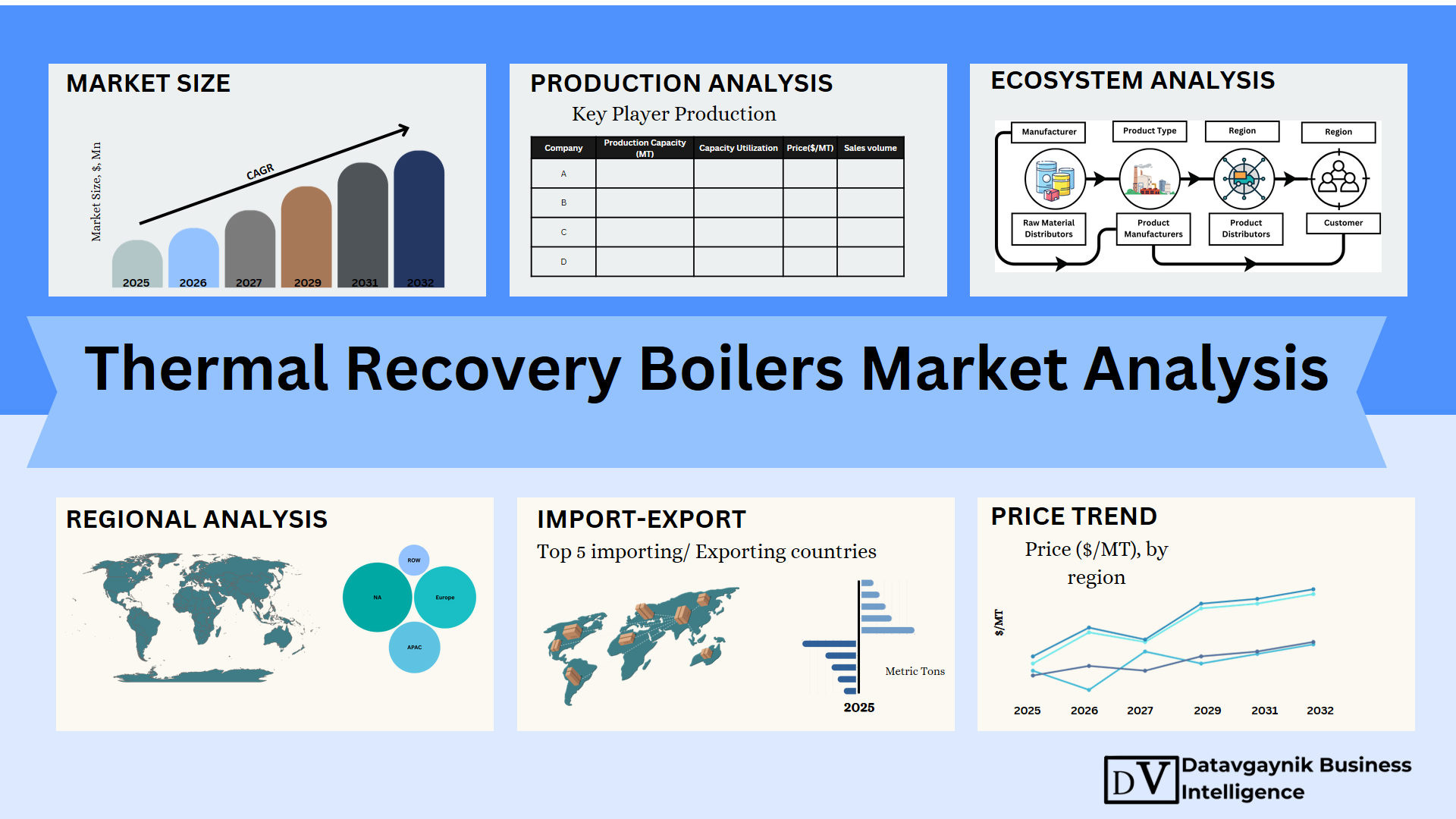
Thermal recovery boilers are engineered systems that capture high-temperature exhaust, flue gas, process gas, or industrial waste heat and convert it into useful steam, hot water, or power-generation input. In simple terms, they help industrial plants recover energy that would otherwise be lost. That makes them relevant in refining, petrochemicals, power generation, cement, steel, pulp and paper, waste-to-energy, and large-scale manufacturing.
The Thermal Recovery Boilers Market sits at the intersection of energy efficiency, industrial decarbonization, and process-cost reduction. By 2026, buyers are no longer looking at these boilers only as utility equipment. They are treating them as part of plant-level energy strategy. A cement producer may use waste heat from kiln exhaust to generate power. A refinery may recover process heat to reduce fuel consumption. A combined-cycle power plant may depend on heat recovery steam generators to lift output without adding equivalent fuel load.
The growth case for 2026–2035 is shaped by four practical forces. First, fuel prices remain volatile, so industrial users want to squeeze more energy from existing operations. Second, governments are pushing energy-efficiency standards and lower industrial emissions. Third, older boiler assets in developed markets need retrofit, replacement, or digital monitoring upgrades. Fourth, Asia Pacific, the Middle East, and parts of Latin America are still adding industrial capacity, which brings new demand for waste heat recovery systems and heat recovery steam generators.
That said, this is not a plug-and-play market. Project economics depend on gas temperature, pressure profile, plant uptime, fuel mix, metallurgy, and site layout. This is why demand is strongest where heat recovery can be directly linked to measurable savings or process reliability.
| Market Indicator | Estimate / Outlook |
| Global Market Size, 2026 | $3.9 billion |
| Projected Market Size, 2035 | $6.2 billion |
| Forecast CAGR, 2026–2035 | 5.3% |
| Core Demand Base | Power generation, refining, petrochemicals, cement, steel, pulp and paper, waste-to-energy |
| Strategic Buying Trigger | Lower fuel use, steam recovery, emissions reduction, process efficiency |
| Main Equipment Scope | Heat recovery steam generators, waste heat recovery boilers, process gas boilers, industrial recovery boiler systems |
| Excluded Scope | Standalone conventional fossil-fuel boilers used without thermal recovery function |
Key stakeholders include boiler OEMs, EPC contractors, industrial plant operators, power utilities, independent power producers, energy service companies, government energy agencies, industrial efficiency associations, environmental regulators, and infrastructure investors. Major equipment-side participants include GE Vernova, Siemens Energy, Mitsubishi Power, Thermax, Babcock & Wilcox, John Cockerill, Valmet, Andritz, Sofinter, and Alfa Laval, among others.
Expert view: The most attractive opportunities will not come from generic boiler replacement. They will come from sites where recovered heat can be tied to fuel savings, steam balance, carbon reduction, or captive power. That makes application engineering more important than simple equipment pricing.
Market Segmentation and Forecast Scope
The segmentation frame for the Thermal Recovery Boilers Market should reflect how the equipment is actually specified and purchased. Buyers rarely start with a generic boiler category. They start with a heat source, steam requirement, pressure level, operating risk, and project economics. So, the market is best assessed across product type, application, end user, and region.
By Product Type
Heat Recovery Steam Generators form the most visible product category, especially in gas turbine combined-cycle and cogeneration projects. This segment accounts for an estimated 38% of global revenue in 2026. Demand is supported by power plants, industrial cogeneration units, and sites where gas turbine exhaust can be converted into useful steam.
Waste Heat Recovery Boilers are used across cement, steel, glass, chemicals, and non-ferrous metals. Their value depends heavily on process temperature and operating continuity. In energy-intensive industries, they are often justified through payback economics rather than regulatory compliance alone.
Process Gas Boilers are more specialized. They are used in chemical, petrochemical, refinery, syngas, sulfur recovery, and high-temperature process streams. These systems require stronger engineering depth because gas composition, corrosion risk, fouling, and pressure conditions can vary sharply by plant.
Biomass and Pulp Recovery Boilers are relevant in pulp and paper and selected bioenergy applications. They recover heat and chemicals while supporting steam generation. Their demand is tied to mill modernization, biomass-based energy, and circular process economics.
By Application
Power Generation and Cogeneration remains a strategic application area. It includes combined-cycle plants, captive power units, and industrial cogeneration systems. The strongest demand comes from facilities trying to improve output without building an entirely new thermal generation base.
Industrial Waste Heat Recovery is one of the most important long-term opportunity areas. Cement kilns, steel reheating furnaces, glass furnaces, refinery units, and petrochemical processes release large amounts of usable heat. Even a modest recovery system can reduce purchased fuel or grid power exposure.
Refining and Petrochemical Process Recovery requires custom boiler design. These facilities use thermal recovery to support steam networks, sulfur recovery units, hydrogen production systems, and process heat integration.
Waste-to-Energy and Environmental Systems are also gaining attention. Municipal solid waste, biomass residues, and industrial waste streams can support steam and power recovery when paired with properly engineered boiler systems.
By End User
Utilities and Independent Power Producers buy thermal recovery boilers as part of power island or combined-cycle configurations. Their buying criteria usually focus on output efficiency, lifecycle reliability, and turbine-boiler integration.
Heavy Industrial Operators are major end users. Cement, metals, chemicals, refining, and pulp facilities buy these systems to reduce fuel intensity and improve plant economics. This group is expected to be one of the most strategic demand pools during 2026–2035.
EPC Contractors and Industrial Project Developers influence supplier selection. They often decide the preferred boiler package based on project risk, cost, delivery timeline, integration complexity, and long-term service support.
Energy Service Companies are becoming more relevant in retrofit projects. In some cases, they support energy-efficiency upgrades through shared savings, performance contracts, or turnkey heat recovery programs.
By Region
Asia Pacific is expected to hold the largest regional position, with an estimated 43% revenue share in 2026. China, India, Japan, South Korea, and Southeast Asia have a large base of power, steel, cement, refining, chemicals, and process industries. That creates both new-build and retrofit opportunities.
North America is driven by industrial modernization, refinery upgrades, power plant efficiency projects, waste-to-energy facilities, and replacement demand. The region is mature, but project value remains high because buyers often prefer engineered and high-reliability systems.
Europe has a strong regulatory and energy-efficiency push. Demand is linked to industrial decarbonization, district heating, biomass, waste-to-energy, and heat recovery retrofits in older manufacturing assets.
LAMEA is mixed but attractive. The Middle East has refining, petrochemical, and power-generation demand. Latin America offers opportunities in pulp and paper, mining, cement, and industrial cogeneration. Africa is smaller today, but mining, cement, and energy infrastructure projects can open selective demand pockets.
| Segmentation Dimension | Key Sub-Segments Covered | Strategic Signal |
| By Product Type | Heat recovery steam generators, waste heat recovery boilers, process gas boilers, biomass and pulp recovery boilers | HRSGs lead in 2026, while industrial waste heat systems gain strategic depth |
| By Application | Power generation, cogeneration, industrial waste heat recovery, refining, petrochemicals, waste-to-energy | Industrial waste heat recovery is the most practical decarbonization-linked growth area |
| By End User | Utilities, IPPs, heavy industries, EPC contractors, energy service companies | Heavy industries are moving from compliance-led buying to savings-led buying |
| By Region | North America, Europe, Asia Pacific, LAMEA | Asia Pacific leads on scale; Europe leads on policy-led retrofits |
Expert view: The fastest growth will likely come from industrial retrofit projects where steam recovery, fuel savings, and emissions reduction can be shown in one investment case. This is why cement, steel, refining, and chemicals deserve close attention.
Market Trends and Innovation Landscape
Innovation in the Thermal Recovery Boilers Market is moving in a practical direction. Buyers are not asking for experimental equipment. They want stronger heat transfer, lower fouling, better corrosion resistance, faster installation, digital monitoring, and systems that can work with lower-carbon industrial operations.
R&D Evolution
R&D is focused on improving lifecycle performance rather than changing the basic purpose of the boiler. OEMs are working on better tube bank arrangements, improved circulation design, modular configurations, advanced steam separation, and stronger protection against thermal fatigue. These improvements matter because many thermal recovery boilers operate under unstable loads, varying gas flow, and changing temperature profiles.
For industrial buyers, the hidden cost is downtime. A boiler that saves energy but creates frequent maintenance issues loses its business case quickly. So, R&D is increasingly tied to reliability, inspection access, easier cleaning, and predictive maintenance.
Technology Evolution
Modular and shop-assembled systems are gaining attention, especially for mid-sized industrial sites. They reduce site work, shorten installation time, and lower execution risk. Large field-erected units will remain important for power plants and heavy industrial complexes, but modularity is becoming more relevant in smaller cogeneration and waste heat recovery projects.
Digital monitoring is also becoming part of the standard value proposition. Sensors, controls, and analytics can track pressure, temperature, steam output, tube performance, fouling behavior, and abnormal operating patterns. AI is not yet a dominant buying factor across the market, but advanced analytics and predictive diagnostics are becoming relevant in high-value assets where downtime is expensive.
Practical example: A steel plant using waste heat recovery from furnace exhaust may not need “AI” as a headline feature. But it will benefit from early warnings on fouling, pressure drop, or thermal stress. That’s where digital tools create real value.
Material and Design Innovation
Material science is relevant here because these boilers often deal with corrosive gases, high temperatures, dust-loaded exhaust, and variable pressure. Better alloys, improved tube coatings, stronger refractory materials, and corrosion-resistant designs are being used in more demanding applications.
In waste-to-energy and biomass systems, fuel variability creates additional material stress. Chlorine, alkali metals, ash, and deposits can damage boiler surfaces. As a result, suppliers are investing in designs that reduce slagging, improve cleaning, and extend tube life.
In petrochemical and refining applications, process gas boilers must manage severe duty conditions. Engineering quality is critical. A small failure can affect steam balance, process continuity, and safety. This is why buyers in these industries often prefer proven OEMs and customized designs over low-cost standard packages.
Partnerships, M&A, and Industry Announcements
Recent industry activity has been less about headline-grabbing acquisitions and more about portfolio strengthening, service expansion, energy-efficiency partnerships, and decarbonization-linked project announcements. GE Vernova, Siemens Energy, and Mitsubishi Power continue to shape adjacent demand through gas turbine, hydrogen-ready power, and combined-cycle technology platforms. Their activity indirectly supports demand for advanced heat recovery steam generator systems.
Thermax remains relevant in industrial energy and waste heat recovery, particularly across Asia and emerging markets. Valmet and Andritz have strong positions in pulp, paper, biomass, and recovery boiler systems. Babcock & Wilcox, John Cockerill, Sofinter, and Alfa Laval continue to serve different pockets of industrial heat recovery, boiler engineering, and thermal systems.
Partnerships are also emerging around waste heat-to-power, industrial decarbonization, biomass energy, hydrogen production, and carbon capture-ready plant design. These developments matter because thermal recovery boilers are often not sold as standalone equipment. They are bundled into broader energy systems, process upgrades, or efficiency programs.
Future Impact
The next wave of growth will likely come from three directions. First, industrial plants will use heat recovery to reduce fuel intensity before committing to more expensive decarbonization technologies. Second, digital service models will become more common for high-value installations. Third, boiler designs will need to handle more varied operating conditions as plants integrate hydrogen, biomass, waste-derived fuels, and intermittent production schedules.
That creates a clearer path for the Thermal Recovery Boilers Market: not dramatic reinvention, but steady engineering improvement tied to energy savings and lower industrial emissions.
Expert view: The winning suppliers will be those that can combine equipment design, process knowledge, and service support. The market won’t reward a boiler vendor just for selling steel and tubes. It will reward vendors that can prove plant-level value.
Competitive Intelligence and Benchmarking
The competitive structure is shaped by engineering depth, installed base, service reach, and the ability to design around difficult heat sources. Large power projects favor global turbine-and-boiler integrators. Heavy industries often prefer suppliers with custom boiler experience, local execution teams, and lifecycle support.
| Company | Portfolio Position | Market Positioning |
| GE Vernova | Heat recovery steam generators for combined-cycle plants, service upgrades, inspection, repair, and lifecycle extension support | Strong in large gas-fired power projects and utility-scale combined-cycle systems |
| Siemens Energy | Integrated combined-cycle plant solutions, heat recovery systems, steam turbines, controls, and power island engineering | Strong in Europe, Middle East, and large utility projects where plant efficiency and flexibility matter |
| Mitsubishi Power | High-efficiency gas turbine combined-cycle systems, heat recovery steam generators, industrial cogeneration packages, and boiler engineering | Strong in Japan, Asia, Middle East, and utility-scale energy transition projects |
| Thermax | Waste heat recovery boilers, heat recovery systems, industrial boilers, waste-to-energy boilers, and turnkey thermal systems | Strong in India, Southeast Asia, Middle East, Africa, and industrial retrofit applications |
| John Cockerill | Heat recovery steam generators, industrial boilers, cogeneration systems, and service upgrades | Strong independent HRSG specialist with relevance in hydrogen-ready and flexible power applications |
| Valmet | Recovery boilers, biomass boiler systems, chemical recovery systems, boiler rebuilds, automation, and mill-level service support | Strong in pulp, paper, biomass, and recovery boiler modernization projects |
| ANDRITZ | Chemical recovery boilers, power boilers, evaporation systems, biomass-linked energy systems, and lifecycle services | Strong in pulp and paper recovery boiler systems, especially large mill modernization projects |
GE Vernova has one of the strongest positions in utility-scale heat recovery steam generator systems because of its combined-cycle power plant ecosystem. Its advantage is not only equipment supply. It can integrate gas turbines, steam turbines, HRSGs, generators, controls, and long-term service into one project structure. That matters for utilities that want single-point accountability.
Siemens Energy competes through high-efficiency combined-cycle plant design, steam turbine expertise, and flexible power plant architecture. Its position is particularly relevant where buyers want fast-start capability, fuel flexibility, and lower emissions from gas-based generation. The company also benefits from large references in Europe, the Middle East, and Latin America.
Mitsubishi Power is highly relevant in gas turbine combined-cycle and cogeneration applications. Its market position is supported by high-efficiency turbine platforms, HRSG integration, and strong demand from Asian utilities. The company is also well positioned where coal-to-gas conversion, hydrogen-readiness, and high-efficiency dispatchable power are part of the project brief.
Thermax has a different strength. It is closer to industrial customers. Its waste heat recovery portfolio serves cement, metals, oil and gas, chemicals, glass, food processing, and waste-to-energy applications. The company benefits from local engineering cost advantages, emerging-market relationships, and strong execution capability in customized thermal systems.
John Cockerill has a focused position in heat recovery steam generators and industrial energy systems. Its advantage sits in design flexibility, once-through and drum-type boiler know-how, and its push toward hydrogen-ready HRSG certification. This makes the company relevant in markets where power assets must remain useful under future fuel-mix changes.
Valmet is strongest in pulp, paper, biomass, and chemical recovery systems. Its recovery boiler offering is tied to mill energy balance, chemical recovery, safety, automation, and uptime. This gives the company a strong value proposition in pulp mills where boiler reliability directly affects production economics.
ANDRITZ competes closely with Valmet in pulp and paper recovery boilers. Its strength is large-scale recovery boiler engineering, evaporation integration, biomass-linked energy systems, and mill modernization packages. The company is well placed where customers need recovery boiler upgrades that also reduce emissions and support internal energy generation.
Expert view: Competition is not only about boiler manufacturing. The winning suppliers are those that can connect thermal design with plant operation, emissions control, digital service, and project execution risk.
Regional Landscape and Adoption Outlook
Regional adoption depends on industrial density, gas-fired power investment, decarbonization pressure, and the age of installed boiler assets. The market is not evenly distributed. China and North boiler assets. The market is not evenly distributed. China and North America lead by scale. India leads on growth momentum. Europe leads in policy-driven retrofit intensity.
| Region / Country | Estimated 2026 Revenue Share | 2035 Growth Outlook | Adoption Character |
| North America | 21% | 4.5% CAGR | Retrofit, utility efficiency, pulp and paper, refining, waste-to-energy |
| Europe | 20% | 4.8% CAGR | Energy efficiency, district heating, biomass, industrial decarbonization |
| China | 19% | 5.6% CAGR | Cement, steel, chemicals, power, waste heat recovery, industrial efficiency |
| India | 8% | 7.3% CAGR | Cement, steel, chemicals, captive power, industrial energy savings |
| Japan | 6% | 3.7% CAGR | Mature retrofit market, high-efficiency power, pulp and industrial upgrades |
| South Korea | 4% | 5.1% CAGR | Power, petrochemicals, steel, shipbuilding-linked industrial demand |
| Rest of the World | 22% | 5.8% CAGR | Middle East refining and power, Southeast Asia industry, Latin America pulp and mining |
North America
North America is a mature but high-value market. The U.S. leads demand due to its installed base of combined-cycle plants, refineries, chemical facilities, pulp and paper mills, and waste-to-energy assets. Adoption is driven by asset replacement, performance upgrades, emissions compliance, and reliability improvement.
Canada adds demand through pulp and paper, oil sands, industrial cogeneration, and district energy systems. Funding availability is stronger than in most emerging markets. That said, project permitting and long equipment lead times can slow execution.
White space: Mid-sized industrial plants with older steam networks remain underserved. Many facilities still release usable heat because the recovery project looks too small for large EPCs and too complex for standard boiler suppliers.
Europe
Europe is shaped by regulation and industrial decarbonization. Germany, France, Italy, the Netherlands, the Nordics, and the U.K. are key markets. The region has strong demand for biomass boilers, waste-to-energy systems, district heating integration, industrial retrofits, and high-efficiency combined heat and power.
Energy prices and carbon costs make efficiency projects more attractive. Government support is also more structured than in many regions. However, Europe is not a high-volume new-build market. Growth comes from modernization, industrial emissions reduction, and replacement of legacy thermal assets.
White space: Eastern Europe and parts of Southern Europe still have aging industrial boiler systems where heat recovery upgrades remain underpenetrated.
China
China is the largest single-country opportunity by volume. It has deep demand from cement, steel, refining, chemicals, glass, non-ferrous metals, and power generation. Local suppliers are strong in standard and mid-range waste heat systems, while global suppliers remain relevant in high-efficiency combined-cycle and complex industrial projects.
Regulation supports energy efficiency, but adoption is also commercial. Large industrial groups want to reduce coal use, recover process heat, and improve plant economics. China also benefits from domestic manufacturing scale, faster project execution, and a large EPC ecosystem.
India
India is the fastest-growing major country market. Cement, steel, refining, chemicals, paper, textiles, and captive power users are all relevant buyers. Industrial electricity prices, coal logistics, fuel cost volatility, and policy focus on energy efficiency support adoption.
Government-led efficiency initiatives, industrial decarbonization discussions, and corporate sustainability targets are pushing the market forward. But financing remains uneven for smaller industrial users. Many projects still need clear payback periods of 2.5–5.0 years to move ahead.
White space: Small and mid-sized industrial clusters in Gujarat, Maharashtra, Tamil Nadu, Karnataka, Telangana, and eastern India offer strong future potential but need packaged financing and practical project models.
Japan
Japan is a mature engineering-led market. Adoption is linked to high-efficiency power plants, industrial cogeneration, pulp and paper recovery boilers, and replacement of older thermal systems. Buyers focus heavily on reliability, safety, precision engineering, and lifecycle support.
Growth is slower than India or China, but project quality is high. Japan also plays an important role as a technology exporter through domestic OEMs and EPC partnerships across Asia.
South Korea
South Korea is a compact but strategically important market. Demand comes from power generation, petrochemicals, steel, shipbuilding-related heavy industry, and industrial steam systems. The country has strong technical standards and advanced industrial operators.
Adoption will be supported by energy security concerns, lower-carbon industrial operations, and modernization of process heat systems. Growth is not broad-based. It is concentrated in large industrial groups and high-specification facilities.
Rest of the World
The Rest of the World includes the Middle East, Southeast Asia, Latin America, Africa, and Oceania. The Middle East is attractive due to refining, petrochemicals, desalination-linked power, and combined-cycle capacity. Southeast Asia is growing through industrialization, pulp and paper, cement, and gas-fired power. Latin America offers opportunities in pulp, mining, cement, sugar, and biomass energy. Africa remains underserved but has selective demand in mining, cement, and industrial power.
Expert view: The biggest white space is not in countries with no boiler suppliers. It is in countries where project developers, financiers, and OEMs have not yet packaged waste heat recovery as a bankable industrial productivity solution.
End-User Dynamics and Use Case
End-user adoption varies by operating need. Thermal recovery boilers are not bought for the same reason across industries. Utilities look at efficiency and output. Industrial users look at fuel savings and steam balance. Pulp mills look at chemical recovery and uptime. EPCs look at project risk.
Utilities and Independent Power Producers
Utilities and IPPs use heat recovery steam generators mainly in combined-cycle power plants. Their priority is efficiency, dispatch flexibility, emissions performance, and equipment reliability. They often prefer integrated packages where the gas turbine, steam turbine, boiler, controls, and service model are aligned.
For this group, the boiler is part of the power island. A weak HRSG design can reduce plant flexibility, limit steam output, or increase maintenance risk. So, buyers usually select suppliers with proven references rather than lowest-cost fabrication.
Heavy Industrial Operators
Cement, steel, metals, glass, and chemical producers adopt waste heat recovery boilers to recover heat from kilns, furnaces, reactors, incinerators, and process exhaust streams. The decision is usually financial. Does the system reduce fuel use? Does it create steam or electricity? Does it improve energy balance without disrupting production?
This user group is highly attractive because many plants still waste usable heat. But adoption depends on heat consistency, dust load, corrosion risk, and plant uptime.
Refineries and Petrochemical Plants
Refineries and petrochemical plants require customized systems because process gas quality, temperature, pressure, and corrosion behavior can vary widely. These users value safety, reliability, metallurgy, and engineering validation. A boiler failure in this environment can affect multiple units, not just steam output.
Pulp and Paper Mills
Pulp and paper mills use recovery boilers to support chemical recovery, steam generation, and internal energy balance. This is a specialized demand pool where Valmet and ANDRITZ have strong relevance. Buyers focus on safety, black liquor processing, steam efficiency, emissions, and mill availability.
EPC Contractors and Energy Service Companies
EPC contractors influence equipment selection in new industrial and power projects. They assess cost, delivery time, integration risk, supplier bankability, and service support. Energy service companies are more relevant in retrofit projects where the customer wants savings but not full project complexity.
Realistic Use Case Scenario
A 3,000 TPD cement plant in India installs a waste heat recovery boiler on kiln and cooler exhaust streams. The recovered heat supports a 5 MW captive power unit. At 75% annual operating availability, the system can generate around 32–33 GWh of electricity per year. If the plant offsets grid power priced at $0.09 per kWh, annual gross savings can approach $2.9–3.0 million before maintenance and financing costs.
This is exactly why cement remains one of the most practical end-user segments. The heat source is continuous. The power requirement is steady. The savings are measurable. And the project can be justified even without relying only on carbon credits.
Expert view: Adoption improves when buyers see the boiler as a profit-protection tool. Once recovered heat is converted into lower power cost or lower fuel use, the investment conversation becomes much easier.
Recent Developments + Opportunities & Restraints
Recent Developments
| Year / Month | Event | Industry Impact |
| 2025 January | John Cockerill received concept certification from TÜV SÜD for hydrogen-ready heat recovery steam generator designs. | Supports future-ready HRSG adoption in combined-cycle and cogeneration plants where hydrogen blending may become relevant. |
| 2025 January | India’s Bureau of Energy Efficiency and The Energy and Resources Institute announced a center focused on energy transition, including advanced boilers, smart manufacturing, and waste heat recovery systems. | Strengthens policy and technical support for industrial efficiency and boiler modernization in India. |
| 2025 May | ANDRITZ received an order from Green Bay Packaging to supply a recovery boiler, evaporation plant, and power boiler for a U.S. pulp mill. | Confirms continued investment in recovery boilers and integrated energy systems in pulp and paper. |
| 2025 July | GE Vernova announced commissioning of the first block at Taiwan Power Company’s Hsinta plant, including two heat recovery steam generators in the combined-cycle configuration. | Shows how coal-to-gas transition projects continue to create demand for high-efficiency HRSG packages. |
| 2026 May | Valmet announced a recovery boiler upgrade for Sappi Saiccor Mill in South Africa. | Highlights demand for safety, reliability, and lifecycle upgrades in recovery boiler assets outside traditional high-income markets. |
Opportunities
Industrial waste heat monetization: Cement, steel, chemicals, glass, and refining plants still release large volumes of recoverable heat. This gives suppliers a clear retrofit opportunity, especially where electricity and fuel costs remain high.
Digital monitoring and predictive maintenance: Remote condition monitoring, pressure-part diagnostics, fouling alerts, and lifecycle analytics can create service revenue beyond equipment sale. This is most relevant for high-value HRSGs and recovery boilers.
Emerging-market industrial upgrades: India, Southeast Asia, Middle East, Latin America, and parts of Africa offer growth where industrial capacity is expanding and energy efficiency is becoming a board-level priority.
Restraints
High upfront capital cost: Many projects require custom engineering, site modification, downtime planning, civil work, and integration with steam or power systems. This can delay adoption among mid-sized industrial users.
Application complexity: Waste heat quality is not uniform. Dust, corrosion, gas chemistry, temperature variation, and operating cycles can weaken project economics if not engineered properly.
Long payback sensitivity: Projects become harder to approve when fuel prices soften, plant utilization drops, or financing costs rise.
Expert view: The market’s growth ceiling is not technical feasibility. It is project bankability. Suppliers that combine equipment, audit, financing support, and performance assurance will unlock more demand than pure-play boiler vendors.


