

Market Summary and Growth Forecast
The global Tungsten Filaments in Specialized Lighting Market will witness a robust CAGR of 4.3%, valued at $0.46 billion in 2026, expected to appreciate and reach $0.67 billion by 2035.
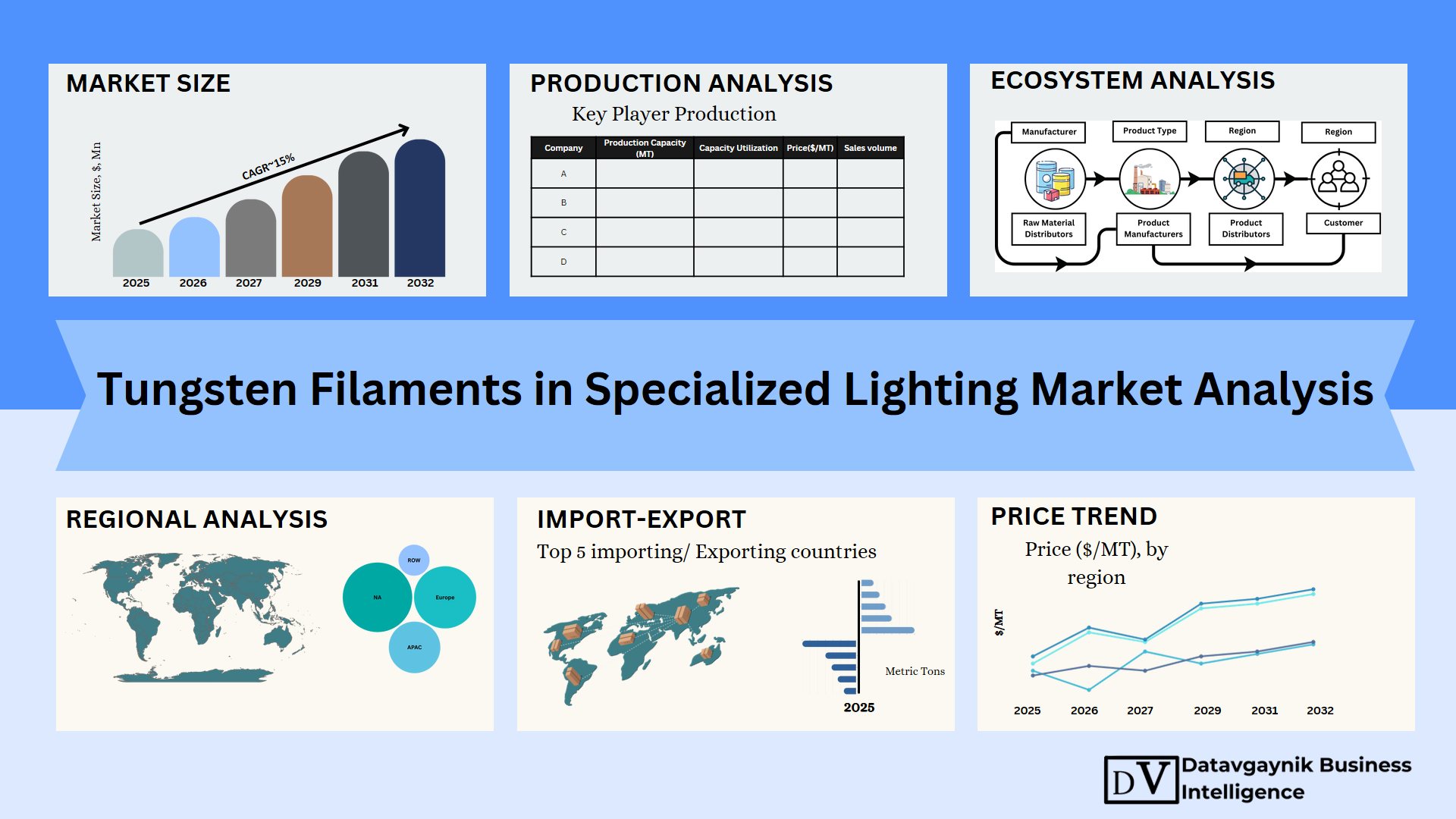
The Tungsten Filaments in Specialized Lighting Market covers precision tungsten filament components used in lighting systems where ordinary LED replacement is not always practical. These include medical lamps, microscope illumination, aircraft and marine lamps, studio and stage lighting, projector lamps, scientific instruments, infrared lamps, inspection lamps, and other high-temperature lighting assemblies. The market is not a broad consumer incandescent lighting story anymore. That part has largely moved to LED. This is a specialty materials and engineered lighting market, where filament stability, thermal behavior, light quality, and equipment compatibility still matter.
In 2026, the market remains relevant because several industrial and professional lighting systems still need controlled radiant output, compact high-intensity emission, predictable color temperature, and fast thermal response. Tungsten performs well in these conditions because it has a very high melting point, strong heat resistance, and stable performance under vacuum or halogen-cycle environments. So, while mass-market bulbs continue to decline, specialized filament demand is being protected by replacement cycles, regulated exceptions, and equipment designs that are expensive to redesign.
From 2026 to 2035, the market will be shaped by four practical forces. First, specialty lighting users are extending the life of legacy platforms instead of replacing entire installed systems. Hospitals, laboratories, airports, theaters, defense maintenance units, and inspection facilities often prefer qualified replacement lamps over full platform conversion. Second, regulation is narrowing the use of general incandescent products but still leaving space for specialty and exempted lamps where performance needs are specific. Third, tungsten filament production will remain tied to high-purity tungsten wire, doped tungsten processing, coil geometry, lamp sealing quality, and small-batch customization. Fourth, supply concentration in tungsten raw materials may keep pricing firm, especially for high-spec filament grades.
The market will not grow like mainstream LED lighting. That would be the wrong benchmark. Its growth is more selective. Demand will come from applications where the filament is not just a light source but part of the operating performance of the equipment. For example, a lab microscope illumination system may rely on a specific filament position and emission profile to deliver uniform imaging. A theater spotlight may still need a particular warmth and dimming behavior. A medical diagnostic lamp may require stable intensity within a certified device platform. These are small pockets, but they carry real replacement value.
Expert insight: The strategic relevance of this market lies in its “difficult-to-substitute” applications. LED conversion will continue, but tungsten filament demand will survive where certification, optical behavior, thermal output, or legacy equipment economics delay replacement.
| Metric | Estimated Value |
| Global market size, 2026 | $0.46 billion |
| Projected global market size, 2035 | $0.67 billion |
| Forecast CAGR, 2026–2035 | 4.3% |
| Primary demand type | Replacement demand and specialty OEM demand |
| Strategic demand base | Medical, scientific, aviation, entertainment, industrial, and inspection lighting |
| Core material input | High-purity tungsten wire and doped tungsten filament grades |
| Market maturity level | Mature, niche, specification-driven |
The Tungsten Filaments in Specialized Lighting Market is also becoming more quality-sensitive. Buyers are not simply looking for low-cost filament wire. They want stable coil geometry, tighter dimensional tolerances, controlled evaporation, longer operating life, and compatibility with halogen or vacuum lamp designs. This matters because failure in specialty lighting can be costly. A lamp outage in a production inspection line, surgical support system, or aircraft maintenance environment can create downtime that is far more expensive than the filament itself.
Production economics will remain mixed. On one side, the market benefits from established tungsten processing know-how and mature lamp manufacturing practices. On the other side, volumes are not large enough to create strong scale efficiencies in every sub-segment. Many suppliers will operate through custom batches, specialty lamp contracts, and aftermarket replacement channels. This gives established producers an advantage because customers value reliability, qualification history, and repeatability more than aggressive price cutting.
By 2035, the market will likely be smaller in mass-volume terms but healthier in value terms. Average selling prices may move upward because demand will shift toward more engineered filament designs, high-performance lamps, and certified replacement applications. The result is a stable, modestly expanding revenue pool rather than a high-volume commodity opportunity.
Key stakeholders in the Tungsten Filaments in Specialized Lighting Market include:
| Stakeholder Group | Role in the Market |
| Specialized lighting OEMs | Design lamps and lighting modules for medical, scientific, aviation, stage, and industrial systems |
| Tungsten wire and filament producers | Supply high-purity tungsten wire, coiled filaments, and custom filament geometries |
| Medical and laboratory equipment manufacturers | Use specialty lamps in imaging, diagnostics, analysis, and illumination systems |
| Aerospace and defense maintenance networks | Maintain certified lighting systems where approved replacement components are required |
| Industrial inspection and machine vision users | Require stable illumination for quality control and process monitoring |
| Theater, studio, and entertainment lighting operators | Use filament-based lamps where warmth, dimming, and optical behavior remain valued |
| Regulators and standards bodies | Define energy-efficiency rules, exemptions, safety requirements, and product compliance frameworks |
| Distributors and aftermarket suppliers | Manage replacement demand across fragmented specialty lamp categories |
| Investors and strategic buyers | Track niche materials opportunities with defensible margins and qualification barriers |
Overall, the Tungsten Filaments in Specialized Lighting Market should be viewed as a resilient specialty market, not a mainstream lighting growth market. Its appeal lies in precision use cases, long equipment lifecycles, and technical switching barriers. Companies that can offer consistent filament quality, small-batch flexibility, and strong OEM relationships will be better placed than suppliers chasing only commodity volumes.
Competitive Intelligence and Benchmarking
The Tungsten Filaments in Specialized Lighting Market is led by a mix of specialty lamp OEMs, photonics companies, and upstream tungsten wire producers. The competitive base is not very large. That is important. This is a specification-driven market where qualification history, filament consistency, thermal stability, and customer trust often matter more than price.
| Company | Portfolio Focus | Market Position |
| Ushio Inc. | Specialty lamps for industrial, entertainment, semiconductor, medical, and projection-related use cases | Strong global specialty lighting player with a deeper position after acquiring a major entertainment and industrial lamp platform from Europe |
| Signify / Philips Lighting | Conventional specialty lamps, professional lighting, health and industry lighting, entertainment lighting, and replacement lamp channels | Strong brand access and distribution reach, especially in professional and institutional replacement demand |
| Excelitas Technologies / Noblelight | Infrared emitters, UV lamps, flash lamps, photonics-based specialty lighting, and engineered light modules | Strong in industrial, analytical, medical, electronics, and process-heating applications where lighting is part of equipment performance |
| Dr. Fischer Group | Halogen, infrared, signal, medical, marine, airfield, railway, and custom specialty lamps | Niche European specialist with strong customization capability and relevance in demanding replacement lamp categories |
| Plansee Group | Fine tungsten wire, molybdenum support wire, refractory metal inputs, and filament-grade materials | Key upstream supplier with strong relevance in filament quality, especially for halogen and high-temperature lamp designs |
| Elmet Technologies | Tungsten and molybdenum wire, coils, filaments, high-purity refractory metal components, and specialty lighting inputs | Important U.S.-based supplier for tungsten-based components, with value in aerospace, medical, R&D, and high-reliability demand |
| Lumileds / Philips Automotive Lighting | Halogen, xenon, LED, and vehicle replacement lighting systems | Relevant in automotive-grade filament demand, though long-term growth is increasingly balanced by LED conversion |
Ushio Inc. now carries one of the strongest positions in high-value specialty lamp categories. Its portfolio spans light-source technologies used in industrial equipment, entertainment systems, semiconductor exposure and inspection environments, and professional lamp replacement. The company’s market position improved after the transfer of a major industrial and entertainment lamp business from ams OSRAM. This move gives Ushio stronger access to European manufacturing know-how, legacy customer contracts, and engineered lamp IP. That matters because customers in this market rarely switch suppliers quickly.
Signify / Philips Lighting remains relevant through professional specialty lighting channels. The company is more strongly associated with LEDs and connected lighting today, but it still has a role in conventional and specialty lamp replacement categories. Its advantage is channel depth. Hospitals, laboratories, entertainment venues, and industrial users often rely on established catalog-based supply routes. That makes the company important even where it is not the most specialized filament producer.
Excelitas Technologies / Noblelight is positioned closer to engineered photonics than commodity lighting. The company serves applications where light is used for heating, curing, sterilization, analysis, sensing, and process control. Its filament-linked opportunity is strongest in infrared and high-intensity lamp formats where tungsten-based emitters remain practical. The company’s value proposition is not simply the lamp. It is the ability to match light output with the operating requirements of the end equipment.
Dr. Fischer Group is a focused specialty lamp manufacturer. It has a useful position in medical, railway, aviation, marine, infrared, and industrial lighting segments. The company is relevant because many end users still need non-standard lamp geometries, voltage ratings, base designs, and filament configurations. In this market, that level of customization can be more defensible than scale.
Plansee Group competes from the material side. It is not just a supplier of metal wire. It influences the performance of the final lamp because tungsten purity, grain structure, ductility, and coil stability affect filament life. For OEMs, a reliable upstream tungsten wire source reduces yield loss and improves repeatability. Plansee’s role is most strategic where lamp makers require fine tungsten wire with tight tolerances.
Elmet Technologies plays a similar upstream role but with a stronger U.S. supply-chain angle. The company’s tungsten and molybdenum wire, coils, and filament-related components are relevant in specialty lighting, medical devices, aerospace systems, and laboratory equipment. Its market position benefits from domestic manufacturing and high-purity refractory metal expertise.
Lumileds / Philips Automotive Lighting remains relevant in filament-based vehicle lighting. Automotive halogen is gradually losing share to LED. Still, aftermarket replacement and vehicle categories in cost-sensitive regions continue to support demand. Its role in the Tungsten Filaments in Specialized Lighting Market is more selective than broad, but the installed vehicle base keeps it commercially meaningful.
Expert insight: The winning companies are not the ones selling the cheapest filament. They are the ones that can protect continuity in legacy systems while gradually repositioning toward engineered specialty light sources.
Regional Landscape and Adoption Outlook
Regional demand is shaped by three forces: installed equipment base, specialty lamp production capability, and regulatory pressure on inefficient general lighting. Advanced economies show higher replacement value per unit. Emerging economies show stronger volume resilience because legacy equipment remains in use for longer.
| Region / Country Cluster | Estimated 2026 Share | Adoption Outlook | Key Growth Logic |
| North America | 24% | Mature but stable | Medical, aerospace, defense maintenance, laboratory instruments, entertainment venues |
| Europe | 27% | Mature and quality-driven | Specialty lamp engineering, rail and aviation signaling, medical devices, stage lighting, stricter compliance |
| China | 21% | Large and supply-influential | Tungsten material base, industrial lamps, domestic equipment, export-linked lamp production |
| India | 7% | High-growth niche | Medical equipment servicing, railway and airport lighting, industrial inspection, price-sensitive replacement demand |
| Japan | 9% | Technically advanced and stable | Specialty lamp OEMs, semiconductor tools, projection, photonics, precision manufacturing |
| South Korea | 5% | Selective but high-value | Hospitals, semiconductor equipment, laboratories, display manufacturing, industrial inspection |
| Rest of the World | 7% | Fragmented and underserved | Mining, marine, defense maintenance, theater, aviation ground lighting, industrial repair channels |
North America remains a high-value region because users prioritize certified replacements and system reliability. The United States leads demand, followed by Canada. Aerospace maintenance, defense depots, diagnostic devices, microscopy, industrial inspection, and research laboratories remain the main demand pockets. Regulation has reduced general incandescent use, but specialty exceptions and qualified replacement needs still preserve filament demand. Funding is strongest in healthcare, defense, and research environments, so buyers often accept higher unit prices if the lamp protects uptime.
Europe is the most regulation-sensitive region and also one of the most technically mature. Germany, France, the United Kingdom, Italy, and the Netherlands are important demand centers. Europe has strong specialty lighting know-how, professional entertainment infrastructure, railway and airfield signaling networks, and medical equipment installed bases. The region is also more exposed to energy-efficiency rules, so ordinary lamp demand keeps declining. That said, technical and exempted applications continue where LED substitution is not simple.
China is both a demand market and a supply-chain anchor. It has major relevance in tungsten raw material availability, lamp assembly, industrial heating lamps, and export-linked conventional lighting production. China’s high-growth pockets include industrial process lamps, inspection systems, medical facilities, and equipment servicing. The key difference is that local sourcing is more available, but export controls and mineral policy can affect global buyers. China is a major influence on price stability across the full value chain.
India is still a smaller market, but it offers white space. Demand comes from hospitals, diagnostic labs, railway signaling, airports, defense workshops, industrial repair, and specialty distributors. India’s installed base of older equipment supports replacement demand. The challenge is fragmented procurement. Many buyers purchase through distributors rather than direct OEM contracts. That creates price pressure, but also opens room for organized suppliers that can offer reliable imports, local stocking, and faster delivery.
Japan is a high-precision market. Demand is supported by specialty lamp OEMs, semiconductor manufacturing, industrial optics, inspection equipment, and projector-related applications. Japan is not the fastest-growing market in volume, but it has strong value density. Customers usually demand tight tolerances, long operating life, and stable optical output. Local engineering capability makes Japan a strategic market for premium suppliers.
South Korea is smaller than Japan and China, but adoption quality is high. The main demand pockets are semiconductor fabs, display manufacturing, hospitals, life science laboratories, and advanced industrial inspection. South Korean buyers are sensitive to performance consistency. They also tend to qualify suppliers carefully. This makes market entry slower, but sticky once approved.
Rest of the World includes Southeast Asia, the Middle East, Latin America, Africa, and parts of Eastern Europe. The highest growth nations include Vietnam, Indonesia, Saudi Arabia, the UAE, Brazil, Mexico, and South Africa. Demand is not evenly spread. It is tied to airports, hospitals, energy sites, mining, marine fleets, and industrial maintenance. These regions remain underserved because many specialty lamps are imported, stock availability is uneven, and technical support is thin.
Expert insight: The best white-space opportunities are not in mass lighting. They are in service-led replacement channels — hospitals, airports, rail networks, labs, and industrial plants that need certified lamps but lack reliable local supply.
End-User Dynamics and Use Case
End-user adoption depends on how critical the lighting system is to operations. Some users replace tungsten filament lamps only when they fail. Others maintain strict replacement schedules because lighting failure can disrupt clinical procedures, inspection accuracy, or production uptime.
| End User | Adoption Behavior | Purchase Priority |
| Medical and diagnostic facilities | Prefer qualified replacements and stable optical output | Safety, certification, reliability, equipment compatibility |
| Laboratories and research institutes | Use filament lamps in microscopes, analyzers, calibration tools, and optical instruments | Light uniformity, repeatability, supplier consistency |
| Industrial inspection and process users | Use filament-based lamps in inspection, heating, curing, and machine-vision support | Uptime, thermal output, replacement availability |
| Aerospace, defense, and marine users | Maintain certified or legacy systems where replacement approval matters | Compliance, ruggedness, documentation |
| Entertainment and studio operators | Use filament lamps where dimming behavior, warmth, and beam quality remain valued | Light quality, color behavior, lamp availability |
| Automotive aftermarket and service channels | Continue to serve halogen replacement demand in cost-sensitive vehicle fleets | Price, distribution reach, brand trust |
Medical and laboratory users tend to be the most conservative adopters. If a lamp is part of a diagnostic system, a microscope, or a certified piece of equipment, the buyer may avoid substitutions unless the equipment manufacturer approves them. This protects demand for tungsten filament lamps even when LED alternatives exist.
Industrial users are more pragmatic. They will switch to LED or other sources if the payback is clear. But for infrared heating, process curing, and specific inspection setups, tungsten-based lamps can still deliver the required energy profile or optical behavior. In these cases, users care less about lighting efficiency and more about process consistency.
Entertainment users are different. They often value the look and behavior of filament-based light. Dimming smoothness, beam warmth, and color rendering can matter in performance venues and studio environments. So, conversion is not only a cost calculation. It is also an artistic and technical decision.
Use case scenario: A tertiary hospital in South Korea used qualified tungsten-halogen replacement lamps across older surgical examination lights and laboratory microscopes instead of replacing the full equipment fleet. The facilities team kept approved lamp specifications in stock, reduced emergency procurement, and avoided revalidation costs for several diagnostic workstations. The decision did not remove future LED conversion from the plan. It simply protected clinical uptime while capital budgets were allocated to higher-priority medical equipment.
The end-user story is clear. Buyers are not defending old technology for nostalgia. They are protecting equipment continuity. This is why the Tungsten Filaments in Specialized Lighting Market continues to hold value in high-control environments.
Recent Developments + Opportunities & Restraints
Recent Developments
| Month / Year | Event | Impact on the Market |
| January 2024 | Excelitas Technologies completed the acquisition of Heraeus Noblelight. | Strengthened consolidation in specialty lighting and expanded engineered lamp capability across industrial, medical, analytical, and electronics applications. |
| April 2024 | The U.S. Department of Energy finalized tighter efficiency standards for general service lamps. | Accelerated the decline of ordinary inefficient lamps while keeping attention on specialty and exempted applications where performance needs differ. |
| May 2024 | The European Critical Raw Materials Act entered into force. | Increased policy focus on secure supply of strategic and critical materials, including tungsten-related supply-chain resilience. |
| February 2025 | China announced export controls covering tungsten and several other critical metals. | Raised supply-chain risk for tungsten-dependent industries and increased the strategic value of diversified tungsten wire sourcing. |
| March 2026 | Ushio completed the acquisition of the industrial and entertainment lamps business of ams OSRAM. | Created a stronger specialty lamp platform with additional European manufacturing, IP, and customer relationships. |
Opportunities
Emerging market service channels: India, Southeast Asia, the Middle East, and Latin America offer room for organized specialty lamp distributors. Many hospitals, airports, factories, and labs still rely on fragmented replacement sourcing.
High-reliability replacement demand: Certified medical, aerospace, defense, and laboratory systems will continue to need stable replacement lamps. This protects value even as general lighting moves away from filaments.
Material and coil engineering: Better tungsten wire control, doped tungsten grades, and improved filament geometry can extend lamp life. This creates margin opportunity for suppliers that can prove reliability.
Restraints
LED conversion pressure: LEDs will keep replacing filament lamps wherever optical, thermal, and certification barriers are low. This caps volume growth.
Raw material concentration: Tungsten supply exposure remains a risk. Any restriction, price spike, or export licensing delay can affect specialty lamp producers.
Small-batch economics: Many specialty applications require low-volume customized designs. That reduces scale efficiency and can increase lead times.
Expert insight: The market’s upside is not in resisting LED adoption. It is in serving the applications where LED adoption is slow, expensive, or technically incomplete.


