

Market Summary and Growth Forecast
The global Vertical Lift Module Market is valued at $1,860 million in 2026 and is expected to appreciate to $4,280 million by 2035, at a CAGR of 9.7%.
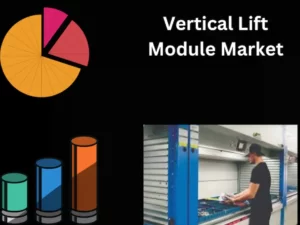
Vertical lift modules are enclosed automated storage systems that arrange trays vertically and deliver the required tray to an operator-facing access point. Each unit combines structural columns, extractors, sensors, controls, safety systems, trays, and inventory software. The system uses available ceiling height instead of consuming additional floor area.
This makes the technology relevant wherever companies need to store many parts in a limited footprint. A conventional shelving area occupying 1,000 square meters can often be consolidated into a much smaller vertical storage zone. The exact reduction depends on ceiling height, SKU dimensions, access frequency, and load requirements. In suitable facilities, floor-space savings can reach 60% to 85%.
The business relevance of the Vertical Lift Module Market will increase between 2026 and 2035 as warehouses and factories move from manual storage toward controlled, software-directed material handling. The investment case is no longer based only on space savings. Buyers increasingly evaluate labor productivity, picking accuracy, workplace safety, inventory control, and production continuity together.
A module can bring the required component directly to the operator. So, workers spend less time walking, searching, bending, and climbing. In repetitive picking environments, this can reduce non-value-added movement by 40% to 70%. Picking rates can rise from roughly 40–80 order lines per hour in conventional shelving environments to 120–250 lines per hour when modules are combined with barcode confirmation, pick-to-light, batching, and warehouse software.
For example, an automotive parts facility can place fast-moving electronic components, tools, bearings, and maintenance parts inside separate trays. The software records every movement and restricts access where required.
Internally Modeled Global Revenue Outlook
| Forecast Year | Estimated Market Revenue | Growth Interpretation |
| 2026 | $1,860 million | Automation investment expands across factories and distribution centers |
| 2029 | $2,455 million | Software-integrated modules gain wider acceptance |
| 2032 | $3,242 million | Asia Pacific installations and brownfield automation accelerate |
| 2035 | $4,280 million | Vertical storage becomes a standard element of flexible intralogistics |
The forecast includes new vertical lift module equipment, embedded controls, standard operating software, trays, installation, and commissioning. Standalone warehouse management systems, horizontal carousels, miniload cranes, AMRs, and unrelated automation equipment are excluded.
Technology and Digital Integration
Technology is changing how these systems are selected and operated. Earlier units worked mainly as isolated machines. New installations are increasingly connected with warehouse management systems, manufacturing execution systems, enterprise resource planning platforms, and order management software.
This connection allows companies to:
- Prioritize urgent production orders.
- Group multiple picks into batches.
- Track parts by lot, serial number, or expiry date.
- Restrict access to sensitive components.
- Monitor tray weight and available storage height.
- Identify slow-moving or misplaced inventory.
- Coordinate vertical modules with conveyors, robots, and mobile systems.
Software integration will raise the average value of each installation. Customers are increasingly purchasing a storage workflow rather than a standalone machine. That said, integration complexity can lengthen project timelines, especially where older enterprise systems or manually maintained inventory records remain in use.
Labor Availability and Operating Costs
Labor pressure is one of the strongest commercial forces supporting adoption. Warehouses, service centers, and manufacturing plants face difficulty maintaining enough trained picking and material-handling staff. Wage increases also make repetitive manual movement more expensive.
A vertical storage project is usually justified through a combination of labor savings and space recovery. A typical medium-scale installation can require an investment of approximately $90,000 to $250,000 per module, including configuration and installation. Heavy-duty, cleanroom, temperature-controlled, or deeply integrated systems can exceed $300,000 per unit.
Payback periods commonly range from 2.5 to 5 years. Facilities with high labor costs, expensive floor space, multiple shifts, or high-value inventory can reach payback sooner. Low-throughput facilities with inexpensive space may need a longer investment horizon.
Industrial Production and Supply-Side Conditions
Vertical lift modules rely on steel structures, motors, drives, chains or lifting mechanisms, sensors, programmable controllers, safety components, and industrial computing systems. Production economics are therefore influenced by:
- Steel and fabricated-component prices.
- Motor and drive availability.
- Industrial electronics supply.
- Freight and installation costs.
- Local engineering capacity.
- Software customization requirements.
- Service-network coverage.
The equipment is large and difficult to transport over long distances as a fully assembled product. Vendors therefore use regional production, component assembly, and local installation networks. This structure favors suppliers with nearby engineering teams and trained service personnel.
Europe remains an important production center due to its established warehouse automation base. North American manufacturing capacity is also expanding as suppliers seek shorter delivery times and lower freight exposure. Asia Pacific production will increase as local automation companies develop higher-load, more software-intensive systems.
Warehouse Footprint and Brownfield Automation
Many factories cannot easily expand their buildings. Urban warehouses face similar limits. Construction costs, permits, land prices, and operational disruption make greenfield expansion difficult.
Vertical modules address this constraint by using height that is otherwise underutilized. They are also suitable for brownfield facilities because a company can automate one storage zone without redesigning the entire warehouse.
This matters for mid-sized manufacturers. Many do not need a fully automated distribution center. They need focused automation around parts storage, kitting, tools, maintenance inventory, or order preparation. A modular system gives them a lower-risk entry point.
Safety, Ergonomics, and Compliance
Workplace safety is another important purchasing factor. Manual shelving can require repeated bending, reaching, lifting, or ladder use. Vertical systems deliver trays at a controlled access height. Safety curtains, doors, sensors, load monitoring, and access controls reduce exposure to moving equipment and falling materials.
Regulatory pressure varies by country, but machinery safety, electrical conformity, fire protection, operator access, and ergonomic design are central to project approval. Pharmaceutical, aerospace, electronics, and defense users also require stronger traceability and access records.
Energy Use and Sustainability
Energy consumption is becoming part of system evaluation. Modern modules use efficient motors, standby settings, load-optimized movement, regenerative drives, and software-based route planning.
The largest sustainability benefit may come from space consolidation. A smaller storage footprint can reduce lighting, heating, cooling, and building expansion requirements. It can also release floor space for productive equipment.
However, sustainability performance depends on utilization. An oversized module with low tray activity may not deliver an attractive energy or capital return. Correct system sizing remains essential.
Key Consumers and Clients
The main buyers include:
- Automotive manufacturers and component suppliers.
- Industrial machinery and metalworking companies.
- Electrical and electronic equipment producers.
- Semiconductor and precision-component facilities.
- Aerospace and defense manufacturers.
- Pharmaceutical and medical-device companies.
- Hospitals and healthcare supply centers.
- E-commerce fulfillment operators.
- Third-party logistics providers.
- Industrial distributors and spare-parts warehouses.
- Food-processing and packaging companies.
- Maintenance, repair, and operations departments.
- Government, military, and public-sector storage facilities.
The most attractive customers are not always the largest warehouses. Facilities with expensive components, high SKU complexity, limited floor space, strict inventory control, or frequent small-part picking often produce a stronger return on investment.
Expert view: By 2035, vertical storage will increasingly be purchased as part of a connected material-flow system. Hardware reliability will remain important, but software usability, integration speed, and lifecycle service will carry more weight in vendor selection.
Market Segmentation and Forecast Scope
The segmentation of the Vertical Lift Module Market reflects how customers configure the equipment, what operational problem they are solving, which industry owns the installation, and where the investment is made. Each dimension affects average selling price, throughput requirements, software content, and service needs.
Forecast Scope Definition
The forecast covers:
- New vertical lift module hardware.
- Extractors and tray-handling mechanisms.
- Standard trays and internal storage accessories.
- Embedded machine controls.
- Standard inventory and operator software.
- Safety equipment supplied with the unit.
- Installation, configuration, and commissioning.
The forecast excludes:
- Horizontal carousels.
- Vertical carousel systems.
- Crane-based miniload AS/RS.
- Shuttle systems.
- AMRs and AGVs.
- Standalone warehouse management software.
- Building construction.
- Used-equipment sales.
- Recurring maintenance revenue sold separately.
This boundary prevents unrelated warehouse automation revenue from inflating the assessment.
By Product Type
Single-Access Vertical Lift Modules
Single-access systems have one primary operator opening. They are widely used for parts storage, maintenance inventory, small-item picking, and production support.
This category accounts for an estimated 54% of global revenue in 2026. Its leading position reflects lower installation complexity, broad industrial applicability, and a relatively accessible investment level.
Demand will remain stable, but growth will be slower than for advanced configurations. Many smaller manufacturers will continue to choose single-access systems as their first automation project.
Dual-Access and Pass-Through Vertical Lift Modules
Dual-access systems can serve operators on separate floors, production zones, or sides of a wall. Pass-through units can connect a warehouse with a controlled production, cleanroom, or secure area.
These systems are more complex and usually carry higher software and safety content. They are strategically important in pharmaceutical, electronics, automotive, and aerospace facilities.
For example, a pass-through module can deliver a component from a general storage area directly into a controlled assembly room without allowing warehouse personnel to enter the production zone.
This configuration is forecast to expand at approximately 10.8% CAGR between 2026 and 2035.
Multi-Bay and Specialized Vertical Lift Modules
This segment includes linked modules, oversized systems, heavy-load configurations, cleanroom units, temperature-controlled installations, fire-protected systems, and applications with special access requirements.
The category will record the fastest product-type growth, at an estimated 11.5% CAGR through 2035. Adoption will be supported by high-value component storage, advanced manufacturing, healthcare, defense, and automated production environments.
Its share is intentionally not disclosed in this section.
By Application
Parts and Component Storage
This is the largest application. It includes mechanical components, electrical parts, fasteners, bearings, tools, repair items, and finished subassemblies.
Demand is supported by SKU proliferation and the need to keep production-critical items close to the line. Growth will remain healthy, although the application is relatively mature in Western European industrial markets.
Order Picking and Kitting
Order picking and kitting will be the fastest-growing application, with an estimated 11.4% CAGR from 2026 to 2035.
The system can present several components in the sequence required for an assembly job, maintenance task, customer order, or production batch. Barcode scanning and pick-to-light reduce errors. Software can also group orders to reduce extractor movement.
This use case is expanding beyond industrial plants into spare-parts distribution, healthcare, retail fulfillment, and technical service networks.
Work-in-Process and Production Buffering
Manufacturers use vertical modules to hold partially completed products, fixtures, tools, electronic boards, or assemblies between production stages.
This application supports flexible manufacturing. It also creates a controlled buffer when upstream and downstream processes operate at different speeds.
Growth will be strongest in electronics, precision engineering, medical devices, and high-mix manufacturing.
Tool, MRO, and Consumable Management
Maintenance departments use vertical storage to manage expensive tools, replacement parts, personal protective equipment, calibration equipment, and consumables.
The value proposition comes from visibility and accountability rather than high throughput. Access records can show who removed a tool, when it was taken, and whether it was returned.
The segment will expand steadily, but its growth rate will remain below the market average.
Secure and High-Value Inventory Storage
This category includes pharmaceuticals, defense components, electronics, controlled substances, confidential materials, and expensive precision parts.
It is strategically attractive because customers are willing to pay for authentication, compartment controls, camera integration, environmental monitoring, and transaction records.
Application Forecast Summary
| Application Segment | 2026 Share Disclosure | 2026–2035 Growth Position | Commercial Relevance |
| Parts and Component Storage | Not disclosed | Moderate to strong | Largest installed demand base |
| Order Picking and Kitting | Not disclosed | Fastest-growing | High productivity and software value |
| Work-in-Process Buffering | Not disclosed | Above average | Supports flexible production |
| Tool and MRO Management | Not disclosed | Moderate | Strong control and accountability case |
| Secure Inventory Storage | Not disclosed | Above average | Higher-value system configuration |
By End User
Automotive and Transportation Equipment
Automotive manufacturers and suppliers use vertical modules for assembly components, tools, spare parts, prototypes, electronic parts, and maintenance inventory.
The transition toward electric and software-defined vehicles is increasing component variety. Battery electronics, sensors, connectors, power-control parts, and low-volume variants create additional storage complexity.
Automotive will remain a major buyer, although investment cycles will be affected by vehicle-production conditions and plant utilization.
Industrial Machinery and Metalworking
This segment includes machine builders, fabrication companies, industrial equipment producers, and precision-engineering facilities.
It has a large installed opportunity because these companies manage many tools and components in relatively constrained production environments. Mid-sized manufacturers represent an important addressable customer group.
E-Commerce, Retail Fulfillment, and Third-Party Logistics
This will be the fastest-growing end-user category, at an estimated 12.3% CAGR through 2035.
Vertical modules are not designed to replace high-throughput shuttle systems in every fulfillment center. They are better suited to slow-moving inventory, small expensive products, replacement parts, returns, and long-tail SKUs.
So, their role will often be complementary. High-volume items can remain in conveyor or shuttle systems, while lower-volume products are stored vertically.
Electrical, Electronics, and Semiconductor
Electronics facilities require controlled handling of small, sensitive, and expensive components. Vertical modules provide access restriction, humidity-management options, clean configurations, and traceability.
Growth will be supported by semiconductor equipment, industrial electronics, communication equipment, data-center hardware, and electronic vehicle systems.
Pharmaceutical, Medical Device, and Healthcare
This segment uses vertical systems for medicines, consumables, implants, laboratory items, medical components, and controlled inventory.
The need for traceability, expiry-date control, batch management, and restricted access supports higher software content. Specialized configurations may include temperature monitoring or controlled-area interfaces.
Aerospace and Defense
Aerospace and defense users manage high-value parts with long storage periods and strict documentation requirements. These facilities often need serial-level traceability, restricted access, and customized trays.
Project volumes may be lower than in automotive or general manufacturing, but average installation values are higher.
Food, Beverage, and Consumer Goods
Applications include spare parts, packaging tools, labels, maintenance supplies, ingredients, and production consumables.
Growth will be selective. Adoption is strongest where hygiene, lot tracking, or floor-space constraints create a clear operational case.
By Region
North America
North America is supported by warehouse labor costs, reshoring, industrial investment, e-commerce infrastructure, and the automation of spare-parts operations.
The United States will account for most regional demand. Canada and Mexico will contribute through automotive, aerospace, food processing, electronics, and cross-border manufacturing.
Growth is forecast at approximately 10.1% CAGR between 2026 and 2035.
Europe
Europe represents an estimated 32% of global revenue in 2026. This is the second and final segment share disclosed in this section.
The region has a mature manufacturing base and a strong concentration of vertical storage suppliers. Germany, Italy, France, the United Kingdom, the Netherlands, Austria, Spain, and the Nordic countries are important markets.
Growth will be slower than in Asia Pacific because adoption is already established. However, replacement demand, software upgrades, energy-efficient equipment, and factory modernization will sustain investment.
Asia Pacific
Asia Pacific will be the fastest-growing region, with an estimated 12.1% CAGR through 2035.
China, Japan, South Korea, India, Australia, Taiwan, and Southeast Asia will create demand. The region benefits from expanding electronics production, automotive supply chains, industrial automation, and modern distribution infrastructure.
China will become increasingly important on both the demand and supply sides. Local equipment companies are improving load capacity, control systems, and integration capability. Price competition will therefore intensify.
LAMEA
LAMEA includes Latin America, the Middle East, and Africa.
Adoption remains concentrated in larger manufacturing plants, mining support operations, aerospace facilities, automotive production, hospitals, logistics centers, and government storage sites.
Brazil, Mexico, the Gulf countries, South Africa, and selected industrial zones will lead demand. Growth will be positive, but high capital costs, import dependence, service availability, and longer project approval cycles will limit broader penetration.
Regional Forecast Positioning
| Region | 2026 Share Disclosure | 2026–2035 Estimated CAGR | Primary Investment Theme |
| North America | Not disclosed | 10.1% | Labor productivity and reshoring |
| Europe | 32% | 8.2% | Factory modernization and replacement |
| Asia Pacific | Not disclosed | 12.1% | New industrial and logistics capacity |
| LAMEA | Not disclosed | 8.8% | Selective automation in larger facilities |
The most strategic opportunity lies at the intersection of order picking, software integration, and brownfield industrial automation. Vendors that can install systems without disrupting existing operations will have an advantage.
Market Trends and Business Innovations
Innovation in the Vertical Lift Module Market is moving from mechanical storage toward connected, adaptive inventory handling. The lifting mechanism remains essential, but competitive differentiation increasingly comes from controls, software, data visibility, integration, and service.
R&D Evolution
Early product development focused on mechanical lifting speed, tray capacity, and system height. Current research and engineering priorities are broader.
Manufacturers are working on:
- Faster tray delivery with lower vibration.
- Improved extractor reliability.
- Dynamic tray-height measurement.
- Automatic load and weight monitoring.
- Better use of irregular storage space.
- Reduced energy consumption.
- Lower maintenance requirements.
- Faster modular installation.
- Improved operator interfaces.
- Remote diagnostics and software updates.
- Safer access to heavy or oversized items.
Dynamic height measurement is particularly important. Sensors identify the height of stored items and place trays with the minimum required clearance. This increases storage density without asking operators to assign fixed shelf spacing manually.
The next R&D phase will focus on system orchestration. Individual modules will be managed as a coordinated fleet rather than as separate machines. Software will determine which module should receive an item and which access point should serve a task.
Software-Led Technology Evolution
Warehouse software is becoming central to system economics. Basic inventory controls are giving way to applications that support slotting, batching, replenishment, access management, audit trails, and production sequencing.
The most useful capabilities include:
Dynamic Slotting
Frequently requested items are moved into trays or module locations that reduce travel time. Slow-moving stock is shifted to less accessible positions.
The system can revise storage logic as demand patterns change. This helps manufacturers with seasonal production, engineering revisions, or changing customer orders.
Batch Picking
Several orders are grouped into one picking cycle. The operator retrieves multiple items from each tray before the module moves again.
This increases throughput and reduces unnecessary machine travel. The benefit is strongest where orders contain many small components.
Digital Inventory Records
Each movement can be linked to a user, order, production batch, serial number, or time stamp. This creates an auditable inventory history.
Such records are especially valuable in aerospace, pharmaceuticals, electronics, medical devices, and defense.
Remote Monitoring
Vendors can track system alarms, extractor cycles, door movements, motor behavior, and other operating indicators. Service teams can identify issues before arriving at the site.
Remote support also reduces downtime in locations where trained technicians are not immediately available.
AI Integration
Artificial intelligence is relevant, but its role should not be overstated. AI is being implemented mainly in the warehouse software and analytics layer rather than in the basic lifting mechanism.
Practical applications include:
- Forecasting which SKUs will be requested.
- Recommending item placement.
- Detecting unusual inventory movements.
- Predicting component wear.
- Prioritizing replenishment.
- Identifying picking bottlenecks.
- Balancing work between multiple modules.
- Comparing operator and system performance.
Machine-learning models can use historical order data to predict which products should be positioned closer to the access opening. They can also detect changes in motor current, cycle time, or vibration that may indicate maintenance needs.
Expert view: AI will create value only when inventory records are accurate. A poorly maintained item database cannot be corrected by advanced algorithms. Data discipline will remain the first requirement.
By 2030, AI-assisted slotting and predictive service functions are likely to become common in larger connected installations. Smaller users will access these capabilities through cloud-based software rather than dedicated on-site systems.
Integration with Robotics and Mobile Automation
Vertical modules are increasingly being designed to work with robots, cobots, conveyors, and autonomous mobile robots.
A robotic arm can remove a tote or component from the access opening. An AMR can transport the retrieved item to an assembly station or packing area. A conveyor can connect several modules with a shared order-processing zone.
For example, a module can release a tray containing electronic components. A collaborative robot transfers the selected tote to an AMR, which delivers it to a production cell.
This architecture reduces manual transport while keeping storage compact. However, robotic picking is more difficult when products vary greatly in size, shape, packaging, or orientation. Human operators will remain important in high-mix environments.
Pick-to-Light, Vision, and Verification
Pick-to-light systems indicate the correct item and required quantity. Barcode scanners confirm the transaction. Vision systems can check whether the operator selected from the correct compartment.
Weight verification can provide another control layer. If the measured tray-weight change does not match the expected quantity, the system can request confirmation.
These technologies lower picking errors and support less-experienced workers. They also shorten training time during peak demand.
Material and Component Engineering
Material science is not the main innovation area, but component choices still affect performance.
High-strength steel allows taller equipment and heavier tray loads while controlling structural weight. Improved surface coatings support corrosion resistance in industrial environments. Low-friction guides and durable polymers reduce wear in moving components.
Specialized users may require:
- Stainless-steel contact surfaces.
- Cleanroom-compatible materials.
- Anti-static trays.
- Fire-resistant enclosures.
- Oil- and chemical-resistant components.
- Temperature-resistant seals.
- Food-compatible finishes.
The commercial opportunity is not in selling a different base material. It lies in configuring the system for regulated or demanding operating environments.
Energy Recovery and Efficient Motion
Energy-saving drives are becoming more important, particularly in Europe and high-cycle installations.
Regenerative systems can recover energy during downward tray movement or deceleration. Efficient motors, optimized movement paths, standby modes, and balanced loads also reduce consumption.
Energy use per transaction varies widely by system height, tray weight, operating speed, and utilization. Vendors will increasingly provide energy-performance estimates during project design.
Expert view: Energy efficiency alone will rarely justify a purchase. It will strengthen projects already supported by labor, space, and inventory-control benefits.
Modular and Scalable System Design
Customers increasingly prefer automation that can expand in stages. A company may begin with two modules and add more units as SKU count or order volume increases.
Modular controls allow several systems to operate through one interface. This lowers the risk of an initial project and makes the technology more accessible to mid-sized buyers.
Scalability will become a major sales point because many companies cannot predict their exact storage and throughput requirements for the next decade.
Lifecycle Services and Subscription Models
Equipment suppliers are expanding their service portfolios. Revenue opportunities now include:
- Preventive maintenance contracts.
- Remote monitoring.
- Software subscriptions.
- Spare-parts programs.
- System inspections.
- Control retrofits.
- Tray reconfiguration.
- Operator training.
- Performance optimization.
- Legacy system modernization.
Some customers are also evaluating leasing or automation-as-a-service structures. These arrangements convert a large upfront investment into recurring payments.
Adoption will be strongest where the supplier can measure equipment availability and performance. Customers will still require clear responsibility for site preparation, operator behavior, inventory accuracy, and damage.
Retrofit and Modernization Opportunity
A large installed base of older vertical systems creates a separate modernization market. Customers may retain the steel structure and lifting hardware while replacing controllers, sensors, drives, screens, software, and safety devices.
Retrofits can cost less than full replacement and involve less disruption. They also extend equipment life.
However, modernization is not practical in every case. Structural wear, unavailable components, outdated safety architecture, or excessive maintenance may justify complete replacement.
Corporate Partnerships and Market Announcements
Competitive activity has focused more on production expansion, software partnerships, and portfolio integration than on large VLM-specific acquisitions.
Kardex has expanded beyond standalone vertical storage through software, lifecycle services, and broader automated-storage partnerships. Its positioning reflects a shift toward integrated intralogistics rather than isolated equipment sales.
Modula has increased regional manufacturing and service capacity, particularly in North America. Local production reduces delivery time, freight exposure, and dependence on European manufacturing schedules.
Hänel has emphasized energy recovery, digital controls, access security, and high-density storage through its Lean-Lift and related product platforms.
SSI Schaefer positions its LOGIMAT systems within a wider portfolio that includes warehouse software, conveyors, picking systems, and automated storage. This broad integration capability is useful for larger projects.
Mecalux, ICAM, Ferretto Group, EffiMat, and Weland Solutions compete through regional engineering, specialized configurations, compact systems, and application-specific design.
The broader warehouse automation industry has also consolidated through transactions such as KION Group’s acquisition of Dematic and Toyota Industries’ acquisition of Vanderlande. These were not direct vertical lift module acquisitions, but they illustrate the strategic value of owning integrated automation, software, and service capabilities.
Future partnerships are likely to involve:
- Warehouse management software providers.
- Robotics companies.
- AMR manufacturers.
- System integrators.
- Industrial distributors.
- Maintenance-service networks.
- Machine-vision specialists.
- Enterprise software companies.
Future Innovation Impact
The industry will move toward systems that are easier to configure, install, connect, and expand. Mechanical performance will continue to improve, but software and service will capture a larger part of customer value.
By 2035, leading installations will automatically adjust slotting, predict service needs, coordinate multiple access points, and exchange tasks with robots or mobile systems. Operators will interact with simpler visual interfaces while the software manages inventory logic in the background.
Expert view: The Vertical Lift Module Market will not replace every manual rack or automated storage technology. Its strongest position will remain in high-mix, space-constrained operations where accuracy, ergonomics, and controlled access matter more than extreme throughput.
Competitive Intelligence and Benchmarking
Competition in the Vertical Lift Module Market is shaped by more than lifting speed or tray capacity. Buyers also compare system uptime, software compatibility, installation capability, safety design, regional service coverage, and the ability to integrate multiple machines.
The competitive landscape includes global intralogistics groups, dedicated vertical-storage specialists, and regional engineering companies. The largest integrated players can deliver complete warehouse projects. Specialist suppliers often compete more effectively in customized vertical storage, brownfield installations, and mid-sized projects.
Competitive Positioning of Major Companies
| Company | Analyst Market Position | Portfolio Emphasis | Primary Competitive Advantage | Key Watchpoint |
| Kardex | Global front-runner | Vertical storage, carousels, miniload systems, software, service and broader goods-to-person automation | Large installed base and lifecycle-service capability | Premium positioning can face price pressure |
| Modula | High-growth specialist | Broad vertical module range, compact systems, controlled-access configurations, pallet handling and high-speed bin fulfillment | Manufacturing scale and strong product breadth | Rapid expansion requires consistent service quality |
| Hänel | Established engineering specialist | Vertical lift systems, rotating storage, multi-axis configurations and customized industrial units | Mechanical durability and application engineering | More concentrated in industrial than high-volume fulfillment |
| SSI Schaefer | Integrated intralogistics leader | Vertical modules, warehouse software, containers, conveyors, picking and large automated systems | Ability to combine VLMs with complete warehouse architecture | VLMs compete internally with other automation platforms |
| ICAM | Customization-led challenger | Multi-column vertical storage, robotic integration, industrial, healthcare and retail systems | Highly configurable systems for complex sites | Smaller international scale than top-tier groups |
| Weland Solutions | Strong regional specialist | Compact and double-depth vertical lifts, software and storage accessories | In-house engineering and strong Nordic manufacturing reputation | International service network is less extensive |
| Mecalux | Broad warehouse-automation competitor | Vertical modules, racking, automated storage, conveyors and warehouse management software | Full-facility integration and software capability | Vertical modules are one element of a much wider portfolio |
The positions above are analyst assessments. They are not reported market-share rankings.
Kardex
Kardex holds one of the strongest positions in automated vertical storage. Its portfolio extends from enclosed tray-based systems to carousel equipment, miniload solutions, software, AutoStore integration, and lifecycle services.
The company’s advantage comes from its installed base and recurring customer relationships. Kardex reports more than 140,000 installed systems across its storage businesses. The group generated approximately €791 million in revenue in 2024, although this figure includes products beyond vertical lift modules.
Its vertical systems are sold into manufacturing, distribution, healthcare, aerospace, electronics, and service-parts environments. The company also benefits from a mature maintenance organization. This matters because customers frequently retain vertical equipment for well over a decade.
The product strategy is moving toward simpler user interfaces, assisted picking, software subscriptions, and broader automation integration. Kardex introduced an upgraded vertical module interface in January 2025, reinforcing this software-led direction.
Strategic view: Kardex is best positioned where buyers prioritize reliability, installed-base support, and low lifecycle risk over the lowest initial price.
Modula
Modula is one of the most focused competitors in this category. It designs and manufactures vertical storage systems, picking technologies, and warehouse software for a wide range of industries.
Its portfolio covers standard industrial modules, narrow-footprint configurations, highly controlled access, pallet-oriented handling, and high-speed bin fulfillment. Certain configurations support tray payloads of up to approximately 2,200 pounds, while high-speed systems can handle up to 180 bins per hour, depending on operating conditions.
The company has built a particularly visible position in North America through local manufacturing, sales offices, and distributor relationships. This reduces freight exposure and gives customers access to regional engineering and spare-parts support.
Its competitive model is based on product variety. A buyer can begin with a relatively simple machine and later add software, pick-to-light tools, external delivery stations, mobile robots, or additional modules.
Strategic view: Modula is one of the strongest challengers to Kardex because it combines specialist focus with expanding regional manufacturing.
Hänel
Hänel competes through engineering depth, long equipment life, customized load handling, and high-density industrial storage. Its portfolio includes extractor-based vertical systems, rotating storage equipment, and multi-axis arrangements capable of serving wider or more complex storage structures.
The company has a strong presence in machinery, automotive, electronics, tools, maintenance stores, and production-support applications. Its systems can be configured for heavy components, sensitive parts, multi-floor access, or controlled environments.
Energy recovery, inventory software, camera-supported verification, access protection, and operator guidance form part of its differentiation. The company also emphasizes custom container arrangements rather than forcing customers into one standard tray layout.
Hänel is less exposed to large e-commerce projects than some integrated warehouse suppliers. However, it remains highly competitive in industrial facilities where mechanical reliability and tailored configuration carry more weight than maximum order throughput.
Strategic view: Hänel is particularly strong in engineering-led projects where a standard machine cannot fully address the storage requirement.
SSI Schaefer
SSI Schaefer approaches the category as part of a much broader intralogistics portfolio. It combines vertical modules with warehouse software, containers, conveyors, order-picking systems, racking, shuttle technology, and larger automated storage solutions.
The group reported approximately €2.0 billion in revenue for 2024, covering its full business rather than vertical modules alone.
Its main advantage is integration. Customers can purchase a vertical storage unit as a standalone machine or connect several machines through central warehouse software. Its current software portfolio supports multi-machine coordination, enterprise-system integration, scanners, RFID tools, and manufacturer-independent control of existing modules.
This capability is relevant for companies that already operate several equipment brands. A manufacturer-independent software layer can extend the value of older machines without requiring immediate replacement.
The main competitive tension is portfolio complexity. For high-throughput applications, SSI Schaefer may recommend shuttle, miniload, conveyor, or robotic systems instead of vertical modules.
Strategic view: SSI Schaefer is strongest where the customer wants a wider intralogistics partner rather than a single-machine supplier.
ICAM
ICAM competes through multi-column design, specialized engineering, and the ability to connect vertical storage with robotics and industrial equipment.
Its portfolio covers industrial storage, healthcare, retail distribution, secure dispensing, and city-logistics applications. The company’s multi-column system can be installed inside or outside a building and integrated with enterprise software, warehouse platforms, or robotic workstations.
The wider configuration range is valuable where a customer needs more capacity than a standard two-column module can provide. It also allows the machine to follow an unusual building layout.
ICAM has demonstrated fully automated tool handling in which a vertical module is connected with a CNC machining environment and gantry equipment. Such projects move the technology beyond operator-assisted storage and toward unmanned production support.
Its challenge is scale. The company does not have the same international service footprint as the largest groups. So, distributor and integration partnerships are important to expansion.
Strategic view: ICAM is a credible specialist for complex, multi-column and robotic applications that sit outside standard VLM configurations.
Weland Solutions
Weland Solutions is a Swedish vertical-storage specialist with a strong position in Nordic and selected European industrial markets. Its portfolio includes compact lifts, double-depth systems, high-load configurations, software, accessories, and direct communication tools for connecting the equipment with business systems.
The company develops and manufactures its systems internally. This gives it greater control over design changes and component quality.
Its double-depth approach increases capacity per square meter by storing two trays behind one another. The configuration is relevant where floor area is limited but retrieval frequency remains moderate.
Weland Solutions is competitive in tools, spare parts, engineering components, plastics processing, and production-support storage. Its main limitation is geographic reach. Buyers in markets without an established service partner may favor a larger global supplier.
Strategic view: Weland is a strong regional choice where buyers value robust design, compact dimensions, and direct manufacturer involvement.
Mecalux
Mecalux offers vertical modules within a larger portfolio of racking, warehouse software, conveyors, pallet automation, miniload systems, and picking technologies.
Its advantage is the ability to design mixed warehouses. Vertical modules can be allocated to slower-moving or high-value small parts, while conveyors, shelving, or automated cranes serve other inventory classes.
The company’s warehouse management platform can connect vertical modules with enterprise systems and other storage technologies. This makes Mecalux relevant where the VLM is one operating zone inside a broader distribution center.
Vertical storage is not the company’s sole specialization. As a result, it may be less aggressive in small standalone projects than dedicated suppliers. Its position improves as project scope expands.
Strategic view: Mecalux is most competitive when customers require software, racking, automation, and vertical storage under one project structure.
Benchmarking by Competitive Capability
| Competitive Factor | Leading Companies | Analyst Interpretation |
| Global installed-base support | Kardex, SSI Schaefer | Strongest for multinational customers |
| Dedicated VLM portfolio breadth | Modula, Kardex | Broad configuration and application coverage |
| Customized industrial engineering | Hänel, ICAM | Suitable for heavy, unusual or controlled loads |
| Warehouse-wide integration | SSI Schaefer, Mecalux | Stronger in multi-technology projects |
| Compact and double-depth design | Weland Solutions, Modula | Relevant for constrained brownfield sites |
| Robotics and automated-cell integration | ICAM, Modula, SSI Schaefer | Strategic area for future differentiation |
| Lifecycle and retrofit services | Kardex, Hänel, SSI Schaefer | Important for long equipment replacement cycles |
Competition will intensify around software rather than basic mechanics. Most established vendors can manufacture a reliable lift. Fewer can connect machines quickly, maintain mixed installed bases, use operating data effectively, and support customers across multiple countries.
Regional Landscape and Adoption Outlook
Regional demand in the Vertical Lift Module Market depends on labor cost, industrial density, ceiling height, land value, warehouse maturity, automation financing, and local service capability.
Europe has the deepest historical adoption. The United States is scaling quickly through manufacturing and distribution automation. China and India offer the strongest expansion potential. Japan and South Korea are driven by labor constraints and advanced manufacturing. The Middle East remains smaller but is becoming commercially relevant as logistics infrastructure expands.
Analyst-Modeled Adoption Outlook
| Market | Adoption Maturity in 2026 | Estimated 2026–2035 CAGR | Primary Demand Base | Main Constraint |
| United States | High | 9.8% | Manufacturing, aerospace, parts distribution, healthcare and e-commerce | Project integration and skilled service availability |
| Europe | High | 8.2% | Automotive, machinery, electronics, pharmaceuticals and industrial distribution | Mature installed base and slower industrial growth |
| China | Medium-high | 13.2% | Electronics, EVs, machinery, e-commerce and industrial logistics | Local price competition and uneven equipment quality |
| India | Emerging | 14.1% | Automotive, pharmaceuticals, electronics, 3PL and industrial components | Capital sensitivity and limited automation expertise |
| Japan | High but selective | 7.3% | Automotive, precision machinery, electronics and service parts | Slow facility replacement and demanding specifications |
| South Korea | Medium-high | 10.4% | Semiconductors, electronics, batteries, automotive and shipbuilding | Concentrated customer base |
| Middle East | Emerging | 10.6% | Logistics hubs, aviation, healthcare, defense and spare parts | Import dependence and limited local manufacturing |
The growth rates are internal analyst estimates, not government or company forecasts.
United States
The United States is one of the most commercially attractive markets because industrial labor is expensive and many warehouses operate in buildings that were not designed for modern SKU volumes.
Demand is concentrated in:
- Automotive and component manufacturing across the Midwest and Southeast.
- Aerospace and defense clusters in Washington, California, Texas, Kansas, Connecticut and Florida.
- Medical-device and healthcare operations.
- Industrial distribution and aftermarket parts.
- Electronics, machinery and data-center equipment.
- E-commerce and omnichannel fulfillment.
The country has a large brownfield opportunity. Many facilities have high ceilings but continue to use static shelving. Vertical automation allows them to recover floor space without constructing a new building.
Federal manufacturing grants, loans, tax incentives, and technical-support programs can indirectly improve capital investment conditions, although there is no nationwide funding program dedicated specifically to vertical lift modules.
Safety remains an important purchasing consideration. OSHA identifies struck-by, ergonomic, material-handling, hazardous-substance, and robotic risks within warehouse operations. Automated storage therefore requires guarding, training, maintenance procedures, and controlled access rather than being treated as a purely productivity-focused purchase.
The strongest growth will come from small and mid-sized manufacturers adopting their first goods-to-person system. Larger distribution centers will use vertical modules mainly for spare parts, slow movers, secure inventory, or returns rather than as the sole fulfillment platform.
Europe
Europe remains the most established regional market. Germany and Italy have strong equipment-production ecosystems, while the United Kingdom, France, the Netherlands, Austria, Switzerland, Spain, Sweden, Norway, Denmark, and Central Europe provide meaningful demand.
Country-Level Positioning
- Germany is the regional leader in industrial adoption. Machinery, automotive, tools, electronics and technical distribution form the core demand base.
- Italy combines strong local manufacturing with a large population of mid-sized industrial companies. It is also an important export center for vertical storage equipment.
- United Kingdom demand is supported by aerospace, defense, healthcare, e-commerce and industrial distribution.
- France offers opportunities in aerospace, pharmaceuticals, automotive, food processing and public-sector logistics.
- Netherlands has a smaller manufacturing base but high warehouse automation intensity due to its logistics and distribution role.
- Poland, Czechia, Hungary and Romania are high-growth locations as automotive, electronics and industrial production expand.
European machinery rules create a relatively demanding compliance environment. The existing Machinery Directive remains applicable until January 20, 2027, when Regulation (EU) 2023/1230 becomes applicable. Suppliers will need updated conformity documentation, risk assessment, safety controls, and technical files for systems placed on the European market.
European funding supports digital manufacturing, AI, robotics and industrial modernization more broadly. Horizon Europe’s 2025 work program includes manufacturing-focused AI development, although this does not translate into direct funding for every warehouse project.
The region’s mature installed base creates a substantial retrofit market. Controller replacement, safety upgrades, software modernization and multi-machine integration will represent a larger revenue stream than in newer markets.
China
China will be one of the fastest-growing national markets through 2035. Demand is supported by electronics, electric vehicles, batteries, machinery, pharmaceuticals, e-commerce, aerospace and high-volume industrial production.
The strongest clusters include:
- Shanghai and the Yangtze River Delta.
- Jiangsu and Zhejiang.
- Guangdong and the Greater Bay Area.
- Beijing–Tianjin–Hebei.
- Chongqing and Sichuan.
- Hubei, Anhui and Shandong.
China’s manufacturing policy continues to promote digital, networked and intelligent production. National and local programs published during 2024–2025 support factory digitalization, industrial software, automated logistics and smart equipment.
Local competition will become more important. Chinese suppliers can offer lower equipment and installation prices, particularly for standard systems. International companies will need to defend their position through safety, software, uptime, specialized loads and multinational service.
The premium opportunity lies in semiconductor plants, battery facilities, automotive electronics, clean production, aerospace and controlled-component storage. Standard spare-parts applications will face greater price pressure.
China will also become a source of components, controls and complete systems for Southeast Asia, the Middle East and other price-sensitive markets.
India
India remains an early-stage but high-growth market. Adoption is concentrated among multinational manufacturers, large domestic industrial groups, pharmaceutical companies, automotive suppliers, electronics plants, modern logistics operators and organized distributors.
High-potential states include:
- Maharashtra for automotive, pharmaceuticals, machinery and logistics.
- Tamil Nadu for automotive, electronics and industrial production.
- Gujarat for chemicals, pharmaceuticals, engineering and ports.
- Karnataka for aerospace, electronics and technology manufacturing.
- Telangana for pharmaceuticals, life sciences and electronics.
- Delhi NCR for distribution, e-commerce and industrial warehousing.
- Uttar Pradesh for electronics and logistics.
- Haryana for automotive and engineering.
The National Logistics Policy, PM Gati Shakti and the Unified Logistics Interface Platform are intended to improve logistics coordination, infrastructure visibility and operating efficiency.
The second edition of India’s warehouse standards, released in 2025, addresses warehouse automation, artificial intelligence, smart warehousing, picking, storage and retrieval. This creates a more structured reference point for developers and operators.
India’s main obstacle is not a lack of operational need. It is capital allocation. Many companies still compare automated storage only with the purchase cost of racks rather than the combined cost of labor, land, errors and production downtime.
Leasing, staged installations, local assembly and stronger ROI documentation will improve conversion. The addressable market will expand rapidly once local reference installations demonstrate payback under Indian wage and property conditions.
Japan
Japan has a technically mature industrial base but relatively measured equipment-replacement cycles. Automotive, electronics, precision machinery, healthcare, tools and aftermarket parts provide the strongest demand.
Important industrial regions include:
- Kanto, including Tokyo, Kanagawa, Saitama and Chiba.
- Aichi and the wider Chubu automotive cluster.
- Osaka, Hyogo and the Kansai region.
- Shizuoka, Hiroshima and Fukuoka.
Labor availability is the central issue. Japan’s logistics sector continues to face the effects of the “2024 problem,” including driver shortages and limits on overtime. Government materials identify mechanization and automation of logistics facilities as part of the response.
Japan also introduced catalog-based subsidies for labor-saving investments by small and mid-sized companies in 2024. Eligibility depends on the equipment category and program conditions, so not every VLM project will qualify automatically.
From April 2026, certain large shippers and logistics companies are required to prepare medium- and long-term plans and submit periodic reports under logistics-efficiency measures. This increases management attention on productivity and material flow.
Customers will demand high reliability, compact dimensions, quiet operation and strong local support. Growth will be steady rather than explosive because many factories already use some form of vertical or automated storage.
South Korea
South Korea is an attractive market for high-specification systems. Its semiconductor, electronics, battery, automotive, shipbuilding and machinery sectors manage expensive components and operate under strict space and traceability requirements.
Demand is concentrated in:
- Seoul–Gyeonggi manufacturing and logistics zones.
- Incheon and its airport-linked logistics network.
- Busan and Ulsan.
- Semiconductor clusters around Gyeonggi Province.
- Electronics and battery production centers in the central and southern regions.
The government is supporting AI-led manufacturing and autonomous production. In 2024, South Korea’s major automation exhibition included approximately 500 domestic and international companies, illustrating the size of the country’s digital-manufacturing ecosystem.
The Ministry of Trade, Industry and Energy has also outlined plans to expand AI manufacturing anchor projects from 26 to 200 by 2027, with these projects expected to attract more than ₩20 trillion in investment. Such programs are not VLM subsidies, but they improve the environment for connected factory equipment and automated material handling.
South Korean buyers will favor systems that integrate with production software, clean environments, robotics and access-control tools. Semiconductor and battery applications should grow faster than general warehousing.
Middle East
The Middle East is relevant primarily through Saudi Arabia and the United Arab Emirates. Qatar, Israel, Oman and Bahrain provide smaller specialized opportunities.
Saudi Arabia
Saudi demand is being created by logistics zones, industrial diversification, aviation, defense, healthcare, mining services and spare-parts distribution.
The country reported 23 activated logistics centers covering 34.6 million square meters in 2024. Fulfilled delivery orders exceeded 290 million, up 27.2%, according to the Saudi General Authority for Statistics.
The National Transport and Logistics Strategy supports logistics infrastructure, advanced operating systems and private investment.
Vertical modules will be most relevant in aerospace maintenance, industrial spare parts, hospitals, defense facilities, high-value retail inventory and temperature-controlled operations.
United Arab Emirates
The UAE combines regional distribution, free-zone infrastructure, aviation, e-commerce, healthcare and high-value imports. Dubai and Abu Dhabi will account for most demand.
Government investment materials identify AI, IoT and automation as emerging technologies within warehousing and distribution.
The UAE is also an effective regional service hub. Suppliers can use local distributors or technical teams to cover Gulf markets without establishing manufacturing in every country.
The major restraint across the Middle East is service dependence. Equipment uptime becomes difficult to protect when spare parts or technicians must travel from Europe. Vendors that establish regional inventory, training and remote support will have a clear advantage.
Regional Infrastructure and Policy Comparison
| Market | Warehouse Infrastructure | Regulatory Intensity | Public-Sector Support | Commercial Outlook |
| United States | Large but fragmented | High safety and local code requirements | Indirect manufacturing incentives | Strong brownfield opportunity |
| Europe | Mature and highly automated | Highest machinery-conformity burden | Strong digital and industrial R&D support | Stable replacement and integration demand |
| China | Rapidly expanding | Increasing technical and digital standards | Strong manufacturing-digitalization policy | High growth with price competition |
| India | Expanding from a low base | Standards framework is improving | Logistics-policy and infrastructure support | Fastest emerging-market opportunity |
| Japan | Advanced but aging | High quality and safety expectations | Labor-saving and logistics-efficiency programs | Strong retrofit and productivity case |
| South Korea | Advanced and concentrated | High industrial-quality requirements | Major AI and smart-factory initiatives | Attractive high-specification demand |
| Middle East | New logistics zones and hubs | Varies by country and free zone | Large infrastructure-led programs | Selective but rising demand |
India and China offer the strongest volume-growth opportunity. The United States offers the best balance of scale and pricing. Europe remains strategically important for installed-base services and replacement. Japan and South Korea favor premium specifications. The Middle East is attractive where a supplier can support equipment locally.
Recent Developments, Opportunities and Restraints
Recent Developments
- January 2025 – Kardex upgraded its vertical lift module platform with a redesigned operator interface. The development focused on simpler navigation and machine operation. This reflects the shift from hardware-led competition toward usability, software and faster worker training.
- March 2025 – Modula introduced a high-speed automated bin-handling system built on vertical-module architecture. The system uses a central extractor capable of handling multiple bins in one movement and connects with warehouse management software for grouped order fulfillment.
- August 2025 – SSI Schaefer announced deeper integration between its vertical storage module and warehouse-control software. The software can coordinate multiple machines, connect with scanners and RFID devices, and manage modules supplied by different manufacturers.
- March 2026 – Modula supplied a vertical storage system to the new $15.5 million Butler Tech aviation training center in Ohio. The installation gives students direct exposure to automated aircraft-parts and maintenance-inventory handling. It also supports the development of technicians familiar with modern industrial storage.
- June 2026 – LVMH Beauty inaugurated an RMB 140 million smart-logistics automation project in Shanghai. The project uses goods-to-person picking, multi-level storage, automated packaging, labeling and sorting. While it is not limited to VLM technology, it demonstrates continued investment in compact, software-directed warehouse systems in China.
Opportunities and Business Insights
Brownfield Automation in Emerging Markets
Many factories in India, China, Southeast Asia, Eastern Europe and the Middle East cannot justify a complete automated warehouse. A vertical module offers a smaller and more manageable first investment.
Suppliers can improve adoption through:
- Local assembly.
- Modular installation.
- Leasing or financing.
- Standard ERP connectors.
- ROI calculations based on local wages and property costs.
- Regional spare-parts inventory.
AI, Remote Monitoring and Software Revenue
Software can increase lifetime revenue without requiring a new machine sale. Predictive maintenance, dynamic slotting, remote diagnostics, access analytics and cloud-based performance reporting can be sold as recurring services.
The strongest opportunity is not generic AI. It is the use of machine and inventory data to reduce downtime, improve placement and identify picking errors.
Hybrid Human–Robot Workflows
VLMs can serve as controlled inventory buffers for cobots, AMRs, conveyors and CNC cells. This creates opportunities in electronics, automotive, medical devices and precision manufacturing.
Human operators will remain relevant for irregular items. Robots will be used first where load dimensions and packaging are standardized.
Market Restraints
- Upfront capital: Low-throughput facilities may struggle to justify automation against inexpensive shelving.
- Integration risk: Poor SKU data or outdated ERP systems can delay implementation.
- Building limitations: Floors, ceiling structures, fire systems and access routes may require modification.
- Service dependence: Downtime becomes expensive where local technical support is unavailable.
- Alternative technologies: Shuttles, carousels, AMRs, miniload systems and conventional shelving may offer a better fit for certain workflows.
- Incorrect system sizing: An oversized machine increases capital and energy costs without improving productivity.
The Vertical Lift Module Market has a strong long-term productivity case, but adoption will remain application-specific. Projects perform best where customers have measurable labor movement, expensive floor space, high inventory complexity, or a clear need for secure access.


