

Market Summary and Growth Forecast
The global Wear-Resistant Pump Linings Market will witness a robust CAGR of 7.1%, valued at $1.42 billion in 2026, expected to appreciate and reach $2.63 billion by 2035.
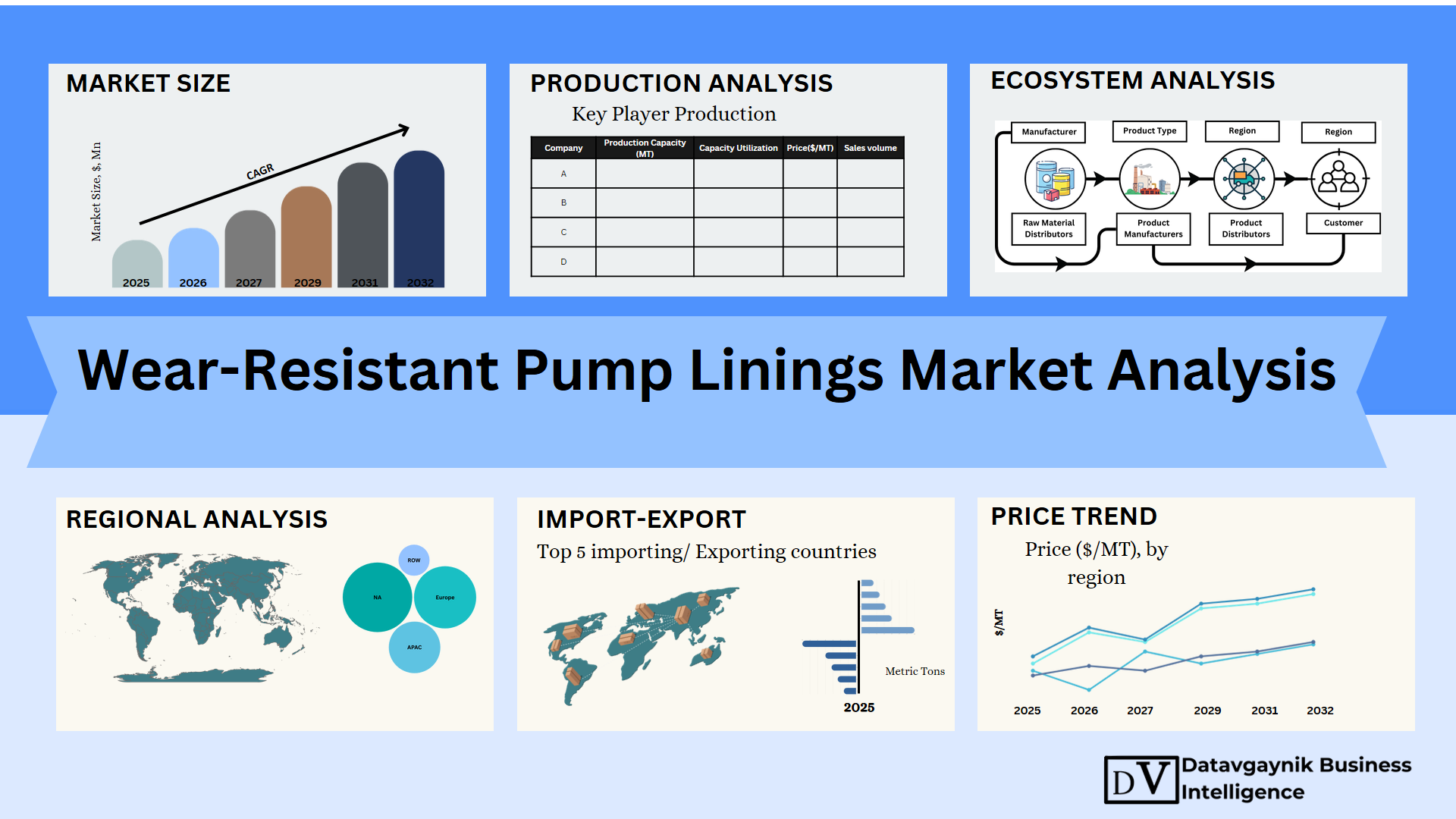
The Wear-Resistant Pump Linings Market covers protective lining systems used inside pumps to reduce abrasion, corrosion, erosion, slurry impact, chemical attack, and mechanical wear. These linings are used in centrifugal pumps, slurry pumps, chemical process pumps, dredging pumps, wastewater pumps, mining pumps, and other heavy-duty fluid handling systems. The core materials include rubber linings, polyurethane linings, ceramic linings, metallic hard-facing liners, composite linings, and advanced polymer-based lining systems.
In 2026, the market is strategically important because industries are trying to extend pump life instead of replacing pump systems too frequently. Mining companies, chemical processors, power plants, cement producers, pulp and paper plants, and wastewater operators are under pressure to reduce downtime. Pump failure in these sectors is not a small maintenance issue. It can stop production, damage upstream and downstream equipment, and increase operating cost sharply.
A large part of the demand comes from abrasive slurry handling. Mining remains the strongest consumption base because pumps handle ore slurry, tailings, mineral concentrates, sand, gravel, and high-solid mixtures. Chemical and wastewater applications are also gaining relevance as operators need linings that can resist both corrosion and solids abrasion. This is where material selection becomes critical. A rubber lining may work well for impact and slurry movement. A ceramic lining may be preferred where hard particle abrasion is severe. Polyurethane and composite systems are gaining attention where flexibility, chemical resistance, and reduced maintenance cycles matter.
From a macro perspective, three forces are shaping the 2026–2035 outlook. First, mineral processing activity is rising due to demand for copper, lithium, nickel, iron ore, rare earths, and industrial minerals. Second, industrial plants are becoming more cost-sensitive. They are looking at lifecycle cost rather than only pump purchase price. Third, regulation around wastewater discharge, tailings management, chemical handling, and industrial reliability is pushing operators toward better engineered pump protection.
Technology improvement is also changing how buyers evaluate lining systems. The market is moving from basic protective coating toward application-specific lining design. Suppliers are focusing on stronger bonding methods, better elastomer compounds, thicker ceramic tiles, modular replaceable liners, and hybrid systems that combine impact absorption with hard-wear resistance. This may sound technical, but the business case is simple: fewer shutdowns, longer service intervals, and lower replacement cost.
Expert insight: Pump linings are becoming a maintenance strategy, not just a spare part. Buyers are increasingly asking which lining can reduce unplanned stoppage over a full operating cycle. That shift will support higher-value lining systems through 2035.
The Wear-Resistant Pump Linings Market is also influenced by regional production patterns. Asia Pacific accounts for a major share of demand because of mining, cement, chemicals, power generation, and large wastewater infrastructure. China, India, Australia, Indonesia, and Southeast Asian industrial corridors remain important demand pockets. North America and Europe show steadier demand, supported by replacement cycles, brownfield industrial upgrades, mining maintenance, and environmental compliance. LAMEA is more project-driven, with demand linked to mining, oil and gas, desalination, and infrastructure-linked slurry applications.
Key stakeholders in this market include pump OEMs, lining material suppliers, mining operators, EPC contractors, chemical plant owners, wastewater utilities, power producers, cement manufacturers, distributors, maintenance service companies, industrial associations, regulators, and private investors focused on industrial aftermarket opportunities. OEMs remain highly important because many lining systems are specified at the pump design stage. At the same time, the aftermarket is a large revenue pool because linings are replaced more often than pump bodies.
By 2035, the market will likely be more specialized. Standard rubber lining will remain relevant, but demand will move toward engineered lining solutions for specific slurry chemistry, particle size, temperature, pressure, and operating speed. This creates room for premium suppliers that can combine materials knowledge with application engineering.
Overall, the Wear-Resistant Pump Linings Market is positioned as a practical industrial reliability market. It is not driven by hype. It is driven by wear, downtime, maintenance cost, and the need to keep pumps running in harsh operating conditions.
Competitive Intelligence and Benchmarking
The Silicone Roof Coating Market is moderately consolidated at the branded systems level, but still fragmented at the contractor and regional distribution level. Large roofing groups lead because they sell more than coating. They offer primers, seam treatments, reinforcement fabrics, technical approvals, warranties, and trained applicator networks. That gives them a clear edge in commercial restoration work.
Smaller coating specialists still matter. They often compete on price, local availability, private-label supply, and faster contractor relationships. So, the market is not only a chemistry battle. It is a system-selling and contractor-trust market.
| Company | Portfolio Position | Market Position |
| GAF | Offers silicone-based roof restoration systems for metal, asphaltic, aged single-ply, and coated roof surfaces. Its portfolio is built around repair, primer, detailing, and reflective coating layers. | Strong in North America due to its contractor network, roofing brand recognition, and commercial roof restoration programs. |
| Henry, a Carlisle Company | Provides silicone roof restoration coatings supported by primers, mastics, adhesion testing, and commercial repair systems. The company also benefits from Carlisle’s wider roofing platform. | Well positioned in commercial reroofing and restoration where owners want an alternative to tear-off replacement. |
| Sika | Supplies liquid-applied roofing systems, including high-solids silicone coatings for UV resistance, waterproofing, and refurbishment over different substrates. | Strong global technical brand. Better placed in specification-led projects, institutional roofs, and premium waterproofing applications. |
| Tremco Roofing | Offers silicone roof restoration systems with reflective, high-solids, liquid-applied formats. Its strength is integrated building envelope repair and maintenance. | Important in institutional, public, education, and commercial building accounts where service support and long-term maintenance matter. |
| Sherwin-Williams | Participates through roof coating lines sold to professional contractors and property maintenance channels. Its silicone coatings are used across metal, single-ply, modified bitumen, concrete, and approved aged roof surfaces. | Strong distribution advantage. Better suited for contractor-accessible restoration jobs and repeat maintenance demand. |
| Gaco | Focuses on silicone roofing systems, waterproofing, roof restoration, and building envelope solutions. Its positioning is close to performance roofing rather than commodity coating. | Recognized in specialty silicone roof coatings, especially among contractors looking for proven field performance. |
| APOC | Offers silicone coatings, primers, flashing materials, and repair products for low-slope roof restoration. Its products target ponding water, reflectivity, and practical roof-life extension. | Competitive in price-sensitive commercial restoration, retail/pro channels, and regional contractor-led projects. |
GAF is one of the strongest system players. Its advantage comes from roofing ecosystem control. It does not only sell coating into the market. It sells roof qualification, surface preparation, detailing, application guidance, and warranty-backed restoration logic. This makes it relevant for building owners who want clear accountability from one brand.
Henry, a Carlisle Company is another major competitor. The company’s position improved because it sits inside a broader commercial roofing group. That matters in this market because coating is often sold as part of a larger roof asset-management decision. Henry’s silicone coating range fits well where contractors are restoring aged commercial roofs rather than replacing them.
Sika competes from a technical performance angle. Its liquid-applied roofing systems give it credibility in projects where waterproofing, substrate compatibility, and specification confidence are important. The company is especially relevant in institutional, industrial, and premium commercial projects where the buyer wants engineering support, not just material supply.
Tremco Roofing has a strong service-led model. Its silicone coating systems are closely linked with roof assessment, maintenance planning, and building envelope restoration. This gives Tremco a strong position in schools, hospitals, government buildings, and large facility portfolios where maintenance budgets are planned over several years.
Sherwin-Williams brings a different advantage: distribution reach. Its roof coating products are accessible to contractors through a large professional coatings network. This helps the company serve mid-sized commercial jobs, maintenance contractors, and facility managers who prefer familiar procurement channels.
Gaco is a specialist brand with strong recognition in silicone roofing. Its portfolio is centered around roof restoration, coatings, foam, and waterproofing. This gives it a clear identity in the contractor community. It is not trying to be only a paint or general building-materials supplier.
APOC is more value-oriented but still highly relevant. The company’s silicone coating range supports practical commercial roof restoration jobs where cost, availability, and ease of use are important. APOC is especially competitive in regional contracting markets and maintenance-driven applications.
Expert commentary: The winners in this market will not be decided only by resin quality. The stronger brands will be the ones that help contractors reduce job failure risk. Adhesion testing, substrate preparation, warranty discipline, and training will matter as much as the coating itself.
From a benchmarking point of view, GAF, Henry, Sika, and Tremco Roofing are positioned toward system-backed commercial restoration. Sherwin-Williams, Gaco, and APOC are stronger in contractor accessibility, regional supply, and practical maintenance use cases. This creates two layers in the Silicone Roof Coating Market: premium system-led restoration and contractor-led repair or recoating demand.
By 2035, competitive advantage will shift toward companies that can document roof-life extension, energy savings, and lower total ownership cost. Building owners will ask tougher questions. How long will the coating last? What substrates are approved? What happens if ponding water remains? Who backs the warranty? Companies that answer these questions clearly will gain share.
Competitive Intelligence and Benchmarking
The Wear-Resistant Pump Linings Market is served by a mix of pump OEMs, slurry-handling specialists, elastomer lining suppliers, ceramic wear protection companies, and aftermarket component manufacturers. Competition is not based only on lining material. It is based on application knowledge, fitment accuracy, replacement speed, and proof of service life in abrasive duty.
| Company | Portfolio Position | Market Positioning |
| Weir Minerals | Offers heavy-duty slurry pumps, rubber-lined pump systems, metallic wear components, elastomer wet-end parts, and service support for mining and minerals processing. | One of the strongest global players in slurry pump wear protection. Its position is driven by deep mining exposure and a large installed base. |
| Metso | Provides slurry pumps with rubber and hard-metal wear parts, mill discharge pumps, dredging pumps, wear lining systems, and aftermarket service packages. | Strong in mining and mineral processing plants where pump lining selection is linked to full slurry circuit performance. |
| KSB / GIW | Focuses on engineered slurry pumps, abrasion-resistant wet-end parts, proprietary metallic liner systems, and customized pump materials for severe-duty slurry movement. | Strong technical position in high-solids and aggressive slurry applications. The company is more premium and engineering-led than price-led. |
| Trelleborg | Supplies rubber lining sheets, wear-resistant elastomer solutions, lining services, and protective systems for mining and industrial equipment. | More material and lining-specialist oriented. It is relevant where operators need rubber-based abrasion and corrosion protection across pumps, pipes, tanks, and connected equipment. |
| Multotec | Offers rubber, ceramic, and composite wear linings, slurry pump components, replaceable liners, and wear protection solutions for mineral processing applications. | Strong in mining-heavy regions, especially where ceramic and rubber-based protection are used to reduce maintenance stoppage. |
| Townley Engineering | Provides slurry pump components, rubber lining, urethane wear materials, metallic wear parts, and abrasion-resistant solutions for mining, dredging, and power applications. | Well placed in specialized aftermarket and replacement applications where operators need tailored wear-life improvement. |
| Schurco Slurry | Supplies slurry pumps, rubber-lined components, replacement liners, impellers, and pump wear parts for abrasive slurry services. | Competes strongly in replacement and interchangeable slurry pump parts. Its appeal is practical: quick availability, compatibility, and maintenance cost control. |
Weir Minerals sits close to the top of the competitive stack because of its position in slurry pumps and mineral processing. Its portfolio covers both original pump systems and replacement wear parts. This gives it an advantage because lining demand often follows the installed pump base. For mine operators, this reduces procurement risk. They can source the pump, wear components, replacement liners, and technical support from the same ecosystem.
Metso also holds a strong position in the market. The company’s advantage is its broader mineral processing footprint. Pump linings are not sold in isolation. They are part of the slurry handling chain, which includes pumps, hoses, pipes, wear parts, and plant maintenance. This helps Metso compete in brownfield upgrades and plant-wide reliability programs.
KSB / GIW is more engineering-focused. Its strength is in severe slurry movement where abrasion, high solids, large particles, and hydraulic efficiency matter. The company is particularly relevant in mining, oil sands, dredging, and heavy industrial slurry applications. Its liner and wet-end solutions are usually selected where buyers are less price-sensitive and more focused on failure prevention.
Trelleborg plays a different role. It is not only a pump player. Its strength is rubber lining and elastomer protection across industrial equipment. This makes it relevant for pump linings, lined pipes, vessels, chutes, and other slurry-contact surfaces. The company benefits from applications where impact absorption and corrosion resistance are equally important.
Multotec is important in mining and mineral processing wear protection. Its portfolio includes rubber, ceramic, and composite lining systems. That gives it a strong position where standard rubber lining is not enough and operators want longer life in high-abrasion zones. Ceramic-lined pump components are a good example of how the market is moving toward more application-specific solutions.
Townley Engineering has a strong aftermarket and custom wear-solution profile. Its position is built around slurry pump parts, urethane systems, rubber lining, and alloy-based wear components. This makes it relevant for plants that want to improve the performance of existing pump assets instead of replacing full pump systems.
Schurco Slurry is positioned around practical replacement demand. Its strength comes from slurry pump components, rubber-lined wear parts, and interchangeable pump solutions. This type of player is important because the Wear-Resistant Pump Linings Market has a large aftermarket layer. Many customers do not replace the complete pump. They replace liners, impellers, throat bushes, casing protection parts, and wet-end components.
Expert commentary: The competitive structure is moving in two directions. Large OEMs are using installed base and service contracts to protect recurring revenue. Specialist lining and aftermarket suppliers are winning where buyers want faster replacement, lower cost, or better material customization. This split will remain visible through 2035.
In 2026, the market is moderately consolidated at the top but fragmented in replacement supply. Global OEMs dominate critical applications in mining and process industries. Regional manufacturers and aftermarket suppliers compete in less critical applications, especially where price and delivery time matter more than lifecycle engineering.
The main benchmarking factors are material performance, bonding quality, liner geometry, compatibility with existing pump models, availability of field service, and proven wear life. Buyers are also becoming more analytical. They are comparing liner cost against shutdown frequency, power consumption, solids throughput, and replacement interval. So, suppliers that can show measurable maintenance savings will hold a stronger position than those selling only on unit price.


