

Market Summary and Growth Forecast
The global Xanthan gum Market is estimated at $1,720 million in 2026 and is expected to reach $2,670 million by 2035, growing at a CAGR of 5.0%.
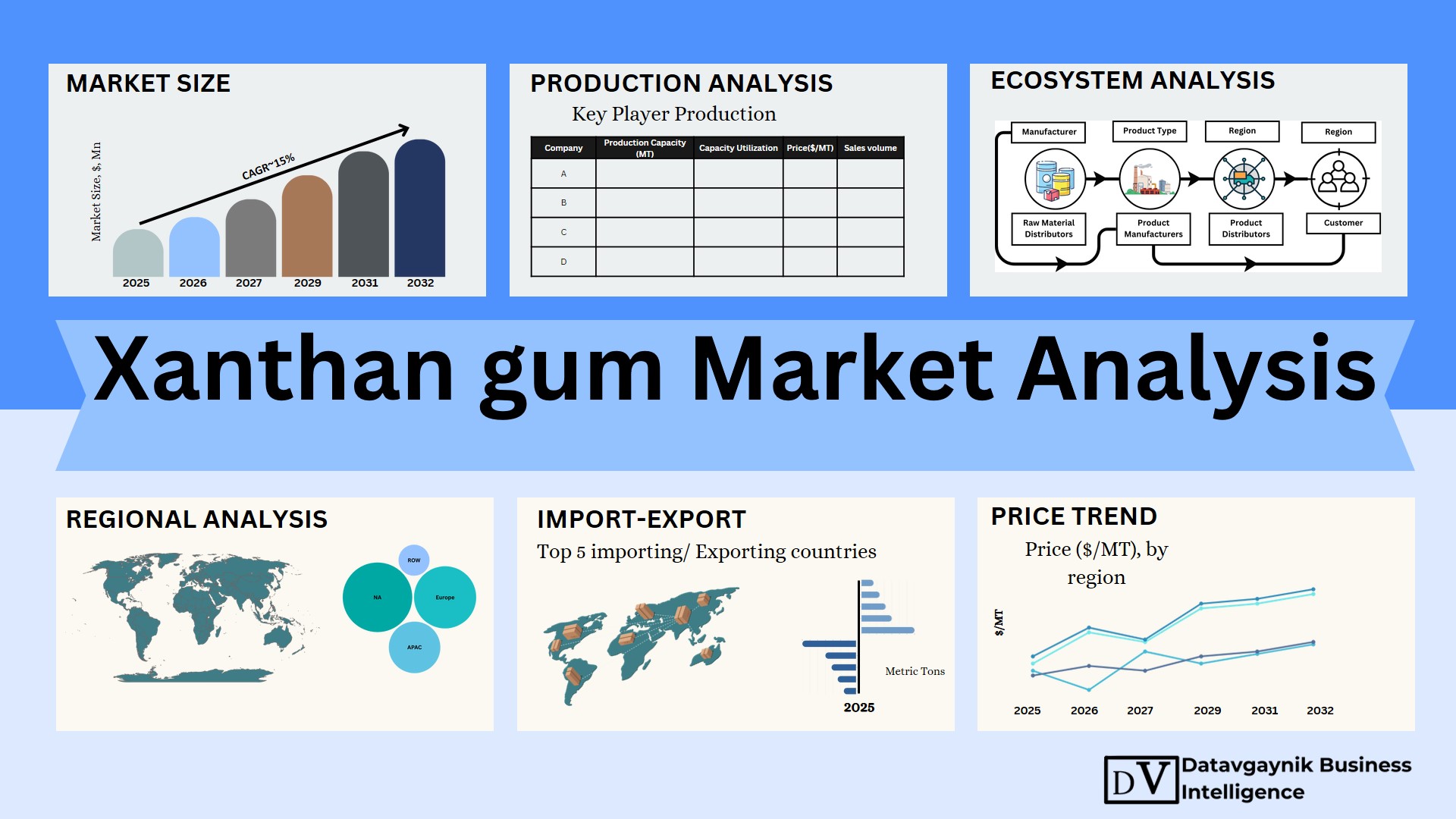
Xanthan gum is a fermentation-derived polysaccharide used as a thickener, stabilizer, suspending agent, and flow-control additive. Its value sits in a simple but important function: it improves texture, viscosity, shelf stability, and processing consistency across food, personal care, pharmaceuticals, oilfield fluids, and several industrial formulations. For buyers, it is not just another additive. It helps products behave the same way across batches, temperatures, packaging formats, and distribution conditions.
Datavagyanik also covers related markets such as the Polysaccharide Gums (e.g., Xanthan Gum) Market, the Dehydroxanthan Gum Market, and the Gellan Gum Market. Each of these markets adds unique insights into end-user applications, regulatory influences, and competitive developments.
The Xanthan gum Market will stay relevant through 2026–2035 because it connects to three practical shifts. First, packaged food and convenience meal consumption continues to widen in both mature and developing markets. Sauces, dressings, bakery fillings, dairy alternatives, beverages, and ready-to-eat meals all need stable texture systems. Second, formulators are under pressure to reduce synthetic additives where possible. Xanthan gum benefits here because it is bio-based, fermentation-produced, and already accepted across many regulated end uses. Third, industrial users are improving fluid performance in oilfield, agricultural, coating, and cleaning applications. Xanthan gum works well where viscosity control and particle suspension are critical.
Production economics will matter more than usual in this market. Xanthan gum is produced through microbial fermentation, mainly using carbohydrate feedstocks such as corn starch, glucose, or sucrose. So, feedstock pricing, fermentation yield, energy cost, downstream recovery cost, and drying efficiency directly affect margins. China remains a major production base due to scale, cost structure, and export capability. That said, buyers in North America and Europe are becoming more sensitive to supply security, traceability, and food-grade consistency. This may lead to more dual-sourcing strategies and tighter supplier audits during the forecast period.
Regulation also shapes the market, but in a measured way. Xanthan gum is widely used in food and pharmaceutical systems, so compliance with food additive standards, excipient quality requirements, labeling rules, allergen controls, and residue limits is essential. The regulatory burden is not blocking demand. Rather, it separates qualified suppliers from commodity-grade producers. In higher-value applications, buyers will pay more for reliable quality documentation, microbiological control, batch traceability, and consistent viscosity performance.
Technology improvements are mostly happening at the production and formulation level. Better fermentation control, strain productivity, purification methods, and particle-size customization can improve yield and application performance. On the customer side, formulators are blending xanthan gum with guar gum, locust bean gum, carrageenan, cellulose derivatives, starches, and pectin to achieve cleaner texture profiles. This is especially visible in gluten-free bakery, plant-based dairy, low-fat sauces, and high-stability beverages.
| Market Indicator | 2026 Estimate | 2035 Forecast | Analyst View |
| Global market size | $1,720 million | $2,670 million | Demand expands with food texture systems, oilfield additives, and bio-based formulation needs |
| CAGR | 5.0% | Growth is steady rather than explosive, supported by broad end-use penetration | |
| Food & beverage demand share | ~55% in 2026 | Not disclosed | Largest demand pool due to sauces, dressings, bakery, dairy alternatives, and beverages |
| Industrial and oilfield applications | ~24% in 2026 | Not disclosed | Cyclical but strategically important due to fluid rheology and suspension performance |
| Asia Pacific production influence | High | High | China remains central to global supply and export pricing |
| Average market pricing band | $3.5–$6.5/kg | $4.2–$7.8/kg | Depends on grade, viscosity, purity, packaging, certifications, and supply contract terms |
The client base is broad, which gives the market some resilience. Key consumers include packaged food manufacturers, beverage companies, sauce and dressing producers, bakery ingredient suppliers, dairy and plant-based product formulators, oilfield service companies, pharmaceutical excipient buyers, cosmetic and personal care brands, agrochemical formulators, and industrial chemical companies. Large ingredient distributors also play an important role because many small and mid-sized buyers source xanthan gum through regional distribution channels rather than direct imports.
For decision-makers, the main point is clear. The Xanthan gum Market is not driven by one dramatic breakthrough. It grows because thousands of formulations need dependable viscosity and stability every day. The market’s upside will come from clean-label food reformulation, plant-based product development, pharmaceutical-grade quality demand, and selective industrial use. The main risks are feedstock volatility, price pressure from Chinese exports, quality variation among lower-cost suppliers, and substitution by other hydrocolloids where price becomes the only purchasing factor.
Expert view: Xanthan gum will remain a “quiet critical ingredient” through 2035. It rarely defines the final product by itself, but it often determines whether that product looks right, pours correctly, stays stable, and survives distribution without quality loss.
Competitive Intelligence and Benchmarking
The Xanthan gum Market is moderately consolidated at the qualified-supplier level, but fragmented at the trading and distribution layer. Large buyers do not select suppliers only on price. They look at viscosity consistency, microbiological control, ash level, particle size, transparency, hydration speed, regulatory documentation, and batch-to-batch reliability. That is where branded and technically supported producers hold an edge.
| Company | Portfolio Position | Market Position and Strategic Role |
| Tate & Lyle / CP Kelco | Offers nature-based hydrocolloids across xanthan gum, pectin, carrageenan, gellan gum, and related texture systems. Its xanthan gum portfolio supports food, personal care, home care, and industrial uses. | One of the strongest global formulation partners in specialty gums. The 2024 CP Kelco combination gives Tate & Lyle a deeper texture platform and better access to clean-label food reformulation. |
| Cargill | Supplies xanthan gum across food, beverage, personal care, pharmaceutical, and bioindustrial applications. The company offers regular, transparent, dust-reduced, and quick-dispersing grades depending on regional needs. | A global ingredient major with strong customer access, technical service, and regulatory support. Its position is strongest with multinational food and beverage companies that prefer dependable supply and documentation. |
| Fufeng Group | Active in fermentation-based ingredients and food additives, including xanthan gum. Its cost base benefits from large-scale bio-fermentation operations in China. | A major Asian producer with strong pricing influence. It competes heavily in bulk food-grade and industrial-grade material. Its advantage is scale. Its challenge is maintaining premium positioning in markets where buyers want traceability and higher documentation quality. |
| Deosen Biochemical | Focused on water-soluble hydrocolloids, including xanthan gum, gellan gum, welan gum, and related fermentation-derived products. | A China-based specialist with strong export orientation. The company is relevant for food, industrial, and oilfield buyers seeking competitive pricing with established production experience. |
| Jungbunzlauer | Produces non-GMO, vegan xanthan gum for food, cosmetic, pharmaceutical, and industrial use. The company positions xanthan gum as a stabilizer, thickener, suspending agent, and rheology modifier. | A premium European supplier with strong appeal in clean-label, personal care, and regulated applications. It does not compete only on volume. It competes on quality assurance and application know-how. |
| Meihua Holdings Group | Offers food-grade and industrial-grade xanthan gum as part of a broader amino acid and bio-fermentation portfolio. | A large Chinese fermentation player. Its role is important in Asian supply balance because it can influence export availability and price competition. |
| Hebei Xinhe Biochemical | Manufactures food-grade, petroleum-grade, construction-grade, and other xanthan gum variants. | A specialist supplier with relevance in industrial and regional export markets. It is more exposed to commodity-grade competition than global branded ingredient players. |
The competitive split is clear. Cargill, Tate & Lyle / CP Kelco, and Jungbunzlauer are better placed in premium food, personal care, pharmaceutical, and regulated formulations. Fufeng Group, Deosen Biochemical, Meihua Holdings Group, and Hebei Xinhe Biochemical carry more weight in cost-sensitive, bulk, and industrial demand.
This structure creates a two-speed market. Premium buyers want technical support and compliance. Commodity buyers want price and availability. The gap between the two will widen through 2035, especially as food companies tighten supplier audits and industrial users continue to negotiate aggressively.
Expert view: The winners will not be the producers with the lowest quoted price. They will be the producers that can keep viscosity stable, documentation clean, and lead times predictable when feedstock and freight markets move.
Regional Landscape and Adoption Outlook
Regional demand in the Xanthan gum Market depends on three factors: food processing maturity, industrial fluid demand, and access to qualified supply. The market is global, but adoption patterns are not uniform. North America and Europe are quality-led. China is production-led. India is volume-growth-led. Japan and South Korea are formulation-led.
| Region / Country | Adoption Level | Growth Outlook to 2035 | Key Demand Centers |
| United States | High | Moderate to strong | Packaged food, sauces, dressings, gluten-free bakery, oilfield fluids, pharma excipients, personal care |
| Europe | High | Moderate | Clean-label food, dairy alternatives, premium cosmetics, pharma-grade applications, low-sugar reformulation |
| China | Very high in production; rising in domestic demand | Strong | Export production, processed food, oilfield chemicals, industrial formulations |
| India | Medium but rising | Strong | Processed foods, bakery, instant mixes, dairy products, pharma formulations, personal care |
| Japan | High but mature | Stable to moderate | Premium food, convenience meals, cosmetics, healthcare formulations |
| South Korea | High in formulated consumer goods | Moderate to strong | Beauty products, beverages, sauces, convenience foods |
| Middle East | Selective but rising | Moderate | Oilfield additives, imported processed food, institutional foodservice, personal care |
The United States remains one of the most attractive demand markets. Food manufacturers use xanthan gum in sauces, salad dressings, bakery fillings, frozen desserts, gluten-free products, and beverage systems. Oilfield demand adds a cyclical but valuable layer. The U.S. also has strong demand for pharmaceutical and personal care grades. Supply is supported through global ingredient companies, distributors, and imports. Regulation is mature, so supplier qualification matters more than basic market access.
Europe is a quality-focused region. Buyers care about non-GMO positioning, clean-label narratives, allergen controls, traceability, and technical documentation. Demand is supported by plant-based foods, low-fat dairy alternatives, gluten-free bakery, and premium cosmetics. Growth is not as fast as Asia, but value per kilogram is stronger. Germany, France, the United Kingdom, Italy, Spain, and the Netherlands are key consumption and distribution markets.
China is central to global supply. It has large fermentation capacity, established export channels, and a strong cost structure. Domestic use is also growing as packaged food, beverages, personal care, and oilfield chemicals expand. That said, China’s role is not only demand-side. It sets the global pricing floor in many bulk-grade categories. Any change in corn input cost, energy prices, plant utilization, or environmental compliance can quickly affect international pricing.
India is one of the more attractive growth markets through 2035. The country’s processed food base is expanding, while bakery, sauces, instant noodles, dairy beverages, frozen desserts, and personal care products continue to move from informal to branded formats. India also has a strong pharmaceutical manufacturing base, which creates demand for better-documented excipient grades. The restraint is price sensitivity. Many customers still compare xanthan gum with cheaper starches or blended hydrocolloid systems.
Japan is mature but technically sophisticated. Demand is tied to high-quality packaged food, convenience meals, sauces, dressings, cosmetics, and healthcare products. Japanese formulators are less likely to chase the lowest-cost material if texture stability or sensory quality is at risk. Growth will be steady rather than aggressive.
South Korea is smaller than China or India, but it is strategically attractive. The country has strong beauty, beverage, convenience food, and functional food industries. Xanthan gum fits well in skin care gels, cleansers, masks, sauces, ready meals, and dairy alternatives. The market favors grades with good dispersibility, sensory control, and clean formulation behavior.
The Middle East is relevant, but not in the same way as food-heavy regions. Oilfield applications support industrial demand in countries such as Saudi Arabia, the UAE, Kuwait, and Qatar. Imported processed food and institutional foodservice also support food-grade consumption. Growth is useful, but the market depends heavily on import flows and distributor strength.
From a funding and infrastructure angle, Asia has the strongest production economics. North America and Europe have the strongest compliance and technical-service ecosystems. India has the strongest consumption upside from a low base. The Middle East has selective demand tied to energy and food import systems.
Use case: A sauce manufacturer in India may start with a low-cost stabilizer blend. As exports grow, the same company may shift toward higher-grade xanthan gum because international retailers demand better texture stability and cleaner documentation.
Recent Developments + Opportunities & Restraints
Recent Developments
| Year / Month | Event | Market Impact |
| November 2024 | Tate & Lyle completed the acquisition of CP Kelco, adding a global specialty gums and nature-based ingredient platform. | Strengthens the premium hydrocolloid supply base. It also increases technical competition in texture systems, especially for food and beverage reformulation. |
| April 2025 | Meihua Holdings Group’s annual reporting continued to highlight xanthan gum within its fermentation-based product base and referenced operational progress in xanthan gum capacity. | Supports China’s role as a major cost-competitive supply base. It also keeps export pricing pressure active in bulk-grade markets. |
| October 2025 | The European Commission adopted Commission Regulation (EU) 2025/2058, updating food-additive rules linked to foods for particular nutritional uses and retaining xanthan gum within the regulated additive framework. | Reinforces the need for regulatory documentation in sensitive nutrition categories. This favors suppliers with stronger compliance systems. |
| April 2026 | Jungbunzlauer published technical application work on xanthan gum as a natural thickener in face-mask formulations. | Highlights growth beyond food. Personal care can become a higher-margin outlet for premium, sensory-focused xanthan gum grades. |
| April 2026 | Jungbunzlauer also released technical content on xanthan gum use in gluten-free bread texture. | Supports continued food innovation in gluten-free bakery, where xanthan gum helps improve structure, softness, and eating quality. |
Opportunities
- Clean-label and plant-based food reformulation
Food companies are still rebuilding texture in low-fat, low-sugar, gluten-free, dairy-free, and egg-free products. Xanthan gum fits this space well because it works at low dosage and blends with other hydrocolloids. This supports premium food-grade growth.
- Emerging-market processed food expansion
India, Southeast Asia, Latin America, and parts of the Middle East will add new demand as packaged sauces, bakery mixes, frozen desserts, instant foods, and beverages scale up. The first demand layer will be cost-sensitive. Later, quality and documentation will matter more.
- Personal care and pharma-grade differentiation
Cosmetics and pharmaceutical formulations create room for cleaner, more controlled grades. Here, suppliers can move away from pure commodity pricing. Better hydration, transparency, microbiological quality, and sensory performance can support stronger margins.
Restraints
- Feedstock and energy cost volatility
Xanthan gum production depends on fermentation economics. Corn-derived glucose, sucrose, energy, utilities, and drying costs all influence margins. Price swings can be difficult to pass through quickly.
- Commodity-grade price pressure
Chinese producers remain highly influential in bulk supply. When utilization rises or export pricing turns aggressive, premium producers face pressure in mid-tier applications.
- Substitution risk in low-cost formulations
In some products, buyers can partly replace xanthan gum with starches, guar gum, cellulose derivatives, carrageenan, or blended hydrocolloid systems. This is most common when texture requirements are basic and price is the dominant factor.


