

Market Summary and Growth Forecast
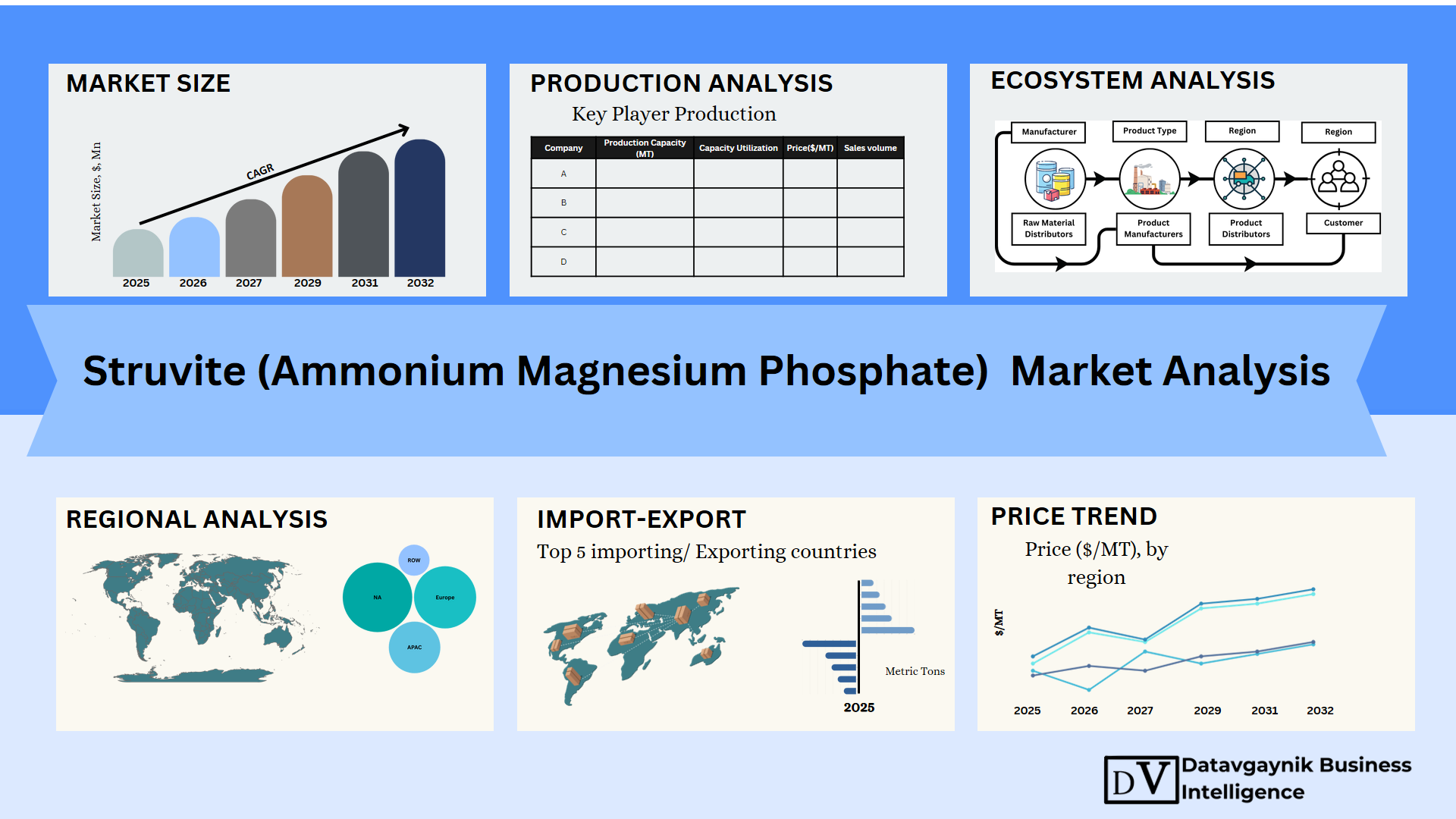
The global Struvite (Ammonium Magnesium Phosphate) Market is valued at $214 million in 2026 and is expected to appreciate to $541 million by 2035, at a CAGR of 10.9%.
Struvite is a crystalline phosphate compound generally represented as magnesium ammonium phosphate hexahydrate. Commercial struvite is mainly recovered by combining dissolved phosphate, ammonium and magnesium under controlled pH conditions. The resulting material contains three plant nutrients: phosphorus, nitrogen and magnesium.
The market covered in this assessment includes commercial sales of recovered and synthetically produced struvite, including granules, crystals, powders and struvite-based fertilizer formulations. It excludes the capital value of complete wastewater treatment plants, unrelated phosphate recovery products such as calcium phosphate and brushite, and naturally occurring struvite associated with medical conditions.
Datavagyanik also covers related markets such as the Ammonium Phosphate Market, the Magnesium Phosphate Market, and the Ammonium Sulfate Market. These compounds are commonly used in oxidation systems and industrial chemical processing, supporting shifts in formulation standards and regulatory compliance.
Global Market Outlook
| Indicator | 2026 | 2029 | 2032 | 2035 |
| Global market value | $214 million | $292 million | $397 million | $541 million |
| Estimated commercial volume | 185,000 tonnes | 242,000 tonnes | 327,000 tonnes | 430,000 tonnes |
| Average realized value | $1,157 per tonne | $1,207 per tonne | $1,214 per tonne | $1,258 per tonne |
| Forecast CAGR | — | 10.9% | 10.9% | 10.9% |
The estimates reflect commercial product value at the producer or first-distributor level. Average values combine recovered crystals, premium granular fertilizers and specialized formulations. They should not be compared directly with bulk phosphate commodity prices.
Business Relevance During 2026–2035
The commercial case for struvite rests on two linked problems. Wastewater operators need to remove excess phosphorus before it reaches rivers and lakes. Fertilizer producers, meanwhile, need alternative phosphorus sources that reduce dependence on mined phosphate rock.
Uncontrolled struvite formation can create hard deposits inside pumps, pipes, centrifuges and sludge-handling equipment. Controlled precipitation changes that maintenance problem into a recoverable nutrient stream. Commercial systems can remove soluble phosphorus before it forms deposits and convert the recovered material into a saleable fertilizer. This gives treatment plants a combination of avoided maintenance costs, lower chemical use and possible by-product revenue.
The Struvite (Ammonium Magnesium Phosphate) Market will therefore develop as part of the wider water-resource recovery economy. Product demand alone will not determine investment. Projects will also be assessed against sludge-disposal savings, phosphorus discharge limits, polymer consumption, equipment downtime and the reliability of fertilizer offtake.
Key Macro Forces
Phosphorus-Recovery Regulation
Europe provides the clearest regulatory pathway. EU rules allow qualifying precipitated phosphate salts, including struvite, to be incorporated into fertilizing products when recovery, purity and safety requirements are met. The framework establishes minimum material-quality conditions and supports the transition of recovered phosphate from waste status to a regulated fertilizer input.
Germany is also moving toward compulsory phosphorus recovery from larger sewage treatment facilities under its sewage-sludge framework. This is encouraging wastewater operators to compare struvite crystallization with sludge-ash processing and other phosphorus recovery routes.
The regulatory effect will not be uniform. Some countries will prioritize nutrient removal without requiring commercial recovery. Others will introduce fertilizer registration, contaminant limits and end-of-waste rules that make the recovered product easier to sell. So, regulatory recognition is as important as technical recovery efficiency.
Circular Fertilizer Demand
Recovered struvite is positioned as a slow or controlled nutrient source rather than a direct substitute for every conventional phosphate fertilizer. Its commercial value is strongest where nutrient-use efficiency, phosphorus runoff, localized application and premium crop economics matter more than the lowest possible cost per kilogram of phosphorus.
Agriculture, horticulture and managed turf are the principal outlets. Struvite is less water-soluble than conventional monoammonium phosphate or diammonium phosphate. Nutrient release is influenced by soil chemistry, plant-root activity, particle size and product formulation. This can reduce immediate phosphorus loss, although agronomic performance remains dependent on crop type, soil conditions and application method.
The Struvite (Ammonium Magnesium Phosphate) Market will gain the strongest traction in specialty crops, transplanted crops, nurseries, turf management and blended fertilizers. Broad-acre use will increase more slowly because conventional phosphate fertilizers retain major advantages in scale, distribution and price.
Wastewater Infrastructure Investment
Municipal sewage, food processing, livestock operations, anaerobic digestion and selected industrial effluents contain recoverable phosphorus and ammonium. However, not every nutrient-rich stream is commercially suitable. Project economics improve when phosphorus concentration is high, flow is predictable and the treatment plant already experiences scaling or chemical-consumption problems.
Large centralized wastewater treatment plants remain the most practical early adopters. Commercial facilities have demonstrated capacities ranging from several hundred tonnes to approximately 10,000 tonnes of struvite fertilizer annually, depending on influent conditions and installed reactor scale.
Industrial wastewater offers a smaller but increasingly attractive opportunity. Potato processing, food manufacturing, dairies, livestock digesters and other nutrient-intensive operations may provide more concentrated streams than municipal wastewater. These projects can also support closed-loop nutrient claims within food and agricultural supply chains.
Production Economics
Struvite recovery is not automatically profitable from fertilizer sales alone. Magnesium chemicals, alkalinity adjustment, pretreatment, drying, granulation, testing and transportation can materially affect production cost.
The strongest installations generate value through several channels:
| Economic Benefit | Commercial Effect |
| Controlled phosphorus precipitation | Reduces unplanned scaling and pipe blockage |
| Lower phosphorus return load | Reduces pressure on upstream biological treatment |
| Improved sludge dewatering | May lower polymer and sludge-disposal costs |
| Sale of recovered nutrients | Adds a secondary revenue stream |
| Regulatory compliance | Reduces exposure to tighter discharge obligations |
| Local fertilizer production | Limits dependence on imported phosphate inputs |
Some recovery processes report improved sludge-cake dryness, reduced polymer use and substantial reductions in soluble phosphorus returned to the treatment plant. The exact savings vary by sludge characteristics and process design.
Expert view: Struvite projects will increasingly be approved as wastewater-efficiency investments with fertilizer revenue, rather than as fertilizer plants that happen to treat wastewater. This distinction matters because avoided operating cost is often more dependable than nutrient-product revenue.
Key Consumers and Clients
The principal commercial participants include:
- Fertilizer manufacturers and regional nutrient blenders
- Agricultural distributors and farm-input retailers
- Commercial farms, growers and agricultural cooperatives
- Greenhouse, nursery and ornamental-plant producers
- Golf-course, turf and landscape-management companies
- Municipal wastewater utilities and water-resource recovery facilities
- Food and beverage processors with phosphorus-rich effluent
- Livestock farms, manure processors and anaerobic-digestion operators
- Phosphate refiners and specialty nutrient formulators
- Universities, agronomy laboratories and applied-research institutions
The most important clients vary by business model. Fertilizer companies buy and formulate the recovered material. Wastewater utilities buy recovery technology and may sell the resulting crystals through an offtake arrangement. Agricultural users then purchase the finished nutrient product through distributors or direct supply programs.
Use case: A municipal treatment plant experiencing recurring struvite deposits may install controlled precipitation upstream of dewatering. The plant reduces maintenance, recovers phosphorus crystals and transfers the finished material to a fertilizer partner for granulation and market distribution.
Market Segmentation and Forecast Scope
The Struvite (Ammonium Magnesium Phosphate) Market is best segmented by production route, product form, application, end user and region. These dimensions capture both the source of the material and the point at which commercial value is created.
The forecast period is 2026–2035. Revenue is measured at the struvite producer or initial commercial-distribution level. Equipment sales, engineering contracts and complete nutrient-recovery plants are reviewed as ecosystem indicators but are not included in the reported product-market value.
By Production Route
Municipal Wastewater-Recovered Struvite
Struvite recovered from municipal wastewater represents an estimated 74% of global revenue in 2026. This segment benefits from established wastewater flows, large centralized treatment facilities and growing pressure to control phosphorus discharge.
Municipal facilities typically recover phosphorus from digester liquor, centrate, sludge-processing streams or other concentrated side streams. Recovery is more economical when biological phosphorus removal has already concentrated phosphorus within the sludge-treatment system.
This segment will remain the largest through 2035, but its share will gradually narrow as industrial and agricultural recovery projects move beyond demonstration scale.
Industrial and Agricultural Effluent-Recovered Struvite
This category includes struvite recovered from food-processing wastewater, livestock manure, agricultural digestate, fermentation streams and other nutrient-rich industrial effluents.
It is expected to be the fastest-growing production route. Feed streams from food, livestock and agricultural operations can carry high phosphorus and ammonium concentrations. They may also be located near fertilizer users, reducing outbound logistics.
The main constraint is feedstock variability. Organic matter, calcium, suspended solids and competing ions can affect crystal purity and process efficiency. Additional pretreatment may be needed before the product can meet fertilizer standards.
Synthetic Struvite
Synthetic struvite is manufactured from controlled chemical inputs rather than recovered waste streams. It offers consistent composition and lower contamination risk. However, its sustainability and cost advantages are weaker because magnesium, ammonium and phosphate inputs must be purchased directly.
The segment will retain a place in laboratory research, agronomic trials, specialty fertilizers and applications where high purity is more important than circular sourcing. It will remain smaller than recovered struvite throughout the forecast period.
By Product Form
Granular and Prilled Struvite
Granular struvite is expected to remain the most commercially strategic form. Uniform granules are easier to store, transport, blend and apply through conventional fertilizer equipment.
Particle-size control is important. Small crystals can create dust, handling losses and inconsistent spreading. Larger, stronger granules offer better commercial acceptance but require careful reactor operation, washing, drying and classification.
Granular products will gain further support from specialty fertilizer blenders seeking slow-release phosphorus and magnesium inputs.
Powdered and Fine-Crystal Struvite
Powders and fine crystals require less finishing but can be more difficult to handle. They are used in direct soil applications, research, customized blends and downstream chemical processing.
This form is more common where the producer has limited granulation capacity or where the buyer intends to reformulate the material. Pricing is generally lower than for consistently sized premium granules.
Blended and Formulated Struvite Products
This category includes struvite combined with nitrogen, potassium, micronutrients, organic materials or conventional phosphate fertilizers.
Blending allows suppliers to correct struvite’s relatively low nitrogen contribution and build crop-specific nutrient profiles. It also supports higher-value formulations for horticulture, turf and specialty agriculture.
Formulated products are likely to grow faster than unprocessed crystals because buyers generally prefer complete nutrient programs over a single recovered ingredient.
By Application
Crop Nutrition
Crop nutrition accounts for an estimated 68% of the market in 2026. The segment includes field crops, vegetables, fruits, vineyards, nurseries, controlled-environment agriculture and other commercial crop applications.
Demand is concentrated in applications where phosphorus-use efficiency and localized nutrient delivery justify a premium over conventional phosphate products. Struvite is particularly relevant for placement near roots, transplant systems, starter fertilizers and crops grown in soils with a high risk of phosphorus fixation or runoff.
The broad-acre opportunity is large but commercially difficult. Farmers producing low-margin cereal and oilseed crops remain highly price-sensitive. Adoption will therefore depend on blending, application efficiency and evidence of improved nutrient utilization.
Turf, Landscape and Ornamental Horticulture
This is expected to be one of the fastest-growing applications. Golf courses, sports fields, public landscapes, nurseries and ornamental-plant producers value predictable nutrient release and lower risk of immediate phosphorus leaching.
The segment also accepts smaller sales volumes and higher realized prices than commodity agriculture. Product branding, distributor education and trial data will be important purchasing factors.
Phosphate Refining and Nutrient-Product Manufacturing
Recovered struvite can be used as an intermediate input for phosphoric acid, phosphate salts and formulated fertilizer production. This remains an emerging application rather than a mainstream outlet.
Research programs are examining routes that dissolve or refine struvite while recovering magnesium for reuse in the precipitation process. Such circular processing may improve long-term economics, especially where direct fertilizer sales are constrained by product variability.
Research and Specialty Uses
Universities, laboratories, soil-science organizations and specialty chemical users purchase small quantities for crystallization studies, nutrient-release testing, environmental research and material development.
Revenue is limited, but unit prices can be high. The category will remain a niche part of the overall market.
By End User
| End-User Segment | Commercial Role | Growth Outlook |
| Fertilizer manufacturers and blenders | Purchase struvite as an ingredient for granular or compound fertilizers | High |
| Commercial farms and grower groups | Apply finished products directly to crops | Moderate to high |
| Horticulture and nursery operators | Use controlled nutrient products in high-value cultivation | High |
| Turf and landscape operators | Use granular products for managed-release fertilization | High |
| Agricultural distributors | Register, stock and market finished products | High |
| Chemical and phosphate processors | Convert struvite into refined phosphorus products | Emerging |
| Research institutions | Conduct agronomic, chemical and wastewater studies | Moderate but small |
Fertilizer manufacturers and blenders will remain the most influential buyers because they connect fragmented recovery facilities with established agricultural distribution.
Direct farm sales will grow, but most wastewater operators do not have the sales network, product-registration capacity or agronomic support needed to market fertilizer independently. Offtake agreements and distributor partnerships will therefore remain central to market development.
By Region
North America
North America has an established base of commercial nutrient-recovery facilities, especially in the United States and Canada. Large municipal wastewater plants, phosphorus-sensitive watersheds and a developed specialty fertilizer industry support adoption.
The region will maintain a strong position in premium granular products. Growth will depend on state-level nutrient regulations, municipal capital budgets and the commercial performance of existing recovery installations.
Europe
Europe is the most strategically important regional market. EU fertilizer rules provide a pathway for compliant recovered phosphate salts, while national phosphorus-recovery mandates are strengthening the project pipeline.
Germany, the Netherlands, Belgium, Spain, the United Kingdom and Nordic countries are important development centers. The regional challenge is not technical interest but the alignment of waste regulation, fertilizer registration, product quality and cross-border trade.
Asia Pacific
Asia Pacific is expected to record the fastest growth through 2035. China, Japan, South Korea, India and parts of Southeast Asia face rising wastewater volumes, fertilizer-import exposure and pressure to improve nutrient management.
Japan has prior experience with sewage-derived phosphorus recovery. China offers the largest long-term volume opportunity, including municipal wastewater, livestock operations and food-processing effluent. India has substantial theoretical potential, although commercial adoption will depend on wastewater collection, plant performance and fertilizer-product approval.
Latin America, Middle East and Africa
LAMEA remains an early-stage market. Brazil, Mexico, Chile, South Africa, Saudi Arabia and the United Arab Emirates offer selected opportunities around livestock waste, food processing, water reuse and large municipal treatment projects.
The regional opportunity is site-specific. Many facilities require basic wastewater-treatment upgrades before advanced phosphorus recovery becomes a priority. High fertilizer-import dependence could strengthen the long-term case, but financing and operational capability will limit near-term deployment.
Regional demand in the Struvite (Ammonium Magnesium Phosphate) Market will therefore remain concentrated in Europe and North America during the early forecast period, while Asia Pacific contributes the largest incremental volume toward 2035.
Expert view: The fastest regional growth will not necessarily occur where fertilizer demand is highest. It will occur where concentrated nutrient streams, enforceable phosphorus limits and reliable product buyers exist at the same time.
Market Trends and Business Innovations
Innovation in the Struvite (Ammonium Magnesium Phosphate) Market is moving beyond basic phosphorus precipitation. Development work now concentrates on crystal quality, feedstock flexibility, operating cost, fertilizer certification and integration with existing sludge-treatment systems.
The technology is commercially proven at selected municipal and industrial sites. Even so, full-scale adoption remains limited compared with conventional phosphorus removal. Recent scientific work continues to focus on real wastewater, pretreatment needs, calcium interference, salinity, reaction control and the consistency of the recovered fertilizer.
R&D Evolution
Higher Recovery from Complex Feed Streams
Early research commonly relied on synthetic solutions with carefully controlled phosphate, ammonium and magnesium levels. Current work is shifting toward real municipal, livestock, food-processing and industrial wastewaters.
These streams are harder to treat. Calcium can compete with magnesium and produce unwanted calcium phosphates. Suspended solids can affect crystal separation. Organic matter may influence purity and fertilizer approval. So, research is increasingly focused on pretreatment, selective precipitation and operating windows rather than precipitation chemistry alone.
Fluidized-bed crystallization remains a central research area because it can support controlled crystal growth and continuous solids separation. New studies are also examining electrochemical precipitation, membrane crystallization, ion-exchange-assisted recovery and biologically influenced mineral formation. Most alternatives still require further validation at commercial scale.
Lower-Cost Magnesium Sources
Magnesium salt is one of the main variable inputs in struvite production. Commercial economics can improve when plants use lower-cost magnesium chloride, magnesium oxide, seawater-derived magnesium, industrial by-products or recycled magnesium streams.
The challenge is consistency. Low-cost sources may contain calcium, metals or other impurities that affect crystal quality. Future R&D will therefore balance reagent cost against product-purity requirements.
One circular approach involves processing recovered struvite into phosphoric acid while generating magnesium chloride that can be reused in further struvite production. This could reduce fresh-magnesium consumption and connect wastewater recovery with conventional phosphate refining.
Product-Quality Standardization
Commercial users require more than phosphorus recovery. They require a product with predictable nutrient content, particle size, moisture, contaminant levels and storage stability.
EU rules for recovered precipitated phosphate salts establish requirements covering permitted inputs, processing and material quality. Such frameworks are pushing technology developers to design recovery systems around the finished-product specification rather than phosphorus-removal efficiency alone.
Expert view: The next stage of R&D will be judged by tonnes of saleable fertilizer, not simply by the percentage of phosphorus removed from wastewater.
Technology Evolution
Controlled Crystallization Reactors
Commercial systems increasingly use fluidized-bed, stirred-reactor or sludge-based precipitation designs to control where struvite forms and how large the crystals become.
In fluidized-bed systems, small seed particles or existing crystals remain suspended while additional material deposits on their surface. This supports larger granules that can be separated, washed and marketed.
Other systems precipitate struvite within digested sludge before dewatering. Carbon-dioxide stripping raises pH, while magnesium addition promotes controlled crystal formation. The approach can also improve dewatering and reduce unwanted deposits downstream.
Improved Crystal Separation and Washing
One operational problem is the recovery of small crystals from wet sludge or centrate. Technology providers are introducing improved settling zones, crystal return loops, washers, screens and automated discharge systems.
CNP CYCLES, for example, has developed process configurations that distinguish between microcrystals retained in sludge and larger crystals harvested as a separate product. Its recent work with Berliner Wasserbetriebe includes automation of struvite discharge, washing and container handling to reduce manual intervention.
The commercial impact is practical. Better solids handling increases product recovery, reduces labor and improves the consistency of downstream fertilizer processing.
Integration with Biological Phosphorus Removal
Struvite recovery is most effective when the wastewater treatment process has already concentrated phosphorus into a manageable side stream. Enhanced biological phosphorus removal, anaerobic digestion and sludge dewatering can create this condition.
Technology suppliers are therefore designing recovery units as part of a broader treatment train rather than as isolated reactors. This integration reduces phosphorus recycle loads and supports more stable plant operation.
NuReSys applies this approach in municipal and industrial facilities, including food-processing sites where phosphorus-rich wastewater can support premium fertilizer production.
Material Science and Fertilizer Formulation
Crystal Size and Mechanical Strength
Crystal size affects filtration, drying, dust generation, blending and field application. Small particles may dissolve differently but are harder to handle. Large granules improve spreading and blending but require controlled growth and sufficient mechanical strength.
Material development is therefore focusing on:
- Controlled nucleation and crystal growth
- Granule-size classification
- Reduction of fines and dust
- Drying without crystal degradation
- Compatibility with conventional fertilizer blends
- Coating or formulation for crop-specific nutrient release
Recovered granular products can contain nitrogen, phosphorus and magnesium in a single crystal. Commercial formulations may then add potassium, sulfur or micronutrients to create a more complete nutrient profile.
Purity and Contaminant Control
A major advantage of controlled precipitation is that struvite can contain lower concentrations of some contaminants than untreated sludge. However, quality depends on the wastewater source, pretreatment and precipitation conditions.
Heavy metals, organic contaminants, pathogens and residual moisture remain important registration considerations. Producers targeting food crops or organic agriculture face more demanding documentation and traceability requirements.
In April 2024, Ostara announced that a recovered granular struvite product had secured registration aligned with EU organic-production requirements and the Dutch input list. The announcement is commercially relevant because organic approval widens the addressable crop market and demonstrates that wastewater-derived nutrients can meet defined product standards.
Commercial and Business-Model Innovation
Utility–Fertilizer Offtake Models
Many wastewater utilities do not want to become fertilizer marketers. They may lack product-registration expertise, storage facilities, agronomic sales teams and agricultural distribution.
Offtake models address this gap. A technology or fertilizer partner agrees to purchase, process or market the recovered struvite. The utility receives product revenue while focusing on wastewater operations.
This model has been used in commercial projects where the technology provider purchases the recovered fertilizer and distributes it through established agricultural channels.
Performance-Based Project Economics
Equipment suppliers are increasingly presenting struvite recovery as a package of operating benefits rather than a stand-alone fertilizer investment.
The economic case may include:
| Value Source | Operating Impact |
| Lower scale formation | Less pipe and equipment cleaning |
| Reduced chemical precipitation | Lower iron- or aluminum-salt consumption |
| Improved sludge dewatering | Lower polymer use and disposal volume |
| Lower phosphorus recycle | More stable biological treatment |
| Fertilizer production | New product revenue |
| Regulatory compliance | Lower risk of future treatment upgrades |
This model makes adoption possible even when fertilizer revenue covers only part of the project cost.
Modular and Retrofittable Systems
Modular reactors, skid-mounted dosing systems and containerized pilot units are becoming more relevant for mid-sized plants and industrial users.
These systems allow operators to test feedstock behavior before committing to a full-scale installation. They can also shorten construction schedules and limit disruption at operating wastewater facilities.
The fastest growth is likely to come from standardized systems that can be adapted to different flow rates without redesigning the complete treatment plant.
Partnerships and Recent Announcements
| Date | Company or Organization | Announcement | Market Significance |
| April 2024 | Ostara | Obtained organic-use registration for a recovered struvite nutrient product in Europe | Expands access to organic and premium crop markets |
| 2025–2026 | CNP CYCLES and Berliner Wasserbetriebe | Advanced automation of struvite discharge and washing at a major German wastewater facility | Shows the shift from basic recovery toward lower-labor commercial operation |
| 2026 | Veolia Water Technologies | Included struvite-based phosphorus recovery in a major wastewater upgrade serving the Oslo Fjord | Links nutrient recovery with stricter water-quality protection and organic fertilizer production |
Sources:
Recent disclosed activity suggests that project awards, technology licensing, municipal partnerships and fertilizer approvals are currently more important than large mergers and acquisitions. The industry remains fragmented, with different companies specializing in reactor design, sludge optimization, fertilizer marketing or downstream nutrient processing.
Future Impact
By 2035, the Struvite (Ammonium Magnesium Phosphate) Market is likely to move from a collection of individual recovery projects toward a more integrated supply network.
Large fertilizer companies may purchase recovered struvite from several treatment plants, standardize it at regional processing centers and distribute it as part of broader nutrient portfolios. Water utilities will increasingly specify product quality and offtake arrangements during the initial project-design stage.
Industrial recovery will also become more important. Food processors, dairies, livestock operations and anaerobic-digestion facilities can create localized nutrient loops in which phosphorus is recovered close to agricultural users.
Expert view: Scale will come from aggregation. One wastewater plant may produce too little material to support a national fertilizer brand. A network of plants using common quality specifications can create a dependable regional supply base.
Use case: A fertilizer blender may combine granular struvite from several municipal facilities with potassium and micronutrients. The finished product can then be sold as a crop-specific blend rather than as an unprocessed wastewater-derived crystal.
Competitive Intelligence and Benchmarking
Competition in the Struvite (Ammonium Magnesium Phosphate) Market is project-led rather than volume-led. Companies rarely disclose annual recovered-stravite output, project revenue or active installed capacity in a consistent form. So, competitive strength is better judged through operating references, process integration, fertilizer commercialization, regional service capability and the ability to guarantee an outlet for recovered material.
The market includes specialist nutrient-recovery companies and large water-treatment groups. Specialists generally offer deeper process knowledge. Large engineering groups bring project financing, global procurement, plant integration and long-term service capabilities.
Competitive Benchmarking
| Company | Technology and Commercial Focus | Main Customer Base | Geographic Strength | Analyst Assessment |
| Ostara Nutrient Recovery Technologies | Fluidized-bed crystallization, upstream phosphorus release and fertilizer commercialization | Large municipal utilities, fertilizer distributors and commercial agriculture | United States, Canada and selected European markets | Leading integrated specialist |
| CNP Cycles / Centrisys-CNP | Sludge-side precipitation, carbon-dioxide stripping, biosolids optimization and dewatering integration | Municipal wastewater and biosolids facilities | Germany, wider Europe and North America | Strong sludge-management specialist |
| NuReSys | Integrated phosphate management and customized recovery from municipal and industrial streams | Municipal plants, food processors and industrial wastewater operators | Belgium, Netherlands, wider Europe and selected US projects | Strong European technology specialist |
| Veolia Water Technologies | Compact crystallization integrated with advanced wastewater-treatment systems | Large municipalities and industrial water users | Global | Major international systems integrator |
| Paques | Combined biological treatment, ammonium management and phosphate recovery | Food, beverage, fermentation, municipal and industrial plants | Europe, Asia and international industrial markets | Strong industrial wastewater position |
| SUEZ | Phosphorus crystallization, sludge treatment and complete wastewater-resource recovery | Municipal authorities and large industrial clients | Europe and international infrastructure markets | Major project-integration competitor |
Competitive positions are analyst assessments based on disclosed technology portfolios, operating references, commercialization capability and geographic reach. They are not reported company market shares.
Ostara Nutrient Recovery Technologies
Ostara Nutrient Recovery Technologies has one of the most complete business models in the sector. Its portfolio connects wastewater phosphorus recovery with the production and commercial sale of granular fertilizer.
The company’s core system uses controlled fluidized-bed crystallization. Dissolved phosphorus and ammonium are directed into a reactor, where magnesium is added under controlled chemical conditions. Crystals grow to a size that permits harvesting, washing and fertilizer use.
Its competitive advantage is not limited to equipment. Ostara has also developed upstream nutrient-management processes and an established downstream fertilizer platform. This reduces one of the largest risks faced by municipal utilities: finding a reliable buyer for recovered material.
The company is particularly well positioned for large biological nutrient-removal plants with concentrated digester side streams. Its model is less suited to smaller treatment plants where daily phosphorus loading cannot support a dedicated recovery and finishing system.
Ostara holds one of the strongest commercial positions in North America. Its installed references, fertilizer expertise and integrated offtake model create a barrier for smaller equipment-only competitors.
CNP Cycles / Centrisys-CNP
CNP Cycles focuses on phosphorus recovery from digested sludge before dewatering. Its approach strips carbon dioxide to raise pH and introduces magnesium to support controlled struvite precipitation.
The process differs from centrate-only crystallization. A significant portion of the crystals remains within the sludge matrix, while recoverable material can be separated through downstream washing and classification. The main economic value comes from reduced scale, lower phosphorus recycle, improved sludge dewatering and reduced polymer demand.
In North America, Centrisys-CNP markets a related phosphorus-management platform alongside centrifuges, thermal hydrolysis and calcium phosphate recovery. This gives the company a strong position where utilities are making broader investments in biosolids handling rather than purchasing an isolated struvite reactor.
The combined portfolio is particularly relevant for plants with recurring deposits in digesters, pipelines, pumps and dewatering equipment. It also appeals to operators seeking operating savings even when fertilizer revenue is modest.
The company has a defensible position in Germany and North America. Its key limitation is that some configurations prioritize plant optimization over the production of large volumes of uniform, market-ready fertilizer granules.
NuReSys
NuReSys offers a broader phosphate-management model covering phosphorus release, precipitation control, crystallization and fertilizer recovery. The company evaluates phosphorus flows across the complete wastewater facility before selecting the recovery point.
This approach matters because poorly located recovery equipment may remove only a small share of the phosphorus entering a treatment plant. NuReSys focuses on redirecting soluble phosphorus toward a controlled recovery stage while reducing unwanted precipitation elsewhere.
Its portfolio addresses municipal wastewater, food-processing effluent, potato-processing streams, dairy wastewater and other industrial sources. These industrial applications can offer high phosphate concentrations and more predictable nutrient loads than diluted municipal wastewater.
The company is well established in Belgium and neighboring European markets. Partnerships with local engineering and biosolids companies support expansion into the United States.
Its main strength is process customization. Its relative weakness is a smaller global sales and project-financing network compared with Veolia and SUEZ.
Veolia Water Technologies
Veolia Water Technologies combines struvite recovery with complete municipal and industrial water-treatment projects. Its portfolio includes compact phosphorus crystallization, biological treatment, sludge processing, water reuse and digital plant services.
The company’s position is strongest where clients prefer one contractor to manage multiple treatment stages. A municipality can procure nutrient removal, phosphorus recovery, microplastic removal, sludge treatment and energy recovery under a coordinated engineering package.
In January 2026, Veolia disclosed an advanced wastewater project in Norway that will recover phosphorus as struvite for organic fertilizer while meeting demanding nitrogen, phosphorus and particle-removal targets. The project demonstrates how phosphorus recovery is being incorporated into larger environmental infrastructure investments rather than sold as a stand-alone unit.
Veolia benefits from global engineering, procurement and service capabilities. However, it may face competition from specialist firms on smaller projects where clients want greater process flexibility or lower engineering overhead.
The company is likely to gain share in large municipal upgrades, water-sensitive industrial sites and public-private infrastructure projects. Its worldwide installed water-treatment base also creates retrofit opportunities.
Paques
Paques combines biological wastewater treatment with nutrient recovery. Its struvite platform removes phosphorus while also addressing ammonium and biodegradable organic matter.
This design is particularly relevant for concentrated industrial effluents. Food-processing, fermentation, beverage, biofuel and organic-waste digestion facilities may need simultaneous treatment of chemical oxygen demand, ammonium and phosphate.
The company states that its process can remove up to 95% of phosphate under suitable operating conditions. Commercial feasibility is strongest above approximately 100 kilograms of phosphorus per day and where phosphate concentration exceeds about 50 milligrams per litre. These thresholds illustrate why concentrated industrial and municipal side streams are preferred over dilute final effluent.
Paques also has a large international base in anaerobic and biological wastewater treatment. This allows nutrient recovery to be combined with biogas production and low-energy nitrogen removal.
Its strongest position is within industrial water projects. It is less prominent than Ostara in branded fertilizer commercialization and direct agricultural distribution.
SUEZ
SUEZ provides phosphorus recovery as part of wider sludge and wastewater-resource management. Its system precipitates struvite from phosphorus-rich water and converts the recovered material into fertilizer.
The company has a relevant European operating reference at the Marselisborg wastewater facility in Aarhus, Denmark. The project links phosphorus recovery with lower chemical consumption, reduced equipment scaling and fertilizer production.
SUEZ has the engineering scale to integrate recovery with digestion, dewatering, nutrient removal and sludge-disposal planning. This is important in countries where utilities must compare struvite crystallization with sewage-sludge incineration and ash-based phosphorus recovery.
Its competitive position is strongest in large public infrastructure contracts. The company’s challenge is similar to that of other global integrators: struvite represents only one part of a much larger treatment portfolio and may receive less commercial focus than within specialist companies.
Competitive Positioning by Capability
| Capability | Best-Positioned Companies | Strategic Importance |
| Fertilizer offtake and downstream marketing | Ostara | High |
| Municipal sludge-side optimization | CNP Cycles / Centrisys-CNP | High |
| Customized phosphorus-flow management | NuReSys | High |
| Large integrated municipal projects | Veolia, SUEZ | High |
| Concentrated industrial wastewater | Paques, NuReSys | High |
| Global engineering and financing reach | Veolia, SUEZ | High |
| Standardized granular fertilizer production | Ostara | High |
| Integration with biological treatment | Paques, NuReSys, Veolia | Medium to high |
Competitive Outlook
No company is likely to dominate every project category. The technology selected depends on plant configuration, phosphorus concentration, sludge characteristics, available space, fertilizer regulation and the value of avoided maintenance.
Competition will increasingly shift toward three commercial outcomes:
- Guaranteed reduction in operating costs
- Reliable production of specification-compliant fertilizer
- Long-term purchase or distribution of recovered material
Expert view: The strongest competitor will not always be the company with the highest phosphorus-recovery percentage. Utilities will favor suppliers that can guarantee stable plant operation and provide a credible route to market for the recovered product.
Regional Landscape and Adoption Outlook
Regional adoption depends on more than wastewater volume. The strongest markets combine concentrated phosphorus streams, enforceable discharge standards, fertilizer approval, project finance and nearby agricultural demand.
Europe currently provides the most supportive regulatory structure. North America has the largest base of well-known commercial projects. Asia Pacific offers the strongest volume growth, but most countries remain in the infrastructure-building or demonstration stage.
Regional Market Outlook
| Region | 2026 Market Value | 2026 Share | 2035 Market Value | 2035 Share | 2026–2035 CAGR |
| Europe | $81.3 million | 38.0% | $194.8 million | 36.0% | 10.2% |
| North America | $68.5 million | 32.0% | $146.1 million | 27.0% | 8.8% |
| Asia Pacific | $51.4 million | 24.0% | $173.1 million | 32.0% | 14.4% |
| LAMEA | $12.8 million | 6.0% | $27.1 million | 5.0% | 8.7% |
| Global Market | $214.0 million | 100% | $541.0 million | 100% | 10.9% |
Regional figures are modeled estimates based on active recovery facilities, regulatory readiness, wastewater infrastructure, addressable nutrient streams and expected project commissioning.
United States
The United States is the largest individual national market in 2026. It has a developed base of large wastewater facilities, biological phosphorus-removal systems, anaerobic digesters and commercial nutrient-recovery references.
US wastewater facilities process approximately 34 billion gallons per day. This creates a large technical feedstock base, although only a limited share is currently suitable for economical struvite recovery. The best opportunities are large utilities with concentrated centrate, digestate or filtrate streams.
Adoption is driven mainly by state discharge permits, watershed protection and utility operating economics. There is no single nationwide mandate requiring phosphorus recovery. As a result, projects must generally compete with chemical precipitation, biological nutrient removal and conventional sludge management.
The Great Lakes, Chesapeake Bay, Pacific Northwest, Florida and selected western states are strategic areas because nutrient pollution, water scarcity or fertilizer demand strengthen the business case. The Great Lakes Restoration Initiative alone directs approximately $22 million annually toward Lake Erie nutrient reduction activities, although this funding covers a broad range of agricultural and water-quality measures rather than struvite projects alone.
The country benefits from established suppliers, engineering firms and agricultural distribution. That said, project development remains slow because municipal procurement, pilot testing and capital approval can take several years.
Market outlook: Moderate growth from an established base. Retrofits and operating-cost savings will matter more than national regulation.
Europe
Europe is the most policy-supported region in the Struvite (Ammonium Magnesium Phosphate) Market. EU fertilizer rules establish a commercial route for qualifying recovered struvite and other precipitated phosphate salts. This reduces the legal uncertainty around placing recovered nutrients on the market.
Germany
Germany is expected to be Europe’s most important growth market through 2032. Its sewage-sludge ordinance requires technical phosphorus recovery under defined conditions.
From 2029, larger treatment plants face restrictions on the agricultural use of sewage sludge, while sludge containing at least 20 grams of phosphorus per kilogram of dry matter becomes subject to recovery requirements. Further restrictions apply to facilities above 50,000 population equivalents from 2032.
The regulation is technology-neutral. So, struvite must compete with phosphorus recovery from sludge ash. Struvite will be preferred where soluble phosphorus can be efficiently separated before sludge incineration and where dewatering or scaling benefits justify the investment.
Germany’s 8,659 public treatment plants processed approximately 8.33 billion cubic metres of wastewater in 2022, providing a substantial infrastructure base.
Netherlands and Belgium
The Netherlands and Belgium are early technology-development centers. Dense wastewater infrastructure, intensive agriculture, strong biological treatment expertise and nutrient-surplus concerns support adoption.
Companies such as NuReSys and Paques also provide local technical capacity. Industrial opportunities are particularly relevant in food processing, potato processing, dairies and anaerobic digestion.
Denmark, Norway and Sweden
Nordic countries are attractive for integrated resource-recovery projects. Strict water-quality objectives, strong municipal utilities and public support for circular infrastructure favor advanced treatment.
The Norwegian project announced by Veolia in January 2026 shows how struvite recovery can be combined with high-rate nitrogen removal, microplastic control, biogas production and protection of sensitive coastal waters.
United Kingdom, France and Spain
The United Kingdom, France and Spain have technical potential but less direct recovery pressure than Germany. Adoption will be selective and focused on major treatment plants, water-sensitive regions and facilities already experiencing severe scaling.
Market outlook: Europe will retain the largest regional revenue through 2035, supported by regulation, fertilizer recognition and public infrastructure investment.
China
China offers the largest long-term volume opportunity. It has extensive municipal wastewater infrastructure, large livestock operations, major food-processing industries and strong demand for fertilizers.
National policy supports wastewater resource utilization, sludge management, industrial-water recycling and demonstration projects. China’s wastewater-resource program has sought to improve collection, treatment and reuse, particularly in water-scarce and environmentally sensitive regions. It also promotes pilot programs for industrial wastewater circulation and sludge-resource utilization.
However, current policy focuses more heavily on water reuse, sludge treatment and pollution reduction than on mandatory phosphorus recovery. Struvite projects therefore need to demonstrate economic value through chemical savings, scale control or fertilizer production.
Priority opportunities include:
- High-capacity municipal plants in eastern cities
- Livestock and manure-processing clusters
- Food, starch and fermentation industries
- Facilities with high-strength ammonium and phosphate streams
- Industrial parks seeking near-zero wastewater discharge
Domestic equipment suppliers are likely to become more active as pilot projects mature. International companies may initially focus on large reference sites and joint ventures.
Market outlook: High growth from a small commercial base. China could become the largest APAC producer after 2030, but adoption will remain uneven between provinces.
India
India has strong theoretical potential but limited near-term commercial readiness. Urban wastewater generation is rising, while fertilizer imports and river pollution create a clear need for nutrient recovery.
The government’s AMRUT 2.0 program carries a total indicative outlay of approximately ₹2.99 lakh crore when ongoing AMRUT commitments are included. It targets sewerage and septage coverage, urban water security, treated-water reuse and infrastructure development.
The Jal Hi AMRIT initiative also incentivizes states and urban local bodies to improve treated-effluent quality and increase recycling.
These programs create the infrastructure needed for future struvite recovery, but they do not yet establish a dedicated commercial market. Many cities are still prioritizing sewer connections, basic treatment capacity, reliable plant operation and treated-water reuse.
Early projects are most likely at:
- Large metropolitan sewage-treatment plants
- Fertilizer and chemical complexes
- Dairies and food-processing operations
- Distilleries and fermentation facilities
- Livestock and biogas projects
The main barriers are variable plant performance, limited nutrient monitoring, uncertain fertilizer registration and weak municipal capacity to manage a commercial by-product.
Market outlook: Strong expansion after 2029, led initially by industrial wastewater and a limited number of large municipal demonstration plants.
Japan
Japan has long-standing experience with sewage-sludge recycling, phosphorus recovery and fertilizer production. Its mature treatment infrastructure and dependence on imported mineral resources support circular nutrient programs.
The Ministry of Land, Infrastructure, Transport and Tourism promotes the use of sewage resources for energy and fertilizer. Japanese programs have included phosphorus recovery from digested sludge, sewage-derived fertilizer and demonstration projects under advanced sewerage-technology initiatives.
Japan’s challenge is scale. The population is declining in many areas, and numerous treatment plants are relatively small. This can weaken the economics of individual crystallization systems.
Regional collection, centralized processing and partnerships with fertilizer cooperatives may improve viability. Technology exports to Southeast Asia also present an opportunity for Japanese engineering companies.
Market outlook: Stable, technology-intensive growth. Japan will remain an important innovation and demonstration market rather than the largest volume producer.
South Korea
South Korea has advanced municipal and industrial wastewater infrastructure. Semiconductor manufacturing, food processing and dense urban development create demand for high-performance nutrient removal.
In February 2026, the government announced measures targeting a 30% reduction in total phosphorus discharge into the Nakdong River by 2030. Large public wastewater facilities discharging into the river system will face a strengthened phosphorus standard of 0.2 milligrams per litre from December 2029.
This policy does not specifically mandate struvite. However, tighter phosphorus limits improve the economics of recovery technologies at large biological phosphorus-removal plants.
South Korea also has research capability in phosphorus crystallization and advanced sludge treatment. Commercial adoption will depend on whether utilities prioritize nutrient recovery over chemical phosphorus removal.
Market outlook: Moderate-to-high growth, concentrated around major river basins, industrial clusters and large urban treatment facilities.
Middle East
The Middle East is relevant primarily through water scarcity, treated-water reuse and food-security programs. Saudi Arabia and the United Arab Emirates are the leading prospects.
Saudi Arabia’s National Water Strategy seeks better wastewater services, optimized use of treated sewage effluent and stronger environmental protection.
The UAE Water Security Strategy 2036 targets increased use of treated water. The country aims to raise treated-water reuse to 95%, supporting investment in advanced wastewater infrastructure and resource-efficient treatment.
Struvite recovery remains secondary to water reuse, desalination and network expansion. Still, it could become relevant at large wastewater plants, food-processing facilities, livestock projects and integrated agricultural developments.
The region has strong access to project finance but limited local fertilizer-offtake structures for recovered struvite. High temperatures, salinity and variable wastewater chemistry may also require process adaptation.
Market outlook: Selective adoption. Saudi Arabia and the UAE will lead, but projects will be justified through water security and circular infrastructure rather than fertilizer sales alone.
Regional Infrastructure and Funding Comparison
| Market | Wastewater Infrastructure | Regulatory Pressure | Public Funding Availability | Struvite Adoption Readiness |
| United States | High | Medium; state and watershed driven | High but fragmented | High |
| Germany | Very high | Very high from 2029–2032 | High | Very high |
| Netherlands and Belgium | Very high | High | High | Very high |
| China | High and expanding | Medium | High | Medium |
| India | Rapidly expanding but uneven | Low to medium | Very high for basic infrastructure | Low to medium |
| Japan | Very high | Medium | Medium to high | High |
| South Korea | Very high | Rising | High | Medium to high |
| Saudi Arabia and UAE | High in major cities and expanding | Medium | Very high | Medium |
Expert view: Asia Pacific will add the most new treatment capacity, but Europe will convert a greater share of eligible plants into commercial phosphorus-recovery projects because its fertilizer and waste regulations are more closely aligned.
Recent Developments, Opportunities and Restraints
Recent Developments
- February 2026 – European manure-derived struvite recognition: The European Commission established treatment and quality conditions covering nitrogen-rich phosphate salts precipitated from livestock manure. This widens the regulatory pathway for manure-derived struvite and could support projects at livestock farms and anaerobic-digestion facilities.
- February 2026 – South Korea tightened phosphorus-control policy: South Korea announced a plan to reduce total phosphorus entering the Nakdong River by 30% by 2030. Large public treatment plants in the basin will face a 0.2 mg/L discharge standard from December 2029, improving the business case for advanced phosphorus removal and recovery.
- January 2026 – Veolia selected for a major Norwegian wastewater upgrade: The planned facility will remove approximately 93% of phosphorus and recover part of it as struvite for organic fertilizer. The project integrates nutrient recovery with biogas, nitrogen removal and microplastic control.
- October 2025 – Germany clarified recovery-cost treatment: The German Environment Agency published guidance addressing the extent to which phosphorus-recovery expenditure can be incorporated into municipal wastewater charges. This reduces a major financing uncertainty before mandatory recovery requirements begin in 2029.
Opportunities and Business Insights
- Compliance-Driven European Retrofits
Germany’s 2029 and 2032 deadlines will force utilities to select phosphorus-management routes. Struvite recovery can win projects where soluble phosphorus is already concentrated and where plants can also reduce polymer, chemical and maintenance costs.
- Industrial and Agricultural Waste Streams
Food processing, dairies, livestock manure and anaerobic digestate offer higher nutrient concentrations than normal municipal wastewater. Smaller modular systems can serve these facilities and create local fertilizer loops.
- Automation and Remote Process Management
Artificial intelligence is not a primary market driver. However, automated control and predictive analytics can improve magnesium dosing, pH control, supersaturation management, crystal size and preventive maintenance. Remote monitoring will also help technology suppliers support plants without maintaining permanent site teams.
Key Restraints
- Struvite sales alone may not provide an acceptable project return.
- Magnesium chemicals, caustic dosing, drying and granulation can raise production costs.
- Wastewater composition changes by season and operating condition.
- Fertilizer registration and contaminant testing differ by country.
- Small plants may not generate enough phosphorus for economical recovery.
- Struvite competes with chemical precipitation, direct sludge use and ash-based phosphorus recovery.
- Agricultural buyers require consistent granule quality and dependable supply volumes.
Expert view: Cost-saving projects will move first. Facilities that rely entirely on fertilizer revenue will face longer payback periods and greater commercial risk.


