

Natural Fiber Composites Market Trends Driven by Sustainability and Lightweight Engineering
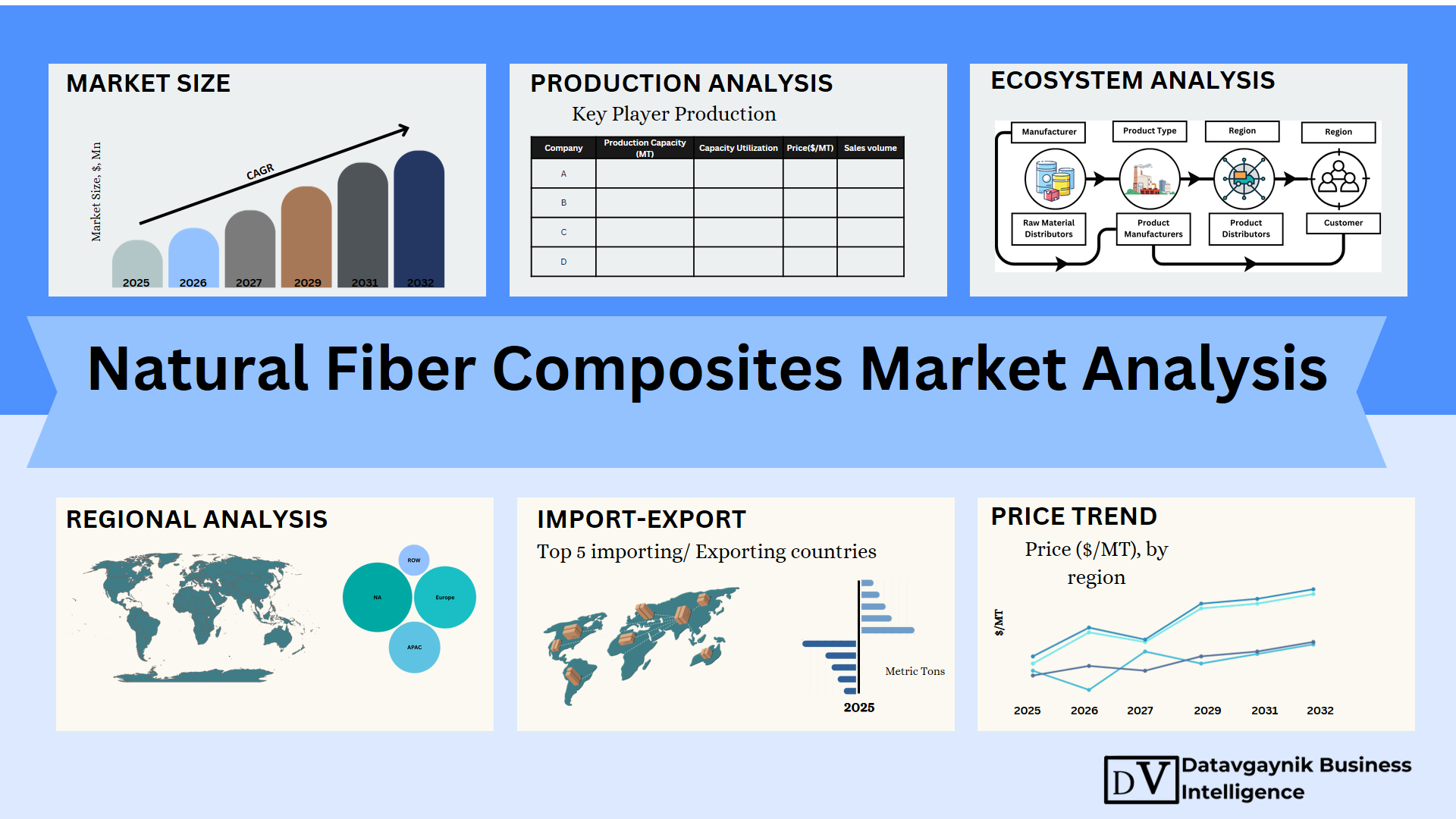
The Natural Fiber Composites Market is witnessing a surge in demand, primarily fueled by the global push toward sustainability and carbon neutrality. Industries across automotive, construction, consumer goods, and packaging are aggressively transitioning away from traditional synthetic composites toward bio-based alternatives. As per Datavagyanik, this structural shift is backed by regulatory mandates, consumer demand, and innovation in fiber-polymer integration. For instance, in the automotive sector, replacing glass fiber with natural fiber composites has resulted in 25% weight reduction and up to 15% lower CO₂ emissions during production. These functional and environmental advantages are reinforcing the position of the Natural Fiber Composites Market in mainstream manufacturing.
Automotive Industry Fueling Natural Fiber Composites Market Expansion
The automotive sector continues to dominate demand in the Natural Fiber Composites Market. Car manufacturers are under immense regulatory pressure to meet emission standards, particularly in Europe, where the EU mandates a fleet-wide average emission of 95g CO₂/km. In response, automakers are substituting metal and plastic with natural fiber composites in non-load-bearing components such as door panels, dashboards, trunk liners, and seat backs. For example, the use of flax fiber-based composites by BMW in its i3 series reduced the overall component weight by over 30%, leading to improved energy efficiency. As fuel economy standards become more stringent, the Natural Fiber Composites Market is projected to penetrate deeper into electric vehicle platforms and next-gen automotive designs.
Datavagyanik also covers related markets such as the Boron Fiber Composites Market and the Graphene-based Composites Market. These materials are considered in high-temperature and specialty chemical environments, where glass production, catalysis, and safety regulations influence adoption patterns.
Natural Fiber Composites Market Benefits from Biodegradable Material Demand
Another critical growth catalyst in the Natural Fiber Composites Market is the increasing preference for biodegradable materials. Natural fibers such as hemp, jute, kenaf, and flax are renewable and decompose naturally, posing minimal environmental hazards. Datavagyanik highlights that nearly 68% of European consumers now favor products with biodegradable or compostable materials. This shift has prompted industries to reevaluate their material usage and adopt composites that align with circular economy models. For instance, IKEA has begun using natural fiber composites in furniture and product packaging to reduce synthetic plastic usage. This transition is not only environmentally favorable but also economically viable due to the lower raw material cost of agricultural residues used in the composites.
Lightweighting Initiatives Boosting Natural Fiber Composites Market Growth
Lightweight construction is becoming a universal priority, particularly in the transportation and infrastructure sectors. The Natural Fiber Composites Market stands at the center of this shift. For instance, reducing vehicle mass by 10% can improve fuel economy by approximately 6–8%. This makes natural fiber composites an ideal replacement for denser alternatives like metals and synthetic reinforcements. Datavagyanik notes that in aerospace and marine applications, these composites are also being explored for cabin interiors and deck structures, where reducing mass is crucial for performance and fuel efficiency. This expanding scope is opening up new verticals for the Natural Fiber Composites Market.
Natural Fiber Composites Market Strengthened by Cost-Effectiveness
In addition to environmental benefits, the Natural Fiber Composites Market is benefitting from favorable economics. Natural fibers are generally less expensive than carbon and glass fibers, both in raw form and processing stages. In regions with abundant agricultural waste like India and China, cost advantages are significant. For example, hemp fibers sourced locally in northern India are priced 25–30% lower than imported synthetic fibers. Combined with advancements in low-energy processing technologies, this has led to a decrease in the total cost of composite production by nearly 15% in some applications. This cost competitiveness is enabling small and mid-sized manufacturers to enter the Natural Fiber Composites Market with minimal capital investment.
Technological Innovations Reshaping the Natural Fiber Composites Market
The evolution of the Natural Fiber Composites Market is closely tied to innovations in material processing and treatment. Surface treatments, fiber hybridization, and advanced thermoset and thermoplastic bonding are significantly improving mechanical properties. For instance, researchers have developed bio-resins that enhance the interfacial adhesion between polymer matrices and fibers, resulting in better tensile strength and thermal stability. Datavagyanik identifies over 40 research projects in Europe alone focusing on bio-based fiber optimization for composite use. These innovations are expanding the application scope of the Natural Fiber Composites Market to more demanding environments such as high-vibration transport systems and load-bearing structural elements.
Natural Fiber Composites Market Size Driven by Construction Sector Adoption
The construction industry is emerging as a key contributor to the Natural Fiber Composites Market Size. Builders and developers are increasingly seeking sustainable alternatives for wall panels, beams, insulation, and decorative finishes. These composites provide benefits such as superior thermal insulation, acoustic dampening, and resistance to moisture. For example, natural fiber boards made from jute and coir are now being used as insulation in green building projects across Germany and the Netherlands. Datavagyanik indicates that the global share of natural fiber insulation materials is expected to reach 7.2% by 2027, up from 4.9% in 2022. This expansion in building applications is directly boosting the Natural Fiber Composites Market Size.
Consumer Goods Industry Accelerating Natural Fiber Composites Market Penetration
In the consumer goods sector, manufacturers are leveraging the aesthetic appeal and environmental credentials of natural fiber composites. Brands are introducing eco-conscious products ranging from kitchenware to luggage using jute, flax, and bamboo-based composites. These products are increasingly preferred by millennials and Gen Z, who prioritize sustainability in purchasing decisions. For instance, a 2023 survey showed that over 62% of global consumers aged 18–35 were willing to pay a premium for eco-friendly materials. This trend is creating an opportunity-rich environment for the Natural Fiber Composites Market, especially for customized, small-batch applications in lifestyle and household product segments.
Natural Fiber Composites Market Gains Traction in Regulatory-Driven Regions
Government regulations play a pivotal role in expanding the Natural Fiber Composites Market. Europe remains the largest regulatory-driven adopter, with mandates on recyclability and emissions in manufacturing. The European Commission’s Green Deal and France’s Anti-Waste Law are compelling industries to phase out non-recyclable materials. Datavagyanik points out that companies using natural fiber composites benefit from tax incentives, regulatory compliance credits, and green certification advantages. These policy frameworks are contributing to a compound annual growth rate (CAGR) of over 7% in the region, further supporting the Natural Fiber Composites Market Size growth in regulatory-led economies.
Natural Fiber Composites Market Diversification Across End-Use Segments
The Natural Fiber Composites Market is becoming increasingly diversified in terms of end-user industries. Initially concentrated in automotive and packaging, the market has now expanded into electronics, marine, and industrial machinery. For instance, biodegradable electronic casings made from bamboo composites are now being used in consumer electronics in Asia. In marine applications, jute-based composites are replacing wood and fiberglass for interior paneling and decking. The broadening application portfolio is enhancing the resilience of the Natural Fiber Composites Market against sector-specific downturns and ensuring a stable, multi-sectoral demand trajectory.
“Track Country-wise Natural Fiber Composites Production and Demand through our Natural Fiber Composites Production Database”
- Natural Fiber Composites production database for 27+ countries worldwide
- Natural Fiber Composites Powder sales volume for 31+ countries
- Country-wise Natural Fiber Composites production capacity and production plant mapping, production capacity utilization for 27+ manufacturers
- Natural Fiber Composites production plants and production plant capacity analysis for top manufacturers
North America Driving Demand in the Natural Fiber Composites Market
The North American Natural Fiber Composites Market is characterized by robust demand, particularly in the United States and Canada. Driven by the stringent regulatory landscape around vehicle emissions and building codes, the region has emerged as a stronghold for bio-based materials. For instance, over 35% of automotive manufacturers in the U.S. now integrate natural fiber composites into vehicle interiors and structural components. The growth is further supported by federal green procurement guidelines that prioritize sustainable construction materials. Datavagyanik estimates that the North American Natural Fiber Composites Market is poised to grow at a CAGR of 6.4% between 2024 and 2030, backed by demand across transportation, building materials, and consumer goods.
Europe at the Forefront of Natural Fiber Composites Market Expansion
Europe represents the most mature and fastest-growing regional segment within the global Natural Fiber Composites Market. Countries such as Germany, France, and the Netherlands are spearheading the use of jute, hemp, and flax in industrial applications. For example, the German automotive industry has adopted flax fiber-based composites in over 15 major vehicle models, reducing weight by up to 30%. Construction projects in Scandinavia are increasingly relying on hempcrete and jute insulation to meet zero-energy building standards. Datavagyanik notes that the European Natural Fiber Composites Market accounted for over 40% of global revenues in 2023 and is forecasted to maintain this dominance through 2032, fueled by environmental legislation and industrial innovation.
Asia Pacific Emerging as the Natural Fiber Composites Market Production Hub
Asia Pacific is rapidly positioning itself as the global production hub for the Natural Fiber Composites Market. Countries like China and India offer abundant access to raw materials such as coir, jute, and kenaf, significantly reducing input costs. For instance, India alone produces over 1.8 million metric tons of jute annually, creating a sustainable raw material pipeline for domestic and export-oriented composite manufacturing. In China, the integration of bamboo and flax into high-volume product categories such as furniture and automotive panels has seen widespread adoption. Datavagyanik highlights that the Asia Pacific region is projected to contribute over 50% of the global Natural Fiber Composites production volume by 2030, owing to cost efficiency, expanding manufacturing infrastructure, and domestic consumption.
Middle East and Africa Witnessing Steady Uptake in the Natural Fiber Composites Market
The Middle East and Africa Natural Fiber Composites Market is in the early stages of development but gaining momentum due to rising construction activities and sustainable packaging initiatives. Countries such as Saudi Arabia and the UAE are incorporating bio-based composites into infrastructure projects under their Vision 2030 and Green Building frameworks. In South Africa, hemp-based wall panels and coir composites are being adopted in residential housing developments, particularly in affordable housing schemes. Datavagyanik expects the region’s Natural Fiber Composites Market to grow steadily, with localized production units emerging as regulatory support for eco-friendly materials strengthens.
Latin America Tapping into Agricultural Residues for Natural Fiber Composites Market Growth
Latin America’s participation in the Natural Fiber Composites Market is being driven by the availability of agricultural by-products and policy shifts toward green industries. Countries such as Brazil and Colombia are leveraging sugarcane bagasse, sisal, and banana fibers for composite production. For instance, Brazilian start-ups are developing automotive interiors using sisal-polypropylene composites to cater to domestic automotive assembly plants. With improving logistics and export frameworks, the region is expected to expand its footprint in the global supply chain. Datavagyanik anticipates an annual growth rate of over 5.8% in the Latin American Natural Fiber Composites Market through 2030.
Segmentation of the Natural Fiber Composites Market by Additive Type
The Natural Fiber Composites Market can be segmented based on the type of natural fiber used. Flax fiber composites are gaining strong traction due to their high tensile strength and lightweight characteristics. These are increasingly used in automotive dashboards and door panels. Hemp fiber, valued for its durability and rapid renewability, is commonly deployed in structural parts and panels. Jute fiber, a cost-effective and biodegradable option, is widely utilized in packaging and low-cost construction components.
Kenaf fiber is being integrated into insulation boards and industrial containers, owing to its superior acoustic insulation. Other fibers such as coir and bamboo are gaining ground in furniture and interior decor, supported by their aesthetic and sustainability attributes. Datavagyanik projects that flax and hemp will remain dominant in terms of market share through the forecast period due to superior mechanical performance.
Plastic Matrix Segmentation in the Natural Fiber Composites Market
The Natural Fiber Composites Market is also segmented based on the polymer matrix used. Polypropylene remains the most widely adopted polymer due to its compatibility with natural fibers and low cost. Polyethylene-based composites are growing in the construction sector, especially in siding and decking. Polyurethane composites are popular in furniture and flexible components. Polyamide composites, though costlier, are gaining demand in high-performance segments such as electronics and aerospace. Emerging categories such as epoxy and polyester resins are carving a niche in specialized applications that require enhanced durability and chemical resistance. Datavagyanik confirms that PP-based composites currently hold over 38% of the total Natural Fiber Composites Market volume.
Application-Based Segmentation Reflects Diversification in Natural Fiber Composites Market
From an application standpoint, the automotive industry remains the largest segment in the Natural Fiber Composites Market. Panels, trims, and seating structures are increasingly manufactured using flax, hemp, and jute composites. In construction, insulation boards, paneling, and siding products now integrate natural fibers to meet green building standards. The consumer goods segment, including home décor, kitchenware, and lifestyle products, is adopting these materials to capitalize on the eco-conscious buyer base. Industrial applications such as conveyor belts, machine housings, and agricultural tool parts are seeing early adoption. Niche applications in sports, aerospace, and marine continue to develop as new composite formulations emerge.
Natural Fiber Composites Price Analysis Reflects Regional Dynamics
Natural Fiber Composites Price varies significantly by geography and input type. For example, in Asia Pacific, where raw fiber availability is high, Natural Fiber Composites Price averages between USD 1.3–1.6 per kilogram for jute-based products. In contrast, in Europe, where supply chains are more complex and environmental compliance adds to the cost, Natural Fiber Composites Price for similar materials ranges from USD 2.4–2.8 per kilogram. The cost of composite production also depends on the polymer matrix, with epoxy and PA-based composites priced higher due to superior performance attributes. Datavagyanik states that overall, Natural Fiber Composites Price Trend remains favorable in high-volume applications, but niche, high-spec composites command a premium due to complex manufacturing processes.
Natural Fiber Composites Price Trend Influenced by Raw Material Volatility
Natural Fiber Composites Price Trend is closely linked to agricultural cycles, energy costs, and polymer pricing. For instance, jute prices in India fluctuated by over 18% between 2021 and 2023 due to climatic disruptions and export restrictions. These variations directly impacted the final composite pricing. Similarly, fluctuations in polypropylene prices have caused cost pressures on manufacturers using PP-based composites. Datavagyanik notes that integrated production setups with in-house fiber processing are better positioned to manage volatility in Natural Fiber Composites Price Trend. Over the next five years, improvements in supply chain efficiency and increased automation are expected to stabilize price variability.
Outlook on Global Production and Trade in the Natural Fiber Composites Market
The global production network in the Natural Fiber Composites Market is becoming increasingly diversified. Asia Pacific leads in fiber sourcing and base-level processing, while Europe and North America specialize in high-end product development and application innovation. This geographical division has led to robust international trade in both raw fibers and finished composite materials. For example, India exports jute and kenaf fibers to composite manufacturers in Germany and the U.S., where they are further processed into automotive or construction components. Datavagyanik projects a 6.2% annual increase in cross-border trade of natural fiber-based composite materials from 2024 to 2030, reflecting growing global interdependence in this market.
“Natural Fiber Composites Manufacturing Database, Natural Fiber Composites Manufacturing Capacity”
- Natural Fiber Composites top manufacturers market share for 27+ manufacturers
- Top 8 manufacturers and top 17 manufacturers of Natural Fiber Composites in North America, Europe, Asia Pacific
- Production plant capacity by manufacturers and Natural Fiber Composites production data for 27+ market players
- Natural Fiber Composites production dashboard, Natural Fiber Composites production data in excel format
Leading Players Dominating the Natural Fiber Composites Market
The Natural Fiber Composites Market is highly fragmented but has witnessed the emergence of several key players who have carved out significant market shares through product innovation, regional expansion, and sustainability-focused strategies. The top manufacturers in the Natural Fiber Composites Market include FlexForm Technologies, Procotex Corporation, UPM Biocomposites, GreenCore Composites, Tecnaro GmbH, and Trex Company. These companies are differentiated by their fiber choices, processing capabilities, and specialized product lines catering to diverse applications such as automotive, construction, consumer goods, and industrial packaging.
FlexForm Technologies: Automotive Composite Leadership
FlexForm Technologies is one of the most recognized names in the North American Natural Fiber Composites Market. The company holds a leading position with a strong focus on natural fiber thermoplastic composites for the automotive industry. Its proprietary line of products, including FlexForm LITE and FlexForm PLUS, is widely used in vehicle interiors such as door panels, consoles, and seat backs. With partnerships across major OEMs like Ford and General Motors, FlexForm controls an estimated 6–7% of the global Natural Fiber Composites Market share. The firm’s strategic advantage lies in its vertical integration of fiber procurement and composite sheet molding, ensuring supply chain control and cost efficiency.
UPM Biocomposites: Pioneering Wood-Plastic and Flax-Based Composites
UPM Biocomposites, a subsidiary of UPM Group, is a major European player driving innovation in flax-reinforced thermoplastic composites. The company’s flagship product line, UPM Formi, blends renewable cellulose fibers with polymers for use in automotive parts, electronics casings, and industrial housings. UPM’s composite facility in Germany serves as a hub for R&D and advanced manufacturing. With a growing emphasis on sustainable manufacturing, UPM Biocomposites commands approximately 5% of the total Natural Fiber Composites Market share, particularly in Europe. The firm is increasingly investing in product lifecycle analysis to enhance recyclability metrics and regulatory compliance.
Procotex Corporation: Specialist in Flax, Hemp, and Kenaf Fibers
Based in Belgium, Procotex is a specialist in natural fiber reinforcement and a core supplier for composite manufacturers globally. The company supplies processed flax, hemp, and kenaf fibers for thermoset and thermoplastic applications. Procotex does not produce final composites but plays a key role as a raw fiber processor with high-volume output for the European Natural Fiber Composites Market. The company’s R&D capabilities have led to the development of fine, mechanically refined fibers suitable for use in lightweight automotive and packaging applications. Its indirect market influence is substantial, supplying to over 50 composite producers across Europe, and it holds around 4% of the global Natural Fiber Composites Market share via raw material dominance.
Trex Company: Leader in Wood-Polymer Composites for Construction
Trex Company is one of the largest producers of wood-polymer composites, particularly for decking and fencing. Its fiber-polyethylene composite boards are widely used in the construction and landscaping sectors in North America. The company integrates recycled wood and plastic into its formulations, aligning well with consumer and regulatory demand for green building materials. Product lines such as Trex Enhance and Trex Transcend have become standard in residential and commercial construction projects. With significant brand recognition and distribution, Trex commands a dominant position in the construction segment and holds an estimated 6% share in the global Natural Fiber Composites Market, driven mainly by the U.S. market.
Tecnaro GmbH: Innovation-Driven Bio-Composite Manufacturer
Tecnaro GmbH, based in Germany, specializes in the development of thermoplastic biomaterials under the product lines ARBOFORM, ARBOFILL, and ARBOBLEND. These formulations use natural fibers blended with bio-based resins to create moldable composites for electronics, automotive, and homeware. Tecnaro has developed over 3,000 proprietary formulations and supplies clients across sectors. Its leadership in the bio-based polymer segment gives it a technical edge and a niche position within the global Natural Fiber Composites Market. Though smaller in volume compared to peers, the company accounts for about 3% of market share and is a key innovator in the space.
GreenCore Composites: Canadian Contender in Automotive and Packaging
GreenCore Composites is a Canadian manufacturer specializing in natural fiber-reinforced polypropylene products. The company’s GreenCore PP is widely used in automotive trim, packaging containers, and interior structures. It sources local hemp and flax for use in its composites, reducing transportation costs and improving environmental metrics. With a focus on low-carbon and lightweight designs, GreenCore is making significant inroads into U.S. and Canadian OEM supply chains. The company’s current share in the global Natural Fiber Composites Market is estimated to be around 2.5%, with strong growth prospects in the automotive and logistics sectors.
Natural Fiber Composites Market Share Distribution Among Manufacturers
The Natural Fiber Composites Market remains relatively unconsolidated, with the top 6–8 players holding approximately 30–35% of the total market share. Smaller regional manufacturers, particularly in Asia and Latin America, collectively account for a large portion of the production volume due to local raw material access and cost-effective manufacturing. For instance, several mid-sized players in India and China supply jute and coir-based composites for construction and furniture, which contributes significantly to volume but less so to revenue due to lower pricing.
Among the global leaders, FlexForm and Trex dominate their respective verticals in automotive and construction. UPM and Tecnaro lead innovation in bio-composite formulation, while Procotex’s influence is driven by raw material supply. Datavagyanik emphasizes that the market is evolving toward regional specialization, with composite manufacturing increasingly localized near fiber sources to optimize logistics and cost.
Recent Developments and Strategic Moves in the Natural Fiber Composites Market
In the last 12–18 months, the Natural Fiber Composites Market has seen several strategic developments. In Q2 2023, UPM Biocomposites announced an investment in a new production line in Germany aimed at scaling its Formi product line to meet growing demand in the electronics and home appliance sectors. This facility is expected to become operational by mid-2025 and increase annual capacity by 30%.
In January 2024, Trex Company expanded its recycling partnerships with several municipal waste management agencies across the U.S. to increase access to post-consumer plastic waste, strengthening its supply chain for composite decking materials. This move supports Trex’s broader sustainability targets and provides a reliable feedstock for future product lines.
In mid-2023, GreenCore Composites secured a development grant from the Canadian government to commercialize new bio-polypropylene blends optimized for high-impact resistance in vehicle interiors. Prototypes from this initiative are currently being tested by two major automotive OEMs in North America.
Additionally, FlexForm Technologies entered a joint venture in Mexico in late 2023 to expand its footprint in Latin America. The facility, scheduled to open in 2025, will produce molded automotive interior parts using hemp and kenaf sourced locally, positioning FlexForm to serve both North and South American markets more efficiently.
“Natural Fiber Composites Production Data and Natural Fiber Composites Production Trend, Natural Fiber Composites Production Database and forecast”
- Natural Fiber Composites production database for historical years, 10 years historical data
- Natural Fiber Composites production data and forecast for next 7 years
Market Scenario, Demand vs Supply, Average Product Price, Import vs Export, till 2035
- Global Natural Fiber Composites Market revenue and demand by region
- Global Natural Fiber Composites Market production and sales volume
- United States Natural Fiber Composites Market revenue size and demand by country
- Europe Natural Fiber Composites Market revenue size and demand by country
- Asia Pacific Natural Fiber Composites Market revenue size and demand by country
- Middle East & Africa Natural Fiber Composites Market revenue size and demand by country
- Latin America Natural Fiber Composites Market revenue size and demand by
- Import-export scenario – United States, Europe, APAC, Latin America, Middle East & Africa
- Average product price – United States, Europe, APAC, Latin America, Middle East & Africa
- Market player analysis, competitive scenario, market share analysis
- Business opportunity analysis
Key questions answered in the Global Natural Fiber Composites Market Analysis Report:
- What is the market size for Natural Fiber Composites in United States, Europe, APAC, Middle East & Africa, Latin America?
- What is the yearly sales volume of Natural Fiber Composites and how is the demand rising?
- Who are the top market players by market share, in each product segment?
- Which is the fastest growing business/ product segment?
- What should be the business strategies and Go to Market strategies?
The report covers Natural Fiber Composites Market revenue, Production, Sales volume, by regions, (further split into countries):
- Asia Pacific (China, Japan, South Korea, India, Indonesia, Vietnam, Rest of APAC)
- Europe (UK, Germany, France, Italy, Spain, Benelux, Poland, Rest of Europe)
- North America (United States, Canada, Mexico)
- Latin America (Brazil, Argentina, Rest of Latin America)
- Middle East & Africa
Table of Contents:
- Introduction to Natural Fiber Composites
- Definition and Overview of Natural Fiber Composites
- Key Benefits and Sustainability Advantages
- Types of Natural Fiber Composites
- Common Natural Fibers Used in Composites: Hemp, Flax, Jute, Sisal, and Others
- Resin Types: Bio-based and Synthetic Resins for Natural Fiber Composites
- Chemical Composition and Properties of Natural Fiber Composites
- Material Properties: Strength, Durability, and Environmental Benefits
- Comparison with Traditional Fiber Composites (e.g., Glass Fiber Composites)
- Global Market Overview for Natural Fiber Composites
- Market Trends and Growth Drivers
- Impact of Sustainability and Eco-consciousness on Market Demand
- Market Size, Share, and Forecast (2019-2035)
- Market Value Projections and Growth Estimates
- Regional Market Breakdown and Segment Analysis
- Regional Market Insights
- North America: Growth Drivers and Key Applications
- Europe: Market Dynamics and Regulatory Influence
- Asia Pacific: Production Expansion and Raw Material Availability
- Latin America: Adoption Trends and Growth Opportunities
- Middle East & Africa: Market Development and Potential
- Production and Manufacturing of Natural Fiber Composites
- Manufacturing Processes for Natural Fiber Reinforced Composites
- Challenges and Innovations in the Production of Natural Fiber Composites
- Leading Manufacturers and Their Market Share
- Raw Materials and Sourcing for Natural Fiber Composites
- Sourcing and Availability of Natural Fibers Globally
- Supply Chain Challenges and Material Sourcing Trends
- Regional Variations in Fiber Availability and Pricing
- Price Trends and Market Influences
- Price Dynamics in the Natural Fiber Composites Market (2019-2035)
- Factors Affecting Raw Material Prices and Production Costs
- Price Variations Based on Fiber Type and Resin Choice
- End-Use Applications of Natural Fiber Composites
- Automotive Industry: Use in Lightweight and Sustainable Components
- Construction and Building Materials: Natural Fiber in Panels and Insulation
- Consumer Goods and Electronics: Eco-friendly Applications
- Aerospace: Adoption of Natural Fiber Composites for Green Aircraft Components
- Competitive Landscape of the Natural Fiber Composites Market
- Market Share Distribution Among Key Players
- Competitive Strategies: Product Development, Partnerships, and Market Penetration
- Leading Manufacturers and Their Strategic Positioning
- Demand and Consumption Patterns
- Key Demand Drivers Across Various Sectors (Automotive, Construction, etc.)
- Regional Consumption Trends and Future Projections
- Impact of Sustainability Initiatives on Consumer and Industry Demand
- Technological Advancements in Natural Fiber Composites
- Innovations in Fiber Treatment and Resin Formulations
- Advancements in Processing Technologies for Enhanced Performance
- Research and Development in High-performance Natural Fiber Composites
- Challenges in the Natural Fiber Composites Market
- Performance Limitations: Durability and Strength Constraints
- Supply Chain and Sourcing Issues for Natural Fibers
- Regulatory and Environmental Concerns
- Environmental Impact and Sustainability
- Environmental Benefits of Natural Fiber Composites over Traditional Materials
- Lifecycle Analysis and the Carbon Footprint of Natural Fiber Products
- Recycling and Circular Economy Approaches for Natural Fiber Composites
- Regulatory Landscape and Compliance
- Global and Regional Regulations Impacting Natural Fiber Composites
- Standards for Sustainability and Eco-friendly Certification in the Industry
- Compliance Challenges and Regulatory Requirements
- Investment Opportunities in Natural Fiber Composites Market
- Investment Trends and Growth Areas in Sustainable Manufacturing
- Market Entry Opportunities for New Manufacturers and Innovators
- Future Investment Potential in Untapped Regions and Applications
- Future Outlook and Market Projections
- Long-term Projections for the Natural Fiber Composites Market
- Emerging Trends and Technologies Shaping the Future of Natural Fiber Composites
- New Applications and Industries Exploring Natural Fiber Solutions
- Strategic Recommendations for Stakeholders
- Actionable Insights for Manufacturers, Suppliers, and Investors
- Recommendations for Expanding Market Presence and Product Development
- Strategic Considerations for Policymakers and Industry Leaders


