

Flexible PVC plasticizers Market Trends Reflect Broad-Based Industrial Momentum
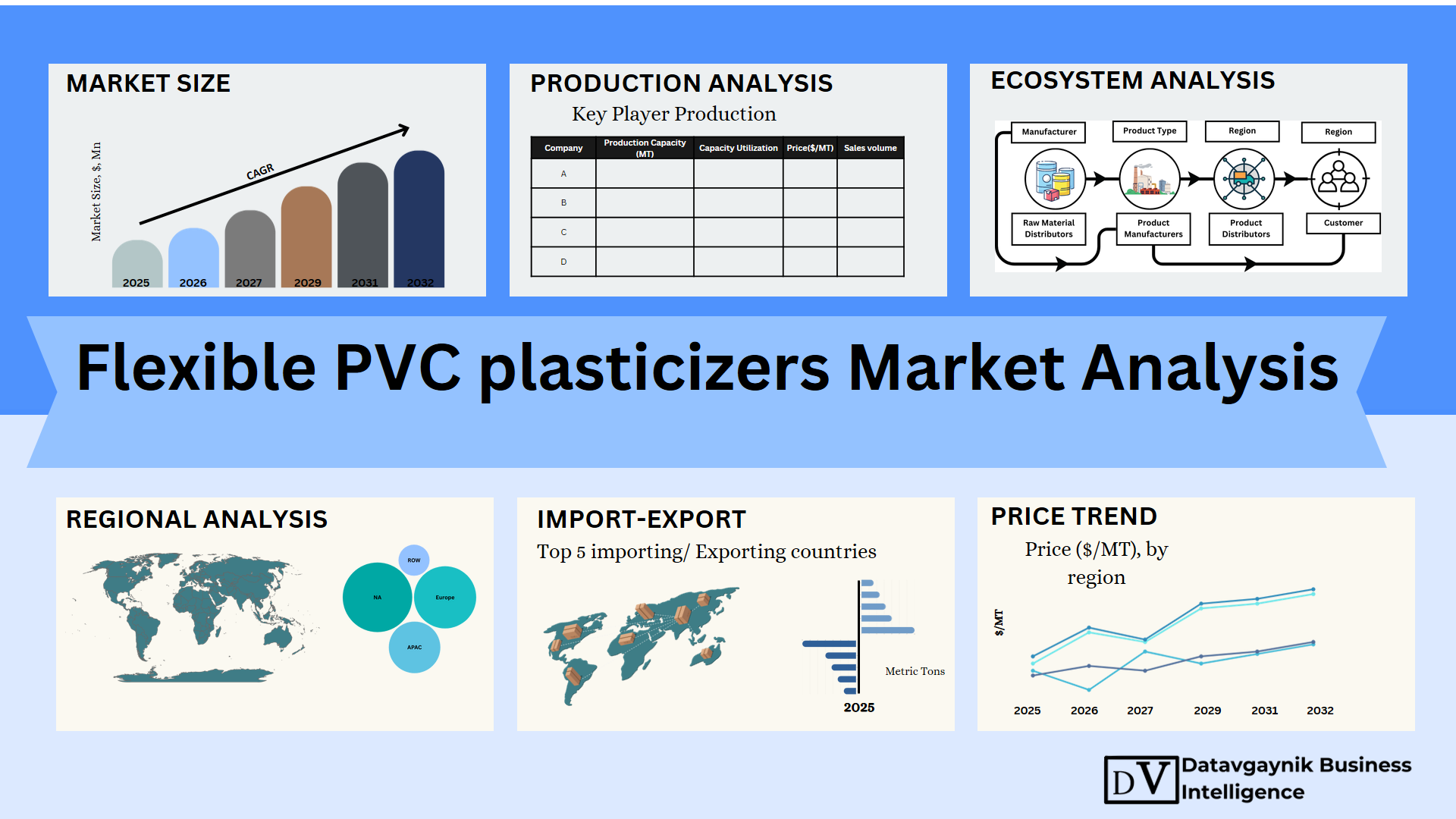
The Flexible PVC plasticizers Market is undergoing significant expansion due to structural changes across global industries. From infrastructure modernization to advancements in medical technologies, flexible polyvinyl chloride (PVC) has emerged as a material of choice. Plasticizers are critical additives in PVC that provide flexibility, processability, and enhanced durability. The market is now witnessing strong growth driven by multiple end-use sectors, with manufacturers increasingly focusing on innovative, non-toxic formulations. As per Datavagyanik, this surge is not a short-term trend but a long-term structural shift rooted in evolving industry requirements, regulatory mandates, and sustainability goals.
Rising Demand from Construction Sector Fueling the Flexible PVC plasticizers Market
One of the most prominent drivers behind the growth of the Flexible PVC plasticizers Market is the construction and infrastructure sector. Flexible PVC is extensively used in flooring, insulation cables, roofing membranes, and wall coverings. For instance, the global flooring industry alone was valued at over USD 350 billion in 2023 and is expected to grow at 5–6% CAGR over the next decade. A substantial portion of this growth is driven by the adoption of flexible PVC flooring solutions, which rely on plasticizers for flexibility and mechanical stability.
In emerging markets such as India and Indonesia, urbanization is adding 25–30 million square meters of new construction annually, creating immense demand for flexible PVC pipes and window profiles—both of which are heavily reliant on plasticizer formulations. Datavagyanik states that this demand directly correlates with a 7–8% annual increase in consumption of flexible PVC plasticizers across the Asia Pacific construction sector.
Datavagyanik also covers related markets such as the Bio Plasticizers Market, the Phthalate plasticizers Market, and the Polymeric plasticizers Market. They create a more holistic picture of the ecosystem in which the primary topic exists, including technological shifts and market demands.
Flexible PVC plasticizers Market Trends Shaped by Automotive Light-Weighting and EV Adoption
The automotive industry continues to be a major end-user of flexible PVC plasticizers, particularly in interior components, under-the-hood wiring, and weather seals. With automotive manufacturers shifting toward lightweight materials to improve fuel efficiency and battery range in electric vehicles (EVs), flexible PVC has found renewed application.
For example, the production of EVs globally is expected to exceed 45 million units by 2030, up from just under 12 million in 2022. In these vehicles, weight reduction is essential, and flexible PVC with plasticizers offers an optimal balance between weight, cost, and durability. As a result, the Flexible PVC plasticizers Market is benefitting from this automotive transformation, with Datavagyanik estimating that 20–25% of plasticizers used in the global market are now channeled toward automotive applications.
Flexible PVC plasticizers Market Driven by Medical Device Expansion
Medical-grade flexible PVC products such as IV bags, tubing, catheters, and blood bags continue to be essential across healthcare systems worldwide. These applications demand not only flexibility and transparency but also compliance with biocompatibility and sterilization standards. Flexible PVC plasticizers are indispensable in meeting these stringent performance parameters.
The global medical devices industry surpassed USD 550 billion in 2023, with tubing and fluid management devices accounting for a substantial share. As healthcare demand rises—driven by aging populations in countries like Japan and Germany—the consumption of medical-grade flexible PVC is increasing by 6–7% annually. This trend directly impacts the Flexible PVC plasticizers Market, especially in regions prioritizing safe and phthalate-free alternatives.
Flexible PVC plasticizers Market Size Grows as Packaging Sector Evolves
Another significant growth contributor is the flexible packaging industry. For instance, flexible PVC is used in pharmaceutical packaging, blister packs, and consumer goods wrapping. The global flexible packaging industry, which was valued at over USD 270 billion in 2023, is growing at a CAGR of 5%. Flexible PVC plasticizers play a pivotal role in enhancing the elongation, tear strength, and weather resistance of these packaging materials.
Food-grade and medical packaging are rapidly transitioning to non-toxic and bio-based plasticizers, which is fueling market innovation. Datavagyanik highlights that the demand for sustainable packaging materials is likely to increase the consumption of bio-based flexible PVC plasticizers by 12–14% annually over the next five years.
Consumer Safety Concerns Shaping the Flexible PVC plasticizers Market Trends
The shift away from phthalate-based plasticizers, especially in North America and Europe, has resulted in a new wave of innovation in the Flexible PVC plasticizers Market. Growing awareness of toxicity, coupled with stricter regulatory oversight, has led to an increased focus on non-phthalate, low-VOC, and bio-based alternatives.
For example, the European Union’s REACH regulations and the United States Environmental Protection Agency’s (EPA) evolving chemical risk assessments have prompted manufacturers to reformulate existing product lines. As a result, the market share of phthalate-free plasticizers grew from 18% in 2015 to over 35% by 2023 and is expected to surpass 50% by 2030. This transformation is reshaping product portfolios and creating opportunities for high-margin, compliant alternatives in the Flexible PVC plasticizers Market.
Flexible PVC plasticizers Market Benefits from Cost-Efficiency of PVC-Based Compounds
Flexible PVC remains a highly cost-effective material, especially in comparison to alternatives such as silicone, thermoplastic elastomers (TPE), or fluoropolymers. For instance, the per-unit cost of flexible PVC materials can be 30–40% lower than comparable TPE solutions, especially in wire insulation and consumer goods.
This cost-efficiency, when combined with adequate mechanical properties and design flexibility, continues to make flexible PVC the material of choice for volume-driven industries such as toys, footwear, and household appliances. Datavagyanik notes that even with rising raw material prices, the economic case for flexible PVC—with the right plasticizers—remains compelling for OEMs in price-sensitive markets.
Flexible PVC plasticizers Market Trends Influenced by Sustainability and Circular Economy Models
Sustainability goals are now central to the strategies of companies operating in the Flexible PVC plasticizers Market. Bio-based plasticizers, derived from renewable feedstocks such as soybean oil, castor oil, or citrates, are gaining traction. These alternatives not only reduce dependency on fossil fuels but also offer better end-of-life environmental performance.
For example, several multinational brands have pledged to transition to 100% recyclable or bio-based flexible PVC components in consumer goods packaging by 2030. In response, manufacturers are expanding their R&D pipelines to develop plasticizers with high biodegradability, low carbon footprint, and improved recyclability, fueling long-term growth prospects across the value chain.
Flexible PVC plasticizers Market Size Expanding with Smart Manufacturing and Digital Integration
Smart manufacturing processes—such as continuous dosing, in-line viscosity monitoring, and automated blending—are transforming plasticizer production efficiency. Datavagyanik emphasizes that automation in chemical processing reduces batch variability and enhances product consistency, which is critical for medical and food-grade applications.
These technological upgrades are not just improving production economics but are also enabling custom plasticizer formulations for niche applications. The outcome is a more diversified and resilient Flexible PVC plasticizers Market, with enhanced ability to serve evolving industrial requirements while ensuring regulatory compliance and traceability.
Regulatory Support and Industry Standards Accelerate the Flexible PVC plasticizers Market
Supportive regulations in favor of environmentally safe plasticizer adoption are now playing a catalytic role. For instance, government policies incentivizing sustainable construction materials in countries such as Germany, Canada, and South Korea are contributing to heightened demand for compliant flexible PVC products.
Standards such as ISO 10993 for biocompatibility and ASTM D2124 for plasticizer extraction testing are being widely adopted. These developments are providing clear frameworks for industry stakeholders, enabling faster commercialization of new plasticizer chemistries and facilitating cross-border trade in compliant formulations.
In Summary: Strong Momentum Across End-Use Verticals Propelling the Flexible PVC plasticizers Market
The Flexible PVC plasticizers Market is being propelled by a convergence of industry-wide transformations. Whether it is the global shift to electric mobility, the rise in medical infrastructure, or the increased push toward sustainable consumer packaging, flexible PVC and its plasticizers are positioned at the intersection of performance, safety, and cost-efficiency.
Datavagyanik projects a sustained compound annual growth rate of over 6% for the Flexible PVC plasticizers Market over the next decade. With demand accelerating across automotive, construction, healthcare, and packaging, and with innovation driving newer non-toxic and sustainable product lines, the market is set to remain a critical enabler of industrial evolution.
“Track Country-wise Flexible PVC plasticizers Production and Demand through our Flexible PVC plasticizers Production Database”
-
-
- Flexible PVC plasticizers production database for 27+ countries worldwide
- Flexible PVC plasticizers Powder sales volume for 31+ countries
- Country-wise Flexible PVC plasticizers production capacity and production plant mapping, production capacity utilization for 27+ manufacturers
- Flexible PVC plasticizers production plants and production plant capacity analysis for top manufacturers
-
Regional Expansion Driving the Flexible PVC plasticizers Market Growth
The Flexible PVC plasticizers Market is displaying strong regional divergence, with Asia Pacific, North America, and Europe accounting for the bulk of global demand. This regional spread is shaped by the concentration of manufacturing hubs, the maturity of end-use industries, and the degree of regulatory enforcement regarding plasticizer types. Datavagyanik highlights that the Asia Pacific region holds the dominant share, accounting for more than 50% of global demand, followed by Europe and North America.
For instance, China alone represents over 35% of global consumption due to its massive construction and automotive industries. The country’s annual infrastructure investments crossed USD 1 trillion in 2023, creating substantial demand for flexible PVC-based components in pipelines, flooring, insulation, and wiring. Flexible PVC plasticizers form the backbone of these products, enabling performance under a range of environmental conditions.
Asia Pacific Remains the Epicenter of Flexible PVC plasticizers Market Production
Asia Pacific not only leads in consumption but also in production capacity for flexible PVC plasticizers. China, India, South Korea, and Japan have emerged as the primary production bases, leveraging cost advantages, raw material availability, and a robust downstream processing ecosystem.
China, the global leader, accounts for over 40% of total global flexible PVC plasticizers production. India’s output is rising at a CAGR of 7% due to growing investments in chemicals and polymers manufacturing zones. For example, the Indian government’s PLI schemes for chemicals are attracting major players to set up or expand facilities, which is increasing domestic availability and reducing dependency on imports.
These economies of scale are enabling Asian manufacturers to offer competitive pricing, which is impacting Flexible PVC plasticizers Price in global export markets. Datavagyanik estimates that average production costs in Asia are 20–30% lower than in North America or Europe, positioning the region as an export powerhouse.
Diverse Applications Fueling Market Segmentation in the Flexible PVC plasticizers Market
The Flexible PVC plasticizers Market is segmented across key industries including construction, automotive, medical devices, packaging, and consumer goods. Among these, construction continues to account for the highest volume, making up nearly 30% of global plasticizer consumption.
In the automotive segment, flexible PVC plasticizers are used in dashboards, floor mats, door panels, and wiring harnesses. For example, global wiring harness demand reached 400 million units in 2023, most of which used flexible PVC insulation requiring plasticizers. In healthcare, the rise of single-use medical devices is accelerating demand. As per Datavagyanik, over 8 billion IV sets and 3 billion catheters were produced globally in 2023, with flexible PVC-based components forming the bulk.
Each application segment demands unique performance characteristics—chemical resistance in automotive, biocompatibility in healthcare, and weather resistance in construction—driving demand for customized plasticizer formulations across the Flexible PVC plasticizers Market.
Europe Shows High Value Demand Amid Regulatory-Driven Transformation
The Flexible PVC plasticizers Market in Europe is driven by a mature regulatory framework and the shift toward sustainable materials. Germany, France, and Italy are key markets, with automotive and construction applications accounting for over 60% of total demand.
Europe is also leading the transition toward non-phthalate and bio-based plasticizers. Datavagyanik notes that more than 45% of flexible PVC plasticizers used in Western Europe are now classified as low-toxicity or renewable origin materials, supported by REACH and the EU Green Deal. For instance, Germany’s automotive sector is increasingly adopting DINP- and DOTP-based plasticizers over traditional DEHP compounds.
This shift has implications on Flexible PVC plasticizers Price Trend. The average price of bio-based plasticizers in Europe ranges from USD 2,300 to USD 2,900 per ton—30–40% higher than traditional options. However, long-term contracts and environmental compliance make these prices viable for OEMs focused on sustainability metrics.
North America’s Flexible PVC plasticizers Market Anchored by Healthcare and Infrastructure
In North America, the United States remains the focal point for the Flexible PVC plasticizers Market. The country’s expansive healthcare, automotive, and infrastructure ecosystems create steady demand. Datavagyanik estimates that over 20% of total U.S. PVC consumption is directed toward healthcare applications, largely due to stringent FDA standards and the aging population.
Construction is another growth engine. With the implementation of the U.S. Infrastructure Investment and Jobs Act, nearly USD 550 billion has been earmarked for transportation, water systems, and broadband expansion. This has led to increased demand for insulated wires, conduits, and flexible piping—applications where flexible PVC plasticizers are essential.
Flexible PVC plasticizers Price in the U.S. remains relatively stable due to domestic production capabilities and long-term procurement contracts. However, the premium on phthalate-free alternatives continues to rise, with price differentials of USD 400–600 per ton compared to conventional plasticizers.
Middle East and Africa Show Emerging Demand for Flexible PVC plasticizers Market
While still a developing region for flexible PVC plasticizers, the Middle East and Africa are witnessing steady growth, especially from Saudi Arabia, the UAE, and South Africa. Infrastructure development, supported by national programs like Vision 2030 in Saudi Arabia, is creating demand for construction-grade flexible PVC products.
In healthcare, rising per capita expenditure and modernization of hospital infrastructure are supporting the uptake of medical-grade plasticizers. South Africa and Egypt, for example, are importing over 80% of their flexible PVC plasticizer requirements, creating an opportunity for regional production expansion in the future.
Flexible PVC plasticizers Price in these regions tends to be influenced by import dynamics, freight volatility, and currency fluctuations. Datavagyanik notes that local buyers are increasingly seeking direct procurement from Asia to bypass European middlemen and reduce procurement costs.
Latin America Gaining Traction in Flexible PVC plasticizers Market
Latin America, led by Brazil and Mexico, is gaining importance in the Flexible PVC plasticizers Market. The construction sector in Brazil accounts for over 7% of national GDP, and PVC-based materials form a major component in residential and commercial infrastructure projects.
Automotive production in Mexico, which crossed 3.5 million units in 2023, has also driven demand for high-performance plasticizers used in flexible PVC components. The regional trend is moving toward DOTP and bio-based alternatives due to growing awareness of health and environmental standards.
Datavagyanik notes that Flexible PVC plasticizers Price in Latin America remains higher than in Asia but lower than in Europe, with a growing inclination among local manufacturers to invest in backward integration and regional production facilities to improve margins.
Flexible PVC plasticizers Price Trend Shaped by Feedstock Volatility and Environmental Regulation
Flexible PVC plasticizers Price is largely influenced by fluctuations in feedstock availability—particularly phthalic anhydride, isobutanol, and vegetable-based oils. In recent years, rising crude oil volatility and disruptions in petrochemical supply chains have created price instability, particularly in Asia and Europe.
For example, in Q3 2023, the average Flexible PVC plasticizers Price increased by 12% globally due to feedstock shortages and energy cost spikes in Europe. Bio-based plasticizers such as epoxidized soybean oil (ESBO) also saw a price surge of 18% due to poor crop yields in South America.
Datavagyanik emphasizes that environmental regulation is also a key price driver. Compliance with REACH, California Proposition 65, and FDA regulations demands additional formulation and certification costs, which are passed on to end users. However, rising demand for high-performance and sustainable products has helped maintain pricing power in niche formulations, particularly in the medical and food-contact segments.
Outlook for Flexible PVC plasticizers Market Segmentation by Plasticizer Type
The Flexible PVC plasticizers Market can be segmented into phthalate-based, non-phthalate, and bio-based categories. Phthalates such as DEHP, DBP, and BBP are in structural decline, with their combined share projected to fall below 35% by 2030. Non-phthalate plasticizers such as DOTP, DINCH, and ATBC are gaining traction due to better toxicology profiles and broad regulatory acceptance.
Bio-based plasticizers are growing at the fastest pace, particularly in Europe and parts of Asia. Datavagyanik projects a CAGR of 10% for bio-based plasticizers through 2032, driven by their adoption in consumer goods, healthcare, and sustainable packaging sectors.
Each plasticizer type carries distinct implications on performance, regulatory clearance, and pricing. For instance, DINCH, a common non-phthalate option, commands a premium of 20–25% over traditional DEHP but is increasingly used in pediatric and medical applications where biocompatibility is critical.
“Flexible PVC plasticizers Manufacturing Database, Flexible PVC plasticizers Manufacturing Capacity”
-
-
- Flexible PVC plasticizers top manufacturers market share for 27+ manufacturers
- Top 8 manufacturers and top 17 manufacturers of Flexible PVC plasticizers in North America, Europe, Asia Pacific
- Production plant capacity by manufacturers and Flexible PVC plasticizers production data for 27+ market players
- Flexible PVC plasticizers production dashboard, Flexible PVC plasticizers production data in excel format
-
Top Manufacturers Driving the Competitive Landscape of the Flexible PVC plasticizers Market
The Flexible PVC plasticizers Market is dominated by a mix of global chemical giants and specialized plasticizer producers, each playing a critical role in fulfilling industrial demand across construction, automotive, healthcare, packaging, and consumer goods sectors. These manufacturers are strategically positioned across Asia Pacific, Europe, and North America, with production capabilities tailored to serve regional and global clients. The leading companies are focusing on expanding their portfolios to include non-phthalate and bio-based alternatives, ensuring compliance with evolving regulatory standards and shifting consumer preferences.
BASF SE: A Leader in Flexible PVC plasticizers Market Share
BASF SE remains one of the most prominent players in the Flexible PVC plasticizers Market. The company offers a comprehensive range of plasticizers under its Palatinol brand, which includes Palatinol DPHP, DOTP, and DINP, targeting both general-purpose and specialty applications. BASF has a strong foothold in Europe and Asia and has made notable investments in bio-based and non-phthalate alternatives to align with global sustainability mandates.
Palatinol DOTP is widely used in flooring, cables, and wall coverings, offering low volatility and good plasticizing efficiency. BASF holds an estimated 12–14% global market share in the Flexible PVC plasticizers segment, driven by its robust distribution network, technical expertise, and regulatory-compliant solutions.
ExxonMobil Chemical: A Global Force in Flexible PVC plasticizers
ExxonMobil is another major player, especially dominant in North America and key parts of Asia. Its Jayflex line of plasticizers includes products like Jayflex DINP, DIDP, and DTDP, which are designed for applications ranging from automotive interiors to wire and cable insulation. Jayflex plasticizers are known for their high thermal stability, making them suitable for demanding environments.
ExxonMobil commands around 10–11% share of the global Flexible PVC plasticizers Market. The company has been expanding its reach in the Middle East and Asia by leveraging integrated petrochemical complexes, which support consistent supply and cost competitiveness.
Eastman Chemical Company: Innovation-Driven Growth in Flexible PVC plasticizers
Eastman is a key innovator in the Flexible PVC plasticizers Market, particularly in the development of non-phthalate and bio-based products. Its flagship product lines include Eastman 168 non-phthalate plasticizer and VersaMax Plus, both of which cater to health-sensitive and high-performance applications like medical tubing, toys, and food packaging.
With a global market share of approximately 9–10%, Eastman has carved a niche in regulatory-sensitive industries. The company has aggressively invested in expanding capacity for non-phthalate plasticizers and holds leadership in the U.S. healthcare and food-contact flexible PVC sectors.
Evonik Industries: Specialty Plasticizer Supplier in the Flexible PVC plasticizers Market
Evonik is recognized for its diverse portfolio of high-performance plasticizers, especially in Europe. Under its VESTINOL brand, the company offers VESTINOL 9 (DINP) and VESTINOL INB, which are used in construction and automotive applications.
Evonik holds around 6–7% of the global Flexible PVC plasticizers Market share and is increasingly focusing on sustainable innovation. Its specialty focus on indoor air quality-compliant and low-VOC plasticizers has positioned it well in markets with stringent environmental requirements.
LG Chem: A Key Asian Manufacturer in the Flexible PVC plasticizers Market
LG Chem is among the largest chemical manufacturers in Asia and a significant supplier of plasticizers for flexible PVC applications. Its product range includes DINP, DOTP, and DOP, which are primarily consumed in automotive and construction sectors in South Korea, China, and Southeast Asia.
LG Chem’s estimated market share is around 5–6% globally, with a larger footprint in the Asia Pacific region. The company is progressively transitioning toward eco-friendly formulations to meet domestic and export market requirements.
UPC Technology Corporation: Focused Growth in the Flexible PVC plasticizers Segment
Based in Taiwan, UPC Technology Corporation is a growing presence in the Flexible PVC plasticizers Market. The company supplies DOTP and other plasticizers to various Asian and Middle Eastern markets, primarily serving the packaging and consumer goods sectors.
UPC Technology is gaining recognition for its cost-effective and high-quality plasticizers and holds a market share of approximately 3–4%. Its vertically integrated manufacturing setup provides an edge in price competitiveness and raw material security.
Aekyung Petrochemical: Strength in Phthalate-Free Offerings
Aekyung Petrochemical, another South Korean player, is well-regarded for its phthalate-free plasticizer solutions. The company’s ECO-DEH and ECO-DOTP products are designed for sensitive applications in packaging, flooring, and children’s products.
Aekyung holds around 2–3% of the global Flexible PVC plasticizers Market but is rapidly gaining ground, especially in regulatory-driven markets. Its strong alignment with environmental safety trends makes it a key supplier to forward-looking clients in East Asia.
Emerging and Regional Players Influencing the Flexible PVC plasticizers Market
Several regional manufacturers in China, India, and the Middle East also contribute significantly to global supply. Companies such as KLJ Group (India), Bluesail Chemical (China), and Nan Ya Plastics (Taiwan) collectively account for another 15–18% of global market share. These players primarily serve regional demand but are increasingly participating in international trade, particularly for low-cost phthalate plasticizers.
Flexible PVC plasticizers Market Share Dynamics and Competitive Shifts
The global Flexible PVC plasticizers Market is moderately consolidated, with the top five players accounting for roughly 45–50% of total market share. Market concentration is higher in non-phthalate and bio-based categories due to limited production capabilities and stricter regulations, whereas the phthalate segment is more fragmented with numerous producers in Asia.
The trend toward sustainability is gradually shifting market share toward companies that offer safer alternatives. For instance, Eastman, BASF, and Evonik have gained noticeable share in the U.S. and EU markets due to their non-phthalate portfolios, while traditional producers are focusing on cost-driven growth in emerging markets.
Recent Developments in the Flexible PVC plasticizers Market
-
In July 2023, Eastman announced the expansion of its Kingsport, Tennessee plant to boost capacity for non-phthalate plasticizers, targeting a 15% increase in supply to meet North American healthcare and food packaging demand.
-
In November 2023, BASF introduced a new bio-based plasticizer under the Palatinol brand, aimed at consumer goods and electrical insulation segments. The new product claims to reduce carbon footprint by up to 30% compared to traditional DINP.
-
In January 2024, Evonik partnered with a European automotive OEM to co-develop a line of low-emission, phthalate-free plasticizers for interior vehicle components.
-
In March 2024, LG Chem signed a supply agreement with a major appliance manufacturer in Southeast Asia to provide DOTP for use in wire harness insulation, a move aimed at expanding its presence in the electronics segment.
These developments reflect the ongoing transformation within the Flexible PVC plasticizers Market, with manufacturers prioritizing innovation, regulatory alignment, and market expansion. As demand accelerates across automotive, healthcare, and packaging, players offering high-performance, sustainable plasticizer solutions are poised to strengthen their position in this competitive landscape.
“Flexible PVC plasticizers Production Data and Flexible PVC plasticizers Production Trend, Flexible PVC plasticizers Production Database and forecast”
-
- Flexible PVC plasticizers production database for historical years, 10 years historical data
- Flexible PVC plasticizers production data and forecast for next 7 years
Market Scenario, Demand vs Supply, Average Product Price, Import vs Export, till 2035
- Global Flexible PVC plasticizers Market revenue and demand by region
- Global Flexible PVC plasticizers Market production and sales volume
- United States Flexible PVC plasticizers Market revenue size and demand by country
- Europe Flexible PVC plasticizers Market revenue size and demand by country
- Asia Pacific Flexible PVC plasticizers Market revenue size and demand by country
- Middle East & Africa Flexible PVC plasticizers Market revenue size and demand by country
- Latin America Flexible PVC plasticizers Market revenue size and demand by
- Import-export scenario – United States, Europe, APAC, Latin America, Middle East & Africa
- Average product price – United States, Europe, APAC, Latin America, Middle East & Africa
- Market player analysis, competitive scenario, market share analysis
- Business opportunity analysis
Key questions answered in the Global Flexible PVC plasticizers Market Analysis Report:
- What is the market size for Flexible PVC plasticizers in United States, Europe, APAC, Middle East & Africa, Latin America?
- What is the yearly sales volume of Flexible PVC plasticizers and how is the demand rising?
- Who are the top market players by market share, in each product segment?
- Which is the fastest growing business/ product segment?
- What should be the business strategies and Go to Market strategies?
The report covers Flexible PVC plasticizers Market revenue, Production, Sales volume, by regions, (further split into countries):
- Asia Pacific (China, Japan, South Korea, India, Indonesia, Vietnam, Rest of APAC)
- Europe (UK, Germany, France, Italy, Spain, Benelux, Poland, Rest of Europe)
- North America (United States, Canada, Mexico)
- Latin America (Brazil, Argentina, Rest of Latin America)
- Middle East & Africa
Table of Contents:
- Introduction to Flexible PVC Plasticizers
-
- Overview of Flexible PVC and the Role of Plasticizers
- Types and Properties of Flexible PVC Plasticizers
- Benefits of Using Plasticizers for PVC Flexibility
- Market Overview and Trends
-
- Global Market Growth Trends (2019–2035)
- Key Drivers and Challenges Impacting Market Demand
- Opportunities in Emerging and Developed Economies
- Classification of Flexible PVC Plasticizers
-
- Phthalate-Based Plasticizers
- Non-Phthalate Plasticizers (Citrate, Epoxidized Soybean Oil, etc.)
- Renewable and Bio-Based Plasticizers
- Applications of Flexible PVC Plasticizers
-
- Use in Wire and Cable Insulation
- Flooring, Wall Coverings, and Roofing Membranes
- Automotive Interiors and Components
- Medical and Food Packaging
- Technological Advancements in Flexible PVC Plasticizers
-
- Development of Low-VOC and Eco-Friendly Plasticizers
- Innovations in High-Performance Plasticizers
- Customization for Specific Industrial Applications
- Raw Materials and Supply Chain Analysis
-
- Key Raw Materials Used in Plasticizer Production
- Availability and Cost Trends of Raw Materials
- Global Supply Chain Challenges and Innovations
- Regulatory Landscape
-
- Global Standards and Regulations for PVC Plasticizers
- Compliance with Environmental and Safety Regulations
- Impact of Policy Changes on Plasticizer Production and Use
- United States Market Insights
-
- Market Size and Growth Forecast
- Key End-Use Industries Driving Demand
- Major Players and Innovations in the U.S. Market
- European Market Overview
-
- Trends in Sustainable Plasticizer Adoption
- Regulatory Pressure on PVC Plasticizers in the EU
- Demand Trends in Key European Industries
- Asia-Pacific Market Dynamics
-
- Rapid Growth in Construction and Automotive Sectors
- Increasing Demand from Developing Economies
- Key Manufacturing Hubs and Regional Players
- Latin America Market Outlook
-
- Market Growth in the Packaging and Consumer Goods Sectors
- Adoption of Flexible PVC Plasticizers in Industrial Applications
- Key Challenges and Growth Opportunities
- Middle East & Africa Market Trends
-
- Rising Demand in Infrastructure and Industrial Applications
- Use of Flexible PVC in Harsh Environments
- Market Potential and Expansion Opportunities
- Competitive Landscape
-
- Market Share Analysis of Key Manufacturers
- Strategic Developments and Mergers in the PVC Plasticizer Industry
- Innovations and Product Portfolio of Leading Players
- Pricing Trends and Cost Structure
-
- Factors Influencing the Price of Flexible PVC Plasticizers
- Global and Regional Pricing Insights
- Cost Structure and Margin Analysis
- Environmental and Sustainability Considerations
-
- Challenges in Recycling Flexible PVC Products
- Development of Green and Biodegradable Plasticizers
- Impact of PVC Plasticizer Regulations on Sustainability
- Market Segmentation by End-Use Industry
-
- Building and Construction Applications
- Automotive Industry Applications
- Consumer Goods and Packaging Applications
- Medical and Healthcare Products
- Consumer Insights and Demand Trends
-
- Shifts in Consumer Preferences for Eco-Friendly PVC Products
- Demand for Higher Durability and Flexibility in PVC Materials
- Market Sentiment Toward Non-Phthalate Plasticizers
- Technological Advancements in Production Methods
-
- Efficiency Improvements in Flexible PVC Production
- Advances in Additive Manufacturing and Plasticizer Integration
- Innovations in Process Optimization and Cost Reduction
- Marketing and Distribution Strategies
-
- Distribution Networks for Flexible PVC Plasticizers
- Partnerships Between Plasticizer Manufacturers and PVC Producers
- Branding and Market Expansion Strategies
- Future Market Outlook and Forecast (2030–2035)
-
- Growth Projections and Emerging Applications
- Future Regulatory Trends and Market Shifts
- Long-Term Revenue and Regional Forecasts


