

Surging Demand for High-Efficiency Lubricants Fueling Friction Modifier Additive Market Growth
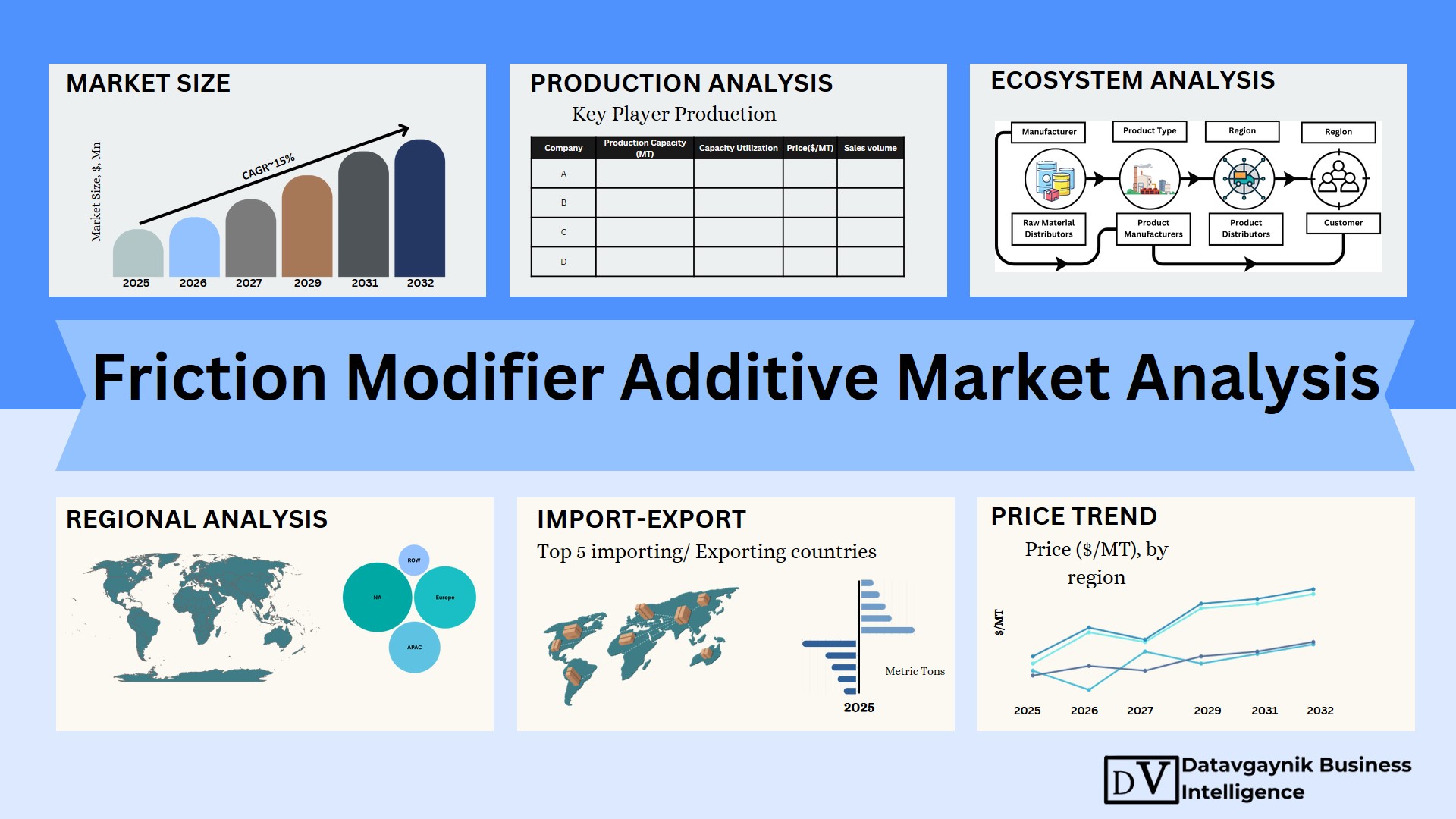
The Friction Modifier Additive Market is undergoing a paradigm shift driven by the global need for enhanced energy efficiency, mechanical longevity, and regulatory compliance. A substantial transformation is visible in the lubricant industry, particularly in sectors such as automotive, aerospace, and industrial manufacturing, where reducing internal friction translates directly into fuel savings, reduced emissions, and minimized wear and tear.
For instance, in the automotive sector alone, the demand for fuel-efficient vehicles is pushing the development of advanced lubricants, which has, in turn, led to a surge in the demand for friction modifier additives. Datavagyanik projects the Friction Modifier Additive Market Size to grow at a CAGR of over 5.8% between 2024 and 2030, reaching significant volume thresholds in both developed and emerging economies.
Regulatory Compliance Driving the Friction Modifier Additive Market
One of the most compelling drivers for the Friction Modifier Additive Market is the global regulatory push to curb emissions. Stricter fuel economy mandates by governments in regions such as the EU, the US, and China have forced automotive manufacturers to reevaluate their lubricant formulations. For instance, the European Union’s CO₂ emission target of 95g/km for passenger cars has amplified the use of low-viscosity engine oils blended with friction modifiers. These additives contribute to reducing boundary friction within the engine, enabling a more efficient combustion process and reducing emissions significantly. Datavagyanik notes that lubricant formulations containing friction modifiers can enhance fuel economy by up to 2%–3%, a figure that carries considerable weight in emission-sensitive industries.
Datavagyanik also covers related markets such as the Low Friction Coatings Market and the Anti-friction coatings Market. They create a more holistic picture of the ecosystem in which the primary topic exists, including technological shifts and market demands.
Automotive Industry at the Core of the Friction Modifier Additive Market
The Friction Modifier Additive Market is heavily anchored in the automotive industry, which accounts for the largest share of consumption. Passenger and commercial vehicle manufacturers are increasingly adopting friction modifiers in engine oils, transmission fluids, and gear oils to meet performance and environmental benchmarks. For example, synthetic engine oils blended with advanced friction modifiers are now a standard requirement in Euro 6 and Tier 3-compliant vehicles.
Furthermore, electric vehicles (EVs) are not immune to this trend. While EVs lack traditional internal combustion engines, their gear systems, bearings, and e-axles require highly efficient lubrication. Datavagyanik reports that with EV sales expected to exceed 17 million units globally by 2025, the Friction Modifier Additive Market is poised to experience parallel growth in specialized formulations tailored for electric drivetrains.
Industrial Machinery Segment Boosting Friction Modifier Additive Market Revenues
Outside the automotive domain, the industrial machinery sector is rapidly emerging as a crucial end-user segment in the Friction Modifier Additive Market. Manufacturing facilities are increasingly investing in high-performance lubricants to optimize uptime, reduce maintenance cycles, and improve equipment life expectancy. For instance, in the cement and steel industries, heavy-load gearboxes and continuous casting machines operate under extreme pressure and temperature. These machines are now routinely serviced with industrial-grade lubricants enriched with friction modifiers that maintain lubrication integrity under high stress. Datavagyanik estimates that the industrial segment accounts for nearly 28% of the global demand for friction modifier additives and is expanding steadily due to rising automation and equipment investments in Asia Pacific and North America.
Electric Vehicles Accelerating Evolution of Friction Modifier Additive Market
The rise of electric vehicles is creating a transformative shift in the Friction Modifier Additive Market. EV drivetrains require customized lubrication solutions that address challenges such as electromagnetic interference, oxidation stability, and low conductivity. Friction modifiers are being developed with unique dielectric properties to cater specifically to EV requirements. For instance, Tesla and BYD have initiated collaboration with lubricant suppliers to co-develop EV-specific lubricants incorporating friction modifiers designed for low-viscosity environments and high torque loads. Datavagyanik highlights that friction modifier applications in EVs are expected to register a growth rate of 7.2% annually through 2030, significantly outpacing traditional automotive lubricants in terms of innovation cycles and product demand.
Technological Advancements Catalyzing Friction Modifier Additive Market Innovation
Chemical and materials science breakthroughs have drastically redefined the capabilities of modern friction modifiers. Polymeric additives and nano-material-based friction modifiers are becoming more prevalent, especially in premium lubricants. These novel compounds exhibit excellent thermal stability and shear resistance, properties that are critical for high-speed engines and precision machinery. For instance, molybdenum-based compounds, historically used in extreme environments such as aerospace applications, are now being reformulated for commercial use due to cost optimization and improved synthesis techniques. Datavagyanik reports that over 35% of lubricant R&D budgets among Tier-1 chemical companies are now being allocated to developing next-gen friction modifiers, underlining the innovation-centric growth model of the Friction Modifier Additive Market.
Expansion in Emerging Economies Powering the Friction Modifier Additive Market
The growth trajectory of the Friction Modifier Additive Market is not confined to industrialized nations. Emerging economies such as India, Brazil, and Southeast Asian countries are witnessing exponential demand for high-efficiency lubricants, fueled by rapid urbanization, infrastructure development, and increased vehicle ownership. For example, India’s passenger vehicle market crossed 4 million units in 2023, a 14% year-over-year increase, spurring lubricant consumption and, by extension, friction modifier usage. Local manufacturers are also partnering with international additive producers to bring cost-effective yet high-performance solutions to market, thereby localizing supply chains and ensuring sustained demand growth.
Sustainability and Eco-Friendly Formulations Reshaping the Friction Modifier Additive Market
Sustainability is no longer a secondary concern—it is now a principal driver of product development in the Friction Modifier Additive Market. Bio-based and environmentally degradable friction modifiers are gaining significant traction, especially in Europe and North America. These formulations use renewable raw materials such as esters, fatty acids, and organic amides, offering both performance and environmental compatibility. Datavagyanik identifies a clear uptick in demand for lubricants certified under EcoLabel and similar green standards, indicating an industry-wide pivot toward sustainable additive chemistry. For instance, over 42% of new product launches in 2023 by European lubricant companies contained eco-certified friction modifiers.
Digital Manufacturing and Industry 4.0 Influencing Friction Modifier Additive Market Dynamics
The integration of smart manufacturing and predictive maintenance technologies in industrial settings is also contributing to the growth of the Friction Modifier Additive Market. Sensors and real-time data analytics enable precise monitoring of friction levels, temperature, and lubricant health, allowing for dynamic adjustment of additive concentrations. This is especially vital in sectors such as wind energy and marine engineering, where operational environments are remote and unpredictable. Datavagyanik underscores that the market for intelligent lubrication systems incorporating smart friction modifiers is projected to grow at over 8% CAGR through 2030, showcasing the potential of digital transformation in traditional lubricant markets.
High-Performance Automotive Trends Reinforcing Friction Modifier Additive Market Demand
Performance vehicles, sports cars, and luxury automobiles are increasingly influencing trends within the Friction Modifier Additive Market. These vehicles operate under higher RPMs and torque loads, demanding lubricants that can withstand thermal stress while minimizing friction. Friction modifiers in this segment must deliver ultra-low wear rates, consistent film formation, and enhanced oxidation resistance. Premium automotive brands are now formulating bespoke lubricants in partnership with additive suppliers to meet these exacting specifications. Datavagyanik highlights that the premium automotive lubricant segment witnessed a 6.5% rise in sales in 2023, largely attributed to heightened demand for friction modifiers in performance applications.
“Track Country-wise Friction Modifier Additive Production and Demand through our Friction Modifier Additive Production Database”
-
-
- Friction Modifier Additive production database for 30+ countries worldwide
- Friction Modifier Additive sales volume for 32+ countries
- Country-wise Friction Modifier Additive production capacity, production plant mapping, production capacity utilization for 30+ manufacturers
- Friction Modifier Additive production plants and production plant capacity analysis by top manufacturers
-
“Track real-time Friction Modifier Additive Prices, Friction Modifier Additive price charts for 30+ countries, Friction Modifier Additive weekly price tracker and Friction Modifier Additive monthly price tracker”
-
-
- Track real-time Friction Modifier Additive prices and Friction Modifier Additive price trend in 30+ countries though our excel-based Friction Modifier Additive price charts
- Real-time Friction Modifier Additive price tracker dashboard with 30+ countries
- Complete transparency on Friction Modifier Additive price trend through our Friction Modifier Additive monthly price tracker, Friction Modifier Additive weekly price tracker
-
North America Leading Innovation in the Friction Modifier Additive Market
The Friction Modifier Additive Market in North America, particularly the United States, is witnessing accelerated innovation and adoption due to stringent emission norms, a robust automotive sector, and a strong research ecosystem. The U.S. accounts for nearly 28% of the global demand for friction modifiers, driven by high consumption across automotive lubricants, transmission fluids, and industrial applications. For instance, American lubricant giants have introduced new synthetic oils infused with organic and polymeric friction modifiers that enhance fuel economy by 2.8% on average. Datavagyanik observes that in states like California, local regulations have catalyzed demand for friction modifiers in environmentally compliant lubricants, boosting the regional Friction Modifier Additive Market significantly.
Europe’s Sustainability Push Reshaping the Friction Modifier Additive Market
Europe remains a global hub for sustainable innovation in the Friction Modifier Additive Market. Countries such as Germany, France, and the UK are spearheading the transition to low-emission vehicles and green manufacturing practices. Germany, for instance, accounts for over 32% of Europe’s total demand for friction modifiers, fueled by its premium automotive sector and strict EU directives on CO₂ emissions. French and Scandinavian manufacturers are also aggressively transitioning to bio-based lubricants, with friction modifiers derived from fatty acids and esters. Datavagyanik highlights that more than 45% of lubricant formulations launched in the EU in 2023 contain eco-labeled friction modifiers, a trend expected to rise further due to regulatory alignment with the Green Deal and Fit for 55 strategies.
Asia Pacific Emerging as a High-Growth Region in the Friction Modifier Additive Market
The Asia Pacific region is witnessing explosive growth in the Friction Modifier Additive Market, driven by rapid industrialization, infrastructure expansion, and a surging middle class. China alone contributes over 35% of the region’s additive demand, propelled by its automotive and heavy manufacturing sectors. For instance, China’s annual production of passenger vehicles exceeded 27 million units in 2023, with over 9 million being electric—a segment that increasingly requires specialized friction modifiers.
Datavagyanik reports that India’s lubricant industry, growing at 4.7% CAGR, is increasingly turning toward high-performance friction modifier blends, especially in commercial vehicle and agriculture machinery oils. South Korea and Japan, known for their advanced automotive technologies, are also contributing heavily to R&D-led demand, positioning Asia Pacific as a strategic node in global friction modifier supply chains.
Latin America and Middle East Witnessing Gradual Uptake in Friction Modifier Additive Market
Though relatively smaller in market size, Latin America and the Middle East are showing promising uptake in the Friction Modifier Additive Market. Brazil’s automotive sector, producing over 2.4 million vehicles in 2023, is expanding its use of synthetic lubricants that incorporate organic friction modifiers. Mexico, a major manufacturing hub for North American auto exports, is seeing lubricant reformulations that align with U.S. standards, further boosting demand. In the Middle East, countries such as Saudi Arabia and the UAE are driving adoption in industrial applications, particularly oil and gas and construction. Datavagyanik notes that these regions are increasingly importing friction modifiers from Europe and Asia, creating strong demand for cost-effective formulations.
Global Production Landscape of the Friction Modifier Additive Market
Production of friction modifier additives is geographically concentrated in key innovation and manufacturing hubs, including the United States, Germany, Japan, China, and India. These countries account for over 70% of the global production output. For example, Germany houses several specialty chemical firms that dominate the European Friction Modifier Additive Market, with vertically integrated operations from synthesis to blending. Meanwhile, China’s scale advantage enables it to produce both commodity-grade and high-end additives, supported by government-led industrial incentives. India, although still a developing player, is rapidly building domestic capacity and is expected to increase its production share by 15% by 2030, according to Datavagyanik.
Friction Modifier Additive Market Segmentation by Product Type Driving Innovation
Segmentation within the Friction Modifier Additive Market reveals a dynamic shift from conventional materials toward next-generation chemistries. Organic friction modifiers, primarily esters and amides, continue to dominate the automotive lubricant segment due to their superior film-forming capabilities. Inorganic additives like molybdenum disulfide are gaining traction in heavy-duty and high-pressure industrial applications. For instance, steel rolling mills and mining equipment are increasingly relying on molybdenum compounds for long-lasting surface protection. Polymeric friction modifiers are becoming more common in electric vehicles and high-performance transmission fluids due to their low-temperature operability. Datavagyanik indicates that the polymeric segment is expected to grow at 6.9% CAGR through 2030, representing the fastest-growing product category.
Application-Based Segmentation Strengthening Friction Modifier Additive Market Position
From an application standpoint, the automotive industry continues to dominate the Friction Modifier Additive Market, accounting for approximately 52% of global consumption. The expansion of hybrid and electric vehicle fleets, as well as fleet electrification by commercial logistics companies, has introduced demand for friction modifiers that perform under lower viscosity ranges and higher load cycles. Industrial applications represent the second-largest segment, with sectors such as agriculture, construction, and manufacturing driving uptake. For example, Datavagyanik notes that over 65% of industrial gear oils launched in 2023 contained friction modifiers aimed at reducing maintenance downtime. Additionally, niche applications such as aerospace, marine, and wind energy are emerging as lucrative areas for advanced, high-shear-resistant friction modifiers.
Friction Modifier Additive Price Trend Reflects Raw Material Volatility and Technological Complexity
The Friction Modifier Additive Price Trend remains volatile, largely influenced by raw material costs, energy prices, and supply chain logistics. Organic additives, particularly those derived from natural oils and fatty acids, have seen a 12% increase in price over the past year due to agricultural commodity price fluctuations. In contrast, molybdenum-based inorganic friction modifiers have experienced price surges of up to 18%, driven by mining constraints and geopolitical factors. Datavagyanik points out that polymeric modifiers, although expensive to produce, have seen a marginal price decline due to advancements in synthetic processes and scaled production in Asia. The global Friction Modifier Additive Price is expected to stabilize by 2026 as producers diversify sourcing and invest in more efficient manufacturing processes.
Regional Disparities in Friction Modifier Additive Price Impact Market Strategies
There is considerable regional variance in Friction Modifier Additive Price levels, shaped by production proximity, regulatory tariffs, and domestic consumption trends. For instance, North American prices are 10%–15% higher than those in Asia due to higher labor and compliance costs. European prices, while also on the higher end, are buoyed by demand for eco-labeled, high-performance formulations. Datavagyanik highlights that in contrast, China and India offer some of the lowest Friction Modifier Additive Price points globally, making them attractive for sourcing and export-oriented production. These price dynamics are influencing global trade patterns, prompting multinational lubricant companies to reconfigure their procurement strategies accordingly.
Technological Advancements Influencing Friction Modifier Additive Price and Market Penetration
As technology advances, the cost of producing friction modifiers is gradually being optimized, although initial R&D investments remain high. For example, nano-friction modifiers that enhance lubricant longevity and reduce metal-to-metal contact have shown efficacy in extending oil change intervals by up to 40%, as observed in fleet trials across Europe. These premium additives carry a higher Friction Modifier Additive Price tag but deliver measurable ROI through reduced maintenance and improved fuel savings. Datavagyanik forecasts that as these technologies mature, their penetration in mass-market lubricants will increase, making premium additives more accessible across sectors.
Supply Chain Consolidation and Its Impact on Friction Modifier Additive Market Stability
The consolidation of additive manufacturing, driven by M&A activity among chemical giants, is influencing pricing and product availability in the Friction Modifier Additive Market. For instance, recent mergers between top additive producers in Europe and North America have led to centralized R&D hubs but also reduced supplier diversity, affecting Friction Modifier Additive Price structures in regions dependent on imports. Datavagyanik notes that vertical integration among producers, particularly in Asia Pacific, is creating resilience against global logistics disruptions, a trend likely to shape pricing strategies and availability in the post-pandemic landscape.
Conclusion: Friction Modifier Additive Market to Witness Competitive Realignment and Innovation-Led Growth
The Friction Modifier Additive Market is entering a phase of strategic realignment, marked by geographic expansion, product diversification, and pricing recalibration. North America and Europe will continue to lead in technological innovation and sustainability, while Asia Pacific emerges as the fulcrum of cost-effective production. With increasing penetration into non-automotive applications and a shift toward sustainable chemistry, the market presents multifaceted opportunities. Datavagyanik affirms that companies that invest in green chemistry, optimize the Friction Modifier Additive Price structure, and adapt to regional demand dynamics will be best positioned to thrive in the evolving global landscape.
“Friction Modifier Additive Manufacturing Database, Friction Modifier Additive Manufacturing Capacity”
-
-
- Friction Modifier Additive top manufacturers market share for 30+ manufacturers
- Top 8 manufacturers and top 18 manufacturers of Friction Modifier Additive in North America, Europe, Asia Pacific
- Friction Modifier Additive production plant capacity by manufacturers and Friction Modifier Additive production data for 30+ market players
- Friction Modifier Additive production dashboard, Friction Modifier Additive production data in excel format
-
“Friction Modifier Additive price charts, Friction Modifier Additive weekly price tracker and Friction Modifier Additive monthly price tracker”
-
-
- Factors impacting real-time Friction Modifier Additive prices in 24+ countries worldwide
- Friction Modifier Additive monthly price tracker, Friction Modifier Additive weekly price tracker
- Real-time Friction Modifier Additive price trend, Friction Modifier Additive price charts, news and updates
- Tracking Friction Modifier Additive price fluctuations
-
Top Manufacturers Dominating the Friction Modifier Additive Market
The global Friction Modifier Additive Market is consolidated among a handful of multinational chemical companies, lubricant giants, and specialized additive manufacturers. These key players command substantial influence through innovation, product diversification, and strategic partnerships with OEMs and industrial consumers. The top five players collectively hold more than 55% of the global market share, shaping trends in technology, sustainability, and pricing.
Lubrizol Corporation – Leader in Friction Modifier Additive Market Share
Lubrizol Corporation, a Berkshire Hathaway company, is widely regarded as the market leader in the Friction Modifier Additive Market. With a diversified portfolio of high-performance lubricant additives, the company supplies friction modifiers to major automotive OEMs and industrial lubricant blenders. Its proprietary product lines such as Lubrizol® 5600 Series and Lubrizol® PV9300 are formulated for next-generation low-viscosity engine oils and electric drivetrains. Lubrizol maintains over 18% of the global Friction Modifier Additive Market share, driven by continuous R&D investment and early adoption of sustainability-focused additive technologies.
Afton Chemical Corporation – Strong Automotive Focus in Friction Modifier Additive Market
Afton Chemical, a NewMarket Corporation subsidiary, holds a significant stake in the global Friction Modifier Additive Market, particularly in the automotive segment. The company is known for its HiTEC® friction modifier series, which includes solutions tailored for automatic transmission fluids (ATFs), gear oils, and EV-specific lubricants. Afton accounts for approximately 14% of the global market share, leveraging its extensive OEM partnerships and technical support infrastructure to expand its presence in North America, Europe, and Asia.
Infineum International – Friction Modifier Specialist for Passenger Car Lubricants
Infineum, a joint venture between ExxonMobil and Shell, specializes in advanced additive systems for passenger car and heavy-duty engine oils. Its product families, such as Infineum P6000 series, integrate advanced organic friction modifiers to meet stringent fuel economy and emissions standards. With a market share of around 11%, Infineum plays a critical role in the European and Asia Pacific Friction Modifier Additive Market, especially in applications requiring performance at low viscosity grades (0W-20, 0W-16).
Chevron Oronite – Emerging Innovator in Friction Modifier Additives
Chevron Oronite is gaining ground in the Friction Modifier Additive Market, focusing on expanding its footprint in Asia Pacific and Latin America. The company’s OLOA® friction modifier range includes products tailored for synthetic and semi-synthetic oils, with recent developments aimed at hybrid and plug-in hybrid vehicle lubricants. Chevron Oronite holds an estimated 7% of the global market and is focusing on developing high-load-bearing additives compatible with electric mobility applications.
BASF SE – Chemistry Powerhouse with Broad Additive Capabilities
As a global chemical conglomerate, BASF offers a broad range of additives, including friction modifiers used in both automotive and industrial lubricants. Its Kerobit® and Emgard® series support high-performance lubricants in off-road, mining, and agricultural machinery. While BASF’s market share in pure friction modifiers is smaller, estimated at around 5%, its vertically integrated model and expansive distribution network give it strategic leverage in the Friction Modifier Additive Market.
Other Notable Participants Contributing to Friction Modifier Additive Market Growth
Several regional and niche manufacturers are also shaping the competitive landscape:
- Croda International: Known for its biodegradable friction modifiers under the Crodafos™ and Priolube™ brands, Croda serves the eco-lubricant segment.
- LANXESS AG: Offers friction modifiers for industrial lubricants and gear oils, focusing on high-temperature resistance and oxidation control.
- King Industries: Specializes in performance additives for metalworking and industrial lubrication, including friction reducers for high-load operations.
- BRB International: Expanding its silicone-based additive solutions to enhance film strength and minimize metal contact in high-friction environments.
Collectively, these players contribute another 10%–12% of the global Friction Modifier Additive Market share, with regional dominance in specialized industrial segments or green chemistry niches.
Market Share Dynamics Among Global Manufacturers
The Friction Modifier Additive Market is competitive yet consolidated, with top manufacturers continuously engaging in mergers, capacity expansions, and technology collaborations. As demand grows across electric mobility, industrial automation, and renewable energy, market shares are expected to shift in favor of companies investing in application-specific formulations.
For example, while Lubrizol and Afton dominate traditional automotive lubricants, companies like Croda and Infineum are gaining ground in hybrid and EV-specific applications. Datavagyanik observes that the market share of conventional friction modifiers is slowly being redistributed toward polymeric and dielectric-enhanced additives, which are being pioneered by newer players and regional innovators.
Recent Industry Developments and Strategic Moves in the Friction Modifier Additive Market
The Friction Modifier Additive Market has seen several noteworthy developments in recent quarters, indicating the strategic direction of leading players:
- October 2023 – Lubrizol announced the launch of its next-gen PV9500 friction modifier, designed specifically for electric vehicles, claiming a 4.2% improvement in drivetrain energy efficiency in early field trials.
- January 2024 – Infineum opened a new R&D facility in Singapore focused on developing Asia-specific friction modifiers for low-viscosity lubricants, targeting 0W-12 and below formulations.
- March 2024 – Afton Chemical completed an acquisition of a mid-sized additive company in Brazil, expanding its market access in Latin America and strengthening its distribution of HiTEC® modifiers.
- February 2024 – BASF unveiled an eco-friendly friction modifier prototype using microencapsulated esters, aimed at reducing the volatility and environmental impact of industrial greases.
- December 2023 – Chevron Oronite signed a strategic alliance with an EV drivetrain manufacturer, focused on co-developing lubricants for high-speed electric motors requiring enhanced thermal and friction control.
These developments underscore the direction of the Friction Modifier Additive Market: one driven by sustainability, electrification, and performance optimization under extreme operating conditions. As competitive intensity increases, the ability of manufacturers to innovate, localize production, and align with emerging vehicle technologies will be critical in shaping their future market share.
“Friction Modifier Additive Production Data and Friction Modifier Additive Production Trend, Friction Modifier Additive Production Database and forecast”
-
-
- Friction Modifier Additive production database for historical years, 10 years historical data
- Friction Modifier Additive production data and forecast for next 7 years
- Friction Modifier Additive sales volume by manufacturers
-
“Track Real-time Friction Modifier Additive Prices for purchase and sales contracts, Friction Modifier Additive price charts, Friction Modifier Additive weekly price tracker and Friction Modifier Additive monthly price tracker”
-
-
- Gain control on your purchase and sales contracts through our real-time Friction Modifier Additive price tracker and Friction Modifier Additive price trend analysis
- Friction Modifier Additive weekly price tracker and forecast for next four weeks
- Friction Modifier Additive monthly price tracker and forecast for next two months
-
Market Scenario, Demand vs Supply, Average Product Price, Import vs Export, till 2035
- Global Friction Modifier Additive Market revenue and demand by region
- Global Friction Modifier Additive Market production and sales volume
- United States Friction Modifier Additive Market revenue size and demand by country
- Europe Friction Modifier Additive Market revenue size and demand by country
- Asia Pacific Friction Modifier Additive Market revenue size and demand by country
- Middle East & Africa Friction Modifier Additive Market revenue size and demand by country
- Latin America Friction Modifier Additive Market revenue size and demand by
- Import-export scenario – United States, Europe, APAC, Latin America, Middle East & Africa
- Average product price – United States, Europe, APAC, Latin America, Middle East & Africa
- Market player analysis, competitive scenario, market share analysis
- Business opportunity analysis
Key questions answered in the Global Friction Modifier Additive Market Analysis Report:
- What is the market size for Friction Modifier Additive in United States, Europe, APAC, Middle East & Africa, Latin America?
- What is the yearly sales volume of Friction Modifier Additive and how is the demand rising?
- Who are the top market players by market share, in each product segment?
- Which is the fastest growing business/ product segment?
- What should be the business strategies and Go to Market strategies?
The report covers Friction Modifier Additive Market revenue, Production, Sales volume, by regions, (further split into countries):
- Asia Pacific (China, Japan, South Korea, India, Indonesia, Vietnam, Rest of APAC)
- Europe (UK, Germany, France, Italy, Spain, Benelux, Poland, Rest of Europe)
- North America (United States, Canada, Mexico)
- Latin America (Brazil, Argentina, Rest of Latin America)
- Middle East & Africa
Table of Contents:
Friction Modifier Additive Market
- Introduction to Friction Modifier Additives
- Overview of Friction Modifier Additives and Their Role in Industrial Applications
- Importance of Friction Modifiers in Enhancing Lubricant Performance
- Key Properties and Benefits of Friction Modifier Additives
- Improved Wear Protection and Reduced Friction
- Enhancing Energy Efficiency and Reducing Operational Costs
- Market Scope and Applications
- Use in Automotive, Industrial, and Manufacturing Sectors
- Applications in Gear Oils, Engine Oils, Hydraulic Fluids, and Greases
- Global Market Overview and Trends (2019-2035)
- Growth in Demand for Advanced Friction Modifiers
- Technological Innovations in Friction Modifier Formulations
- Market Segmentation by Additive Type
- Organic Friction Modifiers (Fatty Acids, Esters, etc.)
- Inorganic Friction Modifiers (Metallic Compounds)
- Hybrid Friction Modifiers (Combination of Organic and Inorganic)
- Market Segmentation by Application
- Automotive and Transportation
- Industrial Equipment and Machinery
- Aerospace and Aviation
- Agricultural and Construction Equipment
- Regional Market Dynamics (2019-2035)
- North America
- Europe
- Asia-Pacific
- Latin America
- Middle East & Africa
- United States Market Insights
- Adoption of Friction Modifiers in Automotive and Heavy Machinery
- Role of Friction Modifiers in Enhancing Fuel Efficiency
- European Market Insights
- Regulatory Impact on Friction Modifier Usage in Automotive Industry
- Innovations in Eco-Friendly and Sustainable Friction Modifiers
- Asia-Pacific Market Insights
- Growth in Manufacturing and Industrial Applications for Friction Modifiers
- Increasing Adoption in Emerging Economies with Expanding Automotive Sectors
- Latin America Market Insights
- Demand for Friction Modifiers in Agriculture and Industrial Equipment
- Opportunities in Cost-Effective Lubrication Solutions
- Middle East & Africa Market Insights
- Expansion in Industrial Applications and Energy Sectors
- Demand for Friction Modifiers in Extreme Temperature and Harsh Environments
- Production Processes for Friction Modifier Additives
- Techniques for Manufacturing Organic and Inorganic Friction Modifiers
- Innovations in Production for Cost-Effectiveness and Performance
- Competitive Landscape and Market Share Analysis
- Key Players in the Friction Modifier Additive Market
- Competitive Strategies and Market Positioning
- Cost Analysis of Friction Modifier Additives
- Breakdown of Raw Material, Production, and Distribution Costs
- Cost-Benefit Analysis of Using Friction Modifiers in Industrial Lubricants
- Raw Materials for Friction Modifier Additive Production
- Sourcing of Organic and Inorganic Compounds for Friction Modifiers
- Trends in Material Sourcing and Pricing
- Supply Chain and Distribution Strategies
- Role of Suppliers and Distributors in the Friction Modifier Market
- Challenges in Managing Supply Chain for Seasonal Demand Variability
- Industrial Chain and Value Chain Analysis
- Integration of Friction Modifiers in Lubricant Manufacturing
- Opportunities for Value Addition in Custom Formulations
- Revenue and Profitability Analysis
- Revenue Trends by Application and Region
- Profit Margins in Friction Modifier Additive Production
- End-User and Consumer Insights
- Preferences for High-Performance and Sustainable Friction Modifiers
- Trends in Adoption Among Automotive, Aerospace, and Industrial Users
- Marketing and Branding Strategies
- Positioning Friction Modifiers as Key Drivers of Lubricant Efficiency
- Branding Friction Modifiers in the Context of Energy Efficiency and Sustainability
- Environmental and Regulatory Considerations
- Compliance with Environmental Standards for Friction Modifiers
- Role of Friction Modifiers in Reducing Emissions and Enhancing Lubricant Recycling
- Research and Development in Friction Modifier Additives
- Innovations in Lubricant Chemistry for Improved Performance
- Emerging Trends in Biodegradable and Non-Toxic Friction Modifiers
- Challenges in the Friction Modifier Additive Market
- Raw Material Availability and Pricing Challenges
- Regulatory Barriers and the Need for Industry Collaboration
- Opportunities in Emerging Applications
- Use in Electric Vehicle (EV) Lubricants and Transmission Fluids
- Applications in Sustainable and Low-Emission Automotive Systems
- Import and Export Dynamics
- Global Trade Patterns for Friction Modifier Additives
- Regional Dynamics in Export and Import Markets
- Market Forecast and Projections (2019-2035)
- Regional and Global Growth Predictions
- Key Trends and Innovations Shaping the Future of Friction Modifier Additives

