

Market Summary and Growth Forecast
The global Fluoropolymer Coatings (e.g., PTFE-based) Market is estimated at $2,430 million in 2026 and is expected to reach $3,940 million by 2035, growing at a CAGR of 5.5%.
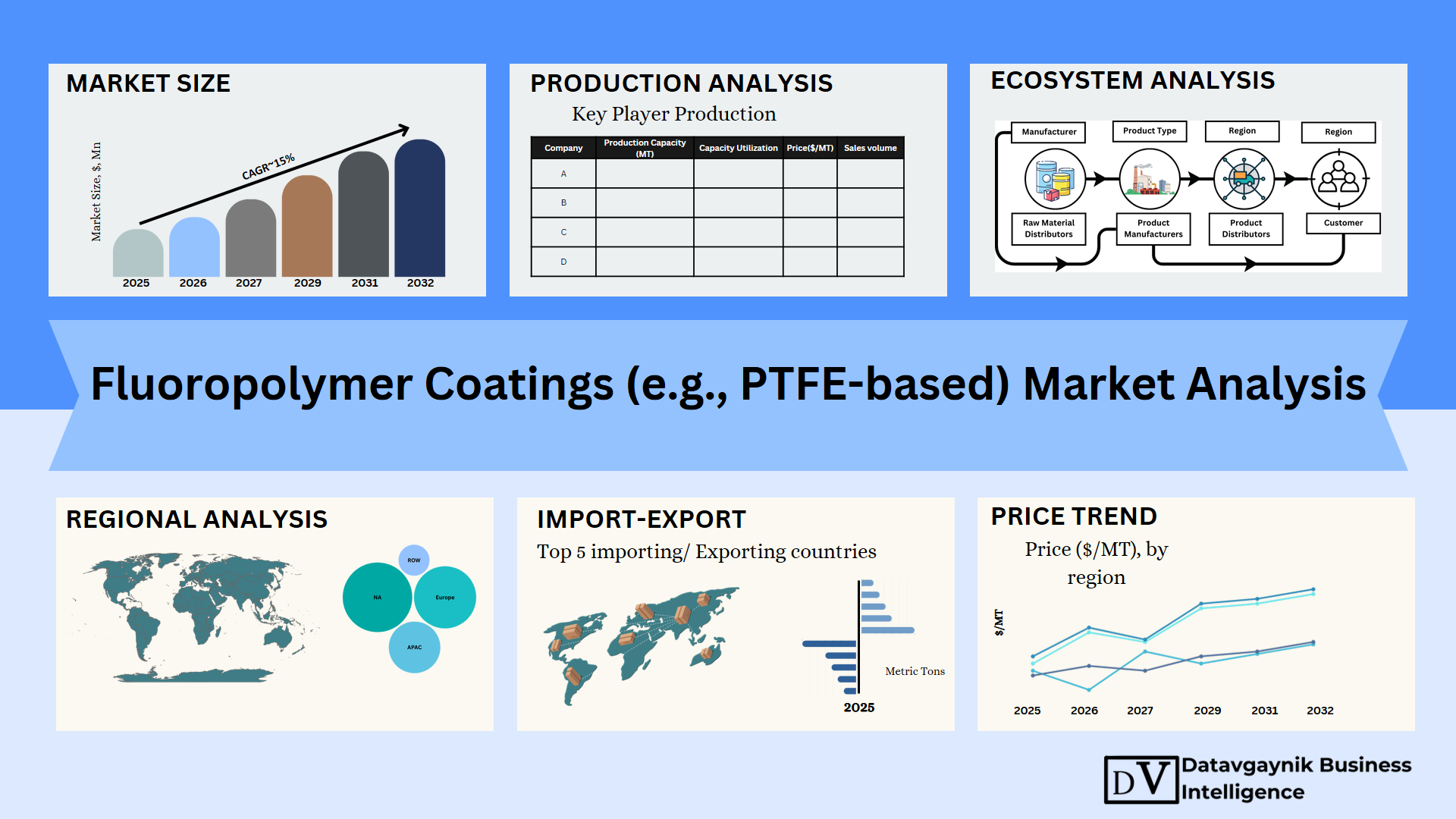
Fluoropolymer coatings are high-performance protective coatings made from fluorinated polymers such as PTFE, FEP, PFA, ETFE, and related blends. They are used when a surface needs low friction, chemical resistance, heat stability, non-stick behavior, electrical insulation, or weather durability. In simple terms, these coatings help materials survive difficult operating environments without adding heavy mechanical complexity.
Datavagyanik also covers related markets such as the Fluoropolymer Films Market, the Polytetrafluoroethylene (PTFE) low friction coatings Market, and the Polytetrafluoroethylene (PTFE) Market. These related markets contribute valuable context to the primary topic by highlighting complementary trends and technologies.
The Fluoropolymer Coatings (e.g., PTFE-based) Market has strong business relevance during 2026–2035 because it sits between several industrial priorities. Manufacturers want longer asset life. Food processors want easier-cleaning surfaces. Semiconductor and electronics companies want chemically stable materials. Automotive and energy companies want coatings that perform under heat, corrosion, and repeated wear. This makes the market less dependent on one end-use cycle and more tied to broad industrial performance requirements.
A practical point matters here. PTFE-based coatings are mature, but not commoditized. The real value is in formulation, adhesion, surface preparation, curing control, and regulatory compliance. Two coatings with similar chemistry can perform very differently in a chemical plant, battery line, or cookware application. So the industry is moving away from simple “non-stick coating” positioning and toward engineered surface systems.
| Metric | Estimate |
| Global Market Size, 2026 | $2,430 million |
| Projected Market Size, 2035 | $3,940 million |
| CAGR, 2026–2035 | 5.5% |
| Estimated 2026 Volume Demand | 89–94 kilotons |
| Average Value Density, 2026 | $26–28/kg equivalent coating value |
The market’s growth is shaped by four macro forces.
First, industrial maintenance economics are becoming more important. Chemical plants, food processing lines, pharmaceutical equipment, pumps, valves, seals, cookware, bakeware, and heat-exposed metal parts all face rising downtime costs. Coatings that reduce sticking, fouling, corrosion, and cleaning frequency can justify premium pricing.
Second, regulation is becoming a strategic filter. Fluoropolymer chemistry is linked to the broader PFAS discussion. This does not mean all use cases disappear. It does mean customers will ask harder questions about emissions, residual chemistry, processing aids, disposal, and documentation. Suppliers with cleaner manufacturing routes, lower VOC systems, traceability, and compliance support will gain share.
Third, production technology is shifting toward waterborne systems, lower-bake formulations, powder-based fluoropolymer coatings, and hybrid systems that combine fluoropolymers with ceramic or silicone-modified binders. These changes are not only environmental. They also help applicators reduce energy use and improve line efficiency.
Fourth, high-spec demand is rising in electronics, EV batteries, solar, hydrogen systems, and semiconductor equipment. These sectors need coatings that can handle chemical exposure, temperature fluctuation, and electrical performance. That creates room for premium PFA, FEP, and specialty PTFE blends.
Key consumers and clients include:
| Consumer / Client Group | Typical Demand Driver |
| Cookware and bakeware manufacturers | Non-stick performance, brand differentiation, scratch resistance |
| Chemical processing companies | Corrosion resistance, anti-fouling, longer part life |
| Food and beverage equipment makers | Cleanability, hygiene, reduced residue build-up |
| Automotive and EV component suppliers | Low friction, heat resistance, insulation, durability |
| Electronics and semiconductor equipment suppliers | High purity, chemical stability, dielectric performance |
| Oil, gas, and energy equipment manufacturers | Corrosion control, sealing support, operating reliability |
| Industrial coating applicators | Custom coating services for OEM and maintenance markets |
Expert view: The next phase of the Fluoropolymer Coatings (e.g., PTFE-based) Market will not be won only on chemistry. It will be won on application know-how, regulatory comfort, and the ability to prove lifecycle value to industrial buyers.
Market Segmentation and Forecast Scope
The Fluoropolymer Coatings (e.g., PTFE-based) Market can be segmented by product type, application, end user, and region. This structure keeps the forecast commercially useful. Product type explains chemistry and performance. Application explains where the coating is used. End user explains the buyer base. Region explains regulation, manufacturing depth, and consumption behavior.
By Product Type
| Segment | Role in the Market |
| PTFE-based Coatings | Core market segment. Strong non-stick, low friction, and heat resistance. Widely used in cookware, industrial parts, fasteners, seals, and processing equipment. |
| FEP Coatings | Used where melt processability, chemical resistance, and smoother film formation matter. Relevant in wires, electronics, chemical equipment, and specialty industrial parts. |
| PFA Coatings | Premium segment. Stronger fit for high-purity and chemically aggressive environments. Used in semiconductor, chemical processing, pharmaceutical, and energy equipment. |
| ETFE Coatings | Used when toughness, abrasion resistance, and outdoor durability matter. Common in chemical tanks, architectural uses, and corrosion-prone equipment. |
| Fluoropolymer Blends and Hybrid Coatings | Includes systems combined with ceramic, silicone, or other performance modifiers. Used to improve scratch resistance, adhesion, and durability. |
PTFE-based coatings account for an estimated 56% of global revenue in 2026. This share is high because PTFE remains the default chemistry for non-stick and low-friction coating needs. It has strong processing familiarity and broad applicator availability.
That said, PFA coatings are likely to be the most strategic product group through 2035. They serve fewer applications, but their value per kilogram is higher. Their growth is tied to semiconductor tools, specialty chemical handling, battery materials processing, and high-purity fluid systems.
By Application
| Segment | Market Logic |
| Non-stick Cookware and Bakeware | Mature but large. Demand depends on consumer replacement cycles, retail brands, and coating durability claims. |
| Industrial Equipment and Machinery | Broadest industrial base. Includes rollers, molds, fasteners, pumps, valves, seals, mixers, and conveyor components. |
| Chemical Processing Equipment | Uses fluoropolymer coatings for corrosion resistance and reduced fouling in harsh media. |
| Electronics and Semiconductor Components | Smaller in volume but higher in specification. Growth comes from purity, dielectric stability, and chemical resistance needs. |
| Automotive and EV Components | Includes low-friction parts, insulation applications, battery equipment, and heat-exposed systems. |
| Food Processing and Packaging Equipment | Demand comes from hygiene, cleanability, residue control, and lower maintenance. |
| Energy and Infrastructure Equipment | Includes oil and gas, renewables, hydrogen-related parts, and outdoor corrosion protection. |
Industrial equipment and machinery represent an estimated 31% of global revenue in 2026. This is the most commercially diverse application base. It includes both OEM demand and maintenance recoating. That mix gives the segment more resilience than cookware-only demand.
The fastest-growing application is expected to be electronics and semiconductor components, followed by EV and battery-related industrial equipment. These segments require higher coating performance and tighter quality control. They also tolerate higher pricing when coatings prevent contamination, corrosion, sticking, or electrical failure.
By End User
| End User | Buying Behavior |
| OEMs | Buy coatings or coated parts for new equipment, consumer goods, automotive systems, and electronics assemblies. |
| Industrial Coating Applicators | Apply coatings for OEMs and maintenance customers. Their technical role is critical because surface preparation controls final performance. |
| Maintenance, Repair, and Operations Buyers | Demand recoating and replacement coatings to extend equipment life. |
| Consumer Goods Manufacturers | Mainly cookware, bakeware, and appliances. Sensitive to safety, branding, and retail quality perception. |
| Process Industries | Chemical, food, pharma, oil and gas, and energy users. Focused on downtime, corrosion, and cleanability. |
OEMs will remain the largest value channel. Still, applicators are becoming more important in the value chain. They translate chemistry into actual performance. Poor application can destroy the value of a premium resin system. This is why large material suppliers often work closely with certified coaters and regional applicator networks.
By Region
| Region | Forecast Scope and Growth Character |
| North America | Strong in industrial maintenance, aerospace-adjacent uses, energy equipment, cookware brands, and high-spec coating services. Regulation will shape formulation choices. |
| Europe | High compliance pressure. Demand favors lower-emission systems, durable coatings, and traceable supply chains. Growth is steady but technically demanding. |
| Asia Pacific | Largest manufacturing base. Strong demand from cookware, electronics, EV batteries, industrial equipment, chemicals, and semiconductor supply chains. |
| LAMEA | Smaller base but growing in oil and gas, food processing, construction materials, and industrial equipment maintenance. |
Asia Pacific is expected to remain the largest regional market through 2035. It benefits from coating demand across China, Japan, South Korea, India, and Southeast Asia. The region has both mass-volume cookware manufacturing and high-value electronics demand.
The Fluoropolymer Coatings (e.g., PTFE-based) Market forecast covers coating materials, formulated systems, and applied coating value where directly tied to fluoropolymer coating performance. It excludes raw fluoropolymer resin sales used outside coating applications, finished cookware retail value, unrelated paint systems, mechanical surface treatments, and non-fluorinated anti-corrosion coatings.
Expert view: The segmentation that matters most is not simply PTFE versus PFA. It is “standard non-stick” versus “qualified industrial performance.” That distinction will decide pricing power through 2035.
Market Trends and Innovation Landscape
Innovation in the Fluoropolymer Coatings (e.g., PTFE-based) Market is being shaped by performance pressure and regulatory pressure at the same time. This creates a difficult but useful tension. Customers still want the same benefits: low friction, chemical resistance, heat tolerance, and clean release. But they also want lower emissions, safer handling, easier compliance, and better lifecycle documentation.
R&D Evolution
R&D is moving in three clear directions.
The first is lower-emission coating systems. Suppliers and applicators are improving waterborne fluoropolymer coatings, reducing solvent dependence, and refining powder technologies. This matters because large OEMs increasingly evaluate coatings not only by performance but also by plant emissions, worker handling, and end-of-life risk.
The second is multi-layer coating architecture. Instead of one coating doing everything, manufacturers are using primers, mid-coats, and topcoats with different roles. The primer anchors the coating to metal. The mid-layer adds toughness. The topcoat delivers release, slip, and chemical resistance. This approach is common in cookware, bakeware, and industrial rollers, but it is also spreading into higher-end industrial parts.
The third is surface preparation science. Pretreatment, grit blasting, plasma treatment, and chemical etching are becoming more important. Why? Because adhesion failure is still one of the biggest reasons coatings underperform. Better surface engineering allows thinner coatings to last longer.
Technology Evolution
The market is shifting from basic PTFE coatings to engineered systems that balance friction, abrasion resistance, corrosion protection, and regulatory acceptance. Standard PTFE remains highly relevant. But customers increasingly ask for coatings that survive more cycles, more aggressive cleaning, and more variable operating conditions.
Powder fluoropolymer coatings are gaining attention in applications where film thickness, lower solvent use, and uniform coverage are important. Waterborne systems are also advancing, especially for consumer-facing and regulated industrial uses. At the same time, high-performance PFA and FEP systems are becoming more visible in semiconductor, chemical processing, and electronics environments.
The role of digital quality control is also increasing. This is not a broad “AI-led market” yet. The real movement is more practical. Applicators are using better process monitoring for spray thickness, cure temperature, surface profile, and defect inspection. Over time, automated inspection may reduce coating variability and improve yield in high-volume coating lines.
Material Science Direction
Material science is highly relevant in this market. The next layer of innovation is not just a new fluoropolymer. It is the combination of fluoropolymer chemistry with fillers, binders, reinforcement particles, and surface-active additives.
Key material directions include:
| Innovation Area | Why It Matters |
| Reinforced PTFE systems | Improve abrasion resistance while retaining low friction. Useful in industrial parts and moving components. |
| Ceramic-modified fluoropolymer coatings | Improve hardness, scratch resistance, and durability. Relevant for cookware and industrial surfaces. |
| High-purity PFA and FEP systems | Support semiconductor, pharmaceutical, and chemical applications where contamination control matters. |
| Low-VOC and waterborne formulations | Help customers meet emissions and workplace safety targets. |
| Hybrid release coatings | Balance non-stick performance with better wear life and adhesion. |
The hard trade-off remains the same. More reinforcement can improve wear resistance, but it can also reduce release performance. More chemical resistance can raise cost. Lower curing temperatures can improve energy use, but may limit coating strength in some systems. So the best innovation will be application-specific rather than universal.
Mergers, Partnerships, and News Announcements
Strategic activity in this market is less about headline-making mega-mergers and more about portfolio repositioning, compliance planning, and application partnerships.
3M’s earlier decision to exit PFAS manufacturing has continued to reshape customer qualification behavior across fluorochemical value chains. Even where the direct coating impact differs by product line, the signal is clear. Large buyers are reviewing supply continuity and documentation more carefully.
Chemours, Daikin, AGC, and Solvay/Syensqo remain important technology anchors because of their fluoropolymer chemistry depth. Their moves around cleaner production, specialty grades, and application-specific materials influence how downstream coating formulators position themselves.
Coating specialists such as PPG, AkzoNobel, Whitford, Teflon-coated applicator networks, and regional industrial coaters continue to focus on durability claims, food-contact compliance, and performance-backed coating systems. Partnerships between resin suppliers, formulators, and certified applicators are likely to become more important as customers demand proof of performance rather than simple chemistry labels.
Expert view: The Fluoropolymer Coatings (e.g., PTFE-based) Market is entering a qualification-heavy cycle. Suppliers that can combine performance data, regulatory clarity, and reliable applicator networks will have an edge. Buyers won’t only ask, “Does it release?” They’ll ask, “Can this coating pass audit, last longer, and stay available?”
Future Impact
By 2035, innovation will likely split the market into two layers. The first layer will be high-volume, cost-managed PTFE coating demand for cookware, bakeware, and general industrial parts. The second layer will be premium engineered coating systems for electronics, semiconductors, batteries, chemical processing, and energy equipment.
The Fluoropolymer Coatings (e.g., PTFE-based) Market will still depend on PTFE at its core. But value growth will increasingly come from specialty formulations, validated performance, and coating systems designed for specific operating conditions.
Use case/example: A battery materials plant using coated mixing and conveying components may not buy fluoropolymer coatings for “non-stick” branding. It buys them to reduce residue build-up, cleaning time, and metal contamination risk. That is where premium coating systems can defend pricing.
Competitive Intelligence and Benchmarking
The Fluoropolymer Coatings (e.g., PTFE-based) Market is moderately consolidated at the chemistry level and more fragmented at the applicator level. A small set of fluoropolymer resin and coating technology owners influence performance standards. Below them, hundreds of regional coaters, cookware coating houses, and industrial applicators serve local OEMs and maintenance users.
This structure matters. Large chemical companies control resin quality, compliance files, formulation support, and brand trust. Applicators control coating performance on the actual part. So the winning model is rarely “resin only” or “application only.” It is a paired model: chemistry depth plus coating-process discipline.
| Company | Portfolio Position | Market Position |
| Chemours | PTFE, FEP, PFA, ETFE-linked fluoropolymer platforms, industrial coatings, additives, films, dispersions, and high-performance fluoropolymer systems. | One of the strongest global reference players in branded PTFE-based and specialty fluoropolymer systems. It has strong pull in industrial coatings, electronics, food processing, chemical equipment, and semiconductor-adjacent applications. |
| Daikin Industries | Broad fluorochemical platform covering fluoropolymers, fluoroelastomers, fluorochemical materials, and application support. | A technology-heavy Japanese supplier with strong Asia presence and expanding India focus. Its strength is not only resin supply. It is technical service for high-performance materials used in semiconductors, batteries, electronics, and industrial systems. |
| AGC Inc. | Fluon-based PTFE and other fluorochemical materials used in semiconductor, transport, chemical, and industrial applications. | Strong in Japanese and Asian high-purity supply chains. AGC is well positioned where customers value quality assurance, fluorine resource strategy, and semiconductor-grade materials. |
| Syensqo | Specialty polymers including PTFE powders, PVDF, ECTFE, fluorinated fluids, and performance additives. | Strong in specialty applications rather than commodity coating volume. Its position is relevant in high-spec industrial, semiconductor, fluid handling, and additive markets. |
| PPG | Industrial coatings, low-friction and non-stick coating systems, sol-gel alternatives, powder/liquid coatings, pretreatments, and applicator-linked coating technologies. | A major downstream coating competitor. PPG’s edge is broad industrial customer access and coating-system know-how. Its fluoropolymer-related relevance increased through its non-stick and low-friction coating capabilities. |
| Arkema | Fluoropolymer materials mainly around PVDF platforms, plus advanced materials and coating-related solutions. | More exposed to PVDF and specialty materials than PTFE cookware coatings. Strategic in batteries, chemical resistance, membranes, architectural coatings, and high-performance industrial uses. |
| Gujarat Fluorochemicals / INOXGFL Group | Fluoropolymers and fluoro-specialty materials with growing relevance in PTFE, FKM, PVDF, and battery-linked materials. | A rising India-based supplier. It benefits from import substitution, export demand, and customer interest in diversified fluoropolymer supply outside traditional Western and Japanese sources. |
Chemours remains a benchmark because of its long-standing PTFE-based coating ecosystem. Its industrial coating range is used across non-stick, low-friction, chemical resistance, heat resistance, and electrical insulation applications. The company has also positioned fluoropolymers around semiconductor manufacturing, advanced electronics, automotive, energy, and chemical processing needs. That gives it both legacy demand and new-cycle demand.
Daikin Industries is a serious technology competitor. It has broad fluorochemical experience and has been building closer customer support in growth regions. Its India chemical business move is important because India’s electronics, batteries, air conditioning, and industrial manufacturing base is expanding. For the Fluoropolymer Coatings (e.g., PTFE-based) Market, this improves technical reach in one of the fastest-growing demand pockets.
AGC Inc. brings a materials-quality story. Its fluorochemical business is tied to high-performance uses including semiconductors and transport equipment. The company’s work on recycled fluorite-based PTFE resin verification also supports a future where buyers ask about raw material circularity, not only coating durability.
Syensqo sits in the specialty polymer lane. Its PTFE powders and fluorinated polymer platforms are relevant for additives, industrial components, fluid handling, and high-spec systems. Its broader non-fluorosurfactant positioning also helps in Europe, where regulatory pressure is shaping customer qualification decisions.
PPG competes closer to the customer. It is not only a materials supplier. It sells coating systems into cookware, bakeware, appliances, industrial equipment, construction products, and specialty parts. Its advantage is application know-how. This matters because the final customer usually buys performance: fewer rejects, easier cleaning, lower friction, or longer service life.
Arkema is more strategic than broad in this exact coating market. Its fluoropolymer strength is centered around PVDF and specialty polymer platforms. That makes it relevant in corrosion protection, membranes, batteries, chemical processing, and industrial coatings where PVDF or related chemistries fit better than PTFE.
Gujarat Fluorochemicals is the supplier to watch in India and export-led markets. Its growth logic is supply diversification. Buyers do not want overdependence on a handful of Western and Japanese fluorochemical producers. This gives Indian suppliers a clear opening, especially in price-sensitive industrial and mid-spec applications.
Expert view: Competitive advantage in this market is moving from brand-only positioning to qualification depth. The companies that can show consistent coating performance, stable supply, and credible compliance documentation will protect margins better than those selling only chemistry.
Regional Landscape and Adoption Outlook
Regional demand is uneven. It depends on industrial maturity, cookware manufacturing, semiconductor investments, chemical processing depth, and regulatory intensity. The Fluoropolymer Coatings (e.g., PTFE-based) Market has a global base, but each region buys for a different reason.
United States
The United States remains a premium market. Demand comes from industrial equipment, chemical processing, food processing, aerospace-adjacent parts, electronics, semiconductor manufacturing, medical devices, and energy infrastructure.
The U.S. market is not mainly about low-cost coating volume. It is about specification. Buyers want traceability, performance documentation, food-contact clarity, and domestic supply comfort. Semiconductor and advanced electronics manufacturing also support demand for high-purity PFA, FEP, and PTFE-based systems.
Regulation is a major factor. PFAS reporting and state-level restrictions are pushing buyers to review coating specifications more carefully. That does not remove fluoropolymer coatings from industrial use. It raises the cost of compliance. Suppliers with strong technical files, emissions controls, and customer documentation will have a better position.
Funding support for semiconductor and clean-energy manufacturing indirectly benefits coating demand. More fabs, battery facilities, and chemical infrastructure mean more coated tanks, valves, seals, cable systems, process tools, and contamination-control surfaces.
Europe
Europe is the most compliance-sensitive region. Adoption is steady, but the purchasing process is tougher. Customers ask more questions on PFAS status, food-contact safety, lifecycle exposure, emissions, and alternatives.
Industrial demand remains strong in Germany, France, Italy, the Netherlands, Belgium, the Nordic region, and the UK. Germany is particularly important because of machinery, automotive, chemical processing, and industrial OEM depth. Italy and France add cookware, industrial coatings, and specialty manufacturing demand.
Europe’s growth is not the fastest by volume. But it can be attractive by value. Buyers pay for durable systems, lower-VOC formulations, waterborne coatings, repair economics, and audit-ready documentation. This favors technically credible suppliers and certified applicator networks.
The main risk is substitution pressure in consumer-facing categories. In cookware and food-contact packaging-adjacent discussions, some buyers will explore ceramic, silicone, sol-gel, or other non-PFAS alternatives. In industrial uses, substitution is harder because PTFE, PFA, FEP, and ETFE often solve problems that alternatives do not match cleanly.
China
China is the largest production and consumption engine in Asia. It has strong demand from cookware manufacturing, electronics, chemical equipment, EV batteries, solar supply chains, industrial machinery, and consumer appliances.
China also has a deep fluorochemical manufacturing base. This gives it supply advantages in cost-sensitive PTFE and fluoropolymer intermediates. Local suppliers are increasingly competing beyond low-cost resin. They are moving into higher-quality PTFE dispersions, modified coatings, and electronics-linked grades.
Adoption is supported by massive industrial scale. The country’s coating demand is tied to production output rather than replacement alone. So when China expands battery materials, solar, semiconductor tools, or chemical processing capacity, coating demand follows.
The challenge is quality segmentation. China has both high-spec and low-spec supply. Premium buyers still pay for validated international or top-tier domestic systems. Commodity cookware and general industrial users remain price-driven.
India
India is one of the highest-growth regional opportunities through 2035. The base is smaller than China, the U.S., or Europe. But the direction is favorable.
Demand is expanding in cookware, food processing equipment, chemical processing, pharmaceuticals, electronics assembly, EV batteries, cables, and industrial machinery. Government-led manufacturing programs, domestic electronics growth, and specialty chemical investment are raising the need for fluorinated materials and technical coating support.
India’s coating applicator ecosystem is still developing. This is important. Resin availability alone does not build a premium coating market. The country needs more qualified coaters, better curing lines, surface-preparation control, and OEM-level testing capabilities.
Daikin’s move to establish a chemical business presence in India also signals how global suppliers view the market. India is not only a sales market. It is becoming a technical support and future localization market.
Japan
Japan remains a high-quality fluoropolymer and coating technology market. Demand is supported by semiconductor materials, electronics, automotive components, chemical processing, precision equipment, and high-performance industrial parts.
Japanese suppliers have a strong position in quality-sensitive applications. Buyers value consistency, contamination control, and long-cycle supplier relationships. Japan may not show the fastest volume expansion, but it remains strategically important because it influences high-spec material standards across Asia.
AGC and Daikin are especially relevant in Japan’s fluorochemical ecosystem. Their capabilities support semiconductors, transportation equipment, and industrial durability applications. Japan’s role is therefore more technology-setting than volume-only.
South Korea
South Korea is a compact but high-value market. Demand comes from semiconductors, displays, batteries, electronics, automotive components, and chemical process equipment.
The coating opportunity is closely linked to Samsung, SK, LG, and the broader supplier base around chips, displays, and batteries. These customers need chemically resistant and clean process materials. So the market leans toward premium systems rather than general-purpose industrial coatings.
South Korea is also a strong testing ground for high-performance coatings in advanced manufacturing. Coating suppliers that qualify with electronics and battery supply chains can use Korea as a reference market for wider Asia expansion.
Middle East
The Middle East is relevant, but selectively. It is not a broad consumer fluoropolymer coatings market. Demand is tied to oil and gas, petrochemicals, desalination, energy infrastructure, and industrial maintenance.
Saudi Arabia, the UAE, Qatar, and Kuwait offer the clearest demand base. Coatings are used where corrosion, heat, chemical exposure, and downtime risk are material business issues. The region may also see incremental demand from hydrogen, clean-energy infrastructure, and downstream chemical expansion.
The main constraint is limited local coating technology depth. Many high-spec systems depend on imported materials, foreign technical support, or approved regional applicators. That creates room for service-led coating companies.
Expert view: Asia will deliver the volume growth. The U.S., Europe, Japan, and South Korea will shape the high-spec performance ceiling. India is the swing market because it can add both volume and technical localization if applicator capability improves.
Yes, proceed to next section.
- Recent Developments + Opportunities & Restraints
Recent Developments
| Month / Year | Event | Market Impact |
| June 2026 | Chemours announced an agreement with the U.S. EPA to resolve claims relating to PFAS discharges and alleged non-compliance actions at selected facilities. | This reinforces the compliance burden across fluorochemical supply chains. Coating buyers may ask more questions on supplier stewardship, emissions, and plant-level controls. |
| March 2026 | Daikin Industries announced Daikin Chemical India in Gurugram, with sales, technical support, and marketing for fluorochemical products scheduled to begin in April 2026. | This supports India’s fluorochemical ecosystem and improves local technical access for industries such as semiconductors, batteries, ICT, and industrial materials. |
| April 2026 | The U.S. EPA finalized an extension for the TSCA PFAS reporting period and continued rule refinement after proposed scope changes in November 2025. | This gives manufacturers more time, but it also confirms that data reporting, traceability, and compliance readiness will remain central buying issues. |
| January 2025 | The U.S. FDA stated that PFAS grease-proofers for paper and paperboard food packaging were no longer sold into the U.S. market and that related food contact notifications were no longer effective. | This does not directly eliminate polymerized non-stick cookware coatings. Still, it raises consumer and brand sensitivity around PFAS-related claims in food-contact markets. |
| November 2025 | AGC completed UL 2809 third-party verification for PTFE resin using recycled fluorite. | This supports circular fluorine-resource positioning. It may become relevant for semiconductor and transport customers that want sustainability evidence without compromising material performance. |
Opportunities & Business Insights
Opportunity 1: India and Southeast Asia as high-growth coating hubs
India and Southeast Asia offer strong upside in cookware, industrial machinery, pharmaceuticals, food processing, EV batteries, and electronics assembly. These markets still need better coating infrastructure. So the opportunity is not only to sell resin. It is to build certified applicator networks, curing capacity, surface-preparation standards, and local technical support.
Opportunity 2: Premium industrial coatings for batteries, semiconductors, and chemical processing
High-spec end users are less price-sensitive when coatings reduce contamination, downtime, corrosion, or cleaning losses. PFA, FEP, reinforced PTFE, and hybrid fluoropolymer systems can gain value share here. This is where the Fluoropolymer Coatings (e.g., PTFE-based) Market can protect margins even if standard cookware coatings face substitution pressure.
Opportunity 3: Compliance-led reformulation and documentation services
Regulation is not only a threat. It creates a service opportunity. OEMs need suppliers that can provide food-contact declarations, PFAS reporting support, emissions data, safety documents, and lifecycle positioning. Coating companies that package compliance with performance testing can move from vendor status to technical partner status.
Restraints
Restraint 1: PFAS regulation and brand risk
The biggest restraint is the PFAS debate. Even when polymerized fluoropolymer coatings have different exposure behavior from smaller PFAS chemistries, public and regulatory language can group them together. This creates reputational risk, slower approvals, and more customer due diligence.
Restraint 2: Cost pressure in cookware and general industrial coatings
Standard PTFE coatings face price pressure from low-cost suppliers and alternative non-stick systems. Cookware brands may test ceramic or sol-gel alternatives where performance requirements are moderate. This can limit pricing power in mass-market consumer goods.
Restraint 3: Application quality variability
A good fluoropolymer resin can fail if surface preparation, spray control, curing, or coating thickness is poorly managed. This is still a major issue in fragmented applicator markets. Buyers may hesitate to shift suppliers unless coating performance is proven under actual operating conditions.
Expert view: The market’s future is not a simple growth story. It is a sorting story. Low-spec coatings will fight on cost. High-spec coatings will fight on proof: audit files, performance data, application quality, and supply continuity.


