

Rising Demand Driven by the Global Shift to Decarbonization
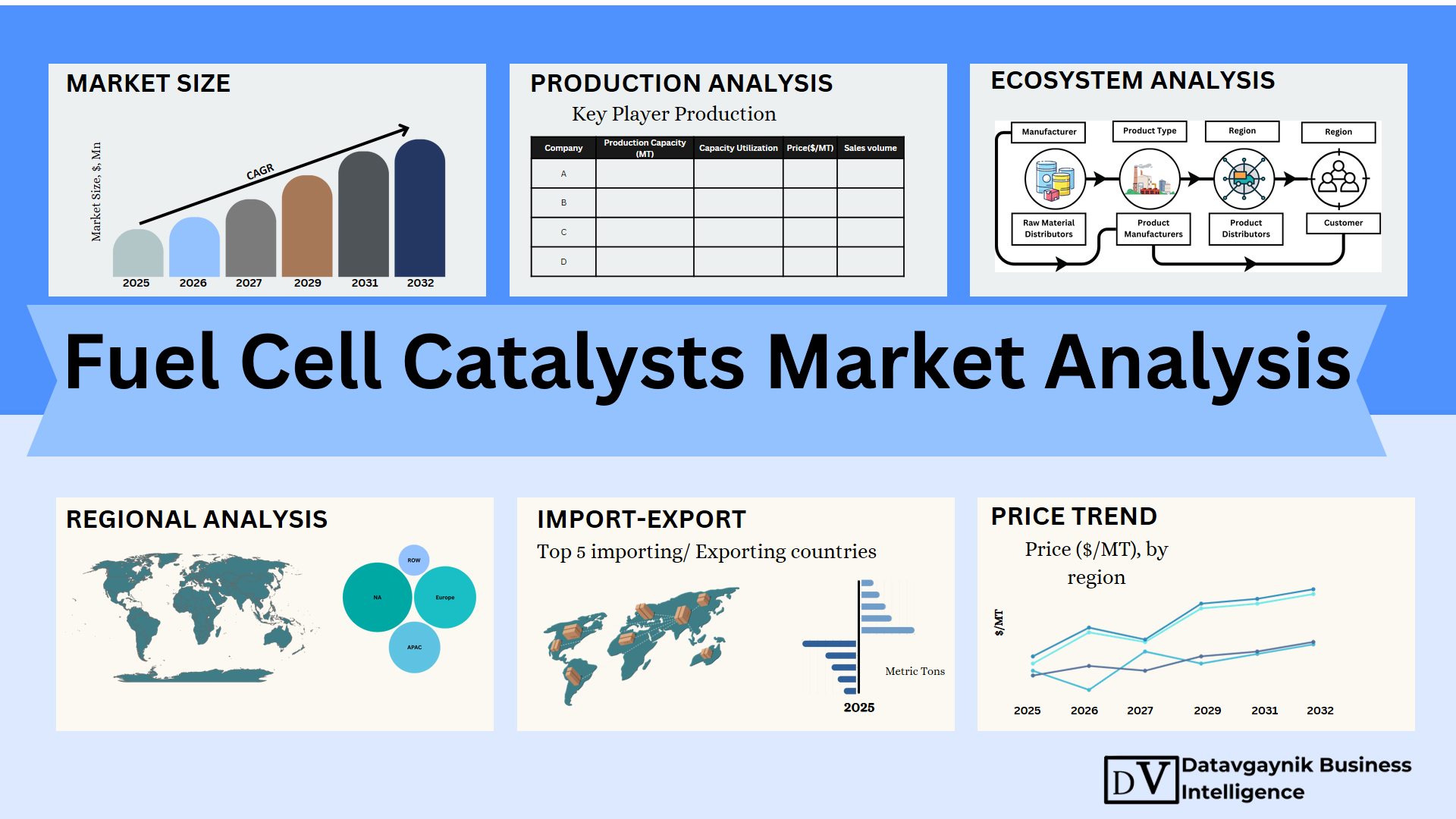
The Fuel Cell Catalystse Market is experiencing a significant transformation, propelled by the intensifying global agenda for decarbonization. Nations worldwide are implementing aggressive sustainability targets, with net-zero goals set between 2040 and 2060. For instance, heavy industries, transport networks, and power generation companies are turning to hydrogen-powered fuel cells as viable solutions to lower carbon emissions. This transition is sharply increasing the demand for efficient and cost-effective catalysts. In 2024 alone, fuel cell vehicle production rose by over 38%, driving a parallel surge in catalyst consumption. The Fuel Cell Catalystse Market Size is projected to expand considerably, backed by a 25% compound annual growth rate (CAGR) in hydrogen-powered transportation infrastructure across key markets like Asia-Pacific, Europe, and North America.
Fuel Cell Catalystse Market Growth Fueled by the Hydrogen Economy
Hydrogen is at the heart of this energy revolution. As the hydrogen economy matures, the Fuel Cell Catalystse Market benefits directly from its upward trajectory. Countries such as Germany, South Korea, and Japan have launched national hydrogen strategies, allocating billions to build production hubs, distribution networks, and fuel cell applications. For example, Japan’s roadmap includes 800,000 residential fuel cell units and 200 hydrogen refueling stations by 2030. These expansions demand high-efficiency catalysts that ensure the reliability and scalability of fuel cell systems. Moreover, green hydrogen production is expected to grow tenfold by 2030, which will further elevate the need for durable and high-performance catalyst materials, reinforcing the upward momentum of the Fuel Cell Catalystse Market.
Government Policies Catalyzing the Fuel Cell Catalystse Market
The role of regulatory support cannot be overstated in the expansion of the Fuel Cell Catalystse Market. Through aggressive funding schemes, such as the U.S. Hydrogen Energy Earthshot and the European Green Deal, governments are enabling infrastructure development, R&D, and mass deployment of fuel cells. In the U.S. alone, the Bipartisan Infrastructure Law earmarked $9.5 billion for clean hydrogen, a significant portion of which directly supports fuel cell manufacturing and associated catalyst technologies. Similarly, Germany has pledged over €9 billion to foster hydrogen innovation, including advanced catalyst development. These measures create a fertile ground for catalyst manufacturers to scale production and invest in next-generation solutions.
Technological Innovation Transforming Catalyst Efficiency
A core dynamic shaping the Fuel Cell Catalystse Market is rapid technological advancement. Traditional platinum-based catalysts, while highly efficient, present cost and supply limitations. As a result, innovation is shifting toward non-platinum group metal (non-PGM) catalysts and alloy-based alternatives. For instance, transition metal-nitrogen-doped carbon catalysts have demonstrated promising electrochemical performance in proton exchange membrane fuel cells (PEMFCs). These innovations not only lower material costs but also enhance durability and tolerance to impurities, a critical factor in real-world applications. Furthermore, nano-engineered catalysts are being deployed to increase surface area and reaction kinetics, improving fuel cell performance in both automotive and stationary applications. This wave of innovation is significantly boosting the competitiveness of the Fuel Cell Catalystse Market.
Expanding Automotive Sector Supporting Fuel Cell Catalystse Market
Transportation is a pivotal application area for fuel cells, particularly in segments where battery electrification faces limitations—such as heavy-duty trucking, buses, trains, and maritime transport. The Fuel Cell Catalystse Market is experiencing heightened demand as automakers like Toyota, Hyundai, and Daimler accelerate the commercialization of fuel cell electric vehicles (FCEVs).
For example, Hyundai has announced its target to produce 500,000 fuel cell vehicles annually by 2030, requiring vast quantities of catalysts. Likewise, the number of fuel cell-powered buses globally increased by over 50% in 2023, signaling robust catalyst demand in public transportation fleets. The long range, quick refueling, and heavy load capacity of fuel cell vehicles make them an ideal solution, driving the sustained expansion of catalyst use in the mobility sector.
Fuel Cell Catalystse Market Gaining Traction in Stationary Power
Beyond mobility, the Fuel Cell Catalystse Market is capturing attention in the stationary power segment, including backup systems, remote power generation, and distributed energy resources. Data centers, telecommunications infrastructure, and hospitals are turning to fuel cells for uninterrupted and clean power supply. For instance, the global stationary fuel cell deployment surpassed 500 MW in 2023, a 40% increase over the previous year, directly correlating to increased catalyst consumption. Countries like South Korea are leading in deploying large-scale fuel cell parks, such as the 78 MW fuel cell power plant in Hwasung. These trends are establishing a stable, high-volume demand base for catalyst materials, making stationary applications a cornerstone of the Fuel Cell Catalystse Market.
Decentralized Energy Goals Elevating Fuel Cell Catalystse Market Demand
A decentralization trend is also influencing the Fuel Cell Catalystse Market, particularly in regions where grid infrastructure is weak or intermittently available. Rural electrification programs in India, Sub-Saharan Africa, and Southeast Asia are exploring microgrid solutions powered by fuel cells. The compact, scalable nature of fuel cell systems enables them to provide resilient and clean electricity, with minimal land footprint. For instance, India’s National Hydrogen Mission includes rural deployment of hydrogen-powered mini-grids, which are expected to grow at a CAGR of 28% through 2030. These developments are unlocking new customer segments and geographic markets, creating significant demand for low-cost and high-efficiency catalysts.
Fuel Cell Catalystse Market Size Expansion Through Industrial Applications
Industrial operations such as steelmaking, cement, and ammonia production are integrating fuel cell technologies into their decarbonization pathways. The use of high-temperature solid oxide fuel cells (SOFCs), which require durable nickel-based catalysts, is expanding rapidly. As an example, Bloom Energy has deployed more than 600 MW of SOFC capacity across commercial and industrial sites. The Fuel Cell Catalystse Market Size is scaling in tandem, as industries seek clean and reliable alternatives to fossil fuel-based heat and power systems. The integration of carbon capture and fuel cell hybrid systems is also accelerating, demanding customized catalysts capable of handling complex reaction environments and extended lifespans.
Advanced Materials Development Reshaping the Fuel Cell Catalystse Market
The material science evolution within the Fuel Cell Catalystse Market is a key enabler of cost reduction and performance enhancement. Manufacturers are increasingly turning to carbon-supported nanoparticles, perovskite oxides, and nanocomposites to overcome traditional limitations of platinum-based catalysts. For example, iron-nitrogen-carbon (Fe-N-C) catalysts have shown superior oxygen reduction reaction (ORR) capabilities, especially in alkaline fuel cell environments. The transition to such alternatives is helping reduce catalyst cost by up to 60%, making fuel cell systems more viable for mass deployment. Moreover, research institutions are pioneering methods to increase catalyst utilization efficiency, further improving the value proposition for end users.
Fuel Cell Catalystse Market Expansion Supported by Supply Chain Evolution
The evolution of the catalyst supply chain is also crucial to the growth of the Fuel Cell Catalystse Market. While platinum group metals remain a critical input, geographic concentration of these resources—in countries like South Africa and Russia—poses risks. To mitigate this, catalyst producers are investing in recycling technologies and alternative material sourcing. Recycling of spent fuel cell catalysts has increased by 35% over the past two years, reducing dependency on raw material imports. Additionally, localized production hubs in the U.S., EU, and Asia are emerging to minimize supply chain disruptions and enhance responsiveness to market demand. This regional diversification of supply chains is reinforcing long-term growth prospects for the Fuel Cell Catalystse Market.
“Track Country-wise Fuel Cell Catalysts Production and Demand through our Fuel Cell Catalysts Production Database”
-
-
- Fuel Cell Catalysts production database for 32+ countries worldwide
- Fuel Cell Catalysts sales volume for 32+ countries
- Country-wise Fuel Cell Catalysts production capacity, production plant mapping, production capacity utilization for 32+ manufacturers
- Fuel Cell Catalysts production plants and production plant capacity analysis by top manufacturers
-
“Track real-time Fuel Cell Catalysts Prices, Fuel Cell Catalysts price charts for 32+ countries, Fuel Cell Catalysts weekly price tracker and Fuel Cell Catalysts monthly price tracker”
-
-
- Track real-time Fuel Cell Catalysts prices and Fuel Cell Catalysts price trend in 32+ countries though our excel-based Fuel Cell Catalysts price charts
- Real-time Fuel Cell Catalysts price tracker dashboard with 32+ countries
- Complete transparency on Fuel Cell Catalysts price trend through our Fuel Cell Catalysts monthly price tracker, Fuel Cell Catalysts weekly price tracker
-
Fuel Cell Catalystse Market in North America: Scaling with Infrastructure and Innovation
The Fuel Cell Catalystse Market in North America is witnessing rapid expansion, driven by aggressive investments in hydrogen infrastructure and a surge in clean energy adoption. In the United States, for instance, over $9 billion in federal funding has been allocated to green hydrogen initiatives, with a significant share directed toward fuel cell technology and catalyst innovation. The number of hydrogen refueling stations across the U.S. grew by 22% in 2023, while fuel cell vehicle registrations saw a 30% jump. These developments are intensifying the demand for high-efficiency catalysts, particularly in transportation and stationary power segments. Additionally, private sector leaders are scaling domestic catalyst production to reduce reliance on imported materials, further strengthening the regional value chain.
Fuel Cell Catalystse Market in Europe: Driven by Policy and Industrial Integration
In Europe, the Fuel Cell Catalystse Market is growing in lockstep with the continent’s ambitious decarbonization goals. Germany, the UK, and France are at the forefront, actively promoting hydrogen adoption through robust policy frameworks. For example, Germany’s National Hydrogen Strategy has accelerated deployment of hydrogen-powered trains, buses, and industrial facilities, pushing up the demand for advanced fuel cell catalysts.
The region is also prioritizing localized manufacturing of catalysts to support the strategic autonomy of its clean energy supply chain. Europe’s industrial base is integrating fuel cell systems into combined heat and power (CHP) plants, further increasing catalyst consumption. The Fuel Cell Catalystse Market in this region is expected to grow at a CAGR of 18% over the next five years, supported by regulatory backing and R&D incentives.
Fuel Cell Catalystse Market in Asia Pacific: Leading Global Production and Deployment
Asia Pacific remains the powerhouse of the global Fuel Cell Catalystse Market, both in terms of demand and production. Countries such as China, Japan, and South Korea dominate the fuel cell supply chain, accounting for over 60% of the world’s catalyst output. China alone produced more than 5,000 fuel cell commercial vehicles in 2023, up from just 1,500 in 2020.
This surge in adoption is fueling exponential growth in catalyst usage, particularly in public transport, logistics, and municipal applications. Japan, on the other hand, continues to lead in residential fuel cell systems, with over 400,000 Ene-Farm units installed to date. South Korea is investing heavily in gigawatt-scale fuel cell power plants, further intensifying catalyst demand. The Fuel Cell Catalystse Market in Asia Pacific is expected to maintain double-digit growth through 2030, underpinned by domestic production strength and rising application diversity.
Fuel Cell Catalystse Market in Middle East and Africa: Resource-Led Opportunity
In the Middle East and Africa, the Fuel Cell Catalystse Market is emerging, primarily driven by the region’s role as a major supplier of platinum group metals (PGMs). South Africa, which holds over 70% of global platinum reserves, is positioning itself as a strategic node in the catalyst supply chain. The country is investing in downstream processing capabilities to supply refined catalyst materials for global export.
Meanwhile, the United Arab Emirates and Saudi Arabia are piloting hydrogen megaprojects in their national energy strategies, which include utility-scale fuel cell applications. This creates a two-fold opportunity: leveraging natural resource wealth while building catalyst production capabilities. The Fuel Cell Catalystse Market in this region is projected to grow steadily as domestic demand complements export-oriented strategies.
Fuel Cell Catalystse Market in Latin America: Gaining Momentum with Green Energy Policies
Latin America is slowly integrating into the global Fuel Cell Catalystse Market, spurred by its abundant renewable energy potential and green policy shifts. Countries like Brazil and Chile are advancing national hydrogen roadmaps that promote the use of electrolyzers and fuel cells. For instance, Chile’s green hydrogen export strategy includes deploying fuel cell systems for mining and remote industrial operations, increasing catalyst requirements. Although production capabilities are currently limited, the region is exploring joint ventures with global catalyst manufacturers to develop local capacity. With wind and solar generation rapidly expanding, the Fuel Cell Catalystse Market in Latin America offers promising long-term growth driven by regional electrification and energy resilience goals.
Fuel Cell Catalystse Market Segmentation by Catalyst Type
The Fuel Cell Catalystse Market is broadly segmented by catalyst type, each category addressing unique operational and cost-performance requirements. Platinum-based catalysts remain dominant, particularly in Proton Exchange Membrane Fuel Cells (PEMFCs), due to their unmatched catalytic activity. However, cost pressures and supply constraints are accelerating the shift toward non-platinum group metal (non-PGM) catalysts. For instance, iron-nitrogen-carbon (Fe-N-C) catalysts are being adopted in low-temperature applications due to their competitive performance and affordability. Alloy catalysts, such as platinum-cobalt or platinum-nickel, are also gaining traction for their enhanced durability and reduced platinum loading. This diversification of catalyst materials is creating tailored solutions for various end-use segments, thereby driving the overall growth of the Fuel Cell Catalystse Market.
Fuel Cell Catalystse Market by Fuel Cell Type: Application-Driven Demand
Different fuel cell technologies are creating distinct avenues for catalyst demand. Proton Exchange Membrane Fuel Cells (PEMFCs) account for over 65% of the total Fuel Cell Catalystse Market share, driven by their use in vehicles and portable systems. Solid Oxide Fuel Cells (SOFCs), on the other hand, utilize nickel-based catalysts and are favored for stationary power generation and industrial heat applications. For example, SOFC installations in commercial buildings across Japan and the U.S. increased by 28% year-on-year in 2023. Molten Carbonate Fuel Cells (MCFCs) are gaining relevance in large-scale power plants, creating demand for high-temperature resistant catalyst materials. Each fuel cell type introduces specific performance and durability needs, pushing catalyst manufacturers to innovate across multiple fronts.
Fuel Cell Catalystse Market by Application: Diverse Growth Anchors
The Fuel Cell Catalystse Market spans several high-growth applications, including transportation, stationary power, and portable devices. In transportation, the surge in hydrogen-powered trucks and buses is driving significant demand for robust catalysts that support fast start-up and high durability. In stationary power, applications like backup systems, microgrids, and combined heat and power (CHP) units are gaining popularity. For instance, data centers in Europe and the U.S. are increasingly adopting fuel cells to ensure uninterrupted power, a move that is boosting catalyst use. Meanwhile, portable applications such as military-grade fuel cells and emergency power kits are creating niche demand for compact and efficient catalysts. This wide application spectrum continues to diversify growth avenues for the Fuel Cell Catalystse Market.
Fuel Cell Catalystse Price Trend: Navigating Cost Dynamics
The Fuel Cell Catalystse Price Trend is undergoing a significant evolution, influenced by both supply chain factors and technology shifts. Platinum prices, which have historically dictated catalyst costs, fluctuated by over 20% in the past 12 months due to geopolitical tensions and mining constraints. This volatility has led to increased interest in non-PGM alternatives, which can reduce catalyst prices by 40–60%.
As a result, the average Fuel Cell Catalystse Price for non-PGM options now ranges between $25–$35 per gram, compared to $60–$80 for platinum-based variants. Manufacturers are also leveraging advanced synthesis techniques to increase yield and reduce material wastage, further stabilizing prices. The Fuel Cell Catalystse Price Trend indicates a gradual decline over the next five years, driven by material substitution, scaling of production, and recycling advancements.
Regional Fuel Cell Catalystse Price Dynamics and Implications
Price trends vary significantly by region, reflecting differences in raw material availability, production scale, and policy environments. In Asia Pacific, particularly China, the Fuel Cell Catalystse Price is among the lowest globally due to localized platinum sourcing and economies of scale. In contrast, prices in Europe remain relatively higher due to import reliance and stringent environmental regulations. North America is bridging the gap through domestic catalyst production and growing adoption of cost-effective manufacturing processes. For example, U.S.-based catalyst producers have reduced platinum loading by up to 50% over the past three years, contributing to a 15% drop in Fuel Cell Catalystse Price across automotive applications. These regional price variations are influencing market competitiveness and adoption rates.
Future Outlook for Fuel Cell Catalystse Market and Price Stabilization
The medium-term outlook for the Fuel Cell Catalystse Market is robust, with projected growth driven by expanding end-use sectors and improving catalyst economics. Datavagyanik expects the global market value to more than double by 2030, supported by annual catalyst volume growth of 20% or more. Price stabilization is anticipated as non-PGM technologies gain commercial traction and material recycling becomes mainstream. Additionally, increased transparency and standardization in catalyst performance metrics will help buyers make cost-effective procurement decisions, further supporting healthy competition in the Fuel Cell Catalystse Market. This convergence of demand growth and cost optimization will be critical in scaling hydrogen adoption across industries.
“Fuel Cell Catalysts Manufacturing Database, Fuel Cell Catalysts Manufacturing Capacity”
-
-
- Fuel Cell Catalysts top manufacturers market share for 32+ manufacturers
- Top 12 manufacturers and top 19 manufacturers of Fuel Cell Catalysts in North America, Europe, Asia Pacific
- Fuel Cell Catalysts production plant capacity by manufacturers and Fuel Cell Catalysts production data for 32+ market players
- Fuel Cell Catalysts production dashboard, Fuel Cell Catalysts production data in excel format
-
“Fuel Cell Catalysts price charts, Fuel Cell Catalysts weekly price tracker and Fuel Cell Catalysts monthly price tracker”
-
-
- Factors impacting real-time Fuel Cell Catalysts prices in 32+ countries worldwide
- Fuel Cell Catalysts monthly price tracker, Fuel Cell Catalysts weekly price tracker
- Real-time Fuel Cell Catalysts price trend, Fuel Cell Catalysts price charts, news and updates
- Tracking Fuel Cell Catalysts price fluctuations
-
Leading Manufacturers Dominating the Fuel Cell Catalystse Market
The Fuel Cell Catalystse Market is highly competitive and concentrated, with a handful of global manufacturers controlling a significant share of the total production. These companies have developed strong research capabilities, expansive production infrastructure, and strategic alliances with automakers, governments, and research institutions. As the demand for fuel cell technologies scales globally, these manufacturers are strengthening their positions by investing in innovation, expanding their product portfolios, and forming global supply agreements.
Johnson Matthey: A Global Leader in Fuel Cell Catalystse Market
Johnson Matthey remains one of the most prominent players in the Fuel Cell Catalystse Market, with an estimated market share of over 25%. The company offers a wide range of platinum group metal-based catalysts, widely used in Proton Exchange Membrane Fuel Cells (PEMFCs). Product lines such as HiSPEC® are among the most recognized in the market, known for high electrochemical performance and durability. Johnson Matthey has also invested significantly in developing non-platinum group metal catalysts to support lower-cost, scalable fuel cell solutions. The company is deeply integrated into the global supply chain, supporting key automotive OEMs and energy companies deploying hydrogen-based power solutions.
Umicore: Strong Portfolio and Technological Versatility
Umicore holds a substantial market share in the Fuel Cell Catalystse Market, estimated at around 18%. With a strong focus on sustainability and closed-loop recycling, Umicore specializes in catalysts for both PEMFC and SOFC technologies. Their portfolio includes proprietary platinum-alloy catalysts that offer extended durability, particularly suited for automotive applications. The company has strategically positioned its R&D and manufacturing units in Europe and Asia to serve both developed and emerging markets. In recent years, Umicore has also formed partnerships to co-develop non-PGM catalyst technologies, reinforcing its forward-looking approach in response to Fuel Cell Catalystse Price volatility.
BASF: Diversified Offerings and Application-Specific Solutions
BASF is another major contender in the Fuel Cell Catalystse Market, with a share of approximately 12%. The company offers a wide range of fuel cell catalyst products under its Celtec® and Ketjenblack® series, designed for various temperature and application conditions. BASF’s catalysts are used in PEMFCs, SOFCs, and direct methanol fuel cells (DMFCs). The company is well-positioned in both transportation and stationary energy applications, supplying to manufacturers across Europe, North America, and Asia. BASF’s emphasis on high-temperature stability and chemical resistance has made its catalysts ideal for industrial and power generation applications.
Toyo Corporation and Tanaka Kikinzoku: High-Precision Japanese Innovators
In Japan, Tanaka Kikinzoku Kogyo and Toyo Corporation collectively command about 10% of the Fuel Cell Catalystse Market. Tanaka specializes in ultra-high-purity platinum catalysts used in PEMFCs for passenger vehicles, with its proprietary catalyst technology integrated into Toyota’s Mirai and other hydrogen vehicle platforms. Toyo Corporation collaborates closely with research institutes and OEMs to develop catalysts that deliver both performance and cost benefits. These companies have become central to Japan’s fuel cell strategy, especially as the country pushes forward with residential fuel cell rollouts and hydrogen transport expansion.
Ceres Power: Innovation-Driven Entrant in SOFC Catalyst Development
Ceres Power is an emerging force in the Fuel Cell Catalystse Market, particularly within the solid oxide fuel cell (SOFC) segment. While not as large in market share—currently estimated at around 3%—Ceres is known for its SteelCell® technology, which uses cost-effective ceramic and nickel-based catalysts. The company has entered licensing and joint development agreements with major industry players in China and Europe, giving it exposure to high-growth regional markets. Ceres Power’s ability to deliver robust and scalable SOFC solutions is expected to boost its future presence in the catalyst segment.
Advent Technologies and Plug Power: U.S.-Based Advancers in Catalyst Innovation
In North America, companies such as Advent Technologies and Plug Power are rapidly increasing their influence in the Fuel Cell Catalystse Market. Advent is focusing on high-temperature PEMFC catalysts suitable for both military and industrial applications, while Plug Power, through its vertically integrated model, has started developing its own catalyst solutions for internal use and commercialization. Together, these firms account for about 5% of the market and are expanding their roles as hydrogen adoption accelerates across U.S. transportation and logistics sectors.
Fuel Cell Catalystse Market Share Overview
The current Fuel Cell Catalystse Market share breakdown shows a high degree of consolidation, with the top five companies accounting for over 70% of global revenue. Johnson Matthey, Umicore, BASF, Tanaka, and Toyo continue to lead, while emerging players like Ceres Power and Advent Technologies are steadily carving out niche positions. As the market matures, these shares are expected to shift, particularly with the rise of non-PGM technologies and increased local production in Asia and the Americas.
Product Line Differentiation Shaping Competitive Positioning
Product differentiation plays a key role in market competitiveness. Companies like Johnson Matthey and Umicore have built extensive catalogues of catalysts tailored to specific cell technologies, fuel sources, and operating environments. For example, Johnson Matthey’s HiSPEC® 12100 series is optimized for durability in PEMFC vehicles, while Umicore’s HCT™ platform focuses on low-platinum catalyst systems for mass-market adoption. This strategic alignment of product lines with application-specific needs is helping top manufacturers sustain and grow their market share despite Fuel Cell Catalystse Price challenges.
Recent Developments and Market News in Fuel Cell Catalystse Market
April 2024: Johnson Matthey announced the opening of a new production facility in Poland aimed at manufacturing next-generation fuel cell catalysts. The facility is expected to increase European supply capacity by 30%, helping meet the region’s surging demand for transportation and stationary fuel cells.
February 2024: Umicore entered a joint development agreement with a leading Chinese fuel cell company to co-engineer non-PGM catalysts for commercial trucks. This deal is set to support Umicore’s expansion into China’s fast-growing logistics and mobility sectors.
March 2024: Ceres Power secured a $120 million investment to scale its SteelCell® technology in collaboration with a German energy utility. The company plans to expand its catalyst R&D capabilities to enhance efficiency and cut production costs.
January 2024: Plug Power announced internal development of proprietary catalyst formulations designed to reduce dependency on external suppliers. The initiative supports its goal to become fully vertically integrated by 2026, reducing exposure to Fuel Cell Catalystse Price fluctuations.
May 2024: BASF introduced an upgraded Celtec® series catalyst with enhanced conductivity and temperature tolerance, targeting new SOFC deployments in industrial CHP systems. The innovation is positioned to help BASF defend its market share amid rising competition from Asian manufacturers.
“Fuel Cell Catalysts Production Data and Fuel Cell Catalysts Production Trend, Fuel Cell Catalysts Production Database and forecast”
-
-
- Fuel Cell Catalysts production database for historical years, 12 years historical data
- Fuel Cell Catalysts production data and forecast for next 12 years
- Fuel Cell Catalysts sales volume by manufacturers
-
“Track Real-time Fuel Cell Catalysts Prices for purchase and sales contracts, Fuel Cell Catalysts price charts, Fuel Cell Catalysts weekly price tracker and Fuel Cell Catalysts monthly price tracker”
-
-
- Gain control on your purchase and sales contracts through our real-time Fuel Cell Catalysts price tracker and Fuel Cell Catalysts price trend analysis
- Fuel Cell Catalysts weekly price tracker and forecast for next four weeks
- Fuel Cell Catalysts monthly price tracker and forecast for next two months
-
Market Scenario, Demand vs Supply, Average Product Price, Import vs Export, till 2035
- Global Fuel Cell Catalysts Market revenue and demand by region
- Global Fuel Cell Catalysts Market production and sales volume
- United States Fuel Cell Catalysts Market revenue size and demand by country
- Europe Fuel Cell Catalysts Market revenue size and demand by country
- Asia Pacific Fuel Cell Catalysts Market revenue size and demand by country
- Middle East & Africa Fuel Cell Catalysts Market revenue size and demand by country
- Latin America Fuel Cell Catalysts Market revenue size and demand by
- Import-export scenario – United States, Europe, APAC, Latin America, Middle East & Africa
- Average product price – United States, Europe, APAC, Latin America, Middle East & Africa
- Market player analysis, competitive scenario, market share analysis
- Business opportunity analysis
Key questions answered in the Global Fuel Cell Catalysts Market Analysis Report:
- What is the market size for Fuel Cell Catalysts in United States, Europe, APAC, Middle East & Africa, Latin America?
- What is the yearly sales volume of Fuel Cell Catalysts and how is the demand rising?
- Who are the top market players by market share, in each product segment?
- Which is the fastest growing business/ product segment?
- What should be the business strategies and Go to Market strategies?
The report covers Fuel Cell Catalysts Market revenue, Production, Sales volume, by regions, (further split into countries):
- Asia Pacific (China, Japan, South Korea, India, Indonesia, Vietnam, Rest of APAC)
- Europe (UK, Germany, France, Italy, Spain, Benelux, Poland, Rest of Europe)
- North America (United States, Canada, Mexico)
- Latin America (Brazil, Argentina, Rest of Latin America)
- Middle East & Africa
Table of Contents:
- Product Overview and Scope of Fuel Cell Catalysts
- Fuel Cell Catalysts Segment Analysis by Product Category
- Global Fuel Cell Catalysts Revenue Estimates and Forecasts (2019-2035)
- United States market size, production, sales, average price, import vs exports
- Europe market size, production, sales, average price, import vs exports
- Asia Pacific market size, production, sales, average price, import vs exports
- Latin America market size, production, sales, average price, import vs exports
- Middle East & Africa market size, production, sales, average price, import vs exports
- Fuel Cell Catalysts Production Estimates and Forecasts (2019-2035)
- Market Competition by Manufacturers
- Global Fuel Cell Catalysts Production by Manufacturers
- Global Fuel Cell Catalysts Revenue Market Share by Manufacturers (2019-2025)
- Production Analysis
- Fuel Cell Catalysts Production, Revenue, Price and Gross Margin (2019-2025)
- Fuel Cell Catalysts Production VS Export
- Fuel Cell Catalysts Consumption VS Import
- Consumption Analysis
- Fuel Cell Catalysts Consumption by Region
- Fuel Cell Catalysts Consumption by Product
- Fuel Cell Catalysts Consumption Market Share by Product
- Global Production of Fuel Cell Catalysts by Product (2019-2035)
- Revenue Market Share by Product (2019-2035)
- Production, Revenue, Price and Gross Margin (2019-2035)
- Fuel Cell Catalysts Manufacturing Cost Analysis
- Fuel Cell Catalysts Key Raw Materials Analysis
- Key Raw Materials
- Key Suppliers of Raw Materials
- Proportion of Manufacturing Cost Structure
- Fuel Cell Catalysts Industrial Chain Analysis
- Marketing Channel, Distributors and Customers
- Fuel Cell Catalysts Distributors List
- Fuel Cell Catalysts Sales Partners
- Fuel Cell Catalysts Customers List
- Production and Supply Forecast
Other recently published reports:

