

Market Summary and Growth Forecast
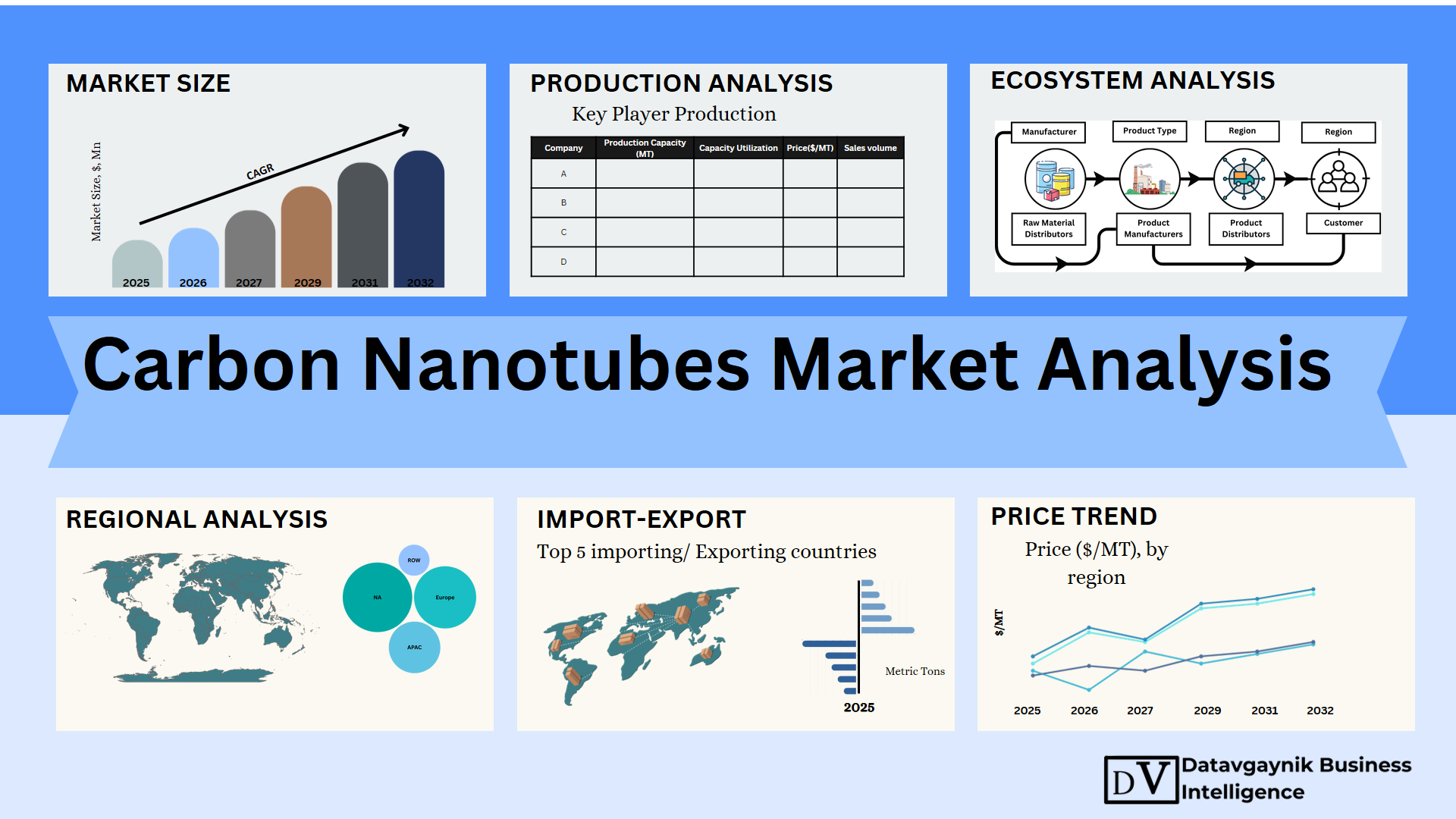
The global Carbon Nanotubes Market is valued at $2,180 million in 2026 and is expected to appreciate to $7,640 million by 2035, at a CAGR of 14.95%.
Carbon nanotubes, or CNTs, are cylindrical nanostructures made from rolled graphene layers. Their commercial value comes from an unusual combination of electrical conductivity, thermal transfer, mechanical strength, chemical stability, and low material weight. Manufacturers can introduce these properties into batteries, plastics, coatings, elastomers, composites, and electronic components using relatively small CNT concentrations.
Datavagyanik also covers related markets such as the Carbon Nanotubes (CNTs) Market, the Single-walled Carbon Nanotubes Market, and the Multi-walled carbon nanotubes (MWCNTs) Market. These markets often align in advanced imaging systems and aerospace-grade components where precision engineering and material integrity are crucial.
The Carbon Nanotubes Market covers single-walled, double-walled, few-walled, and multi-walled nanotubes sold as powders, dispersions, slurries, concentrates, masterbatches, films, fibers, and other intermediate material systems. The estimate includes revenue generated at the first commercial sale of the CNT material or formulated CNT additive. It excludes the downstream value of finished batteries, vehicles, electronic devices, and composite components.
Global Market Forecast
| Market Indicator | 2026 | 2035 |
| Global market revenue | $2,180 million | $7,640 million |
| Dry CNT-equivalent demand | 31,500 tonnes | 91,000 tonnes |
| Blended revenue per dry CNT-equivalent kilogram | $69.2 | $84.0 |
| Revenue CAGR | — | 14.95% |
| Volume CAGR | — | 12.51% |
The figures represent an analyst-modelled estimate. They combine disclosed production capacities, estimated utilization, commercial product forms, downstream qualification rates, and differences between bulk MWCNT and premium SWCNT pricing.
For the Carbon Nanotubes Market, the central business shift is straightforward. CNTs are moving out of laboratory-led specialty applications and entering repeatable industrial procurement programs. Battery producers now require conductive additives in thousands of tonnes rather than research quantities. Polymer compounders are also using CNT masterbatches to provide electrostatic discharge protection without loading plastics with large amounts of carbon black or metallic fillers.
Battery Manufacturing Becomes the Main Commercial Engine
Lithium-ion batteries are creating the strongest incremental demand. CNTs form conductive networks between active-material particles. This allows electrode designers to reduce conventional conductive additives, manage thicker electrodes, improve power delivery, and support higher-capacity materials.
Single-walled nanotubes are especially strategic for silicon-rich anodes. Silicon can store more lithium than graphite but expands sharply during charging. Long and flexible nanotube networks help maintain electrical contact when silicon particles expand, crack, and contract. Multi-walled CNTs remain more widely used in cathode formulations because they are available at larger scale and lower cost.
The production build-out supports this transition. LG Chem disclosed plans to increase annual CNT capacity from 2,900 tonnes to 6,100 tonnes through its fourth Korean plant. OCSiAl opened a European facility with 60 tonnes of annual single-wall nanotube synthesis capacity and stated that its associated dispersion system could support up to 65 GWh of lithium-ion battery production.
Manufacturing Scale and Product Consistency
Chemical vapor deposition remains the main industrial production route. The process uses a carbon-containing gas, a catalyst, and controlled reactor conditions to grow nanotubes. The competitive issue is no longer simply whether a company can produce CNTs. Buyers now evaluate:
- Tube diameter and length consistency
- Metallic impurity levels
- Catalyst residue
- Surface area
- Dispersibility
- Batch-to-batch electrical performance
- Dust control and occupational safety
- Compatibility with the customer’s solvent, resin, or electrode chemistry
Reactor automation, catalyst recovery, continuous processing, and inline quality control are reducing production variability. LG Chem, for example, reported that improvements in reactor stability and manufacturing automation increased productivity per employee by approximately 20%.
Regulation Will Shape Supplier Qualification
CNTs are regulated as engineered nanoscale substances in major markets. In the United States, the Environmental Protection Agency requires reporting of relevant nanoscale chemical substances, including information on production, processing, exposure, releases, and available safety data. In Europe, REACH introduces nanoform-specific information requirements within chemical registrations.
Occupational exposure management is equally important. The U.S. National Institute for Occupational Safety and Health recommends an exposure limit of 1 microgram per cubic metre of respirable elemental carbon as an eight-hour time-weighted average for CNTs and carbon nanofibers. This encourages enclosed handling, local exhaust ventilation, wet dispersions, dust-free concentrates, and routine workplace monitoring.
This may favor larger producers. Battery and automotive customers increasingly require traceable material specifications, toxicology documentation, regional regulatory registrations, and secure multi-year supply. Smaller suppliers can still compete in high-purity and customized grades, but qualifying with a large battery or automotive program can take several years.
Key Consumers and Clients
The main commercial consumers include:
- Lithium-ion battery cell manufacturers
- Cathode and anode material producers
- Battery conductive-slurry formulators
- Engineering-plastic compounders
- Automotive component manufacturers
- Semiconductor and electronics companies
- Paint, coating, and adhesive producers
- Aerospace and defence composite suppliers
- Tire, rubber, and industrial elastomer manufacturers
- Research laboratories and specialty-device developers
Large prospective client groups include companies producing EV batteries, silicon-anode materials, high-nickel cathodes, conductive plastics, electrostatic-safe packaging, electromagnetic-interference shielding, lightweight structural components, flexible sensors, and thermal-management systems. PowerCo provides a visible example: in June 2026, OCSiAl announced an agreement to supply single-wall nanotubes to PowerCo’s Salzgitter battery-cell facility.
Expert view: Battery demand will provide scale, but formulation knowledge will determine margins. The strongest suppliers will sell a verified conductive solution rather than an undifferentiated black powder.
Market Segmentation and Forecast Scope
The Carbon Nanotubes Market is best segmented across nanotube architecture, commercial form, application, end-user industry, and geography. These dimensions measure different parts of the value chain and should not be combined as if they were interchangeable.
By Product Type
Multi-Walled Carbon Nanotubes
Multi-walled carbon nanotubes contain several concentric graphene cylinders. They represent an estimated 78% of global revenue in 2026. Their share of physical volume is even higher because their selling price is lower than that of single-walled products.
MWCNTs are widely used in battery cathodes, conductive plastics, industrial coatings, rubber components, composites, and electrostatic-discharge applications. Existing production infrastructure and broad processor familiarity make this the largest commercial category.
Growth will remain strong, but the segment will become more price competitive. Producers will increasingly differentiate through purity, aspect ratio, dispersibility, and ready-to-use slurry formulations rather than basic nanotube availability.
Single-Walled Carbon Nanotubes
Single-walled carbon nanotubes consist of one graphene cylinder. They provide high conductivity and mechanical performance at exceptionally low loading levels.
This is the fastest-growing product category. Demand is rising in silicon-anode batteries, premium cathode systems, transparent conductive materials, specialty elastomers, high-performance coatings, sensors, and lightweight electromagnetic shielding.
SWCNT suppliers operate with higher selling prices and lower volumes. So, revenue growth can outpace tonnage growth. The main barriers remain production yield, nanotube separation, purity control, safe handling, and consistent integration into customer formulations.
Double-Walled and Few-Walled Carbon Nanotubes
These materials occupy the performance space between single-walled and conventional multi-walled products. They can provide improved conductivity and mechanical properties without reaching the full cost of premium SWCNT grades.
Commercial demand remains relatively small. That said, the category has potential in energy storage, conductive films, sensors, structural composites, and specialized electronics.
By Commercial Form
Powders
Powder CNTs remain important for large compounders and formulators that have their own dispersion systems. They offer shipping efficiency and formulation flexibility.
However, powders create handling and dispersion challenges. Poor dispersion can leave agglomerates in the final material and prevent the nanotubes from forming a uniform conductive network.
Dispersions and Slurries
Water-based, solvent-based, N-methyl-2-pyrrolidone-based, and other customized dispersions are becoming the strategic form for battery applications. They reduce dust exposure and allow more consistent dosing into electrode formulations.
This is expected to be the fastest-growing commercial form. Battery customers generally prefer a qualified dispersion with controlled viscosity, solids content, particle distribution, and electrochemical performance.
Masterbatches and Concentrates
Masterbatches incorporate CNTs into a polymer, resin, rubber, plasticizer, or liquid carrier. They allow processors to add nanotubes through conventional compounding equipment.
Demand is expanding in conductive engineering plastics, fuel-system components, industrial hoses, electronics packaging, automotive exterior parts, and electrostatic-safe components. Arkema markets CNT systems for thermoplastics, thermosets, elastomers, metals, and ceramics, while highlighting conductivity and mechanical reinforcement at low loading levels.
Films, Fibers, Yarns, and CNT Forests
These are emerging higher-value forms. Applications include structural conductors, flexible electronics, thermal interfaces, aerospace materials, sensors, and highly absorptive optical coatings.
The category is strategically important but is not yet a mass-volume market. Manufacturing speed, alignment, joining, defect control, and cost remain constraints.
By Application
Battery Conductive Additives
Battery additives will generate the largest incremental revenue through 2035. CNTs are used in cathodes, anodes, conductive primers, current-collector coatings, lead-acid batteries, supercapacitors, and emerging solid-state designs.
The highest commercial potential lies in high-nickel cathodes, lithium iron phosphate cathodes, silicon-rich anodes, fast-charging cells, and thick-electrode formats. Arkema identifies carbon nanotubes as a cathode conductivity enhancer that can support faster energy flow within the battery system.
Conductive Polymers and Electrostatic-Discharge Protection
CNTs provide permanent electrical conductivity to plastics used in electronics trays, semiconductor handling, fuel systems, industrial equipment, and hazardous-area components.
Unlike surface-applied antistatic agents, CNT networks can maintain conductivity throughout the polymer component. The challenge is preserving colour, surface finish, mechanical strength, and processability.
Structural Composites
CNTs are introduced into thermoset resins, thermoplastics, carbon-fibre composites, ceramics, and metals to improve crack resistance, interlaminar strength, fatigue behaviour, conductivity, or thermal transfer.
Aerospace adoption will remain selective because manufacturers need repeatable performance and extensive qualification. Automotive applications should scale faster where conductivity, electrostatic painting, lightweighting, or localized reinforcement creates measurable production savings.
Coatings, Adhesives, and EMI Shielding
CNT-enabled coatings are used for electrostatic discharge, electromagnetic shielding, corrosion monitoring, conductive primers, heating surfaces, and highly absorptive optical finishes.
Low nanotube concentration is useful in transparent or coloured formulations. Yet the dispersion process must avoid agglomeration, viscosity instability, and uneven electrical performance.
Electronics, Sensors, and Semiconductor Devices
Applications include field-effect transistors, chemical sensors, biosensors, flexible circuits, interconnects, conductive films, memory devices, and thermal-management layers.
This remains a high-value but qualification-heavy segment. Commercial development depends on nanotube placement, chirality control, purity, contact resistance, wafer-level integration, and manufacturing yield.
By End User
The end-user structure consists of:
- Automotive and Battery Manufacturers
- Electrical and Electronics Companies
- Chemical and Polymer Processors
- Aerospace and Defence Manufacturers
- Energy and Industrial Equipment Companies
- Healthcare and Diagnostic Developers
- Universities and Research Institutions
Automotive and battery users will show the strongest commercial expansion. Electronics companies will continue to support higher-value CNT grades, while polymer processors will provide steady industrial demand through conductive compounds and masterbatches.
By Region
Asia Pacific
Asia Pacific accounts for an estimated 58% of global revenue in 2026. China, South Korea, and Japan contain a dense network of CNT producers, battery-material suppliers, cell manufacturers, electronics companies, and polymer processors.
The region will remain both the largest and fastest-expanding market. Battery supply-chain localization, domestic EV production, and large-scale conductive-slurry manufacturing provide a direct route from CNT production to commercial consumption.
North America
North America is stronger in high-value R&D, aerospace composites, advanced batteries, semiconductors, sensors, and specialty formulations. The United States also has established occupational and environmental reporting requirements for engineered nanomaterials.
Regional growth will depend on local battery-cell investment, advanced anode commercialization, defence applications, and the rebuilding of domestic material supply chains.
Europe
Europe combines advanced automotive engineering, specialty chemicals, aerospace composites, battery investments, and strict chemical compliance.
The region is strategically important for qualified, traceable, and lower-dust CNT formulations. OCSiAl’s European investments and Birla Carbon’s ownership of Belgian CNT producer Nanocyl indicate rising interest in localized supply.
Latin America, Middle East, and Africa
LAMEA demand is currently concentrated in imported conductive compounds, coatings, oil and gas applications, industrial plastics, research, and selected automotive components.
Local CNT production remains limited. Growth will come mainly through downstream formulation and imported masterbatches rather than large-scale nanotube synthesis during the early forecast period.
Expert view: Product architecture matters, but commercial form matters just as much. A well-dispersed MWCNT slurry can create more customer value than a technically superior nanotube that cannot be processed consistently.
Market Trends and Business Innovations
Innovation in the Carbon Nanotubes Market is shifting from record-setting laboratory properties toward manufacturing repeatability. Buyers are asking a more practical question: can the material improve performance on an existing production line without increasing rejects, processing time, safety risk, or total cost?
Battery-Grade Conductive Networks
Battery developers are moving away from treating CNTs as a direct replacement for carbon black on a kilogram-for-kilogram basis. The more valuable approach is to use nanotubes as a network-forming additive.
Because CNTs have high aspect ratios, they can connect active-material particles across longer distances. This can reduce the total quantity of inactive conductive material required in an electrode. It may also allow thicker electrodes or higher active-material loading.
The next stage is application-specific formulation. Suppliers are developing separate CNT grades for:
- Lithium iron phosphate cathodes
- High-nickel cathodes
- Silicon-rich anodes
- Dry-electrode processing
- Water-based electrode systems
- Fast-charging cells
- High-power cells
- Conductive current-collector coatings
SWCNTs are especially important for silicon anodes because their long conductive structure can maintain electrical pathways during repeated particle expansion. MWCNTs remain economically attractive for cathode formulations and mass-market battery chemistries.
Expert view: The winning battery product will not necessarily have the highest theoretical conductivity. It will provide the most stable conductivity after mixing, coating, calendaring, cycling, and long-term storage.
Industrial Production Is Becoming More Automated
Production technology is moving toward larger continuous reactors, improved catalyst utilization, closed material handling, automated purification, and inline quality measurement.
A major target is reducing variation between batches. Even small changes in tube length, diameter, defects, residual metals, or agglomeration can alter electrical performance inside a battery slurry or polymer compound.
LG Chem’s planned capacity expansion to 6,100 tonnes per year illustrates the move toward industrial-scale MWCNT production. OCSiAl’s existing, under-construction, and designed single-wall nanotube facilities were described by the company as representing more than 1,000 tonnes per year of combined potential capacity as of 2025.
Larger production runs should reduce unit costs. Still, price erosion will not be uniform. Standard industrial MWCNT grades will face stronger competition, while high-purity SWCNTs, customized dispersions, functionalized materials, and semiconductor-grade products should retain premium pricing.
Dispersion Chemistry Becomes a Core Intellectual Asset
CNTs naturally attract one another and form bundles. This makes dispersion one of the most difficult parts of commercial application development.
Mechanical mixing alone may shorten or damage the tubes. Excessive surfactant can reduce conductivity or contaminate the final material. Strong chemical treatment may improve compatibility but alter the nanotube surface.
Suppliers are therefore investing in:
- Polymer-specific masterbatch carriers
- Battery-compatible dispersants
- Controlled surface functionalization
- Low-foam water-based systems
- High-solids conductive pastes
- Solvent reduction
- Dust-free pellet and concentrate formats
- Application-specific rheology control
In many projects, the dispersion formula becomes more valuable than the nanotube synthesis process itself. It determines whether the customer can introduce the material without replacing existing mixers, coating systems, extruders, or quality-control procedures.
Hybrid Carbon Systems
CNTs are increasingly being combined with carbon black, graphite, graphene, carbon fibres, and porous carbon materials. These hybrid systems balance cost, conductivity, mechanical strength, surface area, and processability.
A hybrid battery additive may use carbon black for short-range particle contact and CNTs for longer conductive bridges. A composite may combine carbon fibre for primary reinforcement with CNTs for crack control, conductivity, or interlaminar performance.
In April 2023, Birla Carbon and CHASM Advanced Materials entered a joint development agreement for nanotube-enhanced carbon products. The companies intended to combine CNT-based technology with established carbon-material manufacturing and commercialization capabilities.
Digital Modelling and AI-Assisted Formulation
AI is not yet a separate commercial segment. Its practical role is in product development and process control.
Machine-learning tools can compare catalyst composition, reactor temperature, gas flow, tube dimensions, impurity content, and electrical performance. Formulation teams can also use experimental data to predict which CNT concentration, dispersant, mixing energy, and polymer or electrode chemistry will produce the required conductivity.
The commercial benefit is faster qualification. A battery or polymer development program can involve hundreds of formulations. Data-driven screening reduces the number of physical trials, but the final product still requires laboratory, pilot-line, and customer-line validation.
Strategic Investments, Acquisitions, and Partnerships
| Date | Company Activity | Business Significance |
| October 2023 | Birla Carbon completed the acquisition of Nanocyl | Combined an established carbon-material supplier with a commercial MWCNT platform focused on batteries, plastics, and conductive applications. |
| October 2024 | OCSiAl opened its first European graphene-nanotube production facility in Serbia | Added regional SWCNT synthesis, dispersion, research, and quality-control capability close to European battery and industrial customers. |
| 2025 | LG Chem scheduled its fourth CNT plant to begin operation | Designed to raise the company’s annual capacity to 6,100 tonnes and strengthen its position in battery conductive additives. |
| November 2025 | OCSiAl announced a $300 million manufacturing hub in Luxembourg | Signals preparation for larger European demand and greater localization of advanced battery materials. |
| June 2026 | OCSiAl announced a supply arrangement with PowerCo | Connects SWCNT production directly with a large European battery-cell manufacturing program. |
The acquisition of Nanocyl gave Birla Carbon an immediate position in MWCNT technology rather than requiring it to build the capability organically. The deal also links nanotubes with Birla Carbon’s wider conductive-carbon portfolio.
Meanwhile, OCSiAl’s $300 million Luxembourg project is intended to create a scalable European manufacturing centre. Its subsequent PowerCo agreement provides an important demand-side signal because it connects announced production investment with a named battery-cell customer.
Future Business Impact
Three changes are likely through 2035.
First, CNT suppliers will become more closely integrated with battery-material and chemical companies. Acquisitions, joint ventures, and long-term supply agreements will reduce qualification risk.
Second, revenue will shift from generic powders toward application-ready dispersions and concentrates. Customers will pay for repeatability, compliance, and processing support.
Third, premium CNT grades will move into fewer but higher-value applications. Semiconductor devices, aligned fibers, structural conductors, medical sensors, and transparent films will develop more slowly than batteries but can generate attractive margins.
Expert view: The Carbon Nanotubes Market will not be won through capacity alone. Durable advantage will come from application patents, dispersion chemistry, regulatory documentation, regional customer support, and the ability to reproduce identical material performance across multiple plants.
Competitive Intelligence and Benchmarking
Competition in the Carbon Nanotubes Market is no longer based only on the ability to manufacture nanotubes. Commercial buyers now compare production scale, nanotube consistency, dispersion quality, application support, regulatory documentation, and the ability to supply identical material from one batch to another.
The market can be divided into three competitive groups:
- Large-scale battery-material suppliers producing CNTs in industrial volumes
- Specialist nanotube companies with proprietary SWCNT or MWCNT technology
- Diversified chemical companies offering CNTs as part of a broader conductive-material portfolio
Competitive Benchmarking
| Company | Core CNT Position | Primary Commercial Focus | Relative Strength | Key Watchpoint |
| OCSiAl | Industrial-scale SWCNT specialist | Batteries, elastomers, coatings, plastics and composites | Technology differentiation and low-loading performance | High product cost and dependence on premium applications |
| LG Chem | Large-scale MWCNT producer | Lithium-ion battery conductive additives | Manufacturing scale and battery supply-chain access | Exposure to battery-sector pricing and qualification cycles |
| Jiangsu Cnano Technology | Integrated CNT powder and conductive-paste supplier | Battery electrodes and conductive compounds | Strong position in China’s battery ecosystem | High regional concentration and growing domestic competition |
| Birla Carbon–Nanocyl | MWCNT and formulated conductive-material supplier | Plastics, batteries, transport, electronics and rubber | Global customer reach and carbon-material integration | Integration of specialized CNT operations into a larger portfolio |
| Arkema | Diversified specialty-material and MWCNT supplier | Batteries, polymers, elastomers and structural composites | Formulation expertise and polymer compatibility | CNT remains one element within a much wider materials business |
| Zeon Corporation | High-purity SWCNT producer | Next-generation batteries and specialty electronics | Japanese quality control and advanced SWCNT technology | Current production scale remains below major MWCNT suppliers |
The positioning above is an analyst assessment based on product breadth, announced capacity, application coverage, regional reach, and customer qualification activity.
OCSiAl
OCSiAl holds the clearest specialist position in industrial single-walled carbon nanotubes. Its commercial portfolio covers dry nanotube material, battery dispersions, polymer concentrates, elastomer additives, and liquid formulations for coatings and composites.
The company’s main advantage is that SWCNTs can create conductive or reinforcing networks at very low loading levels. This supports premium applications where customers need conductivity without adding large quantities of conventional filler.
Its Serbian facility initially provides approximately 60 tonnes of annual SWCNT synthesis capacity. The company has also announced a $300 million manufacturing centre in Luxembourg and a supply relationship with Volkswagen-owned battery manufacturer PowerCo. These investments position OCSiAl as a major supplier to European battery programs rather than only a specialty nanomaterial developer.
The commercial risk is price. SWCNTs cost considerably more than conventional conductive carbon and mass-market MWCNTs. OCSiAl must therefore demonstrate that reduced dosage, higher energy density, improved cycle life, or better mechanical performance offsets the higher material price.
LG Chem
LG Chem is one of the strongest scale-oriented competitors. Its portfolio is focused mainly on multi-walled nanotubes for lithium-ion battery cathodes and other conductive-material applications.
The company has developed proprietary catalyst and reactor technology and has progressively expanded its Korean manufacturing infrastructure. Its fourth plant was designed to add 3,200 tonnes of annual capacity and raise total capacity to 6,100 tonnes. LG Chem reported that reactor stabilization and manufacturing automation also improved employee productivity by approximately 20%.
LG Chem benefits from proximity to South Korean battery producers, cathode-material manufacturers, and automotive supply chains. It can also integrate CNT development with its wider battery-material activities.
Its market position is strongest where customers require large quantities of consistent battery-grade MWCNTs. The main challenge will be maintaining margins as Asian production capacity rises and standard conductive grades become more price competitive.
Jiangsu Cnano Technology
Jiangsu Cnano Technology has developed a vertically integrated position across CNT powders, conductive pastes, graphene-CNT formulations, and polymer masterbatches.
Its commercial focus is closely linked with China’s lithium-ion battery industry. The company also supplies materials for antistatic coatings, conductive polymer composites, and reinforced rubber products. This broader product structure allows it to sell both the nanotube and the ready-to-process formulation.
Cnano’s main competitive advantage is location. China has the world’s largest battery-cell and electric-vehicle manufacturing base. Local supply reduces shipping costs, shortens technical-support cycles, and allows formulations to be adapted rapidly to customer electrode processes.
The company is likely to remain one of the volume leaders. That said, it faces increasing pressure from other Chinese conductive-additive producers and from battery companies seeking lower prices under long-term supply contracts.
Birla Carbon–Nanocyl
Birla Carbon entered the CNT sector through its acquisition of Belgian manufacturer Nanocyl. Nanocyl provides industrial MWCNTs, polymer masterbatches, solvent-based dispersions, and elastomer formulations for electrical conductivity, electrostatic-discharge control, thermal performance, and mechanical reinforcement.
The acquisition combines Nanocyl’s specialized nanotube capability with Birla Carbon’s global conductive-carbon customer network. This creates cross-selling opportunities in batteries, polymers, transport components, electronics, and rubber.
The combined company is well placed to develop hybrid systems containing CNTs and conductive carbon black. Such formulations can reduce cost while maintaining electrical pathways across a battery electrode or plastic component.
Its strategic task is integration. Birla Carbon must retain Nanocyl’s application expertise while using its wider production, sales, and technical-service infrastructure to scale the business.
Arkema
Arkema supplies multi-walled nanotubes for lithium-ion batteries, thermoplastics, thermoset resins, elastomers, composites, and other conductive-material applications.
The company’s strength is not based solely on CNT production. It can combine nanotubes with polymer chemistry, binders, adhesives, coatings, and battery materials. This helps Arkema develop formulations that work within a customer’s complete material system rather than selling CNT powder as an isolated additive.
Arkema is strategically positioned in applications where material compatibility and dispersion quality matter more than the lowest price. Examples include high-performance battery electrodes, structural composites, and conductive engineering plastics.
Its limitation is portfolio priority. CNTs compete internally with many other specialty-material businesses for investment and commercial attention.
Zeon Corporation
Zeon Corporation occupies a premium position in high-purity single-walled nanotubes. Its materials target lithium-ion battery conductive networks, advanced composites, electronics, sensors, and other applications requiring high aspect ratios and low loading.
Zeon has also partnered with Taiwan-based Sino Applied Technology to expand SWCNT conductive-paste capacity for next-generation batteries. In June 2026, the company announced another Japanese SWCNT production line, with full-scale operation scheduled for 2028. The project received certification from Japan’s Ministry of Economy, Trade and Industry under a storage-battery supply program.
Zeon’s advantage is product quality and access to Japanese battery-development programs. Its challenge is scale. It must increase output without losing the purity and consistency that support premium pricing.
Competitive Outlook
The competitive structure will become more concentrated through 2035. Battery manufacturers prefer suppliers that can provide several years of production history, plant audits, safety documentation, technical support, and secure regional supply.
Three capabilities will separate leading companies:
- Consistent industrial production
- Application-ready dispersion systems
- Long-term qualification with battery, automotive, and electronics customers
Expert view: Capacity creates entry into the battery business, but formulation and qualification create customer retention. Suppliers selling only undifferentiated powder will face the greatest price pressure.
Regional Landscape and Adoption Outlook
Regional demand is shaped by battery manufacturing, automotive production, electronics infrastructure, specialty-chemical capacity, and nanomaterial regulation. Asia remains the centre of physical CNT consumption. Europe and the United States generate a larger share of premium research, aerospace, electronics, and specialized composite demand.
Regional Revenue and Growth Outlook
| Market | Estimated 2026 Revenue | Estimated 2026 Global Share | 2026–2035 CAGR | Adoption Position |
| United States | $392 million | 18.0% | 13.6% | Advanced specialty applications |
| Europe | $392 million | 18.0% | 14.3% | Regulated, innovation-led market |
| China | $676 million | 31.0% | 16.7% | Largest manufacturing and consumption base |
| India | $55 million | 2.5% | 18.2% | Small but rapidly developing |
| Japan | $174 million | 8.0% | 11.8% | High-purity and R&D-led market |
| South Korea | $283 million | 13.0% | 15.8% | Battery-integrated production hub |
| Middle East | $15 million | 0.7% | 12.8% | Early-stage specialty demand |
| Other Countries | $193 million | 8.8% | Approximately 12% | Mixed industrial adoption |
Regional revenue and growth figures are analyst estimates reconciled with the global 2026 market value of $2,180 million.
United States
The United States is a high-value rather than high-volume market. Demand comes from advanced batteries, aerospace structures, defence systems, conductive films, semiconductor research, sensors, and specialty polymers.
Domestic CNT production is fragmented. Many users depend on imported nanotubes or on local companies that formulate foreign-produced material into composites, coatings, and electronic systems.
Battery-sector funding is improving the commercial outlook. The U.S. Department of Energy selected more than $3 billion of battery and battery-material manufacturing projects across 14 states. In March 2026, it also announced a funding opportunity of up to $500 million for critical-material processing and derivative battery manufacturing. These programs do not fund CNTs exclusively, but they expand the downstream factories that could consume conductive additives.
Occupational safety requirements raise operating costs but also support demand for enclosed processing and liquid dispersions. NIOSH recommends limiting respirable CNT and carbon-nanofibre exposure to 1 microgram per cubic metre as an eight-hour time-weighted average.
The strongest U.S. growth will come from silicon-anode batteries, defence electronics, thermal-management materials, and lightweight conductive composites.
Europe
Europe has an established CNT supply base in Belgium and France, while Luxembourg and Serbia are emerging as important SWCNT investment locations. Germany is the largest potential customer because of its automotive, chemical, engineering, and battery industries.
European demand places greater emphasis on traceability, lifecycle assessment, worker protection, and chemical registration. Under REACH, manufacturers and importers must address the specific nanoforms placed on the market and demonstrate safe use.
Funding is also becoming more targeted. The European Commission’s 2024 Innovation Fund calls provided a combined budget of €3.4 billion, including a dedicated €1 billion call for innovative electric-vehicle battery-cell manufacturing. The battery call attracted 14 proposals requesting approximately €1.6 billion.
Europe therefore offers a strong opportunity for CNT suppliers with local manufacturing, complete regulatory files, and battery-grade dispersions. However, project delays and financial pressure within the European battery sector may slow near-term material procurement.
China
China is the largest national market for carbon nanotubes. It combines CNT manufacturing, conductive-paste production, cathode and anode processing, battery-cell manufacturing, and electric-vehicle assembly within one supply chain.
The country recorded more than 16 million new-energy vehicle units in both production and sales during 2025, with NEVs accounting for more than half of domestic vehicle sales. This scale creates substantial demand for MWCNT conductive pastes used in lithium iron phosphate and other battery cathodes.
China also had 36.89 million NEVs on the road by the end of June 2025. Battery-electric vehicles represented approximately 69.23% of that fleet.
Domestic suppliers have advantages in cost, access to customers, and rapid formulation testing. China is expected to retain the highest physical CNT consumption through 2035.
The main commercial pressure will be oversupply. As more conductive-additive producers enter the market, basic MWCNT prices may decline. Suppliers will need to differentiate through SWCNTs, water-based pastes, silicon-anode formulations, and higher-purity products.
India
India remains a small commercial market but offers the highest modelled growth rate among the countries assessed.
Near-term demand comes from research institutions, engineering plastics, automotive components, coatings, electronics, defence laboratories, and imported battery materials. Large-volume CNT consumption will depend on the commissioning of domestic battery-cell and electrode-material plants.
India’s Advanced Chemistry Cell production-linked incentive scheme has an outlay of ₹18,100 crore and targets 50 GWh of domestic battery-manufacturing capacity. As of December 31, 2025, 40 GWh had been awarded to four beneficiaries, which had reported combined investment of ₹3,237 crore.
India also has an established academic nanotechnology base supported by the Department of Science and Technology’s Nano Mission. The gap is commercialization. Most domestic projects remain at laboratory, pilot, or small-batch level.
This creates an opportunity for joint ventures covering CNT dispersion, masterbatch manufacturing, and battery conductive pastes. Local formulation is likely to develop before large-scale domestic nanotube synthesis.
Japan
Japan remains an important technology and qualification centre for high-purity CNTs. Its strengths include catalyst science, precision manufacturing, battery materials, electronics, and advanced polymer processing.
The government is working toward domestic storage-battery manufacturing capacity of 150 GWh per year by 2030. This target supports upstream investment in anode materials, cathode materials, separators, binders, and conductive additives.
Zeon is the most visible domestic SWCNT producer. Its planned new line, scheduled for full operation in 2028, has been certified by METI as part of Japan’s battery-supply security framework.
Japanese adoption will remain focused on high-value products rather than basic CNT volume. Batteries, semiconductor devices, sensors, thermal materials, and precision composites will lead growth.
South Korea
South Korea is the second most strategically important Asian market after China. It combines CNT production with global battery-cell, cathode-material, automotive, electronics, and chemical companies.
LG Chem provides the country’s largest announced CNT production platform, designed to reach 6,100 tonnes of annual capacity. Kumho Petrochemical and several smaller material companies also participate in conductive additives and nanocarbon development.
The country’s advantage is customer proximity. CNT producers can work directly with battery companies during electrode formulation, pilot coating, cell testing, and production qualification.
South Korea is likely to remain a major exporter of battery-grade CNTs and CNT dispersions. Risks include dependence on the global EV cycle and strong price competition from Chinese suppliers.
Middle East
The Middle East is relevant but remains an early-stage market. Saudi Arabia and the United Arab Emirates have funded advanced-material research, local electric-mobility projects, renewable-energy systems, aerospace development, and industrial diversification.
Commercial demand is concentrated in:
- Oil and gas coatings
- Conductive and corrosion-resistant composites
- Water-treatment research
- Energy-storage systems
- Aerospace and defence materials
- University nanotechnology programs
Large-scale regional CNT synthesis is unlikely in the near term. The more realistic opportunity lies in imported nanotubes that are formulated locally into coatings, plastics, cementitious materials, and energy-storage components.
Infrastructure, Regulation, and Funding Comparison
| Region | CNT Production Infrastructure | Battery Demand Base | Regulatory Intensity | Public Funding Support |
| United States | Moderate | High and expanding | High | High |
| Europe | Moderate, with new SWCNT investment | High but uneven | Very high | High |
| China | Very high | Very high | Moderate and evolving | Very high |
| India | Low | Emerging | Moderate | High for downstream batteries |
| Japan | Specialized and high quality | High | High | High |
| South Korea | High | Very high | High | High |
| Middle East | Low | Emerging | Moderate | Selective |
Expert view: Asia will continue to control production volume. Europe, Japan, and the United States will exert greater influence over qualification standards, safety documentation, and premium application development.
Recent Developments, Opportunities, and Restraints
Recent Developments
| Date | Development | Market Impact |
| October 2024 | OCSiAl opened its first European SWCNT production facility in Serbia, with initial capacity of approximately 60 tonnes per year. | Established a regional European source of industrial SWCNTs for batteries, plastics, elastomers, and other advanced materials. |
| May 2025 | Zeon Corporation and Sino Applied Technology announced a strategic battery-material partnership, including a $20 million investment led by Zeon. | Expanded the production and commercialization pathway for SWCNT conductive pastes used in next-generation lithium-ion batteries. |
| November 2025 | OCSiAl launched development of a $300 million CNT manufacturing centre in Luxembourg, expected to create more than 300 jobs. | Strengthened Europe’s localized advanced-material supply and indicated confidence in long-term battery and industrial demand. |
| June 2026 | OCSiAl announced an agreement to supply SWCNTs to PowerCo’s Salzgitter battery-cell facility. | Provided evidence that SWCNTs are moving into qualified European automotive battery production. |
| June 2026 | Zeon announced a new Japanese SWCNT production line scheduled for full operation in 2028. | Added future high-purity capacity for batteries and reduced dependence on a limited number of premium SWCNT sources. |
Opportunities and Business Insights
Battery-grade dispersions: The strongest opportunity is not generic CNT powder. It is stable, low-viscosity, battery-compatible dispersion tailored to a specific cathode, anode, solvent, and mixing process.
Emerging manufacturing markets: India and parts of Europe are building domestic battery supply chains but have limited local CNT formulation capacity. Regional paste and masterbatch plants can enter the market with lower investment than full nanotube-synthesis facilities.
AI-assisted process optimization: Machine learning can reduce the number of reactor and formulation experiments needed to achieve a target conductivity, viscosity, aspect ratio, or impurity level. The practical value is shorter customer-qualification time rather than a separate AI-generated revenue segment.
Market Restraints
High processing cost: CNT production, purification, dispersion, and quality control remain more expensive than conventional carbon black and graphite additives.
Dispersion difficulty: Agglomeration can reduce conductivity, damage surface quality, and create inconsistent mechanical performance.
Lengthy qualification: Battery, automotive, aerospace, and semiconductor customers may require several years of testing before approving a new CNT supplier.
Safety and regulatory burden: Dust control, worker monitoring, nanoform registration, and toxicological documentation increase operating expenses.
Price compression: Rapid Asian capacity expansion may reduce prices for standard MWCNT powders and pastes, weakening margins for suppliers without differentiated formulations.
Expert view: The most attractive business model combines nanotube production with dispersion chemistry, customer testing, and long-term supply contracts. Selling powder alone offers limited protection from competition.


