

Market Summary and Growth Forecast
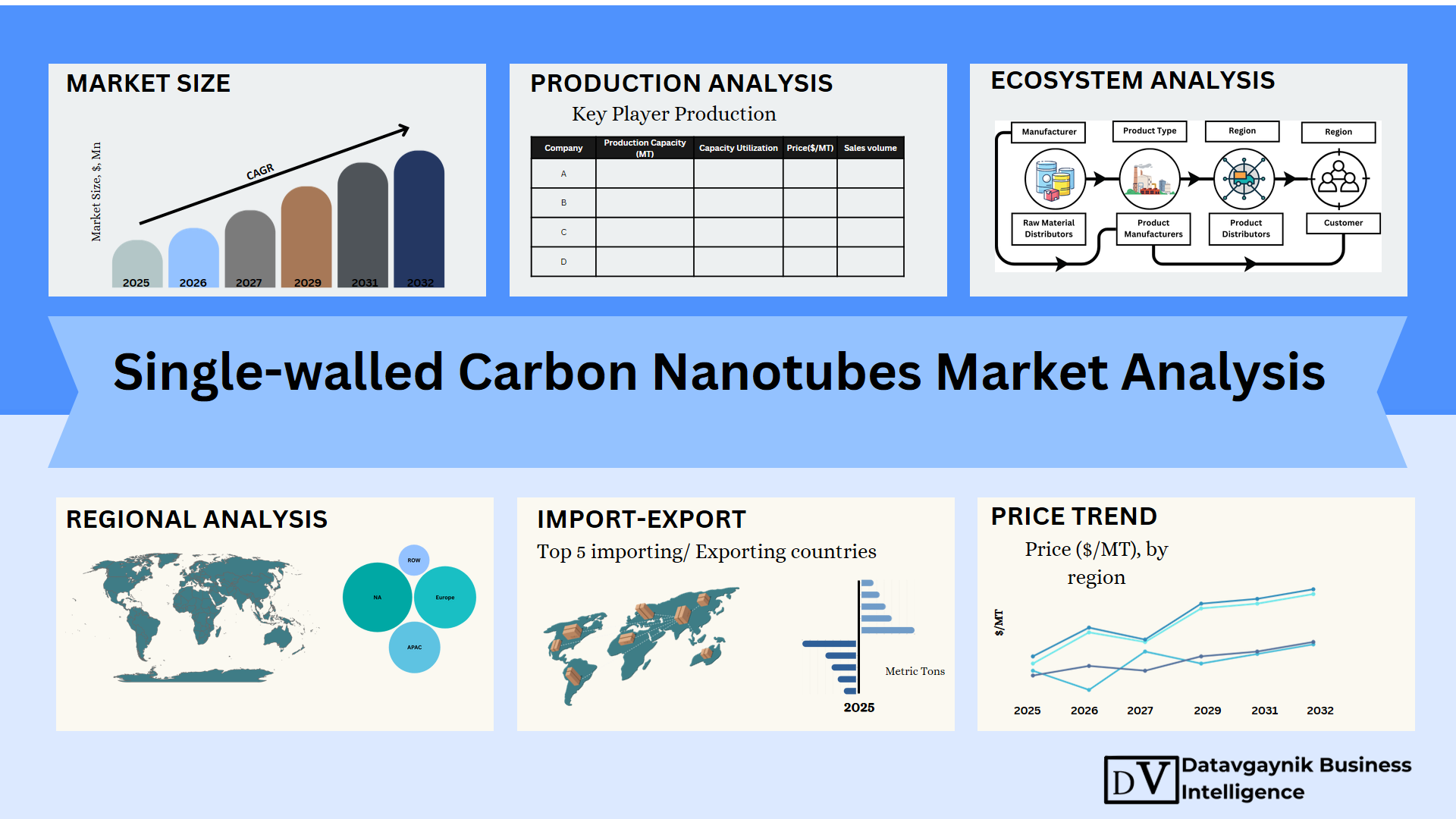
The global Single-walled Carbon Nanotubes Market is estimated at $565 million in 2026 and is expected to reach $2,470 million by 2035, growing at a CAGR of 17.8%.
Single-walled carbon nanotubes, or SWCNTs, are cylindrical carbon nanostructures made from a single graphene sheet rolled into a tube. Their commercial value comes from a rare mix of properties: high electrical conductivity, strong mechanical performance, low loading requirement, thermal stability, and compatibility with advanced materials systems. In business terms, that means SWCNTs are not just a lab material anymore. They are becoming a performance additive for batteries, conductive plastics, coatings, sensors, electronics, and high-strength composites.
Datavagyanik also covers related markets such as the Carbon Nanotubes Market, the Multi-walled carbon nanotubes (MWCNTs) Market, and the Carbon Nanotubes (CNTs) Market. These markets often align in advanced imaging systems and aerospace-grade components where precision engineering and material integrity are crucial.
The Single-walled Carbon Nanotubes Market sits at the intersection of battery materials, specialty chemicals, advanced electronics, and lightweight industrial materials. The market is still small compared with conventional carbon black, graphite, or multi-walled CNTs. But its strategic relevance is much higher. One reason is dosage. In batteries and polymers, SWCNTs can deliver conductivity at very low loading levels. This helps formulators improve performance without adding too much inactive material.
The commercial story for 2026–2035 is mainly about scale. Until recently, SWCNT adoption was slowed by high price, limited production capacity, difficult dispersion, and qualification barriers. Those constraints are easing. Producers are adding capacity. Battery material suppliers are working on ready-to-use dispersions. Cell makers are testing SWCNTs for silicon-rich anodes, high-nickel cathodes, LFP cells, solid-state batteries, and ultrafast-charging formats. OCSiAl’s 2025 partnership with Molicel for ultrahigh-power lithium-ion cells and Zeon’s 2026 plan to build a new SWCNT production line for lithium-ion battery demand show how the market is moving from technical validation to supply-chain positioning.
The market’s revenue base in 2026 is estimated at $565 million, with battery conductive additives representing the largest commercial pull. By 2035, the market is projected to reach $2,470 million, supported by wider use in EV batteries, energy storage systems, conductive elastomers, anti-static packaging, EMI shielding, aerospace composites, transparent conductive films, printed electronics, and high-end sensors.
The regulatory angle is also becoming more important. Buyers are asking harder questions on worker exposure, nanoparticle handling, environmental release, and lifecycle safety. This is not stopping adoption. But it is shaping supplier qualification. Large customers now prefer producers that can offer consistent morphology, impurity control, batch traceability, dispersion know-how, and documentation for safe handling. For a material that often enters mission-critical systems, performance alone is not enough.
Production will remain one of the defining forces. SWCNT manufacturing is technically harder than multi-walled CNT production. Purity, tube length, chirality mix, catalyst residue, and dispersion quality affect downstream performance. Producers that can deliver stable material at commercial scale will capture premium customers. Smaller suppliers will stay relevant in R&D, electronics, sensors, and specialty formulations, but battery-scale contracts will favor companies with deeper manufacturing control.
| Indicator | 2026 Estimate | 2035 Forecast | Analyst Reading |
| Global market size | $565 million | $2,470 million | Strong growth from battery and conductive material adoption |
| CAGR | — | 17.8% | High-growth specialty material category |
| Main demand center | Asia Pacific | Asia Pacific | Battery supply chain concentration remains decisive |
| Main application pull | Battery conductive additives | Battery conductive additives | Silicon anodes and high-power cells improve the case |
| Commercial maturity | Early scale-up | Broader industrial qualification | Cost and dispersion barriers reduce over time |
Key consumers and clients include lithium-ion battery manufacturers, EV cell producers, cathode and anode material companies, conductive additive formulators, polymer compounders, coating manufacturers, electronics firms, aerospace composite suppliers, defense material buyers, research institutes, and specialty chemical distributors. The strongest near-term buying interest will come from battery and polymer customers. The more selective but higher-value demand will come from electronics, sensors, aerospace, and advanced films.
Competitive Intelligence and Benchmarking
The competitive base in the Single-walled Carbon Nanotubes Market is narrow. This is not a crowded commodity market. It is a specialist material ecosystem where production know-how, dispersion capability, purity control, and customer qualification matter more than broad chemical distribution.
Most players fall into three buckets. First, industrial-scale producers serving batteries and conductive materials. Second, high-purity suppliers focused on electronics, sensors, and research. Third, emerging regional players trying to localize supply for batteries, defense, space, and specialty composites.
| Company | Product Portfolio | Market Position | Strategic Reading |
| OCSiAl | SWCNT powders, dispersions, concentrates, elastomer additives, polymer solutions, battery-grade conductive additives | Largest visible industrial SWCNT producer with strong battery and polymer positioning | Strongest commercial reach. The company is building its role around application-ready materials rather than only raw nanotube supply. |
| Zeon Corporation | High-purity SWCNTs, conductive additives, battery material solutions, composite-use materials | Japan-based advanced materials player with credible battery-grade SWCNT positioning | Strong technical reputation. Expansion plans show a clear push toward lithium-ion battery demand. |
| Meijo Nano Carbon | High-purity SWCNTs produced through arc-discharge-based technology, research and electronics-grade materials | Specialist Japanese supplier with strong academic and high-purity material roots | Better positioned in research, electronics, and specialty grades than mass battery volumes. |
| Raymor Industries / NanoIntegris | SWCNT powders, high-purity semiconducting nanotubes, metallic nanotubes, sorted nanotube inks | Niche high-purity supplier for electronics, sensors, and research applications | Valuable in premium applications where electronic type control matters. Not a battery-scale volume leader. |
| Thomas Swan | Single-wall and multi-wall CNT materials, specialty chemical-supported nanomaterial formats | UK-based specialty materials supplier with carbon nanomaterial experience | Useful supplier for composites, coatings, and specialty formulations. Scale is selective. |
| NoPo Nanotechnologies | Small-diameter SWCNTs, HiPCO-type nanotubes, application-development materials for batteries, electronics, filtration, sensors, and space-linked use cases | India-based emerging SWCNT producer | Strategic for India’s localized advanced materials ambition. Still needs broader industrial qualification. |
| Carbon Solutions, Inc. | Research-grade SWCNTs, purified SWCNTs, functionalized nanotubes, small-volume specialty materials | US-based supplier serving academic, R&D, and specialty customers | Stronger in research and customized nanotube supply than industrial volume markets. |
OCSiAl is the benchmark company for commercial scale. Its portfolio covers dry nanotubes, dispersions, concentrates, and downstream application systems for batteries, plastics, coatings, elastomers, and composites. This makes the company hard to compare with smaller SWCNT suppliers. Its advantage is not only volume. It is customer integration. Battery and polymer buyers need dispersion support, safety documentation, and process compatibility. OCSiAl has built its positioning around those needs.
Zeon Corporation is a serious challenger in high-performance SWCNTs. Its ZEONANO platform is positioned around high purity, high aspect ratio, and high specific surface area. That matters for battery electrodes and advanced composites. The company’s production expansion at the Tokuyama site also signals confidence in lithium-ion battery demand. For customers in Japan, South Korea, and global battery supply chains, Zeon Corporation offers credibility through chemical manufacturing discipline and material consistency.
Meijo Nano Carbon is more specialized. The company’s products are linked to high-quality SWCNT production and Japanese nanotechnology research depth. Its market position is not based on large battery volumes. It is stronger in research labs, electronics materials, and customers that need quality over bulk supply. This type of player remains important because electronics-grade SWCNTs require different quality metrics than conductive battery additives.
Raymor Industries / NanoIntegris occupies a premium niche. The company is known for sorted semiconducting and metallic nanotubes, high-purity SWCNT inks, and materials used in electronics and sensor research. Its relevance will rise if printed electronics, transparent conductors, nanotube transistors, and specialty sensors move closer to commercial production. The revenue base may stay limited, but the margin profile can be attractive.
Thomas Swan brings a specialty chemicals lens to the market. Its CNT offering is broader than SWCNT alone, but the company remains relevant because industrial customers often need formulated material support, not only nanomaterial powder. Its stronger opportunity sits in coatings, composites, specialty polymers, and engineered additive packages.
NoPo Nanotechnologies is important for India. The company focuses on small-diameter SWCNTs and has positioned itself around scalable production. India does not yet have the same SWCNT ecosystem as Japan, South Korea, China, or Europe. So NoPo Nanotechnologies is strategically relevant for domestic advanced materials localization, especially in batteries, aerospace, electronics, filtration, and defense-linked materials.
Carbon Solutions, Inc. is a smaller but useful US supplier. Its strength is catalog-style access to purified, functionalized, and research-grade SWCNTs. These suppliers support universities, startups, device developers, and specialty formulators. They do not dominate bulk demand, but they help keep the innovation funnel alive.
Expert view: Competitive advantage in this market is moving from “who can make SWCNTs” to “who can make customers comfortable using them at scale.” That means dispersion support, quality repeatability, and application testing are now as important as nanotube synthesis.
Regional Landscape and Adoption Outlook
The Single-walled Carbon Nanotubes Market has a regionally uneven demand pattern. Adoption is strongest where battery manufacturing, specialty materials, electronics, and nanomaterial process infrastructure overlap. That puts Asia Pacific in the lead. Europe and the United States are building more localized demand through battery supply-chain investment. India is still early but strategically interesting.
United States
The United States market is estimated at $82 million in 2026 and is projected to reach $390 million by 2035. Growth will be driven by EV battery localization, defense materials, aerospace composites, sensors, energy storage, and semiconductor-linked research.
The US does not lead global SWCNT production by volume. But it has strong downstream capability. Battery startups, national labs, universities, aerospace companies, and specialty chemical firms create a solid qualification base. CHASM’s license agreement with Ingevity for CNT conductive additives in North America and selected European countries is a useful signal. It shows that regional supply security is becoming part of the battery additive conversation.
Regulation in the US is more documentation-led than subsidy-led for SWCNTs. Producers and formulators need strong safety data, exposure management, product stewardship, and customer handling guidelines. The funding environment remains favorable through clean energy, domestic battery manufacturing, and advanced materials programs. That said, US adoption will depend on whether SWCNT suppliers can connect with domestic cell manufacturing at commercial scale.
Europe
Europe is estimated at $96 million in 2026 and is forecast to reach $455 million by 2035. The region’s adoption story is tied to EV battery plants, carbon-reduction policy, automotive materials, specialty chemicals, and industrial coating systems.
Germany, France, Sweden, Hungary, and Poland are the key demand nodes because they link battery capacity, automotive manufacturing, and advanced materials processing. Europe will also be strict on nanoparticle safety, worker exposure, and environmental documentation. This can slow onboarding but creates a higher barrier against low-quality suppliers.
The most attractive European opportunity is battery-grade SWCNT dispersions for localized cell plants. OCSiAl’s supply move linked to PowerCo’s Salzgitter facility supports this direction. Europe wants more domestic battery supply security. SWCNT suppliers that can offer European availability, regulatory documentation, and customer application support will be better placed.
China
China is estimated at $148 million in 2026 and projected to reach $675 million by 2035. It is the largest national demand base because of its EV battery scale, LFP leadership, energy storage rollout, electronics manufacturing, and domestic CNT ecosystem.
China’s advantage is speed. Cell makers and material suppliers can test, reformulate, and scale faster than most regions. The country also has a large base of conductive additive suppliers, including multi-walled CNT players. SWCNT penetration will depend on price reduction and clear performance gains versus carbon black, graphene, and multi-walled CNT systems.
China will likely use SWCNTs first in high-performance batteries, silicon-rich anodes, premium EV cells, fast-charging formats, and advanced conductive pastes. Broader adoption in cost-sensitive LFP batteries will need stronger proof of cost-per-performance benefit.
India
India is estimated at $18 million in 2026 and may reach $115 million by 2035. The base is small. The direction is positive.
India’s demand will come from battery materials, space applications, defense composites, conductive polymers, coatings, filtration membranes, academic labs, and electronics R&D. The country’s production ecosystem is not yet deep. But domestic interest in advanced batteries, semiconductors, EV supply chains, and strategic materials creates a medium-term opening.
NoPo Nanotechnologies gives India an early domestic SWCNT platform. This is important. If Indian battery and aerospace customers want lower dependence on imported nanomaterials, domestic suppliers will need to prove consistent quality, safe handling, and application-specific performance.
India’s biggest constraint is not demand imagination. It is qualification infrastructure. More pilot lines, dispersion labs, battery testing centers, and industry-academic validation programs will be needed. Without that, adoption will remain fragmented.
Japan
Japan is estimated at $70 million in 2026 and projected to reach $270 million by 2035. The country has a strong position in high-quality SWCNT production, battery materials, specialty chemicals, and precision manufacturing.
Zeon Corporation and Meijo Nano Carbon make Japan strategically important. Japan’s SWCNT market will not be the fastest by volume, but it will remain influential in quality standards, high-purity materials, and battery-grade development. Japanese customers tend to qualify slowly. But once materials are approved, supplier relationships can be stable.
Japan’s opportunity is concentrated in lithium-ion battery materials, high-performance composites, electronics, sensors, and specialty industrial materials. The country’s manufacturing discipline gives it a strong edge in quality-sensitive SWCNT applications.
South Korea
South Korea is estimated at $64 million in 2026 and forecast to reach $300 million by 2035. Growth will be linked to battery giants, cathode and anode material producers, electronics companies, and advanced automotive supply chains.
South Korea is a high-value adoption market because it sits close to global battery leaders. The country has strong material qualification capability and strong demand for conductive additives that support energy density, cycle life, and fast charging. SWCNT suppliers that qualify with Korean battery ecosystems can gain access to global EV programs.
South Korea’s challenge is supplier dependence. Domestic multi-walled CNT capability is strong in the broader CNT ecosystem, but SWCNT supply is more specialized. This may encourage partnerships, licensing, or imports from Japan, Europe, and other producers.
Middle East
The Middle East is relevant but not central. The regional market is estimated at $7 million in 2026 and may reach $42 million by 2035. Demand will be tied to university research, oil and gas coatings, corrosion-resistant systems, membranes, construction materials, defense, and selective battery investments.
The strongest potential markets are Saudi Arabia, the UAE, and Israel. Saudi Arabia and the UAE are investing in advanced manufacturing and energy transition infrastructure. Israel has stronger electronics, defense, and materials R&D capacity. Still, the Middle East is unlikely to become a major SWCNT consumption hub before 2035 unless battery manufacturing investment accelerates.
| Region / Country | 2026 Estimate | 2035 Forecast | Adoption Outlook |
| United States | $82 million | $390 million | Strong in battery localization, defense, aerospace, and R&D |
| Europe | $96 million | $455 million | High regulatory discipline and battery supply-chain pull |
| China | $148 million | $675 million | Largest demand base due to EV batteries and energy storage |
| India | $18 million | $115 million | Early-stage market with strategic localization upside |
| Japan | $70 million | $270 million | High-quality production and premium material applications |
| South Korea | $64 million | $300 million | Battery-led demand with strong qualification ecosystem |
| Middle East | $7 million | $42 million | Niche demand in research, coatings, membranes, and defense |
Expert view: Asia will lead volume. Europe will shape compliance. The United States will push localization. Japan and South Korea will decide technical credibility in battery-grade use cases. India is not a large market yet, but it is one of the few countries where domestic SWCNT production could become strategically meaningful.
Recent Developments + Opportunities & Restraints
Recent Developments
April 2026 – OCSiAl introduced new SWCNT products for high-performance electrodes and emerging battery chemistries.
The launch focused on electrode performance, next-generation batteries, and application-ready SWCNT systems. This matters because battery customers usually want pre-engineered conductive additive formats, not raw powder alone.
May 2026 – Zeon announced a new SWCNT production line for lithium-ion battery demand.
The company plans to build the line at its Tokuyama Plant, with full-scale operation scheduled for 2028. This is one of the clearest signs that Japanese suppliers expect SWCNT demand to move deeper into battery manufacturing.
November 2025 – CHASM and Ingevity expanded their partnership through a license agreement.
The agreement gives Ingevity rights to manufacture CNT conductive additives for battery applications in North America and selected European markets. The strategic message is clear: localized conductive additive supply is becoming important for EV battery gigafactories.
May 2025 – OCSiAl and Molicel announced a long-term partnership for ultrahigh-power lithium-ion cells.
The partnership links SWCNTs with high-power cylindrical cell development, fast charging, and silicon-dominated anode work. It supports the view that premium battery cells will adopt SWCNTs earlier than cost-sensitive mass-market cells.
May 2025 – Zeon and Sino Applied Technology announced a collaboration to expand SWCNT conductive paste products.
The collaboration targets next-generation lithium batteries for electric vehicles and related high-growth battery applications. It also shows how the market is shifting toward paste and dispersion formats.
Opportunities
Battery electrode reformulation is the largest commercial opening.
SWCNTs can support conductive networks at low loading levels. That gives cell makers more room for active materials. The strongest opportunity is in silicon-rich anodes, high-nickel cathodes, ultrafast-charging cells, and high-power batteries.
Application-ready dispersions can unlock mid-sized industrial buyers.
Many polymer, coating, and composite customers do not want to handle dry nanotube powders. Ready-to-use dispersions, masterbatches, and conductive concentrates can reduce processing risk and shorten qualification cycles.
India and Southeast Asia offer future localization upside.
These regions are not major SWCNT demand centers today. But battery manufacturing, electronics assembly, defense materials, and space programs may create demand for domestic or regional supply over the next decade.
Business Insights
The market will reward suppliers that solve customer-side pain points. That means dispersion stability, batch repeatability, lower catalyst residue, technical documentation, and safe handling support. Price reduction matters. But it will not be enough. A low-cost SWCNT that cannot disperse consistently is not a bargain for a battery or coating manufacturer.
Automation and AI have a supporting role. The real opportunity is in formulation screening, process analytics, electrode performance prediction, and quality control. AI will not sell SWCNTs directly. But it can reduce trial-and-error cycles for customers and suppliers.
Restraints
High price remains the first barrier.
SWCNTs deliver strong performance at low loading. Even so, purchasing teams compare them against carbon black, graphene, and multi-walled CNTs. Suppliers must prove performance per dollar, not only performance per gram.
Dispersion difficulty still limits adoption.
Agglomeration can reduce conductivity benefits and create processing issues. This is why dispersions and pastes are gaining traction.
Safety and regulatory documentation will become stricter.
Nanomaterial handling requires clear exposure controls, workplace guidance, and environmental documentation. Larger customers will not compromise on this.
Qualification cycles are long.
Battery, aerospace, electronics, and automotive customers take time to approve new materials. Even a successful lab result can take years to become recurring commercial revenue.


