

Market Summary and Growth Forecast
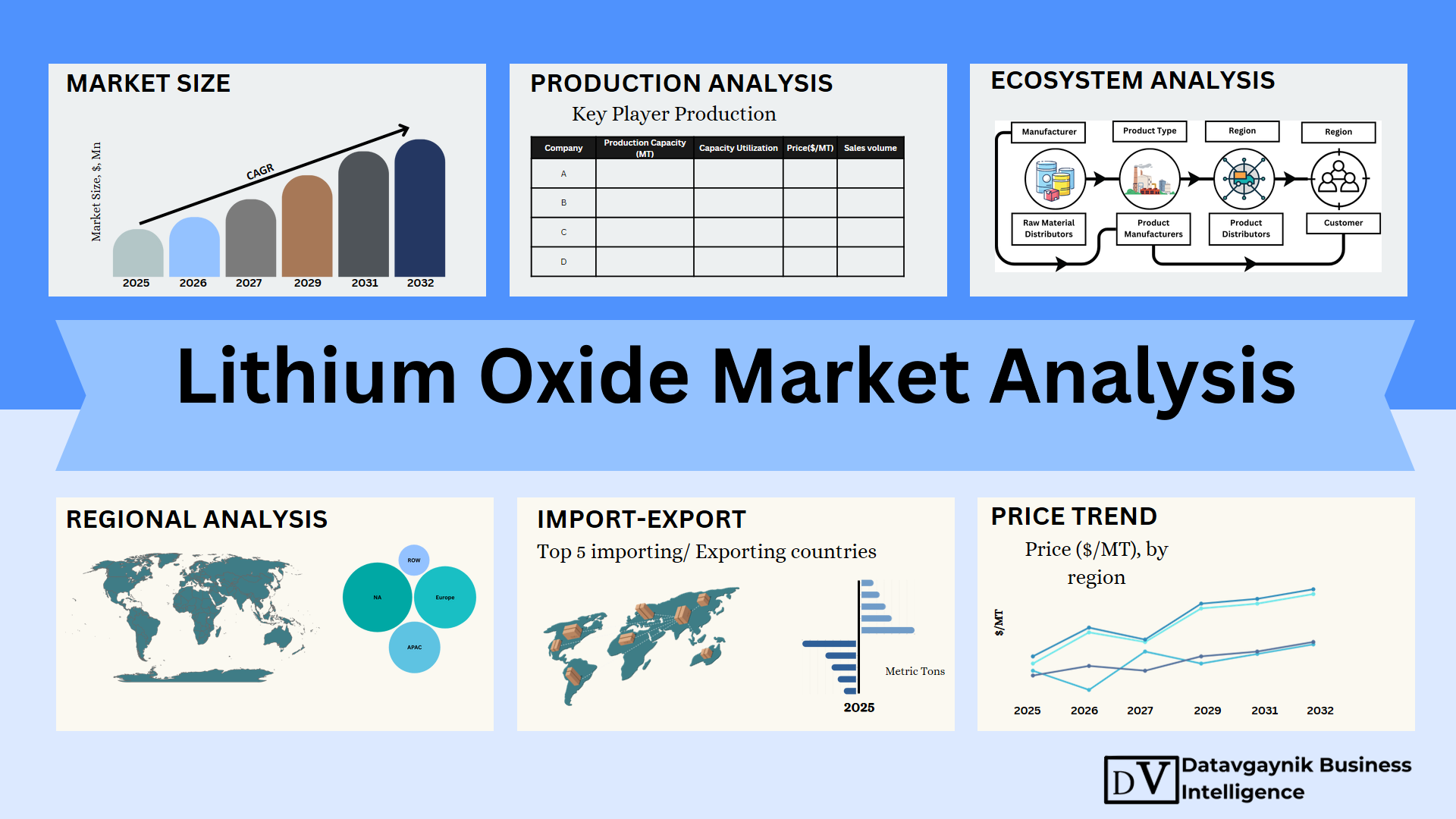
The global Lithium Oxide Market will witness a robust CAGR of 9.0%, valued at $0.18 billion in 2026, expected to appreciate and reach $0.39 billion by 2035.
Lithium oxide, or Li₂O, is a specialty lithium compound used in glass-ceramics, ceramic glazes, advanced battery materials, solid-state electrolyte research, chemical synthesis and selected nuclear or high-temperature applications. It is not a bulk lithium market like lithium carbonate or lithium hydroxide. So, the addressable market is smaller. But its strategic value is rising because manufacturers want lighter, more thermally stable and more chemically controlled materials.
In 2026, the Lithium Oxide Market sits at the intersection of three forces. First, glass and ceramic producers are using lithium-based additives to lower melting temperatures, improve thermal shock resistance and support stronger specialty materials. Albemarle notes that lithium carbonate and spodumene are used in glass and ceramics to lower firing temperatures, reduce thermal expansion and improve durability, corrosion resistance and strength. Those same performance targets support Li₂O-based demand in high-spec formulations.
Datavagyanik also covers related markets such as the Lithium Sulfate Market, the Lithium Phosphate Market, and the Lithium Chloride Market. These compounds are commonly used in oxidation systems and industrial chemical processing, supporting shifts in formulation standards and regulatory compliance.
Second, advanced battery R&D is creating a higher-value lane. Lithium oxide is being positioned in lithium batteries, glass ceramics, lithium chemicals and nuclear applications, while battery-grade Li₂O is linked with solid lithium battery electrolyte materials and cathode material pathways. This does not mean Li₂O will replace mainstream lithium carbonate or hydroxide. It means Li₂O will gain more relevance where purity, particle size and controlled oxide chemistry matter more than price per kilogram.
Third, lithium supply-chain restructuring is becoming more visible. Major lithium producers and mining groups are expanding resource positions and downstream capacity. Rio Tinto completed its $6.7 billion acquisition of Arcadium Lithium in March 2025, creating Rio Tinto Lithium and targeting more than 200 thousand tonnes per year of lithium carbonate equivalent capacity from Tier 1 assets by 2028. That kind of move does not directly expand Li₂O overnight. But it strengthens the upstream base for specialty lithium derivatives over the forecast period.
Expert insight: The market is small, but not weak. Specialty lithium compounds often grow quietly until end-use qualification catches up. In Li₂O, the strongest upside sits in controlled-purity products for glass-ceramics and next-generation battery material development.
Market Size and Forecast Snapshot
| Metric | Estimate |
| Global Market Size, 2026 | $0.18 billion |
| Projected Market Size, 2035 | $0.39 billion |
| CAGR, 2026–2035 | 9.0% |
| Estimated 2026 Volume Demand | 8.5–10.0 kilotons |
| Estimated 2035 Volume Demand | 15.5–18.0 kilotons |
| Average Value Range, 2026 | $18–22 per kg, depending on purity and contract type |
| Primary Demand Base | Glass-ceramics, ceramics, specialty chemical synthesis, advanced battery materials |
| Fastest Strategic Demand Pool | Battery-grade and high-purity lithium oxide for solid-state battery and advanced material R&D |
The Lithium Oxide Market is strategically relevant from 2026 to 2035 because it supports material platforms that need controlled lithium chemistry. In glass-ceramics, Li₂O helps tune thermal expansion and melting behavior. In advanced batteries, it supports work around solid electrolytes and oxide-based cathode or precursor systems. In chemical synthesis, it remains a specialty reagent. In nuclear and high-temperature materials, demand is limited but technically important.
Key Stakeholders
Key stakeholders include specialty chemical manufacturers, lithium refiners, glass-ceramic producers, ceramic glaze manufacturers, battery material developers, solid-state battery companies, EV OEMs, electronics OEMs, research institutions, regulatory agencies, industry associations, governments, mining companies, investors, and technology licensing firms.
Market Segmentation and Forecast Scope
For the Lithium Oxide Market, segmentation should be built around purity, application intensity and end-use qualification. This is important because Li₂O demand is not uniform. A low-volume battery-grade order can generate more value than a larger technical-grade order for ceramics. Also, several buyers do not purchase Li₂O as a mass commodity. They buy it against exact purity, moisture control, particle size and packaging requirements.
Segmentation Framework
| Segmentation Dimension | Sub-Segments Covered | Analyst View |
| By Product Type | Technical Grade, High-Purity Grade, Battery Grade, Research / Laboratory Grade | Technical Grade holds the broader volume base in 2026, while Battery Grade and High-Purity Grade carry stronger pricing power. |
| By Application | Glass-Ceramics, Ceramic Glazes and Enamels, Battery Materials, Solid Electrolytes, Chemical Synthesis, Nuclear / Specialty Uses | Glass-Ceramics remains the most stable demand base. Battery Materials is the fastest-moving strategic segment. |
| By End User | Glass Manufacturers, Ceramic Producers, Battery Material Companies, Research Institutes, Specialty Chemical Producers, Electronics Material Suppliers | Demand is gradually shifting from traditional ceramics toward advanced material users. |
| By Region | North America, Europe, Asia Pacific, LAMEA | Asia Pacific leads consumption due to lithium refining, electronics materials, battery supply chains and ceramic manufacturing depth. |
Selective Sub-Segment Shares, 2026
Only selected sub-segment shares are revealed here to preserve the full forecast model.
| Sub-Segment | Estimated Share, 2026 | Reason for Strength |
| Technical Grade Lithium Oxide | 62% | Used across ceramics, glass additives, chemical synthesis and general industrial applications. |
| Glass-Ceramics Application | 48% | Supported by thermal shock resistance, lower thermal expansion and specialty glass demand. |
By Product Type
Technical Grade lithium oxide accounts for the largest portion of demand in 2026. It is used where cost, availability and functional performance matter more than ultra-tight purity. Ceramic glaze producers, glass formulators and specialty chemical users fall into this category.
High-Purity Grade is more selective. It serves electronics materials, laboratory work and advanced ceramic systems where impurity control affects performance. This grade is not the largest by tonnage, but it matters commercially because margins are stronger.
Battery Grade lithium oxide is the most strategic sub-segment. It is still developing, but it benefits from solid-state battery research, oxide cathode development and lithium-containing glass-ceramic electrolyte work. Research on lithium-containing glass-ceramics also points to their use in lithium-ion battery components and electrolyte systems.
Research / Laboratory Grade is small in volume. It supports universities, pilot labs, material science companies and formulation testing. This segment is less price-sensitive but fragmented.
By Application
Glass-Ceramics will remain the anchor application through 2035. Lithium-bearing inputs help create materials with low or near-zero thermal expansion, which is useful in high-temperature environments. SCHOTT describes lithium as essential in glass-ceramics because it enables low or near-zero thermal expansion for use in high-temperature ranges.
Ceramic Glazes and Enamels represent a steady industrial lane. Lithium oxide acts as a strong fluxing component. It helps reduce firing temperature and improves surface finish in selected ceramic systems. This demand is mature, but still useful because producers are under pressure to lower energy use.
Battery Materials is smaller today but structurally attractive. It includes solid-state battery research, oxide-based material preparation and high-purity lithium compound pathways. The addressable opportunity depends on how quickly advanced battery chemistries move from pilot scale to commercial manufacturing.
Chemical Synthesis demand includes reagent use and conversion into other lithium compounds. It remains stable but not explosive.
Nuclear / Specialty Uses are niche. They matter more for technical qualification than for large revenue expansion.
By Region
Asia Pacific will remain the core demand region through 2035. China, Japan and South Korea have strong positions in lithium refining, batteries, ceramics, electronics materials and specialty glass. India is still smaller, but domestic lithium compound interest may rise with battery manufacturing and ceramic export growth.
North America demand is linked to battery innovation, specialty chemicals, defense-linked ceramics and research institutions. The U.S. also has a policy-driven interest in domestic lithium supply chains.
Europe demand is shaped by specialty glass, ceramics, advanced materials and battery localization. Regulatory pressure on chemical handling and sustainability will keep suppliers focused on documentation, traceability and product stewardship.
LAMEA has lower direct consumption today, but lithium resource development in Latin America and emerging downstream processing could change the supply landscape. Chile and Argentina remain strategically important in lithium extraction and processing.
Expert commentary: The best way to read this market is not by tonnage alone. The value pool is moving toward purity, documentation and qualification. Suppliers that can certify stable chemistry will capture better margins than suppliers competing only on industrial-grade volume.
Market Trends and Innovation Landscape
The Lithium Oxide Market is moving through a practical innovation cycle. It is not a hype-led market. The real progress is happening in formulation control, purity management, battery-material experimentation and upstream lithium supply security.
R&D Evolution
R&D is expanding in three directions.
First, glass-ceramic researchers are studying how lithium oxide changes phase development, thermal behavior and ceramic performance. A 2026 systematic review on Li₂O in ceramic materials highlights its use in glass-ceramics and notes Li₂O contents of up to 19.55% in some reviewed glass-ceramic work. This signals a deeper material science focus rather than simple additive substitution.
Second, battery researchers are testing lithium-containing oxide systems for solid-state batteries. The focus is not only energy density. It is also ionic conductivity, interfacial stability, safety and manufacturability.
Third, suppliers are improving purity, particle-size control and moisture-resistant packaging. This matters because Li₂O reacts with water and forms lithium hydroxide, so handling and storage discipline is not optional. Ganfeng describes Li₂O as easy to deliquesce and notes that it dissolves in water to generate strongly alkaline LiOH.
Technology Evolution
Technology evolution is visible in how buyers specify the product. Earlier, Li₂O was often treated as a ceramic or chemical additive. Now, advanced users ask for tighter tolerances. They want low metallic impurities, controlled particle size and better batch-to-batch consistency.
For glass-ceramics, the technical goal is better thermal behavior, lower expansion and more durable products. For battery materials, the target is high-purity lithium chemistry that can support solid electrolyte and cathode development. For specialty chemical users, the focus is safe handling and reliable conversion chemistry.
The strongest technology shift through 2035 will be qualification-led demand. Once Li₂O is approved in a formulation, users tend to avoid frequent supplier changes. That creates sticky customer relationships.
Material Science Landscape
Material science is central to this market. Lithium oxide modifies glass and ceramic networks. It influences melt behavior, thermal expansion, strength and stability. In high-performance ceramics, small formulation changes can alter the final material’s thermal shock resistance or durability.
In batteries, Li₂O is tied to oxide chemistry rather than mainstream carbonate-heavy conversion alone. This makes the market relevant to solid-state battery developers, advanced cathode researchers and specialty electrolyte companies.
Expert commentary: The biggest future impact may come from “invisible” material improvements. A glass-ceramic that lasts longer, fires at a lower temperature or handles thermal stress better can justify a higher-value lithium input even if the final product never advertises Li₂O as a feature.
AI Integration
AI is not a major direct operating theme in lithium oxide production today. It should not be overstated. That said, AI-assisted materials discovery is becoming more relevant in battery and ceramic R&D. It can help screen compositions, predict thermal behavior and reduce trial-and-error cycles in oxide materials. So, AI’s impact will be indirect. It will show up in faster formulation development rather than automated Li₂O production itself.
Mergers, Partnerships and News Announcements
The most important developments are happening around lithium supply chains and downstream capacity.
Rio Tinto completed the $6.7 billion acquisition of Arcadium Lithium in March 2025, forming Rio Tinto Lithium and strengthening its position in energy transition materials. This creates a more integrated lithium platform and could improve long-term feedstock security for specialty lithium compounds.
In May 2025, Rio Tinto was confirmed as the preferred partner for ENAMI’s Salares Altoandinos lithium project in Chile’s Atacama region. This matters because large lithium resource projects shape the long-term availability and cost base for downstream lithium derivatives.
In February 2026, Rio Tinto assumed majority interest and management responsibilities at Nemaska Lithium, which includes the Bécancour lithium hydroxide plant in Québec and the Whabouchi spodumene mine. Commissioning activities at Bécancour are planned to start in 2026, with first production expected in 2028.
Also, Toyota and Sumitomo Metal Mining announced progress in advanced cathode materials for all-solid-state batteries in October 2025, with Toyota targeting practical EV use around 2027 or 2028 and Sumitomo planning cathode mass production from fiscal 2028. This is not a direct Li₂O supply announcement, but it supports the broader movement toward advanced lithium-based material systems.
Trend Impact Summary
| Trend | Impact on Demand | Expected Timing |
| Growth in specialty glass-ceramics | Raises demand for Li₂O-based performance additives | 2026–2035 |
| Solid-state battery material development | Creates high-value demand for battery-grade and research-grade products | 2027–2035 |
| Lithium supply-chain consolidation | Improves feedstock security for downstream derivatives | 2026–2030 |
| Tighter purity and documentation needs | Supports premium pricing for qualified suppliers | 2026–2035 |
| AI-assisted materials discovery | Speeds up formulation screening but remains indirect | 2028–2035 |
Expert commentary: The Lithium Oxide Market will not grow like mainstream battery lithium chemicals. It will grow through specification creep. More users will ask for cleaner, narrower, better-documented Li₂O. That is where the value expansion sits.
Competitive Intelligence and Benchmarking
The competitive structure is fragmented because lithium oxide is not sold like lithium carbonate or lithium hydroxide. Large lithium refiners control feedstock, process know-how and downstream lithium chemistry. Specialty chemical companies control high-purity formats, small-batch supply, certificates of analysis and laboratory access. That creates a two-layer market: industrial availability on one side, precision-grade supply on the other.
| Company | Product Portfolio and Market Position | Strategic Benchmark |
| Ganfeng Lithium | Ganfeng Lithium is one of the more visible integrated suppliers with lithium resources, lithium compounds, lithium metals and battery-linked operations. Its lithium oxide offering is positioned around industrial and specialty use, with published specifications showing ≥98.5% main content and -150 μm particle size. The company benefits from upstream integration and China’s strong lithium chemical processing base. | Strongest fit for scaled industrial supply and downstream lithium-compound integration. |
| Merck KGaA / Sigma-Aldrich | Merck KGaA, through Sigma-Aldrich, serves the high-purity and research-grade side of the market. Its battery-grade lithium oxide is positioned at 99.9% purity by trace metals and is marketed for advanced battery material synthesis, solid-state battery work and precursor chemistry. | Strong in premium small-lot supply, research labs and battery-material development programs. |
| Thermo Fisher Scientific | Thermo Fisher Scientific supplies lithium oxide through its Thermo Scientific Chemicals portfolio, including legacy Alfa Aesar materials. Its product is listed at 99.5% metals basis, used in ceramics, special glass formulations and battery materials development. It is also clearly positioned as air- and moisture-sensitive, which is important for qualified handling. | Strong distribution reach, laboratory access and regulated research supply. |
| American Elements | American Elements is positioned as a specialty materials supplier with broad lithium, battery and advanced material coverage. It emphasizes high and ultra-high purity materials, particle-size control and custom formats for battery and supercapacitor applications. | Strong in custom material forms, R&D supply and specialty technical requests. |
| Stanford Advanced Materials | Stanford Advanced Materials supplies lithium compounds and other advanced materials for research, ceramics, electronics and battery-related users. Its market role is strongest in flexible global supply, small-to-mid quantity fulfillment and specialty procurement. | Useful supplier for research institutions and prototype-scale material users. |
| ProChem Inc. | ProChem Inc. is a U.S.-based high-purity inorganic compound and custom precursor supplier. Its positioning is not mass lithium refining. It is closer to custom synthesis, advanced materials and critical raw material onshoring. Its 2024 facility expansion was linked to higher manufacturing space and domestic critical raw material needs. | Strong fit for custom precursor work and U.S. specialty-material security needs. |
| Materion Corporation | Materion Corporation is not a pure lithium oxide player, but it is relevant in advanced battery precursors, electronic materials, oxides, sulfides, fluorides and high-performance material systems. Its battery material portfolio includes solid-state battery precursor materials such as LLZO and lithium sulfide-related systems. | Strong in advanced material platforms where Li₂O may be part of adjacent qualification work. |
Expert commentary: The winning suppliers will not be the cheapest sellers of lithium oxide. They’ll be the ones that can document purity, manage moisture sensitivity, supply consistent batches and support customer qualification. In this market, paperwork and handling discipline can be as valuable as the chemistry itself.
Regional Landscape and Adoption Outlook
The Lithium Oxide Market has a clear regional pattern. Asia Pacific leads in lithium chemical processing, battery materials and ceramics. North America and Europe are rebuilding domestic critical-material capacity. Japan and South Korea sit at the high-value end because their battery and electronics ecosystems demand strict quality control.
Regional Adoption Matrix
| Region / Country | Adoption Outlook | Country-Level Leaders / High-Growth Nations | Infrastructure, Regulation and Funding View |
| North America | Demand is led by battery R&D, specialty glass, advanced ceramics, academic labs and defense-linked materials. The U.S. is the core market. Canada is increasingly relevant because of upstream lithium development and processing ambition. | United States, Canada | The U.S. has active policy support for lithium and critical minerals. In 2026, the U.S. Department of Energy announced $500 million to strengthen domestic critical materials processing, recycling and manufacturing, including lithium and battery minerals. |
| Europe | Europe is a quality-led market. Demand is linked to specialty glass, ceramics, battery localization, chemicals and advanced materials. Direct Li₂O volume is not massive, but regulatory pull is strong. | Germany, France, Finland, Portugal, Czechia | The European Critical Raw Materials Act targets stronger domestic supply chains, international partnerships and resilience. It sets 2030 benchmarks of 10% extraction, 40% processing, 25% recycling, and no more than 65% dependence on a single third country for any strategic raw material at any relevant processing stage. |
| China | China is the strongest production and processing center. It combines lithium refining, battery materials, ceramics, specialty chemicals and downstream battery manufacturing. | China | China benefits from scale, mature chemical conversion infrastructure and domestic champions such as Ganfeng Lithium. The IEA notes that refining and processing of critical minerals have become more geographically concentrated, with China holding a strong position in several refined materials. |
| India | India is still an early-stage demand market for lithium oxide. The strongest near-term use is in ceramics, glass, research labs and emerging battery material work. The upside is tied to cell manufacturing and domestic critical-mineral policy. | India | India allows 100% FDI under the automatic route for mining and exploration of metal and non-metal ores. The government has also proposed duty exemptions on lithium-ion battery scrap and several critical minerals to support domestic manufacturing. |
| Japan | Japan is a high-value demand center. Adoption is linked to specialty glass-ceramics, precision ceramics, solid-state battery materials and advanced automotive battery R&D. | Japan | Japan’s 2026 Battery and Power Industry Strategy targets 150 GWh of domestic battery manufacturing capacity from 2030 to the mid-2030s, tripling Japanese companies’ global battery-related sales from 2025 to 2035, and full-scale commercialization of all-solid-state batteries around 2030. |
| South Korea | South Korea is a strategic battery-material market. Demand is led by cathode producers, cell makers, electronics material suppliers and advanced material labs. | South Korea | The country has deep battery manufacturing capacity and strong export orientation. Its white space is not basic lithium chemicals. It is high-purity specialty compounds, local qualification support and secure non-China sourcing. |
| Rest of the World | Latin America and Australia are more important as upstream lithium suppliers than direct lithium oxide consumers. Africa is becoming relevant through lithium mining in Zimbabwe and Namibia. Middle East demand is still limited but could grow through specialty chemicals and energy storage investments. | Australia, Chile, Argentina, Zimbabwe, Brazil, Namibia | USGS data shows major 2024 lithium production from Australia, Chile, China, Argentina and Zimbabwe, with production capacity expansions in Argentina, Chile, China and Zimbabwe. |
White Space and Underserved Regions
The biggest white space is not where lithium is mined. It is where lithium is converted into high-purity specialty compounds. India, Southeast Asia, Eastern Europe and parts of Latin America remain underserved for certified lithium oxide supply. Buyers in these regions often depend on imports for high-purity material, technical documentation and small-batch availability.
There is also a packaging and handling gap. Lithium oxide reacts with moisture and carbon dioxide. So, regional distributors that can provide inert packaging, quick delivery and technical documentation can create value even without owning upstream lithium resources.
Expert commentary: China leads on scale. Japan and South Korea lead on demanding applications. North America and Europe are trying to reduce dependency. India is the wild card. If local battery-material and specialty ceramics capacity scales, India could shift from small buyer to meaningful regional growth pocket after 2030.
End-User Dynamics and Use Case
End-user adoption varies sharply because lithium oxide is used for performance, not bulk consumption. Buyers care about purity, reactivity, storage stability and supplier qualification.
End-User Adoption by Segment
| End User | Adoption Pattern | Purchasing Criteria |
| Glass-Ceramic Manufacturers | Use lithium oxide or lithium-bearing inputs to manage thermal expansion, melting behavior and durability in specialty glass-ceramic products. | Consistent oxide chemistry, low contamination, predictable melt behavior, reliable documentation. |
| Ceramic Producers | Use lithium oxide as a functional fluxing component in selected glazes, enamels and advanced ceramic compositions. | Cost-performance balance, particle size, firing-temperature impact, supply reliability. |
| Battery Material Developers | Use high-purity Li₂O in solid-state electrolyte work, cathode precursor synthesis and advanced lithium material experimentation. | Battery-grade purity, moisture control, trace-metal limits, technical support. |
| Research Institutes and Universities | Use small quantities for synthesis, testing and formulation studies. | High purity, small-pack availability, safety documents, fast procurement. |
| Specialty Chemical Producers | Use lithium oxide as a reagent or intermediate in lithium compound production and controlled chemical synthesis. | Batch consistency, packaging integrity, safety handling, commercial availability. |
| Electronics and Advanced Material Suppliers | Use lithium oxide where high-performance ceramic, optical or battery-linked material systems require controlled lithium chemistry. | Qualification history, impurity control, repeatability and supplier quality systems. |
Realistic Use Case
A specialty glass-ceramic manufacturer in Japan used high-purity lithium oxide in a pilot formulation for a heat-resistant glass-ceramic component supplied to electronics equipment customers. The company’s technical team needed lower thermal expansion, cleaner melt behavior and better thermal shock resistance. Instead of buying the lowest-cost industrial material, it selected a qualified supplier with tighter impurity documentation and moisture-controlled packaging. The material was first tested in lab-scale batches, then moved into a small production trial. The commercial value came from fewer formulation adjustments, better batch repeatability and faster customer qualification.
Expert commentary: This is how adoption usually happens. The buyer does not switch because Li₂O is fashionable. It switches because a formulation problem needs solving and the supplier can prove the material behaves the same way every time.
Recent Developments + Opportunities & Restraints
Recent Developments
| Year / Month | Event | Market Impact |
| 2024 / September | Toyota’s next-generation BEV battery and all-solid-state battery development and production plans were certified by Japan’s METI under the Supply Assurance Plan for Batteries. | Supports Japan’s advanced battery-material ecosystem and strengthens demand signals for high-purity lithium-based compounds. |
| 2025 / February | Idemitsu Kosan announced plans to build a large-scale lithium sulfide plant in Chiba, Japan, with completion targeted by June 2027 and annual capacity of 1,000 metric tons. | Reinforces Japan’s solid-state battery supply chain. It indirectly supports demand for high-purity lithium chemistry and adjacent precursor materials. |
| 2025 / March | Rio Tinto completed its $6.7 billion acquisition of Arcadium Lithium, creating Rio Tinto Lithium. | Strengthens global upstream lithium integration and improves long-term feedstock security for downstream lithium derivatives. |
| 2025 / October | Toyota and Sumitomo Metal Mining entered a joint development agreement for mass production of cathode materials for all-solid-state batteries. | Signals stronger commercialization momentum for next-generation battery materials where high-purity lithium compounds can play a supporting role. |
| 2026 / June | Japan revised its Battery Industry Strategy into the Battery and Power Industry Strategy, targeting 150 GWh domestic battery manufacturing capacity from 2030 to the mid-2030s and all-solid-state battery commercialization around 2030. | Creates a stronger policy base for advanced batteries, material localization and high-spec lithium compound demand. |
Opportunities
- High-purity battery-grade demand: The most attractive opportunity sits in high-purity lithium oxide for solid-state battery materials, cathode precursor research and specialty electrolyte synthesis. Volumes may stay moderate, but price realization should be stronger than technical-grade supply.
- Regional supply-chain localization: North America, Europe, India, Japan and South Korea want lower supply dependency. Qualified local or regional distributors can win by offering certified grades, inert packaging and faster delivery.
- Specialty glass-ceramic efficiency: Ceramic and glass producers are under pressure to lower firing temperatures and improve material durability. Lithium oxide can support better thermal behavior in selected formulations.
Restraints
- Small addressable volume: The market remains much smaller than lithium carbonate or lithium hydroxide. Many buyers use lithium oxide only in specific formulations.
- Handling complexity: Li₂O is moisture-sensitive and reacts with water to form lithium hydroxide. This raises packaging, storage and safety requirements. Ganfeng and Thermo Fisher both highlight moisture sensitivity or water reactivity in product documentation.
- Substitution risk: Some users can achieve similar formulation goals using lithium carbonate, spodumene concentrate or other lithium-bearing materials, especially where ultra-high purity is not required.
Expert commentary: The Lithium Oxide Market offers a specialty-chemicals opportunity rather than a commodity lithium opportunity. The upside is real, but it depends on qualification-heavy demand and disciplined handling. Suppliers that treat it as a technical material will outperform those selling it as a catalog chemical.


