

Market Summary and Growth Forecast
The global Lithium Phosphate Market will witness a robust CAGR of 9.2%, valued at $0.78 billion in 2026, expected to appreciate and reach $1.72 billion by 2035.
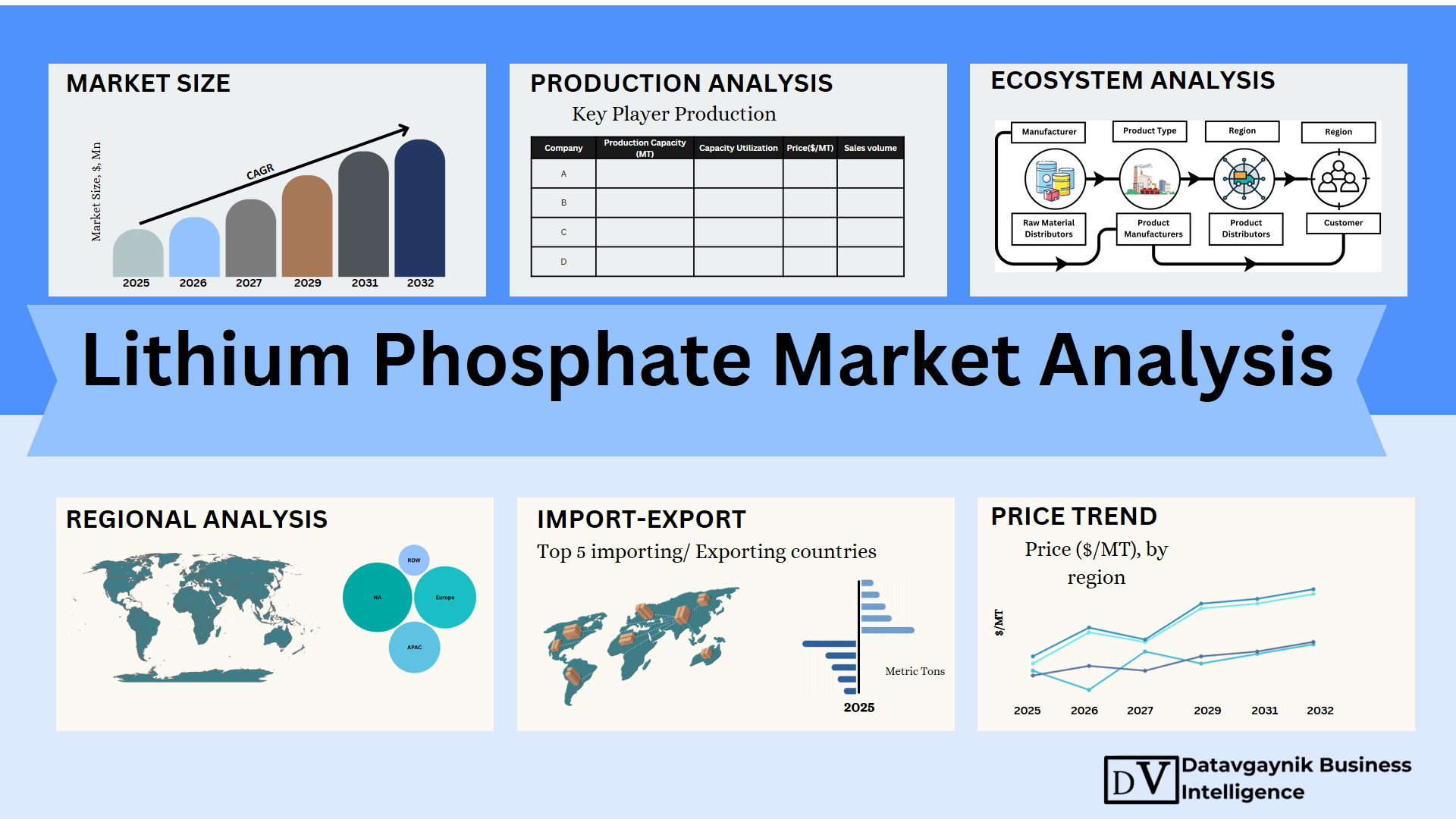
Lithium phosphate is moving from a relatively narrow specialty chemical into a more strategic material within the battery and advanced materials value chain. In simple terms, the market covers lithium phosphate compounds used in battery materials, specialty glass, ceramics, catalysts, phosphors, and emerging solid-state electrolyte research. The biggest commercial pull in 2026–2035 will come from battery-linked applications, especially where lithium phosphate is used as a precursor, additive, or high-purity lithium source for lithium iron phosphate chemistry and next-generation lithium-ion systems.
Datavagyanik also covers related markets such as the Amblygonite (Lithium Phosphate) Market, the Lithium Oxide Market, and the Lithium Sulfate Market. These compounds are commonly used in oxidation systems and industrial chemical processing, supporting shifts in formulation standards and regulatory compliance.
The market is not as large as lithium carbonate or lithium hydroxide. That matters. Lithium phosphate sits in a more selective part of the lithium value chain, where purity, particle control, consistency, and downstream qualification matter more than bulk commodity volume. Battery producers and cathode material companies are becoming more careful about precursor traceability. This is giving lithium phosphate suppliers a stronger role in qualification-based supply chains.
| Metric | Global Estimate |
| Market size, 2026 | $0.78 billion |
| Market size, 2035 | $1.72 billion |
| CAGR, 2026–2035 | 9.2% |
| Largest demand anchor, 2026 | Battery materials and LFP-related precursor applications |
| Most strategic growth area | High-purity lithium phosphate for battery and solid-state material development |
The strategic relevance of the Lithium Phosphate Market is tied to three forces. First, lithium iron phosphate battery chemistry continues to gain share in electric vehicles, stationary storage, two-wheelers, commercial fleets, and lower-cost mobility platforms. Not every LFP supply chain directly consumes lithium phosphate as a main feedstock, but the chemistry’s expansion supports demand for phosphate-based lithium intermediates, additives, and high-purity compounds.
Second, battery manufacturers are placing more emphasis on materials consistency. For a chemical such as lithium phosphate, small differences in impurity profile, moisture level, particle size, and batch stability can affect downstream processing. So, supplier selection is becoming less about spot pricing and more about qualification history, technical documentation, and reproducible quality.
Third, governments are trying to localize parts of the battery supply chain. The U.S., Europe, China, India, Japan, and South Korea are all pushing battery manufacturing, energy storage deployment, or critical mineral processing in different ways. This does not automatically create lithium phosphate capacity everywhere. But it does encourage regional buyers to review alternative suppliers and reduce dependence on single-region sourcing.
The practical point is this: lithium phosphate will not behave like a pure commodity market. The high-value opportunity will sit where suppliers can meet battery-grade or electronic-grade specifications and stay qualified across long production cycles.
Production economics will also shape the market. Lithium phosphate is linked to upstream lithium availability and phosphate chemistry. When lithium carbonate and lithium hydroxide prices move sharply, downstream buyers become more sensitive to inventory timing and contract structure. However, for high-purity lithium phosphate, customers often prioritize stability over the lowest quoted price because requalification can be slow and costly.
From a stakeholder perspective, the market cuts across several groups:
- Battery material producers that require controlled lithium compounds for cathode and advanced material development
- Cell manufacturers working with LFP, blended chemistries, and next-generation lithium-ion formulations
- Chemical manufacturers producing lithium salts, phosphates, and specialty inorganic compounds
- EV OEMs and energy storage system companies that indirectly influence material qualification standards
- Governments and trade bodies supporting battery localization, critical minerals strategy, and domestic processing
- Investors tracking specialty lithium chemicals beyond the larger carbonate and hydroxide markets
- Research institutes and pilot-scale battery labs developing solid-state, glass-ceramic, and phosphate-based lithium systems
By 2035, the Lithium Phosphate Market will likely be more segmented than it is today. Industrial-grade material will continue serving ceramics, glass, and specialty applications. Battery-grade and high-purity grades will command more attention because they sit closer to strategic energy storage supply chains. This shift may also widen the pricing gap between standard lithium phosphate and application-specific grades.
That said, the market still carries real constraints. Demand visibility outside battery-linked applications remains limited. Customer qualification cycles are slow. Also, many buyers still prefer established lithium carbonate or hydroxide routes unless lithium phosphate provides a processing, performance, or purity advantage. So growth will be strong, but not automatic. It will depend on how fast suppliers can align product quality with battery-sector expectations.
Competitive Intelligence and Benchmarking
Competition in the Lithium Phosphate Market is shaped by two very different supplier groups. One group includes broad lithium chemical producers with upstream access and large-scale processing capability. The other includes specialty chemical and advanced materials suppliers that serve laboratories, battery R&D teams, electronics firms, glass makers, ceramic producers, and pilot-scale battery companies.
This is not a simple volume race. Buyers care about purity, documentation, impurity control, supply reliability, particle profile, and technical responsiveness. Battery-linked buyers are even more selective because material consistency can affect cathode processing, interface chemistry, and qualification cycles.
| Company | Portfolio Position | Market Role | Competitive Strength |
| Albemarle | Lithium chemicals, battery-grade lithium salts, specialty lithium compounds | Global lithium producer with strong upstream integration | Resource access, lithium processing know-how, global customer relationships |
| Ganfeng Lithium | Lithium compounds, lithium metals, recycling, battery materials | Integrated lithium ecosystem player | Scale, China supply chain access, downstream battery exposure |
| American Elements | High-purity lithium compounds, advanced materials, battery and research chemicals | Specialty materials supplier | Broad catalog, custom grades, R&D and pilot-scale supply strength |
| Merck KGaA / Sigma-Aldrich | Laboratory-grade lithium phosphate and research chemicals | Research and analytical supply channel | Strong lab distribution, quality documentation, institutional customer base |
| Thermo Fisher Scientific | Research-grade lithium phosphate and specialty chemical supply | Scientific and laboratory chemical distributor | Global reach, catalog access, technical documentation |
| Tinci Materials | Battery chemicals, electrolyte materials, phosphate-linked battery inputs | China-based battery materials supplier | Battery ecosystem integration, cost position, downstream customer access |
| Guizhou Anda Energy Technology | Iron phosphate and lithium iron phosphate materials | LFP cathode material specialist | Strong positioning in China’s LFP battery supply chain |
Albemarle holds a strong position because of its lithium resource base and processing capability. Its relevance is not limited to lithium phosphate alone. The company’s strength sits in its ability to supply qualified lithium inputs to battery and industrial customers. In this market, that gives it credibility with buyers who want supply assurance and long-cycle contracts rather than opportunistic spot buying.
Ganfeng Lithium has a broader integrated structure. It participates across lithium resources, lithium compounds, battery manufacturing, and recycling. This gives the company visibility across the lithium value chain. For lithium phosphate demand, Ganfeng’s advantage is its ability to support customers that want lithium chemical security, especially in China-linked and export-oriented battery supply chains.
American Elements competes more as a specialty and advanced materials supplier. It is important in high-purity, research, pilot-scale, and custom material requirements. This makes the company relevant where customers need small-to-mid volumes, documentation, and specialized grades rather than bulk industrial supply.
Merck KGaA / Sigma-Aldrich is strongest in laboratory and research demand. Its lithium phosphate offering is more aligned with R&D users, academic labs, material science teams, and small-volume industrial testing. The company’s market position is built around reliability, traceability, and availability through established scientific procurement channels.
Thermo Fisher Scientific plays a similar role in the research and laboratory supply chain. Its strength comes from global distribution and the ability to serve universities, industrial laboratories, pharmaceutical users, battery researchers, and analytical chemistry teams. It is not positioned as a bulk battery material producer, but it is relevant in early-stage product development and qualification work.
Tinci Materials is important because lithium phosphate demand increasingly connects with battery chemicals and LFP-linked ecosystems. The company has built depth in lithium-ion battery materials, especially electrolyte-related chemistry and supporting raw materials. Its position benefits from China’s dense battery manufacturing base and cost-competitive supply chain.
Guizhou Anda Energy Technology is closer to the LFP cathode material chain than the broader lab chemical market. Its portfolio around iron phosphate and lithium iron phosphate gives it relevance in battery material production. The company’s advantage is not global catalog reach. It is its focus on the phosphate battery material route and access to Chinese cell manufacturers.
The benchmark is clear. Western suppliers are stronger in documentation-heavy specialty supply. Chinese players are stronger in scale, battery ecosystem linkage, and cost structure. Buyers that need battery-grade growth will likely evaluate both groups, but for different reasons.
Regional Landscape and Adoption Outlook
Regional adoption in the Lithium Phosphate Market will follow the battery materials map more than the conventional specialty chemical map. Demand will be strongest where lithium-ion battery production, LFP cathode development, specialty glass, ceramics, and advanced material research are active.
North America
North America will move from import dependence toward selective localization. The United States is the main demand center, supported by EV battery plants, stationary storage projects, federal battery supply chain incentives, and rising interest in LFP chemistry. Canada will remain important through battery mineral strategy, recycling activity, and material processing investments.
The U.S. is the clear regional leader. Demand will come from battery cell plants, energy storage system manufacturers, research labs, and specialty chemical users. The strongest growth pocket will be battery-grade and R&D-grade lithium phosphate linked to LFP cells, solid-state research, and lithium phosphate-based interface materials.
White space still exists in domestic intermediate production. North America has battery assembly momentum, but upstream and midstream lithium chemical conversion remain less mature than China. This creates room for qualified suppliers that can offer local stocking, toll processing, or customer-specific grades.
Europe
Europe’s adoption will be driven by energy storage, EV supply chain localization, specialty chemicals, and stricter material traceability norms. Germany, France, Sweden, Italy, and Hungary are the most relevant countries. Germany leads in automotive and battery R&D. France and Italy are gaining from energy storage and domestic battery initiatives. Hungary is important because of battery manufacturing capacity and Asian cell manufacturer investments.
Europe will not be the lowest-cost production base. Its strength will be compliance, sustainability, traceability, and technical qualification. Buyers may accept higher pricing where suppliers can provide documentation, REACH alignment, and lower-risk sourcing.
The region’s biggest gap is scale. Europe wants battery independence, but its lithium processing and cathode precursor ecosystem is still developing. So lithium phosphate suppliers with European warehousing, regulatory support, and consistent purity grades can find a practical opening.
China
China remains the center of gravity. It leads in LFP cathode production, lithium chemical processing, battery cell manufacturing, and downstream energy storage deployment. The country has the deepest cluster of phosphate-based battery material producers, cell makers, and chemical intermediates.
China’s advantage is structural. It has processing scale, supplier density, fast qualification cycles, and strong links between chemical producers and cell manufacturers. This allows lithium phosphate-related materials to move faster from production to battery integration.
That said, China’s market is highly competitive. Margins can be tight. Suppliers must defend position through cost control, downstream customer relationships, and process reliability. For global buyers, China remains difficult to ignore, even as governments push supply diversification.
India
India is a high-growth but still early-stage market. The country is building battery cell manufacturing capacity through advanced chemistry cell incentives, while demand for electric two-wheelers, three-wheelers, buses, and stationary storage continues to rise. LFP chemistry fits India well because it offers cost control, safety, and thermal stability.
India’s near-term lithium phosphate demand will be linked to imported cell manufacturing inputs, pilot cathode development, research institutes, and specialty chemical distribution. Local production of battery-grade lithium phosphate is still limited. That creates an opportunity for foreign suppliers, Indian specialty chemical companies, and joint ventures.
The white space is clear: India needs more local lithium refining, cathode material capability, and quality-controlled inorganic precursor supply. The country may not become a major supplier overnight, but it can become a meaningful demand market by 2030–2035.
Japan
Japan will remain a high-value technology market. Its demand is less about large-volume low-cost supply and more about advanced batteries, solid-state research, electronic materials, ceramics, and premium material qualification. Japanese companies are deeply engaged in battery chemistry improvement, interface stability, and solid electrolyte systems.
Japan’s strength is precision. Material suppliers must meet strict quality expectations and long validation cycles. For lithium phosphate, the opportunity sits in high-purity grades, R&D materials, and specialty compounds for battery interface and solid-state studies.
The limitation is volume. Japan may not match China in bulk LFP material consumption, but it will remain influential in advanced material specifications and future battery technology pathways.
South Korea
South Korea is shifting more seriously into LFP and energy storage applications. Historically, Korean battery companies were stronger in nickel-rich chemistries. But global demand for lower-cost energy storage and entry-level EV platforms is pulling them toward LFP production and phosphate-based supply chains.
South Korea’s demand will be tied to cell manufacturers, cathode material companies, energy storage exporters, and U.S.-linked battery production. The country also has strong process engineering capability, which may support higher-value lithium phosphate use in advanced battery systems.
The main gap is raw material dependence. South Korean companies will need stable lithium and phosphate-linked inputs. This makes supplier qualification and long-term sourcing agreements more important.
Rest of the World
The Rest of the World includes Latin America, the Middle East, Southeast Asia, Australia, and Africa. Australia and Latin America are relevant from a lithium resource perspective. Southeast Asia is emerging through battery assembly, EV manufacturing, and energy storage deployment. The Middle East may become more important in stationary storage due to grid-scale renewable energy integration.
Latin America, especially Argentina and Chile, will influence upstream lithium availability. However, most lithium phosphate conversion and downstream battery material production will still happen elsewhere unless local chemical processing expands.
Southeast Asia offers demand upside. Indonesia, Vietnam, Thailand, and Malaysia are attracting battery and EV ecosystem investment. But for now, the region is more likely to import refined specialty lithium compounds rather than produce high-purity lithium phosphate at scale.
Regional winners will not be decided only by lithium reserves. The real advantage will sit where lithium conversion, phosphate chemistry, battery manufacturing, and technical qualification are clustered together.
End-User Dynamics and Use Case
End-user demand in the Lithium Phosphate Market is concentrated across battery materials, specialty industrial manufacturing, research laboratories, and advanced material development. Each group buys the product differently.
Battery material producers are the most strategic customers. They look at lithium phosphate as a controlled lithium-phosphate compound that can support cathode development, LFP-linked material pathways, and advanced battery interface studies. Their purchasing process is strict. They need impurity data, batch-to-batch stability, particle consistency, moisture control, and supplier reliability.
Research institutes and battery R&D laboratories buy smaller volumes, but they influence future demand. Their focus is high-purity material for solid-state electrolytes, lithium phosphate glass systems, lithium-ion interface chemistry, and phosphate-based material synthesis. These customers pay more attention to purity and documentation than to bulk price.
Glass and ceramics manufacturers use lithium phosphate in more conventional industrial applications. Here, the product may support thermal behavior, fluxing performance, durability, or specialty formulation requirements. Buyers in this segment are more cost-sensitive than battery researchers, but they still require stable chemical quality.
Chemical and catalyst users represent a smaller demand base. Their purchases are linked to formulation chemistry, additives, and niche process requirements. Demand is steady but not as fast-growing as battery-linked consumption.
Relevant Use Case
A battery materials pilot facility in Germany used high-purity lithium phosphate during early-stage LFP cathode formulation trials for stationary energy storage cells. The team tested different lithium-phosphate input grades to assess impurity sensitivity, mixing behavior, and downstream calcination consistency. After multiple pilot batches, the facility prioritized a supplier that could provide tighter documentation on trace metals and moisture content, even though the material was priced above standard technical grade. The decision reduced rework during qualification and gave the customer a cleaner path toward cell-maker validation.
This use case reflects how the market actually behaves. For battery-linked buyers, the cheapest material is not always the preferred material. A small inconsistency can disrupt testing, delay qualification, or force repeat trials. That is why high-purity grades can command a better margin than industrial-grade lithium phosphate.
Recent Developments + Opportunities & Restraints
Recent Developments
| Year / Month | Event | Market Relevance |
| 2024 / October | American Battery Factory signed an MoU with Tinci Materials for battery chemical material supply. | Supports U.S. LFP battery localization and strengthens demand visibility for phosphate-linked battery inputs. |
| 2025 / February | Ganfeng Lithium started lithium production at the Mariana project in Argentina. | Adds upstream lithium supply support for global battery and lithium chemical markets. |
| 2025 / July | General Motors announced plans to produce lower-cost LFP battery cells at its Tennessee joint venture plant with LG Energy Solution. | Reinforces North American interest in LFP chemistry and related lithium-phosphate supply chains. |
| 2025 / December | Samsung SDI’s U.S. unit signed a major LFP battery supply deal for energy storage systems. | Shows Korean battery companies are moving deeper into LFP for U.S. stationary storage demand. |
| 2026 / May | Eni and Seri Industrial agreed to develop a stationary battery supply chain focused on LFP batteries in Europe. | Strengthens Europe’s domestic LFP battery ecosystem and creates pull for qualified battery materials. |
Opportunities
- Battery-grade lithium phosphate demand can expand with LFP and energy storage growth
Stationary storage is becoming a major demand outlet for LFP batteries. This supports lithium phosphate indirectly through precursor development, material qualification, and high-purity battery research demand. - India, Southeast Asia, and Europe offer localization-led upside
These regions want more battery supply chain control but still lack mature specialty lithium chemical ecosystems. Suppliers that can offer qualified material, regional warehousing, and technical support can build early relationships. - High-purity and custom-grade products can protect margins
Standard technical-grade lithium phosphate may face price pressure. Battery-grade, electronic-grade, and research-grade material can perform better because buyers value consistency and documentation.
Restraints
- Lithium phosphate competes with established lithium carbonate and lithium hydroxide routes
Many LFP and lithium-ion production processes are already optimized around carbonate or hydroxide inputs. Lithium phosphate must show a clear processing or performance benefit to gain wider direct use. - Qualification cycles are slow in battery applications
Battery customers do not switch input materials quickly. Even a technically suitable product may take months of testing before commercial approval. - Raw material price volatility can disrupt procurement planning
Lithium price swings affect inventory behavior. Buyers may delay purchases during falling price cycles or overstock during shortage fears. This creates uneven quarterly demand.


