

Potassium Chloride (Sylvite) Market: Growth Drivers and Emerging Trends
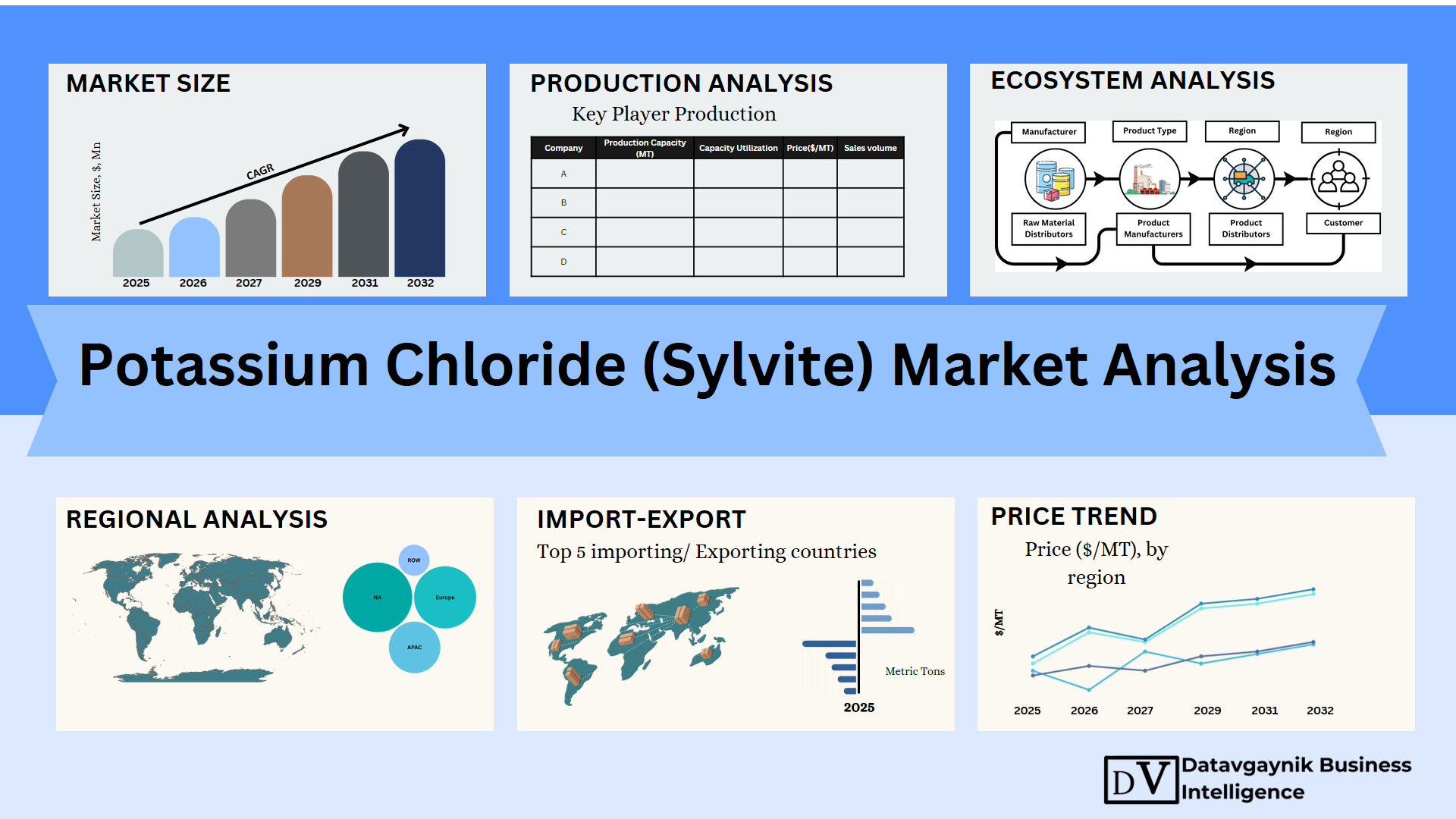
The Potassium Chloride (Sylvite) Market is undergoing substantial growth, driven by key demand factors across multiple sectors, notably agriculture, industry, and emerging economies. Potassium Chloride, a critical source of potassium, plays an essential role in enhancing agricultural productivity and is increasingly being adopted in industrial applications. The global market is evolving as various industries seek more efficient and sustainable solutions, propelling the Potassium Chloride (Sylvite) Market to new heights. Let’s explore some of the most significant drivers and trends influencing this market.
Agricultural Demand: A Critical Driver of Potassium Chloride (Sylvite) Market Growth
One of the primary factors fueling the Potassium Chloride (Sylvite) Market is the growing demand for potassium-based fertilizers, which are crucial for improving crop yields. Potassium Chloride is a key ingredient in fertilizers, helping to improve plant health, resistance to disease, and drought tolerance.
As the global population continues to rise, reaching an estimated 9.7 billion by 2050, the need for food production is becoming more critical. For instance, the increasing pressure on the agricultural sector to enhance productivity and meet food security goals is driving the adoption of fertilizers like Potassium Chloride. The global fertilizer market size, which is a direct contributor to the Potassium Chloride (Sylvite) Market, is projected to reach approximately USD 200 billion by 2025, with a significant share of this demand being met by Potassium Chloride.
The rising demand for food is not just restricted to population growth but also stems from changes in dietary patterns, especially in developing countries where urbanization is on the rise. Increased meat and dairy consumption, which requires more feed crops, further intensifies the need for fertilizers. Potassium Chloride’s role in ensuring optimal nutrient supply to crops in both developed and emerging agricultural economies is a pivotal driver in the market’s expansion.
Datavagyanik also covers related markets such as the Sylvite (Potassium Chloride Mix) Market, the Carnallite (Potassium Magnesium Chloride) Market, and the Potassium Sulfate Market. These compounds are commonly used in oxidation systems and industrial chemical processing, supporting shifts in formulation standards and regulatory compliance.
Technological Advancements in Fertilizer Application: Boosting Potassium Chloride (Sylvite) Market Demand
The advancement in fertilizer application technology is playing an important role in shaping the future of the Potassium Chloride (Sylvite) Market. Controlled-release fertilizers and improved soil management practices are increasing the efficiency of Potassium Chloride application, reducing waste and enhancing crop yields. For example, technologies such as precision agriculture enable the use of Potassium Chloride in a more targeted and efficient manner, optimizing the amount of fertilizer applied based on specific crop and soil needs. This not only boosts crop productivity but also reduces environmental impacts, particularly nutrient runoff.
In addition, innovations in fertigation—the process of delivering fertilizers through irrigation systems—have further propelled the demand for Potassium Chloride. According to recent statistics, the global fertigation market is expected to grow at a compound annual growth rate (CAGR) of 12% through 2030, driven by its ability to optimize resource use and enhance agricultural productivity. As more farmers adopt these advanced agricultural practices, Potassium Chloride’s role in improving soil health and crop resilience becomes even more critical, positioning it as a cornerstone in modern farming techniques.
Increasing Focus on Soil Fertility Management: Supporting Potassium Chloride (Sylvite) Market Growth
Soil fertility is an ongoing concern for farmers worldwide. Many regions, particularly those with intensive farming systems, are experiencing soil depletion and nutrient deficiencies. Potassium Chloride plays a key role in replenishing these nutrients and improving soil structure. As agricultural practices evolve to address these issues, the demand for Potassium Chloride (Sylvite) is rising.
For instance, in regions with intensive crop cultivation, such as parts of Asia and North America, Potassium Chloride is essential for maintaining optimal soil health and enhancing plant productivity. In the U.S., soil nutrient depletion has led to a strong reliance on Potassium Chloride-based fertilizers. According to the USDA, over 50 million acres of farmland in the U.S. require fertilization to ensure sustainable crop production, contributing to a significant demand for Potassium Chloride. The need for effective soil fertility management, especially in the face of climate change and shifting agricultural practices, ensures that Potassium Chloride will remain a vital product in the agricultural sector.
Industrial Applications of Potassium Chloride (Sylvite): A Growing Trend
While agriculture remains the dominant sector for Potassium Chloride (Sylvite) use, industrial applications are also becoming increasingly important. Potassium Chloride is a critical raw material in the production of potassium hydroxide, potassium sulfate, and other potassium-based chemicals. These chemicals are essential in various industries, including soap manufacturing, detergent production, and the chemical processing sector.
For example, the demand for Potassium Chloride in the production of potassium hydroxide, which is used in manufacturing products such as soaps and detergents, is growing as the global cleaning products market expands. According to industry reports, the global market for cleaning products is expected to grow at a CAGR of 5.6% from 2021 to 2028, further driving the need for potassium-based chemicals. Additionally, Potassium Chloride is crucial in water treatment processes, where it is used for softening water and treating wastewater, expanding its utility beyond agriculture.
As industrialization continues, especially in emerging economies, the industrial applications of Potassium Chloride are expected to increase, diversifying its market reach and creating new opportunities for growth.
Growing Demand in Emerging Economies: Potassium Chloride (Sylvite) Market Expansion
Emerging economies, particularly in Asia, Latin America, and parts of Africa, are contributing significantly to the growth of the Potassium Chloride (Sylvite) Market. As these regions experience rapid economic development and industrial expansion, the demand for fertilizers and industrial chemicals, including Potassium Chloride, is on the rise. In Asia, countries like China and India are seeing an increasing need for Potassium Chloride as they work to meet the food production demands of their growing populations.
China, as the largest global consumer of fertilizers, has a significant demand for Potassium Chloride. The country’s agricultural sector, which faces challenges such as soil degradation and nutrient depletion, is heavily reliant on potassium fertilizers to ensure the health and productivity of its crops. India, with its vast agricultural base, is also experiencing a surge in demand for Potassium Chloride-based fertilizers, driven by government initiatives aimed at boosting crop yields and ensuring food security.
Similarly, in Latin America, Brazil’s expansive agricultural sector, particularly in the production of soybeans, is contributing to the growing Potassium Chloride demand. Brazil’s agricultural exports, which account for a significant share of the country’s economy, require the use of efficient fertilizers like Potassium Chloride to optimize crop yields. The trend of increasing industrialization and agricultural development in these regions will continue to expand the global Potassium Chloride (Sylvite) Market.
Sustainability and Environmental Awareness: Shaping the Potassium Chloride (Sylvite) Market
The growing focus on sustainability is also impacting the Potassium Chloride (Sylvite) Market, especially as governments and industries seek environmentally friendly solutions to agricultural challenges. Sustainable farming practices that prioritize efficient fertilizer use, such as precision agriculture, are becoming more widespread. These practices help reduce fertilizer waste, lower environmental impacts, and improve soil health, ensuring that Potassium Chloride continues to play a key role in modern farming.
For instance, the European Union’s “Farm to Fork” strategy aims to reduce the environmental footprint of agriculture, including fertilizer use, while increasing food production. As part of this initiative, the EU is investing in technologies that improve the efficiency of fertilizers like Potassium Chloride. This shift toward sustainable practices is further driving demand for Potassium Chloride-based fertilizers, as they help optimize crop production while minimizing negative environmental impacts.
In addition, increasing consumer awareness of sustainable farming practices and the environmental consequences of excessive fertilizer use is influencing demand. The global trend toward sustainable and eco-conscious farming will continue to drive innovation and the adoption of efficient Potassium Chloride applications in both developed and developing markets.
Conclusion: Potassium Chloride (Sylvite) Market Outlook
The Potassium Chloride (Sylvite) Market is experiencing robust growth, driven by several key factors, including rising agricultural demand, technological advancements, industrial applications, and the increasing emphasis on sustainability. As the global population grows, the need for efficient agricultural solutions to ensure food security becomes even more pressing. Potassium Chloride’s vital role in enhancing crop yield, improving soil health, and contributing to industrial processes ensures that its demand will continue to rise.
Emerging economies in Asia, Latin America, and parts of Africa will be key drivers in the expansion of the Potassium Chloride (Sylvite) Market, as their agricultural sectors grow and industrialization accelerates. Additionally, the increasing focus on sustainable practices and efficient fertilizer application technologies will continue to shape the market in the coming years. Companies that innovate and invest in sustainable, eco-friendly solutions are poised to capitalize on the growing opportunities in the Potassium Chloride (Sylvite) Market.
“Track Country-wise Potassium Chloride (Sylvite) Production and Demand through our Potassium Chloride (Sylvite) Production Database”
-
-
- Potassium Chloride (Sylvite) production database for 24+ countries worldwide
- Potassium Chloride (Sylvite) sales volume for 29+ countries
- Country-wise Potassium Chloride (Sylvite) production capacity, production plant mapping, production capacity utilization for 24+ manufacturers
- Potassium Chloride (Sylvite) production plants and production plant capacity analysis by top manufacturers
-
“Track real-time Potassium Chloride (Sylvite) Prices, Potassium Chloride (Sylvite) price charts for 24+ countries, Potassium Chloride (Sylvite) weekly price tracker and Potassium Chloride (Sylvite) monthly price tracker”
-
-
- Track real-time Potassium Chloride (Sylvite) prices and Potassium Chloride (Sylvite) price trend in 24+ countries though our excel-based Potassium Chloride (Sylvite) price charts
- Real-time Potassium Chloride (Sylvite) price tracker dashboard with 24+ countries
- Complete transparency on Potassium Chloride (Sylvite) price trend through our Potassium Chloride (Sylvite) monthly price tracker, Potassium Chloride (Sylvite) weekly price tracker
-
Geographical Demand for Potassium Chloride (Sylvite) Market
The global Potassium Chloride (Sylvite) Market has experienced substantial growth across various regions, driven by demand for fertilizers, industrial applications, and environmental concerns. Potassium Chloride remains a vital commodity, especially in regions with large-scale agricultural activities. As crop production becomes increasingly critical to meet the growing demands of the global population, the demand for Potassium Chloride (Sylvite) is intensifying across diverse geographical markets.
North America: Potassium Chloride (Sylvite) Market Demand
In North America, the United States and Canada dominate the Potassium Chloride (Sylvite) Market, particularly in agricultural applications. As one of the world’s largest producers of grains, vegetables, and fruits, North America’s reliance on fertilizers to maintain soil health and enhance crop yields is paramount. The U.S. alone is responsible for a significant portion of global fertilizer consumption, with Potassium Chloride playing a critical role in enhancing crop resilience and boosting yield.
For instance, the demand for Potassium Chloride in U.S. agriculture is directly linked to growing food production requirements and crop diversification. The rise in organic farming, which demands more efficient fertilization, has further fueled the Potassium Chloride (Sylvite) Market in the region. In Canada, the demand is equally strong, especially with the country’s vast agricultural land dedicated to wheat, canola, and corn. The agricultural demand for Potassium Chloride in these areas is expected to grow consistently, supported by government incentives for sustainable farming practices.
Latin America: Potassium Chloride (Sylvite) Market Expansion
In Latin America, the Potassium Chloride (Sylvite) Market is witnessing robust growth, primarily driven by agricultural demand. Brazil, Argentina, and Mexico are the key players in this market due to their vast agricultural exports, particularly in soybeans, corn, and other staple crops. Brazil stands as one of the largest producers and exporters of soybeans, a crop that heavily relies on potassium-rich fertilizers like Potassium Chloride. The country’s expanding agricultural base has fueled the demand for high-quality fertilizers, boosting the overall growth of the Potassium Chloride (Sylvite) Market.
According to Datavagyanik, Brazil’s agriculture sector saw a 10% increase in fertilizer consumption in 2023 alone, with a substantial portion allocated to Potassium Chloride. Argentina and Mexico, with their increasing focus on agricultural modernization, also contribute to the rising demand for Potassium Chloride-based fertilizers. As Latin America continues to invest in advanced farming technologies, such as precision farming and smart irrigation systems, the need for efficient fertilizers like Potassium Chloride will continue to grow, ensuring a steady expansion of the market.
Europe: Potassium Chloride (Sylvite) Market Trends
Europe’s Potassium Chloride (Sylvite) Market is marked by a dual focus on agricultural sustainability and industrial demand. Countries like Germany, France, and Russia play a pivotal role in shaping the European market. Germany, with its strong agricultural sector, requires Potassium Chloride to enhance crop productivity, particularly in grain and vegetable farming. The country’s agricultural output relies heavily on fertilizers to meet both domestic and export demands, and Potassium Chloride is central to this process.
In France, agriculture is deeply integrated into the national economy, with a significant demand for Potassium Chloride in the production of wine and other crops. Similarly, Russia, with its large-scale farming activities, is also seeing a marked increase in Potassium Chloride demand. The country’s modernized agricultural methods, alongside its vast crop-growing regions, contribute to the need for potassium-based fertilizers, including Potassium Chloride. Additionally, the European Union’s emphasis on sustainable agriculture is further driving the use of controlled-release fertilizers, which include Potassium Chloride, to reduce environmental impact and increase nutrient uptake.
Asia Pacific: Potassium Chloride (Sylvite) Market Growth and Demand
The Asia Pacific region remains one of the most significant drivers of the Potassium Chloride (Sylvite) Market, with countries like China, India, and Indonesia leading the demand. China, as the world’s largest consumer and producer of fertilizers, has a substantial need for Potassium Chloride to maintain soil health and boost agricultural productivity. With its vast agricultural base, including rice, wheat, and vegetables, China’s increasing dependence on potassium fertilizers is pushing Potassium Chloride consumption to new heights.
India, similarly, is seeing a surge in demand for Potassium Chloride as it focuses on increasing food production to meet its growing population. The Indian government’s initiatives to enhance food security, combined with a growing focus on sustainable farming practices, have led to an increase in the use of Potassium Chloride-based fertilizers. Southeast Asia, with nations like Indonesia and Thailand, is also experiencing rapid agricultural expansion, particularly in cash crops such as palm oil, rubber, and rice. The region’s agricultural needs are fueling demand for Potassium Chloride, which is expected to grow steadily in the coming years.
Middle East and Africa: Potassium Chloride (Sylvite) Market Potential
In the Middle East and Africa, the Potassium Chloride (Sylvite) Market is expanding as a result of the growing need for fertilizers in arid and semi-arid regions. Countries like Saudi Arabia, Egypt, and South Africa have seen increased reliance on Potassium Chloride to enhance agricultural productivity in regions with limited arable land. Saudi Arabia, for example, has made significant strides in modernizing its agricultural practices, particularly in desert farming. The country’s reliance on Potassium Chloride to improve soil fertility and boost crop yields has grown substantially.
Similarly, Egypt, with its vast irrigation-based agriculture, heavily depends on Potassium Chloride to maintain soil fertility and support crop production, particularly for wheat and rice. The country’s agricultural reforms, aimed at improving food security, are expected to drive further growth in the demand for Potassium Chloride. In Africa, nations like South Africa and Kenya are seeing increased use of fertilizers, including Potassium Chloride, to improve food production and meet domestic consumption needs.
Potassium Chloride (Sylvite) Market Segmentation
The Potassium Chloride (Sylvite) Market is segmented based on grade, application, and end-use industry, each contributing significantly to the market’s expansion.
Potassium Chloride (Sylvite) Market by Grade
The Potassium Chloride (Sylvite) Market is typically divided into industrial-grade, food-grade, and pharmaceutical-grade categories, each serving specific purposes.
- Industrial-grade Potassium Chloride is used in the chemical industry to produce potassium hydroxide, potassium sulfate, and other potassium-based chemicals. The growing demand for these chemicals, used in manufacturing products like soaps, detergents, and specialty chemicals, is driving the market for industrial-grade Potassium Chloride.
- Food-grade Potassium Chloride is used primarily as a salt substitute and preservative in the food processing industry. The increasing consumer demand for healthier, lower-sodium food alternatives is boosting the demand for food-grade Potassium Chloride.
- Pharmaceutical-grade Potassium Chloride is used in medical applications, such as intravenous solutions and dietary supplements. The rising health consciousness and an increase in potassium deficiency-related conditions are supporting the growth of this segment.
Potassium Chloride (Sylvite) Market by Application
The Potassium Chloride (Sylvite) Market is also segmented by application, with significant demand arising from fertilizers, water treatment, de-icing, and industrial uses.
- Fertilizers: As the largest application segment, fertilizers are the major driver of the Potassium Chloride (Sylvite) Market. With global population growth and the increasing need for food security, the demand for potassium-based fertilizers is surging. Potassium Chloride is critical for improving crop yield and enhancing plant health.
- Water Treatment: Potassium Chloride is used in water softening and reverse osmosis processes. With growing concerns over water scarcity and the need for improved water management, the demand for Potassium Chloride in water treatment applications is on the rise.
- De-icing: Potassium Chloride is used extensively in de-icing roads and highways in colder regions. The increasing frequency of winter storms, particularly in North America and Europe, is boosting the demand for de-icing products.
Potassium Chloride (Sylvite) Market by End-Use Industry
The Potassium Chloride (Sylvite) Market’s end-use industries include agriculture, chemicals, pharmaceuticals, and food and beverages.
- Agriculture: The agriculture sector remains the largest consumer of Potassium Chloride, primarily for use as a fertilizer to enhance soil fertility and improve crop yields.
- Chemicals: Potassium Chloride is used in the production of potassium-based chemicals, which are vital for the manufacturing of a wide range of industrial products.
- Pharmaceuticals: The demand for Potassium Chloride in the pharmaceutical sector is rising due to its use in potassium supplements and intravenous fluids.
Potassium Chloride (Sylvite) Price Trends
The price trends of Potassium Chloride (Sylvite) have been influenced by several factors, including raw material costs, production capacity, and global supply-demand dynamics. In recent years, the Potassium Chloride (Sylvite) Price has seen fluctuations due to variations in raw material availability and geopolitical factors affecting major producing countries.
For instance, in 2023, the Potassium Chloride (Sylvite) Price saw an upward trend as key production regions like Canada and Russia experienced logistical challenges. These challenges, combined with increased global demand, led to a rise in prices. Similarly, price trends for Potassium Chloride are expected to remain volatile, particularly as demand from emerging markets increases, placing pressure on existing supply chains.
The Potassium Chloride (Sylvite) Price Trend in 2024 is expected to be influenced by factors such as crop production cycles, government policies in major agricultural markets, and fluctuations in transportation and mining costs. As countries increasingly focus on sustainability, there is also potential for price stability through innovations in fertilizer application and more efficient production methods.
Conclusion: Potassium Chloride (Sylvite) Market Outlook
The Potassium Chloride (Sylvite) Market is set for continued growth, driven by regional demand, technological advancements, and the expansion of agricultural and industrial applications. As various geographical regions invest in agricultural productivity and sustainability, the market for Potassium Chloride will continue to evolve, with emerging markets in Asia, Latin America, and Africa becoming increasingly important players. The price trends for Potassium Chloride will remain dynamic, influenced by global supply and demand patterns, technological innovation, and geopolitical developments.
“Potassium Chloride (Sylvite) Manufacturing Database, Potassium Chloride (Sylvite) Manufacturing Capacity”
-
-
- Potassium Chloride (Sylvite) top manufacturers market share for 24+ manufacturers
- Top 7 manufacturers and top 14 manufacturers of Potassium Chloride (Sylvite) in North America, Europe, Asia Pacific
- Potassium Chloride (Sylvite) production plant capacity by manufacturers and Potassium Chloride (Sylvite) production data for 24+ market players
- Potassium Chloride (Sylvite) production dashboard, Potassium Chloride (Sylvite) production data in excel format
-
“Potassium Chloride (Sylvite) price charts, Potassium Chloride (Sylvite) weekly price tracker and Potassium Chloride (Sylvite) monthly price tracker”
-
-
- Factors impacting real-time Potassium Chloride (Sylvite) prices in 19+ countries worldwide
- Potassium Chloride (Sylvite) monthly price tracker, Potassium Chloride (Sylvite) weekly price tracker
- Real-time Potassium Chloride (Sylvite) price trend, Potassium Chloride (Sylvite) price charts, news and updates
- Tracking Potassium Chloride (Sylvite) price fluctuations
-
Top Manufacturers in the Potassium Chloride (Sylvite) Market
The global Potassium Chloride (Sylvite) Market is led by several key manufacturers, each playing a significant role in meeting the rising demand for potassium-based fertilizers, chemicals, and other industrial applications. These companies not only dominate production but also drive innovations that improve product quality and environmental sustainability.
1. Nutrien Ltd.
As one of the largest producers of Potassium Chloride (Sylvite) in the world, Nutrien Ltd. commands a significant share of the global market. With a diverse range of operations across agriculture, chemicals, and retail, Nutrien is a key player in the Potassium Chloride (Sylvite) industry. The company’s product lines include premium grades of Potassium Chloride, marketed under various brand names for use in agriculture, industrial applications, and food processing. Nutrien’s focus on efficient production techniques, particularly through its advanced potash mining operations in Canada, has helped solidify its leadership position.
Nutrien has consistently expanded its global footprint, with substantial investments in emerging markets in Latin America and Asia, ensuring the continued growth of the Potassium Chloride (Sylvite) Market. The company’s commitment to sustainability, combined with the integration of smart farming practices and precision agriculture, allows it to maintain a stronghold in both developed and developing regions.
2. The Mosaic Company
The Mosaic Company is another key manufacturer of Potassium Chloride (Sylvite), recognized for its high-quality potash products used across the globe. Mosaic’s Potassium Chloride offerings include several grades tailored to different agricultural needs, including soil-specific and controlled-release formulations. As a major player in North America and Latin America, Mosaic’s market share is propelled by its robust distribution network and continuous expansion into international markets.
Mosaic operates primarily in North America, South America, and Asia, where it maintains a steady market share. Their strategic alliances with local distributors in key agricultural regions enable them to stay competitive in the global market, while their significant research and development efforts continue to enhance the efficacy of Potassium Chloride in various applications, from traditional farming to industrial and environmental uses.
3. K+S AG
K+S AG is a leading global supplier of potassium-based fertilizers, including Potassium Chloride (Sylvite), with operations that span across Europe, North America, and South America. The company’s portfolio includes high-quality Potassium Chloride products aimed at enhancing agricultural productivity and promoting sustainable farming practices. K+S AG’s product lines feature several grades of Potassium Chloride, optimized for different types of crops and soil conditions.
In addition to its core Potassium Chloride business, K+S AG is deeply involved in environmental management and the development of eco-friendly fertilizers, making it a prominent player in the green fertilizer market. With mining operations in Europe and North America, K+S AG continues to expand its presence in emerging agricultural markets, particularly in Asia and the Middle East, where demand for fertilizers is surging.
4. Uralkali
Uralkali is one of the largest producers of Potassium Chloride (Sylvite) globally, with its operations based primarily in Russia. The company holds a significant market share, largely due to its extensive potash reserves in the Perm region, making it a dominant force in the global supply of Potassium Chloride. Uralkali’s products include a variety of Potassium Chloride grades, tailored for both agricultural and industrial applications.
Uralkali’s Potassium Chloride products are widely used in agriculture, especially in countries with large-scale crop production, such as India, China, and Brazil. The company is also a major player in the global chemical industry, producing potassium-based chemicals used in water treatment and other industrial processes. With a stronghold in the Eurasian market, Uralkali continues to expand its international presence through partnerships and strategic investments in global markets.
5. Belaruskali
Belaruskali, a state-owned enterprise based in Belarus, is one of the world’s leading producers of Potassium Chloride. The company holds a substantial share of the global market, particularly in the agricultural sector. Belaruskali’s Potassium Chloride products are marketed under various brand names and are well-regarded for their high quality and consistent supply.
With significant production capacity and a strong domestic market presence, Belaruskali plays an influential role in shaping the global Potassium Chloride (Sylvite) price trends. The company has a well-established distribution network that extends throughout Europe, Asia, and Africa, with increasing penetration into North and South American markets. Belaruskali has also focused on sustainable practices and efficient production methods to meet the growing demand for Potassium Chloride while minimizing environmental impact.
6. Israel Chemicals Limited (ICL)
Israel Chemicals Limited (ICL) is a global manufacturer of a range of agricultural and industrial products, including Potassium Chloride (Sylvite). The company’s products are designed to improve crop yields, enhance soil health, and support industrial processes. ICL’s Potassium Chloride products are marketed for use in fertilizers, particularly in regions with challenging soil conditions or high crop demand.
ICL’s extensive product portfolio includes various grades of Potassium Chloride suitable for agricultural and industrial use. The company’s focus on innovation and technology-driven solutions has made it a preferred supplier in regions like North America, Europe, and Asia. With a growing emphasis on sustainability and water management, ICL continues to make strides in offering eco-friendly solutions in the Potassium Chloride market.
Potassium Chloride (Sylvite) Market Share by Manufacturers
The Potassium Chloride (Sylvite) Market is highly concentrated, with a few large companies dominating the landscape. Nutrien Ltd., Mosaic, and K+S AG hold the largest shares in the market, collectively controlling a significant portion of global Potassium Chloride production. These companies benefit from extensive distribution networks, production capabilities, and strong relationships with agricultural sectors worldwide.
Uralkali and Belaruskali, despite operating in more specific geographic regions, remain dominant players in the global market. Their vast reserves of potash and large-scale production facilities allow them to supply Potassium Chloride at competitive prices, making them important contributors to global market share.
Smaller players, while accounting for a smaller portion of the market, are also making their mark by focusing on niche products, such as specialty Potassium Chloride formulations for organic farming or controlled-release fertilizers. The rise of sustainable farming practices and precision agriculture has opened the door for these companies to increase their market share by providing customized solutions for diverse agricultural needs.
Recent News and Industry Developments
In recent months, several significant developments have shaped the Potassium Chloride (Sylvite) Market:
- Mosaic’s Sustainability Initiatives (February 2024): Mosaic has committed to reducing its carbon footprint by 30% by 2030. The company is focusing on sustainable mining practices and energy-efficient technologies to meet the increasing global demand for Potassium Chloride while minimizing environmental impact. This commitment aligns with the company’s broader sustainability goals and positions it as a key player in the environmentally-conscious segment of the Potassium Chloride market.
- Uralkali’s Expansion in Asia (March 2024): Uralkali has announced an expansion of its distribution operations in China and India. As demand for Potassium Chloride increases in these rapidly growing agricultural markets, Uralkali is positioning itself to capitalize on new opportunities. The company aims to increase its market share in Asia by establishing local distribution centers and improving supply chain logistics.
- Belaruskali’s Strategic Partnerships (April 2024): Belaruskali has entered into a strategic partnership with a leading agricultural technology firm to develop precision fertilizers that optimize Potassium Chloride usage. This collaboration will focus on creating controlled-release fertilizers that improve nutrient efficiency and reduce environmental impacts, further driving demand for Potassium Chloride in sustainable farming applications.
“Potassium Chloride (Sylvite) Production Data and Potassium Chloride (Sylvite) Production Trend, Potassium Chloride (Sylvite) Production Database and forecast”
-
-
- Potassium Chloride (Sylvite) production database for historical years, 10 years historical data
- Potassium Chloride (Sylvite) production data and forecast for next 7 years
- Potassium Chloride (Sylvite) sales volume by manufacturers
-
“Track Real-time Potassium Chloride (Sylvite) Prices for purchase and sales contracts, Potassium Chloride (Sylvite) price charts, Potassium Chloride (Sylvite) weekly price tracker and Potassium Chloride (Sylvite) monthly price tracker”
-
-
- Gain control on your purchase and sales contracts through our real-time Potassium Chloride (Sylvite) price tracker and Potassium Chloride (Sylvite) price trend analysis
- Potassium Chloride (Sylvite) weekly price tracker and forecast for next four weeks
- Potassium Chloride (Sylvite) monthly price tracker and forecast for next two months
-
Market Scenario, Demand vs Supply, Average Product Price, Import vs Export, till 2032
- Global Potassium Chloride (Sylvite) Market revenue and demand by region
- Global Potassium Chloride (Sylvite) Market production and sales volume
- United States Potassium Chloride (Sylvite) Market revenue size and demand by country
- Europe Potassium Chloride (Sylvite) Market revenue size and demand by country
- Asia Pacific Potassium Chloride (Sylvite) Market revenue size and demand by country
- Middle East & Africa Potassium Chloride (Sylvite) Market revenue size and demand by country
- Latin America Potassium Chloride (Sylvite) Market revenue size and demand by
- Import-export scenario – United States, Europe, APAC, Latin America, Middle East & Africa
- Average product price – United States, Europe, APAC, Latin America, Middle East & Africa
- Market player analysis, competitive scenario, market share analysis
- Business opportunity analysis
Key questions answered in the Global Potassium Chloride (Sylvite) Market Analysis Report:
- What is the market size for Potassium Chloride (Sylvite) in United States, Europe, APAC, Middle East & Africa, Latin America?
- What is the yearly sales volume of Potassium Chloride (Sylvite) and how is the demand rising?
- Who are the top market players by market share, in each product segment?
- Which is the fastest growing business/ product segment?
- What should be the business strategies and Go to Market strategies?
The report covers Potassium Chloride (Sylvite) Market revenue, Production, Sales volume, by regions, (further split into countries):
- Asia Pacific (China, Japan, South Korea, India, Indonesia, Vietnam, Rest of APAC)
- Europe (UK, Germany, France, Italy, Spain, Benelux, Poland, Rest of Europe)
- North America (United States, Canada, Mexico)
- Latin America (Brazil, Argentina, Rest of Latin America)
- Middle East & Africa
Table of Contents:
Potassium Chloride (Sylvite) Market: Trends, Insights, and Forecasts
- Introduction to Potassium Chloride (Sylvite)
-
- Overview of Potassium Chloride and Its Chemical Composition
- Historical Significance and Applications of Sylvite in Various Industries
- Scope and Objectives of the Market Research
- Market Segmentation
-
- By Type (Industrial Grade Potassium Chloride, Agricultural Grade Potassium Chloride)
- By Application (Fertilizers, Chemical Manufacturing, Pharmaceuticals, Water Treatment)
- By End-Use Industry (Agriculture, Chemicals, Pharmaceuticals, Industrial Applications)
- Global Potassium Chloride Market Overview (2015-2035)
-
- Market Growth Trends and Historical Analysis
- Key Drivers and Influencers in the Potassium Chloride Market
- Market Challenges and Opportunities
- Demand and Supply Dynamics
-
- Key Demand Drivers in Agriculture, Fertilizer Production, and Chemicals
- Global Supply Chain and Major Manufacturers
- Raw Material Sourcing, Production, and Market Availability
- Regional Market Insights
-
- North America
- Applications in Fertilizers, Water Treatment, and Chemical Manufacturing
- Market Trends and Regulatory Landscape
- Europe
- Market Dynamics in Agriculture and Fertilizer Use
- Policy Impacts and Sustainability Trends in Chemical Production
- Asia Pacific
- Expanding Demand in Agricultural and Chemical Sectors
- Key Growth Markets in China, India, and Southeast Asia
- Latin America
- Regional Market Insights and Growing Use in Agriculture
- Opportunities for Potassium Chloride in Industrial and Chemical Applications
- Middle East & Africa
- Demand for Potassium Chloride in Agriculture and Industrial Applications
- Regional Market Development and Emerging Trends
- North America
- Production and Manufacturing Insights
-
- Methods of Potassium Chloride Extraction and Processing
- Key Manufacturers and Market Share Analysis
- Innovations in Potassium Chloride Mining and Production
- Competitive Landscape
-
- Leading Players in the Potassium Chloride Market
- Competitive Positioning and Market Share Distribution
- Strategic Focus on R&D, Product Development, and Market Expansion
- Pricing Trends and Economic Insights
-
- Historical Pricing Trends (2015-2024)
- Factors Influencing Price Movements in Potassium Chloride
- Price Forecasts and Economic Outlook for 2025-2035
- Applications of Potassium Chloride
-
- Fertilizers: Role in Nutrient Enrichment for Crop Yield
- Chemical Manufacturing: Use in Potash and Other Chemical Derivatives
- Pharmaceuticals: Contribution to Medical Solutions and Supplements
- Water Treatment: Potassium Chloride in Softening and Purification Processes
- Sustainability and Environmental Impact
-
- Environmental Concerns in Potassium Chloride Mining and Production
- Innovations in Eco-friendly Extraction and Sustainable Practices
- Regulatory Compliance and Environmental Protection Standards
- Global Trade and Distribution Networks
-
- Key Exporting and Importing Regions for Potassium Chloride
- Barriers to Trade and Market Access Considerations
- Distribution Channels and Logistics Challenges
- Consumer Insights and Market Behavior
-
- Shifting Demand in Agriculture, Industrial Chemicals, and Water Treatment
- Regional Consumption Patterns and Market Insights
- Increasing Preference for Sustainable and Efficient Products
- Technological Developments in Potassium Chloride
-
- Advances in Fertilizer Production and Chemical Manufacturing
- Role of Potassium Chloride in Green Technologies and Clean Energy
- Innovations in Water Treatment and Industrial Solutions
- Market Risks and Challenges
-
- Fluctuations in Raw Material Prices and Supply Chain Risks
- Regulatory Barriers and Compliance Costs
- Environmental and Health Risks in Potassium Chloride Mining and Use
- Growth Opportunities in the Potassium Chloride Market
-
- Expanding Applications in Agriculture and Fertilizer Production
- New Opportunities in Industrial and Chemical Manufacturing
- Growth in Emerging Economies and Technological Advancements
- Market Forecast and Projections (2025-2035)
-
- Revenue and Demand Projections by Region
- Application-Specific Growth Forecasts
- Long-Term Trends and Market Opportunities
- Sustainability and Circular Economy
-
- Role of Potassium Chloride in Sustainable Agriculture and Green Manufacturing
- Innovations in Recycling and Resource Efficiency
- Contribution to Circular Economy Models in Chemical and Agricultural Industries
- Value Chain and Stakeholder Analysis
-
- Key Stakeholders in the Potassium Chloride Value Chain
- Opportunities for Collaboration and Strategic Partnerships
- Role of Research Institutions, Governments, and Regulators
- Emerging Applications and Innovations
-
- New Uses in Agriculture, Green Chemistry, and Clean Energy
- Expanding Role in Fertilizers and Water Treatment Technologies
- Innovations in Potassium Chloride for Advanced Industrial and Environmental Solutions
- Appendix and Supporting Resources
-
- Glossary of Key Terms
- Research Methodology and Data Sources
- References and Further Reading

