

Market Summary and Growth Forecast
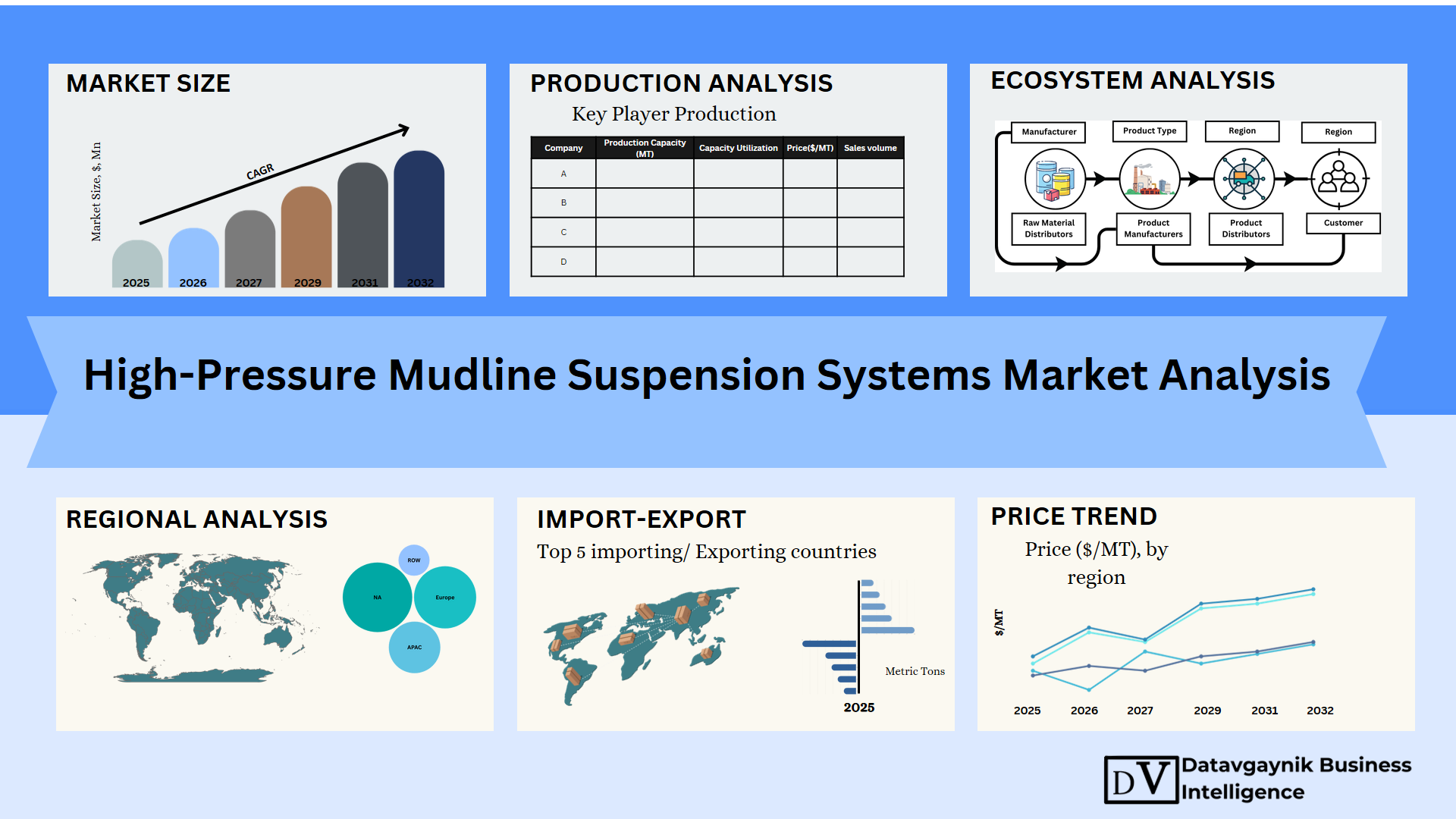
The global High-Pressure Mudline Suspension Systems Market is estimated at $365 million in 2026 and is expected to reach $612 million by 2035, growing at a CAGR of 5.9%.
High-pressure mudline suspension systems are used in offshore well construction to support casing strings at the mudline and maintain structural integrity during drilling, suspension, abandonment, and future tieback operations. In simple terms, they help operators keep the well architecture stable below the seabed while managing high-pressure conditions. That makes them a critical part of offshore development, especially where shallow-water jack-up drilling, subsea completions, and phased field development are used.
Datavagyanik also covers related markets such as the High-Pressure Gas Injection Systems Market and the High-Pressure Subsea Connectors Market. Each of these markets adds unique insights into end-user applications, regulatory influences, and competitive developments.
The business relevance of the High-Pressure Mudline Suspension Systems Market during 2026–2035 is tied to one clear reality: offshore operators are trying to extract more value from complex reservoirs without allowing well integrity risk to increase. This market is not a high-volume equipment category. It is a specialized wellhead and casing-support segment. But each system carries high technical value because failure risk is unacceptable. Operators pay for pressure rating, fatigue performance, material reliability, qualification history, and installation certainty.
Demand in 2026 is shaped by three clusters of activity. First, mature offshore basins are extending production through sidetracks, infill wells, and tieback-led development. Second, national oil companies are pushing offshore reserves to secure domestic energy supply. Third, international oil companies are favoring shorter-cycle offshore projects where existing infrastructure can be reused. Mudline suspension fits well in this operating model because it supports staged well construction and later completion flexibility.
The market also benefits from higher pressure and higher temperature drilling environments. Not every offshore well needs a high-pressure mudline system. But wells targeting deeper reservoirs, tighter pressure windows, or complex casing programs require stronger suspension and pressure containment capability. This is why demand is gradually shifting from standard systems toward 10,000 psi and 15,000 psi rated configurations. The pricing is higher. The engineering burden is also higher.
| Market Indicator | 2026 Estimate | 2035 Forecast | Strategic Meaning |
| Global market size | $365 million | $612 million | Niche but technically critical offshore equipment segment |
| CAGR | 5.9% | Growth supported by HPHT wells and offshore redevelopment | |
| Estimated annual system demand | 1,420–1,560 units | 2,050–2,230 units | Volume grows slower than revenue because ASP rises |
| Average system value range | $210,000–$380,000 | $260,000–$465,000 | Higher-pressure systems lift blended pricing |
| High-pressure rated systems share | ~58% of 2026 revenue | Hidden | Driven by deeper reservoirs and stricter well integrity standards |
Technology is a major force in this market. Operators are asking for systems that can reduce installation time, simplify tieback readiness, and maintain casing load performance under difficult seabed and reservoir conditions. Design improvements are focused on lockdown mechanisms, improved hanger profiles, better seal reliability, fatigue-resistant materials, and easier running tools. Suppliers that can reduce rig-time exposure without compromising qualification standards will stay better positioned.
Regulation is another influence, though it works indirectly. Offshore regulators have become more demanding on well integrity, pressure control, barrier philosophy, and abandonment planning. This pushes operators to document equipment qualification more carefully. It also favors proven suppliers. A low-cost system with weak field history is a hard sell in high-pressure offshore drilling. That said, price still matters. Procurement teams now compare lifecycle risk, not just equipment cost.
Production dynamics also matter. Mudline suspension systems rely on precision machining, alloy steel forgings, elastomeric and metal-to-metal sealing components, pressure testing, and traceable quality documentation. Lead times can stretch when offshore project sanctions rise at the same time across multiple regions. This may lead to longer supplier backlogs and stronger pricing power for qualified manufacturers. For project owners, early vendor engagement is becoming more important.
Key consumers and clients include offshore exploration and production companies, national oil companies, integrated oil majors, independent offshore operators, drilling contractors, wellhead system integrators, subsea equipment suppliers, and offshore EPC contractors. In practical terms, the buying decision is usually influenced by drilling teams, well engineering teams, supply-chain groups, and well integrity specialists. The end client may be an operator, but the technical specification often comes from the well design team.
Major client groups include Shell, bp, TotalEnergies, Chevron, ExxonMobil, Equinor, Petrobras, Saudi Aramco, ADNOC, QatarEnergy, Petronas, ONGC, and regional offshore independents. Equipment and service-side participation is typically linked to companies such as SLB, Baker Hughes, TechnipFMC, Dril-Quip, NOV, Plexus Holdings, and specialized wellhead engineering suppliers.
The High-Pressure Mudline Suspension Systems Market should therefore be viewed as a technical infrastructure market inside offshore drilling. It won’t behave like a commodity product category. Growth will follow offshore project sanctioning, HPHT drilling intensity, subsea tieback economics, and well integrity requirements. The strongest demand pockets are likely to come from the Gulf of Mexico, Brazil, the North Sea, West Africa, the Middle East offshore belt, India, Southeast Asia, and parts of Australia.
Expert view: The market’s real upside is not only from more offshore wells. It is from more demanding offshore wells. Higher casing loads, tighter pressure margins, and delayed tieback strategies all increase the value of qualified mudline suspension technology.
Market Segmentation and Forecast Scope
The High-Pressure Mudline Suspension Systems Market can be segmented by product type, pressure rating, application, water depth, end user, and region. This structure is practical because buying behavior changes depending on well pressure, drilling method, future tieback plans, and local offshore development models.
By Product Type
The market includes casing suspension systems, mudline hanger systems, tieback-ready mudline systems, temporary abandonment and re-entry systems, and integrated high-pressure mudline wellhead assemblies.
Casing suspension systems form the core of the market. They support casing strings at or near the mudline and allow the operator to continue drilling while maintaining well stability. These systems are widely used where operators want flexibility in offshore well construction.
Mudline hanger systems are used to suspend individual casing strings and transfer loads into the mudline wellhead structure. Their design is sensitive to casing weight, formation pressure, seabed conditions, and future access requirements.
Tieback-ready mudline systems are gaining more attention. These systems allow operators to drill wells first and complete or tie them back later when field economics are clearer. This is useful in phased offshore development. It also helps operators reduce upfront capital exposure.
Temporary abandonment and re-entry systems support wells that may be suspended before final completion. This segment is strategically important in areas where drilling campaigns are separated from production infrastructure installation.
Only one product-level share is disclosed here: tieback-ready mudline systems account for nearly 31% of 2026 revenue. This share is likely to expand because operators are using more phased development models in offshore fields.
By Pressure Rating
The pressure-rating segmentation includes 5,000 psi, 10,000 psi, 15,000 psi, and above 15,000 psi / custom HPHT systems.
5,000 psi systems remain relevant in lower-pressure offshore wells and legacy shallow-water projects. However, their revenue contribution is under pressure because operators increasingly prefer future-proofed designs where reservoir uncertainty exists.
10,000 psi systems represent the commercial center of the market. They provide a balance between technical capability, field-proven acceptance, and cost control.
15,000 psi systems are becoming more strategic as offshore wells move into higher-pressure formations. These systems require stronger materials, tighter qualification protocols, and more rigorous testing.
Above 15,000 psi / custom HPHT systems are still a smaller niche. But they carry high value per unit. They also create supplier differentiation because qualification expertise matters more than price.
The fastest-growing pressure category is expected to be 15,000 psi systems, supported by HPHT drilling programs and stricter well-control planning.
By Application
The application scope includes offshore exploration wells, development wells, subsea tieback wells, temporary abandonment wells, workover and re-entry programs, and field redevelopment wells.
Offshore exploration wells use mudline suspension systems when operators need safe casing support and future access flexibility. Demand here moves with exploration budgets and offshore licensing cycles.
Development wells represent a more predictable demand stream. These wells are linked to sanctioned offshore projects and multi-well drilling campaigns.
Subsea tieback wells are strategically important. Operators are prioritizing tiebacks because they can monetize discoveries faster by connecting to existing production facilities. Mudline systems support this model by keeping wells ready for future completion and connection.
Temporary abandonment wells require reliable suspension equipment because the well may remain idle before completion or decommissioning decisions are made.
Field redevelopment wells are a growing opportunity in mature offshore basins. Operators are re-entering fields with existing infrastructure. Mudline systems help maintain well architecture in these staged programs.
Only one application share is disclosed here: development wells represent around 46% of 2026 market revenue. This reflects the higher number of planned wells tied to offshore project execution rather than pure exploration.
By Water Depth
The market can be grouped into shallow water, mid-water, and deepwater / ultra-deepwater associated projects.
Shallow-water wells remain important because mudline suspension systems are commonly used in jack-up drilling environments. Many Middle East, India, Southeast Asia, and Gulf of Mexico shelf projects fall into this demand pool.
Mid-water projects provide steady demand where operators need flexible well construction but do not always require full deepwater subsea architecture.
Deepwater and ultra-deepwater associated projects are more selective. Mudline suspension is not used in every deepwater design. But when it is part of the well construction strategy, system value is higher because pressure, fatigue, and installation requirements become tougher.
The strategic growth area is not simply deepwater. It is high-pressure shallow-to-mid-water offshore drilling, where operators want proven technology and cost discipline at the same time.
By End User
End users include national oil companies, international oil companies, independent offshore operators, drilling contractors, and wellhead and subsea system integrators.
National oil companies are important because many offshore drilling programs are state-backed and linked to energy security. These buyers tend to prioritize proven qualification, local content, long-term service support, and supplier reliability.
International oil companies focus heavily on technical performance, lifecycle economics, and global frame agreements. They often set the specification standard for complex offshore wells.
Independent offshore operators are more cost-sensitive. They may adopt high-pressure systems where the reservoir case justifies it, but they still push for shorter lead times and competitive pricing.
Drilling contractors influence tool compatibility and running efficiency. They may not always be the final buyer, but their feedback can shape equipment selection.
System integrators matter because mudline suspension systems often need to align with broader wellhead and subsea equipment packages.
By Region
The regional scope covers North America, Europe, Asia Pacific, and LAMEA.
North America is driven mainly by the Gulf of Mexico. Demand is linked to offshore redevelopment, tieback activity, and high-pressure reservoirs. The region also favors high-specification equipment because regulatory scrutiny and technical standards are strict.
Europe is led by North Sea activity. The market is mature, but redevelopment, plug-and-abandonment planning, and selective new offshore drilling continue to create demand. Buyers in this region value reliability and documented field performance.
Asia Pacific includes India, Southeast Asia, China offshore, Australia, and parts of East Asia. This region has a mixed demand profile. Some projects are cost-driven shallow-water wells. Others require high-pressure systems due to more complex reservoirs.
LAMEA includes Latin America, the Middle East, and Africa. Brazil, West Africa, and the Middle East offshore belt are the most important demand centers. The Middle East supports shallow-water high-volume demand. Brazil and West Africa support technically demanding offshore programs.
The High-Pressure Mudline Suspension Systems Market is expected to see its fastest regional expansion in LAMEA, supported by offshore investments in Brazil, the Middle East, and West Africa. Asia Pacific should remain the second strategic growth pocket, particularly where India and Southeast Asia continue offshore development campaigns.
| Segmentation Dimension | Key Sub-Segments | Strategic Growth Signal |
| Product type | Casing suspension, mudline hanger, tieback-ready, temporary abandonment, integrated assemblies | Tieback-ready systems gain importance |
| Pressure rating | 5,000 psi, 10,000 psi, 15,000 psi, above 15,000 psi | 15,000 psi systems grow fastest |
| Application | Exploration, development, subsea tieback, temporary abandonment, re-entry, redevelopment | Development and tieback wells lead revenue |
| Water depth | Shallow water, mid-water, deepwater-linked projects | High-pressure shallow and mid-water wells remain attractive |
| End user | NOCs, IOCs, independents, drilling contractors, integrators | NOCs and IOCs set most technical requirements |
| Region | North America, Europe, Asia Pacific, LAMEA | LAMEA and Asia Pacific show stronger expansion |
Use case: An operator drilling a high-pressure offshore development well may use a tieback-ready mudline suspension system to drill and suspend the well first. Once production infrastructure is available, the same well can be re-entered and completed. This lowers upfront project risk and gives the operator more timing flexibility.
Market Trends and Innovation Landscape
The innovation landscape in the High-Pressure Mudline Suspension Systems Market is shaped by a simple engineering challenge: operators want safer wells, faster installation, and higher pressure capability without adding complexity offshore. That is not easy. Offshore rig time is expensive. Equipment failure is costly. So suppliers are working on incremental but valuable improvements rather than dramatic redesigns.
R&D Evolution: From Basic Suspension to Lifecycle Well Integrity
Earlier mudline systems were largely evaluated on mechanical suspension and casing support. That is no longer enough. R&D is now focused on lifecycle performance. The question is not only, “Can this system suspend casing?” The better question is, “Can it support drilling, suspension, re-entry, tieback, and eventual abandonment without integrity issues?”
This has shifted supplier investment toward qualification testing, load capacity optimization, seal-stack reliability, and compatibility with multiple casing programs. Operators also want better documentation. Traceability, pressure testing records, material certificates, and field history are becoming part of the commercial value proposition.
The most relevant R&D themes include higher casing load capacity, metal-to-metal seal reliability, fatigue-resistant hanger designs, compact running tools, improved lockdown mechanisms, and tieback interface standardization. These improvements are not flashy. But they reduce execution risk. That matters more than novelty in offshore drilling.
Technology Evolution: Faster Running and Better Re-Entry
The technology shift is moving toward systems that reduce rig-floor complexity. Running tools are becoming easier to operate. Interfaces are being designed for cleaner engagement. Locking and release mechanisms are being improved to reduce non-productive time.
This is important because the economic case for offshore drilling is heavily influenced by rig days. Even a small reduction in installation time can justify higher equipment pricing. For complex wells, the value of reliability can exceed the value of procurement savings.
Tieback readiness is another major technology theme. Operators increasingly want mudline systems that support staged development. This allows wells to be drilled before final production infrastructure is installed. It also supports appraisal-to-development transitions where reservoir understanding improves over time.
The High-Pressure Mudline Suspension Systems Market is therefore becoming more connected to offshore project flexibility. Systems that help operators defer completion decisions without compromising well integrity will remain attractive.
Material and Sealing Innovation
Material science is relevant here, but in a practical way. This is not a market driven by exotic material branding. It is driven by performance under pressure, load, corrosion, and fatigue.
High-strength alloy steels remain the backbone of the system. However, suppliers are improving heat treatment, coating selection, corrosion resistance, and seal material compatibility. HPHT conditions place greater stress on elastomers and sealing interfaces. This is pushing interest in metal-to-metal sealing and improved backup sealing designs.
Corrosion resistance is also gaining attention in offshore basins where sour service, CO₂ exposure, and saline environments can affect long-term equipment reliability. The system must perform during drilling and also remain dependable if the well is suspended for a long period before re-entry.
Material selection is therefore being shaped by three questions: Can the system handle pressure? Can it handle casing load? Can it remain reliable after long exposure in offshore conditions?
Digitalization and AI: Limited Direct Use, Strong Indirect Value
AI is not a core product feature in mudline suspension systems. These are mechanical pressure-control and casing-support systems, not software-led assets. So it would be inaccurate to present AI as a direct growth driver for the product itself.
That said, digital engineering has a growing indirect role. Suppliers and operators are using simulation tools, finite element analysis, digital qualification records, and predictive planning models to improve equipment selection and reduce design risk. AI may support engineering workflows, tender evaluation, inventory planning, and failure-mode analysis. But it is not transforming the installed product in the field.
Expert view: AI will not “reinvent” mudline suspension hardware. Its real value will sit behind the scenes. Better modeling, faster design validation, and smarter maintenance planning may shorten engineering cycles and reduce risk before equipment reaches the rig.
Partnerships and Commercial Announcements
Partnership activity in this market usually sits inside broader offshore drilling, wellhead, subsea, and field-development agreements. Dedicated mudline suspension announcements are less common because the product is often bundled into wider well construction packages.
Three types of partnerships are most relevant.
The first is operator-supplier technical collaboration. Operators work with qualified wellhead suppliers to adapt mudline systems for specific pressure ratings, casing programs, and tieback needs.
The second is drilling contractor alignment. Compatibility with rig equipment and running procedures matters. Suppliers that can work smoothly with drilling contractors reduce offshore execution risk.
The third is regional manufacturing and service partnerships. Local content requirements are increasing in several offshore regions. This may lead suppliers to expand machining, assembly, inspection, or service support closer to demand centers.
On the news side, recent industry announcements across the offshore equipment ecosystem have focused more on subsea tiebacks, HPHT field development, regional offshore licensing, and drilling campaign awards than on mudline systems alone. This still matters. Each offshore drilling campaign creates pull-through demand for casing suspension, wellhead, and re-entry equipment. So even when mudline systems are not named directly, they benefit from the same project cycle.
Companies such as SLB, Baker Hughes, TechnipFMC, Dril-Quip, NOV, Plexus Holdings, and specialized wellhead suppliers are likely to remain relevant to the competitive and technology landscape. Their positioning depends on pressure-rating capability, offshore track record, installation support, and ability to integrate with wider wellhead or subsea packages.
Strategic Trend Outlook
The strongest trend in the High-Pressure Mudline Suspension Systems Market is the move from standard offshore suspension hardware toward engineered, high-pressure, tieback-ready solutions. Operators are not simply buying equipment. They are buying assurance that the well can be drilled, suspended, accessed, and completed safely under a changing project schedule.
This may lead to a wider pricing gap between basic systems and qualified HPHT-capable systems. Suppliers with strong testing capacity, documented field performance, and regional service support should gain share. Smaller suppliers may still compete in standard pressure categories, but entry barriers rise sharply in 10,000 psi and 15,000 psi environments.
The market is also likely to see more modularity. Operators want systems that can work across multiple well designs with limited customization. Too much customization increases cost and lead time. Too little customization creates technical risk. The best-positioned suppliers will sit in the middle: standardized core platforms with engineered options for pressure rating, casing load, and tieback interface.
| Innovation Area | Current Direction | Likely Impact by 2035 |
| Pressure-rating upgrades | More 10,000 psi and 15,000 psi systems | Higher ASP and stronger supplier qualification barriers |
| Seal design | Improved metal-to-metal and backup sealing systems | Lower integrity risk in HPHT wells |
| Tieback-ready architecture | More re-entry and delayed completion capability | Better fit with phased offshore development |
| Running tool simplification | Faster and cleaner rig operations | Lower non-productive time |
| Digital engineering | Simulation, qualification records, design validation | Faster approvals and better equipment selection |
| Regional service models | Local inspection, assembly, and support | Better access to NOC-led offshore programs |
Expert view: By 2035, the winning suppliers will not be those offering the cheapest mudline suspension system. They’ll be the suppliers that help operators remove uncertainty from offshore well construction. That means proven pressure performance, field support, and compatibility with future tieback plans.
Competitive Intelligence and Benchmarking
Competition in this market is narrow. Buyers are not looking for generic offshore hardware. They need pressure-rated casing support, proven sealing behavior, installation reliability, and service response near active offshore basins. So, the supplier bench is led by companies with wellhead engineering depth, subsea qualification history, and field-service capability.
Key Company Benchmarking
| Company | Product Portfolio and Position | Competitive Reading |
| Innovex / Dril-Quip | Offers mudline suspension, subsea wellhead, casing connector, and liner-related equipment for offshore well construction. Its mudline suspension portfolio is one of the most directly relevant offerings in this niche because it is built around casing support at or near the mudline and disconnect / reconnect capability for offshore drilling programs. | Strong specialist position. Best placed where operators want proven mudline architecture and high technical assurance rather than broad package bundling. |
| SLB / OneSubsea | Competes through integrated subsea production and well-construction capability. OneSubsea combines the subsea businesses of SLB and Aker Solutions, backed by Subsea7, giving it strong access to deepwater projects and integrated subsea packages. | Strongest in complex subsea ecosystems. Less dependent on standalone mudline hardware because it can influence specifications through full-field subsea programs. |
| Baker Hughes | Provides subsea wellhead systems, subsea production systems, associated services, and offshore equipment support. Its positioning is strongest where operators require wellhead-to-tree integration, supplier scale, and long-term service coverage. | Strong global challenger. Benefits from large offshore programs, especially Brazil, the Gulf of Mexico, and fields where subsea trees and wellheads are procured together. |
| TechnipFMC | Offers wellhead systems and subsea drilling services with stated operating capabilities up to 20,000 psi and high-temperature service windows. Its strength sits in integrated subsea project execution, engineering, tooling, monitoring, and field support. | Very strong in high-spec offshore projects. More relevant where mudline suspension is part of a wider subsea or wellhead architecture rather than a standalone item. |
| NOV | Supplies pressure-control equipment, BOPs, risers, multiplex control systems, wellhead connectors, conductor connectors, and subsea-related systems. Its portfolio is adjacent to mudline suspension because it supports the broader rig, well-control, and casing-interface environment. | Strong adjacent player. Most competitive where rig systems, pressure control, and connector technology influence procurement decisions. |
| Plexus Holdings | Focuses on wellhead systems and sealing-led technology for jack-up and subsea applications. Its subsea conversion approach is relevant where pre-drilled wells using mudline equipment are later prepared for subsea production. | Niche technology player. Stronger in selected high-integrity wellhead applications than in broad-volume global supply. |
| Oil States International | Supplies wellhead connectors and offshore connection systems designed for demanding loads and remote subsea operation. Its role is more interface- and connector-led than full mudline system-led. | Important adjacent supplier. Useful in high-load offshore environments where connector reliability and subsea interface integrity are critical. |
Competitive Interpretation
Innovex / Dril-Quip has the clearest direct connection to mudline suspension. It is positioned as a focused wellhead and casing-support specialist. That gives it credibility in technical bids where the mudline system itself is central to the well design.
SLB / OneSubsea, Baker Hughes, and TechnipFMC compete from a broader systems angle. They can bundle wellheads, subsea trees, installation tooling, engineering services, and lifecycle support. This matters because large operators often prefer fewer interfaces on complex offshore programs.
NOV and Oil States International are more adjacent but still relevant. Their connector, pressure-control, and rig-interface technologies influence how offshore well systems are installed and operated. They may not always be specified as mudline suspension suppliers, but they sit close to the same engineering ecosystem.
Plexus Holdings is a specialist case. It does not compete mainly on scale. It competes on sealing integrity, jack-up wellhead use cases, and technology-led differentiation. That can be attractive where operators are sensitive to leakage risk and future re-entry needs.
| Competitive Factor | High-Value Supplier Requirement | Why It Matters |
| Pressure qualification | Proven performance in 10,000 psi, 15,000 psi, and higher-spec environments | Operators avoid unproven systems in high-pressure wells |
| Installation reliability | Clean running, lockdown, release, and re-entry performance | Reduces rig time and non-productive time |
| Tieback readiness | Ability to support future completion or subsea conversion | Fits phased offshore field development |
| Field support | Regional service teams near active offshore basins | Critical when rig operations cannot wait |
| Documentation | Material traceability, test records, and qualification files | Supports regulatory and well-integrity approval |
| Package integration | Compatibility with wellheads, trees, BOPs, and running tools | Reduces interface risk across contractors |
Expert view: The supplier that wins is not always the one with the lowest bid. In this category, buyers pay for confidence. A few hours saved offshore can outweigh a large difference in equipment price.
Regional Landscape and Adoption Outlook
Regional adoption is tied to offshore drilling intensity, pressure profile, rig type, local content rules, and operator appetite for staged field development. The strongest demand comes from basins where offshore wells are either high-pressure, tieback-led, or drilled through jack-up campaigns that need reliable casing support at the seabed.
United States
The United States remains one of the highest-value demand centers. The Gulf of Mexico is the key basin. Its demand profile is shaped by deepwater redevelopment, high-pressure reservoirs, subsea tiebacks, and strict well-integrity expectations.
The market is also benefiting from renewed ultra-high-pressure activity. Chevron’s Anchor development reached first oil in August 2024 using 20,000 psi subsea technology, which signals a wider technical shift toward higher-pressure offshore systems. bp’s Kaskida project, approved for investment in July 2024, also supports the future high-pressure equipment cycle in the Gulf.
Regulation is a double-edged force. It raises compliance costs, but it also favors qualified equipment suppliers. BOEM’s offshore lease-sale schedule and policy direction remain important for long-term drilling visibility.
Adoption outlook: High. The United States will stay a premium market for 15,000 psi and above-capable offshore well systems.
Europe
Europe is led by Norway and the United Kingdom. Norway has the stronger investment profile. The Norwegian Continental Shelf still has active production, redevelopment, and drilling work. At the end of 2025, Norway had 97 producing fields, with 69 in the North Sea.
Norway’s offshore spending remains relatively resilient. The Norwegian Petroleum Directorate projected $24 billion of investment in exploration, production, and pipeline transport on the Norwegian Continental Shelf in 2025, with $20–22 billion annually expected over the next couple of years.
The United Kingdom is more uncertain. New drilling is still possible, especially around existing fields, but climate policy and licensing scrutiny create a more selective project funnel.
Country-level leaders: Norway leads on stability and technical offshore activity. The United Kingdom remains relevant but is more policy-sensitive.
Adoption outlook: Moderate. Demand is strongest in redevelopment, re-entry, and selected high-integrity offshore wells.
China
China is a strategic growth market because domestic offshore production is expanding. CNOOC remains the central client and project driver. In 2025, CNOOC reported new discoveries and appraisals across the South China Sea, and brought several offshore development projects into operation.
The Bohai Sea is especially relevant for shallow-water and mid-water demand. CNOOC’s Kenli 10-2 development started production in July 2025 and is described as a large shallow offshore heavy crude project with major reserves.
China’s market is shaped by localization. Imported high-spec equipment may still be used where qualification matters, but domestic procurement preference will keep pressure on foreign suppliers. Local manufacturing partnerships and service bases will matter.
Adoption outlook: High. Growth will be driven by offshore drilling volume, domestic energy security, and shallow-water field development.
India
India is a smaller but important growth market. Demand is led by ONGC, offshore redevelopment, and deepwater exploration in the Krishna-Godavari basin. International collaboration is becoming more relevant because India needs technical support for complex offshore wells. In 2025, ExxonMobil, bp, and Shell were reported to be exploring potential collaboration with ONGC on a deep-sea drilling project in the KG basin.
India’s adoption curve is cost-sensitive. Operators need proven systems, but procurement pressure is intense. Local service support, price discipline, and compatibility with existing offshore drilling practices will influence supplier selection.
Infrastructure remains mixed. Western offshore fields are mature. Eastern offshore basins offer growth but need more technical investment. Funding is available through national energy-security priorities, but project execution can move slower than in the Gulf of Mexico or Norway.
Adoption outlook: Medium to high. Best opportunities sit in KG basin drilling, offshore redevelopment, and higher-spec wells requiring tieback or re-entry flexibility.
Japan
Japan has limited commercial offshore oil and gas demand compared with the United States, China, and the Middle East. Adoption is therefore low in volume. The country’s relevance is more strategic than immediate.
JOGMEC plays a central role in resource security, technical studies, and energy supply resilience. It supports exploration and resource-development initiatives, but Japan does not have the same offshore drilling base as China or India.
For this market, Japan is more likely to act as a niche buyer, technology participant, or engineering partner rather than a major demand pool. Some demand may come from offshore gas studies, imported technology evaluation, or Japanese participation in overseas offshore projects.
Adoption outlook: Low to moderate. Japan is not a volume market, but it may support specialized engineering and qualification work.
South Korea
South Korea is not a large domestic market for mudline suspension systems today. Its offshore oil and gas activity is limited, and the East Sea gas exploration theme remains uncertain. KNOC has historical offshore gas field experience through Donghae-1, and recent exploration discussions around the East Sea show potential but also funding and political sensitivity.
South Korea’s real strength is industrial. It has shipbuilding, offshore fabrication, and marine engineering capabilities through companies such as HD Hyundai Heavy Industries, Hanwha Ocean, and Samsung Heavy Industries. So, its opportunity is more supply-chain-led than demand-led.
Adoption outlook: Low domestic adoption. Moderate indirect opportunity through offshore fabrication, rig construction, subsea modules, and export-oriented engineering.
Middle East
The Middle East is highly relevant. The region has large shallow-water offshore programs, jack-up drilling activity, national oil company spending, and high-pressure reservoir conditions in selected fields. ADNOC Offshore operates across established offshore fields, super complexes, and artificial islands, making the UAE one of the most important regional demand centers.
Saudi Arabia remains important, but its jack-up market has become more selective after rig suspensions and activity recalibration. In February 2025, S&P Global reported that Saudi offshore jack-up activity had moved down from peak levels, while ADNOC continued to operate a sizeable jack-up base.
Qatar also matters because offshore gas infrastructure and LNG expansion support the broader well-construction ecosystem. The opportunity is not only volume. It is repeat procurement, local service bases, and NOC-driven frame agreements.
Adoption outlook: High. The Middle East is one of the most attractive regions for high-pressure shallow-water and jack-up-linked mudline suspension demand.
Regional Comparison Table
| Region / Country | Adoption Level | Main Demand Driver | Infrastructure and Funding View | Growth Outlook |
| United States | High | Gulf of Mexico HPHT wells, subsea tiebacks, redevelopment | Strong offshore infrastructure, strict regulation, strong operator funding | High-value growth |
| Europe | Moderate | Norway drilling, UK redevelopment, re-entry work | Strong technical base, but UK policy uncertainty | Selective growth |
| China | High | CNOOC offshore expansion, Bohai and South China Sea activity | Strong state backing and localization push | High growth |
| India | Medium to high | ONGC offshore redevelopment and KG basin drilling | Improving funding, slower execution, strong price sensitivity | Medium-high growth |
| Japan | Low to moderate | Resource-security studies and niche offshore activity | Strong engineering base, limited domestic drilling | Niche growth |
| South Korea | Low domestic / moderate supply-chain role | East Sea exploration uncertainty and offshore fabrication | Strong shipbuilding, limited upstream demand | Indirect opportunity |
| Middle East | High | NOC offshore drilling, jack-up campaigns, high-pressure shallow-water wells | Strong NOC funding, local content pressure | High growth |
Expert view: The strongest regional story is not only deepwater. High-pressure shallow-water wells in the Middle East and Asia can create steady demand because they combine repeat drilling with tighter well-integrity requirements.
Recent Developments + Opportunities & Restraints
Recent Developments
| Month / Year | Event | Market Relevance |
| July 2024 | bp approved the Kaskida project in the U.S. Gulf of Mexico, a high-pressure deepwater development planned around a new floating production hub. | Supports demand for qualified high-pressure offshore well construction equipment and future tieback-ready systems. |
| August 2024 | Chevron achieved first oil at Anchor in the Gulf of Mexico using 20,000 psi subsea technology. | Signals a higher pressure-rating trajectory for offshore well equipment and raises the qualification bar for suppliers. |
| September 2024 | Innovex and Dril-Quip completed their merger, creating a broader energy industrial platform with offshore well-equipment capabilities. | Consolidation strengthens the supplier base around wellhead, casing-support, and offshore completion technologies. |
| February 2025 | OneSubsea and Innovex signed a master service agreement for subsea wellhead technology. | Reinforces collaboration around subsea wellhead systems and may improve integrated project execution for offshore operators. |
| June 2025 | BOEM announced a proposed offshore oil and gas lease sale in the Gulf of America. | Improves future offshore drilling visibility and supports the long-cycle demand base for wellhead and mudline suspension systems. |
Opportunities
Emerging offshore basins: India, Southeast Asia, West Africa, and the Middle East offer room for supplier entry. The strongest opening is in high-pressure shallow-water and mid-water wells where operators need reliable equipment but remain cost-sensitive.
Tieback-ready well construction: Operators are using phased development more often. This creates demand for systems that allow wells to be drilled, suspended, and re-entered later without major redesign.
Productivity-led engineering: Faster running tools, simpler lockdown systems, and better re-entry interfaces can reduce rig time. Even small efficiency gains can carry large commercial value offshore.
Restraints
Project cyclicality: Demand follows offshore drilling budgets. Delayed FIDs, lower oil prices, or operator capex cuts can quickly reduce order flow.
High qualification barriers: New suppliers face long approval cycles. Operators rarely switch to unproven systems in high-pressure wells.
Regulatory and environmental scrutiny: Offshore approvals are becoming more complex in several regions. This can delay projects and push procurement timelines outward.
Expert view: The best opportunity is not chasing every offshore well. It is targeting wells where pressure, re-entry, and tieback uncertainty make the mudline suspension system strategically important.


