

Rising Global Shift Towards the Phosphate-free Automatic Dishwashing (ADW) Detergents Market
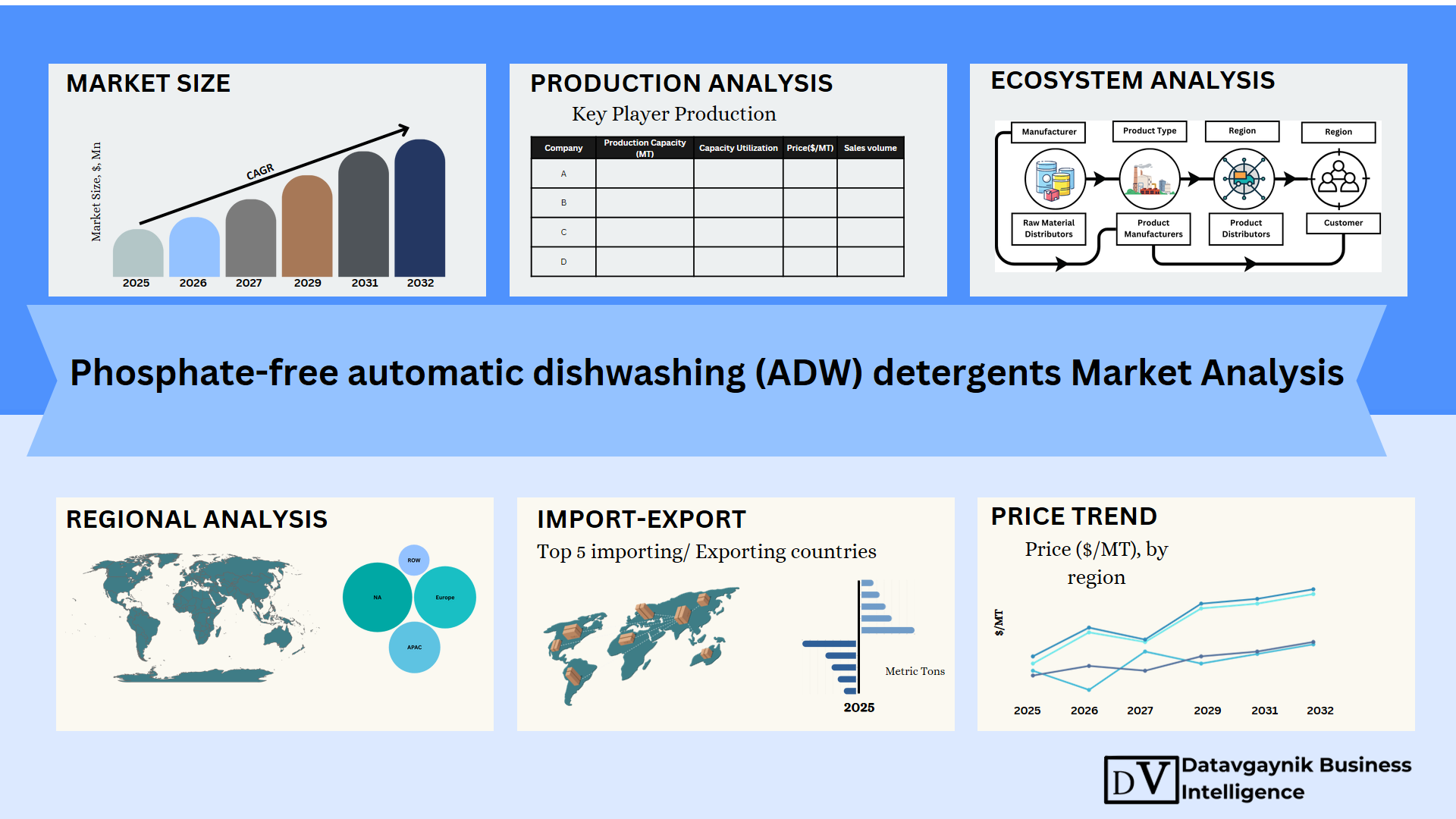
The phosphate-free automatic dishwashing (ADW) detergents market is undergoing a transformative phase, shaped by an unprecedented global shift toward sustainable consumer goods. In developed and emerging economies alike, detergent formulations are being reimagined to align with ecological mandates and shifting consumer expectations. A pivotal driver of this change is the tightening of environmental regulations, which has redefined the composition of household cleaning products.
Governments in the European Union, the United States, and across Asia Pacific have initiated aggressive action plans to combat water pollution. One of the core culprits—phosphates—has been extensively targeted, particularly in dishwashing detergents. For instance, eutrophication caused by phosphate runoff has led to widespread ecological damage in freshwater lakes, accelerating government intervention. Consequently, the phosphate-free automatic dishwashing (ADW) detergents market has emerged as a direct beneficiary of this regulatory transformation.
Stringent Environmental Mandates Fueling Demand in the Phosphate-free Automatic Dishwashing (ADW) Detergents Market
The global ban or restriction on phosphates in household cleaning products has created an urgent need for alternative formulations. In the United States, the Clean Water Act and subsequent phosphorus restrictions resulted in an immediate spike in demand for phosphate-free formulations. Similarly, the European Union’s Detergent Regulation (EC) No. 648/2004 played a crucial role in eliminating phosphates from automatic dishwashing products across member states.
As a result, several manufacturers re-engineered their product lines to offer compliant, phosphate-free variants. The phosphate-free automatic dishwashing (ADW) detergents market size surged significantly in the years following the EU regulatory push, with a reported growth of over 18% between 2017 and 2022 across Western Europe. This growth trend continues to intensify as enforcement becomes more uniform across additional regions.
Consumer Preferences Shifting Toward Sustainable Alternatives
Environmental awareness among consumers has become a defining factor in shaping the phosphate-free automatic dishwashing (ADW) detergents market. Modern households are no longer only concerned about cleaning performance; they are equally invested in product safety, sustainability, and long-term ecological impact.
For example, brands that market enzyme-based, plant-derived detergent pods without phosphate content have experienced exponential growth. In the U.S., eco-conscious detergent brands reported sales increases of more than 25% year-on-year between 2021 and 2023. This consumer behavior reinforces the premise that awareness-driven demand is one of the most influential levers behind the rapid expansion of the phosphate-free automatic dishwashing (ADW) detergents market.
Health Concerns Driving Residential Adoption of Phosphate-Free ADW Detergents
Consumers are increasingly associating phosphate residues in dishwashing products with potential health risks. Residual phosphate can remain on dishes and be ingested inadvertently. With this concern gaining traction, there is growing household demand for formulations that are both effective and residue-free.
This trend has had a direct impact on phosphate-free automatic dishwashing (ADW) detergents market size, particularly in North America and Western Europe. In 2023, over 42% of all new ADW detergent launches in these regions were phosphate-free. These figures are not only indicative of rising awareness but also represent a deep structural change in consumer expectations and industry innovation.
Surging Commercial Sector Demand Accelerating Market Penetration
Beyond residential use, commercial institutions such as hotels, restaurants, and catering businesses are adopting phosphate-free dishwashing solutions at a rapid pace. This transition is driven by both regulatory compliance and corporate ESG (Environmental, Social, and Governance) goals.
For instance, major hotel chains across Europe and North America have integrated phosphate-free cleaning systems into their operations to meet sustainability benchmarks. In 2022 alone, the commercial segment contributed to over 35% of the phosphate-free automatic dishwashing (ADW) detergents market size, up from just 22% in 2018. This segment is expected to grow further as industries standardize sustainability practices across supply chains.
Innovation and Enzyme-based Formulations Redefining Product Performance
One of the most notable advancements propelling the phosphate-free automatic dishwashing (ADW) detergents market is the emergence of high-performance enzyme-based formulations. These detergents leverage bioenzymes such as amylase, protease, and lipase to break down complex food particles while remaining biodegradable and phosphate-free.
Manufacturers have successfully overcome the long-standing perception that phosphate-free equals lower efficacy. For instance, enzyme-boosted phosphate-free pods are now outperforming traditional detergents in stain and grease removal tests. This innovation has catalyzed a spike in market adoption—global sales of enzyme-based phosphate-free dishwashing tablets grew by 31% in 2023 compared to the previous year.
Corporate Sustainability Programs Supporting Phosphate-Free Product Lines
Sustainability commitments from global FMCG companies are injecting momentum into the phosphate-free automatic dishwashing (ADW) detergents market. Multinationals like Unilever, Henkel, and Reckitt have pledged to eliminate all phosphates from their cleaning product portfolios. These companies are now actively investing in R&D, patenting new green cleaning technologies, and expanding eco-friendly product lines globally.
For instance, Henkel reported that over 85% of its dishwashing detergent sales in Europe were from phosphate-free variants as of 2023. Similarly, Unilever introduced phosphate-free lines under various sub-brands across Asia Pacific and Latin America to capture emerging eco-conscious demographics. These moves are not only enhancing brand equity but also strengthening long-term market positioning.
Asia Pacific Emerging as a Growth Powerhouse for the Phosphate-free Automatic Dishwashing (ADW) Detergents Market
While North America and Europe have led the early adoption curve, Asia Pacific is quickly becoming the fastest-growing region in the phosphate-free automatic dishwashing (ADW) detergents market. With expanding urbanization, a burgeoning middle class, and growing regulatory action on water pollution, countries like China, India, and Japan are driving regional growth.
China alone accounted for over 22% of all new product launches in the phosphate-free detergent category in 2023. Meanwhile, Japan’s domestic brands, which traditionally prioritize minimal environmental impact, have seen sales growth of over 17% for phosphate-free variants in the last two years. The market in India is witnessing a strong surge in demand through e-commerce channels, targeting eco-conscious urban consumers with herbal and phosphate-free options.
Packaging Innovations and Zero-Waste Models Adding Competitive Edge
In addition to product formulation, packaging has become a key differentiator in the phosphate-free automatic dishwashing (ADW) detergents market. Manufacturers are increasingly offering biodegradable packaging, compostable wrappers, and refillable containers to appeal to consumers committed to reducing their environmental footprint.
For instance, brands that launched zero-waste detergent tablet refill programs in Europe recorded a 40% customer retention boost. In Australia, phosphate-free detergents packed in 100% recycled material outpaced traditional detergent sales by nearly 3 to 1 in premium supermarket chains during 2023. This convergence of eco-packaging and phosphate-free formulations is setting a new standard in product development.
Conclusion: A Market Undergoing Rapid, Purposeful Disruption
The phosphate-free automatic dishwashing (ADW) detergents market is no longer a niche segment—it is fast becoming the new industry norm. Backed by regulation, driven by innovation, and sustained by evolving consumer values, phosphate-free products are redefining what constitutes effective and responsible cleaning solutions.
As manufacturers continue to expand their product lines and invest in plant-based and enzymatic alternatives, the phosphate-free automatic dishwashing (ADW) detergents market size is projected to accelerate at a CAGR exceeding 9% over the next five years. From the rise of refillable systems to the dominance of enzyme-powered pods, this is a market shaped by science, driven by conscience, and defined by performance.
“Track Country-wise Phosphate-free automatic dishwashing (ADW) detergents Production and Demand through our Phosphate-free automatic dishwashing (ADW) detergents Production Database”
-
-
- Phosphate-free automatic dishwashing (ADW) detergents production database for 30+ countries worldwide
- Phosphate-free automatic dishwashing (ADW) detergents sales volume for 31+ countries
- Country-wise Phosphate-free automatic dishwashing (ADW) detergents production capacity, production plant mapping, production capacity utilization for 30+ manufacturers
- Phosphate-free automatic dishwashing (ADW) detergents production plants and production plant capacity analysis by top manufacturers
-
“Track real-time Phosphate-free automatic dishwashing (ADW) detergents Prices, Phosphate-free automatic dishwashing (ADW) detergents price charts for 30+ countries, Phosphate-free automatic dishwashing (ADW) detergents weekly price tracker and Phosphate-free automatic dishwashing (ADW) detergents monthly price tracker”
-
-
- Track real-time Phosphate-free automatic dishwashing (ADW) detergents prices and Phosphate-free automatic dishwashing (ADW) detergents price trend in 30+ countries though our excel-based Phosphate-free automatic dishwashing (ADW) detergents price charts
- Real-time Phosphate-free automatic dishwashing (ADW) detergents price tracker dashboard with 30+ countries
- Complete transparency on Phosphate-free automatic dishwashing (ADW) detergents price trend through our Phosphate-free automatic dishwashing (ADW) detergents monthly price tracker, Phosphate-free automatic dishwashing (ADW) detergents weekly price tracker
-
North America Leads the Phosphate-free Automatic Dishwashing (ADW) Detergents Market with Innovation-Led Demand
In North America, the phosphate-free automatic dishwashing (ADW) detergents market is undergoing a strong growth phase, driven by regulatory clarity and rising household preferences for sustainable solutions. The region has witnessed a steady shift away from phosphate-based formulations, particularly in the United States and Canada, where phosphate bans have been enforced at both federal and state levels.
This regulatory framework has created significant opportunity for local and global manufacturers to launch phosphate-free variants across powder, liquid, and tablet formats. In urban centers like Los Angeles, Chicago, and Toronto, demand has increased by over 30% in the past five years, especially within the premium and health-conscious consumer segments. The phosphate-free automatic dishwashing (ADW) detergents price in North America has also increased in tandem with this demand, with an average price point ranging between USD 9 and USD 13 for a standard pack of enzyme-based pods. This price premium is sustained by perceived product safety, natural composition, and brand equity.
Europe’s Policy-Driven Market Structure Anchoring Phosphate-free Automatic Dishwashing (ADW) Detergents Demand
The phosphate-free automatic dishwashing (ADW) detergents market in Europe is defined by comprehensive regulatory governance and a highly informed consumer base. Major economies including Germany, France, the United Kingdom, and the Netherlands have been at the forefront of removing phosphates from household detergents, following EU-wide directives.
This transition has been met with significant product diversification and growth in eco-labeled offerings. Germany, for instance, saw a 45% increase in phosphate-free detergent sales between 2018 and 2023. In France, large-scale retail networks have restructured their product assortments to include nearly 80% phosphate-free alternatives on detergent shelves.
Manufacturers across Europe have responded with high-efficiency enzyme and plant-based blends tailored to regional preferences. The phosphate-free automatic dishwashing (ADW) detergents price in this region shows wide variation, ranging from EUR 4.50 for economy tablets to EUR 12 for premium zero-waste, vegan-certified options. Price elasticity in this market is relatively low, as consumers are willing to pay more for certifications such as EU Ecolabel, Vegan Society, and FSC-certified packaging.
Asia Pacific Emerging as the Next Growth Epicenter in the Phosphate-free Automatic Dishwashing (ADW) Detergents Market
The Asia Pacific region is rapidly becoming a high-growth territory for the phosphate-free automatic dishwashing (ADW) detergents market. With urbanization rates accelerating across China, India, Southeast Asia, and Japan, household penetration of dishwashers and eco-friendly detergents is rising concurrently.
In China, the expanding middle-class segment is driving demand for premium cleaning products, with phosphate-free variants experiencing a compound annual growth rate of over 20% in urban districts such as Shanghai and Beijing. Indian consumers are also transitioning toward natural cleaning agents, and local producers have launched ayurvedic and herbal phosphate-free formulations to tap into domestic preferences.
Japanese and South Korean manufacturers have focused on packaging innovation and hypoallergenic properties, appealing to both environmental and wellness-oriented buyers. The phosphate-free automatic dishwashing (ADW) detergents price trend across Asia Pacific shows a steady incline, especially in the premium segment, where enzyme-rich pods and biodegradable sachets retail at 25–40% above traditional powders.
Latin America and Middle East Building Momentum in the Phosphate-free Automatic Dishwashing (ADW) Detergents Market
Latin American markets, including Brazil, Mexico, and Chile, are witnessing a gradual but consistent uptake of phosphate-free automatic dishwashing (ADW) detergents. While regulatory enforcement is not yet as advanced as in Europe or North America, shifting consumer sentiment is leading to increased adoption. Retail data indicates a 19% annual increase in phosphate-free detergent sales in urban Brazilian centers.
In the Middle East, particularly in the UAE and Saudi Arabia, premium international brands are capitalizing on the growing demand for sustainable living. Retailers are stocking more imported phosphate-free variants, and domestic producers have started introducing enzyme-based formulations tailored to local water hardness conditions. The phosphate-free automatic dishwashing (ADW) detergents price in these regions is notably higher due to the reliance on imports and the high cost of sustainable packaging.
Production Hubs and Regional Export Dynamics of the Phosphate-free Automatic Dishwashing (ADW) Detergents Market
Production trends in the phosphate-free automatic dishwashing (ADW) detergents market are increasingly concentrated in countries with established environmental regulations and advanced manufacturing ecosystems. Germany, the United States, and Japan lead global production, leveraging high R&D capabilities, automation, and access to eco-friendly raw materials.
These countries not only cater to domestic demand but also serve as major exporters to emerging markets. For example, Germany exports phosphate-free detergents to Eastern Europe, Latin America, and parts of Asia, taking advantage of its compliance with international eco-labeling standards. Similarly, Japanese producers have found strong distribution channels in Southeast Asia, driven by their reputation for safety and innovation.
In contrast, localized production in emerging economies is now gaining momentum. India, Vietnam, and Indonesia have started producing plant-based phosphate-free variants at scale, enabled by lower manufacturing costs and proximity to raw botanical inputs. This shift is expected to reduce dependence on imports over the next five years and may influence the phosphate-free automatic dishwashing (ADW) detergents price trend toward more competitive pricing.
Market Segmentation Driving Targeted Growth in the Phosphate-free Automatic Dishwashing (ADW) Detergents Market
The phosphate-free automatic dishwashing (ADW) detergents market is segmented across product type, formulation, end-user, and sales channel—each driving distinct growth opportunities.
By Product Type: Tablets and pods are leading in value sales due to their convenience and dosage control. They account for nearly 55% of the total market revenue, especially among consumers seeking consistent cleaning performance. Liquid detergents follow, particularly in regions where dishwashing machines are adapted for high-water flow. Powdered variants are popular in price-sensitive markets but are steadily losing ground to more efficient alternatives.
By Formulation: Enzyme-based phosphate-free detergents dominate the formulation landscape, offering superior stain removal and biodegradability. Plant-based products are also gaining traction, especially in Asia and Latin America, where natural ingredients are culturally favored. Hybrid formulations—combining enzymes and botanical elements—are emerging as a growth segment, addressing both performance and sustainability.
By End-User: Residential demand continues to drive the largest volume, but commercial sectors are rapidly growing. Hotels, restaurants, and institutional kitchens are transitioning to phosphate-free options to meet sustainability audits and health certifications. For instance, large hospitality chains have pledged to transition 100% of their cleaning supplies to phosphate-free alternatives by 2027.
By Distribution Channel: Online retail has emerged as the fastest-growing channel, particularly in Asia Pacific and North America, with annual growth rates exceeding 25%. Brick-and-mortar supermarkets still dominate volume in Europe and Latin America. Specialty organic stores are key contributors in developed markets, offering high-margin, certified phosphate-free detergents.
Phosphate-free Automatic Dishwashing (ADW) Detergents Price Trend Reflecting Product Differentiation and Market Maturity
The phosphate-free automatic dishwashing (ADW) detergents price trend reveals key insights into consumer behavior, production economics, and market maturity. In developed markets, price premiums of 20–30% are standard, driven by certified ingredients, recyclable packaging, and brand reputation. Consumers in these regions display low sensitivity to price when purchasing green-certified products.
In emerging economies, pricing is more volatile. Local producers are striving to bring down the phosphate-free automatic dishwashing (ADW) detergents price by adopting lower-cost, plant-derived inputs and streamlining logistics. Bulk packaging and refillable formats are helping reduce unit costs. As economies of scale increase, the phosphate-free automatic dishwashing (ADW) detergents price is expected to stabilize across mid-tier and mass-market segments.
Regional Competition and Strategic Positioning in the Phosphate-free Automatic Dishwashing (ADW) Detergents Market
Competitive dynamics in the phosphate-free automatic dishwashing (ADW) detergents market vary significantly by geography. In North America and Europe, global multinationals dominate through brand strength, extensive R&D pipelines, and wide retail penetration. In contrast, Asia Pacific and Latin America are increasingly being influenced by agile local players who tailor their offerings to regional needs and sensitivities.
For instance, in India, mid-sized firms offering herbal phosphate-free detergents have grown over 150% in revenue between 2020 and 2024. In Southeast Asia, local startups are using coconut-based surfactants to develop regionally sourced, phosphate-free alternatives with competitive pricing.
These evolving strategies are not only expanding market access but are also redefining the phosphate-free automatic dishwashing (ADW) detergents price trend by challenging legacy cost structures and introducing localized innovation.
“Phosphate-free automatic dishwashing (ADW) detergents Manufacturing Database, Phosphate-free automatic dishwashing (ADW) detergents Manufacturing Capacity”
-
-
- Phosphate-free automatic dishwashing (ADW) detergents top manufacturers market share for 30+ manufacturers
- Top 11 manufacturers and top 18 manufacturers of Phosphate-free automatic dishwashing (ADW) detergents in North America, Europe, Asia Pacific
- Phosphate-free automatic dishwashing (ADW) detergents production plant capacity by manufacturers and Phosphate-free automatic dishwashing (ADW) detergents production data for 30+ market players
- Phosphate-free automatic dishwashing (ADW) detergents production dashboard, Phosphate-free automatic dishwashing (ADW) detergents production data in excel format
-
“Phosphate-free automatic dishwashing (ADW) detergents price charts, Phosphate-free automatic dishwashing (ADW) detergents weekly price tracker and Phosphate-free automatic dishwashing (ADW) detergents monthly price tracker”
-
-
- Factors impacting real-time Phosphate-free automatic dishwashing (ADW) detergents prices in 30+ countries worldwide
- Phosphate-free automatic dishwashing (ADW) detergents monthly price tracker, Phosphate-free automatic dishwashing (ADW) detergents weekly price tracker
- Real-time Phosphate-free automatic dishwashing (ADW) detergents price trend, Phosphate-free automatic dishwashing (ADW) detergents price charts, news and updates
- Tracking Phosphate-free automatic dishwashing (ADW) detergents price fluctuations
-
Top Manufacturers in the Phosphate-free Automatic Dishwashing (ADW) Detergents Market
The phosphate-free automatic dishwashing (ADW) detergents market has seen rapid growth as demand for environmentally friendly cleaning products has surged. Leading manufacturers are at the forefront of driving this growth, responding to consumer needs for sustainable, effective, and safe dishwashing solutions. These players continue to innovate and strengthen their position within the market by aligning their products with global environmental regulations and consumer preferences for eco-friendly goods.
Unilever is one of the dominant players in the phosphate-free ADW detergents market, driven by its commitment to sustainability and eco-conscious consumers. Through its Seventh Generation and Sun brands, Unilever has created a range of phosphate-free dishwashing products that cater to environmentally aware consumers. The company’s detergent lines are known for using plant-based ingredients, biodegradable formulas, and recyclable packaging, meeting the growing demand for both performance and sustainability.
Procter & Gamble, with its Cascade brand, is another major player, offering phosphate-free ADW detergents that provide high cleaning performance while aligning with eco-friendly values. Cascade’s phosphate-free products are designed to ensure powerful cleaning results while minimizing their environmental footprint. P&G’s innovation in the cleaning products sector enables the brand to maintain its competitive edge, offering solutions that balance effectiveness with environmental responsibility.
Henkel, a global consumer goods company, has been a strong proponent of sustainable dishwashing products with its Somat brand. Somat’s range of phosphate-free ADW detergents focuses on premium quality, combining stain-removal and water-efficient cleaning technologies. Henkel’s emphasis on quality, innovation, and eco-conscious formulations has positioned it as a key player in the phosphate-free ADW detergents market.
Church & Dwight, the company behind the OxiClean brand, also plays a vital role in the phosphate-free ADW detergents market. Church & Dwight’s products are marketed as highly effective while being aligned with environmental sustainability goals. The company’s commitment to providing phosphate-free, eco-friendly solutions appeals to the growing base of consumers who prefer natural, non-toxic products for their homes.
Other notable players in the phosphate-free ADW detergents market include Ecover, Colgate-Palmolive, Amway, and Werner & Mertz. Ecover’s line of phosphate-free detergents is known for its plant-based ingredients and sustainable practices. Similarly, Colgate-Palmolive’s Palmolive brand has embraced phosphate-free formulations, providing consumers with effective cleaning options while promoting environmental responsibility. Amway’s Dish Drops product line and Werner & Mertz’s Frosch brand are also recognized for offering phosphate-free detergents that meet consumers’ growing demand for sustainable household products.
Market Share of Phosphate-free Automatic Dishwashing (ADW) Detergents by Manufacturers
The market share in the phosphate-free automatic dishwashing (ADW) detergents segment is largely dominated by a few key players, with Unilever, Procter & Gamble, and Henkel holding substantial portions. These companies are at the forefront of both innovation and market expansion, driven by their strong product portfolios, global presence, and continued investments in research and development.
Unilever, with its Seventh Generation and Sun brands, leads the market, capturing a significant share of the phosphate-free ADW detergents market. As consumer demand for sustainable products continues to grow, Unilever’s product lines are well-positioned to cater to this shift. Unilever’s market share is also supported by its global supply chain, allowing it to efficiently distribute products across various regions, particularly in North America and Europe, where eco-conscious consumers are increasingly opting for phosphate-free solutions.
Procter & Gamble’s Cascade brand also holds a strong position in the phosphate-free ADW detergents market. Cascade’s effective cleaning formulas and commitment to sustainability have made it a top choice for consumers seeking high-performance and environmentally friendly dishwashing solutions. P&G’s strong brand recognition and wide-reaching distribution channels contribute to its significant share in the market.
Henkel, with its Somat line, represents another key player in the phosphate-free ADW detergents market. The brand’s premium offerings appeal to consumers who prioritize both performance and sustainability, and Henkel’s continued investment in research and development keeps Somat at the forefront of the market. Henkel’s market share is particularly strong in Europe, where consumers demand high-quality, environmentally friendly cleaning solutions.
While Unilever, P&G, and Henkel dominate a large portion of the phosphate-free ADW detergents market, other brands such as Church & Dwight, Ecover, and Colgate-Palmolive continue to capture market share by focusing on niche segments and delivering innovative, eco-friendly products. Church & Dwight’s OxiClean brand has a strong presence in North America, while Ecover leads the way in Europe with its range of plant-based, biodegradable detergents. Colgate-Palmolive’s Palmolive brand also provides phosphate-free options that cater to both value-conscious and sustainability-minded consumers.
Manufacturers’ Specific Product Lines and Innovations in the Phosphate-free Automatic Dishwashing (ADW) Detergents Market
The phosphate-free automatic dishwashing (ADW) detergents market continues to evolve with new product lines and innovations from manufacturers. Each player brings unique formulations, packaging, and marketing strategies to meet the growing consumer demand for sustainable dishwashing solutions.
Unilever’s Seventh Generation and Sun brands offer an extensive line of phosphate-free ADW detergents that are plant-based and biodegradable. The company has focused on developing formulas that are tough on grease and stains, while remaining gentle on the environment. Seventh Generation’s dishwasher gels and pods are well-regarded for their cleaning power, and the company is continuously working on innovations in packaging and formulations to reduce its environmental footprint further.
Procter & Gamble’s Cascade brand has launched a variety of phosphate-free products, including its popular Cascade Platinum dishwasher pods, which combine advanced cleaning technology with environmentally responsible ingredients. Cascade’s focus on innovation is evident in its introduction of dual-action formula pods, which provide both grease-cutting power and a protective shield for dishwashers. These products cater to consumers who seek powerful performance without compromising on environmental responsibility.
Henkel’s Somat brand is synonymous with premium quality in the phosphate-free ADW detergents market. Somat offers a variety of products, including dishwasher tablets, gels, and powders, all formulated to be phosphate-free while ensuring excellent cleaning results. Henkel has introduced water-efficient products and formulations that perform well even in low-temperature washes, making Somat a popular choice for energy-conscious consumers.
Church & Dwight’s OxiClean brand has expanded its offerings with phosphate-free solutions that focus on stain removal and eco-friendliness. The OxiClean dishwasher detergents combine powerful cleaning ingredients with a commitment to environmental sustainability, providing effective solutions for a wide range of consumers.
Ecover’s phosphate-free dishwashing products are a standout in Europe, with a focus on plant-based ingredients and eco-friendly packaging. Ecover’s commitment to using renewable plant-based resources in its formulations helps drive its popularity, particularly in regions with strong sustainability trends.
Recent Industry Developments and News
The phosphate-free ADW detergents market has witnessed significant developments recently, as manufacturers continue to innovate and align with growing environmental regulations and consumer preferences.
In 2023, Unilever announced the launch of a new line of dishwasher detergents under its Seventh Generation brand, which features 100% recyclable packaging and plant-based formulas. This move is part of Unilever’s broader sustainability strategy, which aims to reduce its carbon footprint and improve the sustainability of its product lines.
In early 2024, Procter & Gamble introduced a new phosphate-free dishwasher pod in the Cascade Platinum line, which includes a unique formula designed to tackle tough stains while using natural ingredients. This product was specifically designed to meet the increasing demand for environmentally responsible products without sacrificing cleaning performance.
Henkel has also made strides in the phosphate-free ADW detergents market, with the release of a new Somat product that is certified by a major sustainability standard, ensuring that the product meets high environmental and performance criteria. The launch of this product further solidifies Henkel’s position as a market leader in the phosphate-free space.
As manufacturers continue to expand their phosphate-free offerings, these recent innovations reflect the ongoing evolution of the market, which is increasingly defined by a commitment to sustainability, high performance, and consumer-driven product development.
“Phosphate-free automatic dishwashing (ADW) detergents Production Data and Phosphate-free automatic dishwashing (ADW) detergents Production Trend, Phosphate-free automatic dishwashing (ADW) detergents Production Database and forecast”
-
-
- Phosphate-free automatic dishwashing (ADW) detergents production database for historical years, 11 years historical data
- Phosphate-free automatic dishwashing (ADW) detergents production data and forecast for next 11 years
- Phosphate-free automatic dishwashing (ADW) detergents sales volume by manufacturers
-
“Track Real-time Phosphate-free automatic dishwashing (ADW) detergents Prices for purchase and sales contracts, Phosphate-free automatic dishwashing (ADW) detergents price charts, Phosphate-free automatic dishwashing (ADW) detergents weekly price tracker and Phosphate-free automatic dishwashing (ADW) detergents monthly price tracker”
-
-
- Gain control on your purchase and sales contracts through our real-time Phosphate-free automatic dishwashing (ADW) detergents price tracker and Phosphate-free automatic dishwashing (ADW) detergents price trend analysis
- Phosphate-free automatic dishwashing (ADW) detergents weekly price tracker and forecast for next four weeks
- Phosphate-free automatic dishwashing (ADW) detergents monthly price tracker and forecast for next two months
-
Market Scenario, Demand vs Supply, Average Product Price, Import vs Export, till 2035
- Global Phosphate-free automatic dishwashing (ADW) detergents Market revenue and demand by region
- Global Phosphate-free automatic dishwashing (ADW) detergents Market production and sales volume
- United States Phosphate-free automatic dishwashing (ADW) detergents Market revenue size and demand by country
- Europe Phosphate-free automatic dishwashing (ADW) detergents Market revenue size and demand by country
- Asia Pacific Phosphate-free automatic dishwashing (ADW) detergents Market revenue size and demand by country
- Middle East & Africa Phosphate-free automatic dishwashing (ADW) detergents Market revenue size and demand by country
- Latin America Phosphate-free automatic dishwashing (ADW) detergents Market revenue size and demand by
- Import-export scenario – United States, Europe, APAC, Latin America, Middle East & Africa
- Average product price – United States, Europe, APAC, Latin America, Middle East & Africa
- Market player analysis, competitive scenario, market share analysis
- Business opportunity analysis
Key questions answered in the Global Phosphate-free automatic dishwashing (ADW) detergents Market Analysis Report:
- What is the market size for Phosphate-free automatic dishwashing (ADW) detergents in United States, Europe, APAC, Middle East & Africa, Latin America?
- What is the yearly sales volume of Phosphate-free automatic dishwashing (ADW) detergents and how is the demand rising?
- Who are the top market players by market share, in each product segment?
- Which is the fastest growing business/ product segment?
- What should be the business strategies and Go to Market strategies?
The report covers Phosphate-free automatic dishwashing (ADW) detergents Market revenue, Production, Sales volume, by regions, (further split into countries):
- Asia Pacific (China, Japan, South Korea, India, Indonesia, Vietnam, Rest of APAC)
- Europe (UK, Germany, France, Italy, Spain, Benelux, Poland, Rest of Europe)
- North America (United States, Canada, Mexico)
- Latin America (Brazil, Argentina, Rest of Latin America)
- Middle East & Africa
Table of Contents:
- Introduction to Phosphate-Free Automatic Dishwashing Detergents
- Overview of Phosphate-Free Detergents
- Environmental Impact of Phosphates in Detergents
- Importance of Sustainable Alternatives in the ADW Industry
- Market Overview of Phosphate-Free ADW Detergents
- Global Market Trends and Growth Rates
- Market Dynamics and Drivers for Phosphate-Free Alternatives
- Regulatory Influence and Environmental Policies
- Composition and Technology of Phosphate-Free ADW Detergents
- Key Ingredients Used in Phosphate-Free Formulations
- Innovation in Cleaning Agents and Surfactants
- Performance vs Traditional Phosphate-Containing Detergents
- Consumer Demand and Preferences in the ADW Detergent Market
- Growing Consumer Awareness of Environmental Impact
- Demand for Green and Eco-friendly Products
- Influence of Labeling and Certifications on Consumer Choices
- Regional Market Analysis for Phosphate-Free ADW Detergents
- North American Market: Key Trends and Adoption Rates
- European Market: Environmental Regulations and Consumer Behavior
- Asia-Pacific Market: Market Potential and Growth Forecast
- Latin American and Middle Eastern Markets: Opportunities and Challenges
- Market Segmentation by Application and Product Type
- Segmentation Based on Formulation: Liquids, Tablets, and Pods
- Differentiation Based on Cleaning Strength and Efficacy
- Price Segmentation: Premium vs. Mass Market Products
- Competitive Landscape of the Phosphate-Free ADW Detergents Market
- Key Manufacturers and Market Share Analysis
- Mergers, Acquisitions, and Strategic Alliances
- Product Differentiation and Branding Strategies
- Regulatory Environment and Compliance for Phosphate-Free ADW Detergents
- Global and Regional Regulations Governing Detergent Formulations
- Impact of Phosphate Bans and Restrictions
- Compliance with Environmental Standards and Certifications
- Environmental and Sustainability Impact of Phosphate-Free Detergents
- Benefits of Reducing Phosphates in Water Systems
- Role of Biodegradable Ingredients in Sustainability
- Waste Management and Packaging Innovations
- Innovation and R&D in Phosphate-Free ADW Detergents
- Research into Alternative Cleaning Agents and Technologies
- Advances in Green Chemistry for Household Detergents
- Future Trends in Formulation and Packaging
- Consumer Behavior and Market Adoption Challenges
- Barriers to Adoption of Phosphate-Free Products
- Price Sensitivity vs. Eco-Conscious Purchasing Decisions
- Educating Consumers on the Benefits of Phosphate-Free Detergents
- Cost Structure and Pricing Analysis for Phosphate-Free ADW Detergents
- Production Costs vs. Traditional Detergents
- Pricing Strategies in a Competitive Market
- Cost of Sustainable Sourcing and Manufacturing
- Impact of COVID-19 on the ADW Detergent Market
- Changes in Consumer Purchasing Patterns During the Pandemic
- Supply Chain Disruptions and Their Effect on Production
- Long-Term Shifts in Demand for Eco-friendly Detergents
- Challenges and Risks in the Phosphate-Free ADW Detergents Market
- Maintaining Cleaning Efficiency Without Phosphates
- Supply Chain Issues and Raw Material Sourcing
- Competition from Traditional Detergent Brands
- Supply Chain and Distribution Channels for Phosphate-Free ADW Detergents
- Key Raw Materials and Supplier Network
- Distribution Channels: Online vs. In-Store Sales
- The Role of Retailers and E-commerce in Market Growth
- Market Forecast and Projections (2020-2035)
- Future Growth Rate Estimates for Phosphate-Free ADW Detergents
- Regional Demand Projections and Market Trends
- Long-Term Impact of Environmental Regulations on Market Expansion
- Consumer Awareness Campaigns and Marketing Strategies
- Role of Advertising in Promoting Eco-friendly Products
- Social Media and Influencer Marketing in Shaping Consumer Preferences
- Public Policy and Advocacy for Sustainable Products
- Global Trade and Export-Import Dynamics in the ADW Detergent Market
- International Trade Patterns for Phosphate-Free Detergents
- Impact of Tariffs and Trade Agreements on Market Access
- Export Potential in Emerging Markets
- Case Studies of Leading Brands in Phosphate-Free ADW Detergents
- Success Stories from Top Manufacturers
- Strategic Moves to Enhance Market Share
- Brand Loyalty and Consumer Engagement
- Conclusion and Strategic Recommendations for Market Stakeholders
- Key Insights for Manufacturers, Retailers, and Distributors
- Recommendations for Future Growth and Product Development
- Strategic Actions for Strengthening Market Position in the Eco-Friendly Segment
Other recently published reports:

