

Market Summary and Growth Forecast
The global Polylactide (PLA) Composites Market is valued at USD 1,148.6 million in 2026 and is expected to appreciate to USD 2,964.3 million by 2035, at a CAGR of 11.1% during the forecast period.
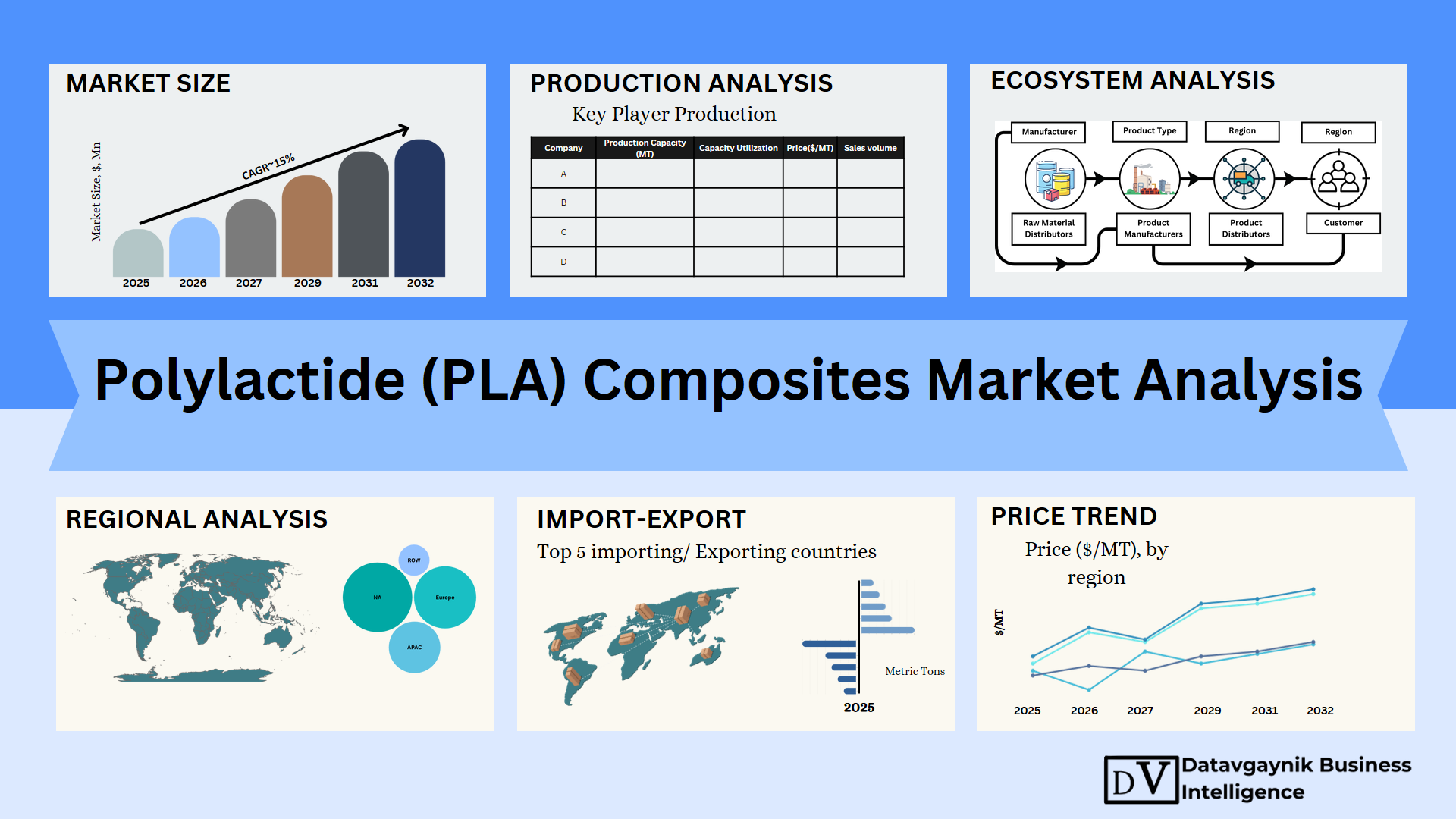
The Polylactide (PLA) Composites Market represents a specialized segment of the advanced bio-based materials industry where polylactic acid is reinforced with natural fibers, mineral fillers, carbon fibers, glass fibers, or other functional additives to improve stiffness, thermal resistance, impact strength, and durability. These composite materials help bridge the performance gap between conventional plastics and biodegradable polymers, making them attractive for manufacturers seeking sustainable alternatives without compromising product functionality.
Datavagyanik also covers related markets such as the Polylactic Acid (PLA) Market, the PLA (Polylactic Acid) Market, and the Polylactic Acid (PLA) Market. Their relevance lies in how they intersect with the core topic, influencing investment trends and shaping market opportunities.
In 2026, commercial demand is moving beyond niche biodegradable packaging. Manufacturers are increasingly incorporating PLA composites into automotive interiors, consumer electronics housings, durable consumer goods, medical devices, agricultural products, and industrial applications. This reflects a broader shift toward materials that reduce fossil resource dependence while supporting circular economy objectives.
One of the strongest market influences is continued investment in bio-based polymer production capacity. Improvements in fermentation efficiency, resin purification, and polymerization technology have expanded the commercial availability of high-quality PLA grades. At the same time, composite processing technologies such as twin-screw extrusion, reactive compounding, and fiber surface modification are delivering better mechanical performance, opening new opportunities in engineering applications.
Regulatory developments continue to shape purchasing decisions. Several regions are promoting renewable-content materials through extended producer responsibility frameworks, green procurement policies, and packaging sustainability initiatives. Rather than mandating one material, these policies encourage manufacturers to evaluate bio-based alternatives that lower lifecycle carbon emissions. As a result, PLA composites are receiving greater attention across multiple manufacturing industries.
Material innovation is also strengthening the business case. Researchers and compounders are improving heat deflection temperatures, moisture resistance, dimensional stability, and impact performance through optimized fiber reinforcement and compatibilizer systems. These improvements reduce one of the historical limitations of PLA and expand its application range.
Production economics remain equally important. Although PLA composites generally carry a premium over commodity plastics, increasing production scale, better feedstock utilization, and localized compounding operations are gradually improving cost competitiveness. This may lead to faster adoption among manufacturers balancing sustainability commitments with operating margins.
The customer ecosystem spans resin producers, compound manufacturers, injection molders, thermoforming companies, OEMs, packaging converters, and component suppliers. Major buyers include automotive manufacturers, packaging companies, consumer electronics brands, healthcare product manufacturers, construction material suppliers, and agricultural equipment producers.
| Market Indicator | Estimate |
| Market Size (2026) | USD 1,148.6 Million |
| Market Size (2035) | USD 2,964.3 Million |
| CAGR (2026–2035) | 11.1% |
| Base Year | 2026 |
| Forecast Period | 2026–2035 |
Expert view: The next phase of growth will depend less on sustainability messaging alone and more on how effectively PLA composites can deliver engineering performance comparable to conventional reinforced plastics while maintaining competitive production costs.
Market Segmentation and Forecast Scope
The Polylactide (PLA) Composites Market serves multiple manufacturing industries through a diverse portfolio of composite formulations. Market participants increasingly customize material properties for application-specific performance rather than offering standardized grades. This trend is creating stronger differentiation across product categories and end-use sectors.
By Product Type
The market includes:
- Natural Fiber Reinforced PLA
- Glass Fiber Reinforced PLA
- Carbon Fiber Reinforced PLA
- Mineral Filled PLA
- Hybrid PLA Composites
- Other specialty composite formulations
Among these, Natural Fiber Reinforced PLA accounted for approximately 39.8% of the market in 2026, supported by its renewable content, lightweight characteristics, and favorable sustainability profile. Agricultural fibers such as flax, hemp, bamboo, kenaf, and wood fibers continue to gain acceptance in automotive interiors and consumer products.
Glass fiber and carbon fiber reinforced grades are becoming increasingly important where higher stiffness and structural performance are required. Meanwhile, hybrid formulations combining multiple reinforcement technologies are emerging as one of the most strategic product categories because they balance cost, strength, and environmental performance.
By Application
Major applications include:
- Packaging
- Automotive Components
- Consumer Goods
- Electrical & Electronics
- Medical Products
- Agriculture
- Industrial Components
- Others
Packaging remains the largest commercial application due to increasing adoption of bio-based rigid packaging and thermoformed products. However, automotive applications are expected to record one of the fastest growth rates as manufacturers pursue lightweight materials that contribute to vehicle sustainability targets.
Consumer electronics manufacturers are also evaluating PLA composites for external casings and accessories where appearance, rigidity, and environmental credentials are equally important.
By End User
Key end users include:
- Packaging Industry
- Automotive Industry
- Consumer Electronics
- Healthcare
- Construction
- Agriculture
- Industrial Manufacturing
The Packaging Industry represented approximately 34.6% of total demand in 2026, reflecting continued substitution of petroleum-derived plastics across selected product categories. Healthcare and electronics are projected to become increasingly strategic as higher-performance composite grades enter commercial production.
By Region
Regional analysis covers:
- North America
- Europe
- Asia Pacific
- LAMEA
Asia Pacific remains the manufacturing hub due to expanding polymer production capacity, strong electronics manufacturing, and growing automotive supply chains. Europe continues to benefit from sustainability-focused regulations and advanced bioeconomy initiatives, while North America is witnessing increased investment in bio-based material commercialization. LAMEA represents an emerging opportunity as regional packaging and consumer goods industries gradually adopt renewable materials.
| Segmentation Dimension | Strategic Observation |
| Leading Product Type (2026) | Natural Fiber Reinforced PLA – 39.8% |
| Leading End User (2026) | Packaging Industry – 34.6% |
| Fastest Growing Product Category | Hybrid PLA Composites |
| Fastest Growing Application | Automotive Components |
| Highest Manufacturing Activity | Asia Pacific |
Expert view: Future competition will increasingly revolve around formulation expertise rather than polymer production alone. Companies capable of tailoring composite performance for industry-specific requirements are likely to secure stronger long-term contracts.
Market Trends and Business Innovations
Innovation within the Polylactide (PLA) Composites Market is increasingly focused on improving material performance while preserving the environmental advantages of bio-based polymers. Instead of treating PLA as a replacement for commodity plastics, manufacturers are engineering composite systems that compete in higher-value technical applications.
Research and development priorities have shifted toward improving thermal stability, impact resistance, crystallization behavior, and moisture tolerance. Advanced compatibilizers, reactive additives, and optimized reinforcement techniques are enabling PLA composites to withstand more demanding service environments than earlier commercial generations.
Material science remains the core innovation driver. Natural fibers are receiving advanced chemical treatments that improve adhesion with PLA matrices, resulting in stronger mechanical properties and better durability. Simultaneously, mineral fillers and engineered hybrid reinforcements are reducing shrinkage while improving dimensional stability during processing.
Several compound manufacturers are also developing recyclable composite formulations that simplify end-of-life material recovery. Although biodegradable performance remains important, customers increasingly evaluate complete lifecycle performance, including manufacturing emissions, recycled content compatibility, and overall carbon footprint.
Digital manufacturing is becoming more influential across the value chain. AI itself has limited direct integration into PLA composite materials, but manufacturers are using machine learning for formulation optimization, extrusion process control, predictive quality monitoring, and production efficiency improvements. These applications help reduce material waste and accelerate product development cycles rather than changing the composite chemistry itself.
The market has also experienced greater collaboration across the bioeconomy ecosystem. Resin producers, fiber suppliers, compound manufacturers, and automotive OEMs are establishing joint development programs to accelerate commercialization of next-generation sustainable materials. Universities and industrial research institutes continue to support pilot-scale validation of novel reinforcement technologies.
Business activity has remained steady over recent years, including capacity expansions, strategic partnerships, licensing agreements, and collaborative research projects aimed at expanding global production capabilities. Companies are investing in localized compounding facilities to reduce logistics costs and improve supply chain responsiveness for regional customers.
Another emerging trend is the development of PLA composites tailored for additive manufacturing. Improved filament formulations with enhanced strength and thermal performance are expanding opportunities in industrial prototyping, customized healthcare products, and low-volume production components.
| Innovation Area | Business Impact |
| Advanced Fiber Treatment | Improved mechanical performance |
| Hybrid Reinforcement Systems | Better balance of stiffness and toughness |
| Reactive Compounding Technologies | Enhanced heat resistance |
| Digital Process Optimization | Lower production waste and higher consistency |
| 3D Printing Composite Grades | Expansion into industrial additive manufacturing |
| Collaborative Product Development | Faster commercialization of specialty grades |
Expert view: The companies that combine advanced composite engineering with scalable bio-based manufacturing are likely to define the competitive landscape over the coming decade. Performance improvements, rather than sustainability claims alone, will increasingly influence procurement decisions across industrial sectors.
Competitive Intelligence and Benchmarking
Competition in the Polylactide (PLA) Composites Market is defined by formulation capability, bio-based material expertise, global supply networks, and long-term customer relationships rather than production volume alone. Companies are investing in new compounding technologies, sustainable feedstocks, and application engineering to strengthen their market positions. As end users demand higher-performance biodegradable materials, suppliers are differentiating themselves through customized solutions instead of standardized resin offerings.
| Company | Market Position | Portfolio Focus |
| NatureWorks LLC | Technology leader in PLA materials | Bio-based polymer platforms, engineered grades, sustainable compound development |
| TotalEnergies Corbion | Strong global supplier | Renewable polymers, industrial compostable materials, advanced composite feedstocks |
| BASF SE | Diversified specialty materials company | Performance additives, biodegradable material technologies, formulation support |
| Toray Industries, Inc. | Advanced materials innovator | High-performance reinforcement technologies and lightweight composite solutions |
| Futerro SA | Integrated PLA producer | Bio-based polymer manufacturing, circular production technologies, specialty PLA materials |
| Covestro AG | Sustainable materials participant | Polymer innovation, engineering materials, sustainable formulation partnerships |
| Mitsubishi Chemical Group | Premium engineering materials supplier | Functional polymer systems, specialty compounds, industrial bio-based materials |
Company Benchmarking
NatureWorks LLC maintains one of the strongest positions within the PLA ecosystem due to its vertically integrated production capabilities and extensive experience in commercial bio-based polymers. The company continues expanding application development across packaging, consumer products, and durable industrial uses.
TotalEnergies Corbion has strengthened its presence through continuous investments in renewable polymer capacity and collaboration with downstream manufacturers. Its strategy focuses on improving material performance while supporting industrial-scale adoption.
BASF SE participates through complementary material technologies rather than solely relying on PLA production. Its expertise in additives and formulation chemistry enables customers to improve processing efficiency and mechanical performance.
Toray Industries, Inc. leverages decades of composite engineering experience. The company contributes reinforcement technologies that support lightweight structural applications where enhanced strength and stiffness are required.
Futerro SA differentiates itself with an integrated production model covering multiple stages of the PLA value chain. This allows greater flexibility in product customization and supply reliability.
Covestro AG continues expanding its sustainable materials portfolio through innovation partnerships and advanced polymer research. Its focus remains on improving durability while supporting lower-carbon manufacturing.
Mitsubishi Chemical Group serves premium industrial applications requiring higher-performance engineered materials. Its expertise in specialty polymers positions the company well for technically demanding PLA composite applications.
Expert view: Competitive advantage is gradually shifting toward companies capable of integrating material science, application engineering, and sustainable manufacturing into a single commercial offering. Customers increasingly value technical collaboration as much as product availability.
Regional Landscape and Adoption Outlook
Regional demand within the Polylactide (PLA) Composites Market reflects differences in manufacturing capability, sustainability regulations, industrial investment, and customer adoption of bio-based materials. While developed economies continue driving innovation, emerging manufacturing hubs are expanding production capacity and downstream processing capabilities.
| Region/Country | Current Position | Growth Outlook (2026–2035) |
| United States | Mature innovation market | High |
| Europe | Sustainability-driven leader | High |
| China | Largest manufacturing base | Very High |
| India | Emerging production market | Very High |
| Japan | Technology-focused market | Moderate to High |
| South Korea | Advanced industrial adopter | High |
| Middle East | Early-stage opportunity | Moderate |
United States
The United States remains one of the largest innovation centers for PLA materials. Strong university research, industrial biotechnology investments, and growing demand for sustainable packaging continue supporting market expansion. Federal and state-level sustainability initiatives are encouraging manufacturers to evaluate renewable materials for consumer products and industrial applications.
Europe
Europe continues leading regulatory-driven adoption. Circular economy strategies, packaging sustainability targets, and industrial decarbonization programs encourage greater utilization of renewable polymers. Germany, France, Italy, and the Netherlands remain among the strongest contributors due to advanced manufacturing infrastructure and established recycling ecosystems.
China
China is expected to remain the fastest-growing manufacturing hub throughout the forecast period. Large-scale polymer production, expanding electric vehicle manufacturing, consumer electronics production, and increasing investment in bio-based chemicals continue strengthening domestic demand. Government support for green manufacturing further reinforces long-term market expansion.
India
India represents one of the most promising emerging markets. Rapid industrialization, expanding packaging demand, government initiatives supporting sustainable manufacturing, and increasing domestic polymer processing capacity are creating new opportunities. Cost-effective manufacturing also enhances India’s attractiveness as a future export hub.
Japan
Japan emphasizes premium material performance rather than production volume. Domestic manufacturers continue investing in advanced composite technologies, lightweight materials, and precision engineering applications where high-value PLA composites can deliver differentiated performance.
South Korea
South Korea benefits from its globally competitive automotive, electronics, and advanced materials industries. Strong R&D investments and close collaboration between manufacturers and research institutions continue accelerating adoption of high-performance bio-based composite materials.
Middle East
Although adoption remains comparatively limited, selected countries are investing in circular economy initiatives, sustainable construction materials, and industrial diversification. The region may become a niche growth market as manufacturing investments continue expanding over the coming decade.
| Comparison Factor | Regional Leader |
| Manufacturing Capacity | China |
| Regulatory Support | Europe |
| Technology Innovation | United States |
| Fastest Emerging Opportunity | India |
| Advanced Industrial Applications | Japan & South Korea |
Expert view: Regional competition is increasingly shaped by localized production ecosystems. Countries combining renewable feedstocks, advanced manufacturing, and supportive sustainability policies are likely to capture a larger share of future investment.
Recent Developments + Opportunities & Restraints
Recent Developments (Last Two Years)
| Month & Year | Development |
| March 2026 | A major bio-based polymer producer announced an expansion of PLA production capacity to address rising demand from packaging and durable consumer goods manufacturers. |
| October 2025 | Several European research organizations launched a collaborative program focused on improving high-performance biodegradable composite materials for automotive applications. |
| July 2025 | A government-backed sustainable manufacturing initiative in Asia introduced additional funding for industrial bio-based materials and advanced polymer processing technologies. |
| April 2025 | An international materials manufacturer expanded partnerships with automotive suppliers to accelerate commercialization of lightweight renewable composite components. |
| January 2025 | New industrial pilot projects demonstrated improved recycling pathways for bio-based composite materials, supporting broader circular economy implementation. |
Opportunities & Business Insights
Opportunities
- Rapid expansion of sustainable packaging manufacturing across Asia Pacific and Latin America is creating new commercial demand for advanced PLA composite formulations.
- Increasing lightweight material adoption in electric vehicles presents long-term opportunities for reinforced bio-based polymers with improved structural performance.
- Continued improvements in automated compounding, digital manufacturing, and formulation optimization can reduce production costs while improving product consistency.
Business Restraints
- Higher raw material costs compared with conventional petroleum-based plastics continue limiting broader commercial adoption.
- Industrial composting and recycling infrastructure remains inconsistent across many developing economies, affecting end-of-life management.
- Performance limitations under high-temperature operating conditions still restrict adoption in selected engineering applications, despite ongoing material improvements.
Expert view: Commercial success over the next decade will depend on balancing sustainability objectives with engineering performance and competitive production economics. Companies investing in scalable formulation technologies are expected to strengthen their market position.


